Canada and
the G7 Claim
A single talking point has anchored much of the public case for ALTO. Three independent international datasets tell a different story.
“Canada is the only G7 country without high-speed rail. We should build what they have.”
Canada Is One of Three G7 Countries Without True HSR
Among the G7 — Canada, France, Germany, Italy, Japan, the United Kingdom, and the United States — only France, Germany, Italy, and Japan operate domestic 300 km/h+ HSR. The UK’s 300 km/h capability is confined to the 108 km HS1 line serving Eurostar international trains. The USA’s fastest train (Acela) peaks at 240 km/h on a handful of track segments. Canada is one of three G7 countries without a 300 km/h network — not the only one.


Even accepting the G7 framing, the implied premise — that building 300 km/h HSR is what wealthy, successful nations do — is directly testable. Three entirely independent international datasets allow us to check it rigorously.
Wealth, Development, and Happiness vs. High-Speed Rail
The CRI examined the top 10 countries by three independent global measures — GDP per capita, the UN Human Development Index, and the World Happiness Report — and cross-referenced each against whether those countries operate domestic 300 km/h+ high-speed rail. The result is consistent across all three.
Index 1: GDP Per Capita · IMF 2025 Nominal Estimates
GDP per capita distributes total economic output across the population and correlates strongly with disposable income, consumer purchasing power, and infrastructure investment capacity. It is the measure that best answers: can the people — and their government — actually afford large infrastructure?
| # | Country | GDP / Capita (USD) | Max Train Speed | 300 km/h HSR? |
|---|---|---|---|---|
| 1 | Luxembourg † | $145,000 | ~200 km/h | No |
| 2 | Switzerland | $107,000 | ~200 km/h | No |
| 3 | Ireland † | $105,000 | ~160 km/h | No |
| 4 | Norway | $94,000 | ~210 km/h | No |
| 5 | Singapore | $92,000 | ~90 km/h | No |
| 6 | United States | $87,000 | 240 km/h | No |
| 7 | Iceland | $79,000 | No rail | No rail |
| 8 | Denmark | $70,000 | ~200 km/h | No |
| 9 | Netherlands ‡ | $65,000 | 300 km/h | Hosted ‡ |
| 10 | Australia | $64,000 | ~200 km/h | No |
Not a single country in the top 10 by nominal GDP per capita has built its own 300 km/h+ high-speed rail network. Nations above $85,000 GDP per capita have either no HSR or rail systems maxing out well below 300 km/h. The top-10 cluster in a 160–240 km/h band — fast and comfortable, but clearly separated from the HSR tier.
— CRI Policy Brief: Wealth, Development & High-Speed Rail, March 2026Index 2: UN Human Development Index · UNDP 2025
The HDI broadens the lens beyond income alone to incorporate life expectancy and education. It produces a top 10 almost identical in its HSR verdict.
| # | Country | HDI Score | Max Train Speed | 300 km/h HSR? |
|---|---|---|---|---|
| 1 | Iceland | 0.972 | No rail | No rail |
| 2 | Norway | 0.970 | ~210 km/h | No |
| 3 | Switzerland | 0.970 | ~200 km/h | No |
| 4 | Denmark | 0.962 | ~200 km/h | No |
| 5 | Germany ★ | 0.959 | 300 km/h | Yes ★ |
| 6 | Sweden | 0.959 | ~200 km/h | No |
| 7 | Australia | 0.958 | ~200 km/h | No |
| 8 | Hong Kong SAR | 0.955 | ~200 km/h | No |
| 9 | Netherlands ‡ | 0.955 | 300 km/h | Hosted ‡ |
| 10 | Belgium ‡ | 0.951 | 300 km/h | Hosted ‡ |
Germany — ranked 5th by HDI at 0.959 — is the sole country in this top 10 with a genuine domestic 300 km/h network. The Nordic nations (Iceland, Norway, Denmark, Sweden) rank in the world’s top six by human development and have built nothing above ~210 km/h. This convergence across two independent indices strongly suggests that the decision to build HSR is driven by corridor geometry and institutional heritage — not national wealth or human development.
Index 3: World Happiness Report 2025 · Oxford Wellbeing Centre / Gallup
The World Happiness Report asks citizens to rate their own lives on a 0–10 scale. It is an entirely independent measure from both GDP per capita and HDI.
| # | Country | Happiness Score | Max Train Speed | 300 km/h HSR? |
|---|---|---|---|---|
| 1 | Finland | 7.74 | ~220 km/h | No |
| 2 | Denmark | 7.58 | ~200 km/h | No |
| 3 | Iceland | 7.53 | No rail | No rail |
| 4 | Costa Rica | 7.27 | ~80 km/h | No |
| 5 | Sweden | 7.25 | ~200 km/h | No |
| 6 | Netherlands ‡ | 7.24 | 300 km/h | Hosted ‡ |
| 7 | Norway | 7.22 | ~210 km/h | No |
| 8 | Israel | 7.17 | ~160 km/h | No |
| 9 | Luxembourg | 7.12 | ~200 km/h | No |
| 10 | Switzerland | 7.10 | ~200 km/h | No |
Zero of the ten happiest countries on Earth operate domestic 300 km/h+ HSR. The happiest nation in the world (Finland) has no HSR. The third-happiest (Iceland) has no intercity rail at all.
A Consistent Pattern Across All Three Measures
| Index | Publisher | Domestic 300 km/h HSR | Hosted Int’l HSR | No 300 km/h HSR |
|---|---|---|---|---|
| GDP per Capita | IMF 2025 | 0 | 1 (Netherlands) | 9 |
| Human Dev. Index | UNDP 2025 | 1 (Germany) | 2 (NL, Belgium) | 7 |
| World Happiness | Oxford / Gallup 2025 | 0 | 1 (Netherlands) | 9 |
Across three entirely independent measures of national wellbeing, the pattern is remarkably consistent: the world’s wealthiest, most developed, and happiest nations have overwhelmingly chosen not to build 300 km/h+ HSR. Germany is the single exception, reflecting unique corridor geometry, deep public rail culture, and a GDP per capita rank well below the top 10.
— CRI Policy Brief: Wealth, Development & High-Speed Rail, March 2026The World’s Best Rail Network Has No HSR
Switzerland has no 300 km/h HSR, yet operates what many transport experts consider the finest integrated rail network in the world — IC2000 double-deck trains, the Bahn 2000 clockface timetable, and seamless cross-platform interchange.
It ranks 10th happiest, 3rd by HDI, 3rd by GDP per capita. Its citizens’ rail satisfaction is among the highest on Earth. Switzerland is the clearest demonstration that rail excellence and citizen wellbeing are achieved through network integration, frequency, and reliability — not headline speed.
Canada’s analogue to Switzerland is not ALTO. It is High-Performance Passenger Rail on freed existing corridors — faster, cheaper, and serving the actual travel market.
What the G7 “Success Stories” Actually Show
Even setting aside the three-index finding above, the G7 HSR success narrative contains a further misrepresentation: the claim that France, Germany, Italy, and Japan demonstrate that HSR works. The research record is far more constrained than that.
“No country has a high-speed rail system that is profitable. All but three high-speed rail lines require significant subsidies. Even when revenue covers capital costs or operating and maintenance costs, it rarely covers both.”
— Reason Foundation Policy Study 418, drawing on UIC data across European and Asian networksThe First-Line Trap
The two genuinely successful lines — Japan’s Tokaido Shinkansen (Tokyo–Osaka) and France’s LGV Sud-Est (Paris–Lyon) — worked because of specific, non-transferable conditions: very large cities at each end, continuous dense urban corridors, and unusually low construction costs achieved through deliberate government constraint. France has the highest HSR passenger-km ridership per capita on the planet, and SNCF’s long-distance arm is profitable most years — but only on its core routes.
Critically: both countries have seen their initial successes spawn politically-driven expansions that consistently underperform. The third and fourth Shinkansen lines cost ten times the original per kilometre. ALTO is not analogous to the original TGV. It is analogous to the expansion phase — built before the original has succeeded.
The Conditions ALTO Cannot Meet
| Success Condition | Japan Tokaido | France TGV (core) | ALTO (proposed) |
|---|---|---|---|
| Major metro at each end (10M+) | ✓ Tokyo, Osaka | ✓ Paris, Lyon | × Toronto, Quebec City |
| Continuous dense urban corridor | ✓ 50M people, 500 km | ✓ High-density strip | × Dispersed cities, rural gaps |
| Low construction cost per km | ✓ Flat terrain, existing ROW | ✓ Deliberate govt constraint | × $60–90B for 1,000 km |
| Stations in city centres | ✓ Central terminals | ✓ Gare de Lyon | × Peterborough misalignment |
| Strong feeder transit network | ✓ Dense metro systems | ✓ TER regional network | × Car-dependent corridor |
| Positive benefit-cost ratio | ✓ Operationally profitable | ✓ SNCF profitable most years | × BCR ~0.4 · NPV –$21.1B |
HS2: Built for G7 Parity. A Governance Failure.
The United Kingdom built HS2 explicitly to join the G7 HSR club. The result is the most instructive comparator for ALTO — and a direct warning about what “G7 envy” costs.
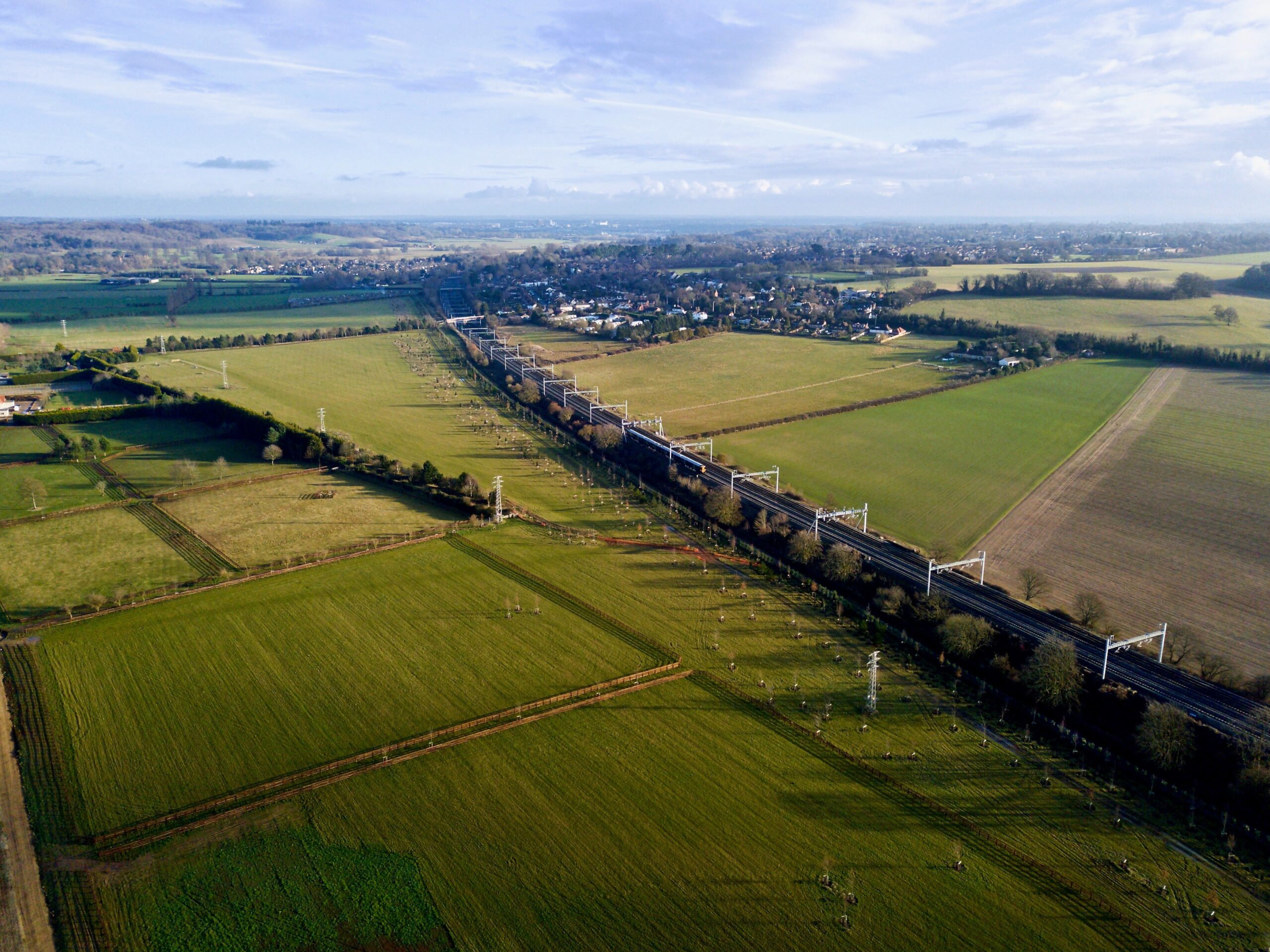
Original estimate: £32 billion
HS2 was announced as an affordable project that would connect London with Birmingham and the North, generating economic development and modal shift from air and road.
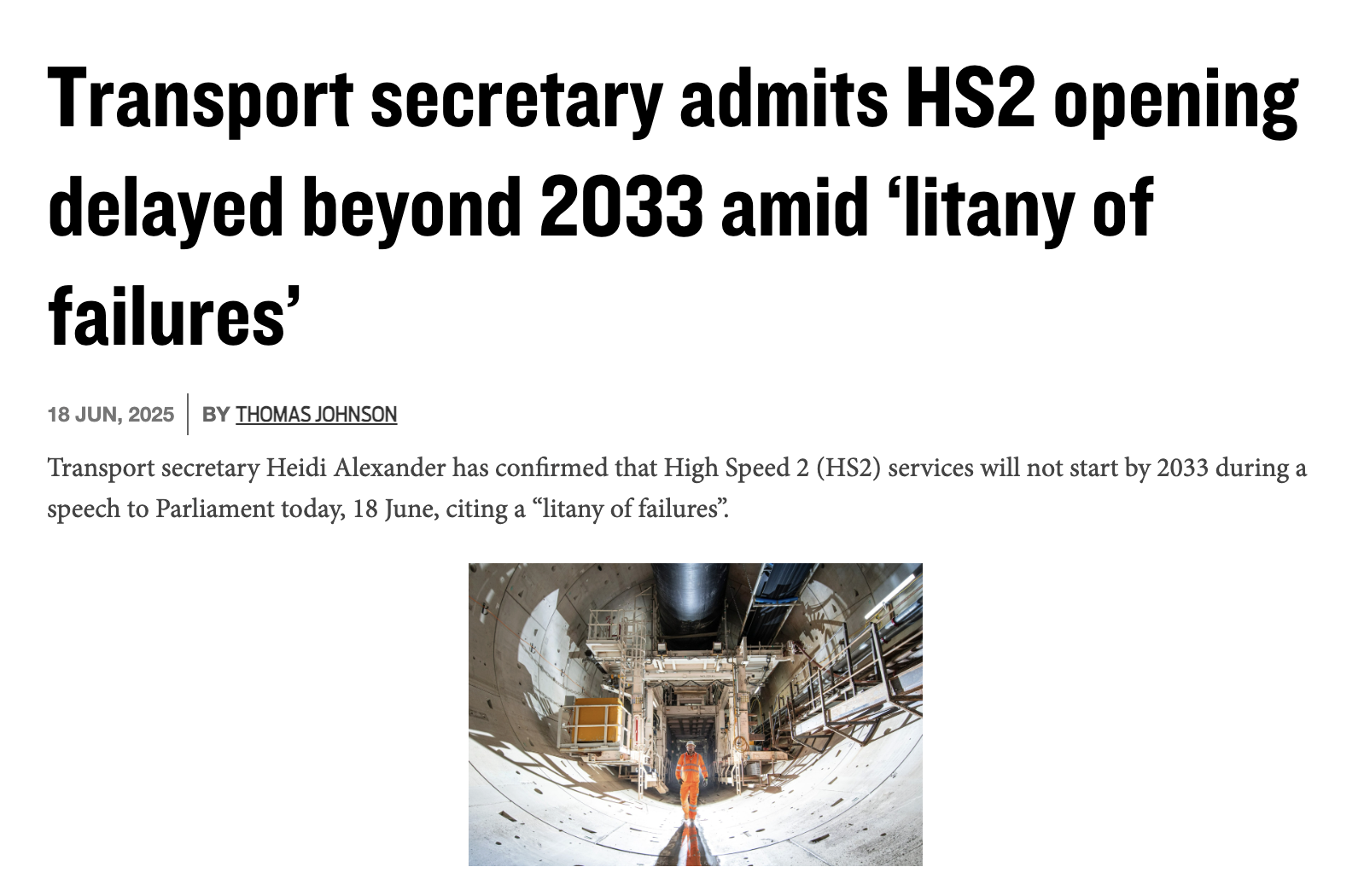
Current estimate: £100+ billion
Independent Department for Transport estimates have placed the cost at more than £111 billion — for a dramatically curtailed system with the northern legs cancelled after construction began.
Ancient woodlands destroyed
The British Psychological Society cited HS2 as a direct cause of solastalgia — the psychological distress of watching irreplaceable environments destroyed — with rural communities disproportionately affected.

The verdict
HS2 is now widely regarded as a governance and cost-control failure. Joining the G7 HSR club by building something that looks like HSR but performs like a subsidised underperformer is not parity with France or Japan. It is parity with HS2.
“Both France’s and Japan’s first high-speed rail lines were economically justified. However, success of those lines created political pressure and a constituency group that urged expansion of the system. Politicians then placed pressure on builders to construct additional lines that made less financial sense.”
— Reason Foundation Policy Study 418, on the political economy of HSR expansionWhat Three Independent Datasets Tell Us
The G7 claim rests on a factual error, is contradicted by three international indices, and points to a cautionary precedent rather than a success template.
Canada is one of three G7 countries without 300 km/h HSR — not the only one. The United States, with more than eight times Canada’s population and the world’s largest economy, also lacks true HSR.
Examined against GDP per capita, the UN Human Development Index, and the World Happiness Report, a clear and consistent pattern emerges: the world’s wealthiest, most developed, and happiest nations have not built 300 km/h HSR. Germany is the single exception, for reasons specific to its corridor geometry and rail heritage. Canada’s peer group — Norway, Switzerland, Australia, the Nordic nations — has chosen not to build HSR without exception.
The decision to build HSR is driven by corridor geometry, population density, and institutional heritage. ALTO’s corridor fails to replicate the conditions that produced the world’s two genuinely successful HSR lines. Its own Business Case records a benefit-cost ratio of approximately 0.4 and a net present value of –$21.1 billion.
High-Performance Passenger Rail on freed existing corridors — analogous to the approach of Switzerland and the Nordic nations — offers a more evidence-based path to both transport efficiency and public wellbeing.
- 0 of the 10 wealthiest countries (GDP/capita) have domestic 300 km/h HSR
- 1 of the 10 highest HDI countries (Germany) has domestic 300 km/h HSR
- 0 of the 10 happiest countries have domestic 300 km/h HSR
- Canada is one of THREE G7 countries without 300 km/h rail — not the only one
- No national HSR system is profitable when full capital costs are included
- ALTO BCR ~0.4; NPV –$21.1 billion (JPO Business Case)
- HS2 — built for G7 parity — is now a widely acknowledged governance failure
- Switzerland: world-class rail, zero HSR, top-10 in all three indices
† Ireland’s nominal GDP is materially distorted by multinational profit-shifting (pharmaceutical and tech transfer pricing). Irish GNI* is approximately 40% lower (~$65,000). Luxembourg’s headline GDP is similarly inflated by financial sector tax-planning flows.
‡ The Netherlands and Belgium host Thalys/Eurostar services at 300 km/h on the HSL-Zuid and LGV Belge corridors respectively, but did not commission or operate those networks domestically. Rolling stock and operations are French and Belgian-French joint ventures.
★ Germany (~16th globally by GDP per capita) is the highest-ranked country by any of the three indices that operates a genuine domestic 300 km/h HSR network (ICE trains, Frankfurt–Cologne and other routes, DB Fernverkehr).
Data sources: IMF World Economic Outlook (October 2025 projections, nominal); UNDP Human Development Report 2025 (data year 2023); World Happiness Report 2025, Oxford Wellbeing Research Centre / Gallup World Poll (3-year average 2022–2024); UIC High-Speed Rail Database; Wikipedia List of High-Speed Railway Lines (accessed March 2026). Maximum speeds are maximum operational (revenue service) speeds, not test records or design speeds.