→ Government Documents
Community map (not the ALTO map): highspeedrailmap.ca ↗
In the News — January–April 2026
Elliot Ferguson reports on financial analysis by Andrew Hyett of the ALTO HSR Citizen Research Initiative comparing Alto to 16 other high-speed rail projects worldwide. Hyett’s analysis projects the project could cost more than $142 billion — $52 billion above the top end of the stated $60–90 billion budget. The most striking finding: 53% of the projected overrun is attributable to community opposition, not engineering challenges. Hyett: “I didn’t really expect this when we started off. I thought cost was just all about engineering. I’m not a railway expert. I’m a geotech engineer. It’s so interesting.” The analysis incorporated public attitudes toward consultation process, land expropriation, political debate, environmental impact, and cost concerns — alongside engineering challenges including geotechnical conditions, major structures, topography and alignment, hydrology and drainage, infrastructure interfaces, and climate and environmental loading. Hyett’s probability analysis: a 1-in-40 chance the project finishes on budget at $75 billion; an equal chance it balloons to $264 billion. Cited reference: Bent Flyvbjerg’s research showing rail megaprojects average more than 44% over budget. Hyett on the policy implication: “The government knows what I’m saying in my paper and Alto knows all about this. That’s why they think that (Bill) C-15 is so important and why it’s so integral. They have to shut down opposition.” And: “Bill C-15 has been prioritized over the engineering or anything, so my papers just kind of reinforce the fact that they know where these costs come from.” The article notes the Coalition for Better Rail’s high-performance rail alternative at approximately $28 billion, with trains travelling 200 km/h instead of Alto’s greenfield 300 km/h.
May require a Postmedia subscription: thewhig.com
Hadassah Alencar (Local Journalism Initiative) reports that members of the Longhouse in Kanesatake have formally opposed the Alto project in a letter to government over the railway’s projected path through Kanesatake’s ancestral lands. The letter — signed by Sabrina Richard for the Rotinonhseshá:ka of Kanehsatà:ke and secretary Wenhni’tano:ron Catherine Beauvais — was sent to Alto, PM Mark Carney, and Crown-Indigenous Relations Minister Rebecca Alty. “This is a very sensitive area for all involved, the potential impact on our identity, cultural heritage, and environment as well as the use of our ancestoral territory without our consent.” The letter continues: “The Kanien’kehá:ka are longstanding stewards of the lands. Since the arrival of the European peoples, they have stripped our traditional territory for their own gain. This must stop.” The Longhouse position came days after the Kanesatake Economic and Business Development Commission (KEBD) closed an April 21 community survey informing how the Mohawk Council of Kanesatake (MCK) will respond. MCK caretaker council member Brant Etienne offered a different framing, suggesting the project could create leverage in negotiations: “The Alto project, there’s no way around it. It passes right through our traditional territory. I think there are potential positives and potential negatives.” Alto spokesperson Crystal Jongeward confirmed the Indigenous Relations team has been in contact with Kanesatake for approximately three years, citing the community’s proximity to the planned corridor and the future Laval and Montreal stations. CIRNAC confirmed receipt of the letter. MCK survey results are expected next week, with further engagement sessions to follow including an open house with Alto representatives.
Nelson Zandbergen reports from the April 21 meeting at Crosspoint Baptist Church in Navan, where roughly 500 Eastern Ontario farmers and rural landowners packed the sanctuary, with overflow watching on closed-circuit TV in the fellowship hall. Expropriation lawyer Robert Miller (Davies Howe), by video link, walked through Bill C-15’s strengthened expropriation powers: the government can now skip any amicable purchase attempt and proceed straight to expropriation; it can impose a right of first refusal on coveted properties and a prohibition-of-work order barring improvements beyond basic maintenance. Objections no longer go to an independent hearing officer — they go directly to the Minister of Transport, whose decision is final; owners can be required to vacate within 90 days. Lanark-Frontenac-Kingston MP Scott Reid characterised Alto as a financially doomed project that he predicted will never be built: Oxford research shows the average HSR project runs 45% over budget, and Alto’s 24-million-passenger-per-year target equates to 138% of all current passenger traffic by every mode (air, rail, car) in the served area. Reid compared Alto to Pickering Airport, Mirabel, and LeBreton Flats, and warned that the harm to landowners arrives with expropriation itself — regardless of whether the project is later cancelled. Emcee Mike McGillivray, an eighth-generation organic farmer from Glengarry County, urged attendees to mark their properties on Alto’s online project map as no-trespass and to send the same message to Alto, their MPs, and municipal councillors. A Prescott-Russell farmer told the paper that Alto had offered him $1,500 to test and survey his land: “I wouldn’t take a million dollars.” Realtor Steve Montroy described an Alto-driven chill already depressing property values and threatening mortgage renewals and refinancing. By April 22, the most-signed petition against the project had reached 13,000 signatures.
Ken Hashizume reports from the April 22 town hall at the Storrington Centre in Sunbury, which drew roughly 200 people in person with additional viewers following on Facebook. Co-leads Katie Koopman and Gord Boulton presented a summary of the group’s three-month report, with Koopman arguing that the public has not yet been properly consulted on the project and calling on Alto and the federal government for transparency. South Frontenac Mayor Ron Vandewal, National Farmers Union Local 316 President Josh Suppan, and Dr. Andrew Hyett (retired geologist and CRI co-lead) also spoke. Hyett’s presentation focused on the project’s ground-level impacts, arguing that the more community friction the project generates, the more likely it is to exceed its $90-billion headline estimate. Koopman said opposition has grown substantially in the three months since the group formed, and highlighted strong turnout both at the town hall and through the group’s Facebook page.
Elliot Ferguson surveys the municipal landscape at the close of 14 weeks of Alto consultation. Save South Frontenac’s weekly map of municipalities and organizations along the proposed routes shows near-complete opposition across rural areas around Kingston — a sea of red, with a handful of municipalities in yellow seeking route modifications. Two new developments this week. Napanee town council was presented with a CAO recommendation from Matthew Grant to endorse the northern route and decline to sign a joint letter opposing Alto. Grant told council that based on a March 26 stakeholder consultation with Alto, “they weren’t talking about if. They were talking about when.” Councillors rejected the recommendation and deferred the vote for two weeks so two absent members could be present; opposition groups on social media criticised the direction as throwing northern-route residents under the bus. Havelock resident Richard Kent called the recommendation horrible and out of line for a CAO role, and Heather Levy of Save Stone Mills said she could not understand Grant’s rationale. The following day, Northumberland County council approved a motion supporting the northern route and opposing the southern route on grounds of disproportionate impacts to prime agricultural lands, natural heritage systems, rural communities, and municipal infrastructure, and the absence of clear local or regional transportation benefits. Perth-area resident Susan Tannahill pushed back on the endorsement, citing fragile ecosystems and livelihoods at stake along the northern alignment. Kent framed the broader pattern as citizens unifying across both routes rather than pointing the project at each other — the consensus being that the proposal cannot be supported regardless of alignment.
May require a Postmedia subscription: thewhig.com
Elliot Ferguson covers the release of Save South Frontenac’s 96-page report, published Wednesday afternoon as the first round of Alto public consultation drew to a close. The report urges Alto and the federal government to take a “cautious and evidence-based approach” to the next phases and catalogues the compounding effects the southern corridor could have on South Frontenac: severance of communities, dead-ended roads, expropriation of private property, mental-health impacts on corridor residents, emergency-service disruption, splitting of agricultural lands, biodiversity loss, watershed damage, and harm to wildlife migration routes and sensitive habitats. Seven recommendations are issued to Alto: do not route through South Frontenac; protect agricultural land and food security; safeguard rural tourism and the outdoor economy; respect environmental sensitivity; minimise expropriation and community disruption; protect road connectivity and public safety; and prioritise appropriate station locations. The report aligns Save South Frontenac with South Frontenac Township council and Kingston city council in calling for the line to use the existing rail corridor alongside Highway 401, with a Kingston station added. The recommendations are framed as minimising harm to rural communities while maximising broader public benefit, and the report emphasises the need for meaningful consultation, comprehensive and integrated impact assessments, and preference for existing transportation corridors.
May require a Postmedia subscription: thewhig.com
Elliot Ferguson reports from the April 19 public meeting in Tamworth, where the Coalition for Better Rail proposed setting aside the 300 km/h ALTO project in favour of a 200 km/h passenger rail line paralleling Highway 401 for nearly its entire length. Coalition representative Kathryn Wood argued the existing transportation corridor offers opportunities for creative solutions and for coordinating new track construction with the upcoming 401 reconstruction in eastern Ontario — running rail under or over overpasses as they are rebuilt — while integrating with existing municipal transit. Queen’s University researcher Andrew Hyett, a co-founder of the ALTO HSR Citizen Research Initiative, framed the underlying issue as a forced marriage between CN freight and VIA passenger operations on the same track: “Basically, they want a divorce.” Hyett said the Coalition’s modelling shows a 200 km/h railway along the 401 corridor is feasible, contradicting ALTO’s claim that the corridor is foreclosed; he cited VIA’s superior on-time performance on its own Ottawa-area tracks as evidence of what dedicated passenger infrastructure can achieve, and noted that the severance was already done when the 401 was built in the 1960s and 1970s, dramatically reducing the need for rural expropriation compared with a greenfield HSR corridor. Hyett on the Coalition’s constructive framing: “We will get on board this project… if we can all have some benefit from it, then we’re going to be much more positive towards any project.”
May require a Postmedia subscription: thewhig.com
Andrew Phillips argues that if ALTO fails to terminate in downtown Toronto and downtown Montreal, it cannot compete with air travel — eliminating the central rationale for the project. Picking up the Takagi/Blosser Apr 19 reporting on Imbleau’s equivocation about Union Station, Phillips calls the $60–90B estimate a “Day One estimate, surely to be exceeded” and notes the 24M-riders-by-2055 projection is six times current Montreal–Toronto rail traffic. On the terminus problem: Union Station is the obvious choice — feeding directly into downtown transit and the business district — but Imbleau calls it “a challenge.” The East Harbour Transit Hub, 2.5 km east of Union, would add 20–30 minutes door-to-door — enough to erase the time advantage over flying. Worse, Imbleau has floated a secondary station outside the Toronto core as the initial terminus, mirroring Montreal’s planned suburban Laval station while ALTO works on a “superexpensive plan to tunnel under Mount Royal” to reach downtown Montreal. The result could be an opening-day high-speed rail service that connects Laval (15 km north of downtown Montreal) to the edge of Toronto — a configuration Phillips argues would make flying faster and more convenient. He closes with a glancing note on the decision to bypass Kingston in favour of Peterborough, “which is much smaller and has no existing rail connections”. Phillips: “If you get that wrong, no amount of vision will save the project.”
Bill Hall reports from the April 18 town hall at the Arden Canadian Legion, packed with residents from across rural Frontenac County. Lanark-Frontenac-Kingston MP Scott Reid on Alto’s projections: “These are heroic projections. I don’t think any of them should be believed.” Cites Oxford research that rail megaprojects typically run 50% over budget and rarely meet ridership targets; cites McGill study projecting annual ridership closer to 9 million against Alto’s 24M figure — which Reid notes is “more than all trips currently taken by rail, road and air combined between Toronto, Ottawa and Montreal.” On Bill C-15: right-of-first-refusal notices, freezing land values by preventing improvements for up to four years, bypassing negotiated settlements for direct expropriation. “The harm is done in communities, and then we never actually get the project” — citing Pickering Airport, Mirabel, and LeBreton Flats as precedents. Former Central Frontenac councillor Brent Cameron contrasted the 2015 HFR proposal: “There wouldn’t have been expropriations… a much more modest proposal, not quite as expensive and not uprooting people’s lives.” Organizer Ron Couchman — who owns 215 acres and has had land previously expropriated twice (for Highway 7 and a rail project never built, still held by government): “I refuse to accept we are at that stage at this point.” Davies Howe Partners expropriation lawyers appeared remotely. Managing partner Ava Kenner: “You cannot stop it outside of the political route.” Partner Robert Miller: “The consent of the landowner is not required. The Act exists to ensure compensation, not to determine whether the project should proceed.” Gord Boulton of Save South Frontenac and the Corridor Train Alliance identified two alternatives: cancel outright or relocate along the 401. Couchman closing, on a family member excited about cheap Blue Jays day trips from the city: “I understand that as a father, that’s costly and a valid concern. But is it worth me losing my home?”
May require a Postmedia subscription: thewhig.com
Glenn Hendry reports that Whitby Mayor Elizabeth Roy, in a letter to federal Transport Minister Steven MacKinnon co-signed by CAO Matt Gaskell, has formally requested a seat at the Alto consultation table. Whitby is not scheduled to receive a station, but routing options under assessment may run north of the community and could conflict with existing rail or rural areas. Roy warns of “significant implications… for land use planning, agricultural lands, transportation networks, municipal infrastructure, and long-term growth management” — including grade separations, road realignments, environmental considerations, and integration challenges with the planned GO train expansion to Bowmanville. The letter requests technical and detailed briefings for town staff and council on potential corridor alignment options within or adjacent to Whitby, with anticipated land requirements, environmental constraints, and timelines. Whitby frames itself as supportive of the project and a “constructive partner.” The article cites Carney’s own figure that the project requires a 10-km-wide study corridor but only a 10-metre track swath, and a recent INsauga reader poll in which 60% of respondents believe the project won’t ever be built.
Pro-project column by Ottawa journalist Mohammed Adam. Argues rural opposition — while understandable — must not be allowed to block a “transformational national project”; affected landowners must be compensated, but “then the project must go ahead.” Frames resistance as “not-in-my-backyard syndrome”: “if individual or local interests were allowed to stand in the way of the national interest, there will never be progress anywhere.” Cites Vankleek Hill beekeepers Russell Gibbs and Andrea Glenn (Gibbs Honey) as sympathetic but ultimately unreasonable. Notable caveats Adam makes on record: cites Pickering Airport, the Spadina Expressway, and Mirabel Airport as cautionary precedents — all major expropriations for projects that were never built, never completed, or subsequently decommissioned. Raises Ottawa LRT as an engineering-risk parallel: “it is crucial that the engineering of the all-electric HSR be sound enough to not become a larger version of Ottawa’s LRT.” Adam’s endorsement is conditional: “If Canadians can be assured that HSR will be feasible, affordable, professionally engineered and work efficiently, then I say full-speed ahead.”
Op-ed by Dan Albas, CPC Transport critic. Notes Liberal MP Chris Malette (Bay of Quinte) has come out in opposition to the project. Key arguments: no public fiscal review, independent scrutiny, or feasibility report; $90B represents roughly $8,000 per family; a state-run crown corporation “kills competition and potential private sector investment”; 14 of 15 pre-existing “national interest” projects at the Major Projects Office are primarily financed by private companies or ratepayers — Alto is the outlier. On the Progressive P3 structure: “until the Cadence consortium actually invests in the project — which is not slated to happen until stage four — the taxpayer, not the private sector, is on the hook.” Cites Ottawa’s Confederation Line and Toronto’s Eglinton Crosstown as cautionary cases. Global rail megaprojects average 44.7 per cent cost overrun even after contingencies. Cites McGill analysis concluding that even with strong ridership, fares would not cover operating and financing costs. Conservative alternative: fix VIA Rail performance, fast-track Billy Bishop runway expansion, partner with provinces and private sector on regional rail integrated with existing bus and transit networks.
May require a Postmedia subscription: nationalpost.com
Leo Ryan reports on the April 9 announcement of C$1.16 billion in Canada Infrastructure Bank loan financing for the Port of Montreal’s Contrecœur container terminal, with PM Carney in attendance. Total project cost: C$2.3 billion; construction completion targeted for 2030; operator DP World. Once operational, Contrecœur will add up to 1.15 million TEUs of annual capacity — a 60% increase in the Port of Montreal’s container handling. Carney: the project “went from a proposal to a construction site” in under seven months — “the speed and ambition we need to build Canada strong.” Montreal is the first port to benefit from the Carney government’s “nation-building projects” list. Board Chair Nathalie Pilon, responding to industry analysts who question whether traffic volume justifies the investment: “Canada’s trade future depends on infrastructure that is ready before demand arrives.” Governance items worth flagging: the article reports that Paul Bird, the Port of Montreal’s Chief Commercial Officer in charge of the Contrecœur expansion, has recently moved to ALTO’s executive team — ALTO being headed by Martin Imbleau, who was CEO of the Port of Montreal immediately prior to his ALTO appointment. Separately, the MPA announced on April 3 that Julie Gascon “ceased her position” as President and CEO effective immediately, with no reason given — widely interpreted in industry coverage as a dismissal. 2025 container data: Montreal +3.6% (1.5M TEUs); Halifax −1.4% (502,000 TEUs); Port Saint John +29.4% (239,364 TEUs), a 175% five-year container growth following C$247M of west-side terminal investment, with a new Hapag-Lloyd Mediterranean service. Filed for corridor context: these east-coast container flows move into central Canada largely on the CN Kingston Subdivision — the corridor the ALTO proposal would parallel.
AJOT Premium: ajot.com
The Canadian Taxpayers Federation column by Gage Haubrich appears on Todayville under a Trudeau-focused headline, carrying the same core figures as the National Post version (see Apr 15 entry below): $53 billion in subsidies and 44 years to profitability (McGill), $1.7 million per promised construction job, California HSR and HS2 overruns, and the federal fiscal position. Distinctive to this version: explicit framing of the announcement as a Trudeau-era legacy commitment; the observation that ALTO’s promised $35B annual GDP boost would roughly double projected combined Ontario–Quebec GDP growth this year — from seven stops; and the ArriveCan $60M cost overrun cited as a federal project-management cautionary tale. The column closes with a call to cancel the project before construction begins.
Andy Takagi and Anastasia Blosser report on unanswered questions from Alto CEO Martin Imbleau. On Union Station as the Toronto terminus: “It’s a challenge. It’s a constraint.” Alto is “considering different options.” U of T civil engineering professor Eric Miller: “I don’t think it’s a slam dunk.” East Harbour Transit Hub proposed as alternative; Imbleau floats a secondary station outside the downtown core as an initial terminus while the downtown build proceeds. Three options to reach downtown — existing tracks, elevated, or tunnel — each with drawbacks. Imbleau on the 401 corridor: not straight enough to support high-speed travel (contradicting Premier Ford’s repeated statements). Expropriation lawyer Ajay Gajaria (Aird & Berlis): “Both in dollar value terms and the number of properties, I think this project will be the largest number and the largest value of expropriations in modern Canadian history.” Construction will begin Montreal–Ottawa first: “Toronto is not the place where you start. It’s a place where you deploy what you have learned elsewhere.” Imbleau on project scope: “We will have tension, we’ll have hurdles, we will have issues, we’ll have surprises and we’ll be wrong.” Transit expert Reece Martin on interagency dynamics: “You’ve got this federal government agency, Alto and Metrolinx and they don’t interface. In other countries, it would be a national agency, there would be regulatory frameworks … that just doesn’t exist in Canada.”
Raisa Patel on the political dynamics of Conservative opposition. Peterborough Mayor Jeff Leal: “I don’t get the politics of it… I think it’s a political loser.” Smiths Falls Mayor Shawn Pankow: “I guess he’s painted himself into a corner to a great extent.” Kingston Mayor Bryan Paterson: “Rather than saying no to it, what we’ve said is that we would support it, but there needs to be changes to it” — aligned with Premier Ford’s 401-corridor position. Abacus Data polling (commissioned by Altno, a group opposing the rail proposal): 62% of Canadians support the project, 18% oppose; 73% of young Canadians and 72% of current Liberal voters in favour. David Jones, C.D. Howe Institute senior fellow: project economic benefits of $11B–$27B over 60 years depending on ridership — separate from Alto’s $24.5B annual GDP estimate. Jones credits Poilievre for questioning “whether high-speed rail gets the most value for money” and highlighting Canada’s track record on cost overruns, but takes issue with the taxpayer-burden framing. Former Conservative staffer Mitch Heimpel: “You don’t want to be seen opposing a technology because of its newness” — and warns Alto will draw users from profitable VIA routes, making it harder for VIA to cross-subsidise lesser-travelled regions. Conservatives hold no seats in any stop city except Quebec City. Alto CEO Imbleau op-ed: “High-speed rail is not a leap of faith. It’s a measured response to growing mobility needs and economic pressures.”
ALTO President and CEO Martin Imbleau makes the pro-project case in a Toronto Star op-ed (updated Apr 19). Key figures cited: the Toronto–Quebec City corridor has grown by 30% to 18 million people in 20 years, is projected to reach 22 million in 15 years, and generates about half of national GDP; 95 million intercity trips currently take place annually between ALTO cities, projected to reach 140 million by 2049. Imbleau argues a 50% cut in Toronto–Montreal travel time (to three hours) would reshape daily life, and draws the Madrid–Barcelona comparison to support a projected 24 million passengers annually by 2055. He says the project will support 50,000 jobs and generate a permanent 1.1% GDP increase — equivalent to $24 billion annually. On the consultation record: more than 260,000 online-platform visits and 10,000 open-house participants across 26 sessions; Imbleau cites polling showing 62–69% of Canadians support high-speed rail and 75% say they would use it. On engineering, he notes a 320 km/h train demands millimetre-level precision and that cost cannot be finalized until alignment is chosen. Imbleau concludes: “The question is not whether Canada can afford to build it but whether we can afford not to.”
Alto, the Crown corporation proposing high-speed rail between Quebec and Ontario, is seeking to conduct environmental surveys along the proposed corridor. CBC’s Cameron Mahler spoke to a farmer concerned about what survey access requests could mean for his land and property rights.
Frontenac County council voted to oppose both proposed Alto corridors over concerns about local impact and a lack of consultation, becoming the latest municipal body to take a formal stand against the project. Jesse Reynolds reports.
Northumberland County council voted Wednesday to formally oppose the southern Alto corridor and affirm conditional support for the northern route. Trent Hills Deputy Mayor Michael Metcalf told council the southern alignment would pass through two of Trent Hills’ three urban centres — Campbellford and Hastings — as well as prime agricultural land: “It came quickly, it was a shock and there are no answers as to why you would want to take that route through the south, through that fertile agriculture, productive land.” A staff report found the southern corridor would introduce “disproportionate agricultural, environmental and community impacts to Northumberland County without providing corresponding local or regional transportation benefits.” At Port Hope Mayor Olena Hankivsky’s urging, the resolution also asked for consideration of strengthening existing transportation corridors. Brighton Mayor Brian Ostrander: “I, too, oppose the southern route as it stands.” The Eastern Ontario Wardens’ Caucus resolution opposing the project in its current form was cited as context.
Conservatives are accusing the Liberals of filibustering the House of Commons ethics committee to block questioning Finance Minister François-Philippe Champagne about his personal connection to the Alto project. Ethics critic Michael Barrett reported the filibuster had passed 12 hours by Thursday. Champagne’s partner, Anne-Marie Gaudet, is VP Environment at Alto, hired in August 2025. Barrett sought to have the committee question Champagne, Alto CEO Martin Imbleau, and Conflict of Interest and Ethics Commissioner Konrad von Finckenstein. A finance minister’s spokesperson said the commissioner determined in August that “there is no risk of a conflict,” and that Champagne opted to impose a screen proactively; the minister has not participated in any Alto discussions or decisions since September. Barrett pointed out that Champagne — not the transport minister — introduced and championed the Alto legislation in Bill C-15: “Why wasn’t the bill with respect to the high-speed rail network act brought forward by the transport minister?” Barrett has formally asked the Ethics Commissioner to investigate. The committee had not voted on calling Champagne to appear as of publication. With the Liberals now holding a House majority, they could move to change committee composition — historically giving majority governments committee control.
Greater Napanee’s CAO Matthew Grant told council Tuesday that Alto’s consultation process is focused on “how, not if” the project moves forward — and that based on the project’s inclusion on the Major Projects Office list, “I believe them.” Staff recommended endorsing the northern corridor as the option with least local disruption. Council members pushed back strongly. Councillor Mike Schenk: “This is straight politics” and questioned whether the project represents the best use of public funds. Councillor Bill Martin said he would support a joint letter opposing the project entirely: “I could not support this staff recommendation whatsoever.” Councillor Shawn Davey said he could not support either route under the current proposal. The article highlights a structural tension: while Alto conducts consultations, final authority over whether and where the railway is built rests with the federal government, not Alto. Council deferred a formal decision to a future meeting as two councillors were absent. Staff recommend advocating for increased VIA Rail frequency and potential GO Transit extension east to Kingston as complementary measures.
May require a Postmedia subscription: thewhig.com
An open letter signed by 73 South Frontenac Township small businesses calls on the federal government to halt the southern route until more details are made public. The letter states: “As currently planned, this project will not strengthen our community — it will destabilize it.” It describes a continuous fenced barrier approximately 60 metres wide, no level crossings, and limited overpasses resulting in permanent road network fragmentation, reduced emergency responsiveness, divided farmland, and forced expropriation. “This is not a theoretical concern, it is an immediate and material threat to our ability to operate, employ, and serve our communities.” The letter notes that anticipation of these impacts has already negatively affected real estate and construction activity in the township. Tourism concerns are prominent: the Cataraqui Trail, Frontenac Provincial Park, and the seasonal cottage economy are cited as at risk. Businesses call for: a halt to southern route planning; release of a detailed business plan and social, economic and environmental impact review; meaningful consultation with local businesses and municipalities; and re-evaluation of alternative routes that limit rural community impact.
May require a Postmedia subscription: thewhig.com
Gage Haubrich and Noah Jarvis of the Canadian Taxpayers Federation call for the project to be cancelled before it leaves the station. Key figures cited: the project will only become profitable after $53 billion in subsidies and 44 years of operation (McGill University research); each of the 51,000 promised construction jobs costs approximately $1.7 million and most end at construction completion; only one in three surveyed residents said they would take the train more than once per year. Historical parallels: California HSR was projected at $46B in 2008, now estimated at $174B with no track laid; HS2 was £59B in 2011, now over £148B. Closer to home: the Ontario Line ballooned from $10.9B to $27.2B before a single track was laid. The authors also note the federal government’s current $78B annual borrowing and a federal debt reaching $1.35 trillion, with debt-interest payments of $55.6B annually — more than the government collects through the GST.
The Hub editorial board subjects Alto’s ridership and context claims to systematic comparative analysis. The CEO’s 25-million-passenger projection is tested against the Shinkansen comparison Alto’s proponents favour: Japan’s Tokaido corridor connects metropolitan populations exceeding 60 million across 515 km; the Toronto–Montreal segment links metros totalling approximately 10 million — a difference in addressable ridership the editorial calls structurally inapplicable. The board cites Richard Shimooka (The Hub) on why the Shinkansen comparison is “simplistic at best.” International parallels: HS2 from £37.5B in 2015 to past £100B before northern legs were cancelled; California HSR costs tripled since 2008; Trans Mountain expanded from $7.4B to approximately $21.4B over budget — illustrating Canada’s particular vulnerability given layered regulatory authorities, Indigenous consultation obligations, and provincial friction. The editorial raises practical questions unaddressed by Alto: terminal expansion costs at Union Station and Gare Centrale; whether airport-style security screening is planned; whether ticket prices would undercut driving for families; and the intra-city mobility problem HSR does not solve. Counterintuitively, the board identifies a genuine Japanese lesson: Japan maintains a robust domestic aviation network that competes with the Shinkansen — upgraded aviation infrastructure and greater airline competition would distribute benefits nationally rather than concentrate them in a single corridor.
Business columnist David Olive argues Alto is a poor choice among nation-building projects. PM Carney defended it this week — “It’s more cost-effective, it’s more sustainable, it’s connecting our communities, it’s going to be faster” — but Olive writes: “The facts don’t yet support that assertion.” Alto is proceeding without a budget, confirmed route, fare structure, or completion timeline. Olive cites California’s troubled HSR as a cautionary parallel, warns that cities not on the original route will lobby for service with runaway costs the result, and proposes an Edmonton–Calgary pilot as a lower-risk proof of concept. Alto’s financial viability is also questioned: at planned speeds of up to 300 km/h — slower than European and Japanese standards — the project is unlikely to lure enough customers from air travel to achieve break-even operating costs.
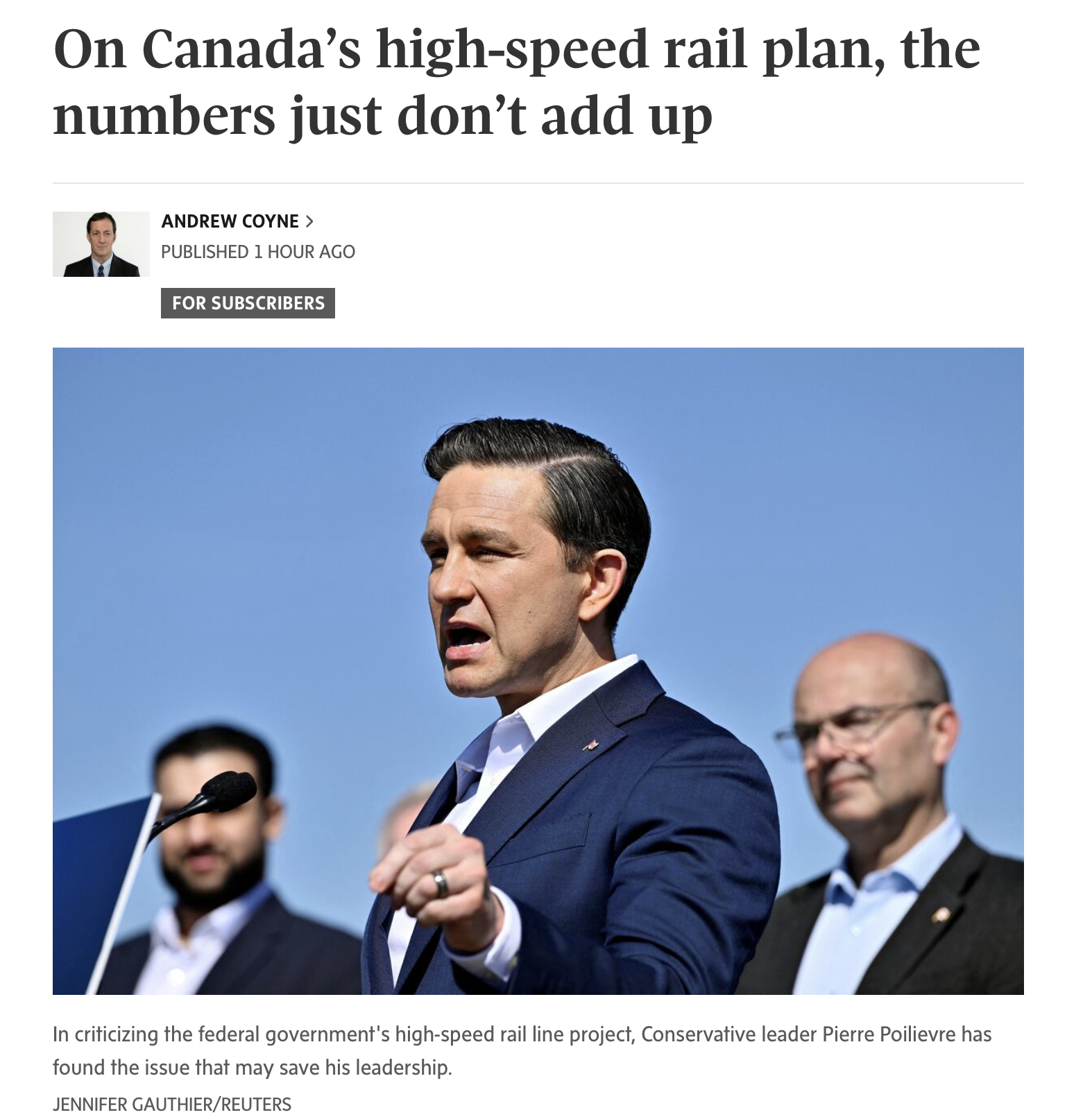
Andrew Coyne (Globe and Mail) subjects Alto to systematic cost-benefit scrutiny. Projected annual ridership of 24 million trips by the 2050s — three times the Eurostar network’s current numbers, from a corridor a fraction of the size — he calls “highly ambitious.” He calculates that once you strip out passengers who would have ridden existing VIA Rail service and those diverted from other modes, the cost per genuinely diverted passenger runs to roughly $1,000 per trip. He argues High Frequency Rail on dedicated track would capture most of the modal-shift benefits at far lower cost, and that a carbon price plus a 401 toll would do the rest more efficiently. The $60–90B estimate is the “opening bid” — citing Bent Flyvbjerg’s global average cost overrun of 39% for HSR, and Canada’s own infrastructure record. Coyne concludes: “On this one, I’m with Pierre.”
A detailed legal explainer on the High-Speed Rail Network Act (part of Bill C-15, Royal Assent March 26, 2026) by expropriation lawyer Robert Miller (Davies Howe LLP). Key changes: the government is no longer required to approach landowners with an offer to purchase before expropriation begins; the 30-day public hearing process before a hearing officer has been replaced with a 30-day window to submit a written objection directly to the minister, whose decision is final; a notice of confirmation transfers ownership to the Crown, with possession possible as early as 90 days later. New powers include a right of first refusal (government can match any sale price) and a prohibition on work (no improvements that could increase land value). Miller: “The whole point of C-15 is to save the federal government time in the expropriation process and also to limit their exposure to cost of land.” Farmer Jeff Leroux (South Frontenac): “It’s eroding our rights as Canadians. It takes value away from land ownership… It’s your savings. It’s your pension plan. It’s everything.” Shelagh Hurley (Opinicon Property Owners Community): “Expropriation is the most brutal thing a government can do, apart from colonization.” Miller: most expropriation cases settle before court, but the mass scale of this project could change that.
May require a Postmedia subscription: thewhig.com
Letter to PM Carney from Ron Higgins, former Mayor of North Frontenac and former Warden of the County of Frontenac. Higgins states he is not opposed to infrastructure investment but argues the government has not yet demonstrated the project is justified in the broader public interest. His central concern: the debate has become focused on which route rather than whether this project, at this scale, cost, and level of rural impact, has earned public confidence. He identifies practical long-term rural consequences including fragmentation of agricultural land, road severance, drainage and watershed interference, wildfire response and emergency access, and impacts on wildlife habitat and recreation. He specifically raises the K&P Trail and related trail systems, warning that the connectivity, accessibility, and public return on investment in these assets must be assessed before route decisions are made. Five conditions before any final route decision: (1) a realistic full-cost estimate including overruns; (2) an independent cost-benefit analysis identifying who benefits and who bears impacts; (3) a route-specific assessment of farmland, roads, drainage, wetlands, and recreation assets; (4) a clear explanation of what rural communities receive in exchange for the footprint they absorb; and (5) a transparent comparison with alternatives including upgrades to existing passenger rail. “Consultation is not enough if the central logic of the project has already been politically accepted before communities are given a meaningful opportunity to influence outcomes.”
May require a Postmedia subscription: thewhig.com
Finance Minister François-Philippe Champagne released a letter he says he wrote in September 2025, vowing not to participate in any decisions about Alto. The letter, addressed to PM Carney, confirms he applied a “conflict of interest filter” due to a “personal connection” to someone in the organization — his partner Anne-Marie Gaudet, hired as Alto’s VP Environment in August 2025. The letter is not posted on the Ethics Commissioner’s website, where such disclosures are normally required. Ethics specialist Ian Stedman (York University): “I can’t even think of a reason why it wouldn’t be on the registry.” Less than two months after the letter, Champagne’s budget allocated $597M to Alto for 2025–26 plus $3.9B over six years. The screen is overseen by Champagne’s chief of staff and deputy minister of finance, with Secretary of State Wayne Long holding delegated authority when engaged. Note: The CRI identified the Gaudet–Champagne relationship as a Tier 1 Critical governance concern in its April 2026 profile series.
Parallel Star reporting on the Champagne ethics screen. Confirms the screen means Champagne has been “unable to participate in decisions related to the federal government’s proposed high-speed rail line.” The screen is overseen by Champagne’s chief of staff Ian Foucher and deputy minister of finance Nick Leswick. Only the Bionest Technologies screen (concerning Champagne’s father’s company) appears on the Ethics Commissioner’s public registry — the Alto screen does not, despite the Commissioner reportedly being informed of both. The letter states Champagne proactively initiated the Alto screen himself.
Two letters in response to Globe and Mail coverage of the ALTO project. Charged up — Raymond Leury, President, Electric Vehicle Council of Ottawa: compares auto industry resistance to EV mandates with its historical resistance to seat belts, airbags, and catalytic converters; argues Canada’s EV supply — not demand — is the problem, and the industry risks “following Kodak into irrelevance.” Wait a minute — Michèle Dextras, Ottawa: argues Montreal, Ottawa and Toronto are still struggling with city transit systems that have faced chronic delays; suggests improving urban transit would benefit far more people than a $60B+ high-speed rail line primarily used by upper- and middle-class travellers.
Analyst Guillaume St-Pierre notes that while 85% of Quebecers and Ontarians on the proposed route are open to the idea, Ottawa would be wrong to treat this as unconditional support. McGill transport professor Ahmed El-Geneidy: “If we put politics aside and start thinking about what we really need, we will realize that the project would be completely different from the one Alto is proposing.” A Laval station would slow the journey and cost billions; every mayor wants a stop. The federal government needs to present a detailed business plan. “The photo shoots will not be enough to convince the skeptics.” (French, may require subscription.)
Imbleau says “compromises” are necessary for this “nation-building” project, acknowledging he is “not dumb enough” to claim a 320 km/h train on someone’s land has no impact. Alto is three-quarters through its 100-day consultation. Canadian Federation of Agriculture adopted a resolution calling for suspension to allow “genuine consultation.” OFA president Drew Spoelstra called Alto’s response “underwhelming” and demanded an “agriculture-first” approach: “If that can’t happen, the project shouldn’t go ahead.” Louise Fish of Rideau Lakes, a retired risk manager: “We’ve lost a lot of sleep… planning is essential to getting things right. And if you don’t do it right, you’re going to face all kinds of unintended consequences.”
Imbleau says Kingston’s push for a station on the high-speed rail line has been noticed, crediting the ongoing public consultation process for surfacing the city’s support. He characterizes the region’s feedback as favouring the southern corridor because it runs closer to Kingston, and adds: “The mobilization is very strong. The message is received.” Imbleau confirmed that any future route will not run along the Highway 401 corridor. Note: Petition e-7203 — calling for the project to be cancelled — has 11,682 signatures from the same region, compared with 305 for the pro-Kingston-station petition (e-7257). See CRI analysis of the petition record.
May require a Postmedia subscription: thewhig.com
Save South Frontenac distanced itself from Pierre Poilievre’s pledge to cancel Alto, saying the project’s impact on communities is “deeply personal” rather than political. Spokesperson Katie Koopman: “This isn’t just a project on paper; it’s our homes, our land, and our way of life — places where people have built their lives over generations.” Koopman added: “This also isn’t about politics for us; it’s about people.” The group said it welcomes attention from across the political spectrum but wants the stories of residents, farmers, and small business owners to be “heard, understood, and genuinely considered.”
May require a Postmedia subscription: thewhig.com
Tristin Hopper calculates Alto represents a starting cost of at least $4,000 per Canadian taxpayer and examines alternatives: the Mid-Canada Corridor (new cities and resource infrastructure across the boreal belt, estimated ~$100B); solving Canada’s electricity deficit with new hydro and nuclear; building Australia’s worth of LNG export ports; tripling Pacific oil export capacity; or “several moon landings.” Poilievre’s primary objection: extensive expropriation of private property across Ontario and Quebec.
May require a National Post subscription: nationalpost.com
John Michael McGrath draws a direct parallel with Kathleen Wynne’s Toronto–London HSR proposal, which became politically toxic in rural southwestern Ontario and was cancelled by Ford without electoral cost. He warns that “major civil works in Canada carry an implicit assumption that Liberals keep winning elections forever” — and that a Conservative government in the 2030s could still cancel Alto before it serves a single passenger. He argues cancellation is not the answer but that the project needs to be faster and cheaper to survive the political cycle.
In an interview with the Whig-Standard, Alto CEO Martin Imbleau says he sympathizes with rural concerns but denies the railway will “cut communities in half.” Promises: access roads on both sides, overpasses and bypasses at reasonable distances, no “significant dead ends.” On the timeline: a second round of consultation is planned for late 2026 or early 2027, at which point Alto will have a specific alignment and can detail crossing locations and compensation. Imbleau acknowledges: “There’s no perfect alignment. It always has some local impact and consideration, and it’s a compromise.”
May require a Postmedia subscription: thewhig.com
The At Issue panel discusses the ALTO high-speed rail project, April 2, 2026.
Bloc Québécois leader Yves-François Blanchet is making Alto the defining issue of the Terrebonne byelection (April 13), invoking memories of Mirabel Airport’s mass expropriation. The Bloc is critical of the removal of public hearing rights for expropriated landowners under Bill C-15. Blanchet: “If you are against it — or if you support it but need clear information, a respect for property rights, and for it to be done well — Nathalie and the Bloc will speak for you.” Polling shows 58% of Conservative voters and 68% of Bloc supporters back the project nationally, complicating the opposition framing.
Bloc Québécois Leader Yves-François Blanchet outlined his party’s conditions for supporting the Alto high-speed rail project. Blanchet: “It has to be done properly, with the right information, the right analysis for this project.” The Bloc will not back the project if it overrides normal legislative and environmental review processes.
Conservative Leader Pierre Poilievre, at a news conference near Peterborough, called Alto “another example of a ridiculous pie-in-the-sky Liberal spending initiative” and pledged: “A future Conservative government will cancel this $90-billion boondoggle altogether.” Poilievre also opposed land expropriation, calling it a “Liberal land grab.” Transport Minister MacKinnon responded: “The Conservatives, as usual, think small.” Ontario Premier Ford reiterated his preference for the Highway 401 corridor.
Open letter to PM Carney and Minister MacKinnon signed by the Lennox and Addington Stewardship Council, Friends of the Salmon River, Friends of the Napanee River, Save Stone Mills, and more than 90 local businesses and organizations. Key arguments: Bill C-15 would fast-track land acquisition without traditional public hearings; a fenced 300 km/h corridor creates irrevocable harm to rural cohesion; the southern route crosses the Napanee Limestone Plain Key Biodiversity Area and threatens five river watersheds. Project costs cited at $60–120 billion with no benefit to rural communities where the train does not stop.
May require a Postmedia subscription: thewhig.com
Jane Wilson, president of Wind Concerns Ontario, draws direct parallels between the grassroots fight against rural wind turbines and the current community resistance to Alto. Wilson on Alto’s consultation: “The events they’re holding are really just storyboard presentations and the maps are so vague.”
May require a Postmedia subscription: thewhig.com
Smiths Falls council continues to advocate for a stop on the proposed Alto high-speed rail project. Mayor Shawn Pankow says the town has supported a station since discussions began nearly a decade ago, viewing it as a major economic driver.
Reporter Elliot Ferguson visits the Salmon River watershed. Marilyn Murray of the Lennox and Addington Stewardship Council says the southern route could cross up to 5,000 acres of farmland. Quinte Conservation’s board voted to oppose the high-speed rail proposal and urged investment in Via Rail along the existing corridor instead.
May require a Postmedia subscription: thewhig.com
A 19-minute Q&A with Alto president and CEO Martin Imbleau on CBC Ottawa Morning. Key admissions: the route will not be finalized until “sometime in the fall”; land acquisition involving “thousands of properties” will begin in 2027; environmental field studies began “this week.” On the VIA Rail alternative: “I wouldn’t do it. I studied it.” On landowner access: “I’m not a private project, I’m representing the state.”
Marcus Haefele of Agri-Caledonia Inc. says the project could cut his family off from roughly 405 hectares of farmland, a newly-built $7 million chicken barn, and the water source for both barns. Andrea Glenn of Gibbs Honey: “No matter what, this is going to affect us. What we’ve built here is not easily replicable.” Haefele: “Rural Canada is not here to be sacrificed for city-goers to have easier transportation.”
Approximately 100 protesters rallied with the Save Stone Mills group in Camden East. Steve Essen, who relocated from Toronto after Metrolinx acquired land in Riverdale for the Ontario Line, says his Stone Mills farm now faces the same fate: “Never in my wildest dreams could I have imagined it happening all over again.”
May require a Postmedia subscription: thewhig.com
Alto is launching the next stage of its field studies program, seeking permission to enter private properties this spring. Alto’s general manager of planning, Marcia Wallace, says Alto aims to have a “preliminary preferred rail alignment and station location” for Ottawa by end of 2026.
Alto senior communications advisor Crystal Jongeward confirmed: “Our mandate from the government of Canada remains the same — to develop a high-speed rail network between Ontario and Quebec, which includes seven stations. Nothing has changed in our mandate.”
Northumberland County Council has passed a resolution requesting more detailed information from Alto on the proposed high-speed rail corridor, including its potential impacts on Northumberland communities, agricultural land, and rural infrastructure.
The Patton family’s farm near Elgin has 150 acres still in the family today. Sharon Patton: “It’s like somebody is sick in your family. That’s how I feel.” For daughter Jennifer and son William, who is autistic, the farm represents their entire future.
May require a Postmedia subscription: thewhig.com
Ontario Premier Doug Ford stated at a March 16 news conference in Brockville that he wants Alto’s high-speed rail built along the Highway 401 corridor rather than through rural eastern Ontario.
CTV National News reports from eastern Ontario on the human cost of Alto’s proposed route. Residents along the corridor describe the threat of land seizure, longer emergency response times, and travel delays as primary reasons for their opposition.
Save South Frontenac organizer Gord Boulton notes there will be no level crossings anywhere. U of T’s Prof. Matti Siemiatycski — an Alto academic advisor — says “they’ve underestimated the cost and overestimated the benefits” and warns ticket prices will be “slightly below flying.”
May require a Postmedia subscription: thewhig.com
17 of the Trust’s 25 properties fall within the proposed Alto southern route — lands forming part of the UNESCO Frontenac Arch Biosphere Reserve containing more than 50 at-risk species.
Both morning and evening sessions of the Perth open house drew over 1,000 residents. Perth Mayor Judy Brown praised the open house format.
Expropriation lawyer Ajay Gajaria: “Both in dollar value terms and number of properties, this will be the largest value of expropriations in modern Canadian history.” Covers Bill C-15’s elimination of public hearing rights and the Mirabel parallel.
Concerns are growing about the proposed Alto high-speed rail project in the Peterborough area. A farmers’ group is calling for a pause on the current route study.