Wild Turkeys & High-Speed Rail
A 40-year conservation success story meets a risk nobody has studied
The Problem. Ontario spent four decades and about $120,000, most of it donated by hunters and conservation groups, rebuilding its wild turkey population from provincial extirpation. The first restored flock was released near Kingston, and the farmland-and-woodlot country of Eastern Ontario remains core turkey range. ALTO’s southern corridor option, which the federal government described in June 2026 as its “strong preference,” would cross this landscape. We have found no published study of what happens when 300 km/h trains meet wild turkeys, or any comparable ground bird.
Executive Summary. Wild turkeys are North America’s largest game bird. They forage on the ground, nest on the ground, and walk long distances in flocks along field edges, which places them squarely in the path of a high-speed line. The most detailed research on birds and high-speed rail, from Spain, estimated mortality of 60.5 birds per kilometre per year on one line section, mainly pigeons, corvids, larks and other small to medium-sized species. Standard HSR fencing will not exclude turkeys, which readily fly over 2-metre barriers. The anti-bird screens tested in Spain reduced mortality of small and medium-sized birds by more than 30% where installed, but they address birds flying across the line, not birds foraging on it. An Initiative calculation puts the kinetic energy of an average adult male turkey struck at 300 km/h at about 26 kilojoules, and of a large male at about 47 kilojoules. Turkeys occur along both of ALTO’s Eastern Ontario corridor options, but the southern option crosses more of the agricultural mosaic that supports the highest turkey numbers. ALTO has not published a bird collision risk assessment for any corridor option.
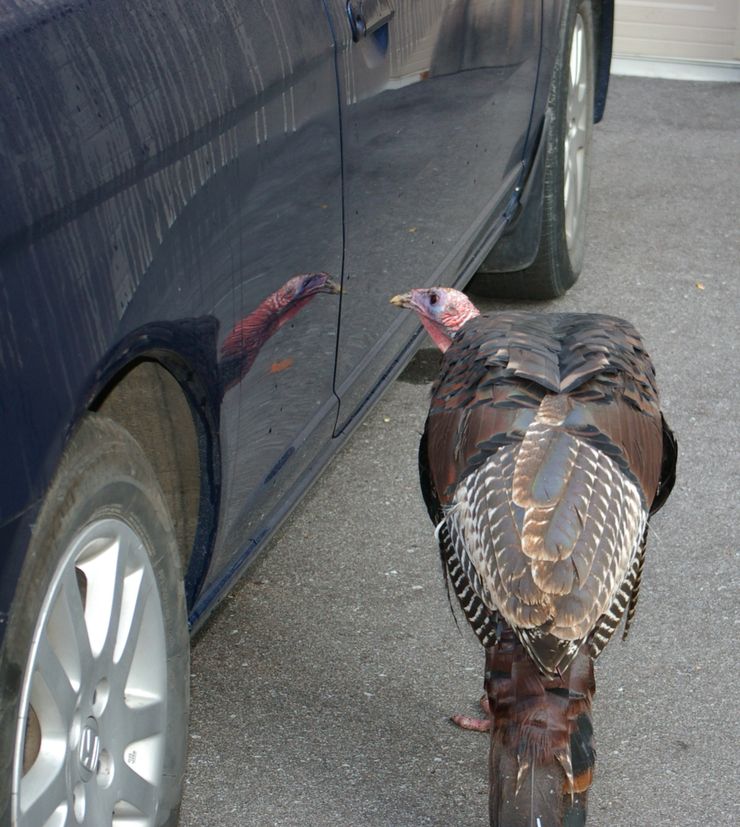
Wild turkey interacting with a low-speed vehicle in Eastern Ontario. Photo: L. Davidson
Wild turkeys were native to southern Ontario for thousands of years. Unregulated hunting and forest clearing drove them out of the province by 1909; the last native bird was seen near Aurora, north of Toronto. Canadian Encyclopedia →
Planned restoration began in 1984, led by the Ontario Ministry of Natural Resources with the Ontario Federation of Anglers and Hunters (OFAH) and the National Wild Turkey Federation (NWTF). Ontario traded river otters to Missouri, moose to Michigan and partridges to New York for wild turkeys. The first birds were released near Kingston, and further exchanges brought the total to about 274 live-trapped birds. From the winter of 1986–87, birds from established Ontario flocks were trapped and moved, and about 4,400 turkeys were eventually released at 275 sites across the province. Project Upland →
The Ministry estimated the provincial population at “over 70,000 birds and growing” in 2007, and later estimates are around 100,000. These figures are derived from harvest data and carry wide uncertainty. MNR 2007 → In 2002 OFAH identified the Trenton, Belleville, Kingston and Napanee area as a region of burgeoning turkey populations, as new Wildlife Management Units there were opened to turkey hunting. OFAH 2002 → Spring and fall seasons now support outfitters, accommodations and retailers across the region.
Wild turkeys are not sparrows. Adult males (toms) typically weigh 5–11 kg, averaging about 7.6 kg, and large toms reach about 13.6 kg; hens average about 4.3 kg. They are built for life on the ground: powerful legs for walking and running, short rounded wings for brief bursts of flight, and a strong preference for foraging on foot across field edges and forest openings. They roost in trees overnight. Wild turkey →
Between Peterborough and Perth, ALTO’s corridor study published two broad options. In June 2026 the federal Transport Minister described the southern route as the government’s “strong preference” and asked ALTO to assess a potential stop near Kingston. Transport Canada → A refined corridor map was expected in fall 2026; no final alignment had been published at the time of this revision.
Southern Option
Where: The more densely settled agricultural and cottage country, passing south of Westport and through South Frontenac. Local reporting indicates a Kingston variant would shift the line toward Rideau Lakes, Stone Mills and Hastings County. Frontenac News →
Landscape: The Napanee Limestone Plain and the farmland belt north of Lake Ontario, with abundant field edges, hedgerows and woodlots. This is the area where the first restored flock was released and where OFAH reported burgeoning populations.
Northern Option
Where: Across the Canadian Shield through Hastings, Frontenac and Lanark counties, roughly between Highway 7 and the Cloyne–Mazinaw Lake area.
Landscape: Predominantly Shield forest, rock and wetland, with deeper snow and less farmland. Turkeys are present but generally sparser.
What the science says about turkey distribution. Trent University researcher Jennifer Baici found that building density and snow depth and temperature were the strongest predictors of turkey presence in Ontario. Project Upland → The Ontario Wild Turkey Management Plan notes that periodic severe winters can eliminate turkeys from localized areas, and that hen losses have a greater impact on populations in northern areas where winter mortality is higher. On this basis the southern option is likely to carry the higher collision exposure, while northern populations, though sparser, may be less able to absorb added mortality. Neither proposition has been quantified; MNRF harvest and hunter-observation data by Wildlife Management Unit would allow turkey density to be compared along each option.
Systematic data on birds and high-speed trains come mainly from Spain: the LIFE Impacto Cero project (2013–2019) and associated research by the Autonomous University of Madrid. LIFE Impacto Cero → Smaller studies exist elsewhere, including a collision-risk assessment for the crested ibis on a Chinese HSR line. We have found no published study of bird collisions on high-speed rail in North America.
The Spanish on-board camera study estimated 60.5 birds/km/year on a section with 53 daily trains and 26.1 on a section with 25; an earlier carcass survey along 10.6 km of line found about 91.3 birds/km/year. In 37.7% of crossings, the birds had been resting on some part of the infrastructure shortly before the train arrived. García de la Morena et al. 2017 → Spanish work has also documented deaths of large species, including the great bustard and Eurasian eagle-owl on the Madrid–Valencia line. Mata et al. 2025 →
Spain has no wild turkeys. In the United States, Amtrak’s Acela reaches 150 mph (about 240 km/h) on parts of the Northeast Corridor and Brightline runs at up to 125 mph (about 200 km/h) in Florida, both within wild turkey range, but we have found no published bird-strike data for either. On current evidence, the collision risk to wild turkeys from 300 km/h trains is unquantified.
The instinctive response to wildlife-rail collision risk is: “fence it.” HSR lines are normally fenced for public safety and to exclude large mammals like deer and moose. But fencing does not stop wild turkeys, and the purpose-built bird screens tested in Spain were designed for a different problem.
Standard HSR Fencing
Typically 2-metre fencing designed for public safety and large-mammal exclusion.
Why it fails: Wild turkeys are strong short-distance fliers, reported to reach about 90 km/h, and routinely fly up to tree roosts, barn roofs and power poles. BirdFact → A 2-metre fence is not a barrier for a wild turkey. It is a perch.
Anti-Bird Screens (Spain)
Tubular screens designed to make birds fly higher as they cross the track.
Why they fall short for turkeys: The project reported a reduction of more than 30% in mortality of small and medium-sized birds in the area of the screens, mainly for birds flying across the tracks. Screens do nothing for birds on the tracks: foraging in the track bed, dust-bathing, or resting.
The Fundamental Problem: Turkeys Don’t Just Cross — They Occupy. Screens and fencing are designed for animals moving across a corridor. Turkeys could be drawn into the fenced corridor to forage, collect grit and dust-bathe. A fence that keeps deer out may help keep turkeys in. Once inside, a heavy ground bird would have roughly one to two seconds to detect and evade a 300 km/h train.
Acoustic Deterrents
Bio-acoustic emitters can deter some species, but their effectiveness has been reported to decline within 3–6 weeks unless they are moved. Turkeys are adaptable and habituate readily; urban turkeys already ignore traffic and sirens. Great Ecology →
Speed Reduction in Sensitive Areas
Slowing trains reduces collision energy and gives birds more escape time. But speed restrictions long enough to cover the turkey habitat on the southern option would erode the journey-time advantage on which the HSR case rests.
Slab Track (Eliminating Ballast)
Slab track would remove a potential grit source and dust-bathing surface. It does not address embankment foraging, insect feeding along cleared edges, or a heavy bird’s difficulty evading a 300 km/h train, and its cost and cold-climate performance would need to be weighed.
Bird-train collisions are not only an ecological concern. A turkey struck at 300 km/h carries substantial kinetic energy, which must be absorbed by the train’s nose, windscreen or underframe.
On an Initiative calculation (with 300 km/h = 83.3 m/s), a turkey struck at full speed carries about 15 kJ for an average hen (4.3 kg), 26 kJ for an average tom (7.6 kg) and 47 kJ for a large tom (13.6 kg). US and Canadian rules for transport-category aircraft require the windshield to withstand a 4-lb (1.8 kg) bird at the aircraft’s design cruising speed. 14 CFR 25.775 → Because that speed is higher than 300 km/h, the energy comparison is smaller than the mass comparison: assuming a certification speed of about 300 knots, the test bird carries roughly 21 kJ (Initiative calculation), comparable to an average tom at 300 km/h and less than half the energy of a large tom.
The European standard for train windscreens (EN 15152) specifies impact testing with a 20-gram aluminium projectile fired at 20 km/h above the train’s design speed; we have not identified any requirement in it for bird-sized masses of several kilograms. Bilar et al. → The Spanish researchers noted that “the possibility of collision with large birds or with large flocks is not insignificant, given the potential cost of stopping the trains and repairing the damage.” García de la Morena et al. 2017 →
What a turkey strike could do to a high-speed train.
- Windscreen damage: ALTO has not published windscreen impact specifications for its proposed rolling stock. A cracked cab windscreen would ordinarily require the train to be withdrawn from service.
- Nose and equipment damage: Modern HSR trains carry signalling antennas, sensors and aerodynamic fairings in the nose assembly, all exposed to a strike.
- Underframe damage: Brake equipment, bogies and electrical equipment beneath the train are exposed when birds are struck at track level.
- Service disruption: Each withdrawal can affect later departures. The Spanish mortality rates relate to much smaller species and cannot be transferred directly to turkeys, but the frequency of operationally significant strikes is a business risk for which ALTO has not published an estimate.
The Flock Problem. Wild turkeys travel in flocks that can number several dozen birds, raising the possibility of multiple simultaneous strikes, the rail equivalent of the flock strike that aviation treats as among the most dangerous bird-collision scenarios. In the 2009 “Miracle on the Hudson,” US Airways Flight 1549 lost both engines after striking a flock of Canada geese and ditched in the Hudson River. Bird strike → Canada geese typically weigh about 2.6–6.5 kg; turkey hens average about 4.3 kg and toms about 7.6 kg. We have found no evidence that any high-speed train has been designed or tested for multiple strikes by birds of this size at 300 km/h.
ALTO should answer: What are the windscreen and nose-cone impact specifications for the proposed rolling stock? Have they been tested against impacts by birds of turkey size at 300 km/h? What is the service protocol when a bird strike requires inspection? What are the projected annual costs of bird-strike-related maintenance and delays through turkey habitat on the selected corridor?
Railway ecology research warns that continuous fencing “should be reserved for collision hotspots, as it increases barrier effects.” Barrientos et al. 2017 → The Frontenac Arch, which ALTO’s Eastern Ontario corridor options would cross, is a narrow link between the Canadian Shield and the Adirondacks. A continuous fenced HSR line would sever movement routes for turtles, snakes, amphibians and small mammals already under pressure from roads and existing rail.
Turkey hens with young poults are also affected: poults cannot fly until about two weeks after hatching. A fenced corridor during brood-rearing season would cut routes between nesting cover and foraging areas at the population’s most vulnerable time.
| Risk Factor | Condition on Southern Option | Evidence | Risk Level |
|---|---|---|---|
| Turkey population | Core Ontario turkey range; first restored flock released near Kingston; MNR 2007 estimate >70,000 province-wide | MNR 2007; OFAH; Project Upland | HIGH |
| Landscape type | Agricultural/forest mosaic, similar to the farmland setting of the Spanish study line | García de la Morena et al. 2017 | HIGH |
| Embankment profile | Flat farmland likely to need embankment for drainage and road crossings, as on the Spanish study line; alignment not yet published | García de la Morena et al. 2017 | HIGH |
| Ballast attraction | Ballast fines, shoulders and access roads may supply grit; dry track bed suits dust-bathing. Inferred, untested | Turkey biology; gamebird road-grit studies | MODERATE |
| Fencing effectiveness | Standard 2 m fencing does not exclude turkeys; anti-bird screens untested for ground-foragers | LIFE Impacto Cero | VERY HIGH |
| Evasion capability | Heavy bird; about 1–2 seconds’ warning at 300 km/h; birds judge fast vehicles poorly | García de la Morena et al. 2017; DeVault et al. 2015 | VERY HIGH |
| Existing data | No published North American HSR bird collision study found; none found for turkeys or comparable gallinaceous birds | Literature review | UNKNOWN |
| Population resilience | Severe winters can sharply reduce local populations; collision losses would add to existing mortality | Ontario Wild Turkey Management Plan 2007 | HIGH |
| Train damage risk | About 26 kJ (average tom) to 47 kJ (large tom) at 300 km/h; 4–7.5× the mass of the aviation certification bird; flock strikes possible | Initiative calculation; 14 CFR 25.775; EN 15152 | VERY HIGH |
| Service disruption | Each strike requiring inspection removes a trainset from service; 26–60 birds/km/yr measured on Spanish HSR for smaller species | García de la Morena et al. 2017 | HIGH |
Wild turkeys are not just an ecological asset. Ontario’s Wild Turkey Management Plan sets the goal of managing them for the “continued social, cultural and economic benefit of the people of Ontario.” MNR 2007 →
Spring and fall turkey seasons support hunting outfitters, rural accommodations, equipment retailers and local restaurants across Eastern Ontario. The reintroduction was funded mainly by conservation groups and volunteer effort: $100,000 of the $120,000 total was donated by OFAH, NWTF and other conservation organizations, with $20,000 from government. Project Upland → Any population-level impact on turkeys in the corridor would affect a recreation economy built on four decades of community-funded conservation.
Require a Bird Collision Risk Assessment Before Route Selection
We have found no published HSR bird collision study in North America. ALTO must commission pre-construction baseline surveys of bird populations, including turkey density by Wildlife Management Unit, along all corridor options, with bird collision risk as a route-selection criterion.
Fund North America’s First HSR Bird Collision Research
The Spanish on-board camera methodology should be adapted and piloted on existing rail corridors through turkey habitat, including the faster US services within turkey range, to establish baseline collision rates before HSR construction.
Evaluate Slab Track Through High-Density Turkey Habitat
Eliminating ballast would remove a potential grit source and dust-bathing surface. It would not eliminate collision risk, and its cost and cold-climate performance would need to be weighed.
Design Species-Specific Mitigation
Spanish anti-bird screens were designed for small and medium-sized birds flying across the line in Mediterranean farmland. Any mitigation for Eastern Ontario must address ground-foraging gallinaceous birds in a cold-climate agricultural mosaic, which is a different problem.
Require Continuous Monitoring With Adaptive Management Triggers
On-board camera mortality monitoring with publicly reported annual data. If mortality exceeds thresholds, operational changes must be implemented automatically.
Formally Consult MNRF, OFAH, NWTF and Hunting Communities
The turkey recovery was driven by hunters and conservation organizations. Stakeholders in the affected Wildlife Management Units must be consulted on corridor selection and mitigation.
Assess Cumulative Impacts on the Conservation Investment
Wild turkeys are not a species at risk; they are a conservation success story. But Ontario is near the northern edge of the species’ range, and severe winters can sharply reduce local populations. The environmental assessment must quantify the risk that HSR collisions could degrade corridor populations and undermine four decades of conservation investment, most of it contributed by hunters and conservation organizations.
Disclose Rolling Stock Bird-Strike Specifications and Projected Costs
ALTO must disclose windscreen and nose-cone impact specifications for proposed rolling stock and state whether they have been tested against birds of turkey size (roughly 4–14 kg) at 300 km/h. Projected annual costs of bird-strike-related maintenance, delays and trainset withdrawals must be included in the business case.
Make Bird Collision Risk a Formal Route-Selection Criterion
The southern option crosses more of the farmland-and-woodlot landscape that supports Ontario’s highest turkey numbers; the northern option crosses Shield country where turkeys are generally sparser. Bird collision risk and operational disruption potential should be quantified and compared across corridor options before the alignment is fixed.
Status of the figures. Figures attributed to a source are quoted from the named published sources listed below and can be checked there. Kinetic energies, travel distances and times, and mass ratios are Initiative calculations from the stated inputs (bird mass, a 300 km/h train speed, and the cited certification values); they are estimates, not measurements. Turkey population figures are agency or published estimates with wide uncertainty. Where ALTO has not published something, such as a bird collision assessment, rolling-stock impact specifications or a final alignment, the text says so rather than inferring it, and no claim is made about why any particular information has or has not been published.
- [1] The Canadian Encyclopedia. Wild Turkeys in Canada. thecanadianencyclopedia.ca
- [2] Project Upland. Wild Turkeys in Ontario: Conservation History, Reintroduction, and Hunting. projectupland.com
- [3] OFAH (2002). Turkey population soars – new hunting options in eastern Ontario. ofah.org
- [4] Ontario MNR (2007). Wild Turkey Management Plan for Ontario. ontario.ca
- [5] Canadian Geographic (2013). Resurgence of the eastern wild turkey.
- [6] Wikipedia. Wild turkey. wikipedia.org
- [7] BirdFact. Can Wild Turkeys Fly? birdfact.com
- [8] Alaska Dept. of Fish & Game (2004). Grit patterns of gamebirds along interior Alaska roads (conference abstract). adfg.alaska.gov
- [9] García de la Morena, E.L. et al. (2017). “On-Board Video Recording Unravels Bird Behavior and Mortality Produced by High-Speed Trains.” Frontiers in Ecology and Evolution 5:117. frontiersin.org
- [10] Mata, C., Malo, J.E., García de la Morena, E.L. et al. (2025). Bird mortality on a high-speed railway: great bustard and Eurasian eagle-owl. Scientific Reports 15:32617. nature.com
- [11] “Evaluating bird collision risk of a high-speed railway crossing the habitat of the crested ibis (Nipponia nippon) in Qinling Mountains, China” (2019). arXiv:1907.04765
- [12] EC LIFE Programme. LIFE Impacto Cero: Anti-bird strike tubular screen for HSR. LIFE12 BIO/ES/000660. ec.europa.eu
- [13] DeVault, T.L. et al. (2015). “Speed kills: Ineffective avian escape responses to oncoming vehicles.” Proc. R. Soc. B 282:20142188. royalsocietypublishing.org
- [14] Great Ecology (2013). High Speed Railways and Bird Mortality. greatecology.com
- [15] Barrientos, R. et al. (2017). “Railways as Barriers for Wildlife: Current Knowledge.” In: Railway Ecology, Springer. springer.com
- [16] Wikipedia. Bird strike. wikipedia.org
- [17] US 14 CFR §25.775 and Transport Canada Airworthiness Manual 525.775. Windshields and windows (4-lb bird at design cruising speed). ecfr.gov
- [18] EN 15152, Railway applications: windscreens for trains; impact test as described in Bilar et al., Gravelling test for rail windshield. yadda.icm.edu.pl
- [19] Frontenac News (2026). High speed rail line could cross Road 38 between Harrowsmith and Verona, or run north of 7, south of Cloyne. frontenacnews.ca
- [20] Transport Canada (22 June 2026). Release of ALTO’s What We Heard Report and announcement of Kingston as a potential stop. canada.ca
- [21] The Brockvilleist (22 June 2026). ‘Our strong preference’: Southern route appears favoured for ALTO high speed rail. brockvilleist.com
ALTO HSR Citizen Research · March 2026 · Revised October 2026