Wild Turkeys & High-Speed Rail
A 40-year conservation success story meets a threat nobody has studied
The Problem. Ontario spent four decades and over $120,000 rebuilding its wild turkey population from extinction. Today, approximately 100,000 eastern wild turkeys live in the province, with the Trenton–Belleville–Kingston–Napanee corridor identified as prime turkey habitat. Alto’s proposed Southern Route runs directly through this corridor. No study has ever examined what happens when 300 km/h trains meet North America’s largest ground-nesting bird.
Executive Summary. Wild turkeys are the largest ground-dwelling bird in North America. They forage on the ground, nest on the ground, and prefer to walk rather than fly. Everything about their biology places them in the danger zone of a high-speed rail corridor: on the tracks, between the rails, in the ballast stone. The only HSR bird-collision research ever conducted — in Spain — found mortality rates of 60–91 birds per kilometre per year in agricultural landscapes similar to the Napanee Plain. Standard HSR fencing cannot exclude turkeys, which fly at speeds up to 90 km/h and routinely clear fences, power poles, and barn rooftops. The only purpose-built anti-bird barriers ever tested reduced mortality by just 30%, and only for small species crossing over the tracks — not for ground-foraging birds using them. Alto has not assessed bird collision risk for any corridor option.
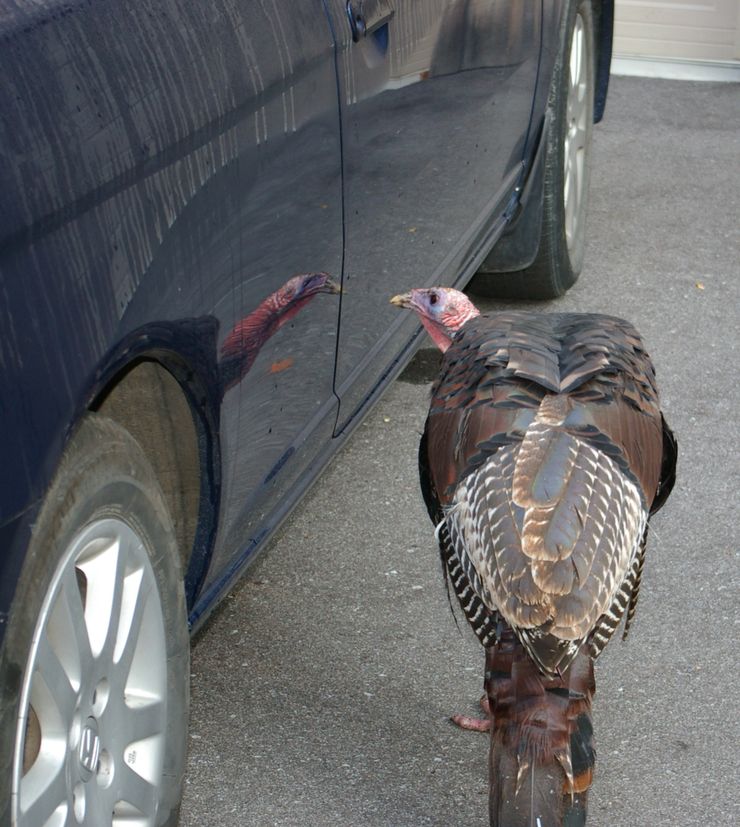
Wild turkey interacting with a low-speed vehicle in Eastern Ontario. Photo: L. Davidson
Wild turkeys were native to southern Ontario for thousands of years. Unregulated hunting and habitat clearing for agriculture drove them to extinction in the province by 1909 — the last native bird was spotted near Aurora, north of Toronto. Canadian Encyclopedia →
In 1984, the Ontario Ministry of Natural Resources launched one of the world’s most successful wildlife reintroduction programs. Ontario traded river otters to Missouri, moose to Michigan, and partridges to New York in exchange for 274 live-trapped wild turkeys. Between 1985 and 2005, another 4,400 turkeys were trapped and relocated to 275 locations across the province. Project Upland →
The Ontario Federation of Anglers and Hunters specifically identified the Trenton, Belleville, Kingston and Napanee corridor as a region of burgeoning turkey populations, opening new Wildlife Management Units for hunting there. OFAH 2002 → The Kingston–Napanee WMUs (69A, 65, 64B) now support robust populations with both spring and fall hunting seasons — generating recreation and tourism income for rural communities. This is exactly the territory through which Alto proposes the Southern Route.
Wild turkeys are not sparrows. They are North America’s largest ground-nesting bird — adult toms can stand 4 feet tall and weigh up to 14 kg (30 lbs). They are built for life on the ground: powerful legs for walking and running, short rounded wings for brief emergency flights, and a strong preference for foraging on foot across field edges and forest openings. Every aspect of turkey biology places them in the highest-risk category for HSR collision.
Wild turkeys are present along both the proposed Northern and Southern corridors. However, population density, habitat quality, and management status differ dramatically between the two routes.
Southern Corridor (Kingston–Belleville–Napanee)
Population: High-density established populations. WMUs 65, 64B, 69A, 72 all support spring and fall hunting seasons — fall seasons are only approved when spring harvests exceed 200 birds per WMU for three consecutive years.
Landscape: Prime turkey habitat — the Napanee Plain is a rich agricultural/forest mosaic with abundant field edges, hedgerows, and woodlots. Exactly the landscape type associated with highest HSR bird collision rates in Spanish research.
Trend: Stable, high-density populations with expanding recreational hunting economy.
Northern Corridor (Parry Sound–Sudbury–North Bay)
Population: Spotty, lower-density, expanding populations. WMUs 42, 47, 49, and 50 only received spring turkey hunting seasons in 2014. No fall seasons approved, indicating populations below the 200-bird harvest threshold.
Landscape: Transitional boreal/mixed forest with less agricultural mosaic. Snow depth and cold temperatures limit turkey populations.
Trend: Expanding northward, but near the climatic limit of the species. More fragile and susceptible to severe winter mortality events.
What the science says about northern limits. Trent University PhD candidate Jennifer Baici found that the strongest predictors of turkey presence were building density and snow depth/temperature. There are documented cases of turkeys freezing to death from frostbite in northern Ontario. Project Upland → The MNRF considers turkeys near their northern tolerance limit in WMU 42 and above. The Ontario Wild Turkey Management Plan explicitly notes that hen harvest has a greater impact on populations in northern areas where winter mortality is higher — meaning northern populations are more vulnerable to additional mortality sources, but far less dense. The Southern Route would affect the heartland of Ontario’s turkey recovery.
Almost everything we know about bird-HSR collisions comes from a single country: Spain. The LIFE Impacto Cero project (2013–2019) and associated research by the Autonomous University of Madrid represent the world’s only systematic studies of this problem. No North American HSR bird collision study has ever been conducted. LIFE Impacto Cero →
The Spanish research found that HSR bird mortality is not random. Specific infrastructure features and landscape contexts create predictable collision hotspots. The highest-risk conditions are tall embankments through open agricultural land with nearby water features and woodland — precisely the landscape of the Napanee Plain between Kingston and Belleville. García de la Morena et al. 2025 →
Critically, over 40% of birds detected from train cockpit cameras were already on infrastructure elements — resting on embankments, foraging along the track bed, perching on catenary poles. Spain does not have wild turkeys. No country with HSR has wild turkeys. Nobody has ever studied what a 14 kg ground-foraging bird attracted to railway ballast does when 300 km/h trains arrive.
The instinctive response to wildlife-rail collision risk is: “fence it.” All HSR lines are fenced for human safety and to exclude large mammals like deer and moose. But fencing is irrelevant to wild turkeys, and the only purpose-built bird barriers ever tested had limited effectiveness even for species they were designed for.
Standard HSR Security Fencing
2-metre chain-link designed for human safety and large-mammal exclusion.
Why it fails: Wild turkeys fly at speeds up to 90 km/h and routinely clear fences, barn rooftops, and power poles up to 30–40 feet high. Even domestic heritage turkeys easily breach 6-foot fences. BirdFact → A security fence is not a barrier for a wild turkey. It is a perching spot.
Anti-Bird Collision Barriers (Spain)
4–5 metre tubular screens designed to force birds to fly higher above trains.
Why they fail for turkeys: Spain’s barriers reduced mortality by about 30% for small and medium birds flying across the tracks. They do nothing for birds on the tracks — foraging in ballast, dust-bathing, or resting. The entire concept addresses crossing behaviour, not occupation behaviour.
The Fundamental Problem: Turkeys Don’t Just Cross — They Occupy. Barriers and fencing are designed for birds that fly across a corridor. Wild turkeys would be attracted into the fenced corridor: foraging for grit in ballast, dust-bathing in dry crushed stone, feeding on insects and seeds along cleared embankment edges. A fence that keeps deer out keeps turkeys in. Once they fly over to forage, they’re inside the danger zone with nowhere to go.
Acoustic Deterrents
Bio-acoustic emitters can deter some bird species, but their effectiveness declines after 3–6 weeks without being moved frequently. Turkeys are intelligent, highly adaptable birds with excellent learning capacity. They habituate rapidly to static or predictable deterrents — urban turkeys already ignore traffic, sirens, and propane cannons. Great Ecology →
Speed Reduction in Sensitive Areas
Reducing train speed through Important Bird Areas reduces collision force and gives birds more escape time. But it directly undermines the core purpose of high-speed rail. The Southern Route traverses turkey habitat for roughly 150 km of the Kingston–Belleville–Napanee corridor. Speed reduction across this distance would negate HSR’s competitive advantage over conventional rail or driving.
Slab Track (Eliminating Ballast)
Slab track instead of ballasted track would remove the grit attraction. However, it does not address embankment foraging, dust-bathing on dry surfaces, insect feeding along cleared edges, or the fundamental problem of a heavy ground bird’s inability to evade a 300 km/h train. Slab track also costs significantly more and has its own maintenance challenges in cold climates.
Bird-train collisions are not only an ecological concern. A 14 kg wild turkey striking a train at 300 km/h delivers enormous kinetic energy — energy that must be absorbed by the train’s nose cone, windshield, or undercarriage.
A 14 kg turkey at 300 km/h delivers approximately 48,600 joules — equivalent to roughly 35,860 foot-pounds of force. Aircraft windshields are certified to withstand impacts from a 1.8 kg (4 lb) bird. A wild turkey tom is nearly eight times heavier than the certification standard. Transport Canada →
The Spanish HSR researchers explicitly flagged this operational dimension, noting that the possibility of collision with large birds is not insignificant, given the potential cost of stopping the trains and repairing the damage. García de la Morena et al. 2017 →
- Windshield damage: HSR cab windshields are not certified against 14 kg impacts at 300 km/h. A cracked or shattered cab windshield forces an immediate stop and train withdrawal from service.
- Nose cone and sensor damage: Modern HSR trains carry forward-facing radar, signalling receivers, and aerodynamic fairings in the nose assembly. A 14 kg bird impact could damage these systems, impairing train control and requiring depot inspection.
- Undercarriage damage: A turkey flock on the ballast between the rails could result in simultaneous strikes to brake systems, bogies, and electrical equipment.
- Service disruption cascade: Each withdrawal affects every subsequent departure. With collision rates of 60–91 birds/km/year documented in Spain for much smaller species, the operational impact on a 150 km section through dense turkey habitat could be significant.
The Flock Problem. Wild turkeys travel in flocks of 6 to 50 birds. A flock of turkeys on or near the tracks presents the possibility of multiple simultaneous strikes — the rail equivalent of the “flock strike” that aviation considers the most dangerous bird collision scenario. The 2009 “Miracle on the Hudson” crash resulted from a Canada goose flock strike on both engines. A flock of turkeys — each bird weighing 5–14 kg — striking an HSR train nose at 300 km/h is a scenario for which no train has been designed or tested.
Alto must answer: What are the windshield and nose cone impact certifications for the proposed rolling stock? Have they been tested against 14 kg bird strikes at 300 km/h? What is the service disruption protocol when a bird strike requires inspection? What are the projected annual costs of bird-strike-related maintenance and delays through 150 km of dense turkey habitat?
Even if fencing could exclude turkeys (it cannot), it would create a continuous barrier across the landscape. The Frontenac Arch is already a geographically narrow wildlife corridor — the only land bridge connecting the Canadian Shield to the Adirondack Mountains. A continuous fenced HSR corridor across this landscape would fragment habitat for ground-dwelling species that cannot fly over it: turtles, snakes, amphibians, and small mammals already under pressure from existing road and rail infrastructure.
Turkey hens with poults (chicks) are ground-bound for the first 4–5 weeks after hatching — poults cannot fly until their wing feathers develop. A fenced corridor during nesting season would sever turkey brood-rearing routes between nesting cover and foraging areas, functionally fragmenting the population during its most vulnerable period.
| Risk Factor | Condition on Southern Route | Evidence | Risk Level |
|---|---|---|---|
| Turkey population density | ~100,000 turkeys in eastern/southern Ontario; corridor identified as prime habitat with expanding populations | OFAH, MNRF, Canadian Geographic | VERY HIGH |
| Landscape type | Mixed agricultural/forest mosaic — exactly the landscape type associated with highest HSR bird collision rates in Spain | Malo et al. 2017; García de la Morena et al. 2025 | VERY HIGH |
| Embankment profile | Napanee Plain is flat terrain; HSR would require elevated embankments, which Spanish research identifies as highest-risk configuration | García de la Morena et al. 2025 | VERY HIGH |
| Ballast grit attraction | Crushed angular stone in ballasted track is functionally identical to commercial “turkey grit” — an attractive nuisance for all gallinaceous birds | Turkey biology; no HSR-specific study exists | HIGH |
| Fencing effectiveness | Standard HSR fencing cannot exclude turkeys; birds fly over 2m fences routinely; anti-bird barriers untested for ground-foraging species | LIFE Impacto Cero; avian flight literature | VERY HIGH |
| Evasion capability | Turkeys are heavy (up to 14 kg), need running start for liftoff, have 1.6 seconds to react at 300 km/h; poor night vision | DeVault et al. 2015; turkey biology | VERY HIGH |
| Existing collision data | No North American HSR bird collision research exists; no study of gallinaceous bird–HSR interactions anywhere; risk entirely unquantified | Literature review | UNKNOWN |
| Population resilience | Turkeys are sensitive to hen survival; severe winters can decimate localized populations; additional chronic mortality is additive | Ontario Wild Turkey Management Plan 2007 | HIGH |
| Train damage risk | 14 kg bird at 300 km/h delivers ~48,600 joules; 7.8× heavier than aviation windshield cert standard; flock strikes compound the problem | Transport Canada physics; aviation cert standards | VERY HIGH |
| Service disruption | Each strike requiring inspection removes trainset from service; 60–91 birds/km/yr mortality documented for smaller species; flock strikes possible | García de la Morena et al. 2017; Renfe | HIGH |
Wild turkeys are not just an ecological asset. Ontario’s Wild Turkey Management Plan explicitly identifies them as important for the “continued social, cultural and economic benefit of the people of Ontario.” MNRF 2007 →
Spring and fall turkey seasons support hunting outfitters, rural accommodations, equipment retailers, and local restaurants across the Kingston–Belleville–Napanee corridor. The turkey reintroduction program was funded primarily by conservation groups and volunteer effort — $100,000 of the $120,000 total came from hunters and conservation organizations, not government. Project Upland →
The Spanish LIFE Impacto Cero project found that HSR collisions were causing populations of certain bird species to decrease and become increasingly isolated, including species in protected areas. Any population-level impact on turkeys in the corridor would affect a recreation economy built on four decades of community-funded conservation investment.
Conduct a Bird Collision Risk Assessment Before Route Selection
No HSR bird collision study has ever been conducted in North America. Alto must commission pre-construction baseline surveys of bird populations along all proposed corridor options. Bird collision risk should be a route-selection criterion, not an afterthought.
Fund North America’s First HSR Bird Collision Research
The Spanish methodology — cockpit-mounted cameras and GPS — should be adapted for Canadian conditions. Alto should fund a multi-year pilot study using existing conventional rail corridors through turkey habitat to establish baseline collision rates for North American gallinaceous birds before HSR construction begins.
Evaluate Slab Track Through Turkey Habitat
If the Southern Route proceeds, slab track (rather than ballasted track) should be mandatory through areas of high turkey density to eliminate the grit attraction. This does not eliminate collision risk but removes a known attractant.
Design Species-Specific Mitigation, Not Generic “Bird Barriers”
Spanish anti-bird barriers were designed for flying-across species in Mediterranean landscapes. Any mitigation for Eastern Ontario must be designed for ground-foraging gallinaceous birds in a cold-climate agricultural mosaic — a completely different problem.
Require Legally Binding Monitoring and Adaptive Management
If constructed, Alto must be required to implement continuous bird mortality monitoring using on-board camera systems, with publicly reported annual data. Adaptive management triggers should require operational changes (speed reduction, seasonal scheduling) automatically if mortality exceeds thresholds.
Consult MNRF, OFAH, and the Hunting Community
Ontario’s wild turkey recovery was driven by the hunting and conservation community. The MNRF, OFAH, National Wild Turkey Federation, and local hunting clubs and outfitters in affected WMUs must be formally consulted on corridor selection, construction timing, and operational mitigation.
Assess Cumulative Impacts on the 40-Year Recovery Investment
Wild turkeys are not a species at risk — they are a conservation success story. But the population remains at the northern edge of its range and is sensitive to winter mortality events. The Environmental Assessment must quantify the risk that HSR collision mortality, combined with habitat fragmentation, could degrade the population in the corridor and undermine four decades of public conservation investment.
- [1] The Canadian Encyclopedia. Wild Turkeys in Canada. thecanadianencyclopedia.ca
- [2] Project Upland. Wild Turkeys in Ontario: Conservation History, Reintroduction, and Hunting. projectupland.com
- [3] OFAH (2002). Turkey population soars – new hunting options in eastern Ontario. ofah.org
- [4] Ontario MNRF (2007). Wild Turkey Management Plan for Ontario. ontario.ca
- [5] Wikipedia. Wild turkey. wikipedia.org
- [6] WDFW. Wild turkey. wdfw.wa.gov
- [7] García de la Morena, E.L. et al. (2017). “On-Board Video Recording Unravels Bird Behavior and Mortality Produced by High-Speed Trains.” Frontiers in Ecology and Evolution 5:117. frontiersin.org
- [8] García de la Morena, E.L. et al. (2025). “Infrastructure profile and surrounding land use determine bird-train collision risk in a High-Speed Railway.” Global Ecology and Conservation. sciencedirect.com
- [9] EC LIFE Programme. LIFE Impacto Cero: Anti-bird strike tubular screen for HSR. LIFE12 BIO/ES/000660. ec.europa.eu
- [10] Malo, J.E. et al. (2017). “Cross-scale Changes in Bird Behavior Around a High Speed Railway.” In: Railway Ecology, Springer. springer.com
- [11] BirdFact. Can Wild Turkeys Fly? birdfact.com
- [13] Rivas-García, S. et al. (2023). “Bird flight behavior, collision risk and mitigation options at high-speed railway viaducts.” Science of the Total Environment. sciencedirect.com
- [14] Great Ecology (2013). High Speed Railways and Bird Mortality. greatecology.com
- [15] Barrientos, R. et al. (2017). “Railways as Barriers for Wildlife.” In: Railway Ecology, Springer. springer.com
- [28] Transport Canada. Bird Impact Forces: The Physics. tc.canada.ca
L. Davidson · ALTO HSR Citizen Research · March 2026