Don’t Build Tomorrow’s Cleanup Problem Today
The case for a No EPS/XPS standard in the ALTO rail corridor
ALTO has not published construction material specifications. The April 24, 2026 consultation deadline closes before Canadians know how much expanded or extruded polystyrene foam may be buried in their watersheds. We are being asked to comment on environmental risk we cannot see.
Ontario’s Bill 228 formally established that expanded and extruded polystyrene — EPS and XPS — are waterway pollutants requiring legislative control. The ALTO corridor would introduce these same materials in industrial quantities into the hydrological catchments Bill 228 was designed to protect.
Ontario passed a law to keep polystyrene out of its lakes and rivers. The ALTO corridor must be held to the same standard — not a lower one.
EPS and XPS in railway construction
Expanded Polystyrene (EPS) and Extruded Polystyrene (XPS) are petroleum-derived foam plastics used extensively in transportation infrastructure. In cold-climate railway construction, their applications are structural and widespread — not incidental.
EPS Geofoam — embankment fill
Lightweight fill in frost-susceptible, soft, or load-sensitive terrain. Standard practice on routes crossing glacial till, peat, compressible soils, and LEDA clay — precisely the substrate conditions encountered in the ALTO routes through Eastern Ontario and the Ottawa and St Lawrence Valleys.
XPS Frost Protection Board
Placed beneath track subgrade to prevent frost penetration and differential heave. Used at culverts, grade crossings, and bridge approaches — locations immediately adjacent to watercourses.
EPS Void Fill
Used in culvert reconstruction, abutment backfill, and retaining wall drainage layers. Placed in direct contact with groundwater flows in many applications.
Environmental risk pathways in wetland and riparian zones
The muskrat fragmentation vector

The muskrat (Ondatra zibethicus) is the primary wildlife mechanism for polystyrene dispersal in Ontario’s freshwater systems — a fact confirmed in the legislative record of Bill 228 and by Georgian Bay Forever’s scientific research program. Muskrats chew EPS for nest-building material, mistaking the texture for cattail pith. A single animal can destroy a standard dock billet in one season, scattering beads and fragments across lake edges and wetland margins.
This fragmentation vector does not distinguish between dock foam and construction foam. Any unencapsulated EPS within reach of riparian muskrat populations — embankment slopes, culvert outfalls, drainage swales — is subject to the same mechanical dispersal. The ALTO corridor would create hundreds of kilometres of new EPS-bearing infrastructure at exactly the water’s-edge locations that muskrats inhabit.
Spring dispersal is the critical window: muskrat activity peaks in March–May during ice-out, breeding season, and lodge repair — precisely when waterfowl are nesting and amphibians are breeding.
Microplastic generation
EPS and XPS degrade to microplastics (<5 mm) and nanoplastics (<1 µm) through four pathways operating simultaneously in wetland-edge railway environments:
- UV photodegradation — surface yellowing, embrittlement, and bead release; accelerated at exposed embankment faces
- Freeze-thaw cycling — repeated ice formation within the bead matrix disrupts structural cohesion; particularly aggressive in the limestone plain climate regime
- Mechanical abrasion — wave action, ice scour, and maintenance vehicle traffic at culvert and drainage locations
- Biological fragmentation — muskrats, beavers, and burrowing rodents (see 2.1 above)
Freshwater microplastic concentrations are now documented in virtually every Canadian Shield lake system studied. Polystyrene is consistently among the dominant polymer types in nearshore zones. Construction-phase EPS and XPS would add a concentrated, point-source contribution to catchments that receive diffuse microplastic loading from existing dock foam stocks — precisely the problem Bill 228 was designed to reduce.
Human health consequences
The microplastic particles generated by EPS and XPS degradation are not a passive pollutant. The human health evidence has matured substantially since 2023 and now constitutes a direct public health argument against placing unencapsulated polystyrene in freshwater-proximate infrastructure serving communities that depend on private wells and local food sources.
Cardiovascular mortality — New England Journal of Medicine, 2024
Marfella et al. examined carotid artery plaque from 304 patients. Those in whom microplastics and nanoplastics were detected within the plaque faced a 4.53-fold higher risk of myocardial infarction, stroke, or all-cause death at 34 months (HR 4.53; 95% CI 2.00–10.27; p<0.001). In an accompanying editorial, Professor Philip Landrigan of Boston College described the association as “strongly suggestive of causality” and noted that a hazard ratio of 4.5 is “large and alarming.”
Brain accumulation and dementia — Nature Medicine and Science Advances, 2025
Microplastic and nanoplastic concentrations in human brain tissue increased significantly between 2016 and 2024 samples (p=0.01). Brains of individuals with dementia diagnoses showed markedly higher accumulation, with deposition in cerebrovascular walls and immune cells. A parallel study found that microplastics in the bloodstream can induce cerebral thrombosis and neurobehavioural abnormalities. Ontario spends approximately $5.5 billion per year on dementia care.
Reproductive harm
A 2024 systematic review in Environmental Science & Technology rated evidence quality as “high” and concluded microplastic exposure is “suspected” to adversely impact sperm quality and digestive immune function. Microplastics smaller than 10 µm have been confirmed to penetrate the placental barrier.
Styrene: IARC Group 2A
In 2019, IARC upgraded styrene from Group 2B to Group 2A — probably carcinogenic to humans — based on evidence of lymphohaematopoietic malignancies and “strong evidence” of genotoxicity in human cells. The karst hydrology of the Napanee Limestone Plain provides a fast-transport pathway from corridor drainage to residential wells.
Ontario healthcare budget: the 50-year cost baseline
Trasande et al. (2024, Journal of the Endocrine Society) estimated plastic-associated chemical disease burden in the United States at US$249 billion per year (1.22% of GDP) — acknowledged to be an underestimate. A proportional per-capita extrapolation to Ontario yields a baseline plastic-attributable health cost of approximately $11 billion per year. Over a 50-year infrastructure horizon, the ALTO corridor’s EPS and XPS emissions would represent an incremental, compounding addition to that baseline. This cost is entirely absent from ALTO’s published financial estimates.
Chemical contamination
EPS and XPS are not chemically inert. They leach:
- Styrene monomer — residual unreacted monomer; aquatic toxicity documented; IARC Group 2A (probably carcinogenic to humans); endocrine-disrupting properties documented
- HBCD (Hexabromocyclododecane) — flame retardant used in XPS until ~2015–2016; listed under the Stockholm Convention as a Persistent Organic Pollutant and on Canada’s CEPA Schedule 1 Toxic Substances List; bioaccumulates in fish, waterfowl, and mammals; detected in Arctic wildlife far from source areas
- Polymeric FR (PolyFR / FR-122P) — the HBCD replacement used in foam manufactured post-2016; environmental fate and bioaccumulation potential remain incompletely characterised
Polystyrene particles also function as sorption vectors for legacy hydrophobic contaminants — PCBs, PAHs, pesticides — concentrating them at levels orders of magnitude above ambient water. This “Trojan horse” mechanism operates independently of the foam’s own chemical leachate.
Wetland-specific risk amplification
Wetlands are disproportionately vulnerable to polystyrene contamination for structural reasons that compound all of the above pathways:
- Low flushing rate — particles accumulate rather than disperse
- Organic-rich sediments — microplastics bind to organic flocs and settle, creating permanent sediment reservoirs
- High wildlife density — waterfowl, amphibians, turtles, and muskrats all concentrate in wetland habitat
- Freeze-thaw dynamics — ice physically embeds EPS beads into shoreline substrate; spring melt releases them in concentrated pulses
- Karst groundwater connectivity — the Napanee Limestone Plain alvar pools have direct hydrological connection to aquifer recharge zones; microplastics and leachates can enter drinking water aquifers
SARA-listed species at specific risk
Eastern Loggerhead Shrike — Endangered
Fewer than 40 wild individuals. Napanee is one of two remaining Canadian breeding sites. Forages over wetland and alvar margins where contaminated invertebrate prey would concentrate.
Little Brown Myotis, Northern Myotis, Tri-colored Bat — Endangered
Drink by skimming water surfaces; ingest surface-floating microplastics directly. Hibernaculum at Moira Karst is within the corridor study zone.
Grey Ratsnake — Threatened
Wetland-edge forager; prey including frogs and small mammals carry polystyrene-associated contaminants up the food chain.
Blanding’s Turtle — Endangered
Wetland obligate; documented to ingest floating plastic debris. Long-lived species with slow reproductive rate means population-level harm accumulates across decades.
Bill 228 and the provincial legislative standard
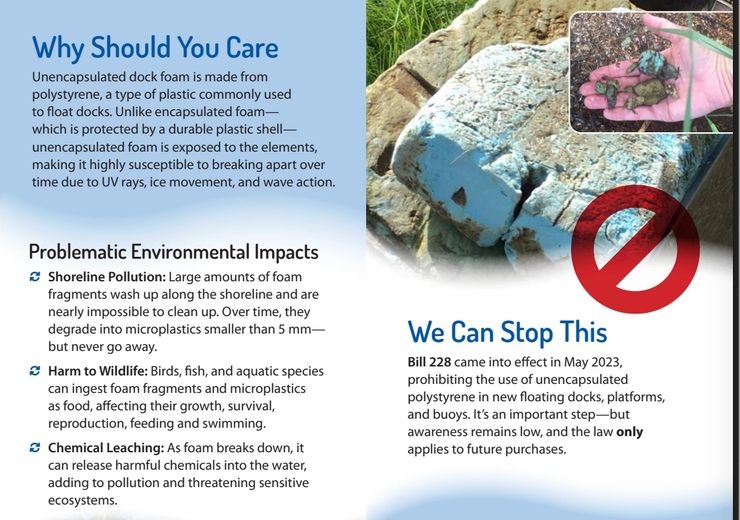
Ontario’s Keeping Polystyrene Out of Ontario’s Lakes and Rivers Act, 2021 (Bill 228) is not merely a policy signal — it is binding statute, in force since May 2023. The Act requires that any person who sells, offers to sell, constructs, or reconstructs a floating dock, floating platform or buoy must ensure that any expanded or extruded polystyrene is fully encapsulated. The statute applies to both EPS and XPS. It passed unanimously — supported by all parties.
“In 2019, volunteers with Georgian Bay Forever conducting a cleanup of the Georgian Bay shoreline in Parry Sound collected an estimated 5,000 pieces of dock foam — far more than any other kind of litter.”
The critical legislative gap
Bill 228 applies to dock floats. It does not apply to construction-grade EPS geofoam, XPS frost-protection board, or EPS void fill used in railway embankments — even when those embankments are placed within metres of the same lakes and rivers the Act was designed to protect. This is not a principled distinction. It is a scope limitation in a private member’s bill focused on the residential dock market. The ALTO Environmental Impact Assessment process is the first opportunity to close that gap for large-scale infrastructure.
The 100-year contamination timeline
Railway infrastructure has a design life of 75–100+ years. EPS and XPS embedded in that infrastructure create an open-ended contamination obligation. Unlike a dock float, a railway embankment cannot be hauled out of the water and replaced.
| Phase | Risk profile |
|---|---|
| Construction (Yrs 0–5) | Largest single polystyrene input event. EPS offcuts, packaging waste, and damaged geofoam sections enter drainage during earthworks. No equivalent of dock float inspection applies. |
| Early operation (Yrs 1–20) | Foam largely intact beneath protective layers. Subsurface styrene monomer and HBCD leaching begins immediately, especially in karst terrain where groundwater travel times are short. Culvert-face XPS exposed to UV and freeze-thaw. |
| Mid-life (Yrs 20–50) | UV embrittlement and burrowing wildlife fragment exposed foam at culvert outfalls, slope faces, and drainage structures. Microplastic pulse enters adjacent wetlands. First detection likely in sediment cores. |
| Late infrastructure (Yrs 50–75) | Karst subsidence events — a documented risk on the Napanee Limestone Plain — can expose previously buried geofoam, releasing large volumes into surface and subsurface drainage. Remediation requires partial embankment reconstruction. |
| End of life / rebuild (Yrs 75–100+) | Corridor reconstruction requires excavation and disposal of contaminated geofoam. Material cannot be recycled, cannot be composted, and will persist in landfill for centuries. Any material not recovered has already entered the watershed permanently. Cleanup cost passes to future governments and taxpayers. |
What we are asking for
The ALTO HSR Citizen Research Initiative calls for a No EPS/XPS standard as a precondition of Environmental Impact Assessment approval for any ALTO corridor route passing through provincially significant wetlands, SARA critical habitat zones, or karst terrain.
Commit to a polystyrene-free design standard
For all corridor segments within 500 metres of provincially significant wetlands, SARA critical habitat, karst terrain, and designated water supply watersheds. Alternative materials — recycled aggregate fill, cellular concrete, expanded clay aggregate (LECA), air-entrained concrete void fill — are available, proven, and do not create century-scale contamination obligations.
Require a full polystyrene mass balance in the EIA
Total volume of EPS and XPS proposed, mapped by segment against adjacent watercourses, wetlands, and SARA critical habitat, with a quantified risk assessment for each fragmentation and leaching pathway described in Section 2 of this brief.
Extend the logic of Bill 228 to ALTO construction materials
Ontario has established by statute that polystyrene does not belong in its lakes and rivers. The federal Environmental Impact Assessment process must apply the same standard to large-scale infrastructure that provincial law applies to residential dock floats.
Establish a bonded 100-year environmental remediation fund
If EPS or XPS is used in any corridor segment, the fund must be sized to the full volume of polystyrene installed and indexed to the documented cost of embankment excavation and polystyrene disposal at current rates. This cost must not fall to future taxpayers.
Disclose all construction material specifications before April 24, 2026
Including geofoam type, volume, and placement locations. Canadians cannot provide informed comment on environmental risk they cannot see. Material disclosure must be a precondition of any consultation period.
Require wildlife interaction monitoring
During construction and the first decade of operation, with specific protocols for muskrat activity at all EPS/XPS locations within 200 metres of watercourses and wetland boundaries.