ALTO Consultation:
Participant Experience Survey
What did affected residents actually experience during the ALTO public consultation? 354 respondents — more than 72% holding property within or immediately adjacent to the study corridor — documented their experiences across notification, information quality, map usability, session usefulness, and process integrity. Headline figures are drawn from the analytical sample after an objective data-integrity filter documented in the section on Data Integrity.
Key Findings by Question
Results from all structured survey questions, with analysis. Charts are reproduced directly from the SurveyMonkey data export. n varies slightly by question due to skipped responses.
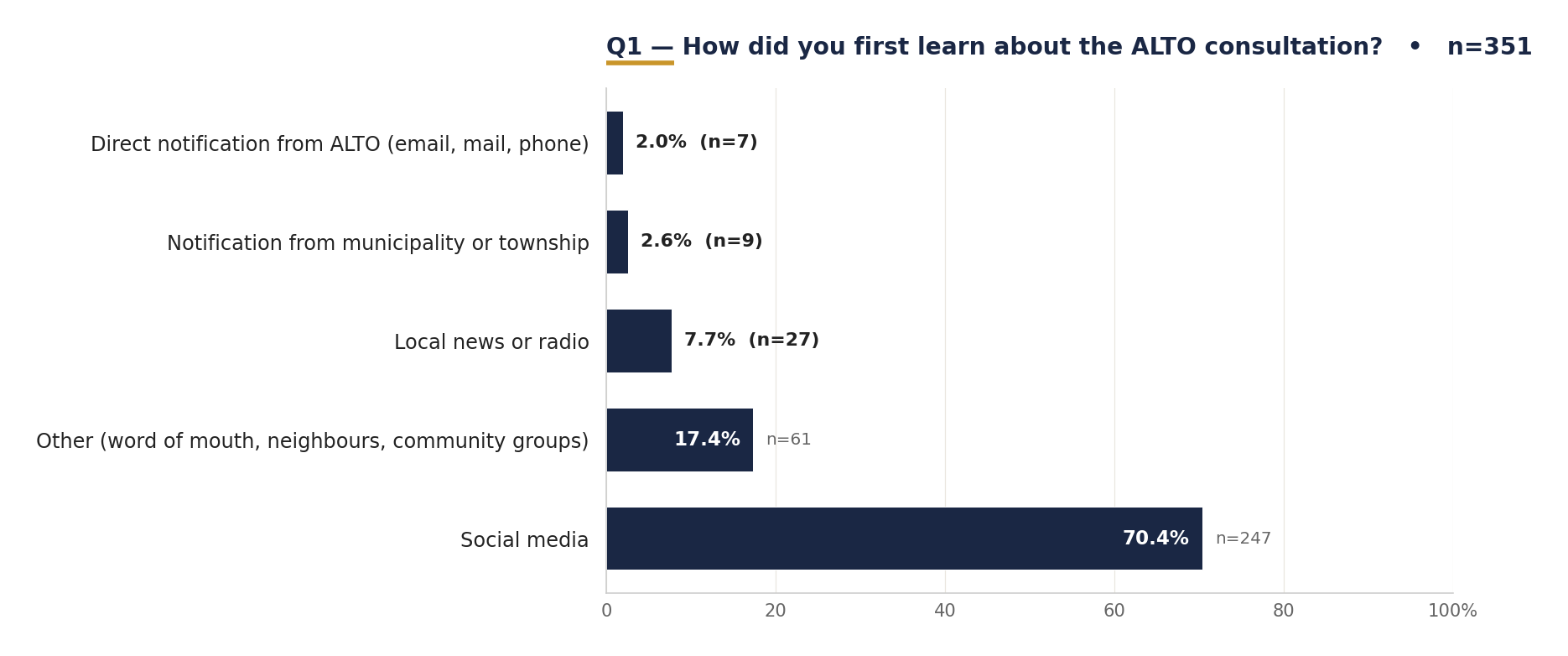
How did you first learn about the ALTO public consultation?
ALTO’s own notification channels — email, mail, and phone — reached just 7 of 351 respondents (2.0%) in the analytical sample. Social media accounted for approximately 73% of awareness, but the open-ended responses confirm this was driven almost entirely by citizen-created content: community Facebook groups, neighbours’ posts, and advocacy organizations such as Save South Frontenac. ALTO’s own social presence contributed negligibly.
A further 17% learned through “Other” channels — overwhelmingly neighbours, friends, flyers distributed by local groups, and communications from MPPs or township councillors. Only 2.3% were notified by their municipality.
This represents a structural notification failure: the reach of a major federally mandated consultation depended entirely on citizen self-organization rather than any direct outreach from the proponent.
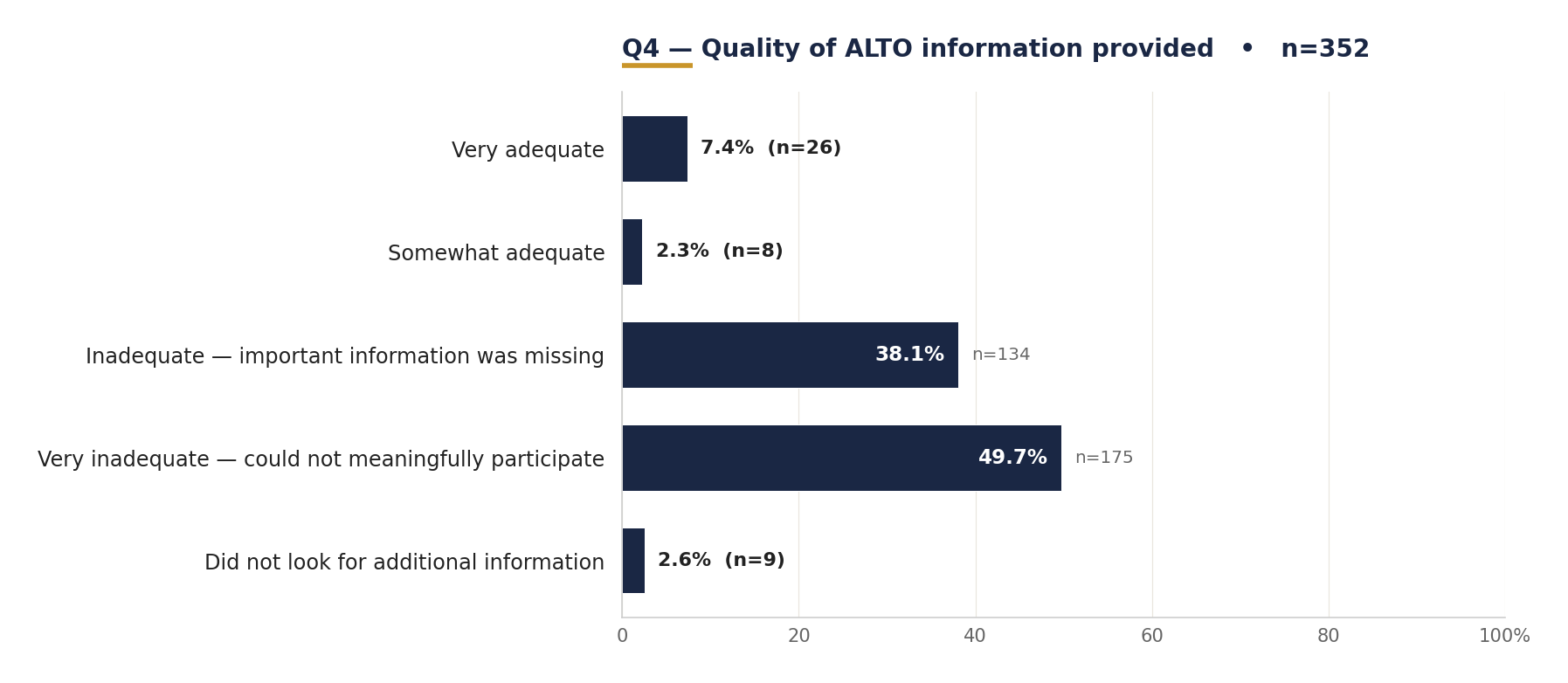
Rate the quality of information ALTO provided to help evaluate the two corridor options
Only 12 of 181 respondents — 6.6% — found the information provided adequate at any level. Of these, just 6 rated it “Very adequate.” The dominant rating was “Very inadequate — I did not have enough information to meaningfully participate,” at 54.1%.
Open-ended responses document what was absent: no business case, no net present value analysis, no environmental assessment, no geotechnical studies, no ridership methodology, and no meaningful cost comparison between corridor options.
This near-consensus result directly negates any ALTO claim that the consultation was information-sufficient. Participation without adequate information cannot constitute meaningful public engagement.
Failure to provide the public with enough information to be able to make informed comments. This consultation was a sham.
— Survey respondent, Q16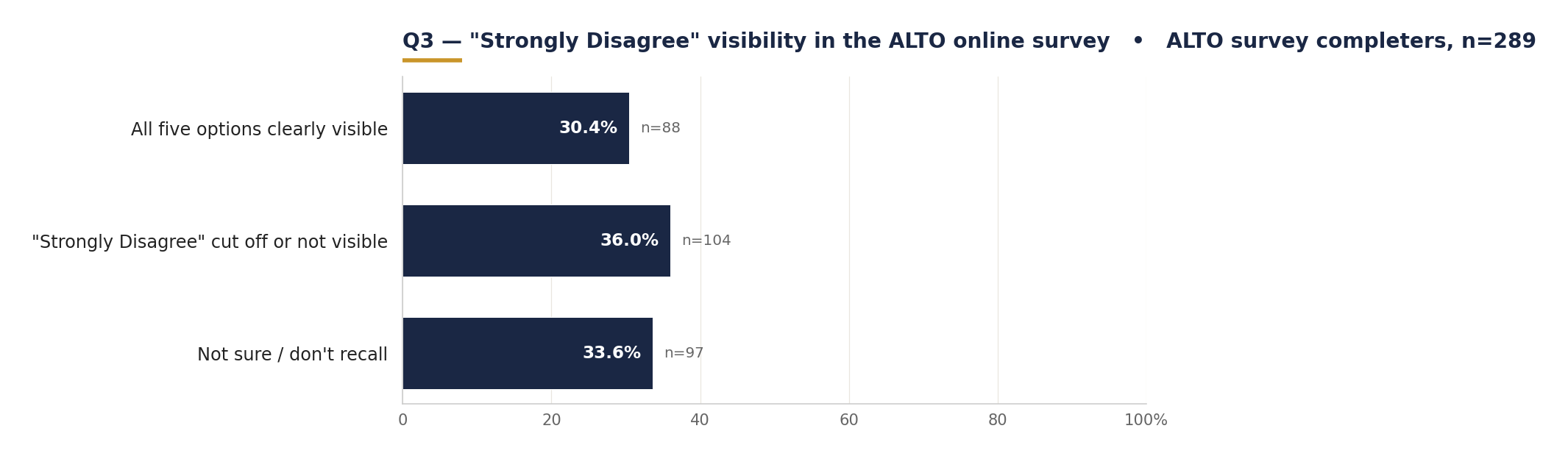
Did you have any problem seeing all 5 choices (including “Strongly Disagree”) in the ALTO online survey?
Among the 202 respondents who completed the ALTO online survey, 36.1% experienced a truncated response scale — “Strongly Disagree” was cut off or not visible. This is the single largest definitive response category among completers.
If the “not sure/don’t recall” group is further excluded, leaving only those with clear recall (n=104), the split becomes 46.2% suppressed vs. 53.8% all visible — essentially even.
A response option that cannot be seen cannot be selected. The systematic suppression of the “Strongly Disagree” option introduces a directional bias toward apparent support in ALTO’s own survey data, compromising the integrity of any quantitative results ALTO reports from that instrument.
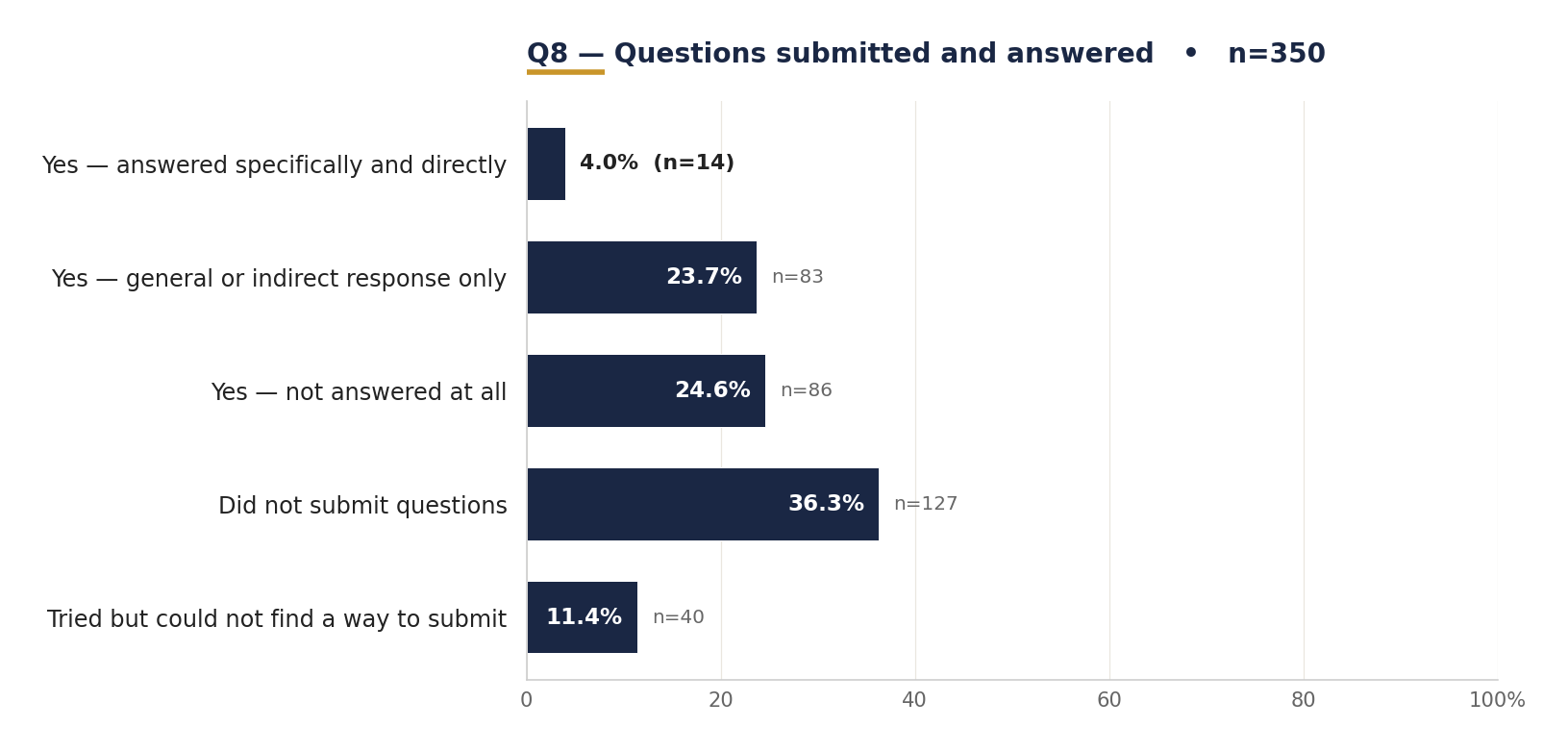
Did you submit questions to ALTO, and were they answered?
Of 127 respondents who actually submitted questions, only 4 (3.1%) received answers that were specific and direct. A further 51.2% received only a general or indirect response, and 45.7% received no substantive response at all. An additional respondents tried but could not find a mechanism to submit questions.
Open-ended responses document a pattern of scripted, contradictory responses: staff gave different answers to the same question, deferred to “we don’t know yet,” or failed to follow up on commitments made at sessions.
One respondent submitted a question about the criteria used to evaluate consortium proposals, was told someone would follow up — and had heard nothing after one month at the time of the survey.
The staff at the open house had no answers to any of our questions. They asked for our input, but didn’t write anything down, so were unlikely intending to relay any of our concerns.
— Survey respondent, Q16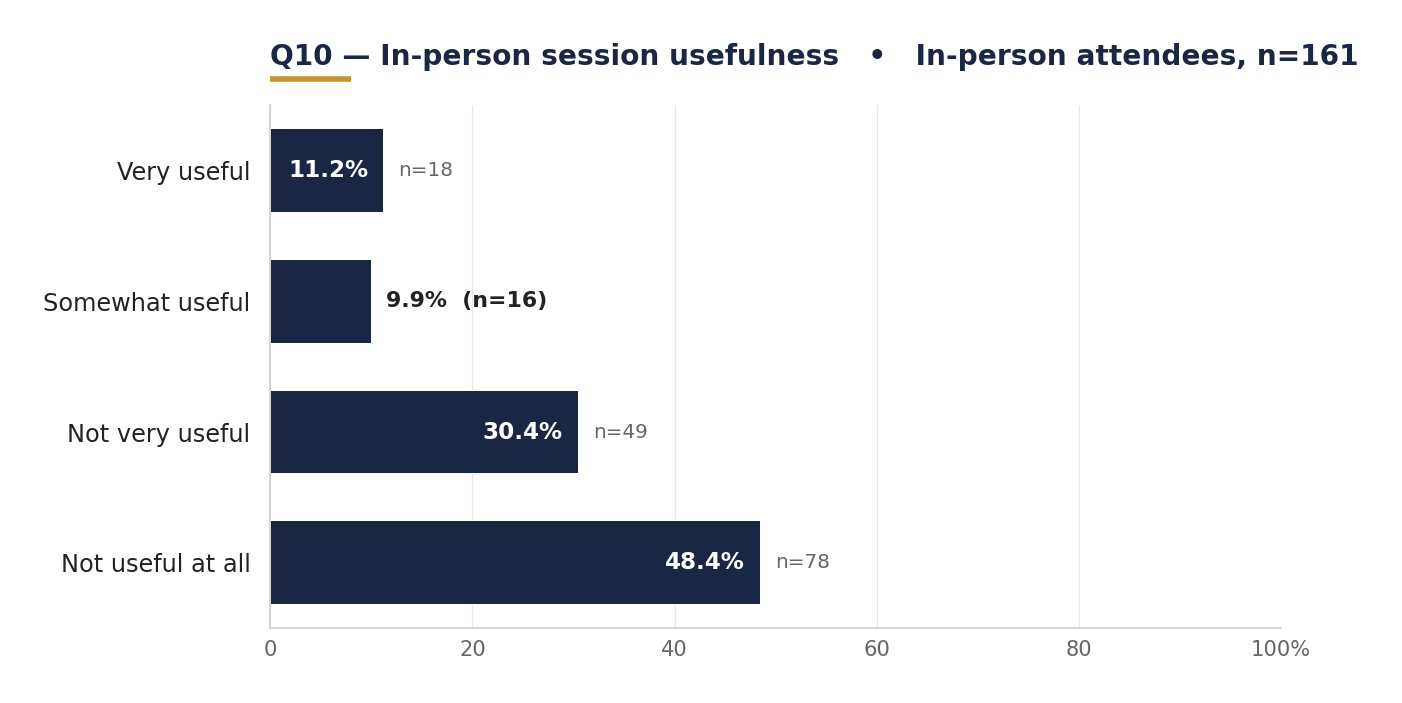
How useful were the in-person and virtual sessions in helping you understand the project?
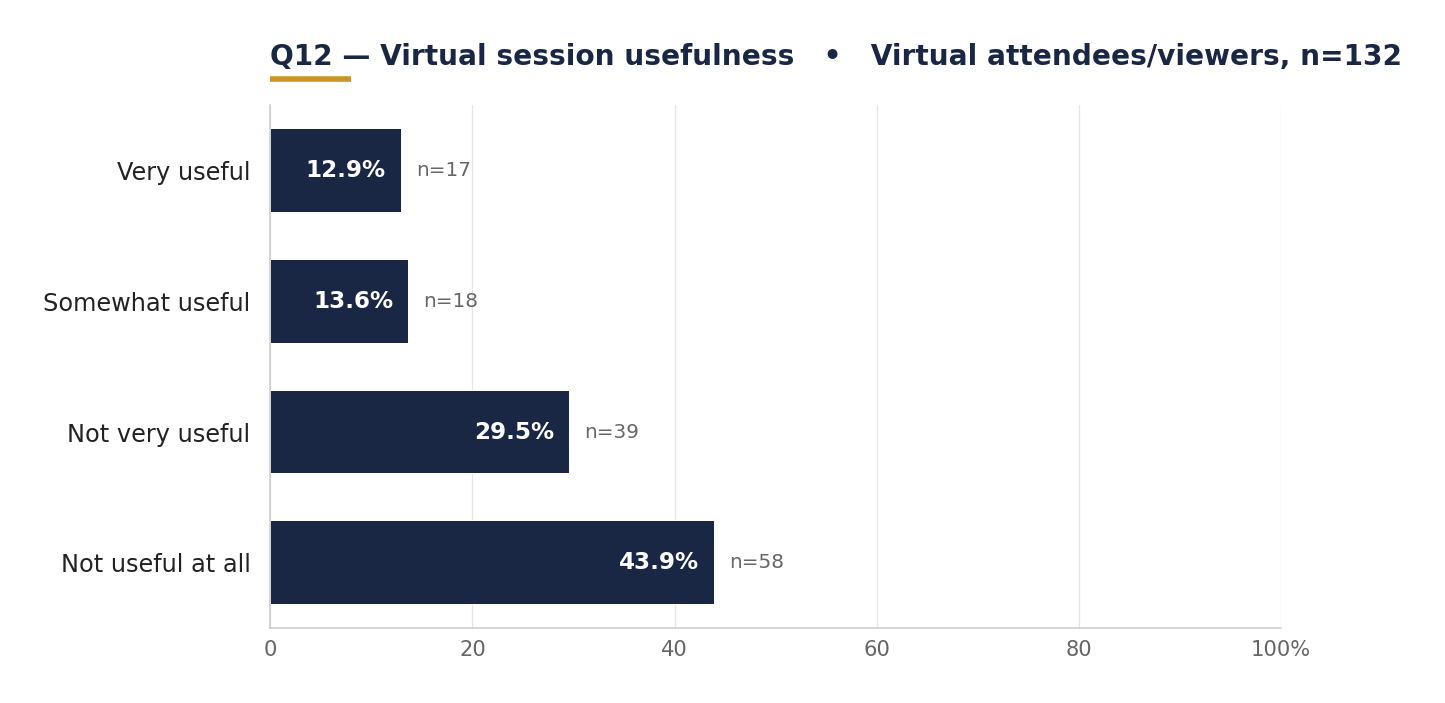
Restricting to those who actually attended or watched each format: 83.5% of in-person attendees (n=110) rated those sessions not very useful or not useful at all; 75.5% of virtual attendees and viewers (n=95) gave equivalent ratings. Both results are strongly negative, though the in-person sessions rated notably worse.
Of note: the 60 non-attendees who nonetheless answered Q10 rated in-person sessions 96.7% negative, and the 65 non-virtual-viewers who answered Q12 rated them 98.5% negative — indicating that those excluded from the process were even more dissatisfied than those who participated.
Structural deficiencies identified in open-ended responses include: an information-fair format that prevented shared Q&A; absence of note-taking; absence of senior decision-makers and subject-matter experts; contradictory information from different representatives at the same events; and last-minute switches from in-person to virtual (the Tyendinaga township council meeting was cited specifically).
One respondent observed: “They sent young enthusiastic staff equipped with prepared marketing answers. They could not answer real questions. It was an insult to attendees and grossly unfair to their staff. The executives were cowards.”
Did the ALTO consultation process give your community a genuine opportunity to influence the route decision?
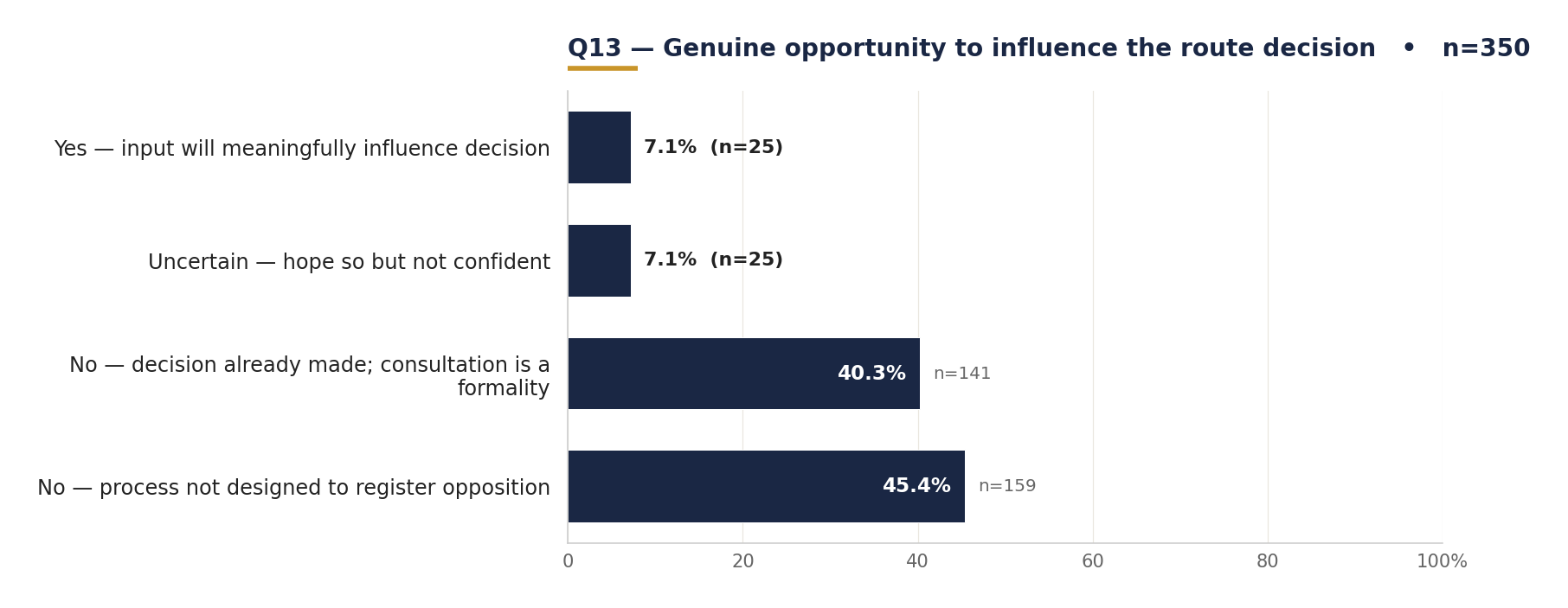
Only a small minority of respondents believe that community input will meaningfully influence the decision. 85.7% fall into the two negative categories — and critically, the larger group (45.4%) takes the stronger position: that the process was not designed to register opposition, rather than simply being inadequate or premature.
The phrase “tick a box” appeared verbatim in multiple independent open-ended responses across Q15 and Q16. Respondents described the process as a “PR exercise,” a “sales pitch,” and a “foregone conclusion,” with no note-taking, no plenary debate, and no pathway from community input to decision-making visible.
This legitimacy deficit is the most consequential single finding of the survey: a consultation in which 85.7% of directly affected residents do not believe their input will matter has failed the basic standard of meaningful public participation.
Consulting implies a two-way conversation. Alto did not meaningfully participate.
— Survey respondent, Q16Open-Ended Response Themes
Three questions invited open-ended responses. Coding was performed inductively; responses could contribute to multiple themes. Percentages are calculated against the number who answered each question.
Respondents described information they could not find on the official ALTO map. Themes document a systematic absence of the environmental and infrastructure data needed for the pin-placement feedback mechanism to function.
| Theme | n | % | Description |
|---|---|---|---|
| Wetlands & conservation areas absent | 28 | 27.2% | Wetlands, conservation authority boundaries, easements, ANSIs, protected areas not visible at any zoom level. |
| Road names disappear or missing | 26 | 25.2% | Local road names vanished on zoom, making it impossible to orient or place pins accurately. |
| Property and building features absent | 24 | 23.3% | No property lines, no structures, no farms, no residential buildings — the built environment was not shown. |
| Map became unusable when zoomed | 20 | 19.4% | Corridor shading disappeared and labels vanished when users zoomed in to locate their properties. |
| Waterways incomplete or absent | 22 | 21.4% | Local creeks, streams, and smaller water bodies were missing or only partially traced. |
| Grade crossing / road closure information absent | 18 | 17.5% | No indication of which roads would be closed, where crossings would occur, or areas becoming water-access only. |
| Map format / usability problems | 18 | 17.5% | Poor colour contrast, no satellite layer, geolocation disabled, password failures, inconsistent corridor display. |
| Pin placement unreliable | 14 | 13.6% | Without adequate landmarks, respondents could not place pins accurately — “stabbing in the dark.” |
| Frontenac Arch / UNESCO boundaries absent | 12 | 11.7% | The Frontenac Arch Biosphere Reserve, A2A corridor, and Rideau Canal UNESCO boundary were not shown. |
| Heritage / cemetery sites absent | 10 | 9.7% | Cemeteries, First Nations significant sites, historic hamlets, and cultural heritage features not shown. |
| Topographic / geotechnical data absent | 9 | 8.7% | No contour lines, elevation data, bedrock or soil information, hydro infrastructure, or fault lines. |
| Emergency and municipal services absent | 7 | 6.8% | Hospitals, fire stations, ambulance routes, schools, and municipal facilities were not shown. |
| Agricultural land not classified | 8 | 7.8% | Prime agricultural land designations were absent; farms were not labelled as such. |
Representative responses
Frontenac Arch Biosphere boundary; proposed over/underpass roads; roads slated to be closed; areas to be designated “water access only”; the Rideau Canal UNESCO World Heritage Site boundary; wetlands and geological formations inadequately identified, including watersheds and directions of drainage.
— Survey respondentThe map was just a blue smear across the landscape, but with zero context — as ALTO has said they have not done any studies on the proposed routes, so we have no idea of their plan and neither do they.
— Survey respondentThe ALTO people I spoke with did not even know how to locate my township (Rideau Lakes) in their corridor, let alone its cultural history as a community of interconnected pre-Confederation settlements.
— Survey respondentRespondents were asked for the single most significant positive feature of the consultation. The most common response, by a large margin, was that there was none. Where positives were identified, most were unintended outcomes of the process’s failures.
| Theme | n | % of 206 | Description |
|---|---|---|---|
| No positive feature identified | 73 | 35.4% | “None,” “Nothing,” “There were none” — the single most common response category by a wide margin. |
| Process galvanized community opposition | 18 | 8.7% | The consultation’s failures united rural communities and strengthened organized opposition — an unintended positive. |
| Illustrated ALTO’s lack of preparedness | 9 | 4.4% | The process revealed how little ALTO knew, which respondents viewed as useful evidence for opposition purposes. |
| Staff were polite | 14 | 6.8% | Frontline ALTO staff were personally friendly, even if unable to provide substantive information. |
| Awareness of the project at all | 11 | 2.9% | Learning about ALTO through the process, however inadequate, was cited as a marginal positive by some. |
| Map / pin functionality in principle | 8 | 5.3% | The pin-placement mechanism was identified as useful in concept, even where execution was criticised. |
| Community networking | 6 | 3.9% | Meeting neighbours and other affected residents, building local connections, was cited as an unintended benefit. |
| Sessions were offered at all | 7 | 3.4% | Availability of virtual sessions and open houses was noted as a positive even where content was inadequate. |
| Genuinely positive assessment of process | 3 | 1.5% | A small minority viewed the consultation as genuinely early-stage and commended the level of outreach. |
Representative responses
The Alto consultation process was so bad, so useless, so inept, that it has radicalized and ignited a serious opposition to the HSR.
— Survey respondentThat it brought the community, rural and urban, together on a common cause.
— Survey respondentThat Alto made it so easy to see their strategic PR campaign disguised as public consultation. That their well-thought-out plan to isolate rural communities from full participation was blatantly on full display.
— Survey respondentThis question produced the richest qualitative dataset in the survey — 167 responses addressing eight primary failure themes. Listed in descending order of frequency. Multiple coding applied where a single response addressed more than one theme.
| Theme | n | % of 222 | Description |
|---|---|---|---|
| Absence of substantive project information | 98 | 44.1% | No business case, NPV, environmental assessment, geotechnical studies, ridership methodology, or cost comparison. The most frequently cited failure. |
| Representatives unable to answer questions | 87 | 39.2% | Scripted responses, contradictions between reps, “we don’t know yet” as default. Staff lacked knowledge and authority. |
| Process was a PR exercise / foregone conclusion | 78 | 35.1% | “Tick a box,” “sales pitch,” “done deal.” No note-taking, no plenary, no pathway from input to decision. |
| Failure to notify affected communities | 52 | 23.4% | No Canada Post mailing, no direct contact with landowners. Farmers specifically called out as unreached. |
| Structural session format failures | 34 | 15.3% | Information fair format; no plenary; executives absent; last-minute virtual switches; conflicting information from different reps. |
| Geographic and local knowledge deficit | 22 | 9.9% | Staff demonstrated no familiarity with local geography, ecology, or community history. One respondent noted staff could not distinguish the Frontenac Arch from the Rideau Canal. |
| Bill C-15 / Expropriation not addressed | 18 | 8.1% | ALTO’s failure to address the amended Expropriation Act. Use of “acquisition” instead of “expropriation” called deliberately misleading. |
| Ridership assumptions / business model not credible | 14 | 6.3% | The 24 million ridership figure challenged as unsupported and unrealistic; no methodology provided. |
Representative responses
Alto has failed with flying colours to contact the citizens on the proposed corridor who will be directly impacted. So many people still don’t know about it. This so-called consultation period is just a formality as the decision has been made to proceed with the HSR without a business plan, basic geological, environmental and financial information.
— Survey respondentAlto downplayed or ignored the effects of Bill C-15, the changes to the Federal Expropriation Act. Calling expropriation “acquisition” doesn’t fool us.
— Survey respondentThe entire process has created nothing but speculation and mental anguish. Alto representatives provide smug, scripted answers to legitimate concerns without providing any concrete answers. The last-minute addition of the Southern Route showed a staggering lack of awareness and accountability for the harm that half-baked plans have caused regular citizens.
— Survey respondentConsulting implies a two-way conversation. Alto did not meaningfully participate.
— Survey respondentFive Systemic Findings
The quantitative and qualitative results present a coherent and internally consistent picture of consultation failure across every dimension assessed.
Notification Failure
ALTO’s direct notification reached just 2.0% of respondents. Awareness spread through citizen networks — neighbours, community Facebook groups, and advocacy organizations. A significant share of respondents became aware only in the final four weeks. Farmers, elderly residents, and those without social media access were systematically excluded.
Information Withholding
87.8% rated information Inadequate or Very Inadequate. No business case, NPV, environmental assessment, geotechnical studies, or cost comparison was made available. Participation without adequate information cannot constitute meaningful engagement.
Map Design and Usability Failure
72.7% of ALTO map users rated it not very useful or not useful at all. Despite near-universal attempted map use, the platform failed to display wetlands, conservation boundaries, local roads, property lines, waterways, or environmental features — rendering the primary feedback mechanism non-functional.
Representative Unpreparedness
Only 3.1% of those who submitted questions received a direct answer. Staff lacked subject matter knowledge and familiarity with local geography. In-person sessions were rated not useful by 83.5% of attendees (n=110); virtual sessions by 75.5% of viewers (n=95) — both overwhelmingly negative results, confirming failure was structural rather than format-specific.
Process Legitimacy Deficit
85.7% do not believe the consultation was designed to genuinely register community input — and the majority take the stronger position that it was actively structured to suppress opposition. The “Strongly Disagree” suppression finding (36.0% of ALTO survey completers experienced a truncated five-point scale; n=289 completers) provides specific technical evidence consistent with the broader legitimacy concerns documented qualitatively throughout this survey. The consultation design, information provision, notification strategy, and session format together constitute a process that did not meet the standard of meaningful public participation.
Data Integrity
This survey was subjected to a coordinated submission attempt in its final days. The pattern was detected, documented, and — for the headline figures on this page — analytically excluded. The section below describes what was found and how the analytical sample was constructed.
A distinct batch of short, positively-framed responses arrived after April 11, 2026 — with behavioural signatures that distinguish them from the rest of the dataset.
386 responses were collected in total. Of these, 32 meet all three criteria of a concurrent-validity signature (post–April 11 arrival, ≤120-second completion time on a 17-question survey, and a uniformly positive rating profile on Q4, Q6, and Q13). Zero critical respondents and zero pre–April 11 respondents of any sentiment meet this signature. These 32 responses have been excluded from the analytical sample (n=354); the full dataset remains intact for reference.
The behavioural fingerprint
Five independent signals all point in the same direction — including the single hardest metric to disguise: completion speed.
Analytical filter — objective, replicable, conservative
A response was excluded from the analytical sample if and only if all three of the following held:
(a) submission date on or after April 11, 2026;
(b) total completion time of 120 seconds or less;
(c) a pro-ALTO rating profile on Q4 (information adequacy), Q6 (map usefulness), and Q13 (process legitimacy) — i.e., positive on at least two of the three with no negative response on any.
Under this rule, 32 of 386 responses (8.3%) are excluded. No critical respondent at any point in the survey window meets the rule, so the filter cannot be accused of suppressing dissent. A further 16 post-April 11 pro-ALTO responses fall outside the exclusion rule — either by arriving before the inflection, by taking more than 120 seconds, or by showing a more mixed profile — and have been retained. The retained 8 pre-April 11 pro-ALTO respondents wrote substantial, specific, internally coherent responses (one explicitly critical of the CRI’s methodology) and read as authentic minority-view participants.
The full raw dataset (n=386) remains intact. It has not been deleted, edited, or altered. All filtering is performed analytically and is fully reversible. The underlying dataset and filter script are available on request for independent verification.
Context. The discovery of a coordinated submission effort against an independent citizen research survey — timed to coincide with the final days of the ALTO consultation period — is itself evidence about the integrity of the broader consultation environment. It sits alongside the “Strongly Disagree” suppression finding in ALTO’s own online survey (Q3, 36.0% of completers) as documentation that participation mechanisms in this consultation have been subject to manipulation from more than one direction.
Full Reports Available
The complete analysis and the detailed forensic appendix on the coordinated submission attempt are both available for download. The underlying dataset and filter script are available on request for independent verification.
Download Full Survey Analysis (PDF) Download Data Integrity Appendix