Tag: HPR

  • Ottawa-montreal

    ALTO is starting where rail already works

    The Ottawa–Montréal segment is ALTO’s first construction phase — and the corridor’s weakest case for high-speed rail.

    ⚠ ALTO Has Chosen Its Easiest Case

    ALTO has confirmed that the Ottawa–Montréal segment will be the first phase of construction, with work to begin in 2029–30. ALTO CEO Martin Imbleau publicly describes the segment as “shorter and technically simpler”; Transport Minister Steven MacKinnon called it “relatively short, flat and straight”; ALTO’s own consultation materials describe it as a “learning segment” — a test case to refine before scaling to the rest of the corridor. CBC News   ALTO consultation

    The case ALTO is starting with is the strongest case for HSR that the project can publicly make. If the case fails on this segment, it fails on the corridor.

    Critical Finding

    The Ottawa–Montréal segment is ALTO’s strongest case for high-speed rail. It is also the corridor’s weakest case for it. VIA Rail owns the bulk of this 185-km line — the 110-km Alexandria Subdivision from Ottawa east to Coteau Junction, Québec — and on this VIA-owned segment, on-time performance runs at approximately 90%, well above any other corridor route. The freight-conflict problem that ALTO exists to solve is confined to the ~65-km CN-owned approach into Montréal from Coteau Junction.

    ALTO’s CEO has publicly refused to estimate the segment cost. The project will require crossing approximately 1,700 properties, including roughly 500 farms, in a 60-metre right-of-way through Eastern Ontario and western Québec farmland, with construction taking 8–10 years — to save approximately 25–30 minutes of travel time. The alternative — upgrading the existing line to High Performance Rail — would deliver nearly the same time savings at a fraction of the cost, decades sooner, without greenfield expropriation. The federal government has never produced a public comparison.

    Download One-Pager
    ALTO Is Starting Where Rail Already Works — Ottawa–Montréal Case Study (PDF)
    Single-page summary for distribution to MPs, municipal councils, and constituents along the Ottawa–Montréal corridor
    Download PDF
    The Choice

    ALTO picked Ottawa–Montréal because it’s the easiest. They said so.

    In December 2025, the federal government announced that the Ottawa–Montréal segment would be the first construction phase of the ALTO project. The rationale offered, publicly and consistently, has been that this segment is the most straightforward to deliver. ALTO CEO Martin Imbleau has described it as “shorter and technically simpler” than the rest of the corridor. Transport Minister Steven MacKinnon called it “relatively short, flat and straight.” ALTO’s own consultation materials describe Ottawa–Montréal as a “learning segment” that will be used to refine delivery methods before scaling to the Toronto and Québec City segments. CBC News   Railway-News

    This framing is not incidental. The Toronto and Québec segments are technically harder, politically harder, and considerably more expensive. The Toronto segment must enter a constrained urban transportation system; the Mount Royal tunnel approach to Montréal on the Québec end carries McGill engineering estimates exceeding $1 billion per kilometre. ALTO is leading with Ottawa–Montréal because it is the demonstration most likely to succeed, and because demonstrating success here is the political precondition for proceeding with the rest. The whole project’s institutional credibility now rests on a segment ALTO itself has framed as its strongest case for HSR.

    The test-case logic, stated by ALTO itself

    Imbleau told the US High Speed Rail Conference that the Ottawa–Montréal segment is “a learning segment to refine delivery methods before scaling to the full network.” By starting here, the project “can validate assumptions and manage scope responsibly before expanding east and west.” The strongest case ALTO can make for high-speed rail is the case on this segment. If validation fails here, the rest of the corridor cannot inherit a successful demonstration.

    What Already Works

    The Ottawa–Montréal train is the corridor’s most reliable service

    2h 4min
    current VIA Ottawa–Montréal travel time over 185 km
    VIA Rail published schedule
    ~90%
    on-time performance on the VIA-owned segment
    VIA spokesperson, via CBC News
    34+
    scheduled departures per week between the two cities
    VIA Rail published schedule

    VIA Rail Ottawa–Montréal currently runs 34 or more scheduled departures per week over 185 km, with an average travel time of 2 hours 4 minutes. The route’s defining characteristic is not its speed; it is its reliability. Unlike most of the Québec City–Windsor corridor, where VIA passenger trains share track with CN-owned freight operations, VIA Rail owns the bulk of this line — specifically the 110-km Alexandria Subdivision running from Ottawa east to Coteau Junction in Québec. CPTDB Wiki   VIA Rail

    VIA Rail confirmed to CBC News that on-time performance on this VIA-owned segment runs at approximately 90% — significantly better than any other corridor route. By comparison, VIA’s national on-time performance has hovered between 65% and 75% over recent years, with the gap explained almost entirely by passenger trains being held in sidings while CN freight passes through. Where VIA controls the dispatch, the trains run on schedule. CBC News

    The reliability problem is a freight-conflict problem

    ALTO repeatedly cites VIA’s poor on-time performance as the justification for HSR investment. That problem is real on most of the corridor: across VIA’s national network, 97% of the track it operates on is owned by other companies, mostly CN. But the poor reliability is concentrated on the freight-shared segments. On the segment ALTO is starting with, the problem is already substantially solved — not by ALTO, but by VIA’s existing ownership of the line.

    Solving What Problem?

    The freight conflict ALTO exists to solve barely exists here

    ALTO’s entire rationale — what justifies the $60–90 billion estimated price tag for a dedicated passenger-only high-speed line — is that VIA passenger trains share CN-owned freight track across most of the Québec City–Windsor corridor and get pushed aside whenever freight passes. Building a new dedicated passenger-only line is presented as the solution. ALTO consultation

    On Ottawa–Montréal, the problem is already mostly solved. The 110-km Alexandria Subdivision from Ottawa to Coteau Junction is owned and dispatched by VIA Rail. Passenger trains on this segment have priority because VIA controls the line. The 90% on-time performance reflects exactly that. The freight conflict that does exist on this route is confined to a relatively short stretch — the approximately 65-km CN-owned approach into Montréal from Coteau Junction, where VIA trains pick up CN’s Kingston Subdivision into Central Station. CPTDB Wiki

    The proportionality problem this creates for ALTO’s case is significant. If the freight-conflict problem on Ottawa–Montréal is confined to roughly 65 km of CN-owned approach to Montréal, the corresponding intervention is a 65-km fix, not a 185-km greenfield replacement. The targeted alternatives — track-sharing reform, capacity upgrades, dedicated passenger right-of-way on the CN section, or a publicly negotiated priority agreement with CN — have not been publicly evaluated against the cost and disruption of the ALTO HSR plan on this segment.

    Starting where the problem isn’t

    ALTO is starting construction by replacing the segment of the corridor where reliability is already strongest, and where the freight-conflict problem ALTO claims to solve is structurally smallest. That is not a demonstration of HSR’s necessity. It is a demonstration of where institutional and engineering risk is lowest — precisely the segment where the case for HSR specifically is weakest on the merits.

    The Cost

    ALTO refuses to put a number on this segment

    ~1,700
    properties to be acquired on the Ottawa–Montréal segment
    Imbleau, May 2026
    ~500
    farms within the planned 60-metre right-of-way
    Imbleau, May 2026
    25–30
    minutes of travel time saved over current VIA service
    ALTO projection vs. VIA schedule

    Asked directly at the December 2025 announcement to estimate the cost of building HSR on the Ottawa–Montréal segment, ALTO CEO Martin Imbleau refused. “It would be difficult to have an estimate,” he told reporters. He added that it would be “kind of absurd to have an independent budget” for a portion of the corridor. Eight months later, no segment-specific cost figure has been published. The project’s overall $60–90 billion estimate is, in Imbleau’s own May 2026 characterisation, a working assumption rather than a cost estimate; reliable estimates are expected only in 2027 or 2028, after engineering follows alignment selection. CBC News

    What ALTO has confirmed about the segment is what it would take to build it. The line will cross approximately 1,700 properties, including roughly 500 farms (about 40% of the total acquisitions), in a 60-metre fenced right-of-way through Eastern Ontario and western Québec farmland. Construction will take 8–10 years, with no passenger service on the segment until the late 2030s. The travel-time saving, as currently projected: approximately 25–30 minutes, taking the Ottawa–Montréal journey from 2h 4min to roughly 1h 35min. CBC News

    The price ALTO has named, even without a cost figure

    Twenty-five minutes saved on a route that already arrives on time approximately 90% of the time. For an undisclosed cost. Crossing 500 farms, in the segment ALTO itself has chosen as its strongest case for high-speed rail. The federal commitment is not to a price; it is to a process — corridor narrowing in autumn 2026, formal letters to property owners before that corridor is publicly disclosed, acquisition beginning in late 2026 or early 2027, ahead of any segment-specific cost estimate the public can scrutinise.

    The Alternative

    High Performance Rail on the existing line

    There is an alternative that addresses the corridor’s actual problem — reliability where freight conflict exists — without replacing what already works. High Performance Rail (HPR) on the existing Ottawa–Montréal line means upgrading the VIA-owned track to dedicated passenger speeds of approximately 200 km/h, with targeted intervention on the CN-owned Montréal approach to address the reliability bottleneck where it actually lives. Operational time on the upgraded line would be approximately 1 hour 40 minutes — within minutes of ALTO’s projected 1h 35min on a brand-new HSR alignment, and roughly 25 minutes faster than today.

     ALTO HSR (planned)HPR on existing line
    Travel time Ottawa–Montréal~1h 35min projected~1h 40min projected
    Travel time saved vs. current VIA (2h 4min)~25–30 minutes~20–25 minutes
    Operational byLate 2030s (construction 2029–30, then 8–10 years)3–5 years from project start
    Capital costUndisclosed; project total $60–90BA fraction of ALTO’s segment cost
    Properties affected~1,700, including ~500 farmsMinimal — existing right-of-way
    Right-of-wayNew 60-metre fenced corridorExisting VIA-owned alignment
    Downtown stationsMount Royal tunnel required for Central; Ottawa station status “not ideal”Ottawa rail station and Montréal Gare Centrale preserved
    Rolling stockNew procurementVIA’s already-purchased Siemens Venture fleet
    National network impactCross-subsidy from corridor revenue diverted to private operatorVIA’s national network preserved

    The federal government has never produced a public comparison of HSR against HPR on this segment. The procurement process has moved from concept directly to dedicated-corridor HSR design without an intermediate evaluation of whether the existing line, upgraded, would deliver most of the benefit at a small fraction of the cost. This is not a question of opposing modernisation. It is a question of what modernisation is being procured, against what alternatives, and at whose recommendation.

    The integrated-network case

    HPR on Ottawa–Montréal would be one piece of an integrated rail network upgrade: dedicated passenger track on the existing Toronto–Montréal CN Kingston Subdivision, upgrades to existing alignments where they already work, targeted new construction where genuinely needed. The result is faster trains on every existing corridor route, not a single greenfield HSR line bypassing the network that exists. The federal government has commissioned twenty-eight studies into the 300 km/h vision. None into this.

    Take Action

    Three questions for the Minister of Transport

    Construction on the Ottawa–Montréal segment is currently scheduled to begin in 2029–30, with corridor narrowing in autumn 2026 and acquisitions beginning shortly after. The window to compel the government to produce, and publish, an independent comparison of HSR against the HPR alternative on this segment is narrow. Three questions, the kind that must be answered or visibly declined, are sufficient to make the case for that comparison politically unavoidable.

    1. Publish a cost estimate for the Ottawa–Montréal segment specifically, before construction begins in 2029–30. ALTO’s continued refusal to do so on a publicly funded project of this scale is not justifiable.
    2. Publish a public comparative analysis of HSR versus HPR on the existing Ottawa–Montréal line — time, cost, disruption, and timeline side by side, with the methodology disclosed.
    3. Refer ALTO to the Parliamentary Budget Officer for independent review of the fiscal, ridership, and station-location assumptions underpinning the project before construction commitments are made.

    Also write to your Member of Parliament — Ottawa-area, Eastern Ontario, and western Québec MPs in particular have constituencies that will bear the operational consequences of the choices made now. The decision to refer the project to the PBO for independent review can be initiated through any MP.

    Download One-Pager
    ALTO Is Starting Where Rail Already Works — Ottawa–Montréal Case Study (PDF)
    Single-page printable version for distribution
    Download PDF
    Sources

    Primary documents and statements

    1.
    Benjamin Shingler, “Ottawa-Montreal chosen as 1st segment of promised high-speed rail line,” CBC News, December 12, 2025 — carries Imbleau’s refusal to estimate the Ottawa–Montréal segment cost. cbc.ca
    2.
    CBC News live story, December 12, 2025 — carries the “kind of absurd to have an independent budget” Imbleau quote on segment-specific costing. cbc.ca
    3.
    Mathieu Berger, “Montreal–Ottawa high-speed rail line could cross 1,700 properties, Alto predicts,” CBC News / Radio-Canada, May 5, 2026 — the 1,700 properties / 500 farms figure for the Ottawa–Montréal first segment. cbc.ca
    4.
    “Via Rail’s performance has gone from bad to worse,” CBC News, November 7, 2024 — carries VIA spokesperson’s confirmation that on-time performance is approximately 90% on the small section of track VIA owns between Ottawa and Montréal. cbc.ca
    5.
    CPTDB Wiki, VIA Rail Montreal–Quebec line — documents the Alexandria Subdivision (Coteau Junction, QC to Ottawa, ON) as VIA-owned. cptdb.ca
    6.
    Via Rail, Wikipedia — on-time performance, track ownership, and corridor service data. The 97% figure for VIA operating on track owned by other companies is from VIA’s most recent reporting. en.wikipedia.org
    7.
    VIA Rail, Montréal–Ottawa route information — 185 km distance, 2h 4min average travel time, 34+ scheduled weekly departures. viarail.ca
    8.
    Alto Project, “Shaping the Canada of tomorrow with high-speed rail” consultation site — Ottawa–Montréal as “shorter and technically simpler route,” first construction phase, 8–10 year build per phase. altotrain.ca
    9.
    “Alto Provides Update on Canada’s High-Speed Rail Programme,” Railway-News, May 2026 — the “learning segment” framing and Imbleau’s USHSR Conference remarks. railway-news.com
    10.
    “A Generational Move: Alto CEO Martin Imbleau,” ReNew Canada, May/June 2026 — Imbleau’s Empire Club address and the timeline for construction. renewcanada.net
  • Urban concerns

    Three hours, downtown to downtown?

    It sounds wonderful — a fast train at French or Japanese speeds, the airport hassle gone. The plan being sold isn’t that plan.

    ⚠ What ALTO Is Selling, And What Has Actually Been Promised

    ALTO is marketed as a three-hour, downtown-to-downtown high-speed train between Toronto and Montréal, equivalent to French TGV or Japanese Shinkansen service. The federal government has approved a $3.9 billion design phase, with construction projected at $60–90 billion over twelve to fourteen years and operating speeds of up to 300 km/h. Wikipedia   ALTO consultation

    What is not in the marketing: the “three hours” is train-in-motion time only; none of the three terminus cities has a contractually committed downtown station; ALTO has not published a single projected fare; and the corridor is being graded for the entire 1,000 km through Class 1 and 2 agricultural land that took millennia to form.

    Critical Finding

    ALTO has obvious urban appeal: civilised, fast, no airport, no security line. The case against it is not ideological and is not rural nostalgia. It is structural. With realistic station locations, door-to-door times grow by 60–90 minutes — Toronto–Montréal becomes essentially identical to flying, and Toronto–Québec City becomes slower. ALTO’s own internal Benefit-Cost Ratio is approximately 0.4, well below the viability threshold of 1.0. The CEO has publicly committed that the service will operate without government subsidy, which is mathematically incompatible with fares comparable to subsidised European or Japanese services.

    The alternative is High Performance Rail on existing alignments — dedicated passenger track at 200 km/h alongside the 401 highway or on the CN Kingston Subdivision. Under $10 billion. Operational in five to seven years. Real downtown stations preserved. Serves all eleven existing corridor communities rather than bypassing them. The federal government has never produced a public evaluation of this option.

    Download One-Pager
    Three Hours, Downtown to Downtown? — Urban Reader’s Brief (PDF)
    Single-page summary for distribution to MPs, municipal councils, and constituents in Toronto, Ottawa, Montréal, and Québec City
    Download PDF
    The Time

    The “three hours” is the train, not your trip

    0 of 3
    terminus cities with a contractually committed downtown station
    Toronto, Montréal, Québec City
    10+ km
    Mount Royal tunnel required for direct Montréal Gare Centrale access
    McGill engineering analysis
    60–90 min
    added door-to-door time once realistic station locations and the Montréal reversal are accounted for
    CRI analysis

    ALTO’s published travel times — the “three hours” from Toronto to Montréal, the “under two hours” from Toronto to Ottawa — are train-in-motion only. They exclude getting to the station, through it, and from the terminus to your actual destination. The marketed times assume true downtown stations at every end. None has been contractually committed.

    In April 2026, ALTO CEO Martin Imbleau publicly conceded that Toronto’s first station will be a suburb — the downtown station, if it is built at all, would come in a later phase. Even the eventual “downtown” candidate, East Harbour, sits approximately 3 km east of Union Station. Montréal’s downtown station depends on a 10+ km tunnel under Mount Royal at over a billion dollars per kilometre (McGill engineering estimate); the P3 partner has every incentive to shorten or omit the tunnel. Québec City favours suburban Sainte-Foy. Globe and Mail

    Toronto–Montréal at realistic times

    With a suburban Toronto first stop, the unavoidable Montréal reversal at Gare Centrale (the existing terminus configuration), and surface transit at both ends, door-to-door times grow by 60 to 90 minutes. Toronto–Montréal becomes essentially identical to flying, point to point. Toronto–Québec City becomes 45 minutes slower than flying. The civilised, no-airport advantage is the marketing’s strongest emotional claim — and the part that least survives realistic stations.

    The Geography

    We’re not France or Japan. The geography isn’t comparable.

    1,000+ km
    ALTO corridor length, three meaningful destinations
    Toronto, Montréal, Québec City
    465 km
    TGV Paris–Lyon, the canonical HSR success
    SNCF Voyageurs
    515 km
    Tokaido Shinkansen, four metro areas of 5M+ each
    JR Central

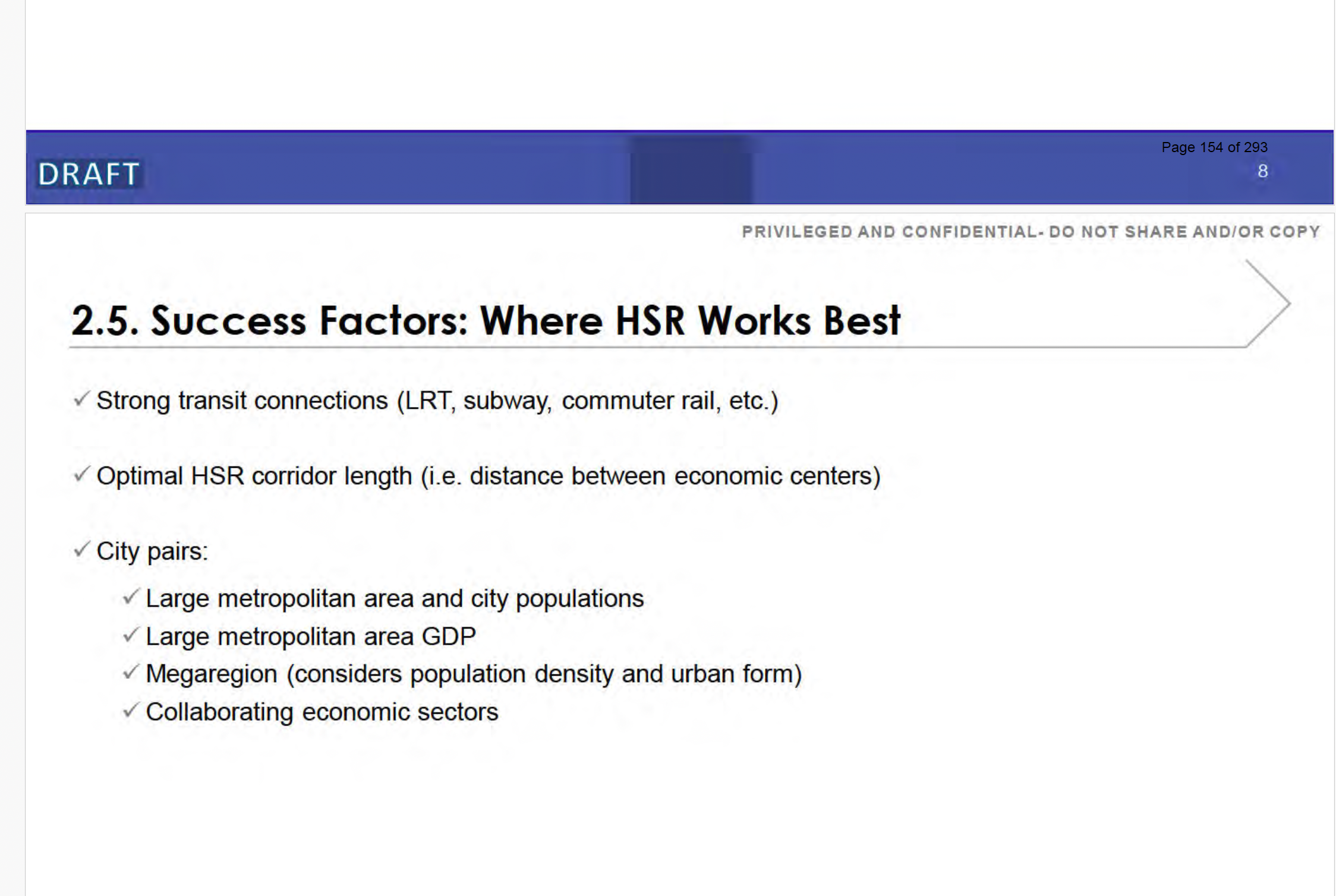
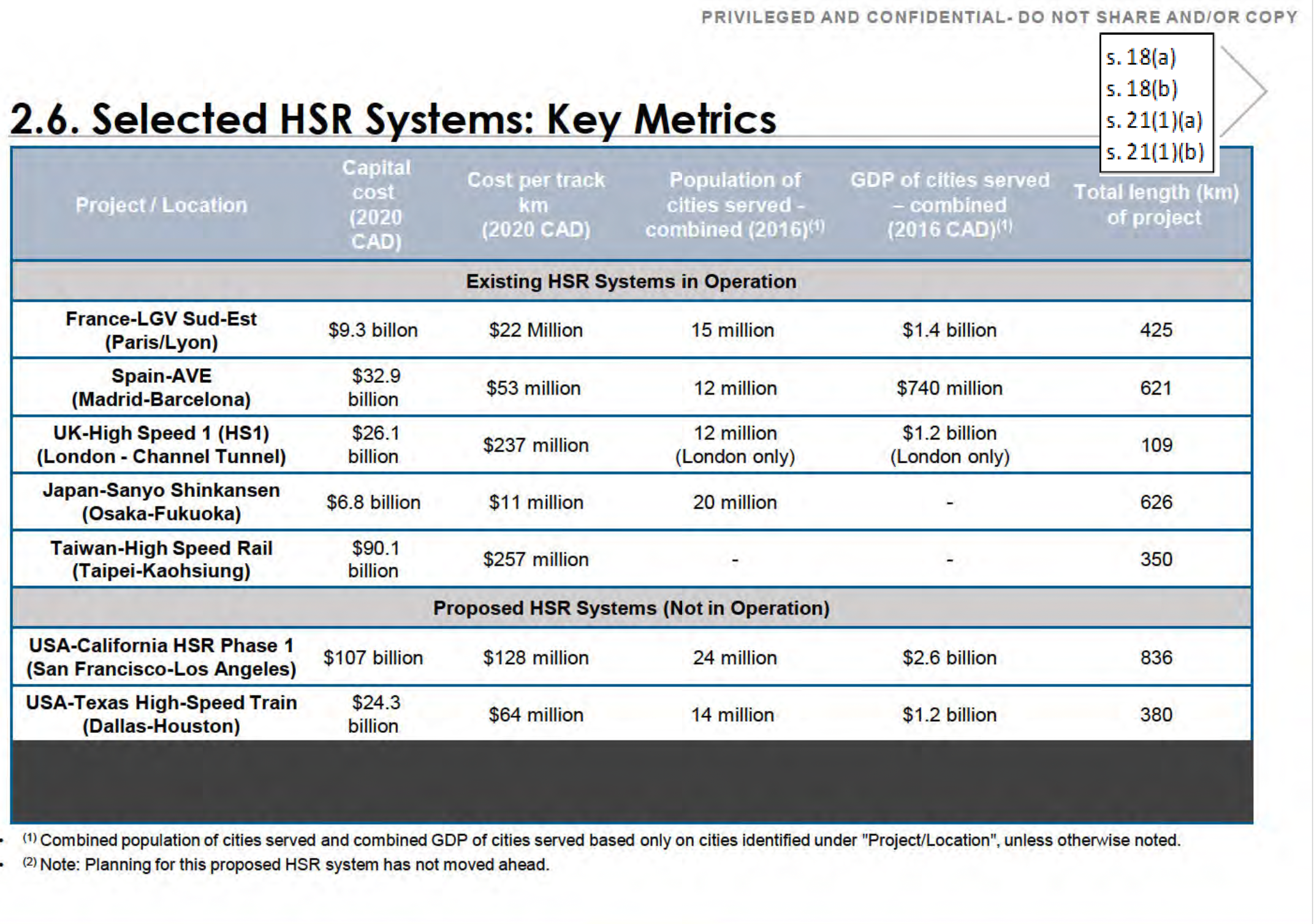
    The TGV connects Paris and Lyon — two of Europe’s largest cities — in 465 km. The Tokaido Shinkansen connects four metropolitan areas of five million people or more in 515 km. These are short, dense corridors with multiple major hubs. They are the cases where high-speed rail demonstrably outperforms air and conventional rail in both ridership and economics.

    The ALTO corridor is 1,000 kilometres or more between only three destinations with meaningful ridership demand. The intermediate stops — Peterborough, Laval, Trois-Rivières — are too small to sustain frequent HSR service in their own right. Ontario’s own 2016 high-speed rail business case, prepared for the more densely populated Toronto–Windsor corridor, found explicitly that “speeds of up to 300 km/h do not deliver a significant increase in benefits” over 250 km/h. The geography of southern Ontario and Quebec does not deliver the conditions that make HSR work elsewhere.

    The federal government’s own number

    ALTO’s internal Benefit-Cost Ratio is approximately 0.4. The viability threshold for federal infrastructure investment is 1.0. A BCR below 1.0 means the project’s costs exceed its measurable benefits, even on the project’s own assumptions. The federal government has not publicly disputed the figure. It has proceeded with the project regardless.

    The Price

    ALTO won’t tell you what a ticket will cost. Here’s why.

    $0
    government operating subsidy committed by ALTO
    Imbleau, public statements
    $200–400
    typical Acela fare in Canadian dollars on the New York–Washington corridor
    Amtrak published fares
    $275+
    typical Eurostar London–Paris fare in Canadian dollars
    Eurostar published fares

    Four years into procurement, ALTO has not published a single projected fare. Its public FAQ says fares “cannot be set” until the route is finalised. At the same time, the CEO has publicly committed that the service will operate without any government subsidy. These two positions are mathematically incompatible with low fares. A $60–90 billion design-build-finance-operate-maintain project — private profit, debt service, and operating costs all recovered from the farebox — must price like one. ALTO FAQ

    International benchmarks are the closest available proxies. In Canadian dollars: Amtrak’s Acela on the Northeast Corridor typically prices between $200 and $400 one-way; Eurostar between London and Paris starts around $275 and rises sharply at peak times. Both services are operated on networks that receive substantial state support. ALTO is committing to the opposite: full-cost recovery from passengers. CRI analysis indicates ALTO fares are likely to run higher than these benchmarks rather than lower — most international HSR is state-subsidised; ALTO has committed not to be.

    The civilised, affordable train is not what is being built

    ALTO’s own published FAQ concedes the answer most plainly: “VIA Rail may remain the more economical option for travellers with time but tighter budgets.” The civilised, affordable, no-airport train urban Canadians imagine is a French- or Japanese-style public service operating under social-rate fare regulation. ALTO, as procured, is the opposite financial structure: a privately operated profit centre with no fare ceiling, expected to recover its full $60–90 billion capital cost from passengers.

    The Land

    The farmland we lose doesn’t come back. Your grocery bill does.

    ~5%
    share of Canada’s total land base classified as Class 1 or 2 agricultural soil
    Agriculture and Agri-Food Canada
    60 m
    width of the fenced, level-crossing-free ALTO right-of-way
    ALTO published specifications
    1,000+ km
    of new greenfield corridor through the St. Lawrence Lowlands
    Network total length

    The proposed greenfield corridor crosses some of Canada’s most productive agricultural land — Class 1 and 2 soils in Eastern Ontario and the St. Lawrence Lowlands that took millennia to form. Canada has only about 5% of its land base in this top agricultural category. Once expropriated and graded for a 300 km/h alignment — fenced, unscalable three-metre security walls, no level crossings, severed fields, viaducts — it is no longer farmland. The loss is permanent and irreversible.

    ALTO’s chief executive has publicly estimated that the Ottawa–Montréal first segment alone will cross approximately 1,700 properties, including roughly 500 farms. The Toronto and Québec segments have not yet been quantified in equivalent terms, but the agricultural footprint of the full 1,000 km network is necessarily substantially larger. CBC News

    This is not a sentimental rural concern

    The food on grocery shelves and farmers’ market stalls along this corridor comes from this land. Less farmland nearby means higher prices and a longer, more fragile import chain — at the exact moment trade with the United States has become unreliable. The four major Canadian farm associations — OFA, UPA, CFA, and BFO — have unanimously called for a halt to the project to allow for independent agricultural impact assessment before route selection. The federal government has declined to do so.

    The Alternative

    High Performance Rail on existing corridors

    There is a credible alternative that delivers the substantive benefits ALTO is meant to provide — faster trains, more frequent service, real downtown access, intercity rail competitive with driving and flying — without the cost, the timeline, or the irreversible disruption. High Performance Rail: new dedicated passenger track at 200 km/h, alongside the 401 highway or on the existing CN Kingston Subdivision, integrated with VIA Rail’s existing fleet and stations. The federal government has commissioned twenty-eight studies into ALTO’s 300 km/h vision. None into this.

     ALTO HSR (Planned)HPR Alternative
    Top speed300 km/h dedicated200 km/h dedicated
    Toronto–Montréal, train only~3h projected~3.5h projected
    Toronto–Montréal, door-to-door~4h (suburban Toronto stop)~4h (existing downtown stations)
    Capital cost$60–90 billion (working assumption)Under $10 billion (CRI estimate)
    Years to operation12–14 years (full network)5–7 years
    InfrastructureNew 1,000 km greenfield corridorExisting 401 and CN Kingston Sub alignments
    Downtown stationsNone contractually committedPreserved at all existing VIA terminals
    Corridor communities served7-station network; bypasses major existing VIA stops including Belleville, Kingston, Brockville, CornwallAll eleven existing corridor communities preserved
    Rolling stockNew procurementVIA’s already-purchased Siemens Venture fleet
    VIA national networkCorridor cross-subsidy diverted to private operatorNational network revenue preserved

    Premier Doug Ford has stated his preference for the 401 alignment over the ALTO greenfield route. The Eastern Ontario Wardens’ Caucus, representing 103 municipalities along the corridor, has supported it. The Coalition for Better Rail and the four major Canadian farm associations have all called for an independent comparative evaluation before construction commitments are made. The federal government has not produced one.

    The integrated-network case

    HPR is not a single project; it is a network upgrade. Existing VIA-owned segments (the Alexandria Subdivision between Ottawa and Coteau Junction; the Brockville and Smiths Falls subdivisions on the Toronto–Ottawa route) already deliver corridor-best reliability. Targeted new construction along the 401 and on the CN Kingston Subdivision addresses the remaining bottlenecks. The result is faster, more reliable service on every existing corridor route — not a single greenfield HSR line bypassing the network that exists.

    Take Action

    Three questions for the Minister of Transport

    Construction is scheduled to begin in 2029–30. The window in which the federal government can be compelled to produce, and publish, a credible comparative evaluation of HSR against HPR is the period before that date. Three questions, the kind that must be answered or visibly declined, are sufficient to make the case for that evaluation politically unavoidable.

    1. Release the comparative analysis between 200, 250, and 300 km/h options that preceded the rebrand from VIA HFR to ALTO. The decision to commit to 300 km/h dedicated HSR was not transparently justified against alternatives.
    2. Publish a public evaluation of dedicated passenger track along the 401 and the CN Kingston Subdivision before construction commitments are made — time, cost, disruption, and timeline side by side, with methodology disclosed.
    3. Refer ALTO to the Parliamentary Budget Officer for independent review of fiscal, ridership, and station-location assumptions before construction commitments are made.

    Also write to your Member of Parliament. The decision to refer the project to the Parliamentary Budget Officer for independent review can be initiated through any MP. Urban-riding MPs, in particular, have an interest in establishing whether the procurement that has been authorised will deliver the service their constituents have been told to expect.

    Download One-Pager
    Three Hours, Downtown to Downtown? — Urban Reader’s Brief (PDF)
    Single-page printable version for distribution
    Download PDF
    Sources

    Primary documents and statements

    1.
    Alto Project, “Shaping the Canada of tomorrow with high-speed rail” consultation site — project scope, timeline, $60–90 billion cost range, 300 km/h speed, “reduce travel times by half” framing, FAQ on fares. altotrain.ca
    2.
    Alto (high-speed rail), Wikipedia — project history, $3.9 billion design phase, Cadence consortium, 12–14 year timeline, intermediate station list. en.wikipedia.org
    3.
    Bill Curry, “Ottawa train station isn’t ideal location for high-speed rail terminal, Transport Minister says,” The Globe and Mail, May 1, 2026 — carries the Imbleau / MacKinnon concession on station locations. theglobeandmail.com
    4.
    Benjamin Shingler, “Ottawa-Montreal chosen as 1st segment of promised high-speed rail line,” CBC News, December 12, 2025 — project costing context, MacKinnon and Imbleau statements. cbc.ca
    5.
    Mathieu Berger, “Montreal–Ottawa high-speed rail line could cross 1,700 properties, Alto predicts,” CBC News / Radio-Canada, May 5, 2026 — the 1,700 properties / 500 farms figure for the Ottawa–Montréal first segment. cbc.ca
    6.
    Ontario Ministry of Transportation, High Speed Rail Business Case Toronto–Windsor (2016) — on the 250 vs 300 km/h marginal benefit analysis. Referenced in subsequent federal procurement documentation.
    7.
    VIA Rail Canada — published schedules, fleet composition (Siemens Venture procurement), and corridor track ownership disclosed in annual reporting. viarail.ca
    8.
    Ontario Federation of Agriculture and l’Union des producteurs agricoles, joint press release, February 27, 2026; Canadian Federation of Agriculture AGM resolution, February 25, 2026; Beef Farmers of Ontario statement, March 3, 2026 — the four-association call for project halt and independent agricultural impact assessment. ofa.on.ca
    9.
    ALTO HSR Citizen Research Initiative — supporting research notes on door-to-door travel time analysis, the High Performance Rail alternative framework, and the Benefit-Cost Ratio assessment are available at citizenresearch.ca. citizenresearch.ca