Two incompatible traffic types share one corridor
Why North America’s freight railways work the opposite way from Europe’s—and what that means for the passenger problem.
The Toronto–Montréal corridor’s passenger problem has a single physical cause: intercity passenger trains and heavy freight trains are competing for the same tracks. This chapter explains why that conflict is the real problem—and why the solution isn’t to build a new line somewhere else, but to separate the traffic on the corridor that already exists.
Figures attributed to a source are quoted from the named published source and can be checked there. Every other figure on this page is a calculation or estimate by the ALTO HSR Citizen Research Initiative from those inputs. Market and operating figures for CN and CPKC are as reported at the dates given and will move. The quantitative work behind this chapter is carried in Chapters 4 to 8; the figures quoted here are summaries of those chapters rather than independent estimates. Where ALTO has not published something — a freight benefit in its appraisal, for instance — the text says so rather than inferring it.
North America and Europe run railways in opposite ways
Europe’s model: Railways are run by the state or with heavy state support. The network is built around passenger service first—high-speed trains get priority over freight. Freight competes for capacity on a passenger-focused network and often loses money or relies on subsidies.
North America’s model: Railways are private companies that own their own tracks. Freight is the core business, and it comes first. Intercity passenger trains are tenants that run in between freight movements. The freight railways have spent 30 years optimizing for moving more tonnage at lower cost.
What the freight model bought. The clearest physical expression of the North American model is the size of the trains it runs. Because crew and locomotive costs are largely fixed per departure, length is leverage. North American freight trains routinely run beyond three kilometres and the longest exceed four, against a European standard of roughly 740 metres. The second and larger efficiency is double-stack, introduced in North America in 1984 and now carrying the majority of US intermodal traffic: two containers stacked vertically in a single well car, roughly doubling the container payload of a train of a given length. Europe cannot do either, because siding lengths, signalling design and overhead electrification on a passenger-first network cap both train length and loading gauge.
The numbers tell the story. In the United States, freight carries roughly 40 percent of long-distance goods movement by weight—among the world’s highest. In Europe, it’s fallen to about 17 percent and still dropping. Why? Because Europe invested in passenger railways, and freight became the secondary user. North America invested in freight railways, and passenger service became secondary.
Canada’s proposed Toronto–Montréal corridor would run on North American freight railway tracks owned by Canadian National Railway. That means it’s joining a corridor governed by North American logic: the freight railway owns the track, and its tonnage comes first. A passenger plan modelled on Europe won’t work here.
CN is constrained, and its problem is capacity—not speed
Canadian National Railway (CN) owns and operates the Kingston Subdivision, the main freight line through the Toronto–Montréal corridor. CN’s story over the past three decades is a master class in what makes private railways valuable: squeezing more output from existing track without building new infrastructure.
When CN was privatized in 1995, it was a struggling Crown corporation. By the 2000s, under new leadership, CN adopted “Precision Scheduled Railroading”—moving individual cars on fixed schedules, cutting dwell time in rail yards, and lengthening trains. The operating ratio—the industry’s efficiency measure, where lower is better—fell from 76 percent to 56 percent. CN’s share price went up roughly 60 times.
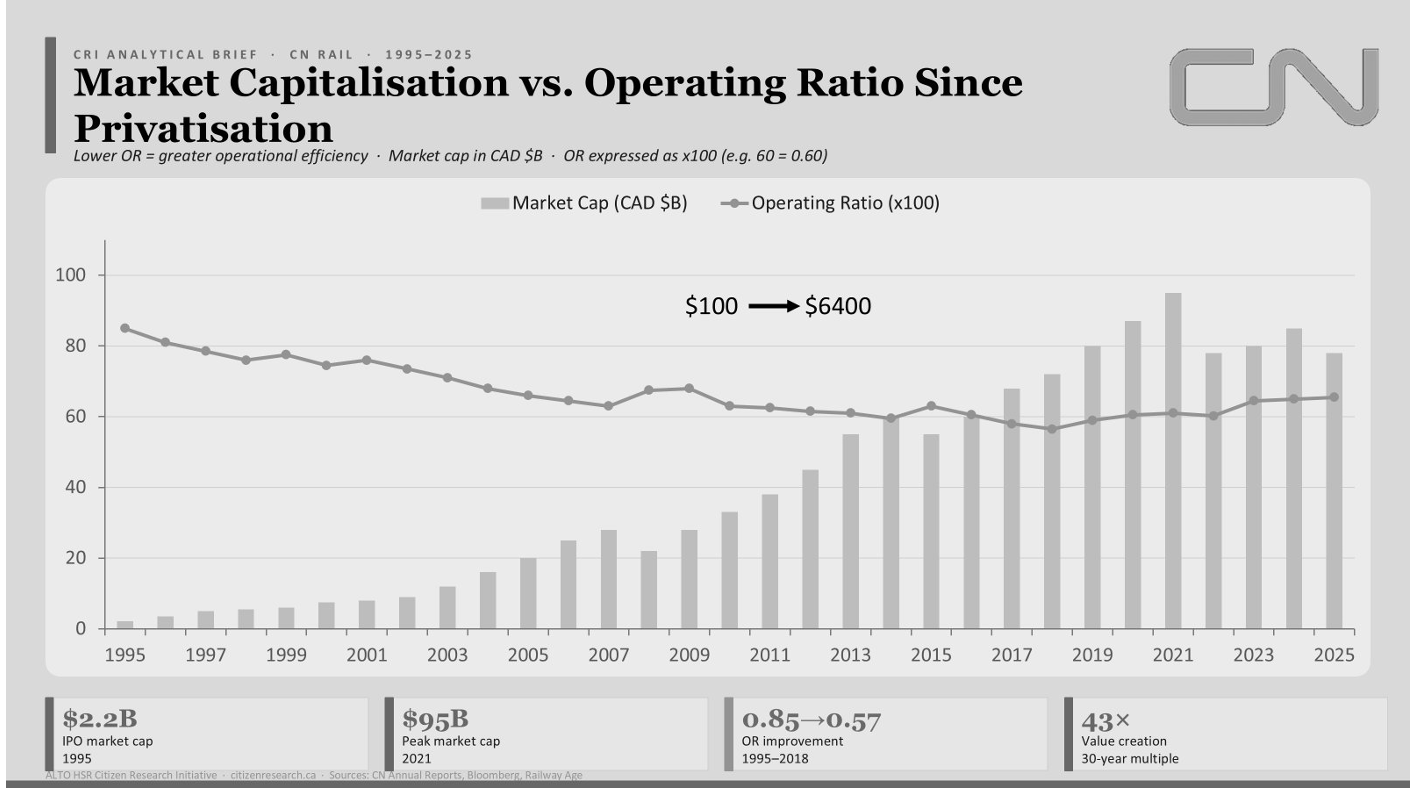
The lesson: The market rewarded CN not for building new railways but for extracting more value from the railway it already owned. This is the capital-light path to rail value: efficiency on assets in the ground, not greenfield construction.
CN’s problem today is not speed—it’s capacity. Its three main intermodal terminals in the Greater Toronto Area are running at full capacity. It proposed a new terminal at Milton in 2015 and met a decade of local opposition, environmental assessment and litigation before construction could start; the approval was ultimately upheld on appeal and the terminal is now being built. This tells us something crucial: the cost of building new capacity in a populated landscape is measured in years, not just dollars — Milton took roughly a decade from proposal to construction on a facility of about $250 million — and community resistance is as big a factor as engineering difficulty.
What about CP? It runs on its own track
CN isn’t the only major freight railway on the Toronto–Montréal axis. Canadian Pacific—since its 2023 merger with Kansas City Southern, now Canadian Pacific Kansas City (CPKC)—also runs a line through the corridor. It’s reasonable to ask whether CPKC changes the picture. It doesn’t, and the reason is geographic.
CPKC runs west out of Toronto on its Galt Subdivision. Its main Toronto–Montréal line is the Belleville Subdivision, which runs roughly parallel to CN’s Kingston Subdivision through the central part of the corridor, then turns north toward Smiths Falls and continues to Montréal on CPKC’s own tracks. CPKC’s eastern freight travels on its own metals, not on CN’s. Since the KCS merger, CPKC’s strategic focus has shifted decisively north–south—to the continental Canada–US–Mexico network that is now its primary growth story.
The passenger–freight conflict is specific to CN’s Kingston Subdivision, where VIA’s trains share track with CN’s freight. CPKC, on its separate Belleville Subdivision, is not a party to it—so the freight capacity that separation liberates accrues to CN, the line’s owner. The Belleville Subdivision matters in one further respect: it’s a second existing rail right-of-way running parallel to the CN line and Highway 401 through the corridor’s central section—further evidence that the ground HPR would follow is already a multi-track transport spine rather than open country.
Entanglement: two traffic types, one track
VIA’s intercity passenger trains and CN’s freight trains share the Kingston Subdivision. They have opposite operating needs.
Freight trains
Long, heavy, slow to accelerate. Can tolerate delays. Run to commercial schedules. Need to be as long as possible to spread fixed locomotive costs across more cargo.
Passenger trains
Short, light, quick to accelerate. Cannot tolerate delays. Need frequent, reliable service. Need short platforms and quick turnarounds.
Under the “host railway priority” rules that govern shared track across North America, when a freight train and a passenger train want the same track at the same time, the freight train proceeds and the passenger train waits in a siding. VIA cannot unilaterally add frequency because every additional passenger train needs to be negotiated around CN’s freight schedule. CN controls the dispatcher, and under this ownership structure nothing requires the track owner to give up freight capacity to improve passenger reliability.
This creates a two-sided failure: every passenger path is capacity CN cannot use for freight; every siding meet is friction on a network built and operated to move tonnage without interruption. They are entangled—neither can be optimized without degrading the other. And the owner of the track whose traffic comes first has no incentive to give ground.
It’s not a shortage of speed. It’s not an engineering problem. It’s a structural conflict over who owns the capacity and whose traffic comes first. No schedule adjustment solves this while the two traffic types remain on one set of rails.
Separation: give each traffic type its own path
If entanglement is the disease, separation is the cure—and it’s the single design principle behind HPR.
The idea is simple: build a dedicated passenger path engineered for passenger requirements, and hand the shared corridor back to freight. Each traffic type then runs on infrastructure suited to it. The capacity conflict that produces the corridor’s present failure simply ceases to exist. This doesn’t ask a private freight railway to subordinate its tonnage to passenger priority—it removes the passenger trains from the freight railway’s tracks altogether.
Separation can be achieved cheaply or expensively. The difference between the two approaches is the difference between HPR and ALTO.
HPR pursues separation through a brownfield-led philosophy: Build the dedicated passenger path along the geometry of corridors that are already disturbed—Highway 401 and the existing rail right-of-way. Upgrade and reuse infrastructure wherever engineering permits; build new only where geometry or capacity genuinely demands it. This keeps the new passenger alignment adjacent to the freight corridor it is relieving.
What that means in practice: a roughly 479 km new-build passenger spine from Pickering Junction to Dorval, designed for a 177–240 km/h operating band with 240 km/h the design maximum on the straightest stretches, plus about 200 km of upgrade on the VIA-owned Smiths Falls and Alexandria Subdivisions. The spine is the capital project; the upgrades extend it using track already in public hands.
ALTO pursues separation through greenfield construction: Build a new high-speed line through Eastern Ontario, engineered for 300 km/h, away from the existing freight corridor. This imports the European passenger-first model—a dedicated high-speed line as an end in itself—into a North American freight corridor whose economics it doesn’t engage.
Build one, make one free: the dual-asset structure
This is where HPR differs fundamentally from ALTO, and where the economics become positive-sum rather than single-purpose.
When HPR moves passenger trains onto their own dedicated path, they vacate the Kingston Subdivision. The capacity they were consuming—the paths, the priority negotiations, the siding meets—reverts to CN as liberated freight capacity on the line it owns. That capacity bears on the operating ratio and the terminal congestion CN’s own public reporting identifies as central. CN has taken no public position on HPR, and none should be inferred here — the point is that the incentives run in the same direction.
Think of it this way:
- “Build one” is High Performance Passenger Rail (HPPR)—the dedicated passenger path. That’s the capital project.
- “Make one free” is High Performance Freight Rail (HPFR)—the freight capacity liberated on the shared corridor the moment passenger trains vacate it. No additional construction is required to create the liberated paths: they fall out of the geometry of the build. Double-stack capability is a separate matter — it depends on vertical clearance work, which is a distinct category of capital investment with its own cost and its own return, and is not claimed here as free.
One capital project produces two separable outputs. The passenger business case needs only to justify itself on passenger benefits. The freight-capacity dividend is surplus—untouched by any reference-class reduction of passenger ridership forecasts. This is a deliberate bias countermeasure against the benefit-shortfall failure mode that sinks megaprojects.
ALTO builds one thing — a passenger-only line — at about $142M/km, taken from its own published midpoint, and captures one benefit stream. HPR builds one thing at about $40M/km as specified, or $54M/km once its own estimate is adjusted against the overrun record, and captures two. The difference isn’t in execution quality; it’s in whether the design is aligned with the corridor’s actual economics and incentives.
The freight dividend: how the freed capacity translates to real benefits
The liberated freight capacity is not abstract. It lands on named, motivated beneficiaries:
The host railway (CN)
Recovers paths previously consumed by passenger service. Uncongested freight paths translate to higher network fluidity, more predictable transit times, and the ability to grow tonnage without hitting a capacity ceiling. Where clearance is addressed, it enables double-stack container operation—which roughly halves the per-container cost of moving goods by rail. A freight railway that no longer dispatches around passenger priority is materially more valuable on the same physical asset.
Shippers and supply chain
Reliable, uncongested rail capacity on the busiest goods corridor in the country is a resilience asset. It raises the ceiling on how much freight moves by rail and reduces variability that pushes shippers toward more expensive or higher-emission alternatives. Combined with on-dock terminal design of the kind the Montréal Port Authority is building at Contrecœur, it extends competitive intermodal service to a larger share of corridor flows.
The public
Freight capacity that would otherwise be unavailable on rail is capacity that can absorb goods movement currently carried by road. Each tonne shifted from truck to rail reduces highway congestion, road wear, and—most consequentially—carbon emissions, given the substantial per-tonne-kilometre advantage of rail over road haulage.
Why ALTO cannot capture the freight dividend
ALTO is also a separation scheme—it too gives passenger trains a dedicated line. But the freight dividend is not equally available to it, and the reasons are fundamental.
First, routing: ALTO’s dedicated line runs away from the existing freight corridor, through new terrain in Eastern Ontario. It doesn’t reorganize the freight corridor; it builds a parallel facility through different ground and leaves the freight network’s configuration, congestion, and clearance constraints essentially as it found them.
Second, design: ALTO is a single-purpose asset—a passenger-only line engineered for 300 km/h. It cannot carry freight and is not designed to. The only benefit it can capture is the passenger benefit.
Third, accounting: ALTO’s own business case books no freight benefit at all. The freight dividend does not appear in ALTO’s appraisal because ALTO’s design does not produce it.
Fourth, cost: ALTO solves the single problem it addresses — passenger throughput — at the maximum per-kilometre cost the corridor admits: a new greenfield high-speed alignment through sensitive terrain. The capital cost analysis in Chapter 4 places HPPR at roughly $40 million per kilometre as specified and about $54 million per kilometre on the de-biased central estimate, some $19.0B to $26.1B for the 479 km spine, against ALTO at approximately $142 million per kilometre, taken from ALTO’s own published midpoint of roughly $75 billion.
Compared on the same un-adjusted basis — the Initiative’s own estimate against ALTO’s own published figure — ALTO costs about three and a half times as much per kilometre. Set against HPPR’s de-biased $54 million the ratio is roughly two and a half times, and that is the conservative reading, because HPPR’s estimate has been adjusted against the overrun record and ALTO’s has not. On either basis ALTO costs several times as much per kilometre to produce one benefit stream — and considerably more in total, once its far longer corridor is counted. HPR’s lower-cost, corridor-aligned build produces two benefits, and leaves CN’s capacity and clearance problems measurably better than it found them.
ALTO builds one and makes nothing free. HPR builds one and makes one free, at roughly a third the per-kilometre cost as specified. The difference is not in how well each is executed; it is in whether the concept is aligned with the corridor’s actual economics and the incentives of the parties who own and operate it.
The concept in eight parts
3.1 — North America runs the opposite railway
North American freight railways are private, profitable, vertically integrated, and freight-priority. Rail’s freight share is far higher in North America (~40% of US long-distance ton-miles vs ~17% of EU inland tonne-km). A passenger plan modelled on Europe imports passenger-first assumptions into a freight-first corridor.
3.2 — CN is the incumbent, and it is constrained
CN’s extraordinary returns came largely from efficiency on existing track, not construction. Its valuation has stalled; it struggles to add capacity (Milton took a decade from proposal to construction); and its corridor economics improve on uncongested paths and double-stack clearance.
3.3 — CP is not a party to the conflict
CPKC runs its own Belleville Subdivision on the Toronto–Montréal axis, parallel to the CN Kingston Sub, and shares no track with VIA. The entanglement, and the freight dividend, are CN’s. CPKC’s parallel line is also a second disturbed right-of-way in the corridor.
3.4 — Entanglement is the root cause
Passenger and freight share the Kingston Subdivision with opposite operating characteristics. The corridor’s failure—sub-64% on-time performance, four-hour schedules, low frequency—is one capacity conflict seen from two sides, on track owned by the party whose tonnage comes first.
3.5 — Separation is the design principle
Give passenger service its own dedicated path and hand the shared corridor back to freight—resolving the conflict with the North American model, not against it. HPR does this brownfield-led, along Highway 401 and existing rail geometry: a ~479 km Pickering Junction–Dorval spine plus ~200 km of upgrade on the VIA-owned Smiths Falls and Alexandria Subdivisions.
3.6 — Build one, make one free
One capital project—HPR—produces two separable assets: HPPR (the dedicated passenger path) and HPFR (the freight capacity liberated on the shared corridor), the liberated paths created at no incremental cost by the geometry of the build; double-stack capability is a separate, costed clearance investment.
3.7 — HPFR lands on a motivated beneficiary
The liberated freight corridor benefits the host railway (fluidity, operating-ratio gains, double-stack where cleared), shippers (resilience, Contrecœur-style reach), and the public (road freight diverted to rail, with emissions and safety gains). It is carried as a measured quantity: a Chapter 8 benefit-cost stream and Chapter 5 emissions.
3.8 — ALTO cannot capture it
ALTO builds a greenfield passenger-only line at ~$142M/km, from ALTO’s own published midpoint, against HPPR’s ~$40M/km as specified — about three and a half times on the same un-adjusted basis, and roughly two and a half times against HPPR’s de-biased ~$54M/km, which is the conservative reading — and captures one benefit. HPR captures two. ALTO builds one at maximum cost and makes nothing free.