Two Lines Across the Land
Highway 401 divided Eastern Ontario in the 1950s and ’60s. Now Alto proposes to do it again — but the tools, the speed, and the stakes are very different.
Our Position
The priority for Eastern Ontario must be reliable regional transportation near an existing major transportation corridor — a dedicated passenger rail track that minimises harm to farms, nature, and communities. It does not need to be high-speed rail. Speed should not be the leading criterion.
History does not repeat itself exactly. But it rhymes. And in Eastern Ontario, the rhyme is getting louder.
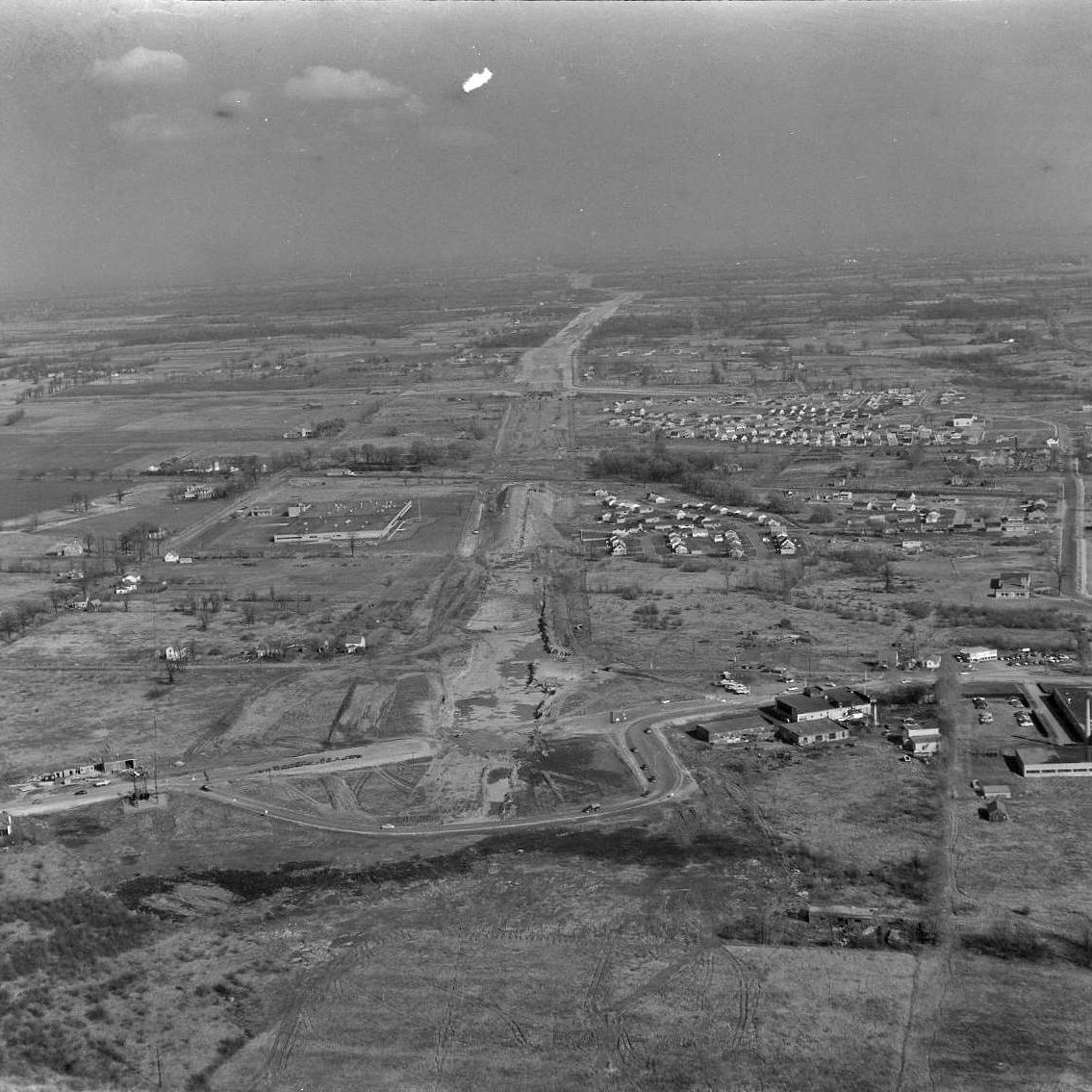
Highway 401 under construction near Brockville, late 1950s (Brockville Museum collection)
How Highway 401 Changed Eastern Ontario
Highway 401’s construction through Eastern Ontario between the late 1950s and 1968 imposed a continuous barrier on the landscape for the first time. Unlike county roads and railways that cross at grade and can be crossed freely, 401 was designed as a fully controlled-access freeway: no at-grade crossings, no driveways, no free movement across it. The last intersection near Kingston was grade-separated when the final section opened. Highway 401 is now a fully controlled-access freeway for its entire length — there is no at-grade crossing anywhere along it.
The communities of Eastern Ontario adapted to 401 over decades. Farms were divided. Families on opposite sides of the highway developed different routines. Emergency services built their response plans around the fixed crossing points. Wildlife populations were separated. In some places, 401 served as a de facto municipal boundary. This adaptation took a generation, and some of the costs — particularly to wildlife populations — were never fully reckoned with.
The 401 was built for speed and freight movement, not for the communities it passed through. Rural Eastern Ontario received a transportation barrier in exchange for a highway that primarily served long-distance travellers connecting Toronto and Montreal. The same pattern is visible in the Alto proposal today.
What made 401 tolerable was its speed: 100 km/h is fast enough to justify grade separations every few kilometres. Emergency vehicles, farm equipment, and residents can cross at frequent underpasses. The highway was a barrier, but a permeable one by design.
At 300 km/h, a high-speed rail line cannot be crossed by an emergency vehicle, a tractor, or a child on a bicycle. The physics of the speed differential make frequent grade crossings impossible. The barrier is categorically different from 401 — it is more like a geographic feature than an infrastructure one.
Why Alto Is Not Like Building the 401
Proponents of Alto sometimes point to Highway 401 as a precedent: a major linear infrastructure project that disrupted communities during construction but ultimately delivered economic benefits. This comparison deserves scrutiny. There are at least five ways in which a high-speed rail corridor at 300 km/h is categorically harder to live with than a controlled-access highway.
| Factor | Highway 401 | Alto HSR at 300 km/h |
|---|---|---|
| Crossing frequency | Grade separations every 2–5 km; farm vehicles, emergency response, residents can cross | At 300 km/h, crossings must be widely spaced or eliminated — Alto has stated crossings will be “minimized” |
| Noise and vibration | Highway noise is significant but manageable with berms and distance | High-speed rail generates sonic boom effects at 300 km/h; vibration through bedrock and tile drainage systems is a documented concern |
| Safety fencing | Guardrails permit wildlife passage at ground level in many locations | Continuous 2.5–3 m security fencing required for the entire 1,000 km — a complete ecological barrier |
| Emergency response | Emergency vehicles can cross 401 at all interchange points, typically <5 km apart | Crossing points for emergency vehicles may be 15–30+ km apart on HSR; ambulance response times extend significantly |
| Local benefit | 401 provides direct access to business and commercial development at interchanges | No station proposed in Eastern Ontario communities along the corridor; all stops are in major urban centres |
What Could Have Been Built Instead
The Corridor Train Alliance has articulated the position held by many in Eastern Ontario: the priority must be reliable regional transportation near an existing major transportation corridor — near the 401 corridor, at whatever speed engineers determine is possible. It does not need to be high-speed rail.
For over a decade, Canada studied exactly this option under the name High Frequency Rail (HFR). The 2021 VIA Rail business case proposed dedicated passenger tracks at 170–177 km/h alongside existing freight corridors, at a cost of under C$5 billion. That plan would have been operational years ago. The story of how it became an $80–120 billion mega-project is told on the next page.
The question the consultation has not answered: If a line near the 401 corridor cannot achieve 300 km/h, is that a reason to abandon it? Or is 200 km/h on an existing corridor, with no new barrier through Eastern Ontario farmland and ecosystems, a better outcome for everyone outside the major urban centres?