Context5 pages Government
Documents7 pages Community
Resources10 pages Environment13 pages Community
Impacts 9 pages
Plains4 pages Environment3 pages
Fauna6 pages
The Southern Route Threatens Some of Canada’s Rarest Plants
The Frontenac Arch is the most biodiverse terrestrial region in Canada. The southern ALTO corridor runs through the middle of it.
The Frontenac Arch is an ancient granite bridge connecting the Canadian Shield to the Adirondack Mountains. It’s the only continuous north-south forest corridor in eastern North America — the Nature Conservancy of Canada calls it one of the most important forest corridors east of the Rocky Mountains. Five separate forest regions meet here — boreal, Great Lakes–St. Lawrence, Carolinian, Appalachian, and Atlantic. That convergence is why you find plants at the very edge of their range, living in habitats that exist nowhere else in Canada. Destroying this corridor doesn’t just harm the plants living there today. It shuts down the pathway species need to move northward as the climate changes.
The ecological significance of this landscape has been further confirmed through Canada’s Key Biodiversity Areas (KBA) programme. Three KBAs have been formally identified within the Frontenac Arch Biosphere — Thousand Islands, Charleston Lake, and Frontenac Forests — with a fourth, Napanee Limestone Plain, in the process of being proposed. Parks Canada has described the area as a “continentally significant wildlife movement corridor.” Any federal decision to route permanent infrastructure through a landscape containing multiple KBAs would be difficult to reconcile with Canada’s commitments under the Kunming-Montreal Global Biodiversity Framework. WCS Canada
These aren’t hypothetical concerns. Each of these species is protected under federal law, and each has confirmed or likely habitat in the southern corridor study area.
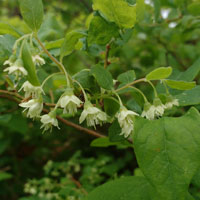
This is the most critical case. Deerberry is a shrub that grows in open woodland on shallow granite soils — exactly the landscape the southern corridor crosses. Less than 1% of its global range is in Canada.
Only 5 populations left in Canada 6 more already extirpated No natural seedling establishment ever recorded
That last point is what makes Deerberry so precarious. The plants set fruit, but no one has ever documented a wild seedling successfully establishing in Canada. Restoration attempts at Thousand Islands National Park have had only limited success. The federal Recovery Strategy says survival depends on maintaining habitat at all currently known sites with no loss of populations. COSEWIC 2020
The southern corridor runs through the fire-dependent Pitch Pine and Red Oak woodland on granite that Deerberry requires. Building a rail line here would destroy habitat directly, fragment the surviving populations, and alter the hydrology these communities depend on. The January 2025 identification of Thousand Islands as a Key Biodiversity Area — the region where nearly all of Canada’s Deerberry populations occur — adds a further layer of formal conservation recognition to the habitat the southern corridor threatens.
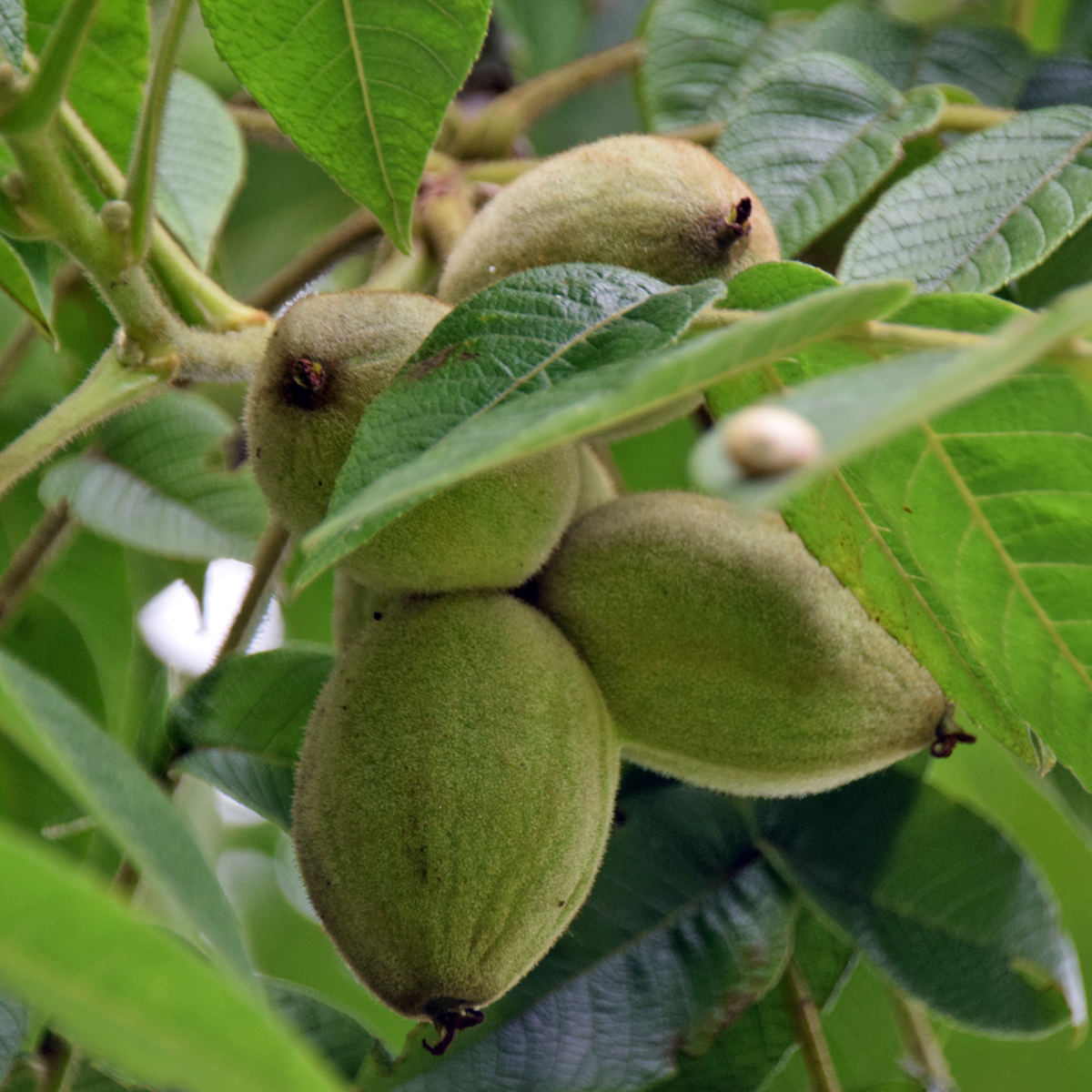
Butternut is a native tree found throughout the southern corridor, particularly at forest edges and along waterways. It has lost most of its range to Butternut Canker, a non-native fungal disease. Only about 13,000 trees remain in Ontario.
Endangered under SARA ~13,000 remaining in Ontario Declining due to canker disease
Any construction that removes a Butternut tree or damages habitat within a prescribed area around confirmed individuals directly engages SARA protections. A significant risk exists that pre-construction surveys have not yet been conducted in the corridor, meaning Butternut populations will only be discovered when the environmental assessment is formally triggered — at which point delays and costs escalate. COSEWIC 2017
The granite barrens of the Frontenac Arch are rocky hilltops and ridgelines with exposed Precambrian bedrock and thin, nutrient-poor soils. They support fire-adapted plants including Pitch Pine, Bear Oak, and Deerberry that exist at their northern limits.
These communities depend on conditions — exposed bedrock, thin soils, periodic fire — that cannot be recreated. Research published in Applied Vegetation Science found that many Frontenac granite barrens are already disappearing due to woody plant encroachment, meaning these populations are already vulnerable before any infrastructure impact. Cohen 2023
Physical destruction through construction is irreversible. You cannot blast and grade bedrock terrain and then restore it to a functioning granite barren.
Alto is a federal Crown corporation. The federal Species at Risk Act (SARA) applies to it without exception. These aren’t optional guidelines — they are binding legal obligations.
When a federal project is likely to affect a SARA-listed species, the proponent must notify the competent minister and take all feasible measures to minimize impacts. For Deerberry — five populations, no natural reproduction — the bar to prove a rail corridor won’t jeopardize recovery is extremely high. SARA s.79
It is illegal to destroy any part of identified critical habitat for a listed species. For Deerberry and Butternut, critical habitat is defined in their Recovery Strategies. This prohibition is absolute — it applies regardless of the proponent’s identity or the project’s public benefit. SARA full text
Conduct a full flora survey before choosing a route
A complete baseline plant survey of the southern corridor — particularly for Deerberry, Butternut, and granite barren communities — must happen before any route recommendation is made, not after.
Notify the ministers under SARA Section 79 — now
The obligation to notify is triggered by current knowledge, not by the formal start of the environmental assessment. The species identified in this research make notification necessary immediately.
Assess whether any southern alignment can pass the Deerberry test
With only five populations in Canada and no natural reproduction, can any route through this corridor genuinely avoid jeopardizing Deerberry’s survival? Commission an independent assessment.
Engage Parks Canada, ECCC, and conservation groups
Thousand Islands National Park, Environment and Climate Change Canada, and the Frontenac Arch Biosphere Network must be consultation partners — not afterthoughts.
Seriously consider eliminating the southern corridor
Based on current knowledge, the southern corridor likely cannot meet SARA requirements. Concentrate assessment resources on the northern corridor, which crosses different terrain with less confirmed critical habitat.
Don’t treat Ontario’s weaker rules as reducing federal exposure
Bill 5 increases the weight carried by SARA, not decreases it. Alto should plan on the federal obligations being the binding floor.
Extend the consultation if the flora survey isn’t done
If pre-construction surveys haven’t been conducted, the public can’t meaningfully comment. Extend the consultation to allow community-sourced species data to be reviewed.
- The Frontenac Arch is the most biodiverse terrestrial region in Canada — five forest ecosystems converge here and nowhere else.
- Deerberry has five populations left in this country. No wild seedling has ever been recorded. The margin for error is zero.
- A permanently fenced HSR corridor would sever the Arch’s north-south connectivity — the pathway species need to survive climate change.
- Three Key Biodiversity Areas have been formally identified within the Biosphere, with a fourth pending. Routing permanent infrastructure through multiple KBAs conflicts with Canada’s Kunming-Montreal commitments.
- Federal law requires Alto to assess these impacts before choosing a route. That assessment hasn’t happened yet.
The route decision will be made in 2026. If these concerns aren’t raised now — during the consultation — they become legal disputes and mitigation negotiations, not design choices.
Research by Rena Upitis and Lindsay Davidson. Facilitated with AI tools with human review and revision. Current as of February 2026.