Context5 pages Government
Documents7 pages Community
Resources10 pages Environment13 pages Community
Impacts 9 pages
Plains4 pages Environment3 pages
Fauna6 pages
Four Endangered Bat Species. One Cave. One Rail Corridor.
The Alto HSR southern route passes through the Moira Karst — a solution cave system in Hastings County that is the confirmed hibernaculum for four Endangered bat species, including what was historically the largest population of Little Brown Myotis in Southern Ontario. Federal law automatically prohibits harming them.
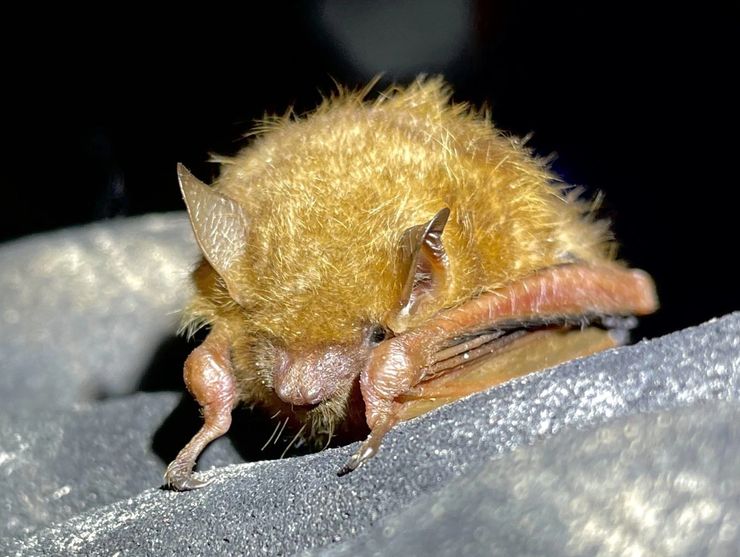
White-nose Syndrome, caused by a fungal pathogen introduced from Europe, has devastated Ontario’s cave-hibernating bats since it was first detected here in 2010. Population declines at infected hibernacula in eastern Ontario have ranged from 85 to 99%. The Moira Karst cave was among the first sites confirmed to carry the fungus — and it has been monitored ever since as a critical refugium for four species.
These are not species at moderate risk. They are species whose populations have already largely collapsed, which survive in reduced numbers at a handful of irreplaceable sites. Adding a new major threat — construction vibration, habitat fragmentation, hydrological disruption, and operational noise from a 300 km/h rail line — to populations at this level of fragility is not a planning inconvenience. It is a potential extinction event.
All four bat species confirmed at the Moira Karst hibernaculum are listed as Endangered on Schedule 1 of Canada’s Species at Risk Act (SARA) and on Ontario’s Species at Risk in Ontario list. This status is not precautionary — it reflects documented, catastrophic population losses. Federal law prohibits killing, harming, or harassing any individual of these species, or destroying the cave they use as a residence, without a permit. That permit cannot be granted if the project would jeopardize their survival or recovery.
Little Brown Myotis
Once the most abundant bat in Canada. The Moira Karst cave historically supported the largest colony in Southern Ontario. White-nose Syndrome has caused over 90% average decline in eastern Ontario hibernacula. Each forced arousal from torpor costs the equivalent of 68 days of stored fat — disturbance is directly lethal.
Northern Myotis
A forest-dependent species that forages along interior edges and in gaps in mature woodland. About 40% of the global population lives in Canada. Confirmed 94% decline in known hibernating populations in eastern Canada and the northeastern United States.
Eastern Small-footed Myotis
The smallest bat in eastern North America — weighing about as much as a nickel. One of the rarest bats in Canada, with only approximately ten known hibernacula in all of Ontario, all in karst areas. Returns to the same site year after year.
Tri-colored Bat
Canada holds an estimated 10% of the global population, found only in Ontario, Québec, New Brunswick, and Nova Scotia. Loses up to 30% of body mass during hibernation — leaving no margin for additional energy expenditure from disturbance.
The Moira Karst is a limestone karst formation in Hastings County, eastern Ontario, formed through the slow dissolution of Paleozoic carbonate bedrock over geological time. The system includes the Moira Cave — one of the largest solution cave systems in eastern Ontario, with passages extending beyond 11 kilometres. The cave system has been documented since at least the 1960s and was among the first sites in Ontario confirmed to carry White-nose Syndrome when the disease arrived in 2010.
Hibernating bats require very specific conditions: temperatures of 2–10°C, humidity above 80%, and a stable microclimate through a five- to six-month winter. These conditions occur naturally only in deep cave systems — and in Ontario, almost exclusively in karst limestone terrain. Bats using a hibernaculum demonstrate strong site fidelity, returning to the same cave year after year over decades. This is why the loss or degradation of even one hibernaculum is a significant conservation event. There is no bat box, artificial mine, or engineered structure that can replicate what a natural karst cave provides.
Karst limestone transmits ground-borne vibration with particular efficiency through its network of solution channels, fractures, and voids. Vibration generated by construction activity — blasting, pile-driving, vibratory compaction, heavy earthmoving — travels along these pathways and can reach cave systems at significant distances from the surface source. For hibernating bats, each vibration-induced arousal from torpor consumes fat reserves equivalent to weeks of undisturbed sleep. At a population already depleted by 85–99%, there is no energetic margin.
The impacts of high-speed rail on cave-hibernating bats are not limited to direct habitat clearance. Research from the UK, Europe, and North America documents multiple independent pathways — each capable of causing significant harm, and all of which would be active simultaneously during an HSR project.
Ground-borne vibration reaching the hibernaculum
Construction blasting, pile-driving, and earthmoving generate vibration that propagates through bedrock. In karst limestone, this transmission is especially efficient. Each forced arousal from torpor costs a Little Brown Myotis the fat equivalent of 68 days of undisturbed hibernation. For WNS-affected bats already depleting fat reserves months early, additional arousal pressure can be directly lethal.
Hydrological disruption of cave microclimate
The temperature and humidity inside a karst cave are controlled by surface water infiltration patterns. Rail construction involving drainage modification, culverting, earthworks, and de-icing chemical application can alter these patterns — shifting the thermal regime and humidity of the connected cave system, potentially rendering the hibernaculum unsuitable.
Habitat loss and foraging fragmentation
Bats travel substantial distances between their hibernaculum and summer foraging and maternity habitats. A high-speed rail corridor severing forest edges, wetlands, and waterway corridors disrupts these movements. Research has documented that total bat activity increases more than threefold between 0 and 1,600 m from a major transport corridor — demonstrating how extensively infrastructure displacement extends beyond the physical right-of-way.
Artificial light at night suppressing foraging
Myotis species are among the bat species most sensitive to artificial light. Construction lighting, station lighting, and infrastructure lighting introduced into previously dark landscapes disrupts foraging behaviour, blocks access to roosting sites along illuminated corridors, and forces bats onto less productive routes.
Train-pass disturbance suppressing foraging during operation
A peer-reviewed 2021 study (Mathews & Jerem, University of Sussex, Scientific Reports) found that bat activity fell 30–50% each time a train passed, and required at least two minutes to recover. Alto’s planning documents indicate 20 to 30 trains per day in each direction. High-speed trains at 300 km/h generate considerably greater broadband noise and vibration per pass than the conventional trains in the study. For populations already depleted 85–99%, the energetic cost of repeated forced evasive responses leaves no margin for error.
Permanent barrier effect isolating the hibernaculum
High-speed rail infrastructure — fencing, noise barriers, catenary, grade separation — creates a perceptually and physically impermeable linear barrier. If this barrier severs the movement corridor between the Moira Karst and productive summer range, the hibernaculum population becomes isolated from the foraging and maternity habitats it depends on seasonally. Given the low reproductive rates of all four species (typically one pup per female per year), isolated populations face a direct extinction risk.
“Taking evasive action every time a train passes may be energetically expensive, and reduce feeding opportunities, potentially disadvantaging bats using rail-side habitats.”
HS2’s Sheephouse Wood Bat Mitigation Structure is a 900-metre-long, up to 10-metre-high steel mesh arch enclosing the railway as it passes through habitat used by Bechstein’s bat — a species with fewer than ten breeding colonies in all of England. The structure must span four tracks, withstand concurrent train derailments, passively ventilate, and is designed for a 120-year service life.
In 2021, the UK government convened a review by the Department for Transport, DEFRA, and Natural England to determine whether any cheaper alternative existed. It did not. The legal firm Herbert Smith Freehills summarised the outcome: “If HS2 couldn’t have shown that the Bechstein bat colony would stay in favourable conservation status, they simply could not have built the line through Sheephouse Wood.”
This is the precedent that applies to Alto HSR near the Moira Karst — but with four Endangered species instead of one, all populations already decimated, and a karst substrate that makes vibration management substantially more complex.
Canada’s Species at Risk Act creates binding legal obligations the moment a species is listed on Schedule 1. All four Moira Karst bat species have been listed as Endangered since 2012–2014. These obligations apply to Alto HSR as a federal Crown corporation project.
Section 32 — Automatic prohibition on harm
No person shall kill, harm, harass, capture, or take any individual of a listed Endangered species. Construction vibration that arouses hibernating bats, light pollution that disrupts foraging, or habitat clearance that destroys movement corridors — all constitute harm. This offence does not require intent. It attaches automatically.
Section 33 — The hibernaculum is a legally protected “residence”
No person shall damage or destroy the residence of one or more individuals of a listed Endangered species. SARA explicitly recognizes a hibernaculum — a cave used by bats for overwintering — as a “residence.” Any construction or operational activity that renders the Moira Karst cave unsuitable as a hibernaculum constitutes destruction of a residence, which is a federal offence.
Section 58 — Critical habitat cannot be destroyed
Destruction of critical habitat is prohibited. Critical habitat for these species includes the hibernacula themselves, swarming sites, maternity roosts, and foraging habitat within specified buffer distances around each. Even on private land, SARA’s safety net provisions can extend this protection if provincial law is found inadequate.
Section 73 — The permit test: three conditions, all mandatory
A SARA permit can only be issued if: (a) all reasonable alternatives have been considered; (b) all feasible measures to minimize impact will be taken; and (c) the activity will not jeopardize the survival or recovery of the species. For four species facing functional extirpation timelines measured in years, this third condition is an extraordinarily high threshold — and one that may be impossible to meet if the Moira Karst is within the vibration transmission zone of the proposed alignment.
The Moira Karst hibernaculum contains four SARA-listed Endangered species, all at active risk of extirpation. Populations have declined 85–99% in eastern Ontario since 2010.
Rail construction and operation present six distinct, compounding pathways of impact: construction vibration, hydrological disruption, habitat fragmentation, light pollution, operational train disturbance, and barrier effects.
International precedent — HS2’s £100M+ Sheephouse Wood structure — confirms that bat mitigation near HSR is non-negotiable and fiscally material. A government review found no cheaper option.
SARA’s automatic prohibitions apply to all four species. No exemption exists for infrastructure projects. Bill C-15’s fast-tracking powers do not override them.
The SARA permit test requires demonstrating that the project will not jeopardize survival or recovery. For populations at near-collapse, this may be impossible to satisfy — making route avoidance the only legal pathway.
Alto’s $60–90B budget does not visibly incorporate bat mitigation costs at a scale consistent with HS2 precedent. The Moira Karst section alone could require CAD $100–200M.
- Commission independent multi-season bat surveys at the Moira Karst cave system, covering all four confirmed species
- Commission independent geotechnical vibration pathway assessment specific to karst terrain
- Conduct and publish a formal route alternatives analysis demonstrating why alternatives that avoid the Moira Karst were or were not considered
- Engage ECCC Canadian Wildlife Service and Ontario MNRF in pre-consultation — before route selection, not after
- Disclose bat mitigation as a material budget risk in all public consultations, with a cost scenario based on HS2 precedent
- Require that the Environmental Impact Statement address bat species at risk as a distinct, site-specific topic