Context5 pages Government
Documents7 pages Community
Resources10 pages Environment13 pages Community
Impacts 9 pages
Plains4 pages Environment3 pages
Fauna6 pages
The Eastern Loggerhead Shrike: Canada’s Most Endangered Songbird
What building a high-speed rail line through the Napanee Plain would mean for a bird on the edge of extinction
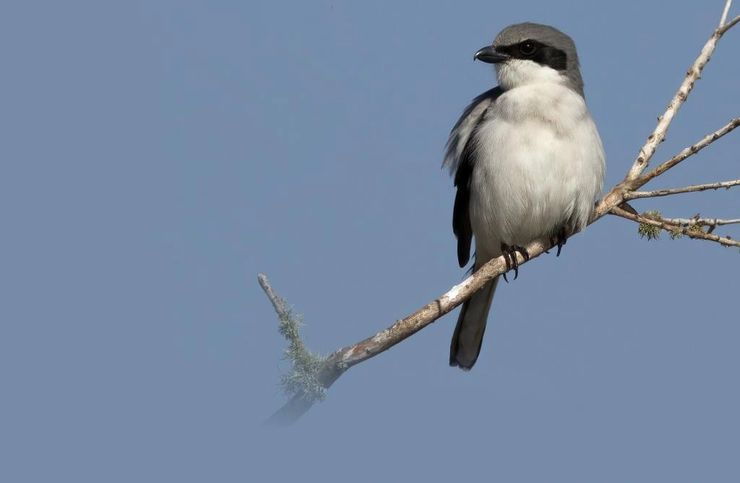
- The Eastern Loggerhead Shrike is Canada’s most endangered songbird. The entire wild Canadian population is estimated at approximately 40 individuals — and they live almost entirely on the Napanee Limestone Plain in eastern Ontario.
- ALTO’s proposed southern corridor would pass directly through the last place in eastern Canada where this bird regularly breeds — its critical habitat, protected by federal law.
- Federal law makes it a criminal offence to destroy this bird’s habitat without a permit — and those permits require proving the project won’t push the species further toward extinction.
- At exactly this moment, Ontario is removing its own protections for this species, leaving federal law as the only backstop — and the federal government is simultaneously the project’s proponent and its regulator.
- The public consultation closes April 24, 2026. This bird has no other advocate in that process except the public.
The Eastern Loggerhead Shrike looks a little like a small falcon — grey, white, and black, with a sharp hooked beak and a distinctive black mask across its eyes. But it’s a songbird, not a raptor. It earned the folk name “butcher bird” from an unusual habit: it catches grasshoppers, small mice, lizards, and frogs, and impales them on thorns or barbed wire to store for later, since its feet are too weak to hold prey the way a hawk’s can. Despite this fierce method, it sings and nests like any other small bird of the eastern Ontario countryside.
Fifty years ago, Eastern Loggerhead Shrikes were found across eastern North America from Manitoba to New Brunswick. Today, the situation is dire.
The Napanee area was once a stronghold. In the 1990s it held at least 30 percent of Canada’s entire Eastern Loggerhead Shrike population. As recently as 2003, 35 percent of the national total — half of Ontario’s breeding birds — nested here. The numbers since then have continued to fall.
The species has been listed as Endangered under Canada’s federal Species at Risk Act since 2003. A dedicated team at Wildlife Preservation Canada has been breeding shrikes in captivity and releasing them into the wild since 2003, releasing over 1,300 young birds. The program has kept the species from disappearing entirely. But the wild population has not recovered to even its minimum target after more than two decades of effort.
The Eastern Loggerhead Shrike does not live in just any open field. It needs a very specific habitat: flat, open land with very short grass, scattered hawthorn bushes or Eastern Red Cedar trees for nesting, fence posts and dead branches for hunting perches, and access to the insects and small animals that live in undisturbed limestone grassland — a rare ecosystem type called an alvar.
Alvars exist in only two places on Earth: the Baltic coast of Scandinavia, and the Great Lakes region of North America. Ontario holds 85 percent of all alvar in North America. The Napanee Plain has approximately 50 alvar sites — one of the largest concentrations in the world. This is not a coincidence: the shrike’s habitat requirements align almost exactly with the alvar’s characteristics. These two rare things evolved together.
ALTO’s proposed southern corridor runs from the Ottawa region southwestward through Lanark and Lennox & Addington Counties toward Peterborough — passing directly through or immediately adjacent to the Napanee Limestone Plain. The Napanee Plain also sits within the UNESCO-designated Frontenac Arch Biosphere Reserve, one of only 19 UNESCO Biosphere Reserves in all of Canada. The shrike’s critical habitat — legally identified and mapped under the federal Species at Risk Act — sits in the direct path of the proposed rail line.
Building a high-speed rail corridor through the Napanee Plain would affect this species in six distinct and overlapping ways.
A 60-metre maintained corridor of track, fencing, and access roads permanently removes alvar grassland from production as shrike habitat. Alvar cannot be recreated. Given that a shrike territory can be as small as 3 hectares, a single rail crossing could eliminate multiple breeding pairs’ territories entirely.
Research cited in the federal recovery strategy shows that shrikes nesting near linear features face much higher predation from raccoons, crows, and cats, because predators actively use linear features as travel routes. A maintained, mowed rail verge would function as a permanent predator corridor through the heart of critical habitat.
Shrikes perch on fence lines and utility wires adjacent to roads and railways to hunt. Vehicle collision is already a documented cause of shrike mortality in Ontario. A train running at 300 km/h multiple times per hour represents a vastly higher collision risk than existing road traffic. With only 40 individuals in Canada, each death is significant.
Shrikes are documented as sensitive to disturbance within 400 metres of their nests from April through August. Multi-year construction — with blasting, pile-driving, and heavy equipment — would occur across multiple nesting seasons, directly disrupting the breeding attempts of a population that cannot afford failed seasons.
Rail infrastructure requires heavy winter de-icing. Chemical de-icers entering the shallow soils over the Napanee Plain’s limestone bedrock would accumulate in the grassland insects and small animals that shrikes eat. This species already carries measurable traces of banned pesticides (DDE was found in shrike eggs in Ontario as recently as 2010). Adding new chemical inputs to its food chain is a serious risk for a top predator with so few individuals.
Rail corridors are among the most effective pathways for invasive plants to spread across a landscape. Invasive species that replace short-grass alvar with tall, dense cover eliminate the open foraging habitat that shrikes need. Phragmites, buckthorn, and dog-strangling vine would be introduced along the right-of-way and spread outward into adjacent alvar over the operational life of the project.
This is not a situation where a project simply needs to be managed carefully. Several specific provisions of federal law create binding obligations that Alto — as a federal Crown corporation — cannot set aside. These are not procedural technicalities. They are criminal prohibitions and mandatory duties.
Harming the bird itself is an offence
It is illegal to kill, harm, harass, capture, or disturb an individual Eastern Loggerhead Shrike, or to damage or destroy its nest. Construction activity in active shrike habitat during the breeding season directly engages these prohibitions. Both provisions apply to federal Crown corporations.
Destroying critical habitat is an offence
Critical habitat for the Eastern Loggerhead Shrike has been legally identified on the Napanee Limestone Plain under the federal recovery strategy. Section 58 of SARA prohibits destroying any part of that habitat — on any land, including private farmland. There is no exemption for infrastructure projects.
Alto must notify the minister — and apply the precautionary principle
Any federal authority that proposes a project that may affect a listed species must apply the precautionary principle and notify the Minister of Environment if the project is likely to further endanger the species. This obligation is mandatory, not discretionary — and it cannot be overridden by fast-tracking legislation like Bill C-15.
Getting a permit requires passing three tests — simultaneously
If Alto wants to proceed through critical habitat, it must obtain a permit. To get one, it must prove: (1) all reasonable alternatives have been considered; (2) all feasible measures to minimize impact have been taken; and (3) the activity will not jeopardize the survival or recovery of the species. For a species with approximately 40 wild individuals, proving that a permanently fenced rail line through its critical habitat passes the “no jeopardy” test would be extraordinarily difficult to argue.
The Migratory Birds Convention Act adds another layer
The Eastern Loggerhead Shrike is also protected under Canada’s Migratory Birds Convention Act, 1994. This prohibits disturbing or destroying active nests and eggs, independently of SARA. Both sets of prohibitions apply at the same time — satisfying one does not satisfy the other.
“The fact that the federal government is simultaneously the proponent and the statutory regulator of the species-at-risk consequences creates a structural conflict of interest that demands independent oversight.”
Ontario’s Protect Ontario by Unleashing our Economy Act (Bill 5) came into force on June 5, 2025. Among its effects on species-at-risk protection:
- The purpose of the Endangered Species Act was revised to explicitly balance species protection against economic and social considerations — creating a balancing test where strict protection no longer automatically wins
- “Harass” was removed from the list of prohibited activities — narrowing what activities require authorization
- Habitat definitions were narrowed, reducing the extent of legally protected area around nests and territories
- The mandatory requirement to produce recovery strategies for listed species was removed from the legislation
- The Species at Risk Conservation Fund — the primary mechanism by which projects could offset habitat impacts — was closed and is being wound down
Bill 5 also enacted the Species Conservation Act, 2025, which will repeal the Endangered Species Act entirely once proclaimed.
The provincial government’s rationale is reducing duplication — since SARA already protects the bird, why have two sets of rules? Conservation advocates including Birds Canada and Ecojustice have warned that federal SARA was never designed as a complete substitute for provincial protection, and that Ottawa rarely exercises its power to order provinces to act on federal species-at-risk obligations.
The result is a regulatory situation with no precedent in Ontario’s environmental history: a federal Crown corporation proposes to build infrastructure through the critical habitat of an Endangered species, at the exact moment the provincial backstop protecting that species is being removed. Only federal law stands between the southern corridor and the potential extirpation of the Eastern Loggerhead Shrike from eastern Canada. And the federal government is the same entity proposing the project.
Before the public consultation closes, Alto should be able to answer the following questions. To date, none of them have been publicly addressed in consultation materials. Their absence is not a technicality — it is information the public is legally entitled to have in order to meaningfully participate in the consultation process.
- Has Alto mapped Eastern Loggerhead Shrike critical habitat against the southern corridor footprint? If yes, the results must be publicly released. If no, how has any route assessment been legally valid under Section 79 of SARA?
- Has the Section 79 notification to the Minister of Environment been filed? This is a mandatory requirement for any federal project potentially affecting a listed species.
- What is the current 2025–2026 breeding pair count on the Napanee Plain? The species has not achieved its recovery target. Decision-makers need current data.
- Has Wildlife Preservation Canada’s Shrike Recovery Team been formally consulted? They are the only organization with on-the-ground monitoring data for this population. Have they submitted an assessment, and will it be made public?
- What is Alto’s approach to the three-part SARA permit test if the southern corridor is selected? Specifically — what evidence of “no jeopardy to survival or recovery” will be produced for a species with approximately 40 wild individuals?
- What is Alto’s approach to MBCA compliance during multi-year construction on the Napanee Plain during the April–August breeding season?
The Alto public consultation is open until April 24, 2026. Every submission becomes part of the official record that Alto must respond to. You do not need to be a scientist or a lawyer to make an effective submission. A clear statement of concern from a member of the public carries real weight in the formal process.
- Submit a comment directly to Alto at en.consultation.altotrain.ca. Tell them you are concerned about the Eastern Loggerhead Shrike’s critical habitat in the Napanee Plain, and ask them to publicly disclose their SARA compliance assessment before selecting a corridor.
- Write to your MP and MPP. Ask them to demand that Alto answer the outstanding SARA questions in writing before route selection. The federal government needs to hear that the public is watching this governance conflict closely.
- Contact Wildlife Preservation Canada to report any shrike sightings — the annual count matters, and the shrike’s breeding season begins in late April. Every record helps. wildlifepreservation.ca
- Share this page. The public consultation window is short. The more people who understand what’s at stake, the more weight the shrike carries in Alto’s decision-making.
All factual claims are drawn from cited published sources. This document does not constitute legal advice. Photograph: Eastern Loggerhead Shrike, © Suzanne Labbé.