Category: Briefs

  • Reading the Answer

    Reading the Answer

    What the government tells Parliament about ALTO’s cost, ridership and subsidies — and what two independent academic studies show.

    ⚠ Document Under Analysis

    On April 22, 2026, the Minister of Transport tabled the answer to Order Paper Question Q-923, asked by Philip Lawrence (MP for Northumberland–Clarke). Three numerical claims sit at the heart of that answer.

    Two independent academic analyses of the same corridor have been published by Canadian universities — one in 2025, one in 2021. Both reach quantitatively different conclusions. This brief sets them side by side.

    Critical Finding

    None of the three claims in Q-923 is factually inaccurate. Each is constructed using the most favourable available definition, range, or horizon. The result is a headline picture meaningfully different from the academic record on the same project.

    The brief looks at each claim in turn, sets the government’s wording next to the academic finding, and asks the simple question: is the government’s framing realistic?

    Download
    Reading the Answer — Full Brief (PDF)
    The three numerical claims in Q-923 (cost, ridership, subsidies), set side by side with the published academic record from McGill and the Munk School Global Economic Policy Lab
    Download PDF
    The Three Claims

    What Q-923 says

    On March 5, 2026, MP Philip Lawrence submitted Order Paper Question Q-923, asking the government about the financial viability of the ALTO project. The Minister of Transport’s answer, tabled in the House of Commons on April 22, 2026, contained three specific numerical statements.

    On subsidies
    “Self-sustaining”
    operations expected to cover their own costs — “no need for ongoing operating subsidies”
    On cost
    $60–90 B
    stated range for total project cost — classified by ALTO as AACE Class 5 (−50%/+100% accuracy band)
    On ridership
    43 M / year
    forecast for 2084 — year 55 of operations, if construction begins in 2029 as planned

    Each of these three propositions is the subject of this brief. Each is technically defensible. Neither is, on the academic record now publicly available, the only available framing of what is being described.

    The Academic Record

    Two independent studies of the same corridor

    Two academic analyses of the ALTO corridor are publicly available. They differ in age, scope, methodology and authority. They reach quantitatively similar conclusions on the questions both address.

    McGill University — Transportation Research at McGill (2025)

    The primary academic comparator. Zhang, Negm and El-Geneidy, High-Speed Rail in Canada: Insights from a corridorwide survey and a financial analysis. Combines a 6,738-respondent travel-demand survey across six Census Metropolitan Areas with a 50-year financial model that uses ALTO’s own published cost assumptions as its inputs. Funded by Queen’s University and NSERC. Describes high-speed rail throughout in favourable terms — the study is not advocacy against the project.

    Munk School (Toronto) — Global Economic Policy Lab (2021)

    An earlier independent reference point. Bien, Iqbal, Li and Stecher, under Lab Director Professor Mark Manger. High-Speed Rail: Toronto – Montreal Economic Analysis. Prepared by graduate-level “Clean Energy Analysts” within the Lab. Not a peer-reviewed publication. Covers the Toronto–Montreal segment only (540 km), not the full corridor; figures in 2021 dollars. Written four years before the formal ALTO process began. Its value here is as an early, independent reference point reaching conclusions consistent with the more recent McGill work.

    The brief below treats McGill as the primary academic comparator. Munk is cited where it provides confirming or complementary evidence on the questions both studies address.

    Claim by Claim

    The government’s framing, beside the academic finding

    For each of the three claims in Q-923, the wording of the parliamentary answer is set beside what the McGill and Munk studies show. The pattern at all three points is the same.

    Claim 01 On subsidies
    The government says

    “Operations are expected to be financially self-sustaining, with revenues covering operations and maintenance costs and eliminating the need for ongoing operating subsidies.”

    Minister of Transport, response to Q-923 (April 22, 2026)

    The academic record shows

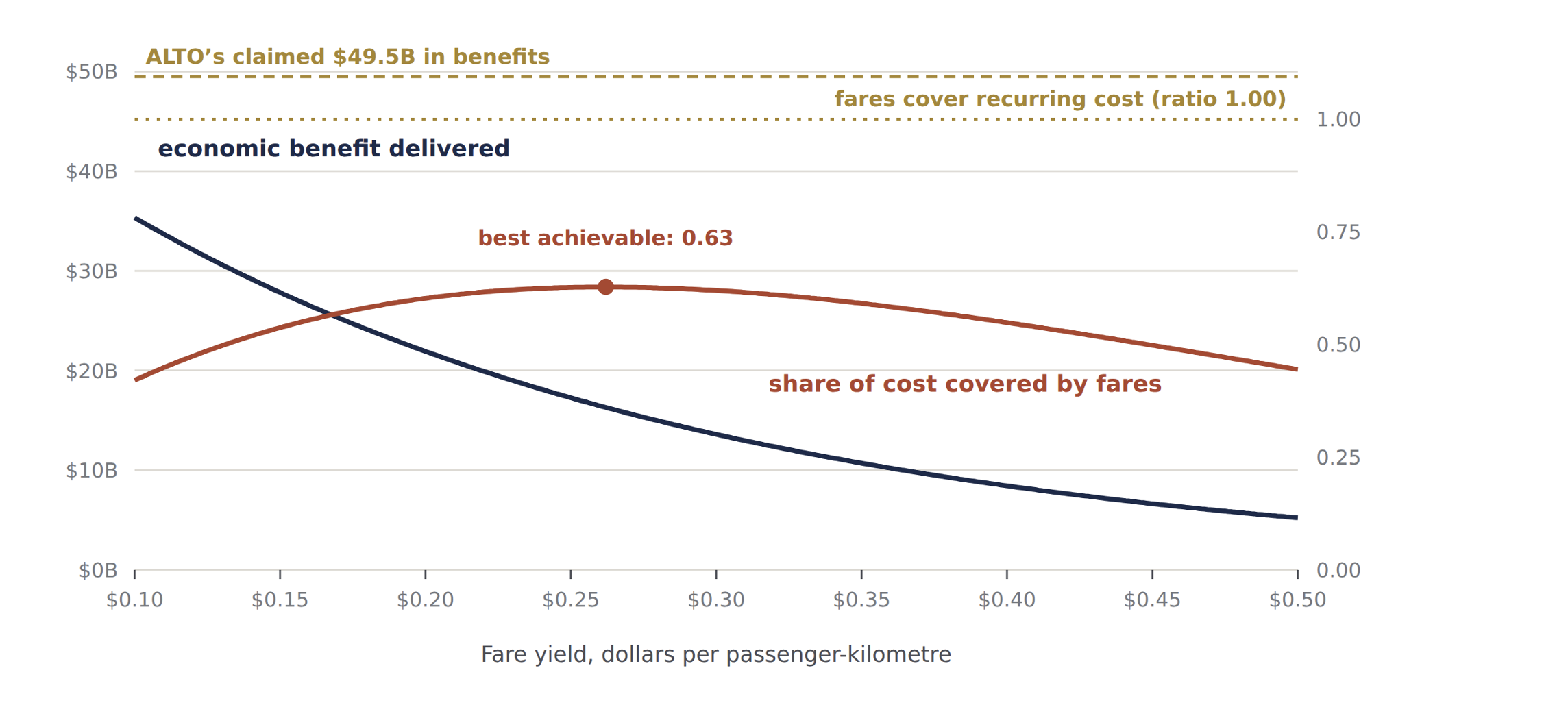
    McGill (2025): Operations cover their own costs at full ridership. Capital must be repaid by public funds at ~C$1.23 billion per year for 47 years, totalling approximately C$61.62 billion before full cost recovery in year 48.

    Munk (2021): Operations cover their costs at a breakeven ticket of C$109. At a more affordable C$75 ticket, the Toronto–Montreal segment alone requires C$5.08 billion in subsidy. The construction phase is publicly financed in both models.

    Why this matters The government defines “subsidy” narrowly — the operating cash transfer required to keep trains running once they are running. The academic studies extend the analysis to capital servicing, which is the much larger lifetime public obligation. A useful way to think about it: a homeowner who rents out a basement suite can truthfully say the rental income covers their utilities and property tax. But the mortgage is still being paid every month, from a different account, on a different schedule. “The suite pays for itself” is technically accurate; it is also not a complete description of the cost of owning the house. ALTO operations being “self-sustaining” is the same kind of statement. The mortgage — roughly C$1.23 billion per year, for 47 years — is still being paid by the public. A reader who treats “self-sustaining” as a description of the project’s lifetime public cost is reading it against the narrowest available technical definition.
    Claim 02 On cost
    The government says

    “Between $60 and $90 billion.”

    Q-923 (April 22, 2026). ALTO’s May 8, 2026 blog post classifies the same figure as an AACE Class 5 estimate — an accuracy range of −50% to +100%.

    The academic record shows

    McGill (2025): Total construction cost C$79.8 billion in 2025 dollars for the full corridor — sits in the upper portion of the government’s range.

    Munk (2021): C$11.94 billion in 2021 dollars for the Toronto–Montreal segment alone, with a 66% contingency already built in. Methodologies and scopes are not directly comparable; neither extrapolates straightforwardly to the other.

    Why this matters The government’s stated range is wide enough to encompass quite different methodological approaches. The accuracy band attached to the underlying Class 5 classification — addressed in the Initiative’s companion brief Reading the Footnote — extends the realistic outturn substantially beyond the stated upper bound. “$60 to $90 billion” is doing the work of multiple very different underlying assumptions. Access to Information documents published by The Canadian Press on May 28, 2025 also show that the corporation now answering for the $60–90 billion figure was, beginning in September 2023, paying a marketing firm to rebrand the project from HFR to HSR — eighteen months before any HSR-specific cost analysis had been tabled to Parliament. The companion brief The Report That Vanished sets out that record in detail.
    Claim 03 On ridership
    The government says

    “43 million annual riders by 2084.”

    Q-923 (April 22, 2026). With construction beginning in 2029, this corresponds to approximately year 55 of operations.

    The academic record shows

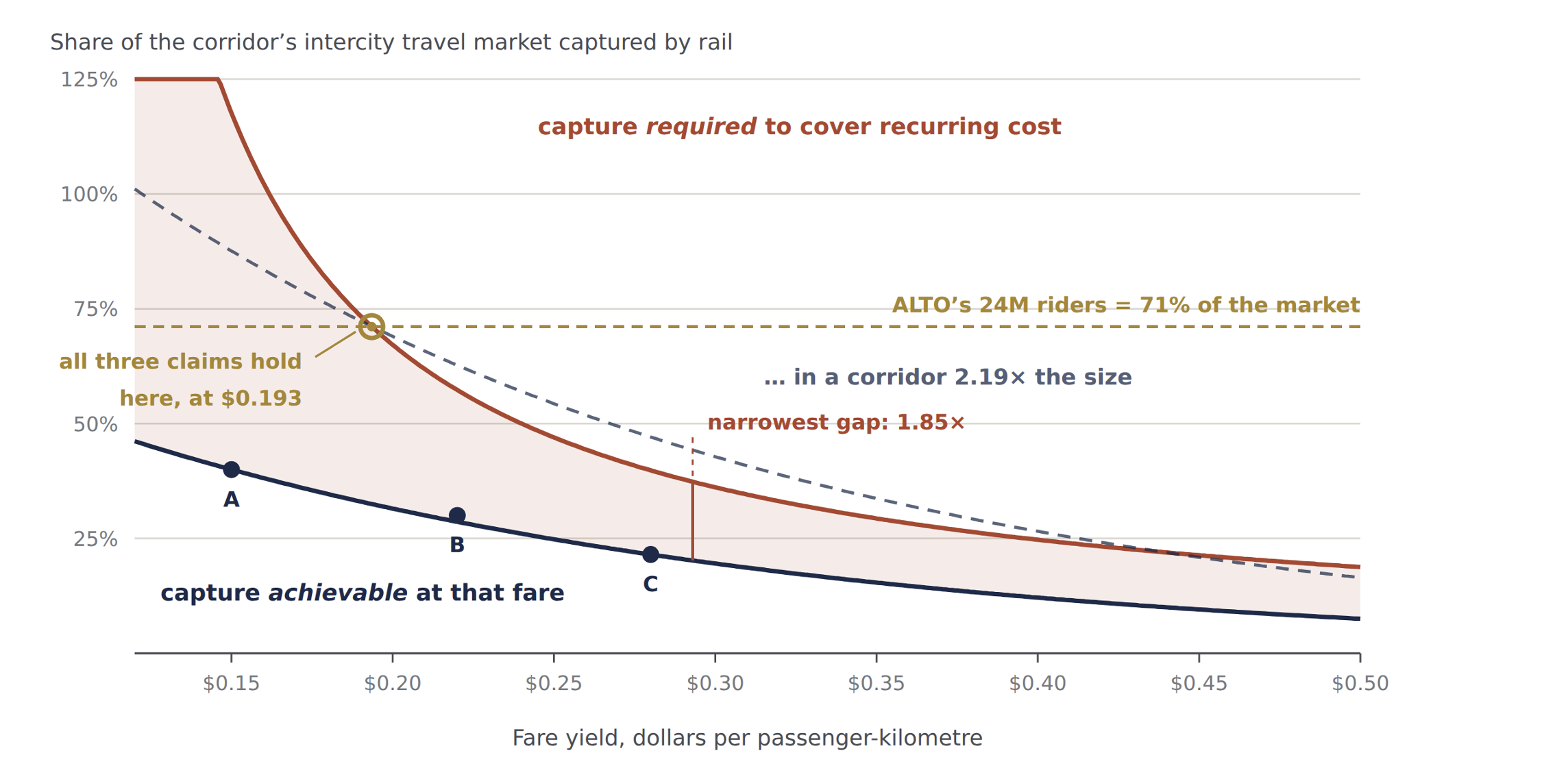
    McGill (2025): 20.8 million annual riders on the full corridor by year 50 of operations.

    Munk (2021): 10.45 million annual riders on the Toronto–Montreal segment by year 30. Using Munk’s own observation that this segment generates ~57% of full-corridor ridership, this implies ~18 million annual full-corridor riders by year 30. The two academic projections converge within 15%; both are approximately half the government figure.

    Why this matters The government’s 43 million figure is roughly twice the academic consensus and is attached to a horizon two to three decades later than the academic projections. By selecting the latest available year and roughly doubling the mature-corridor ridership the academic studies support, the answer constructs a number that is neither directly comparable to the published analyses nor easily falsifiable for several more decades.
    The Disclosure Context

    The parliamentary record Q-923 sits in

    Q-923 was answered on April 22, 2026. The parliamentary record on ALTO that surrounds it is materially thinner than it might otherwise have been. The House of Commons Standing Committee on Transport, Infrastructure and Communities tabled an 18-recommendation report on the same project in September 2024, including specific requests for an HFR-versus-HSR cost analysis (Recommendation 4), the release of the Joint Project Office’s full unredacted report (Recommendation 6), and an analysis of the impact of a dedicated rail line on existing VIA Rail service (Recommendation 8). Transport Canada committed to a formal response that fall or winter. No response was tabled. Parliament was prorogued on January 6, 2025, and the recommendations lapsed procedurally.

    Access to Information documents published by The Canadian Press on May 28, 2025 show that throughout the same period, VIA HFR–VIA TGF Inc. was running an internal rebranding programme: a Quebec-based marketing contract with Cossette Communication Inc. signed in September 2023 (more than $330,000 billed between October 2023 and January 2025), an internal briefing note describing “widespread disinterest” in the HFR framing, and an internal selection of the name “Alto” by April 2024 under the code name “Tracks.” By the time the committee’s six-month deadline for Recommendation 4 arrived, the HFR-to-HSR pivot had been operationally under way for fifteen months. The HFR-versus-HSR cost analysis the committee asked for was never produced. The $60–90 billion figure cited in Q-923 sits within this disclosure context.

    The Initiative’s companion brief The Report That Vanished sets out this parliamentary-process record in detail — the documentary evidence on the marketing-led pivot, the procedural mechanics of prorogation, and the parliamentary mechanisms by which the unanswered recommendations remain available to be revived. The two briefs are intended to be read together: Reading the Answer documents the headline framing of the three specific numerical claims in Q-923, and The Report That Vanished documents the parliamentary record into which those claims were placed.

    Side by Side

    Same project, three different pictures

    Read as one comparison, the three claim cards point in the same direction at every turn. The government’s number describes the largest, latest, or narrowest-defined version of each quantity. The academic record describes a more constrained or more comprehensively defined version.

    Subsidies

    Gov:No operating subsidies

    Acad:~C$61.6 B over 47 yrs (capital)

    Cost

    Gov:$60–90 B (Class 5)

    Acad:C$11.9 B (T–M) — C$79.8 B (full)

    Ridership

    Gov:43 M/yr by 2084 (yr 55)

    Acad:~18–21 M/yr (yr 30–50)

    No single divergence, taken alone, would carry the weight of an argument. Stacked together — cost, ridership, subsidies, all framed in the most favourable way each can be framed — they describe a pattern. The pattern is the brief’s subject.

    The honest answer

    Is the government’s framing realistic?

    The answer depends on what “realistic” is asked to mean.

    If realistic means technically defensible — yes. Each of the three figures in Q-923 can be constructed using some defensible technical methodology. The Minister’s answer is a carefully drafted parliamentary response that would survive most reasonable tests of literal accuracy.

    If realistic means consistent with the picture an informed reader would expect — the answer is more complicated. Two independent academic studies, written by different teams under different funding, with no involvement in the ALTO process, converge on a project that:

    • carries roughly half the ridership the government’s 2084 figure implies, at a horizon two to three decades earlier;
    • requires substantial sustained public capital subsidy over four to five decades, even when operations cover their own costs;
    • could plausibly cost as much as the upper end of the government’s range, or, depending on methodology, materially less.

    The framing in Q-923 is technically defensible. It is not the only available framing of the same underlying material. It is the framing that produces the most favourable headline impression at each of the three points where a choice could be made. Whether to characterise it as “realistic” is finally a judgment for the reader. What this brief documents is that the framing is a choice, and that the academic record provides the basis for reading what each statement leaves out.

    For the next federal statement

    Three questions to ask

    Where the next federal statement on ALTO is concerned — whether in a future Order Paper answer, a ministerial statement, a corporate plan summary, or a public communication from ALTO itself — three questions follow naturally.

    1. On subsidies: What definition is being applied? Does the figure cover operations only, or operations and capital servicing? If capital servicing is excluded, what is its size and duration, and over what time horizon is the public obligation expected to extend?
    2. On cost: What is the basis of the figure? Bottom-up engineering estimate, reference-class-adjusted estimate, or some other methodology? What accuracy band does it carry? Where does the figure sit relative to comparable international HSR projects, adjusted for distance, geography, and construction context?
    3. On ridership: At what horizon is the figure cited? How does it compare to the academic projections at the same horizon? If the comparison is unfavourable, on what basis is the higher figure defended? What sensitivity analysis has been conducted, and what does it show?

    None of these questions presupposes opposition to the project. Each is the kind of question a reasonable reader would ask before forming a view. Each is also the kind of question the parliamentary record has so far not been pressed to answer.

    Download Full Brief
    Reading the Answer (PDF)
    Reference document for federal decision-makers, parliamentarians, journalists, and constituents tracking the file
    Download PDF
    Sources

    Primary documents and references

    1.
    Order Paper Question Q-923, 45th Parliament, 1st session. Asked by Philip Lawrence (MP for Northumberland–Clarke), March 5, 2026; answered by the Minister of Transport and Leader of the Government in the House of Commons, April 22, 2026. ourcommons.ca
    2.
    The Canadian Press, “Via Rail subsidiary paid Quebec marketing firm $330K as it pivoted to high-speed rail,” May 28, 2025. The Globe and Mail published a parallel report on the same Access to Information disclosures the same day. theglobeandmail.com
    3.
    Zhang, B., Negm, H., & El-Geneidy, A. (2025). High-Speed Rail in Canada: Insights from a corridorwide survey and a financial analysis. Transportation Research at McGill, McGill University. Funded by Queen’s University and the Natural Sciences and Engineering Research Council of Canada (NSERC).
    4.
    Bien, P., Iqbal, S., Li, A., & Stecher, I. (2021). High-Speed Rail: Toronto – Montreal Economic Analysis. Global Economic Policy Lab, Munk School of Global Affairs & Public Policy, University of Toronto. Lab Director: Professor Mark Manger.
    5.
    ALTO, “How Much Will Alto’s High-Speed Rail Cost Canadians and how is it Funded?”, blog post published May 8, 2026 — source of the AACE Class 5 classification of the $60–90 billion figure. altotrain.ca
    6.
    ALTO HSR Citizen Research Initiative, Reading the Footnote (Cost Estimation Brief), May 2026 — the companion brief analysing the AACE Class 5 footnote in detail.
    7.
    ALTO HSR Citizen Research Initiative, The Report That Vanished (Parliamentary Process Brief), May 2026 — the companion brief setting out the TRAN Report 18 record, the documented marketing-led HFR-to-HSR pivot, and the procedural mechanisms by which the committee’s recommendations remain unanswered.
  • The report that vanished

    The Report That Vanished

    Eighteen recommendations from Parliament’s Transport Committee. A government commitment to respond. A prorogation in between. And the questions about ALTO that remain unanswered today.

    ⚠ Document Under Analysis

    In September 2024, the House of Commons Standing Committee on Transport, Infrastructure and Communities tabled its 18th Report: Issues and Opportunities: High Frequency Rail in the Toronto to Quebec City Corridor. Six meetings. 33 witnesses. Four written briefs. Eighteen recommendations.

    Transport Canada’s own briefing materials said the government “intends to provide a formal response this Fall/Winter.” The response was never tabled. Documents obtained under Access to Information by The Canadian Press (May 28, 2025) show that the project was simultaneously being rebranded as HSR through an internal process that had been under way since September 2023 — a year before the committee report was even tabled, with more than $330,000 paid to an outside marketing firm. Parliament was prorogued on January 6, 2025. Bill C-15 received royal assent on March 26, 2026 — without the cost analysis, the document release, or the VIA-impact study the committee had asked for.

    Critical Finding

    The recommendations did not fail on their merits. They did not have to be answered. Prorogation ended the committee that asked them; the request to respond technically survives, but the response itself does not. In practice, when prorogation occurs before a response has been tabled, the question evaporates with the parliamentary session.

    The result: a $60–90 billion infrastructure project moved through to royal assent of its enabling legislation without the cost analysis, the preparatory-documents release, or the VIA-impact study that a bipartisan committee had formally asked Parliament to require.

    Download
    The Report That Vanished — Full Brief (PDF)
    Detailed analysis of TRAN Report 18, the marketing-led HFR-to-HSR pivot, the prorogation that intervened, and the parliamentary mechanisms by which the recommendations can still be revived
    Download PDF
    The Committee

    What the Transport Committee did

    On March 7, 2023, the House of Commons Standing Committee on Transport, Infrastructure and Communities agreed to study the proposed High Frequency Rail project, along with two proposed Alberta projects. The committee initially anticipated four meetings; on September 18, 2023, it voted to extend the study. Between September 20, 2023 and February 29, 2024, the committee held six meetings on the file.

    It heard from 33 witnesses: ALTO’s own chief executive Martin Imbleau (then styled CEO of VIA HFR–VIA TGF Inc.); Transport Canada’s ADM for High Frequency Rail Vincent Robitaille; VIA Rail president Mario Péloquin; the Railway Association of Canada; Amtrak; the Urban Institute; HEC Montréal; planners at l’Université de Montréal; chambers of commerce from Trois-Rivières, Québec City, and Metropolitan Montreal; mayoral representatives from Drummondville and Trois-Rivières; Unifor and the International Transport Workers’ Federation; and consultants including civity Management Consultants from Germany. It received four written briefs.

    The committee was bipartisan in the strongest sense. The chair was Peter Schiefke (Liberal). Vice-chairs were Mark Strahl (Conservative) and Xavier Barsalou-Duval (Bloc). NDP transport critic Taylor Bachrach sat on the committee. Conservative members included Scot Davidson, Leslyn Lewis, and Dan Muys — currently Conservative Associate Shadow Minister of Transport. Liberal members included Vance Badawey, Andy Fillmore, Angelo Iacono, Annie Koutrakis, and Churence Rogers.

    The 18-recommendation report was tabled in September 2024. Transport Canada’s October 2024 Deputy Minister briefing materials acknowledged the report and stated:

    “The Standing Committee on Transportation, Infrastructure and Communities has just tabled its report entitled Issues and Opportunities: High Frequency Rail in the Toronto to Quebec City Corridor, to which the Government of Canada intends to provide a formal response this Fall/Winter.”

    — Transport Canada, Deputy Minister briefing (TRAN), October 10, 2024

    The commitment was made in writing. The response was never tabled.

    The Four That Mattered Most

    Recommendations on cost, documents, and VIA Rail

    Of the eighteen recommendations, four are particularly consequential when read against the project as it stands today. Each was specific, evidence-grounded, and addressed a substantive public-interest question. None has been substantively answered.

    Recommendation 4
    Analysis of the cost difference between HFR and HSR
    What the committee asked for

    That the Minister of Transport require VIA HFR–VIA TGF Inc. to provide within six months a budget and a timetable for completing this project, including an analysis of the incremental cost between HFR and HSR, and that this report be tabled in the House of Commons and reported to committee.

    Status as of May 2026

    Never produced. By the time the report was tabled in September 2024, the corporation it was directed at had already been paying an outside marketing firm for a full year to rebrand the project as HSR — the Cossette contract was signed in September 2023, three months before the committee began its second year of hearings. The name “Alto” was selected internally by April 2024. By the time the recommendation’s six-month deadline arrived, the pivot was eighteen months under way. The cost comparison the committee asked for was not produced before the pivot, and has not been produced since. The $60–90 billion AACE Class 5 range in Q-923 (April 22, 2026) now stands without this analysis behind it.

    Recommendation 6
    Release of the Joint Project Office report
    What the committee asked for

    That the government release the Joint Project Office’s full, unredacted report on the HFR project.

    Status as of May 2026

    Not released. The Joint Project Office consumed approximately $18 million in CIB-subcontracted preparatory studies — engineering work by Aecon and Arup, contracts with Ernst & Young, and other studies. Its underlying analysis has never been made public. ALTO is proceeding on the basis of preparatory analysis that Parliament’s own committee formally asked to see.

    Recommendation 8
    Impact on existing VIA Rail service
    What the committee asked for

    That the Minister require VIA HFR–VIA TGF Inc. to provide an analysis of the impact a dedicated rail line will have on existing VIA Rail service in the Toronto–Quebec City corridor: the viability of maintaining current services, the number of trains, on-time performance, and the possible impacts on freight traffic.

    Status as of May 2026

    Not produced. The Senate Transport and Communications Committee, examining Bill C-15 in February 2026, raised the same concern: Transport Canada said VIA-served communities would continue to be served and that service “may be optimized,” and the Senate “questions that assumption.” The analysis the House committee asked for would have answered the question both committees now raise. It has not been provided.

    Recommendation 10
    No reduction in service to communities currently served by VIA
    What the committee asked for

    That the Government of Canada and VIA HFR–VIA TGF Inc. ensure that HFR does not result in a reduction of service to communities currently served by VIA Rail, and that VIA’s regional rail services be connected to the future HFR service wherever possible.

    Status as of May 2026

    Not committed to. ALTO’s published materials refer to “optimization” of existing VIA services but contain no binding commitment that current VIA-served communities will retain present service levels. The House committee request, the Senate committee’s February 2026 concern, and questioning from members in committee (including MP Dan Muys on February 23, 2026) all point at the same unanswered question.

    Also Worth Flagging

    Four other recommendations that touch ongoing CRI work

    Several other recommendations bear directly on questions the Initiative has documented elsewhere.

    Rec. 5

    Asked the government to look to publicly operated HSR systems in Spain, Switzerland, Austria, and Germany to inform the procurement model. The procurement that followed (Cadence: CDPQ Infra, AtkinsRéalis, Systra, Keolis) was a private-led P3 structure. The public-operator comparison was not published.

    Rec. 7

    Asked that the service design be “centred on the objective of providing a mode of transportation that is competitive with travel by car and by air, in order to maximize modal shift.” ALTO’s station decisions (covered in The Last Mile) bear directly on this. The modal-shift analysis was not published.

    Rec. 9

    Asked that travel time be calculated downtown-to-downtown, including transit connections. ALTO’s public travel-time figures continue to be quoted station-to-station rather than door-to-door.

    Rec. 14

    Asked for a governance mechanism “to make coordinated decisions, thus allowing effective communication and collaboration with cities.” The current architecture (covered in What We Know About ALTO’s Reporting and Accountability) places ALTO under the Financial Administration Act Part X regime without project-specific enabling legislation.

    What Happened

    From marketing contract to royal assent

    The sequence of events that produced the HSRN Act — once the Access to Information record published by The Canadian Press in May 2025 is laid out alongside the parliamentary record — runs across nearly thirty months. Two processes overlap: the bipartisan committee study and the internal rebranding contract. They were both happening throughout 2024.

    September 2023
    Cossette contract signed
    VIA HFR–VIA TGF Inc. signs a contract with the Quebec-based marketing firm Cossette Communication Inc. to develop a “brand narrative” and a tagline for a shift to high speed. In the same month, the corporation asks the three qualified procurement bidders to “propose a second option without speed limitations.” The HFR-to-HSR pivot is operationally under way.
    September 20, 2023–February 29, 2024
    TRAN committee hearings
    Across six meetings, the House of Commons Standing Committee on Transport, Infrastructure and Communities hears from 33 witnesses on what is still publicly described as the High Frequency Rail project.
    Late 2023 / Early 2024
    “Widespread disinterest” briefing note
    An undated internal VIA HFR briefing note frames the case for the rebrand: “The concept of ‘high frequency’ faces strong opposition. There’s widespread disinterest and dissatisfaction associated with the term.” Discussions of higher speed “are met with openness,” leading to “greater project support and acceptance.” The note recommends the name change be made early, while public awareness is “relatively low.”
    April 2024
    “Alto” selected internally; code name “Tracks”
    A VIA HFR presentation confirms the name “Alto” has been selected. It is described as embodying “the project’s stronger focus on incorporating higher speeds.” Internally, while work continues, the new name is handled under the code “Tracks.”
    September 2024
    TRAN Report 18 is tabled
    The Standing Committee on Transport, Infrastructure and Communities tables Issues and Opportunities: High Frequency Rail in the Toronto to Quebec City Corridor. Eighteen recommendations — including a request for an HFR/HSR cost comparison within six months. The corporation it is directed at has, by this point, been paying for the HSR rebrand for a full year.
    October 10, 2024
    Government commits to respond
    Transport Canada’s Deputy Minister briefing materials state that the Government of Canada “intends to provide a formal response this Fall/Winter.” The commitment is on the record.
    December 16, 2024
    Formal HFR-to-HSR designation
    Briefing note AY-2024-537411 formally designates the project as HSR. It records what the internal documentary record has already been pointing toward for fifteen months. The document has not been publicly released. The HFR/HSR cost comparison the committee asked for is not produced before this designation.
    January 6, 2025
    Parliament prorogued
    First session of the 44th Parliament ends. Under House procedure: all committee activity ceases; all orders of reference and committee studies lapse. The only aspect that survives is a request for a government response — but not the response itself. The Cossette contract reaches its final invoice the same month.
    February 2025
    Public announcement under the new name
    Then-Prime Minister Justin Trudeau publicly announces “Alto” for the first time, alongside the awarding of a $3.9-billion six-year design contract to the Cadence consortium (CDPQ Infra, AtkinsRéalis, SYSTRA Canada, Keolis Canada, Air Canada, SNCF Voyageurs). The marketing-led rebrand reaches public view.
    February 2025 (post-announcement)
    External reception confirms the marketing logic
    Quebec City Mayor Bruno Marchand tells reporters he is “very happy” with the decision and describes the previous High Frequency Rail project as “crap.” The reception confirms the public-engagement logic the internal briefing notes had set out: openness to higher speeds, scepticism of the high-frequency framing. What the marketing analysis did not address — and what the parliamentary process was meant to produce — was the cost, documents, and VIA-impact scrutiny the committee had asked for to accompany such a change.
    May 26, 2025
    45th Parliament summoned
    New session begins. The TRAN committee is reconstituted with different membership and no obligation to revisit the prior committee’s work. Recommendations are not formally re-adopted.
    May 28, 2025
    Cossette contract reporting published
    The Canadian Press and The Globe and Mail publish parallel reports based on Access to Information disclosures: “Via Rail subsidiary paid Quebec marketing firm $330K as it pivoted to high-speed rail.” The rebrand’s marketing-led, public-opinion-management basis is now on the public record — two days after the new Parliament is summoned, and six months before Bill C-15 is tabled.
    November 2025
    Bill C-15 tabled
    Budget Implementation Act, 2025, No. 1 introduced. Division 1 of Part 5 enacts the High-Speed Rail Network Act — the project-specific statute that grants ALTO Agent of the Crown status, declares the railways works for the general advantage of Canada, and modifies the standard Expropriation Act regime.
    February 12, 2026
    Senate TRCM Second Report
    Standing Senate Committee on Transport and Communications completes a hurried subject-matter study of the relevant divisions of Bill C-15. It raises several of the same concerns about VIA, ridership, and expropriation that TRAN Report 18 had raised — but it is reviewing legislation already in motion, not pre-legislative work shaping the project’s design.
    March 26, 2026
    Bill C-15 receives royal assent
    The HSRN Act becomes law — without the cost analysis (Rec. 4), the JPO report release (Rec. 6), the VIA-impact analysis (Rec. 8), or the no-service-reduction commitment (Rec. 10) that TRAN Report 18 had asked for. The public-opinion analysis on which the marketing-led case for the rebrand rested has not been placed before Parliament for scrutiny.
    April 22, 2026
    Q-923 answered
    The Minister of Transport’s answer to Order Paper Question Q-923 (Lawrence) puts forward three numerical claims — on cost, ridership, and subsidies — that the unanswered TRAN recommendations were specifically designed to make publicly testable. See the companion brief Reading the Answer.
    Why the Erasure Matters

    Four substantive questions, voided procedurally

    Prorogation is a normal feature of Westminster parliamentary government. It is not, in itself, exceptional. What is worth examining is the combination of three things — a substantive bipartisan committee report, an explicit government commitment to respond, and a project redesignation followed by prorogation in the narrow window between the commitment and its fulfilment — and the result that the questions remain unanswered today.

    On cost

    Recommendation 4 asked specifically for the cost difference between HFR and HSR. The redesignation made the comparison more important, not less. It was not produced. The $60–90 billion AACE Class 5 figure in Q-923 now stands as the public record on ALTO’s cost.

    On preparatory work

    Recommendation 6 asked for the JPO’s full unredacted report. The work it commissioned — ~$18 million in engineering studies, consultancies, financial advice — remains outside public view. ALTO is proceeding on the basis of analysis the public, including parliamentarians, has not seen.

    On VIA

    Recommendations 8 and 10 asked, twice, that the dedicated line not reduce VIA service to existing communities. The analysis has not been produced. The commitment has not been given. The same question was raised again by the Senate, and again by MP Dan Muys at committee on February 23, 2026. Asked at least three times across two chambers; not answered.

    On the procurement model

    Recommendation 5 asked for analysis of successful publicly operated HSR systems before the procurement model was locked in. The procurement (Cadence P3) proceeded before the analysis the committee called for was produced.

    The TRAN committee asked the right questions in the right order: cost analysis before the procurement was locked in, preparatory documents released before the project advanced, VIA-service impact studied before a dedicated line was built. The corporation it asked had, by then, already been paying a marketing firm for a year to rebrand the project in a different direction. The procedural sequence that followed — the unmet October 2024 commitment, the formal December 2024 designation document, the January 2025 prorogation, and the eventual royal assent of legislation enacted without the committee’s recommendations being answered — meant that the question of whether the rebrand should have been accompanied by the analyses the committee had asked for never had to be answered substantively before the project moved forward. None of these events is uniquely attributable to any one government, party, or process. What is documented here is that, taken together, they produced an outcome in which a $60–90 billion infrastructure commitment was given its enabling legislation without the parliamentary scrutiny the public record shows Parliament’s own committee had asked for.

    Is This Reversible?

    Four mechanisms that remain available

    The erasure of TRAN Report 18 is procedural rather than substantive. The witness evidence remains in the parliamentary record. The recommendations remain in the tabled report. The unanswered questions remain unanswered — but they have not become unaskable.

    The current TRAN committee

    could adopt a motion to revive the relevant recommendations from Report 18, formally request the response that was not provided in the 44th Parliament, and update the recommendations to reflect the HFR–to–HSR redesignation. The underlying evidence is already on the record; no new hearings would be required.

    A Senate motion

    could request government responses to the substantive recommendations of TRAN Report 18 that bear on questions now governed by the HSRN Act. The Senate’s February 2026 TRCM Second Report already echoed several of the same concerns; a follow-up motion tying them to the unanswered House recommendations would establish bicameral pressure.

    Order Paper questions

    can ask directly why specific recommendations have not been answered. Q-923 (Lawrence) and Q-1191 (Reid) have begun this work in the 45th Parliament; explicitly naming the recommendations of Report 18 would put the procedural-erasure question on the parliamentary record.

    Access to Information

    applications can target the JPO report, the December 16, 2024 HFR–to–HSR briefing note (AY-2024-537411), and the technical record Recommendation 6 had asked be made public. These are sympathetic targets because Parliament’s own committee already formally requested release.

    None of these mechanisms requires the government’s cooperation. Each is available to opposition members of either chamber, and to citizens whose Access to Information rights cover the underlying documents. The erasure of the report is reversible if the political will to revive it exists.

    Download Full Brief
    The Report That Vanished (PDF)
    Reference document for federal decision-makers, parliamentarians, journalists, and constituents tracking the file
    Download PDF
    Sources

    Primary documents and references

    1.
    House of Commons Standing Committee on Transport, Infrastructure and Communities. Issues and Opportunities: High Frequency Rail in the Toronto to Quebec City Corridor. 18th Report, 44th Parliament, 1st Session. Tabled September 2024. ourcommons.ca
    2.
    Transport Canada. Deputy Minister briefing materials (TRAN), October 10, 2024. tc.canada.ca
    3.
    House of Commons Standing Committee on Audit and Oversight (SAMA). Public materials on procedural effects of prorogation, 44th Parliament. parl.ca
    4.
    Standing Senate Committee on Transport and Communications. Second Report on Bill C-15 (subject-matter study), February 12, 2026. sencanada.ca
    5.
    Budget Implementation Act, 2025, No. 1 (Bill C-15), Statutes of Canada 2026, c. 3. Royal assent March 26, 2026. The High-Speed Rail Network Act is enacted as Division 1 of Part 5. parl.ca
    6.
    Order Paper Question Q-923, 45th Parliament, 1st session. Asked by Philip Lawrence (Northumberland–Clarke), March 5, 2026; answered April 22, 2026. ourcommons.ca
    7.
    The Canadian Press, “Via Rail subsidiary paid Quebec marketing firm $330K as it pivoted to high-speed rail,” May 28, 2025. The Globe and Mail published a parallel report on the same Access to Information disclosures the same day. The reporting includes verbatim excerpts from internal VIA HFR–VIA TGF Inc. briefing notes and Cossette Communication Inc. presentations referenced in this brief. theglobeandmail.com
    8.
    ALTO HSR Citizen Research Initiative companion briefs: Reading the Footnote (May 2026); Reading the Answer (May 2026); What We Know About ALTO’s Reporting and Accountability (May 2026).
  • Reading the footnote

    Reading the Footnote

    What ALTO’s $60–90 billion cost estimate actually means — and what the AACE Class 5 label in the footnote tells the public that the headline figure does not.

    ⚠ Document Under Analysis

    On May 8, 2026, ALTO published a blog post titled How Much Will Alto’s High-Speed Rail Cost Canadians and how is it Funded?. The headline figure is $60 to $90 billion. A footnote attributes the estimate to “the Class 5 guidelines set by the Association for the Advancement of Cost Engineering International.”

    That footnote is doing the analytical work in the disclosure. This brief explains what it means and how to read it.

    Critical Finding

    The AACE Class 5 designation in the footnote is the lowest-accuracy cost estimate class in the global standard, intended for concept screening before engineering, geotechnical investigation, station design, or construction contracting have been completed. The accuracy range associated with Class 5 estimates is −50% to +100%.

    Applied honestly to ALTO’s stated $60–90 billion range, that means the realistic outturn range is approximately $30 billion to $180 billion — three to four times wider than the headline range suggests, and skewed toward the upper end.

    This is not a critique of ALTO for being uncertain about cost at the concept stage. Substantial uncertainty is appropriate at this stage. The question is whether the disclosure communicates that uncertainty in a form the public can act on.

    What “Class 5” means

    The AACE classification system

    The AACE International Cost Estimate Classification System is the global standard for describing the maturity and reliability of capital project cost estimates. It defines five classes, numbered from 5 (the least mature) to 1 (the most mature). Each class is tied to a specific stage of project definition and carries a characteristic accuracy range.

    Class 5
    the lowest-accuracy class in the system; intended for concept screening
    AACE RP 18R‑97
    0–2%
    project definition complete at Class 5
    no alignment, design, or contracts
    −50% / +100%
    typical accuracy range at Class 5
    asymmetric: upside risk twice downside
    ClassPurposeProject definitionTypical accuracy
    Class 5Concept screening0% – 2%−20% to −50% / +30% to +100%
    Class 4Feasibility study1% – 15%−15% to −30% / +20% to +50%
    Class 3Budget authorization10% – 40%−10% to −20% / +10% to +30%
    Class 2Control or bid30% – 75%−5% to −15% / +5% to +20%
    Class 1Check estimate65% – 100%−3% to −10% / +3% to +15%

    Class 5 is intended for what AACE calls “screening of viable alternatives” — deciding whether to advance a concept to further study, not committing public funds. At 0–2% project definition, there is no detailed alignment, no completed geotechnical investigation, no station design, no electrical engineering, and no signed construction contract. The estimate is built from per-kilometre parametric assumptions drawn from comparable projects, scaled for length, and adjusted judgmentally for context.

    The accuracy range is wide for a reason: the engineers preparing the estimate genuinely do not know what they will eventually be building. And the range is asymmetric. The upside risk (+30% to +100%) is roughly twice the downside risk (−20% to −50%) — reflecting more than fifty years of empirical experience that infrastructure cost estimates are more likely to be too low than too high.

    Applied to the midpoint of ALTO’s $60–90 billion range, the AACE accuracy band of −50% to +100% produces a realistic outturn range of approximately $37.5 billion to $150 billion. Applied to the upper bound of $90 billion, the upside-risk range extends to roughly $180 billion. The $60–90 billion figure is not a budget envelope; it is the centre of a much wider statistical distribution that current information cannot narrow.

    The empirical pattern

    Which side of the range to expect

    The asymmetry in the AACE accuracy ranges — more upside than downside — is not arbitrary. It reflects more than fifty years of empirical research on infrastructure megaproject cost outturns. The leading scholar in this field is Bent Flyvbjerg, professor at the University of Oxford’s Saïd Business School, who has spent more than twenty-five years compiling the largest dataset of large-project cost outturns in the world. His findings — summarized in Megaprojects and Risk (Cambridge University Press, 2003), in How Big Things Get Done (Currency, 2023), and in several decades of peer-reviewed papers — are remarkably consistent.

    Nine in ten go over

    Of every ten large infrastructure megaprojects studied, nine exceed their original cost estimate in real (inflation-adjusted) terms. The pattern is not isolated to any one country, sector, or political system; it holds across the Flyvbjerg dataset spanning more than a hundred projects and seventy years.

    Rail averages roughly 45%

    For rail projects specifically, the average cost overrun is approximately 45% in real terms. The standard deviation is large, meaning many projects overrun by considerably more than the average; a smaller number come in close to estimate.

    High-speed rail tends higher

    High-speed rail tends to overrun more than conventional rail, for two converging reasons: greater engineering complexity (tighter alignment tolerances, electrification, signalling, grade separation), and the fact that the political case for HSR often rests on ridership forecasts that subsequently prove optimistic.

    Fat tails, not bell curves

    The distribution of cost outcomes is “fat-tailed”: extreme overruns are more common than a normal distribution would predict. A small but significant fraction of large infrastructure projects overrun their original estimate by more than 100%. The mean and the median therefore tell different stories.

    Flyvbjerg’s framework is now incorporated, in various forms, into the cost-estimation guidance of HM Treasury (the UK Government’s “Optimism Bias” supplementary guidance to the Green Book), the Australian Department of Infrastructure, and a growing number of comparable institutions. The technical name for the practice is reference-class forecasting: instead of building a project cost estimate from the inside out (this is what we think it will cost, based on our project), the estimate is calibrated against the actual outturn experience of comparable past projects.

    The reference class · International HSR

    What comparable projects have cost

    International high-speed rail provides the relevant reference class for any forecast of ALTO’s eventual cost. Three large representative HSR projects in democracies with mature engineering and procurement institutions illustrate the pattern:

    ProjectInitial estimateOutcome
    California High-Speed RailUS$33 billion
    2008
    Most recent California Legislative Analyst’s Office and Authority business plan estimate for full Phase 1: ~US$128 billion. The line is not yet operating.
    HS2, United Kingdom~£33 billion
    2010, for the full Y-shaped network
    Pre-cancellation full-network estimates reached ~£100 billion or more. The northern phases were cancelled in 2023; the truncated London–Birmingham line continues, at lower total but higher per-kilometre cost.
    Channel Tunnel~£4.65 billion
    1985
    Final cost: ~£9 billion. Real overrun of roughly 80%. Among the most extensively studied infrastructure cost outturns in the academic literature.

    These are not handpicked outliers. They are large representative HSR megaprojects in democracies with mature engineering and procurement institutions. The pattern they show is consistent with Flyvbjerg’s broader dataset, and is the empirical basis for the asymmetric accuracy band in the AACE classification.

    For ALTO at $60–90 billion Class 5, a reference-class-adjusted central estimate — using the historical outturn distribution of comparable HSR projects — would place the expected outturn meaningfully above the stated upper bound. The exact figure would depend on which reference class is chosen and which adjustment factor is applied; but a defensible central estimate is well into nine figures, and the upper tail of the distribution is materially higher still.

    What is not disclosed

    What ALTO’s post does not say

    ALTO’s May 8 blog post discloses a Class 5 cost range, a brief description of the funding model, the existence of risk-sharing with the Cadence consortium, and the federal investment commitments made to date. What it does not disclose — and what would be necessary to evaluate the project on the merits — falls into four categories.

    Reference-class adjustment

    The post does not say whether the $60–90 billion range is itself a reference-class-adjusted estimate or a bottom-up Class 5 estimate prior to such adjustment. The distinction matters: if the range is bottom-up, the empirical literature would place the expected outturn substantially above the stated upper bound.

    Sensitivity analysis

    The post does not show how the estimate moves in response to specific parameters — ridership, modal shift from car and air travel, construction cost intensity, financing cost, fare-revenue assumptions. A megaproject cost discussion without sensitivity analysis cannot support an informed public judgment.

    Benefit-cost framework

    A cost figure cannot, on its own, answer whether a project is a sound public investment. The standard framework — benefit-cost ratio and net present value — requires both quantified benefits and quantified costs, evaluated against alternative uses of the same capital. ALTO’s blog post discloses neither.

    Funding model in quantified terms

    “A blended model of private capital, fare revenues, and targeted public investment, with construction and operating risks shared with Cadence” describes a structure but does not quantify any of its components. The basic question — what share of the project’s lifetime cost is borne by the taxpayer versus the fare-paying passenger versus the private partner — cannot be answered from the post as written.

    None of these omissions are unique to ALTO. They are common features of project-promoter disclosures at the concept-screening stage of capital projects. But the public interest is in having them addressed, not in having them omitted from the only published cost statement.

    A parallel pattern

    What “self-sustaining” leaves out

    The definitional-line dynamic that runs through the AACE footnote also appears in the government’s parliamentary answers about whether public subsidies will be required.

    In response to Order Paper Question Q-923, answered April 22, 2026, the Minister of Transport stated that “operations are expected to be financially self-sustaining, with revenues covering operations and maintenance costs and eliminating the need for ongoing operating subsidies.” Independent academic analysis published by Transportation Research at McGill (Zhang, Negm, El-Geneidy, 2025) — a Queen’s- and NSERC-funded study that describes HSR throughout in favourable terms — reaches the same narrow conclusion about operations using ALTO’s own published cost figures, and then continues the calculation. The McGill model projects average annual public subsidies of approximately C$1.23 billion to cover capital-repayment obligations, totalling C$61.62 billion before the system reaches full cost recovery in Year 48. The “self-sustaining” framing is technically correct for operations narrowly defined; what it leaves out is the roughly C$3.66 billion in annual capital repayments the public pays separately.

    The structural pattern is identical to the AACE footnote: a technically accurate statement at the top, a definitional line drawn in language most readers will not unpack, and the substantive public obligation kept out of the headline. A reader who acts on the headlines alone — “$60–90 billion” and “self-sustaining operations” — arrives at a picture of the public commitment materially different from the picture the underlying technical material supports.

    For the next cost statement

    Three questions to ask

    Class 5 estimates are not, in principle, inadequate for public communication. They are part of how megaprojects are normally discussed at the concept stage. What is inadequate is presenting a Class 5 estimate as if it were a budget envelope, and burying the methodology in a footnote. The next time a federal infrastructure project releases a cost statement — from ALTO, or from any other proponent — three questions are worth asking.

    1. What is the AACE class of the estimate, and what accuracy range does that imply when applied to the stated figure? A Class 5 figure with a −50%/+100% band tells the public something very different from a Class 3 figure with a −20%/+30% band.
    2. What reference class of comparable past projects has been used to calibrate the estimate, and what does the historical outturn distribution for that reference class suggest about the realistic outturn range?
    3. What benefit-cost analysis accompanies the cost estimate, and what does it show about whether the project is a sound use of the same capital that could otherwise fund alternatives?

    ALTO’s May 8 post answers none of these questions clearly. Whether the answers, when disclosed, support proceeding with the project on the terms now contemplated is a separate question — but the public cannot evaluate that question from the information currently available.

    Sources

    Primary documents and references

    1.
    ALTO, “How Much Will Alto’s High-Speed Rail Cost Canadians and how is it Funded?”, blog post published May 8, 2026. altotrain.ca
    2.
    AACE International, Recommended Practice 18R-97, Cost Estimate Classification System — As Applied in Engineering, Procurement, and Construction for the Process Industries; and 56R-08, … for the Building and General Construction Industries. web.aacei.org
    3.
    Bent Flyvbjerg, Nils Bruzelius and Werner Rothengatter, Megaprojects and Risk: An Anatomy of Ambition, Cambridge University Press, 2003.
    4.
    Bent Flyvbjerg and Dan Gardner, How Big Things Get Done, Currency, 2023.
    5.
    Bent Flyvbjerg, Mette K. Skamris Holm and Søren L. Buhl, “Underestimating Costs in Public Works Projects: Error or Lie?”, Journal of the American Planning Association 68(3), 2002.
    6.
    HM Treasury, Optimism Bias, supplementary guidance to the Green Book. gov.uk
    7.
    California Legislative Analyst’s Office reports on the California High-Speed Rail Authority. lao.ca.gov
    8.
    UK National Audit Office, reports on HS2 including the post-cancellation update. nao.org.uk
    9.
    Order Paper Question Q-923, 45th Parliament, 1st session. Asked by Philip Lawrence (Northumberland–Clarke), March 5, 2026; answered by the Minister of Transport and Leader of the Government in the House of Commons, April 22, 2026. ourcommons.ca
    10.
    Zhang, B., Negm, H., & El-Geneidy, A. (2025). High-Speed Rail in Canada: Insights from a corridorwide survey and a financial analysis. Transportation Research at McGill, McGill University. Funded by Queen’s University and the Natural Sciences and Engineering Research Council of Canada (NSERC).
  • steel

    Three Hundred Thousand Tonnes

    ALTO’s Buy Canadian commitments measured against the technical reality of high-speed rail steel.

    ⚠ On the Record: ALTO CEO on the Domestic Rail Steel Gap

    On September 30, 2025, in an interview with The Logic, ALTO chief executive Martin Imbleau publicly confirmed that the high-carbon-density rail steel required for the 4,000+ kilometres of HSR track is not produced in Canada today. The Canadian Steel Producers Association corroborated: Canadian rail steel production was lost to decades of US free-trade integration. Re-establishing domestic capability would require retooling Algoma Steel or ArcelorMittal Dofasco, with federal financing not yet announced. The Logic

    Critical Finding

    ALTO and Cadence have committed to a Buy Canadian procurement approach for the high-speed rail network. For the steel categories outside the running rails — structural beams for bridges and stations, reinforcing steel, catenary masts, ancillary components — Canadian capacity exists and the framing is operationally credible. For the running rails themselves, the binding constraint is the absence of domestic production capability. The largest rail supplier in North America — the Pueblo, Colorado mill, now Rocky Mountain Steel under the Orion Steel umbrella — is installing a new Danieli mill specifically tooled for HSR-grade rails. Sourcing from Pueblo is politically constrained by 50% US tariffs on Canadian steel. International suppliers (voestalpine, Nippon Steel, ArcelorMittal Europe) are the default fallback.

    The framing-versus-reality gap is closeable — through federal financing of domestic retooling, through honest public framing, or through both — but it is not closed today, and the time available to close it before procurement decisions are locked in is finite. ALTO’s chief executive has already made the underlying admission on the record. Ministerial communications and the project’s own procurement framing have not yet caught up.

    Download
    Three Hundred Thousand Tonnes — Full Brief (PDF)
    Comprehensive category-by-category analysis of ALTO’s Buy Canadian commitments against domestic and international steel supply realities
    Download PDF
    The Tonnage

    What 300,000 tonnes of rail means in context

    ALTO and Cadence have publicly characterized the steel demand of the project as “several hundred thousand tonnes,” with a more specific figure of 4,000+ kilometres of running rails. That rail-steel quantity is the only firm number on the public record. The remaining steel categories must be estimated from the corridor’s stated parameters: 1,000 km of mainly electrified, dedicated passenger track at 320 km/h design speed, with seven stations, multiple major terminals, and a fleet of 30–40 trainsets.

    ~300,000
    tonnes of high-carbon-density rail steel (4,000+ km of running rails)
    Imbleau, on record
    30–40%
    share of total project steel demand represented by running rails (rebar included)
    CRI estimate
    2029–30
    major construction start; pre-procurement activities begin 2026
    ALTO published timeline
    CategoryTonnageBasis
    Running rails≈ 300,000 tImbleau, on record (Sept 2025). 4,000 km × ~60 kg/m HSR profile.
    Turnouts, switches, special trackwork10–20,000 t~200–400 turnouts at 25–50 t each.
    Catenary support structures30–60,000 t17,000–20,000 masts for 1,000 km double-track.
    Structural steel — bridges and viaducts50–150,000 tRoute-dependent; concrete-dominant with steel girders at long spans.
    Structural steel — stations50–100,000 tSeven stations including major terminals.
    Maintenance facilities and depots10–30,000 tMain depot per segment plus secondary facilities.
    Rolling stock (trainsets)10–25,000 t~30–40 trainsets at 400–500 t each, ~60% steel by mass.
    Signal masts, fencing, ancillary15–30,000 t1,000 km × two sides of fencing plus signal portals.
    Reinforcing steel (rebar)200–500,000 tThe wild card — share of viaducts and slab track. Often bundled into concrete supply contracts.

    Outside the running rails, structural beams, plate, rebar, catenary masts, and most ancillary components can be supplied by Canadian producers — ArcelorMittal Dofasco in Hamilton, Algoma Steel in Sault Ste. Marie, Stelco. The Canadian Steel Producers Association has confirmed this: Canadian producers will have no trouble supplying almost all of the structural steel. The supply gap is specifically the high-carbon-density rail steel.

    The Cost Asymmetry

    From tonnes to dollars

    Tonnage and dollars do not move together. Steel categories differ in unit price by an order of magnitude — from commodity-priced rebar at one end, to premium HSR rails in the middle, to specialty manufactured trackwork at the high end. When the tonnage figures from the previous section are converted to approximate value using industry reference pricing, the categories that cannot be sourced from Canadian producers represent a substantially larger share of the procurement than tonnage alone suggests.

    ~35%
    by tonnage: share of steel that cannot currently be sourced from Canadian producers (rails, specialty trackwork, rolling stock steel)
    CRI estimate
    ~50%
    by value: same share when tonnes are converted to dollars (steel categories only, excluding rolling stock)
    CRI estimate, reference pricing
    ~3×
    price multiple: per-tonne cost of HSR-grade rail steel relative to standard commodity rebar
    industry reference pricing
    CategoryApprox tonnageReference price (CAD)Approx value (CAD)
    Running rails — HSR profile~300,000 t$2,500–$3,500 / t$750M – $1.05B
    Turnouts, switches, special trackwork10–20,000 t$8,000–$12,000 / t$120M – $180M
    Catenary support structures30–60,000 t$2,500–$3,500 / t$115M – $160M
    Structural steel — bridges, viaducts50–150,000 t$1,800–$2,500 / t$180M – $250M
    Structural steel — stations50–100,000 t$1,800–$2,500 / t$135M – $190M
    Maintenance facilities, depots10–30,000 t$1,500–$2,000 / t$30M – $40M
    Signal masts, fencing, ancillary15–30,000 t$1,500–$2,000 / t$34M – $45M
    Reinforcing steel (rebar)200–500,000 t$1,000–$1,200 / t$350M – $420M

    The pattern is consistent across categories. Rebar — the largest tonnage line outside the running rails, and a category Canadian producers and importers can supply without difficulty — is also the cheapest per tonne, pricing in commodity markets at roughly $1,000–1,200 CAD. HSR-grade running rails carry a premium of roughly three times that price, reflecting the high-carbon-density specification, head-hardening, and the limited number of mills globally capable of producing 100-metre rails to the relevant hardness. Specialty HSR trackwork — high-angle switches, swing-nose crossings — is sold as engineered units rather than commodity steel, and its effective per-tonne cost is closer to ten times that of rebar.

    Rolling stock: separate procurement, larger scale

    Rolling stock is not included in the per-tonne table above. HSR trainsets at 320 km/h design speed are procured as complete vehicles, with steel content representing only a small fraction of the trainset value — the larger value sits in propulsion, electronics, interiors, and signalling. A fleet of 30–40 trainsets at current-generation HSR reference pricing of roughly $50 million USD per trainset implies a separate trainset procurement of $2 to $3 billion CAD. This procurement is overwhelmingly foreign-sourced, because HSR trainsets at this design speed are not manufactured in Canada (Canadian-based final assembly under Alstom ownership is possible, but the trainset content is overwhelmingly imported).

    Including rolling stock procurement alongside the steel categories, the foreign-sourced share of the project’s combined steel and rolling-stock procurement rises to approximately 65–75% by value.

    A Buy Canadian framing measured in tonnage would substantially overstate the share of the project that domestic suppliers can win. A framing measured in dollars would more accurately reflect both the procurement at stake and the structural reason for the asymmetry. The categories where Canada does not have current capacity — premium-grade rail steel, specialty trackwork, complete trainsets — are also, structurally, the highest-margin categories of railway procurement. They command a premium price precisely because they require specialized capability and capital investment that Canada lost or never developed. Closing the tonnage gap is one decision; closing the value gap is a substantially larger one.

    Reference prices are open-market commodity and specialty steel ranges in Canadian dollars, drawn from industry trade reporting (MEPS International, Steel Business Briefing, Railway Gazette market commentary). Actual contract prices for the ALTO procurement may differ from these reference ranges depending on specifications, contract structure, currency, tariff conditions at the time of procurement, and bundling decisions. The ranges above are intended to illustrate the order-of-magnitude differences between categories, not to predict procurement outcomes.

    What ALTO has said in public

    The Buy Canadian commitments

    ALTO’s published commitments on steel sourcing combine federal policy framing, ministerial communications, and the project’s own procurement-page language. They are not contractual undertakings to source any percentage of steel from Canadian producers; they are statements of intent, supported by an outreach process that began in November 2025.

    November 18, 2025

    “This initiative is one of Canada’s largest infrastructure investments in decades. It is about strengthening our country by building more here at home. This new High-Speed Rail Network will be transformational.”

    — Steven MacKinnon, Minister of Transport, on ALTO/Cadence steel industry outreach announcement. ALTO

    November 18, 2025

    “We will need huge quantities of steel, and we want Canadian steelmakers to be ready to respond to request for proposals, because they are coming fast! This is a massive opportunity for Canadian suppliers, and we want to make sure they can seize it.”

    — Daniel Farina, General Manager, Cadence consortium.

    February 2026 · ALTO procurement page

    “Building on the government’s Buy Canadian initiative, ALTO will seek to leverage domestic resources by sourcing key components for the future rail network from Canadian suppliers wherever possible … However, we recognize that the scale and technical complexity of the project will require the input of international experts and technologies that are not currently deployed in North America.”

    — ALTO Procurement page, altotrain.ca. altotrain.ca

    ALTO has not committed to a percentage Canadian-content target. It has not committed to a domestic-rail-steel timeline. It has not committed to require Cadence to source rails from any particular jurisdiction. The commitments are aspirational: Canadian suppliers preferred where possible; outreach to inform the procurement approach; international suppliers used where domestic capability does not exist. The third commitment is the operative one for rails.

    Comparison · By Steel Category

    The technical reality, category by category

    Each major steel category is assessed for domestic capacity using the same three-state ledger applied elsewhere in CRI’s analysis: Met (Canadian production exists at the required scale and specification); Partial (Canadian production exists but capacity, specification, or timeline is constrained); Not Met (Canadian production does not currently exist at the required specification).

    Running rails — high-carbon-density HSR profile

    ALTO’s claim / framingTechnical / market reality
    Canadian suppliers will be preferred for the 4,000+ km of steel rails required by the network. The Minister of Transport has framed the project as an opportunity for Canadian steelmakers to expand capacity. Federal industrial policy supports the framing.Imbleau, on the record (Sept 30, 2025): “We need 4,000 kilometres of steel track that has a high carbon density. None is produced today in Canada.” The Canadian Steel Producers Association confirms the gap is structural: Canadian rail steel production was lost to decades of US free-trade integration. Re-establishing capability would require retooling, with the business case dependent on sustained demand beyond ALTO. The Logic
    Domestic capacity:Not met

    Turnouts, switches, special trackwork

    ALTO’s claim / framingTechnical / market reality
    Implicit in Buy Canadian framing — outreach to the Canadian steel industry covers “core materials.”HSR-grade specialty trackwork (high-angle switches, swing-nose crossings) is a niche international market dominated by European and Japanese specialty manufacturers (voestalpine VAE, Vossloh). Canadian capacity for HSR-grade specialty trackwork does not currently exist at scale.
    Domestic capacity:Not met

    Structural steel — bridges, viaducts, stations

    ALTO’s claim / framingTechnical / market reality
    Structural beams are a named component of Canadian steel sourcing in ALTO’s announcements. CSPA has confirmed Canadian producers can supply the category without difficulty.Canadian capacity exists. ArcelorMittal Dofasco (Hamilton), Algoma Steel (Sault Ste. Marie), and Stelco produce structural beams, plate, and heavy sections at the scales required. The federal government has pledged more than $800 million to ArcelorMittal and Algoma for equipment upgrades. The constraint is order timing and competing demand, not absolute capacity.
    Domestic capacity:Met

    Reinforcing steel (rebar)

    ALTO’s claim / framingTechnical / market reality
    Rebar is not specifically called out in ALTO’s public framing. In practice, rebar is usually bundled into concrete supply contracts and may not appear under “steel procurement” at all.Canadian producers and importers serve the rebar market at the volumes required. Even if total rebar demand reaches 500,000 tonnes — the upper bound estimate — domestic plus traditional import channels can supply this with no project-specific intervention required.
    Domestic capacity:Met

    Catenary masts and electrification infrastructure

    ALTO’s claim / framingTechnical / market reality
    ALTO’s framing names “catenaries” as a core material category for Buy Canadian sourcing.Catenary support structures (masts, gantries, cantilevers) can be fabricated by Canadian producers to drawings. Engineering and design content typically comes from European suppliers via the SNCF connection in Cadence. Steel fabrication: Canadian; specification and design: international.
    Domestic capacity:Partial

    Rolling stock (trainsets)

    ALTO’s claim / framingTechnical / market reality
    Rolling stock is not the focus of the November 2025 steel outreach. Trainsets are a separate procurement line.HSR trainsets at 300+ km/h are produced by a small number of international manufacturers: Alstom, Siemens Mobility, Hitachi Rail, Talgo, CAF. Canadian-based final assembly is possible (Bombardier’s legacy facilities under Alstom ownership) but the trainset steel content is overwhelmingly imported. The SNCF connection inside Cadence strongly suggests an Alstom procurement.
    Domestic capacity:Not met
    The Supplier Landscape

    Who could actually fill the rail-steel gap

    Three categories of suppliers are positioned to fill the rail-steel gap: domestic producers willing to retool; the Pueblo, Colorado mill, which is the largest rail supplier in North America and is installing a new HSR-grade rolling mill; and established European and Asian HSR rail steel suppliers. Each carries a distinct set of trade-offs.

    Domestic candidates — Algoma Steel and ArcelorMittal Dofasco

    Both have received substantial federal funding for equipment upgrades — totalling more than $800 million across the two firms. Industry Minister Mélanie Joly has signalled that further support for retooling is on the table. When approached by The Logic in September 2025, ArcelorMittal’s response was non-committal: the company indicated it would assess long-term market potential before committing to a pivot. Algoma did not respond. The CSPA’s framing — 300,000 tonnes is “both a lot of steel and not very much” against Canada’s 12-million-tonne annual production — captures the business problem. Retooling for HSR rail steel makes commercial sense only if the order is repeating, not one-off.

    The Pueblo mill — Rocky Mountain Steel / Orion Steel

    The Pueblo facility was, until 2025, EVRAZ North America’s flagship rail mill — the largest rail supplier in North America. Following UK sanctions on the Russian parent in 2022, the North American assets were put up for sale. In June 2025, Connecticut-based private equity firm Atlas Holdings completed a $500 million acquisition, forming Orion Steel with Pueblo operating as Rocky Mountain Steel. Crucially: in May 2025, the mill selected Danieli to supply a new premium rail rolling mill at Pueblo with capacity of 670,000 short tons, producing 100-metre rails up to 88 kg per metre with hardness to 425 BHN. Specifications designed for heavy-haul and high-speed railways. Danieli

    The complication is political. Canada–US trade relations are subject to 50% American tariffs on Canadian steel as of mid-2025, with no signs of resolution. The most logical North American supplier of HSR rail steel sits in the country with which Canada is in an active trade dispute. Sourcing 300,000 tonnes of HSR rail steel from Pueblo while Canadian steel exports face 50% tariffs would be politically untenable on its face.

    International suppliers — Europe and Japan

    The established global suppliers of HSR rail steel are concentrated in Europe and Japan: voestalpine (Austria), ArcelorMittal Europe, Tata Steel Europe, Nippon Steel and JFE Steel (Japan). These are the actual rail suppliers to most operating European and Asian HSR systems. The SNCF Voyageurs presence inside the Cadence consortium creates a natural commercial pathway to European supply. International sourcing carries shipping costs, 12–24 month lead times, and unfavourable political optics — but is the default fallback if domestic retooling is not financed in time and US sourcing remains politically blocked.

    Implications

    Closing the framing-versus-reality gap

    The implications divide naturally between what ALTO and the federal government could address now, and what depends on procurement decisions that lie one or two years ahead.

    Could be committed to now

    Category-level Canadian-content target A commitment in the 80–90% range for non-rail steel — structural beams, rebar, catenary masts, ancillary — would be both achievable and verifiable. The current “to the greatest extent possible” language is not a target. (ALTO)
    Honest framing on rails ALTO and the Minister of Transport could acknowledge publicly that high-carbon-density rail steel is not currently produced in Canada and that procurement of this category will depend on either retooling Canadian producers or sourcing internationally. Imbleau has already made the underlying admission on the record. (ALTO / Transport)
    A retooling financing decision — either way Industry Canada could announce, with a timeline, the federal package that would enable Algoma or ArcelorMittal Dofasco to produce HSR rail steel by 2029–2030. If no such package is contemplated, that should be said publicly. The current ambiguity — Joly’s “may help” phrasing — leaves the procurement question unresolved. (Industry Canada)

    Depends on future decisions

    The actual sourcing outcome for rails This will be made through Cadence’s procurement process, beginning with “pre-procurement activities” in 2026 and RFPs in 2027–2028. The decision will reflect the available market at that time — including whether US tariffs persist, whether Canadian retooling has been financed, and what European and Japanese suppliers offer.
    The political durability of the framing If the procurement outcome is substantially Canadian (with rails from a retooled domestic producer), the framing will be vindicated. If the outcome is substantially international (voestalpine or Nippon Steel), the framing will be retrospectively understood as aspirational language that masked an early procurement decision. The political consequence will depend on whether the public has been prepared in advance for the outcome.
    Where things stand · May 10, 2026

    Summary ledger

    In summary, against the substantive content of ALTO’s Buy Canadian commitments and the technical reality of HSR steel procurement:

    Met
    Structural steel — bridges, viaducts, stations. Canadian capacity exists at the required scale. The Buy Canadian framing is operationally credible for this category.
    Met
    Reinforcing steel (rebar). Domestic and traditional import channels meet demand without project-specific intervention.
    Met
    Ancillary steel (fencing, signal masts, depot framing). Canadian capacity is adequate; commodity category.
    Partial
    Catenary masts and electrification structures. Steel fabrication can be Canadian; engineering and design content typically from European suppliers via the SNCF connection in Cadence.
    Not met
    Running rails — high-carbon-density HSR profile. Not currently produced in Canada (Imbleau, on record, September 2025). Sourcing options: retooled domestic producer (requires federal financing not yet announced), Pueblo / Orion Steel (politically constrained by US tariffs), or international suppliers (voestalpine, Nippon Steel, etc.).
    Not met
    Turnouts, switches, special trackwork. HSR-grade specialty trackwork is a niche international market; Canadian capacity does not exist at scale.
    Not met
    Rolling stock steel content. Trainsets at 300+ km/h are produced internationally; Canadian-based final assembly is possible but steel content is overwhelmingly imported.
    Not met
    Published category-level Canadian-content targets. Not committed. Current framing is aspirational language (“to the greatest extent possible”) rather than measurable targets.
    Not met
    Public acknowledgement of the domestic rail-steel gap. Imbleau has acknowledged this on the record; ministerial communications and ALTO’s procurement framing have not been adjusted to reflect it.
    Not met
    Federal retooling-financing announcement. Industry Canada has signalled possible support without commitment. Lead time required for a Canadian rail steel mill to be operational by 2029–2030 is shrinking.

    ALTO’s chief executive has confirmed publicly that high-carbon-density rail steel is not currently produced in Canada. The Buy Canadian commitments that have been published, taken category by category, are operationally credible for steel outside the rails themselves and are not currently credible for the rails. The gap is closeable — through federal financing of domestic retooling, through honest public framing, or through both — but it is not closed today, and the time available to close it before procurement decisions are locked in is finite.

    Download Full Brief
    Three Hundred Thousand Tonnes (PDF)
    Comprehensive category-by-category analysis for federal decision-makers, industry stakeholders, and constituents tracking ALTO procurement
    Download PDF
    Sources

    Primary documents and reporting

    1.
    Reevely, David. “Alto wants piles of Canadian steel to keep high-speed rail on track.” The Logic, September 30, 2025. Carries Imbleau’s “none is produced today in Canada” admission and Catherine Cobden’s (CSPA) commentary. thelogic.co
    2.
    ALTO. “Alto and Cadence to begin outreach to steel industry in support of Toronto–Quebec City high-speed rail project.” Press release, November 18, 2025. altotrain.ca
    3.
    ALTO. “Procurement.” Page on altotrain.ca, updated February 17, 2026. altotrain.ca/procurement
    4.
    Atlas Holdings. “Atlas Holdings to Acquire EVRAZ North America.” Press release, June 27, 2025. atlasholdingsllc.com
    5.
    Heat Treat Today. “Atlas Acquires Steelmaker EVRAZ North America; Forms Orion Steel.” August 6, 2025. Confirms Orion Steel formation and Pueblo’s operational continuation as the largest rail supplier in North America.
    6.
    Danieli. “EVRAZ North America selects Danieli to supply new premium rail mill.” Press release, May 27, 2025. Confirms HSR-grade specifications: 670,000 short ton capacity, 100-metre rails up to 88 kg/m, hardness up to 425 BHN. danieli.com
    7.
    Railway Age. “Alto HSR Project Advances (UPDATED 12/15).” December 15, 2025. Coverage of November 18 steel-industry outreach announcement.
    8.
    ReNew Canada. “High-speed rail project to support Canadian steel industry.” Coverage of November 18, 2025 announcement. renewcanada.net
    9.
    Daily Commercial News (Construct Connect). “Alto wants steel industry’s feedback on ‘readiness’ for massive high-speed rail project.” November 20, 2025.
  • Alto accountability

    What We Know About ALTO’s Reporting and Accountability

    A $60–90 billion Crown project, governed under the same regime as Canada Post.

    Critical Finding

    ALTO was created by Order-in-Council in 2022, as a wholly-owned subsidiary of VIA Rail. There is no enabling Act of Parliament establishing its mandate, powers, or reporting obligations. Under the Financial Administration Act, ALTO has been deemed a parent Crown corporation for reporting purposes — an administrative designation rather than an Act of Parliament. The framework that follows from this designation requires only summary-level reporting to Parliament, on Treasury Board’s timing.

    This was confirmed on the Senate record by senior Transport Canada officials before the Senate Finance Committee on February 4, 2026, and by the Minister of Transport in his appearance before the Senate Transport and Communications Committee in December 2025. The two descriptions match. This is not a partial picture — it is the entire accountability architecture for the largest federal infrastructure project of the post-war period.

    Download
    ALTO’s Accountability Architecture — Full Brief (PDF)
    Comprehensive analysis of ALTO’s governance, reporting obligations, contractual opacity, and the gaps documented in Senate testimony
    Download PDF
    The Structure

    Three structural facts

    Bill C-15 — the omnibus budget implementation legislation passed earlier this year — has granted ALTO the power to expropriate privately owned land for the high-speed rail corridor. The corporation that will exercise this power has the following structural characteristics, all of which are matters of public record.

    $60–90B
    public cost estimate, characterized by ALTO’s CEO as a working assumption
    Imbleau, May 2 interview
    0
    enabling Acts of Parliament establishing ALTO’s mandate, powers, or accountability
    created by Order-in-Council, 2022
    Same
    parliamentary reporting regime as Canada Post applies to ALTO
    FAA Part X, by deemed designation

    Most parent Crown corporations — Canada Post, the Bank of Canada, the CBC, VIA Rail’s older sister corporations — were established by their own enabling Acts. ALTO was not. It is a subsidiary of VIA Rail, which itself has no enabling legislation, and it was created through an Order-in-Council. The Financial Administration Act applies to it because the Order-in-Council deems it to apply, not because Parliament expressly decided that it should.

    The Senate Finance Committee asked about this directly on February 4. The Transport Canada witness confirmed each of these facts on the record.

    A further structural fact, less visible than the absence of an enabling Act but worth recording, is how ALTO’s directors come into office. Appendix 3 of the Corporate Plan Summary 2025–26 to 2029–30 confirms that directors are identified by the Board itself, recommended to the Minister of Transport, and then formally appointed by VIA Rail (ALTO’s sole shareholder) in consultation with the Minister. The Minister consults rather than appoints. The parent corporation appoints, but only candidates the subsidiary’s own board has nominated. ALTO’s directors are not Governor-in-Council appointees and do not appear in the public GIC appointments database. The board overseeing expropriation and $60–90 billion in proposed capital expenditure is, in appointment terms, substantially self-perpetuating.

    The Reporting Architecture

    What Parliament actually receives

    Under the Financial Administration Act, every parent Crown corporation submits a corporate plan and an operating budget to its responsible minister, who forwards approved versions to the Governor-in-Council. Parliament receives a summary of the corporate plan and a summary of the budget. Treasury Board determines when those summaries are tabled. Annual reports are required and tabled. Parent Crown corporations may be called before parliamentary committees when summoned.

    That is the regime under which a project with public cost estimates between $60 billion and $90 billion will be governed. The Transport Canada witness confirmed this framework before the Senate Finance Committee on February 4. The Minister of Transport described the same framework in his appearance before the Senate Transport and Communications Committee in December 2025.

    Two Officials, One Framework

    What senior officials have told the Senate

    Set side by side, the two appearances — the Minister of Transport before the Senate Transport and Communications Committee in December 2025, and senior Transport Canada officials before the Senate Finance Committee on February 4, 2026 — describe a single, consistent reporting architecture. The fact that two separate officials, before two separate Senate committees, described the same framework in the same terms is itself a finding. There is no additional layer the public has not been told about. What follows is the entire accountability architecture as senior officials understand it.

    Reporting MechanismWhat it Provides — in Officials’ Own Descriptions
    Crown corporation status. The legal foundation for ALTO’s existence and reporting obligations.ALTO is a wholly-owned subsidiary of VIA Rail, created by Order-in-Council in 2022. Because VIA Rail has no enabling Act, ALTO has none either. It is deemed a parent Crown corporation under the Financial Administration Act for reporting purposes. There is no legislated mandate, no statutory definition of its powers, and no statutory framework for its accountability. (Confirmed by the Minister before the Transport and Communications Committee, December 2025; and by the Transport Canada witness before the Finance Committee, February 2026.)
    Corporate plan. The forward-looking strategic and financial document setting out what the corporation intends to do.Submitted to the Minister of Transport for approval, then to the Governor-in-Council. Parliament receives a summary, not the full document. Treasury Board determines when the summary is tabled. The corporate plan itself has not been published.
    Operating budget. The annual financial plan, central to public accountability for a project of this expenditure scale.Submitted with the corporate plan. Parliament receives a summary, not the full budget. The summary’s level of detail is at the discretion of the responsible minister and Treasury Board.
    Annual report. The retrospective accountability document covering the previous fiscal year.Tabled in Parliament, as for all parent Crown corporations. Subject to the same disclosure standards as Canada Post and other established Crown corporations.
    Committee appearances. The mechanism by which Parliament can question ALTO directly.ALTO may be called before parliamentary committees, and has appeared before Senate committees on two occasions to date. Appearances are at the committee’s invitation; there is no scheduled or recurring appearance obligation specific to this project.
    The ALTO–Cadence contract. Described in February 2026 testimony as the project’s first layer of accountability, including a gain-share, pain-share mechanism between the Crown and its private partner.Not publicly available. When asked directly during the February hearing, the Transport Canada witness declined to provide the agreement, characterizing it as a commercial relationship.

    The accountability framework that exists is not a sub-set of a larger framework. It is, on the consistent testimony of the Minister and his senior officials, the framework. There is no additional statutory mechanism that has been mentioned, alluded to, or held in reserve. Parliament knows what it knows, and that knowledge is summary-level, on a schedule controlled by the executive.

    Currently Outside Public View

    What is not in the public domain

    Four documents that would, in a typical major federal infrastructure project, be in the public domain — or at least available to Parliament in unredacted form — are not currently available for ALTO.

    The ALTO–Cadence agreement

    The contract between ALTO and the consortium that will design and operate the high-speed rail system was described by the Transport Canada witness on February 4 as the project’s first layer of accountability, including a gain-share, pain-share mechanism between the Crown and its private partner. Asked directly whether the agreement is publicly available, the witness said it is not, characterizing it as a commercial relationship. The contract that the government has identified as the project’s primary accountability tool is itself unavailable for public scrutiny.

    The financing structure

    The public-private split has not been finalized. The Caisse de dépôt et placement du Québec and Air Canada have committed to equity participation in the Cadence consortium, but the magnitude of private investment relative to public funding has not been disclosed. ALTO’s chief executive has indicated that the published $60–90 billion cost figure is a working assumption rather than an estimate, with reliable cost estimates expected only in 2027 or 2028.

    The ALTO corporate plan

    The full corporate plan submitted to the Minister of Transport and the Governor-in-Council has not been published. Only summaries reach Parliament, on Treasury Board’s timing. For a project of this expenditure scale and physical footprint, the corporate plan is the central document setting out what the corporation will do, when, and at what cost. Its public unavailability is a structural feature of the FAA Part X regime, not an oversight.

    The operational governance instruments

    The Minister of Transport’s mandate letter to the Chair of ALTO, reproduced as Appendix 1 of the Corporate Plan Summary, identifies three operational accountability instruments by name: a Co-Development Charter setting out the government-approved parameters of the Initiative and including a Decision Matrix identifying “Designated Matters” that require ministerial or governmental approval before ALTO may proceed; a bilateral collaboration agreement between Transport Canada and ALTO; and a tripartite agreement among Transport Canada, ALTO, and VIA Rail. None of these three instruments is publicly available. The Financial Administration Act is published statute. The instruments that determine how it is applied to ALTO in operational practice are not.

    Two Clarifications from the February Hearing

    Corrections to the public record

    Two points emerged from the February hearing that correct widespread misunderstandings about the project’s regulatory posture. Both were stated directly by the Transport Canada witness on the Senate record.

    ALTO is not designated under Bill C-5

    Bill C-5 — the Building Canada Act — established the Major Projects Office and its expedited federal review framework. Public reporting and political messaging have at times implied that ALTO is a designated project under this regime. The Transport Canada witness corrected the record on February 4: ALTO has been determined to be a transformative strategy, but it is not currently designated under Bill C-5 as a major Crown project. Whether it will be designated remains undetermined. As of the February hearing, it is not.

    The corporation’s posture toward designation, however, is on the public record. Appendix 5 of the Corporate Plan Summary 2025–26 to 2029–30 identifies, as a formal risk-mitigation activity, “active representation to Government of Canada officials to ask to be designated a project of national interest under C-5.” The plan adds elsewhere that designation “would result in schedule changes and variances in Alto’s funding requirements.” The Crown corporation is on the record lobbying for a regulatory designation that would alter the impact assessment framework applicable to its own project. The channels, content, and recipients of that “active representation” are not disclosed.

    The federal declaration is designed to displace provincial environmental assessment

    Section 4 of the High-Speed Rail Network Act declares the railway to be for the general advantage of Canada. Asked why this declaration was necessary, the witness explained that without it, a provincial environmental impact assessment process might apply to segments wholly within one province — a regulatory uncertainty the legislation is designed to remove. The federal declaration is not, on the witness’s own account, a clarification of pre-existing federal jurisdiction. It is the active mechanism by which provincial environmental review of the corridor is foreclosed. For Eastern Ontario, the practical effect is direct: the Ontario Environmental Assessment Act will not apply to the southern corridor.

    Why This Matters

    Expropriation powers without proportionate oversight

    Bill C-15 has granted ALTO expropriation powers — the authority to take privately owned land for the high-speed rail corridor. The Initiative’s research on the bill has established that this power, on the bill’s terms, can be exercised before the federal Impact Assessment process is complete; that a temporary notice of prohibition of work can attach to land that has not yet been formally expropriated; and that the federal expropriation regime has been adjusted in this legislation to align more closely with provincial practice.

    A power of this magnitude, exercised on this scale, by a corporation without enabling legislation, with summary-only reporting on Treasury Board–controlled timing, with an undisclosed contract with a private consortium, is an architecture that needs strengthening — not because the officials involved are unprofessional, and not because the project is necessarily ill-conceived, but because expropriation of private property at this scale, with public expenditure at this scale, is precisely the situation that parliamentary oversight exists to govern.

    The C-15 powers are not where ALTO’s legislative posture ends. Appendix 5 of the Corporate Plan Summary 2025–26 to 2029–30, under the Land Acquisition and Real Property risk category, lists as risk-mitigation activities “work with the Government of Canada on options to streamline legislative measures by adapting them to the Alto project context and reality” and “provide more efficiency and predictability with regards to the expropriation process.” The corporation that has just received expropriation powers under C-15 has placed on the public record its intention to seek further legislative refinement of those powers. The channels and content of that engagement are not disclosed.

    The Senate Finance Committee’s questioning on February 4 made the gap visible on the parliamentary record. The Initiative’s research has documented the gap from outside Parliament. The two are now mutually reinforcing. What remains is for the gap to be addressed.

    What the Initiative Is Calling For

    Four steps that would close most of the gap

    None of the following requires the project to be paused, cancelled, or fundamentally redesigned. Each is a discrete accountability commitment, available within Parliament’s existing authority, that would bring ALTO’s governance closer to the standard that other major federal Crown projects already meet.

    Within Parliament’s authority now

    Enabling legislation for ALTO An Act of Parliament establishing ALTO’s mandate, powers, and reporting obligations, replacing the Order-in-Council foundation. This brings ALTO into line with other parent Crown corporations of comparable scale and provides Parliament with a statutory anchor for future oversight.
    Public release of the ALTO–Cadence contract With redactions only for genuinely commercial-sensitive information, on the model of routine federal procurement disclosure. The contract that the government has identified as the project’s first layer of accountability cannot serve that function while it remains sealed.

    Standing committee actions

    A Parliamentary Budget Officer review of the project’s economic case, including the benefit–cost ratio, the cost-estimate methodology, and the public-private financing assumptions. A senator has already raised this question with the Minister of Transport at the Transport and Communications Committee, where the Minister confirmed that the PBO is available to senators.
    A standing committee study of the project’s governance and procurement architecture, addressing the gaps documented in the February hearing. Such a study can be initiated under existing Senate or House committee mandates without requiring legislative change.
    Sources

    Primary documents and proceedings

    1.
    Standing Senate Committee on National Finance, Evidence, February 4, 2026 — subject-matter study of Bill C-15. Witnesses from Transport Canada High-Speed Rail Initiative. sencanada.ca
    2.
    Standing Senate Committee on Transport and Communications, Evidence, December 2025 — testimony of the Minister of Transport on the High-Speed Rail Initiative. sencanada.ca/committees/trcm
    3.
    Bill C-15, Budget Implementation Act, 2025, No. 1 — the High-Speed Rail Network Act is contained in Division 1 of Part 5. parl.ca
    4.
    Financial Administration Act, R.S.C. 1985, c. F-11, Part X (Crown corporations). laws-lois.justice.gc.ca
    5.
    Andrew Pinsent, “High-Speed Rail in Eastern Ontario: Rural Backlash, Land Expropriation and Next Steps,” CFRA / Substack, May 2, 2026 — carrying the Imbleau interview confirming acquisition footprint and working-assumption status of the cost figure. Substack
    6.
    Order-in-Council establishing VIA TGF (now ALTO) as a wholly-owned subsidiary of VIA Rail, 2022. Order-in-Council records available through the Privy Council Office. orders-in-council.canada.ca
    7.
    VIA HFR – VIA TGF Inc. (Alto), Corporate Plan Summary 2025–26 to 2029–30. Tabled summary of the corporation’s corporate plan under Part X of the Financial Administration Act. Source for the board appointment mechanism, the C-5 active-representation language, the expropriation legislative-streamlining language, and the three named operational accountability instruments. altotrain.ca
  • Two stories about the same consultation

    Two Stories About the Same Consultation

    A travel-industry article and a survey of consultation participants describe what is supposedly the same process. They do not match.

    Two pictures, both circulating in May 2026

    On May 6, 2026, Travel and Tour World published a piece describing ALTO as “a bold vision for Canadian tourism” — a project the public is welcoming, with $800 million per year in tourism benefits, 50,000 construction jobs, a 1.1% GDP boost, and a “massive wave of feedback” now being analyzed. travelandtourworld.com

    An independent Participant Experience Survey conducted during the same consultation period drew 354 responses from residents along the proposed corridor. 87.8% rated ALTO’s information as Inadequate or Very Inadequate. 85.7% do not believe the consultation was designed to genuinely register community input. citizenresearch.ca

    Summary

    Two characterizations of the ALTO public consultation are now in active circulation. One, in the travel and tourism press, describes a project the public is enthusiastic about, with confident economic figures and a comprehensive June 2026 report poised to “summarize what the public wants.” The other, drawn from 354 residents who actually engaged with the consultation, describes a process that failed across every dimension assessed — notification, information, sessions, and responsiveness.

    This brief sets the two pictures alongside each other, point by point. The economic figures cited in the article appear nowhere in any released business case. The “massive wave of feedback” was, by the testimony of those generating it, neither welcomed nor genuinely heard. The article describes a consultation the public is welcoming. The survey describes one the public has rejected.

    Both pictures cannot be accurate at the same time.

    The Setting

    What is being compared, and why it matters

    The ALTO consultation closed on April 24, 2026. In the weeks since, two narratives about that consultation have begun to circulate publicly.

    The first, exemplified by the May 6 Travel and Tour World article, presents ALTO as a tourism and economic development opportunity that Canadians are embracing. It cites specific figures — $800 million per year in tourism, 50,000 jobs, 1.1% GDP — and quotes the Prime Minister and the ALTO CEO. It frames the consultation as a successful exercise in democratic engagement now poised for implementation.

    The second is the lived experience of residents who actually participated. The ALTO HSR Citizen Research Initiative ran a Participant Experience Survey from March 24 to April 17, 2026, drawing 354 responses (after data-integrity filtering), 85.7% of them from people living in or immediately adjacent to the proposed Eastern Ontario corridor. The full results are publicly available.

    This brief does not draw conclusions about ALTO’s ultimate merits as a project. Its purpose is narrower: to set the public-facing characterization of the consultation, as it appears in the travel-industry press, alongside the documented experience of the people the consultation was meant to engage.

    Side by Side

    The two accounts, point by point

    Each row pairs a claim or framing from the Travel and Tour World article with the corresponding finding from the Participant Experience Survey.

    Travel and Tour World · May 6, 2026Participant Experience Survey · n=354
    On feedback“A massive wave of feedback” now being analyzed for a June 2026 report that will “summarize what the public wants.” On feedback85.7% do not believe the consultation was designed to genuinely register community input. 45.4% take the stronger position: that the process was actively structured to suppress opposition.
    On informationConfident economic figures: $800 million per year in tourism, 50,000 jobs, 1.1% GDP boost, attributed loosely to Transport Canada. On information87.8% rated ALTO’s information as Inadequate or Very Inadequate. The most-cited missing items were environmental impact assessment (65.7%), precise route maps (45.6%), and the financial case — NPV, subsidy, ridership (35.4%).
    On tourism benefitsTreats the $800 million per year tourism benefit as flowing to the corridor regions broadly, including the rural communities the line would pass through. Tourism is the article’s central economic claim. On tourism benefitsInternational HSR research consistently finds tourism gains flow to station communities; communities the train passes through without stopping can lose tourism share as competing destinations become easier to reach. The southern corridor has no planned station between Ottawa and Peterborough. The Frontenac Arch alone supports a ~$1.8 billion regional tourism economy built on quiet, ecologically intact landscapes — assets fundamentally incompatible with a 300 km/h fenced corridor. citizenresearch.ca/tourism-economy
    On reachFrames ALTO as a national conversation, with the public widely engaged. On reachDirect notification from ALTO reached 2.0% of respondents. Awareness spread through neighbours, community Facebook groups, and citizen advocacy organizations. 28.5% learned of the consultation only in its final six weeks.
    On in-person sessionsTreats “over 10,000” in-person attendees as endorsement. On in-person sessionsOf survey respondents who attended an in-person session (n=161), 78.9% rated it Not Very Useful or Not Useful at All. Virtual sessions: 73.5%. Open-ended responses describe young staff with marketing scripts, contradictory answers between representatives, and absent executives.
    On responsivenessPresents ALTO as a project that engages and listens. On responsivenessOf 183 respondents who submitted questions during the consultation, 14 — 7.7% — received a specific, direct answer.
    On positive outcomesDescribes a future of shared sunsets and effortless family visits between Peterborough and Trois-Rivières. On positive outcomesAsked to name the most significant positive feature of the consultation itself, 48.0% identified none. The largest substantive positive theme, at 11.8%, was that the process had “galvanized community opposition.”
    From the Documentary Record

    Two observations, made directly from the two sources

    Without drawing inferences about motive or intent, two observations follow from setting the two accounts side by side.

    1. The figures the article presents as established are figures the public could not find

    The Travel and Tour World article cites $800M/year in tourism benefits, 50,000 jobs, and a 1.1% GDP boost as if these are settled facts. 65.7% of survey respondents named environmental impact assessment as missing information; 35.4% named the financial case — NPV, subsidy, ridership methodology. The economic claims circulating in the travel-industry press are precisely the figures that the public, by their own account, was not given access to evaluate.

    2. The “massive wave of feedback” is not what the article implies

    The article uses the volume of consultation submissions as evidence of public buy-in. The survey shows that 85.7% of those participating do not believe the process was designed to register their input meaningfully, and that 7.7% of those who submitted questions received a specific, direct answer. Volume of submissions, on the testimony of the submitters themselves, does not represent assent. It represents an attempt to be heard within a process most participants regard as already decided.

    The travel-industry article and the participant survey describe what is, in principle, the same consultation. They cannot both be accurate. Readers are invited to compare them directly — the article and the full survey results are linked in the sources below.

    Sources

    The two accounts

    1.
    Travel and Tour World, “Experience Canada Future: Powerful New Alto High-Speed Rail to Boost Tourism,” published May 6, 2026. travelandtourworld.com
    2.
    ALTO HSR Citizen Research Initiative, Participant Experience Survey: ALTO Consultation — What Residents Actually Experienced, published April 17, 2026. Analysis of 354 responses (analytical sample after data-integrity filter) collected March 24 – April 17, 2026. citizenresearch.ca/submission-survey
    3.
    ALTO HSR Citizen Research Initiative, The Southern Corridor Isn’t Just an Environmental Question — It’s an Economic One (Tourism & Economy companion brief). Drawing on CPAWS (2026), Statistics Canada, and international HSR tourism research. citizenresearch.ca/tourism-economy
  • Two targets

    Two Targets

    Ridership figures in ALTO’s 2025-26 Corporate Plan and current public materials, side by side.

    In current ALTO materials

    ALTO’s Corporate Plan Summary 2025-2026 to 2029-30 — the formal accountability document submitted to the Minister of Transport for Treasury Board approval, signed by the Chief Financial Officer in January 2025 — cites a Project Outcome of at least 17 million annual passenger trips by 2059, defined to include “both Alto Passenger Rail Services and Local Services.”

    ALTO’s consultation website, as of May 6, 2026, continues to host a CEO opinion piece projecting 24 million passengers annually by 2055, “fully consistent with international outcomes.” A Globe and Mail editorial citing the same source extended this to 43 million by the 2080s. altotrain.ca

    Summary

    Two ridership figures currently appear in ALTO documents. The figure listed as Project Outcome #1 in the Corporate Plan submitted for Treasury Board approval is 17 million by 2059, defined to include both Alto Passenger Rail Services and the continuation of VIA Rail’s conventional Local Services. The figure in current public-facing materials is 24 million by 2055, rising to 43 million by 2084, presented in reference to Alto.

    The 17 million figure is the same target set in the 2023 Request for Qualifications, when the project was specified as 177 km/h High Frequency Rail at an estimated capital cost of $27.7 billion. It carries forward into the current Corporate Plan, which describes the project as 300 km/h high-speed rail at a Class 4 capital cost estimate of $60–90 billion. The Corporate Plan does not record a formal revision of the figure when the specification changed.

    This brief sets out what each document says, when each figure was published, and what other publicly available evidence indicates about ridership at the corridor scale. It does not draw conclusions about which figure is the operative one. The purpose is to make the documentary record visible.

    Download
    Two Targets — Full Brief (PDF)
    Documentary record of ALTO ridership figures across 2021–2026 publications
    Download PDF
    The Setting

    Why ridership figures matter for accountability

    A megaproject’s ridership projection anchors several other figures: the revenue model, the benefit-cost ratio, the modal-shift carbon argument, and the agglomeration economic case. When a ridership projection moves, related figures move with it.

    For ALTO, two ridership figures are currently visible in the public record. They appear in different documents, communicated to different audiences. This brief sets the two figures alongside each other, with the document trail and the available comparator evidence, and identifies the questions that would resolve which figure is the operative one.

    The brief is not an assessment of either figure on the merits. It is an assemblage of what has been published, in chronological order, with the structural definitions of each figure made explicit. Readers are invited to draw their own conclusions.

    A note on dating the Corporate Plan

    The Corporate Plan Summary 2025-26 to 2029-30 carries a CFO attestation dated January 7, 2025. Several elements of its content, however, post-date that signature: it describes the February 2025 HSR announcement and Cadence selection, the March 2025 PDA execution, Stage 1 of Co-Development as having “occurred from April 2025 to July 2025,” and workforce figures “as of May 2025.” Appendix 12’s chronology ends with August 2025. The document was therefore finalised in approximately mid-2025, with the CFO attestation date preserved as the formal accountability anchor. References in this brief to the Corporate Plan should be read with that timing in mind.

    Side by Side

    The two figures, in their own words

    Both figures appear in current ALTO materials. Both are being communicated to different audiences in May 2026.

    Public Materials · May 6, 2026Corporate Plan to Treasury Board · 2025-26
    24 million by 2055, rising to 43 million by 2084

    From the Imbleau opinion piece originally published in the Toronto Star and La Presse on April 17, 2026, reposted on the consultation site as of May 6, 2026:

    “Alto’s projected 24 million passengers annually by 2055 is fully consistent with international outcomes, based on the modelling used worldwide.”

    The Globe and Mail editorial citing the same source extended this to “43 million by the 2080s, up from three million today.”

    This figure is referenced in connection with the project’s benefit-cost claims, the 1.1% GDP uplift estimate, and the 50,000-job projection.
    At least 17 million by 2059

    From the Corporate Plan Summary 2025-26 to 2029-30, Project Outcome #1, signed by the CFO January 7, 2025:

    “Significantly Increase Intercity Rail Passengers to at least 17 million by 2059 through both the new passenger rail services (NPRS Services) and Local Services through increased annual seat capacity.”

    The same figure appears in Appendix 9 (Long-term Outcomes) as: “up from 4.8 million in 2019, including both Alto Passenger Rail Services and Local Services.”

    This is the figure listed as a Project Outcome in the document submitted for Treasury Board approval.

    Three observations about the two figures, drawn from the documents themselves:

    The 17 million figure includes Local Services

    The Corporate Plan target counts “Alto Passenger Rail Services and Local Services” together. Local Services is the planning term, defined in the Corporate Plan’s glossary, for VIA Rail’s continuing conventional service in the Quebec City–Windsor corridor. The 24 million public figure, as presented, is referenced in connection with Alto. The two figures therefore measure across different scopes.

    The 17 million figure carries forward unchanged from the 2023 RFQ

    17 million by 2059 was the Project Outcome attached to the 2023 Request for Qualifications, when the project was specified as 177 km/h High Frequency Rail at an estimated capital cost of $27.7 billion. The same figure, with the same target year, appears in the Corporate Plan that describes the project as 300 km/h high-speed rail at a Class 4 cost estimate of $60–90 billion. Project Outcomes are formally established in procurement documents and are not trivially revised; the Corporate Plan does not record a revision to this figure on either the specification change or the cost-envelope change.

    The two figures use different baseline years

    The Corporate Plan cites a 4.8 million baseline from 2019 (pre-COVID). The Imbleau opinion piece cites “three million today.” VIA Rail’s 2024 Annual Report records 4.19 million corridor passengers, of which 3.34 million on Corridor East. The growth multiplier from each baseline to its corresponding target therefore differs.

    Document Trail

    When each figure was published

    The chronology below sets out the principal ALTO ridership figures in the public record, in order of publication.

    DateDocumentHeadline ridership figure
    December 2021 JPO Business Case Update v.002
    VIA / CIB internal (released via ATI, November 2025)
    405M cumulative30-year cumulative trips 2030–2059 for HFR Electric scenario, an average of approximately 13.5 million per year. BCR ~ 0.4. NPV −$21.1 billion.
    February 2023 Request for Qualifications (HFR)
    PSPC, 126 pp.
    17M by 2059The Project Outcome attached to the 177 km/h HFR specification at an approximate $27.7B capital cost. Zero operating subsidy was a parallel commitment.
    February 2025 HSR announcement
    Government of Canada
    Specification changeProject rebranded from 177 km/h HFR to 300 km/h HSR. Cadence selected as Private Developer Partner. $3.9B Co-Development Phase funding announced.
    March 2025 Fast Forward: Shaping Canada’s Future
    ALTO public document
    24M by 2055
    43M by 2084
    Stated baseline of “3 million today.” Used in subsequent ALTO public materials and consultation graphics; cited in the Globe and Mail editorial.
    CFO signature
    Jan 7, 2025
    (finalised
    mid-2025)
    Corporate Plan Summary 2025-26 to 2029-30
    Treasury Board submission
    17M by 2059Listed as Project Outcome #1. Defined to include “both Alto Passenger Rail Services and Local Services.” 4.8M (2019) baseline. CFO attestation dated January 7, 2025; document content references events through summer 2025.
    April 17, 2026 Imbleau opinion piece
    Toronto Star · La Presse · ALTO website
    24M by 2055Published one week before the consultation deadline. Described as “fully consistent with international outcomes, based on the modelling used worldwide.” Reposted on ALTO’s consultation site, where it remains as of May 6, 2026.

    The chronology has a feature worth surfacing on its own. The 24 million and 43 million figures first appear in the Fast Forward document of March 2025. The Corporate Plan, finalised in approximately mid-2025, references only the 17 million figure as a Project Outcome and does not mention, footnote, or otherwise acknowledge the higher Fast Forward figures. The April 2026 Imbleau opinion piece reverts to the 24 million figure for public-facing communications.

    In other words: since at least March 2025, the two figures have been running on parallel tracks. The lower figure has appeared in formal accountability documents (the Corporate Plan submitted for Treasury Board approval). The higher figure has appeared in public-facing communications (the Fast Forward document, the consultation website, the CEO’s opinion pieces, and external commentary citing them). Neither document has reconciled the two, and neither has stated which is the operative ridership target.

    Adjacent Disclosure

    The cost figure, in the same period

    The Imbleau opinion piece of April 17, 2026 contains the following statement on the project’s capital cost:

    “In order to finalize project cost, we need to know what is being built and where. We must choose the best alignment through consultation. Then comes detailed engineering for bridges, tunnels and the design; a 320 km/h train requires millimeter level precision.”

    The publicly cited Class 4 capital cost estimate is $60–90 billion. The Co-Development Phase funding of $3.9 billion has been approved and is being expended over fiscal years 2024-25 to 2029-30 per the Corporate Plan. The CEO’s statement above appears in the same publication on the same day as the 24 million ridership figure cited earlier in this brief.

    This brief makes no inference about the relationship between the cost statement and the ridership figures. They are presented here together because they appear in the same document and are part of the documentary record currently available to the public.

    Comparator Evidence

    Other publicly available ridership analyses for the corridor

    For context, three additional sources of corridor ridership analysis are part of the public record. Each uses a different methodology and a different scope.

    Munk School Global Economic Policy Lab (Toronto–Montréal segment only)

    The University of Toronto’s Global Economic Policy Lab published an analysis projecting 9.44 million annual passengers by year 20 and 10.45 million by year 30 on the Toronto–Montréal segment, which the GEPL identified as generating 57% of total corridor ridership. Scaled to the full corridor on the GEPL’s own segment-share assumption, this implies approximately 16–17 million by year 20. This is the only independent academic modelling exercise for the corridor that has been published with a disclosed methodology.

    JPO Business Case Update v.002 (December 2021, ATI release)

    The Joint Project Office Business Case Update released through Access to Information by the Canada Infrastructure Bank in November 2025 projects 405 million cumulative trips over 30 years (2030–2059) for the HFR Electric scenario, an average of approximately 13.5 million per year. The same document records a benefit-cost ratio of approximately 0.4 and a 30-year NPV of −$21.1 billion against a $27.7B capital cost baseline.

    VIA Rail Annual Report 2024 (current corridor baseline)

    The most recent published actual corridor ridership figure is 4,191,080 passengers in 2024, of which 3,336,057 on Corridor East (Quebec City–Toronto). The Montréal–Ottawa–Toronto segment alone carried 2,314,024 passengers. These figures were achieved with on-time performance averaging 51% for the year.

    No reconciliation between the ALTO 17 million Corporate Plan figure, the ALTO 24 million public figure, and these comparator analyses has been published.

    From the Documentary Record

    Five things visible in the public record

    Without drawing inferences about motive or intent, five observations can be made directly from the documents reviewed for this brief.

    1. The two figures have been running on parallel tracks since March 2025

    The 24 million figure was introduced in the Fast Forward document of March 2025. The Corporate Plan was finalised in approximately mid-2025; it references only the 17 million figure as a Project Outcome and does not mention or footnote the Fast Forward figures. Both figures remain in active circulation in May 2026: the 17 million figure in the Corporate Plan, the 24 million figure in the consultation website and the CEO’s April 2026 opinion piece.

    2. The two figures have different scopes

    The 17 million figure is defined as “Alto Passenger Rail Services and Local Services” combined. The 24 million figure, as presented in the Imbleau opinion piece, references Alto. The Corporate Plan does not break the 17 million figure into Alto-component and Local-Services-component shares.

    3. The 17 million figure was set under the previous specification

    17 million by 2059 was the Project Outcome attached to the 2023 RFQ for the 177 km/h HFR specification at $27.7B. The same figure carries forward into the Corporate Plan that describes the project as 300 km/h HSR at $60–90B, without a recorded revision to the target.

    4. The capital cost is also presented as a working figure

    The CEO has publicly stated that “in order to finalize project cost, we need to know what is being built and where.” The Class 4 estimate of $60–90 billion is, on this account, a working figure pending corridor selection and detailed engineering. The Co-Development Phase funding of $3.9 billion has been approved and is being expended.

    5. Independent ridership review remains unpublished

    The Parliamentary Budget Officer has not published a review of either the cost or the ridership figures. The only independent academic modelling exercise for the corridor with a disclosed methodology, the Munk School GEPL analysis, projects approximately 16–17 million for the full corridor by year 20 of operation.

    Where things stand · May 6, 2026

    Disclosure ledger

    The following items are, or are not, currently in the public record.

    Disclosed
    Corporate Plan ridership figure: 17 million by 2059, including Alto Passenger Rail Services and Local Services. Corporate Plan Summary 2025-26 to 2029-30, Project Outcome #1.
    Disclosed
    Public-facing ridership figure: 24 million by 2055, rising to 43 million by 2084. Fast Forward (March 2025); Imbleau opinion piece (April 2026); ALTO consultation website (current).
    Partial
    Definition of the 17M target. Disclosed in Appendix 9 of the Corporate Plan as including Local Services, but not surfaced in summary communications about the figure.
    Not disclosed
    Demand modelling methodology for either the 17 million or the 24 million figure. No model documentation, elasticity assumptions, modal-shift coefficients, or sensitivity analysis has been published for either figure.
    Not disclosed
    Reconciliation between the two figures. No public ALTO statement explaining the relationship between the Corporate Plan figure and the public-marketing figure, or stating which is intended to be the operative ridership target.
    Not disclosed
    The Alto-only share of the 17M target. The Corporate Plan does not break the 17 million into the share attributable to high-speed services and the share attributable to Local Services.
    Not disclosed
    Updated benefit-cost ratio for the current 300 km/h HSR specification at $60–90 billion capital cost against the 17M ridership target. The last published BCR (~0.4) was calculated against the $27.7B HFR specification.
    Not disclosed
    Door-to-door journey time projection from representative origin points, accounting for the now-likely suburban Toronto station and Tremblay Ottawa terminus. The 24M figure is presumed to assume downtown-to-downtown service that is no longer the operating reality.
    Not disclosed
    Independent demand audit results from the Parliamentary Budget Officer or comparable independent body, against either the 17M or the 24M figure.
    Download Full Brief
    Two Targets (PDF)
    Documentary record of ALTO ridership figures, with comparator analyses
    Download PDF
    Questions for the Minister and the PBO

    Six questions that would resolve the disclosure gaps

    The following questions, addressed to the Minister of Transport and to the Parliamentary Budget Officer, would surface the items currently undisclosed.

    Question 1 “Which is ALTO’s operative ridership target: the 17 million by 2059 figure in the Corporate Plan submitted for Treasury Board approval, or the 24 million by 2055 figure in the Corporation’s consultation materials and the CEO’s opinion pieces?”
    Question 2 “Will ALTO publish a breakdown of the 17 million Project Outcome figure into the share attributable to Alto Passenger Rail Services and the share attributable to Local Services?”
    Question 3 “Will ALTO publish the demand modelling methodology, elasticity assumptions, modal-shift coefficients, and sensitivity ranges underpinning both the 17 million and the 24 million figures?”
    Question 4 “What is the updated benefit-cost ratio for the current 300 km/h high-speed rail specification at the Class 4 capital cost estimate of $60–90 billion, calculated against the 17 million Treasury Board ridership target?”
    Question 5 “Has the Parliamentary Budget Officer been asked to review the ridership and cost figures underpinning ALTO’s benefit-cost case, and if so, what is the expected timeline for publication of that review?”
    Question 6 “Given the Corporation’s acknowledgment that ‘in order to finalize project cost, we need to know what is being built and where,’ what is the formal status of the $60–90 billion capital cost figure relative to the $3.9 billion in Co-Development Phase funding already committed?”
    Sources

    Primary documents

    1.
    VIA HFR–VIA TGF Inc. (Alto), “Corporate Plan Summary 2025-2026 to 2029-30,” submitted to the Minister of Transport for Treasury Board approval, signed by the Chief Financial Officer January 7, 2025. Project Outcome #1 (Executive Summary, Appendix 2, Appendix 9, Appendix 13).
    2.
    Martin Imbleau, “High-speed rail is not a leap of faith: Why it matters for Canada’s growth,” opinion piece published Toronto Star and La Presse, April 17, 2026; reposted on ALTO consultation website. altotrain.ca (retrieved May 6, 2026)
    3.
    ALTO, “Fast Forward: Shaping Canada’s Future with a High-Speed Rail Network,” explanatory document, March 2025.
    4.
    Public Services and Procurement Canada, “Request for Qualifications — High Frequency Rail Project (RFQ No. T8128-210188/C),” February 17, 2023. Project Outcomes including 17M ridership by 2059 and zero operating subsidy. 126 pages.
    5.
    VIA Rail Canada / Canada Infrastructure Bank, “JPO Business Case Update v.002,” December 2021. Released through Access to Information by CIB, November 2025. Source for 405M cumulative trips, BCR ~0.4, and 30-year NPV of −$21.1B for HFR Electric option.
    6.
    VIA Rail Canada, “Annual Report 2024,” published 2025. 2024 actual corridor ridership: 4,191,080 passengers; Corridor East subtotal: 3,336,057; Montréal–Ottawa–Toronto segment: 2,314,024.
    7.
    The Globe and Mail, editorial referencing ALTO ridership projections: “projected ridership numbers – 24 million trips annually, in the 2050s, rising to 43 million by the 2080s, up from three million today.”
    8.
    Munk School of Global Affairs and Public Policy, University of Toronto, Global Economic Policy Lab analysis of Toronto–Montréal HSR ridership: 9.44 million by year 20; 10.45 million by year 30 on Toronto–Montréal segment (57% of corridor).
  • Last mile

    The Last Mile

    What ALTO’s Toronto and Ottawa station decisions mean for urban residents — and for door-to-door travel times the marketing does not show.

    ⚠ Recent Developments

    On April 30, 2026, ALTO chief executive Martin Imbleau publicly confirmed that the Greater Toronto Area may receive two stations rather than one, with a suburban station built first because, in Imbleau’s description, a downtown station may take longer due to dense urban conditions. A timeline for the downtown station was not specified. CP24 / Canadian Press

    On May 1, 2026, federal Transport Minister Steven MacKinnon publicly indicated that the former Union Station on Rideau Street in downtown Ottawa is not an ideal location for the city’s high-speed rail terminal, citing geotechnical challenges. ALTO’s chief executive concurred separately on Radio-Canada that a downtown station would have to be underground and would slow trains. The existing VIA Rail station on Tremblay Road, east of the downtown core, has emerged as the operative option. Globe and Mail

    Critical Finding

    For urban residents in Toronto and Ottawa, ALTO’s marketed three-hour Toronto–Montreal journey is not a door-to-door figure. The station decisions now visible in the public record place the boarding and arrival points outside both cities’ downtown cores. The Toronto two-station framing defers the downtown station to an unspecified future timeline that may not arrive within this generation. The suburban station that gets built first will be the operational reality for the foreseeable future.

    The access and egress time this configuration adds at each end of every trip is not addressed in ALTO’s public materials. Door-to-door, the marketed three-hour Toronto–Montreal journey is closer to four and a half hours. The two-hour Toronto–Ottawa journey is closer to three to three and a half hours. The proposition that has carried ALTO’s political case — downtown to downtown in half the time — is not the proposition the disclosed station decisions deliver.

    Download
    The Last Mile — Full Brief (PDF)
    Extended urban impact analysis with Mirabel, HS2, and California high-speed rail precedents
    Download PDF
    The Setting

    What is at stake for urban residents

    Most public discussion of ALTO’s impacts has, understandably, focused on rural communities along the corridor — on farmland, on Eastern Ontario, on the small communities whose VIA service may be reduced or eliminated. That focus is appropriate: those communities sit directly in the path of a fenced sixty-metre right-of-way with three-metre security walls running for one thousand kilometres.

    ALTO is not only a rural infrastructure project, however. It is also an urban one — perhaps especially an urban one, since the project’s political case rests on the proposition that residents of Toronto, Ottawa, Montréal, and Québec City will be able to step on a fast train in their downtown and arrive in another downtown a few hours later. That proposition is the implicit promise behind the $60–90 billion price tag, the 51,000-job claim, and the $35 billion in projected GDP impact.

    The station decisions now visible in the public record — the Toronto two-station framing announced April 30, the Ottawa Tremblay-over-downtown signal of early May — bear directly on whether that promise will be delivered. They do so for urban residents who have not yet been a focus of the consultation conversation. The consultation that closed April 24 was overwhelmingly attended by residents of corridor communities along the proposed route. Urban residents at the corridor’s endpoints — the implied beneficiaries of the project — were largely absent.

    This brief is for them.

    Toronto

    Two stations, one of which is built first — and one of which is for later

    On April 30, 2026, ALTO chief executive Martin Imbleau told reporters that the Greater Toronto Area may feature two high-speed rail stations rather than one. The announcement was widely reported as a service expansion. Read carefully, it is something different.

    Imbleau’s framing was that a secondary station in a nearby suburb could ease the delays associated with constructing a downtown station — which, he indicated, would take longer to build given the dense urban environment. The suburban station gets built first because the downtown station is harder. The downtown station is to follow on a timeline that has not been specified.

    Three points follow from this disclosure that have not, in the reporting to date, been drawn out clearly.

    1. The downtown station has no timeline

    ALTO has not committed to a date by which a downtown Toronto station will be operational. It has not committed to begin construction of a downtown station at a specified point. It has not committed to designs, to a station location, or to a project envelope. The downtown station, at this stage, is a stated intent rather than a project deliverable.

    2. The suburban station will be the operational reality for the foreseeable future

    The Toronto–Quebec City eastern segment is, on ALTO’s own published timeline, the last segment to be built. Construction on the central Ottawa–Montréal segment begins in 2029. The eastern segment construction is to launch “simultaneously” with the central segment, but no completion date has been published. If the Toronto suburban station opens with the rest of the eastern segment, the downtown station — if it ever follows — would arrive years later.

    3. A second station that is never built remains a single suburban station

    Promises to build later infrastructure are common in public-sector mega-projects; their delivery is far less common. The federal commitment is to one station — the suburban one — with the downtown station contingent on technical, financial, and political conditions that have not yet been specified, let alone met. Until those conditions are met, the operational system has one Toronto station, in a location that is not yet identified, somewhere in the suburbs.

    ALTO has separately confirmed that Toronto’s Union Station is not the front-runner for the eventual downtown station either. At a Senate transport committee meeting in December 2025, Imbleau said the objective is a station “in the vicinity of Union Station,” without ruling Union itself out, but signalling clearly that it is not the leading option. The technical reasons have not been publicly explained, but the constraints are well understood: the Union Station Rail Corridor is already the busiest rail corridor in Canada, owned by Metrolinx and operated by Toronto Terminals Railway (a CN/CP joint venture), with platform and trackage capacity already constrained by GO Expansion. TorontoToday

    For an urban resident contemplating an ALTO trip from downtown Toronto, the question is therefore not “which downtown station will I leave from” but “which suburban station will I leave from, and how do I get there.” The published consultation materials identify a study corridor approaching Toronto from the east through industrial and agricultural areas, leveraging existing rail, highway, and utility corridors. The likely siting locations for a suburban station have not been disclosed; the candidates publicly speculated about include eastern Toronto, Pickering, Markham, and Scarborough.

    Ottawa

    How the downtown option was set aside

    Ottawa’s station decision is further along than Toronto’s, and the operative direction is now visible. Two locations were under consideration: the former Union Station on Rideau Street — the city’s grand 1912 Beaux-Arts terminal, currently the temporary Senate building, located steps from Parliament, the National Arts Centre, and the ByWard Market — and the existing VIA Rail station on Tremblay Road, built in the 1960s, located east of downtown along the city’s LRT line.

    Local consensus, as expressed publicly in the months before the consultation closed, favoured the downtown Rideau Street option. Mayor Mark Sutcliffe explicitly backed the downtown option in late January. Days before the consultation closed, the Ottawa Board of Trade, Invest Ottawa, and Ottawa Tourism issued a joint letter calling on ALTO to complete a feasibility study comparing both sites — including comparative ridership, catchment area, end-to-end journey time, and multimodal connectivity. The National Capital Commission, which manages the Rideau Canal and the surrounding heritage areas, expressed openness to collaborating with ALTO on a downtown station. Ottawa Business Journal

    On May 1, 2026, federal Transport Minister Steven MacKinnon, speaking with reporters at an unrelated announcement at Ottawa airport, indicated that the downtown Union Station option presents geotechnical challenges. He cited the 2016 Rideau Street sinkhole that opened during construction of the city’s LRT tunnel. ALTO’s chief executive, separately on Radio-Canada that week, told the broadcaster that a downtown station would have to be underground — which would slow trains and add complexity without growing ridership. CBC

    The Tremblay Road station, by contrast, is on the surface, on the LRT line, and has expansion capability. ALTO has not formally announced Tremblay as the chosen site — that announcement is expected with the narrower corridor disclosure in autumn 2026 — but the public signals from both ALTO and the federal minister now point in that direction.

    Three operational consequences of a Tremblay terminus are worth setting out, since they are not addressed in ALTO’s consultation materials.

    Tremblay is not within walking distance of the parliamentary precinct

    The station sits roughly four kilometres east of Parliament Hill. Arriving travellers reach downtown by LRT (approximately ten to fifteen minutes), by taxi or rideshare (similar time, traffic-dependent), or on foot (approximately fifty minutes). For business and leisure travellers whose destination is the central core — downtown hotels, the conference centre, the diplomatic district, ByWard Market — this is a meaningful door-to-door addition at every trip.

    The Tremblay catchment underperforms suburban Fallowfield

    Historical VIA boarding data — from 2001 when Fallowfield opened through 2019 — shows steady boarding growth at suburban Fallowfield while Tremblay’s share of Ottawa-area VIA boardings declined. The implication is straightforward: under existing intercity rail patterns, Ottawa-area passengers have voted with their feet for a station closer to where they actually live and park, and away from a station that requires a downtown trip first.

    A bridge crossing of the Ottawa River must still be built

    ALTO has indicated the corridor will cross the Ottawa River at a narrow point on a new rail bridge to enter Quebec. The siting and design of that bridge has not been disclosed; it is one of the largest engineering elements of the Ottawa–Montréal segment and will itself involve property acquisitions and environmental approvals on both sides of the river.

    Door-to-Door Reality

    The journey time the marketing does not show

    ALTO’s public materials cite headline travel times of approximately three hours between Toronto and Montréal, and approximately two hours between Toronto and Ottawa. These are train-on-track times: from when the train leaves the boarding station to when it arrives at the alighting station. They are not door-to-door times.

    The peer-reviewed satisfaction literature establishes that access and egress time at each end of a journey contributes independently to overall journey satisfaction and to mode choice — and that remotely-sited stations systematically underperform demand projections. Door-to-door time is what passengers actually experience and what they actually compare against alternative modes when deciding whether to use a service.

    For ALTO’s urban endpoints, the door-to-door reality with the now-likely station configurations is meaningfully different from the marketed train-on-track time. The table below sets out illustrative end-to-end times for three common journey types, comparing the marketed figure with a realistic door-to-door figure that includes access and egress at both ends.

    JourneyMarketed train timeRealistic door-to-door
    Downtown Toronto → Downtown Ottawa
    Suburban Toronto station · Tremblay terminus in Ottawa
    ~ 2 hours ~ 3 to 3.5 hours+ 30–45 min access (downtown Toronto to suburban station, GO or transit)
    + 10–15 min boarding buffer
    + 15 min egress (Tremblay to downtown Ottawa, LRT)
    Downtown Toronto → Downtown Montréal
    Suburban Toronto station · Northern Montréal/Laval terminus
    ~ 3 hours ~ 4.5 hours+ 30–45 min access (downtown Toronto to suburban station)
    + 10–15 min boarding buffer
    + 30–45 min egress (northern Montréal/Laval to downtown via STM/REM)
    Downtown Ottawa → Downtown Montréal
    Tremblay departure · Northern Montréal/Laval terminus
    ~ 1 hour ~ 2 to 2.5 hours+ 15 min access (downtown to Tremblay, LRT)
    + 10–15 min boarding buffer
    + 30–45 min egress (northern Montréal/Laval to downtown)

    Estimates above are illustrative and based on publicly disclosed station options as of May 2026. Final station locations on both ends remain under study. Access and egress times reflect typical transit and ride times to the parliamentary precinct in Ottawa, the financial district in Toronto, and the central business district in Montréal.

    The implication for urban residents is direct. The Toronto–Montréal trip the marketing presents as “three hours” is, in operational reality with the current station configuration, closer to four and a half hours door-to-door. That figure compares against the existing VIA service (approximately five hours, downtown to downtown) and against air travel (one and a half hours flight time plus approximately two hours of airport time, totalling approximately three and a half hours door-to-door from the central business districts). For travellers whose origin and destination are both downtown, ALTO with suburban stations at both ends will be modestly faster than VIA — but the gap is meaningfully smaller than the marketed figure suggests.

    For travellers whose origin or destination is itself in the suburbs — closer to the suburban station than to downtown — the ALTO configuration may be advantageous. This is, in effect, a reorientation of intercity rail toward suburban-to-suburban travel and away from the downtown-to-downtown framing that has been the marketing’s implicit promise. Whether that reorientation matches the demand profile underpinning ALTO’s ridership projections is a question the demand model documentation has not been published to answer.

    Legal Framework

    Bill C-15 and what it changes for urban property

    Most reporting on Bill C-15’s expropriation provisions has focused, reasonably, on rural land — on the farmers, the rural homeowners, the small-community residents whose properties sit in the path of the corridor. The framework, however, applies equally to urban property within ALTO’s eventual right-of-way and to any urban approach corridor that has not yet been narrowed. The legal mechanism is the same; only the property type differs.

    The High-Speed Rail Network Act, embedded inside Bill C-15 (the Budget 2025 Implementation Act), received royal assent in March 2026. It makes targeted amendments to the federal Expropriation Act for the ALTO project specifically. The four changes most directly relevant to urban property owners are these. Davies Howe

    No obligation to attempt purchase first

    The Crown is deemed to require the land for a public work, and the Minister proceeds directly to expropriation without first attempting a negotiated purchase. The standard requirement under the Expropriation Act — that the Crown must generally try to buy a property before expropriating it — does not apply to ALTO acquisitions.

    No in-person public hearings to contest

    The objection and public hearing process under sections 9 and 10 of the Expropriation Act is removed for ALTO acquisitions. Property owners retain a thirty-day window to file a written objection, but the in-person hearing process that would normally be available to contest the expropriation does not apply.

    Right of first refusal for ALTO

    Properties along the route may be subject to a registered notice of right of first refusal: if the owner wishes to sell, ALTO has sixty days to refuse or to buy. The mechanism applies to properties in the corridor under study and may attach before any individual property is formally identified as required for the project.

    Canadian Transportation Agency review excluded

    The construction of the railway lines is deemed approved under section 98 of the Canada Transportation Act, and the CTA is barred from rescinding that approval. The independent regulatory review that would normally apply to a major rail project is, for ALTO, not available.

    A Toronto expropriation lawyer interviewed by The Globe and Mail in November 2025 characterised the project as on track to be the largest number of expropriations in modern Canadian history by both dollar value and property count. ALTO chief executive Imbleau, in a CFRA interview on May 2, 2026, publicly estimated approximately 1,700 properties to be acquired across the corridor, of which approximately forty per cent — roughly 500 — would be farm properties. The remaining sixty per cent — approximately 1,200 properties — would not be farms. A meaningful share of those non-farm properties will be in the urban approach corridors into Toronto, Ottawa, and Montréal, and around station sites and bridge crossings. Globe and Mail

    As of May 2026, no list of urban properties potentially subject to acquisition has been published. The Toronto and Ottawa approach corridors have not been narrowed below the 10-kilometre study-corridor width. The two-station Toronto framing announced April 30 implies acquisitions around two station sites and along an approach corridor, the locations of which have not been disclosed. The Tremblay station decision implies acquisitions around the station and along the bridge approach to the Ottawa River, the location of which has not been disclosed. Property owners in those areas have not yet been notified individually because the corridor decisions that would determine which properties are affected have not been made.

    ALTO’s published timeline puts the corridor narrowing for the Ottawa–Montréal segment in autumn 2026, with formal letters to affected owners sent before public disclosure of the narrowed corridor. The Toronto–Ottawa segment is on a longer timeline with no published narrowing date.

    Cross-Cutting Findings

    Five patterns across the urban impact picture

    Looking at the disclosed information together, five patterns emerge that bear directly on what urban residents in Toronto and Ottawa can expect from the project as currently scoped.

    One area where commitment is concrete

    The procedural framework for property acquisition is now published. Compensation rules, independent appraisals, third-party cost coverage, and the legal sequence are all set out on ALTO’s Property Acquisition Process page. For the property owner who eventually receives a notice, the rules under which their property will be acquired are now clearer than they were before the consultation. This is a genuine procedural advance, even though the substantive decisions that determine which properties receive notices have not been made.

    The downtown-station gap

    For Toronto, ALTO has stated an intent to eventually have a downtown station but has committed to no timeline, no location, no design, and no project envelope for it. For Ottawa, the downtown option appears to have been set aside in favour of an existing suburban-fringe station. In neither city has ALTO published a true downtown station as a project deliverable with a date attached. The marketed downtown-to-downtown service is, in operational terms, suburban-to-suburban service with downtown-adjacent transit connections at each end.

    The door-to-door silence

    ALTO’s consultation materials, public communications, and benefit projections cite train-on-track times. They do not cite door-to-door times. The peer-reviewed mode-choice literature establishes that door-to-door time, not train-on-track time, governs the comparisons travellers actually make against alternatives. The ridership projections that anchor the project’s benefit-cost case have not been published in a form that allows the access-and-egress assumption to be examined.

    The local-consensus override

    In Ottawa, the downtown option was supported by the mayor, the Board of Trade, Invest Ottawa, and Ottawa Tourism, with openness from the National Capital Commission. The federal Transport Minister’s May 1 signal effectively overruled that consensus by characterizing the option as not ideal — without ALTO completing the comparative feasibility study the local stakeholders had requested. The decision was made before the analysis the local stakeholders asked for was published.

    The corridor-to-acquisition compression

    Urban residents whose properties may eventually fall within an approach corridor or station footprint cannot evaluate that possibility until the corridor is narrowed below the current ten-kilometre study width. ALTO’s timeline for the Ottawa–Montréal segment compresses corridor narrowing (autumn 2026), formal property-owner letters (before the narrowed corridor is publicly disclosed), and acquisition (late 2026 or early 2027) into a window of months. By the time urban property owners learn whether they are affected, the alignment will have been selected.

    Implications for autumn 2026

    What could still be disclosed before corridor narrowing

    ALTO’s working timeline puts corridor narrowing for the central segment in autumn 2026. Within that timeline, the disclosures urban residents need to evaluate the project cluster into two categories: items that ALTO and Transport Canada could publish now, and items that depend on broader federal decisions the acquisition framework cannot deliver.

    Deliverable now by ALTO and Transport Canada

    Door-to-door journey time projections For representative origin points in the GTA, the National Capital Region, and Greater Montréal, comparing the planned ALTO configuration against current car, air, and VIA travel. This is a single analytical exercise that could be published before corridor narrowing.
    Toronto downtown station criteria and contingencies A published statement of the conditions under which the downtown Toronto station gets built, including timing milestones, financial triggers, and the mechanism that ensures the downtown station is delivered rather than indefinitely deferred.
    Ottawa station selection rationale The technical and financial analysis underlying the apparent choice of Tremblay over the downtown Union Station option, including the comparative ridership and end-to-end journey-time analysis that the Ottawa Board of Trade, Invest Ottawa, and Ottawa Tourism formally requested.
    Urban property acquisition geography A published breakdown of the approximately 1,700 estimated property acquisitions by region, including the urban approach corridors into Toronto, Ottawa, and Montréal, with approximate counts and timing.

    Depends on broader federal decisions

    Procedural protections for urban owners Whether additional procedural protections apply to urban property owners, given that Bill C-15 removes the negotiated-purchase requirement and abolishes in-person public hearings to contest expropriation. This is a federal legislative question; the acquisition framework cannot deliver it.
    Meaningful consultation post-narrowing Whether the autumn 2026 consultation, which follows corridor narrowing, will accept input that materially reshapes alignment decisions, or whether it will accept comment only at the margin of decisions already made. This is a Transport Canada policy question.
    Independent transparency on the business case Whether the ridership projections, the demand model, and the access-and-egress assumptions underpinning the benefit-cost case will be released in a form that allows independent examination before construction begins. The May 2 working-assumption disclosure on the cost figure underscores how much remains unpublished.
    Where things stand · May 5, 2026

    Summary ledger

    In summary, against the disclosures urban residents in Toronto and Ottawa would need to evaluate the project:

    Disclosed
    Property acquisition framework: compensation rules, independent appraisals, third-party cost coverage, legal process. Published on ALTO’s Property Acquisition Process page.
    Disclosed
    Approximate corridor-wide acquisition count: 1,700 properties across the Toronto–Quebec City corridor, of which 500 are farms. ALTO CEO interview, May 2, 2026.
    Partial
    Toronto station configuration: two-station framing announced, but only the suburban station is committed; the downtown station has no timeline or location.
    Partial
    Ottawa station selection: Tremblay direction signalled, but no formal announcement and no published comparative analysis with the downtown option.
    Not disclosed
    Door-to-door journey times for representative urban origin points, comparing the planned ALTO configuration against current car, air, and VIA travel.
    Not disclosed
    Toronto suburban station candidate sites and the criteria for selection among them.
    Not disclosed
    Toronto downtown station criteria, timeline, and contingencies — the conditions under which it gets built rather than indefinitely deferred.
    Not disclosed
    Ottawa station rationale: the comparative ridership, catchment, and journey-time analysis the Ottawa Board of Trade, Invest Ottawa, and Ottawa Tourism formally requested.
    Not disclosed
    Urban approach corridor alignments for Toronto and Ottawa, including the Ottawa River bridge crossing point.
    Not disclosed
    Urban property acquisition geography: the regional breakdown of the 1,700 estimated property acquisitions.
    Not disclosed
    Multimodal connectivity at each station: timetable integration with GO, UP Express, TTC, OC Transpo, and VIA Rail.

    For the urban resident contemplating ALTO — not as an abstract national infrastructure project, but as a service they might use, near a corridor that may run near their home or workplace — the relevant disclosures are the ones that have not yet been made. The fall 2026 consultation is the next public window. By the time it opens, the central segment’s corridor will be narrowed and substantive alignment decisions will have been taken. Whether the consultation will accept input that materially reshapes those decisions, or whether it will accept input only at the margin of decisions already made, is a question the Minister of Transport has not yet answered.

    For urban residents, the time to ask the questions in this brief is now.

    Download Full Brief
    The Last Mile (PDF, 16 pages)
    Complete urban impact analysis for federal decision-makers, urban municipal leaders, MPs, and constituents tracking the urban impact file
    Download PDF
    Questions for Your MP

    Six questions that surface what has not been disclosed

    Federal MPs in Toronto, Ottawa, and the surrounding ridings will have constituents whose interests in the project are urban as well as rural. The following questions, addressed to the Minister of Transport via constituency MPs, would surface the disclosure gaps identified above.

    Ask your MP “What is the published timeline for the downtown Toronto ALTO station, what conditions must be met before it is built, and what mechanism ensures it is built rather than indefinitely deferred?”
    Ask your MP “Will ALTO publish door-to-door journey time projections for representative origin points in the Greater Toronto Area, the National Capital Region, and Greater Montréal, comparing the planned configuration against current car, air, and VIA travel?”
    Ask your MP “Will ALTO publish the technical and financial analysis underpinning the Ottawa station decision, including the comparative ridership and end-to-end journey-time analysis that the Ottawa Board of Trade, Invest Ottawa, and Ottawa Tourism formally requested?”
    Ask your MP “What is the geographic distribution of the approximately 1,700 properties to be acquired, and what proportion of acquisitions are expected in the urban approach corridors of Toronto, Ottawa, and Montréal?”
    Ask your MP “Given that Bill C-15 removes the requirement to attempt a negotiated purchase before expropriation and abolishes in-person public hearings to contest, what additional procedural protections will apply to urban property owners notified of intended acquisition?”
    Ask your MP “Will the autumn 2026 consultation, which follows corridor narrowing, include a meaningful opportunity to revisit the alignment, or will it be limited to comment on a corridor that has already been selected?”
    Sources

    Primary documents and reporting

    1.
    ALTO, “Map and Network,” ALTO project consultation materials, 2026. altotrain.ca/network-map
    2.
    Christopher Reynolds, “Toronto area could get two high-speed rail stations — not just one — says Alto CEO,” Canadian Press / CP24, April 30, 2026. cp24.com
    3.
    Bill Curry, “Ottawa train station isn’t ideal location for high-speed rail terminal, Transport Minister says,” The Globe and Mail, May 1, 2026. theglobeandmail.com
    4.
    Justin Ball, “Officials dim hopes for downtown Ottawa high-speed rail station,” CBC News, May 1, 2026. cbc.ca
    5.
    Cameron Mahler, “Sutcliffe backs downtown station for high-speed rail,” CBC News, January 28, 2026. cbc.ca
    6.
    “It’s going to hurt, but let’s make it work: Businesses support high-speed rail downtown,” Ottawa Business Journal, May 1, 2026. obj.ca
    7.
    “ICYMI: High-speed rail may not connect to Toronto’s Union Station,” TorontoToday, December 2025. torontotoday.ca
    8.
    Kelly Egan, “Ottawa’s original grand downtown train station under consideration for city’s high speed rail hub,” The Globe and Mail, January 2026. theglobeandmail.com
    9.
    Bill C-15, An Act to implement certain provisions of the budget tabled in Parliament on November 4, 2025 (Royal Assent, March 2026); High-Speed Rail Network Act provisions. openparliament.ca
    10.
    Davies Howe LLP, “Bill C-15: Key Changes to the Federal Expropriation Act for High-Speed Rail Projects,” December 2025. davieshowe.com
    11.
    Bill Curry, “New expropriation powers in budget bill spark concern over high-speed rail megaproject,” The Globe and Mail, November 2025. theglobeandmail.com
    12.
    Priscilla Ki Sun Hwang, “How Alto plans to buy out property owners for its high-speed rail plans,” CBC News, May 1, 2026. cbc.ca
    13.
    Andrew Pinsent, “High-Speed Rail in Eastern Ontario: Rural Backlash, Land Expropriation and Next Steps,” CFRA / Substack, May 2, 2026. substack.com
  • 500 Farms

    Five Hundred Farms

    ALTO’s agricultural commitments measured against the public demands of Canada’s farm associations.

    ⚠ New Disclosure: ALTO CEO Confirms Acquisition Footprint

    ALTO chief executive Martin Imbleau has publicly estimated that approximately 1,700 properties would be acquired on the Ottawa–Montreal first segment alone — the initial phase of construction within the broader 1,000 km Toronto–Quebec City corridor — of which approximately forty per cent, or roughly 500, would be farmland. Land acquisition on this segment is to begin in late 2026 or early 2027, ahead of the 2029 construction start. Imbleau directly confirmed that some expropriation will be required. CFRA / Substack   CBC / Radio-Canada

    ALTO has not yet disclosed a comparable property or farm count for the remainder of the corridor (Ottawa–Peterborough–Toronto, and Montreal–Trois-Rivières–Quebec City). The agricultural footprint of the full network is therefore expected to be substantially larger than the figures above.

    Critical Finding

    Across the four major Canadian farm associations whose demands are operational rather than structural — OFA, UPA, CFA, and BFO — ALTO’s published agricultural framework substantively addresses one demand (tile drainage protection), partially addresses three (independent appraisals, third-party costs, qualitative crossings reference), and does not meet five (independent agricultural impact assessment before route selection; binding farm-access guarantees with minimum dimensions and spacing; protection of all actively farmed lands; recognition that HSR’s permanent impact is more significant than highways or transmission lines; and the four associations’ shared call for a project pause).

    The 500-farm figure is not, in percentage terms, large at the national or provincial scale. It is substantial in the geographic clusters where the alignment runs. ALTO’s chief executive’s disclosure forecloses the response that has been available until now — that agricultural impacts are speculative pending corridor selection. The associations are not asking for revisions to a framework whose existence they accept. They are, with the partial exception of NFU’s structural framing, asking for assessments that have not been done and protections that have not been committed.

    Two contextual findings frame the comparison that follows. The High-Speed Rail Network Act, enacted as Division 1 of Part 5 of Bill C-15 and given royal assent on March 26, 2026, modifies the standard federal expropriation regime for these acquisitions in four specific ways. And the most-cited academic survey of public support for the project — the Transportation Research at McGill corridorwide study (Zhang, Negm, El-Geneidy, 2025) — did not sample the rural communities along the corridor whose land would be acquired.

    Download
    Five Hundred Farms — Full Brief (PDF)
    Comprehensive demand-by-demand comparison of ALTO’s published commitments with the public positions of OFA, UPA, CFA, BFO, and NFU
    Download PDF
    The Footprint

    What 500 farms means in operational terms

    The May 2, 2026 disclosure is the first public quantification of the project’s agricultural footprint by ALTO itself, given in an interview with Andrew Pinsent published on Substack and aired on News Talk 580 CFRA. Three days later, Radio-Canada’s Mathieu Berger reported the same figures with a clarification on geographic scope: the 1,700 properties / 500 farms estimate applies to the Ottawa–Montreal first segment, not to the full 1,000 km Toronto–Quebec City corridor. The Pinsent interview also confirmed the acquisition timeline on this first segment.

    ~1,700
    properties to be acquired on the Ottawa–Montreal first segment
    Imbleau, May 2 interview
    ~500
    farm properties on the Ottawa–Montreal first segment (~40% of acquisitions)
    Imbleau, May 2 interview
    2026/27
    land buying begins on Ottawa–Montreal segment
    ahead of 2029 construction start

    Five hundred farms on the Ottawa–Montreal segment alone is not a small number for the affected agricultural communities. The Ontario Federation of Agriculture represents 38,000 farm families across Ontario; l’Union des producteurs agricoles represents 42,000 producers and 163,000 forest landowners in Quebec. As a percentage of the national or provincial farm population, 500 properties is a small share. As a count of farms in the specific geographic clusters along the proposed first segment, it is substantial — concentrated along the Ottawa–Montreal route through eastern Ontario and the agricultural regions of Quebec immediately east of the Ottawa River. The agricultural footprint of subsequent segments — Ottawa–Peterborough–Toronto, and Montreal–Trois-Rivières–Quebec City — has not been publicly quantified by ALTO; the cumulative total will be substantially larger than five hundred farms once the full network is mapped.

    Five hundred farm properties also represents a structural footprint at the landscape scale. With a 60-metre fenced right-of-way between three-metre security walls, no level crossings, and the engineering requirement that any tens-of-metres alignment adjustment requires approximately seven kilometres of straightening to recover, the corridor’s geometry is highly constrained. Five hundred farms means roughly five hundred site-specific severance, access, and drainage problems to solve, each shaped by local topography, the layout of the existing farm operation, and the position of the rail alignment relative to active fields, laneways, water sources, and farm buildings.

    ALTO’s published timeline now compresses what is operationally possible between corridor narrowing and acquisition. The Ottawa–Montreal corridor is to be narrowed from approximately ten kilometres to approximately sixty metres in autumn 2026. Formal letters to property owners affected by the narrowed corridor will be sent before the narrowed corridor is publicly disclosed. By the time agricultural impact assessment, mitigation framework development, and binding farm-access guarantees would have to be in place to meaningfully precede acquisition, the corridor will already be selected. Substantive change to the alignment will, by ALTO’s own engineering disclosure, no longer be possible at the metre or property scale once that selection is made.

    The Procedural Context

    A different regime applies to these 500 farms

    The 500 farm properties on the Ottawa–Montreal first segment do not sit within the standard federal expropriation regime that applies to other federal land acquisitions. On March 26, 2026 — 29 days before the ALTO consultation deadline of April 24, 2026 — the Budget Implementation Act, 2025, No. 1 (Bill C-15) received royal assent. Division 1 of Part 5 of that Act enacts the High-Speed Rail Network Act (HSRN Act), which establishes a project-specific statutory framework for the Toronto–Quebec City corridor and substantially modifies the procedural rights of affected landowners.

    Four operative provisions of the HSRN Act materially differ from the standard Expropriation Act regime that would otherwise apply:

    Section 17(2) — No required attempt to purchase

    Under section 4.1 of the standard Expropriation Act, the Crown must generally attempt to negotiate a purchase before resorting to expropriation. The HSRN Act removes this precondition for any “interest or right required for the high-speed rail network.” The Crown may proceed directly to expropriation without first attempting to buy the land.

    Section 17(3) — Ministerial discretion foreclosed

    The appropriate Minister “is deemed to be of the opinion” that the land is required for a public work, and “must” expropriate. The standard public-purpose determination is statutorily presumed rather than weighed on the facts.

    Sections 18(1) and 18(2) — Public hearing process removed

    Sections 8, 9, 10 and 11 of the Expropriation Act do not apply. The right to a public hearing before a hearing officer when an objection to expropriation is filed is removed. Affected owners retain a 30-day window to file a written objection under section 21 of the HSRN Act, but no hearing — no oral testimony, no cross-examination of the Crown’s evidence, no public record of the objection process.

    Section 23 — Market value exclusion

    Increases in value resulting from work undertaken after a prohibition-on-work notice has been registered are excluded from compensation. Owners who improve their land between notice and expropriation cannot recover the value of those improvements.

    The Standing Senate Committee on Transport and Communications, in its February 12, 2026 report on the relevant divisions of Bill C-15, recorded that “some witnesses highlighted the significant expropriation powers granted to the federal government as part of the HSR project, in particular emphasizing the removal of the public hearing process set out in the Expropriation Act.”

    The combined effect is that the 500 farms on the Ottawa–Montreal first segment will be expropriated under a more constrained procedural regime than would apply to any other federal land acquisition outside the HSR corridor. The framework ALTO has published — and against which this brief measures the agricultural associations’ demands — operates within this statutory context. The associations’ calls for independent assessment and meaningful consultation are made by communities whose standard procedural rights have already been narrowed by federal statute.

    The empirical gap

    The most-cited academic study of public support for the project — High-Speed Rail in Canada: Insights from a corridorwide survey and a financial analysis, published by Transportation Research at McGill (Zhang, Negm, El-Geneidy, 2025) — provides the headline finding that nearly 90 per cent of respondents perceive substantial benefits for Canada’s economy, international image, tourism, environment, and home regions’ growth. The figure has been cited as evidence of broad public support for the project.

    The McGill survey did not, however, sample the corridor landowners whose property would be acquired. Recruitment was conducted in October 2025 via paid advertisements on Facebook and Instagram targeting users within six Census Metropolitan Areas: Toronto, Montréal, Ottawa-Gatineau, Québec City, Trois-Rivières, and Peterborough. The survey did not sample the rural and small-town communities between these metropolitan areas — including the communities on the Ottawa–Montreal first segment where ALTO has now estimated 500 farms will be acquired. The 89 per cent benefits perception is a metropolitan-area finding; it does not speak for the people whose land would be taken.

    The same study records that even among its metropolitan-area respondents, around 30 per cent were moderately or extremely concerned about land acquisition and impacts on natural habitats. That concern figure, in turn, is generated from a sample that excludes the populations most directly exposed to those impacts.

    The combined picture

    The 500 farms on the Ottawa–Montreal first segment face a statutory regime that strips standard procedural protections, and an academic public-opinion record that was built without consulting them. The agricultural associations’ demands documented in the sections that follow — for independent impact assessment, binding crossing specifications, broader land-classification scope, and a project pause — are made in this context. They are demands made on behalf of communities that have been legislatively expedited and empirically unrepresented.

    ALTO’s Published Framework

    What ALTO has now committed to in writing

    ALTO has published, in two pages, the framework it intends to use for engagement with affected agricultural property owners. The Property Acquisition Process page sets out a four-step process applying to all property acquisitions: identification of required properties, direct communication with property owners, negotiations, and completion of the transaction. The Agricultural Land page sets out the elements specific to working with the agricultural community.

    Compensation: independent professional appraisals at the time of negotiation, with appraisal values explicitly excluding any reduction or appreciation in value caused by the project itself or by prior announcement of the project; market value plus agricultural and business losses; relocation costs where required; reasonable third-party costs covered by ALTO, including independent appraisal and legal fees.

    Infrastructure: pre-construction inspection of existing tile drainage systems with documentation of pre-construction conditions, repair or replacement of damage caused during construction, restoration of drainage function to pre-construction conditions, and replacement infrastructure at ALTO’s cost where changes are required. Topsoil to be stripped, stored, and replaced separately from subsoil. Three-metre security fencing along the future tracks, both temporary during construction and permanent before construction completion.

    Crossings: grade-separated overpasses and underpasses for people, vehicles, animals, and equipment, plus a parallel access road shareable with farmers; the long-term maintenance approach for grade-separated crossing structures is, in ALTO’s own published words, still being developed.

    Governance: an agricultural land trust under consideration as one approach to community benefits; collaboration agreements with associations under exploration.

    These commitments represent a meaningful procedural advance for ALTO. Before the consultation closed, the project had no written, public-facing acquisition framework. Owners and stakeholders had no document to point to. The framework now exists. The question this brief examines is whether the framework, as published, addresses what the major farm associations have publicly asked for.

    Comparison · Ontario & Quebec

    Ontario Federation of Agriculture & Union des producteurs agricoles

    On February 27, 2026, the Ontario Federation of Agriculture and l’Union des producteurs agricoles issued a joint press release calling for an immediate suspension of the ALTO project. The release identified five operational demands directed to provincial and federal governments and to ALTO. Together they represent the agricultural producer community of the corridor’s two provinces. OFA/UPA

    The Association’s DemandALTO’s Published Commitment
    1. Stay out of prime agricultural areas. OFA describes Ontario’s farmland as a strategic provincial and national asset whose highest and best use is agriculture; the agriculture and agri-food sector contributes $51 billion annually to the Ontario economy and employs about ten per cent of the provincial work force. The proposed alignment is currently planned through some of the most productive farmland in Ontario and Quebec.ALTO’s published framework contains no commitment to stay out of prime agricultural areas. The May 2 estimate of approximately 500 farm properties on the Ottawa–Montreal first segment alone confirms that the alignment crosses substantial agricultural land. The framework references following existing property limits where possible, but this is a goal rather than a binding commitment, and the engineering constraints (60-metre right-of-way, 320 km/h alignment geometry, 7-km straightening recovery) limit how much this goal can be honoured in practice.
    Status:Not met
    2. Avoid breaking farms into smaller pieces; keep fields and farm operations whole. Severance — the bisection of a farm by the rail corridor with parts of the operation on each side — creates operational, drainage, access, and biosecurity problems that compound over the life of the farm.Aspirational language only. ALTO’s chief executive has stated publicly that ALTO will try to follow the existing limits of properties. There is no binding commitment to keep farm operations whole, no guarantee that severance will be avoided, and no compensation mechanism specific to severance impacts beyond the general agricultural-loss provision. The 60-metre fenced corridor with three-metre walls and no level crossings makes whole-farm preservation extremely difficult to deliver wherever the alignment crosses contiguous farm parcels.
    Status:Not meaningfully met
    3. Protect farm drainage systems essential for crop production. Tile drainage represents a significant long-term investment for farms; disruption affects both immediate productivity and long-term land value.Substantively addressed in the published framework. ALTO commits to pre-construction inspection of existing drainage systems with documentation of pre-construction conditions, repair of any damage caused during construction, restoration of drainage function to pre-construction conditions, and installation of replacement infrastructure at ALTO’s cost where changes are required. Temporary measures or compensation may apply during construction if drainage is affected. This is the closest match between an OFA / UPA demand and an ALTO commitment in the published framework. Enforcement during construction remains the operational test.
    Status:Substantively addressed
    4. Address farmers’ concerns about construction impacts and ongoing costs. Includes fencing, and the building, upgrading, and long-term maintenance of safe farm crossings for equipment and livestock.Partially addressed; the binding-specification demands are not met. On fencing: ALTO commits to install and maintain three-metre security fencing along the future tracks; temporary fencing during construction; permanent fencing before construction completion. On crossings: ALTO references grade-separated overpasses and underpasses, plus a parallel access road shareable with farmers. ALTO has not committed to crossing spacing standards, minimum dimensions, or any binding-specification requirement on crossings. The long-term maintenance approach for grade-separated crossing structures is, in ALTO’s own published words, still being developed.
    Status:Partially addressed
    5. Ensure agricultural impact assessments are independent, thorough, and publicly available. Without independent assessment, the operational implications of the corridor for agricultural production cannot be evaluated by farmers, by regulators, or by the public.No commitment in the published framework. ALTO’s published sequence is route first (corridor narrowed in autumn 2026), then letters to identified owners, then negotiations. There is no commitment to commission, complete, or publish independent agricultural impact assessments before the corridor is narrowed. The federal Impact Assessment Act process will provide one set of environmental and social assessments, but agricultural-specific independent impact assessment is not committed in the framework.
    Status:Not met
    Comparison · National Federation

    Canadian Federation of Agriculture

    On February 25, 2026, the Canadian Federation of Agriculture passed a resolution at its Annual General Meeting urging the federal government to immediately halt the ALTO project to allow for a thorough economic, social, and environmental impact assessment and meaningful consultation with affected agricultural, forestry, and rural communities. The resolution was put forward by UPA President General Martin Caron and seconded by OFA President Drew Spoelstra. CFA represents the federated provincial federations across Canada. CFA via OFA/UPA

    The Association’s DemandALTO’s Published Commitment
    1. Halt the project to allow for a thorough economic, social, and environmental impact assessment and meaningful consultation. The resolution conditions any subsequent agricultural protections on the prior assessment of whether the project itself should proceed in the proposed form.Not met. The project is proceeding to corridor narrowing in autumn 2026, with land acquisition on the Ottawa–Montreal segment to begin in late 2026 or early 2027. The published $60–90 billion cost figure has been characterized by ALTO’s chief executive (May 2 interview) as a working assumption rather than a cost estimate, with reliable cost estimates expected only in 2027 or 2028 after detailed engineering follows alignment selection. The project is not being halted for that work to be completed before route selection.
    Status:Not met
    2. If the project ultimately proceeds, properly sized agricultural and forestry crossings of minimum 10 metres. The 10-metre figure is specified in the resolution as the minimum that allows modern agricultural equipment, livestock, and forestry vehicles to cross safely with appropriate clearances.Not met as a binding specification. ALTO’s published framework references grade-separated overpasses and underpasses for people, vehicles, animals, and equipment, but does not commit to a minimum crossing dimension. The 10-metre minimum from the CFA resolution is not present in the framework. The long-term maintenance approach for grade-separated crossing structures is, in ALTO’s own words, still being developed.
    Status:Not met
    3. Fair, proportional compensation reflecting the permanent and more significant impact of the rail corridor compared to highways or transmission lines. The recognition that HSR’s impact is permanent and more significant than other linear infrastructure is the analytical foundation for the proportionality demand. The corridor will be fenced on both sides with three-metre walls, with no level crossings, in perpetuity.Partially addressed; the comparative recognition is absent. ALTO commits to compensation including market value, agricultural losses, business losses, relocation costs, and third-party costs. The recognition that HSR’s permanent impact is more significant than highways or transmission lines is not present in the framework. ALTO’s chief executive has compared the project to historical highway construction (May 2 interview), explicitly invoking the framing the CFA resolution rejects.
    Status:Partially addressed
    Comparison · Beef Sector

    Beef Farmers of Ontario

    On March 3, 2026, the Beef Farmers of Ontario formally endorsed the OFA / UPA position and called on the federal government and the Minister of Transport to immediately halt the ALTO project. BFO members voted strongly in favour of a resolution at the BFO Annual General Meeting on February 19, 2026. The BFO statement adopts the OFA / UPA five-point demand list and adds one specific BFO requirement. BFO

    The Association’s DemandALTO’s Published Commitment
    BFO’s additional demand: Protect all actively farmed lands, not only prime agricultural classifications. BFO writes that no lands currently in agricultural production should be impacted by the project — including marginal lands essential to livestock and forage production — unless comprehensive mitigation strategies, properly designed agricultural accommodations, and compensation that fully reflects both immediate and long-term operational impacts are secured in advance. Beef operations require contiguous land bases including pasture, hay ground, and grazing lands. Marginal lands by official classification often play essential operational roles in livestock and forage production.Not addressed. ALTO’s published framework does not differentiate between land classifications when describing acquisition. The 500-farm figure represents total agricultural property acquisitions, not categorized by classification. There is no commitment to broaden protection beyond prime agricultural land, no mechanism to recognize marginal-classification lands as operationally essential to livestock or forage production, and no guarantee that compensation will reflect the operational role of such lands rather than their tax or zoning classification.
    Status:Not met

    BFO’s additional demand sharpens the OFA / UPA list by requiring that protections apply to all actively farmed lands — pasture, hay ground, and grazing lands — and not only to lands meeting the formal prime agricultural classification standards. For livestock-based operations in particular, this distinction is operational rather than rhetorical: marginal-classification lands often carry the forage and pasture function that makes the rest of the operation viable. The framework’s silence on this distinction means that BFO members cannot evaluate whether their operations would be protected by the published commitments.

    Comparison · Structural Critique

    National Farmers Union

    The National Farmers Union has issued multiple statements on the ALTO project, including a national media release titled “Alto High Speed Rail: The Wrong Project, in the Wrong Way, at the Wrong Time” and an NFU-Ontario policy position dated March 2026. NFU’s position differs from those of OFA, UPA, CFA, and BFO in being structural rather than property-level. NFU vice-president of policy Phil Mount has additionally been quoted in The Globe and Mail (May 1, 2026) characterizing ALTO’s compensation framework as empty reassurances aimed at urban constituents seeking assurance that affected farmers will be treated right. NFU

    NFU’s ConcernALTO’s Published Commitment
    1. Transparency of the project’s underlying business case. NFU writes that ALTO has wrapped up its consultation process without releasing a feasibility study or business plan, and characterizes ALTO’s 2025 Explanatory Document as a marketing brochure rather than a substantive document. NFU notes that fully costed plans for HSR projects in 1995 and 2011 were rejected by parliamentarians once the numbers were published.The published framework does not address this concern, and the May 2 disclosure compounds it. ALTO has not released a feasibility study or business plan. ALTO’s chief executive has now publicly characterized the published $60–90 billion cost figure as a working assumption rather than a cost estimate, with reliable cost estimates to follow detailed engineering in 2027 or 2028 — after the corridor is selected. The federal benefit claims that depend on a cost figure (notably $35 billion in GDP impact and 51,000 construction jobs) inherit the working-assumption status.
    Status:Not addressed
    2. The public-private-partnership delivery model. NFU characterizes the partnership between ALTO (a Crown corporation) and Cadence (a multinational consortium including AtkinsRéalis, formerly SNC-Lavalin) as a delivery structure that severely limits public oversight and that, in the event of cost overruns, places taxpayers as the only party held accountable. NFU contrasts this with discrete private contracts for specific pieces of work with clearly-defined timelines and budgets.Not addressed. The acquisition framework does not speak to the project’s overall delivery model. Whether the framework itself can be enforced as committed depends on contractual mechanisms and oversight structures that are outside the scope of the framework’s published text.
    Status:Not addressed
    3. The absence of complementary public transportation infrastructure. NFU argues that successful HSR networks in other jurisdictions rely on a strong foundation of pre-existing complementary public transportation. Canada lacks that foundation: VIA ridership at approximately four million annually compared with the 1920s peak of fifty-one million; commuter mode share dominated by private vehicles in Toronto, Montreal, and Ottawa; underdeveloped urban transit at the corridor’s endpoints.Not addressable through the acquisition framework. The published framework concerns property acquisition and engagement with agricultural producers. It does not speak to the broader transit-policy questions NFU raises. These are project-level rather than acquisition-level questions, and the framework neither answers nor purports to answer them.
    Status:Not addressed

    NFU’s structural objections occupy a different analytical register from the OFA / UPA / CFA / BFO operational demands. NFU does not say that ALTO’s compensation should be higher or that crossings should be wider; it says that the project as currently scoped should not proceed. ALTO’s published acquisition framework is therefore not the right document against which to measure the NFU position. The NFU position is, in its own terms, a position on the project itself — one that the May 2 working-assumption disclosure substantially reinforces.

    Cross-Cutting Findings

    Five patterns across the operational demands

    Across the four associations whose demands are operational rather than structural — OFA, UPA, CFA, and BFO — five patterns emerge.

    One area of substantive alignment

    Tile drainage is the only demand on which ALTO’s published framework substantively meets what the associations have asked for. Pre-construction inspection, repair-or-replace during construction, restoration to pre-construction conditions, and replacement infrastructure at ALTO’s cost where changes are required — these commitments respond directly and operationally to the OFA / UPA / CFA / BFO concern that drainage protection be guaranteed. The remaining test is enforcement during construction, but the published commitment is real.

    The binding-specification gap

    On the questions where the associations have asked for binding specifications — minimum 10-metre crossings (CFA), spacing standards, defined long-term maintenance commitments — ALTO’s published framework speaks in qualitative terms (“grade-separated overpasses and underpasses”, “parallel access road shareable with farmers”) without quantification. Imbleau’s May 2 acknowledgement that the long-term maintenance approach for grade-separated crossing structures is still being developed confirms the gap. Specifications that have not been committed at the framework stage will be very difficult to introduce after corridor selection, given the engineering constraint that alignment cannot be meaningfully moved at fine scales after that decision.

    The independent-assessment absence

    OFA and UPA’s fifth demand — that agricultural impact assessments be independent, thorough, and publicly available — is shared by CFA’s halt-for-assessment resolution and by BFO’s endorsement. ALTO’s framework contains no commitment on independent agricultural impact assessment. The federal Impact Assessment Act process will produce environmental assessments, but agricultural-specific independent assessment with the methodology, scope, and timeline the associations have asked for is not committed. The route-first sequence forecloses the possibility of an independent assessment informing corridor selection.

    The highway-comparison framing

    The CFA resolution’s compensation language calls for fair, proportional compensation reflecting the permanent and more significant impact of the rail corridor compared to highways or transmission lines. ALTO’s chief executive has, on the public record, invoked exactly the comparison the resolution rejects: the framing that the project must proceed in the same way large highways have been built in the past (May 2 interview). The comparison is not merely rhetorical: a fenced 60-metre right-of-way with three-metre security walls and no level crossings creates a more permanent severance than a highway of comparable width, where level crossings remain possible and where the right-of-way edge is not fenced as an absolute barrier.

    The pause demand

    OFA and UPA’s joint release calls for an immediate suspension of the project. CFA’s resolution urges the government to immediately halt the project. BFO calls on the federal government and the Minister of Transport to immediately halt the project. The four associations whose operational demands this brief examines are unanimous on the threshold question of whether the project should proceed in its current form ahead of the assessments they have asked for. ALTO’s framework is silent on this question because it is not within ALTO’s authority to answer; the Minister of Transport’s response to date has been to confirm the project’s timeline rather than to address the request for a pause.

    Implications for autumn 2026

    What could still be delivered before corridor narrowing

    ALTO’s chief executive has confirmed the project’s working timeline: corridor narrowing in autumn 2026, formal letters to property owners affected by the narrowed Ottawa–Montreal corridor sent before public disclosure of that corridor, land acquisition beginning in late 2026 or early 2027, construction beginning in 2029. Within that timeline, the items the associations have asked for cluster into two categories.

    Deliverable before corridor narrowing

    Independent agricultural impact assessment Commissioning, completion, and publication of independent agricultural impact assessments before the corridor is narrowed in autumn 2026 is operationally possible if begun immediately. The methodology, scope, and timeline would have to be specified now to allow completion within five months. (OFA / UPA / CFA / BFO)
    Binding crossing specifications Adopting a minimum 10-metre standard, plus a published spacing requirement, as a project commitment that will inform corridor narrowing rather than follow it. This is a single decision rather than a study; it could be made now. (CFA)
    Land-classification scope A commitment that protections apply to all actively farmed lands, not only prime agricultural classifications. This is a definitional decision; it could be made now. (BFO)
    Compensation recognition A published commitment that compensation will reflect the permanent and more significant impact of HSR compared to highways or transmission lines, with the methodology specified. This is a framework-level decision; it could be made now. (CFA)

    Depends on the project-level pause demand

    Pause for thorough assessment The four associations’ shared call for a halt to allow proper assessment is, by its own terms, conditional on the federal government’s willingness to pause the timeline. ALTO’s framework cannot deliver this because it is not within ALTO’s authority. The Minister of Transport’s response to date is the relevant indicator: as of May 2026, the project is proceeding on the published timeline.
    NFU’s three structural concerns Transparency of the business case; the public-private-partnership delivery model; the absence of complementary public transportation infrastructure. These are concerns about the project itself, and the May 2 working-assumption disclosure substantially reinforces the first of them. Whether they are addressed depends on decisions at the federal cabinet level, not at the level of ALTO’s published commitments.
    Where things stand · May 2026

    Summary ledger

    In summary, against the public demands of the major Canadian farm associations:

    Substantive
    Tile drainage protection (OFA / UPA / CFA / BFO): substantively addressed in ALTO’s published framework. Enforcement during construction remains the operational test.
    Substantive
    Independent appraisals at appraisal-date neutrality (overlaps with the spirit of the OFA / UPA / CFA / BFO compensation demands): substantively addressed.
    Substantive
    ALTO covers owners’ independent appraisal and legal costs (overlaps with the spirit of the compensation demands): substantively addressed.
    Partial
    Crossings — qualitative reference to grade-separated overpasses and underpasses (OFA / UPA item 4; CFA item 2): partially addressed; no minimum dimensions, no spacing standard, long-term maintenance approach still being developed.
    Partial
    Compensation — market value plus losses (CFA item 3): partially addressed; the recognition that HSR’s permanent impact is more significant than highways or transmission lines is absent.
    Not met
    Stay out of prime agricultural areas (OFA / UPA item 1).
    Not met
    Avoid breaking farms into smaller pieces; keep operations whole (OFA / UPA item 2): not meaningfully met.
    Not met
    Independent agricultural impact assessment, public, before route selection (OFA / UPA item 5).
    Not met
    Halt for thorough assessment (CFA item 1; OFA / UPA pause demand; BFO endorsement).
    Not met
    Minimum 10-metre agricultural crossings (CFA item 2): not met as a binding specification.
    Not met
    Protection of all actively farmed lands, not only prime agricultural classifications (BFO additional demand).
    Not met
    NFU structural concerns: not addressed by an acquisition framework, and substantially reinforced by ALTO’s May 2 working-assumption disclosure.

    ALTO’s chief executive has put the operational scale of the agricultural impact on the Ottawa–Montreal first segment at approximately 500 farms; comparable figures for the remainder of the corridor have not been disclosed. The public demands of the associations representing the farmers on those 500 farms — and on the farms across the rest of the corridor still to be quantified — are not, in the main, met by the framework ALTO has published. The associations are not asking for revisions to a framework whose existence they accept; they are, with the partial exception of NFU’s structural framing, asking for assessments that have not been done and protections that have not been committed.

    Download Full Brief
    Five Hundred Farms (PDF, 14 pages)
    Complete demand-by-demand analysis for federal decision-makers, farm associations, MPs, and constituents tracking the agricultural file
    Download PDF
    Sources

    Primary documents and statements

    1.
    Ontario Federation of Agriculture and l’Union des producteurs agricoles, joint press release, February 27, 2026. ofa.on.ca
    2.
    Canadian Federation of Agriculture, Annual General Meeting Resolution on the ALTO project, February 25, 2026.
    3.
    Beef Farmers of Ontario, statement on the ALTO High-Speed Rail project, March 3, 2026. ontariobeef.com
    4.
    National Farmers Union, “Alto High Speed Rail: The Wrong Project, in the Wrong Way, at the Wrong Time,” NFU media release; NFU-Ontario policy position, March 2026. nfu.ca
    5.
    ALTO, Property Acquisition Process page, published April 2026. altotrain.ca
    6.
    ALTO, Agricultural Land approach page, published February 17, 2026, updated April 2026. altotrain.ca/agricultural-land
    7.
    Andrew Pinsent, “High-Speed Rail in Eastern Ontario: Rural Backlash, Land Expropriation and Next Steps,” CFRA / Substack, May 2, 2026. Substack
    8.
    Mathieu Berger, “Montreal–Ottawa high-speed rail line could cross 1,700 properties, Alto predicts,” CBC News / Radio-Canada, May 5, 2026 — clarifies that the 1,700-property / 500-farm estimate applies specifically to the Ottawa–Montreal first segment. CBC News
    9.
    Bill Curry, “Ottawa train station isn’t ideal location for high-speed rail terminal, Transport Minister says,” The Globe and Mail, May 1, 2026 — carries the Phil Mount / NFU response to ALTO’s compensation framework. Globe and Mail
    10.
    Priscilla Ki Sun Hwang, “How Alto plans to buy out property owners for its high-speed rail plans,” CBC News, May 1, 2026. CBC News
    11.
    Budget Implementation Act, 2025, No. 1 (Bill C-15), Statutes of Canada 2026, c. 3. Royal assent March 26, 2026. The High-Speed Rail Network Act is enacted as Division 1 of Part 5; expropriation provisions discussed in this brief appear at sections 17, 18, 21 and 23 of that Act. parl.ca
    12.
    Standing Senate Committee on Transport and Communications, Second Report (subject-matter study of Divisions 1, 2, 24, 28 and 29 of Part 5 of Bill C-15), February 12, 2026. sencanada.ca
    13.
    Zhang, B., Negm, H., & El-Geneidy, A. (2025). High-Speed Rail in Canada: Insights from a corridorwide survey and a financial analysis. Transportation Research at McGill, McGill University.