Context5 pages Government
Documents7 pages Community
Resources10 pages Environment13 pages Community
Impacts 9 pages
Plains4 pages Environment3 pages
Fauna6 pages
The Southern Route Would Run Through Protected Snake Habitat
— and that’s a problem that can’t be mitigated away
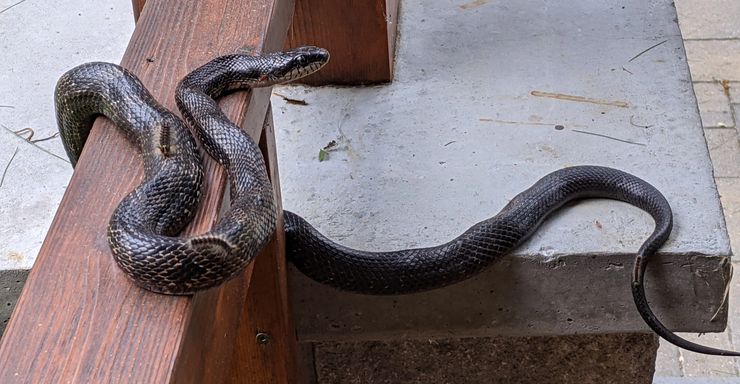
The grey ratsnake is easy to frame as one species in a cost-benefit calculation. But that’s not how ecosystems work. As a large predator, it keeps small mammal populations in check — including rodents that carry Lyme disease. It’s an indicator species: where it survives, the broader web of life is also intact.
The Frontenac Arch it lives in is described by the Nature Conservancy of Canada as one of the most important forest corridors east of the Rocky Mountains. NCC The Frontenac Axis population of the grey ratsnake exists nowhere else on Earth — it can’t be relocated or replaced. Canada committed under the Kunming-Montreal Biodiversity Framework (2022) to halt species loss. That commitment doesn’t disappear because Ontario changed its provincial rules.
The question isn’t whether a snake matters more than a train. It’s whether a major infrastructure project can be designed to avoid destroying something irreplaceable — when a route exists that does exactly that.
Federally listed as Threatened since 2009, the grey ratsnake’s vulnerability isn’t just about its rarity — it’s about its biology. It’s slow to reproduce and deeply tied to specific places. SARA Recovery Strategy
Doesn’t breed until age 7
Most reptiles mature faster. This species can’t bounce back from losses — every adult death counts.
Reproduces every 2–3 years
A population losing adults faster than it replaces them is on a one-way path. There’s no biological buffer.
Returns to the same spots every year
Snakes come back to the same hibernation sites and nesting spots year after year. Destroy a site and those snakes are gone.
Hibernates in groups
Dozens share one rocky outcrop through winter. Losing a single hibernaculum can wipe out an entire local population. COSSARO 2020
Under federal law, the grey ratsnake’s critical habitat is the area “roughly bordered by Highway 7 in the north, the St. Lawrence River in the south, Highway 38 in the west and Highway 29 in the east.” The southern ALTO corridor runs directly through the middle of this zone. Ontario’s Bill 5 does not change these federal boundaries. Federal Recovery Strategy
Canada designated the Frontenac Arch as a UNESCO Biosphere Reserve in 2002 — 220,973 hectares from Kingston to Brockville and north to Perth. The grey ratsnake is a characteristic threatened species of the Biosphere. A rail line through its core wouldn’t just harm snakes — it could put the UNESCO designation at risk, and with it the conservation economy the region has built around it. UNESCO MAB
Some argue that Bill 5’s weaker provincial rules make the southern route more viable. That’s not correct — the provincial ESA was never the main legal barrier. Federal SARA is. Norton Rose Fulbright analysis
- Habitat definition narrowed — movement corridors less protected
- Harassment removed from prohibited activities
- Full permits replaced by online registration
- Government can override independent scientific listings
- Species Conservation Fund being wound down
- Federal critical habitat boundaries unchanged
- SARA s.58 — can’t destroy critical habitat
- SARA s.79 — must prove no reasonable alternative exists
- Federal Threatened listing for grey ratsnake
- UNESCO Biosphere Reserve obligations
1. It goes through the protected zone — there’s no way around that
The entire southern corridor sits between Highway 7 and the St. Lawrence — that’s the federally defined critical habitat. Any route within this corridor is automatically in the protected zone. Federal Recovery Strategy
2. Construction would destroy hibernation sites permanently
The terrain here is rugged Frontenac granite full of rocky outcrops — exactly what these snakes hibernate in communally. Building through it means blasting and excavating those formations. Destroy a hibernaculum, and the snakes that used it are gone for good. They don’t find new ones. COSSARO 2020
3. It cuts the corridor in two — forever
Grey ratsnakes travel up to 4 km between winter and summer habitat. A rail line through the narrowest point of the Frontenac Arch would permanently split the population. Snakes on one side can’t reach snakes on the other — a serious long-term threat to the species’ survival. Recovery Strategy
4. Trains at 300 km/h give snakes zero chance
Road mortality is already the single biggest threat to this population. Cars are bad enough. A 300 km/h train? Zero reaction time. Add frequent service and mandatory safety fencing that blocks movement year-round, and you’ve built a machine designed to eliminate snakes from a landscape. SARA Recovery Strategy
5. Fencing and ecopassages won’t work here
Snake-proof fencing needs intense yearly maintenance over its entire length. This route would need 100+ km of it through remote wilderness, connecting dozens of scattered rocky outcrop hibernacula. A Highway 69 study found snake road abundance was actually higher after mitigation was installed. The terrain makes this practically impossible. SARA Recovery Strategy — Hwy 69
Reject the southern corridor
This corridor can’t be reconciled with federal law, UNESCO obligations, or basic conservation biology. It needs to come off the table entirely. SARA s.58, s.79
Look seriously at routes that avoid the Biosphere
Federal law requires genuinely exploring alternatives before approving a route through Threatened species habitat. That means corridors not currently on the table too. SARA s.79
Don’t use Bill 5 as an excuse
Federal SARA is what matters here, and Ontario law can’t change it. Weaker provincial rules make federal compliance more important, not less. OKT Law analysis
Do the environmental assessment before choosing a route
A proper assessment of impacts on grey ratsnake and other species needs to happen before route selection — not as an afterthought. SARA Public Registry
Bring in conservation groups and Indigenous communities
Real consultation must include the Frontenac Arch Biosphere Network , Nature Conservancy of Canada , species at risk recovery teams, and Indigenous communities with traditional territories in the area.
Watch what happens with the new provincial regulations
The Species Conservation Act, 2025 regulations aren’t finalized yet. Stakeholders should stay engaged with the Environmental Registry to make sure grey ratsnake habitat is protected under the new rules. ERO #025-0909
- The southern corridor still runs through the core of federally protected grey ratsnake critical habitat.
- Federal SARA still requires proof that no reasonable alternative exists — and other options do exist.
- No route through the Frontenac Arch Biosphere Reserve can be reconciled with Canada’s conservation obligations, regardless of what Ontario’s provincial rules say.
The southern corridor must be rejected. ALTO should find a route that doesn’t run through one of Canada’s most important protected ecological corridors.
Research by Lindsay Davidson and Rena Upitis. Facilitated with AI tools with human review and revision. Legislative information current as of February 2026.