Tag: high-speed rail

  • Acquiring the neighbourhood

    Acquiring the Neighbourhood

    What ALTO says publicly about land acquisition — the 60-metre right-of-way — and what a federal procurement document, released under Access to Information, shows the project was designed to do around its stations.

    ⚠ Document Under Analysis

    A Protected A federal slide deck — Subject-Specific Meeting #4B on Housing, dated April 10, 2024 — was released under Access to Information (file A-2025-00223, interim package). It was prepared for the consortia then bidding to become the project’s Private Developer Partner, roughly a year before the public consultations.

    The deck sets out a federal strategy to use the rail project as a vehicle for housing and Transit-Oriented Development around each of the proposed station locations. Its first pillar is to acquire station-area land and define a framework for its development. ALTO has made no public statement about land value capture or station-area land assembly, and frames acquisition publicly around the 60-metre right-of-way alone.

    Critical Finding

    The public discussion of ALTO expropriation runs together three different things. The first — the linear taking of a 60-metre right-of-way — is well documented. The second — fiscal and regulatory value-capture tools such as levies, charges and tax-increment financing — requires taking no one’s home. The third — station-area land assembly, in which a public body acquires a development portfolio around a station — does involve acquisition, and can reach beyond the operational footprint toward station-area homes; it is the variant urban residents have reason to watch.

    The released procurement deck shows that the third was designed into the project at the bidding stage. The honest qualification, drawn from the federal government’s own infrastructure bank, is that the financial payoff Canadian evidence supports for this kind of assembly is modest and market-dependent — which raises a value-for-money question, not only an expropriation one.

    Download
    Acquiring the Neighbourhood — Full Brief (PDF)
    The three takings — right-of-way, fiscal value capture, station-area assembly — set against the released A-2025-00223 procurement deck and the Canada Infrastructure Bank’s own land value capture evidence
    Download PDF
    The Question

    A procurement notice that asks for more than track

    In February 2026, Transport Canada published a tender for Financial Advisory Services to the high-speed rail initiative (solicitation T8080-240075). Among the advisory categories it lists are two that belong to a specific vocabulary: “Land value capture and community benefits advisory services” and “Transit-oriented Development and community benefits advisory services.” Transport Canada was, in other words, procuring the capacity to do land value capture — even though ALTO itself has said nothing public about it.

    Land value capture (LVC) is the principle that public investment — a new station — raises the value of nearby land, and that the public purse can reclaim part of that uplift to help pay for the investment that created it. It is a respectable idea with a long international history. The question this brief addresses is narrower and more practical: how likely is LVC to feature in ALTO, and what would it mean for expropriation for people who live near a prospective station in Ottawa, Toronto or Montreal?

    Until recently, the honest answer was “likely as a financing rationale, but the public record confines acquisition to the right-of-way.” A document released under Access to Information now allows a sharper answer.

    The Released Document

    What the procurement deck shows

    The deck released under file A-2025-00223 is a Protected A federal presentation, “Housing and Transit-Oriented Development (TOD) — High Frequency Rail (HFR) Project, Subject-Specific Meeting #4B,” dated April 10, 2024. Its audience was the consortia then bidding to become the Private Developer Partner (PDP). Its purpose, stated on its own opening slide, was to explore how the project “can serve as a catalyst for housing development” and to describe Canada’s vision for “leveraging Transit-Oriented Development” near railway hubs.

    Three features of the deck bear directly on the expropriation question.

    A four-pillar housing strategy

    Pillar 1, “Land & Real Property,” is to “identify lands along the proposed Alignment for station hubs and define a framework for their usage.” Pillar 4 is to leverage funding programs to “increase housing supply near station hubs.”

    An acquire-then-develop sequence

    The Provisional Guidelines slide states it plainly: “Canada would acquire the lands needed for the project and would explore with the PDP opportunities to optimize the development of station hubs.”

    A worked visual concept

    The deck renders an aerial of an Ottawa station hub ringed by mid- and high-rise towers — labelled a VIA HFR/QMOT 2023 concept, “for information and conceptual illustration only.”

    The construction of that middle sentence is the heart of the matter. Canada acquires; Canada and the PDP then develop. That public-acquisition-then-development sequence is the defining shape of the land-assembly variant of value capture — the Hong Kong “Rail + Property” family of models — not of a simple right-of-way taking. The federal housing department of the day (then Infrastructure Canada, INFC; now Housing, Infrastructure and Communities Canada, HICC) appears throughout as a named party, alongside VIA-HFR, Transport Canada and the PDP.

    This matters because it changes what kind of claim the Initiative can responsibly make. It is no longer necessary to infer a development intent from a procurement notice. The intent was set out, in a federal deck, to the people bidding to build the railway, a year before the public was consulted.

    Three Different Takings

    What “land acquisition” actually covers

    The single phrase “land acquisition” is doing the work of three quite different things. They differ in what they take, from whom, and at what scale. Distinguishing them is the whole of the analysis.

    Taking 01 The right-of-way
    What ALTO says publicly

    Acquisition is framed around a “final right-of-way” of about 60 metres in width; the corporation will seek negotiated agreements at market value before resorting to expropriation.

    ALTO public statements, May 2026

    What it is

    A linear taking: a continuous strip of land for track. The CEO has estimated the Ottawa–Montreal segment alone would cross roughly 1,700 properties, including about 500 farms.

    Bill C-15 sharpens the federal acquisition powers: first right of refusal on coveted properties, prohibition-of-work orders, the ability to skip negotiation and go straight to expropriation, with objections routed to the Minister of Transport rather than an independent hearing.

    Why this matters This is the taking the public debate already knows. It is real, it is large, and it is the source of the rural alarm along the southern corridor. But it is a strip — its footprint is the width of the line. It is not the mechanism by which a neighbourhood around a station would change hands.
    Taking 02 Fiscal & regulatory value capture
    The vocabulary in the tender

    “Land value capture and community benefits advisory services”; “Transit-oriented Development and community benefits advisory services.”

    Transport Canada tender T8080-240075, February 2026

    What it is

    Four of the five LVC classes catalogued by the Canada Infrastructure Bank are fiscal or regulatory: infrastructure levies, development charges, density bonuses, and tax increment financing.

    None of these requires taking anyone’s home. A homeowner near a station can be subject to a levy or a higher assessment without being expropriated at all. Montreal’s REM, for example, uses a $10/sq ft development charge in a zone around its stations — a tax, not a taking.

    Why this matters This is the part of “land value capture” that the alarmed reading of the tender gets wrong. Most LVC tools are taxes and zoning levers, not seizures. If ALTO’s value capture took this form, the effect on station-area residents would be financial — higher charges on new development, possibly passed through to buyers and renters — not displacement. The CIB notes the recognised downside here is “double taxation” concerns and pass-through to affordability, not expropriation.
    Taking 03 Station-area land assembly
    What the deck describes

    “Canada would acquire the lands needed for the project and would explore with the PDP opportunities to optimize the development of station hubs.”

    A-2025-00223, Provisional Guidelines slide (April 10, 2024)

    What it is

    The fifth CIB class: “Land Acquisition, Investment and Disposition” — the public body acquires a land portfolio, then sells, leases, or jointly develops it. The CIB names the Hong Kong MTR Rail + Property model as the archetype.

    The McGill TRAM study’s explicit recommendation is to “empower Alto to lead development and value capture within 2 km around the stations.” Two kilometres around a station is not a platform footprint — it is a neighbourhood.

    Why this matters This is the taking that touches urban homes, and it is the one the released deck shows was designed in. A station chosen for its “intensification potential” is, by definition, a station where the public body has reason to acquire more than the operational footprint. The C-15 powers attach to “lands needed for the project” — and the project’s own 2024 design defined “needed” to include development land for station hubs, not merely track and platform.
    Where the Threads Converge

    The Ottawa case

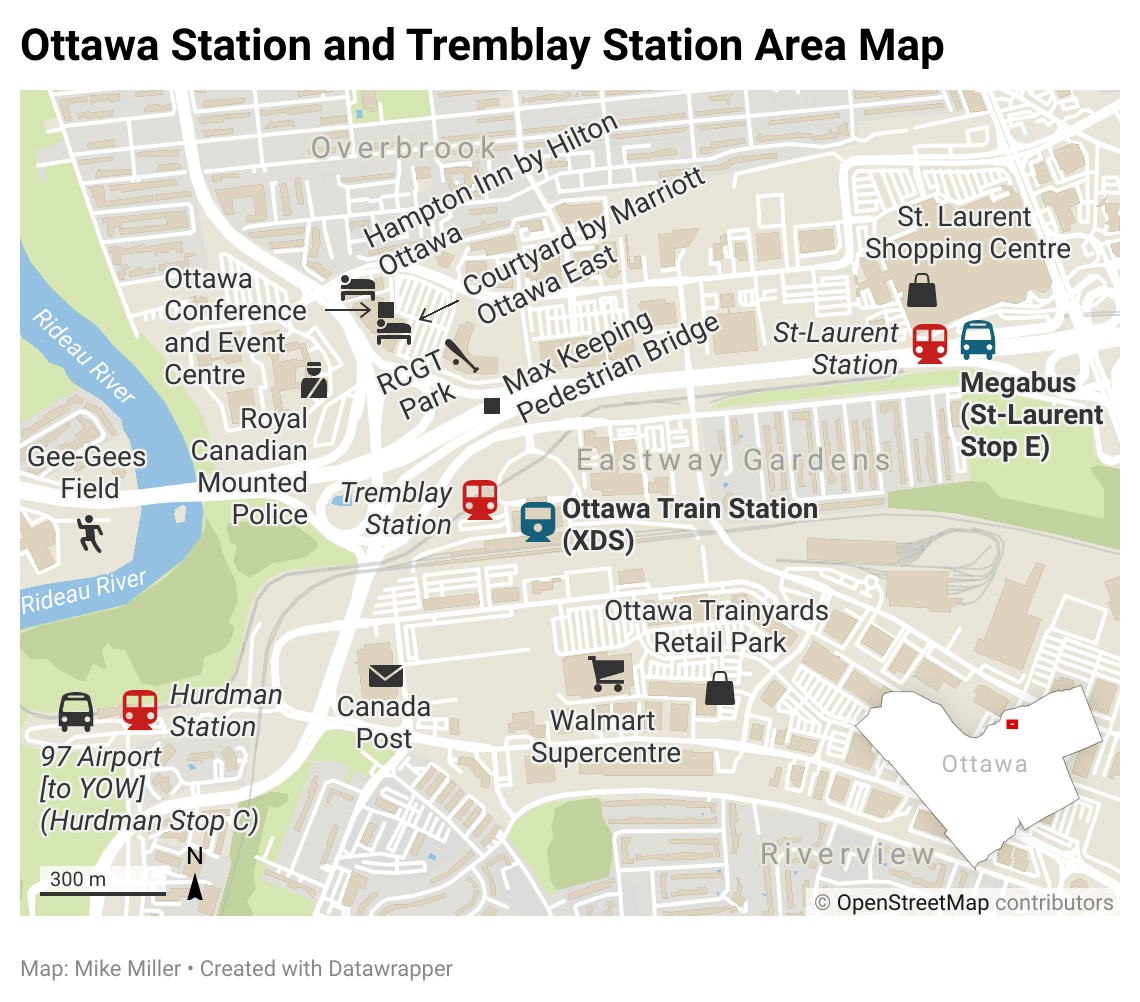
    Map of the Ottawa and Tremblay station area showing the Eastway Gardens neighbourhood east of the existing stations
    Ottawa and Tremblay station area, showing the Eastway Gardens neighbourhood east of the existing stations. Map by Ottawajin, via Wikimedia Commons, licensed under CC BY-SA 4.0. Unmodified.

    Eastway Gardens — the residential pocket east of the Tremblay Road stations, known locally as Ottawa’s “Alphabet Village” for its lettered avenues — is where the abstract distinction becomes concrete. Reporting in the Ottawa Citizen in May 2026 found a neighbourhood already living with the prospect: Alta Vista Councillor Marty Carr, who represents the area, said “the majority of residents in that neighbourhood think that it’s likely that a station would come there,” and described “a lot of trepidation, and a lot of unknowns,” with homeowners “very worried about expropriation.” Alto has identified the area as a potential Ottawa stop, and Carr believes “the space exists” on an empty parcel along Tremblay Road between Avenue U and St. Laurent Boulevard.

    What makes that site attractive is the most telling detail in the reporting. Rideau-Vanier Councillor Stéphanie Plante — whose ward contains the downtown alternative, the former Union Station now serving as the Senate building — recounted what Alto had explained to her about the Tremblay option: “they have the space, it can be developed, the lands are ready to go.” David Jeanes of Transport Action Canada, who attended an Alto roundtable, noted the Tremblay area’s “significant intensification potential.” These are land value capture arguments in everything but name — and, in Plante’s account, they are Alto’s own framing of why Tremblay is preferred. The McGill study’s logic — prioritise “nodes with strong redevelopment and value-appreciation prospects rather than built-out downtown cores” — is exactly that reasoning, and it runs the same direction: toward the developable, ready site and away from the constrained downtown one. Alto’s CEO has said an above-ground station at the Senate building would “completely destroy the neighbourhood”; the Transport Minister cited the 2016 Rideau Street sinkhole and “geotechnical challenges” against it while praising the existing Tremblay station.

    The expropriation question is, in the same reporting, explicitly an urban one and not only a rural one. The CEO estimated to Radio-Canada that the roughly 200 km of track between Ottawa and Montreal would cross about 1,700 properties, including some 500 farms — the linear taking. But residents along Avenue U voiced the wider worry directly, one noting the “really nice big space” between Avenue U and St. Laurent that a station might consume. The conceptual aerial in the released deck is, pointedly, an Ottawa station hub ringed by towers. A site chosen partly for its redevelopment headroom is the site where the gap between a right-of-way taking and station-area assembly is most likely to be tested. The Eastway Gardens trepidation is, on this evidence, responding to something real in the project’s own design documents — even as the public-facing messaging confines itself to the 60-metre strip.

    The Honest Qualification

    What the federal evidence says the payoff is

    The case for watching station-area assembly does not rest on assuming it will be lucrative. The opposite is closer to the truth, and it is the federal government’s own infrastructure bank that says so. The 2023 Canada Infrastructure Bank land value capture study — authored at the University of Toronto’s Infrastructure Institute — is sober about how much development-based LVC actually raises in Canada.

    Modest sums, in practice

    The study’s author characterises the record this way: rail-project value capture typically generates “tens of millions to hundreds of millions of dollars,” with only schemes catalysing large amounts of high-density development in high-value locations generating over a billion. Against an ALTO capital cost of $60–90 billion, the typical case is a rounding error per site; the billion-dollar case depends on exactly the intensification a site like Tremblay is being chosen for.

    Hong Kong does not transplant

    The Rail + Property model depends on Hong Kong’s state leasehold land tenure. The CIB is explicit that Canadian station areas have “fragmented ownership involving multiple public and private entities,” which makes the land assembly that powers the model difficult to convene.

    This cuts two ways, and the Initiative should present both. It tempers the alarm: the financial incentive for aggressive, wholesale neighbourhood acquisition is weaker in the Canadian context than the McGill 15%-of-capital scenario implies, because the revenue simply has not materialised at that scale here. But it also sharpens a different concern. If the development-revenue payoff is modest and market-dependent, then the expropriation footprint of station-area assembly may be incurred for a fiscal benefit that does not arrive. That is a value-for-money question — the same family of question the Initiative’s subsidy-frontier work raises elsewhere — and it is at least as important as the expropriation question itself.

    The McGill financial model illustrates the tension. Its self-sufficiency scenario depends on LVC contributing the equivalent of 15% of capital cost — on the order of C$12 billion against its C$79.8 billion construction estimate. The CIB’s evidence on realised Canadian deals suggests that figure is optimistic by a wide margin. The residents’ exposure, in other words, rests on a development-revenue premise that the more cautious Canadian evidence questions.

    On this point the study’s author has spoken directly to the project. In a submission to the Senate Standing Committee on Transport and Communications, Matti Siemiatycki — who broadly supports value capture “as a matter of complementary public policy” — cautioned that the revenue-generating potential of LVC on the high-speed rail line is “likely limited by the few stations that Alto is proposing.” That is the author of the very study being applied to ALTO by name, reaching the same conclusion this section reasons toward: the development-revenue case is real but constrained, and the constraint is structural. (The caution is about how much LVC will recoup, not about expropriation; the inference that a constrained payoff weakens the case for an enlarged acquisition footprint is the Initiative’s.)

    Side by Side

    Three takings, one project

    Read together, the three takings are not interchangeable. They differ in shape, in who is exposed, and in what the public record acknowledges.

    Right-of-way

    Shape:Linear strip (~60 m)

    Exposed:Corridor owners; ~1,700 properties Ott–Mtl

    Public?Acknowledged

    Fiscal capture

    Shape:Levies, charges, TIF

    Exposed:New development; no homes taken

    Public?In tender only

    Station assembly

    Shape:Beyond the footprint (McGill: up to 2 km)

    Exposed:Development land around the station

    Public?In 2024 deck; not acknowledged publicly

    The pattern is the disclosure asymmetry. The linear taking is discussed openly. The fiscal tools appear only in a procurement notice. The station-area assembly — the acquisition of development land beyond the line itself — was set out to bidders in 2024 and has not been part of any public ALTO communication since. That gap, now documented rather than inferred, is the brief’s subject.

    The honest answer

    How likely is land value capture — and what would it mean?

    As with the cost and ridership questions, the answer depends on what is being asked.

    Is LVC likely to feature in ALTO? On the evidence, yes — as a design intent. It is resourced in the tender, named in the federal housing mandate, modelled by McGill, and set out to bidders in the 2024 deck. What is not established is that it has survived into the Co-Development Phase as an executed land-assembly program. The deck is a procurement-stage document in the conditional voice — “would acquire,” “to be refined” — describing intent and a negotiating posture, not a finalised plan.

    What would it mean for expropriation? That depends entirely on which of the three takings is meant. If ALTO’s value capture takes the fiscal form — levies and charges — the effect on station-area residents is financial, not displacement. If it takes the station-assembly form the 2024 deck describes, the effect can reach beyond the line into development land around the station — how far being the unanswered question — and the C-15 powers apply to that land as “needed for the project.” The deck shows the second was designed in; it does not show it has been executed.

    The defensible position is therefore precise. The most alarming claim — “LVC means ALTO will expropriate your neighbourhood” — is not supported, and the CIB’s own evidence on modest Canadian returns argues against wholesale assembly being worth the trouble. But the reassuring claim — “acquisition is only the 60-metre right-of-way” — is contradicted by the federal government’s own procurement deck. The truth sits between the public messaging and the public fear, and the released document is what lets the Initiative locate it.

    For the next federal statement

    Three questions to ask

    Where the next federal statement on ALTO land is concerned — whether in a corporate plan, a consultation report, or a public communication from ALTO — three questions follow.

    1. On scope of acquisition: Does “land needed for the project” mean the operational right-of-way only, or does it include development land for station hubs? If the latter, what is the geographic extent around each station, and on what basis is that land “needed”?
    2. On mechanism: Which form of value capture is contemplated — fiscal tools (levies, charges, TIF) that take no homes, or land assembly that does? If assembly, what is the expected development revenue, against what acquisition cost and footprint?
    3. On the business case: Given the Canada Infrastructure Bank’s own finding that Canadian development-based LVC has typically raised tens to hundreds of millions per deal — only the largest schemes exceeding a billion — what justifies the McGill model’s assumption of LVC at 15% of a $60–90 billion capital cost, and what expropriation footprint is being incurred to chase it?

    None of these questions presupposes opposition to housing near transit, which is a widely shared public good. Each asks only that the project state plainly what its own 2024 design documents already contemplate — so that residents near a prospective station can know whether they are reading about a tax, a strip, or a neighbourhood.

    There is also a constructive remedy already on the record. In his Senate submission, Siemiatycki recommends that the Bill C-15 acquisition powers “should only be used as a last resort,” and that “the original landowners should be given first right of refusal to repurchase any expropriated land not used for the project.” That second safeguard is precisely calibrated to the concern this brief identifies: a right to repurchase land not used for the project only matters if the project might acquire more than it uses — the surplus-acquisition dynamic that station-area assembly creates. Adopting it would cost the project nothing it needs and would directly answer the station-area resident’s fear.

    Download Full Brief
    Acquiring the Neighbourhood (PDF)
    Reference document for federal decision-makers, parliamentarians, journalists, and residents near prospective station sites
    Download PDF
    Where Things Stand

    Two accounts, one of them public

    As of May 2026, ALTO’s public account of land acquisition is the 60-metre right-of-way. The federal procurement record released under Access to Information shows that, a year before the public consultations, the project was being co-developed with bidders as a vehicle for housing and Transit-Oriented Development whose first pillar was to identify and acquire station-area land. The two accounts are not contradictory, but the second is materially larger than the first — and only the first has been put to the public.

    Sources

    Primary documents and references

    1.
    Housing and Transit-Oriented Development (TOD), High Frequency Rail (HFR) Project, Subject-Specific Meeting #4B, April 10, 2024. Government of Canada slide deck (Protected A), released under the Access to Information Act, file A-2025-00223 (interim release package). The document predates the ALTO rebrand and names Infrastructure Canada (INFC), now Housing, Infrastructure and Communities Canada (HICC).
    2.
    Public Services and Procurement Canada / Transport Canada, “Financial Advisory Services to Transport Canada for the High-Speed Rail (HSR) Initiative,” solicitation T8080-240075, CanadaBuys, published February 20, 2026. Source of the “land value capture” and “transit-oriented Development” advisory categories. canadabuys.canada.ca
    3.
    Siemiatycki, M., Fagan, D., & Arku, R.N. (2023). Land Value Capture Study: Paying for Transit-Oriented Communities. Infrastructure Institute, School of Cities, University of Toronto, supported by the Canada Infrastructure Bank. Source of the five-class LVC taxonomy, the realised-deal range (tens of millions to hundreds of millions, with only the largest schemes exceeding a billion), and the fragmented-ownership finding. cib-bic.ca
    4.
    Siemiatycki, M. Submission on High-Speed Rail to the Senate Standing Committee on Transport and Communications. Infrastructure Institute, School of Cities, University of Toronto. Source of the author’s ALTO-specific judgment that LVC revenue is “likely limited by the few stations that Alto is proposing,” and of the recommendation that Bill C-15 powers be used only “as a last resort” with original landowners given first right of refusal to repurchase any expropriated land not used for the project. Distinct from the 2023 study at source 3.
    5.
    El-Geneidy, A., Anabtawi, R., Zhang, B., Carvalho, T., Negm, H., Alousi-Jones, M. & Page, M. (December 2025). Importance of Land Value Capture regarding the Canada High-speed Rail. Transportation Research at McGill (TRAM), McGill University. Source of the 15%-of-capital scenario and the “within 2 km around the stations” recommendation. tram.mcgill.ca
    6.
    Transport Canada, High-Speed Rail Initiative from Toronto to Québec City — departmental roles, including HICC’s mandate on “strategies to increase housing supply near stations” and PSPC’s responsibility for the expropriation process. tc.canada.ca
    7.
    Ben Andrews, “‘Trepidation’ in neighbourhood next to Tremblay station after Alto officials throw cold water on downtown stop,” Ottawa Citizen, May 18, 2026. Source of the Eastway Gardens accounts (Coun. Marty Carr; residents on Avenues U and T), Coun. Stéphanie Plante’s account of Alto’s Tremblay rationale (“the lands are ready to go”), David Jeanes’ “significant intensification potential” observation, CEO Martin Imbleau’s “completely destroy the neighbourhood” remark (CFRA) and his Radio-Canada estimate of ~1,700 properties / ~500 farms across the ~200 km Ottawa–Montreal segment, and Transport Minister Steven MacKinnon’s “geotechnical challenges” comments. ottawacitizen.com
    8.
    Farmers Forum, reporting on the Bill C-15 acquisition powers as analysed by expropriation counsel (Davies Howe) — first right of refusal, prohibition-of-work orders, direct-to-expropriation, and ministerial rather than independent objection routing.
    9.
    ALTO HSR Citizen Research Initiative companion briefs: Reading the Answer (cost, ridership, subsidies) and The Report That Vanished (the parliamentary record and the documented marketing-led pivot). This brief is intended to be read alongside them.
  • Transport Action Canada

    The Voice ALTO Has Already Heard From

    Transport Action Canada and Transport Action Ontario — the country’s principal pro-rail civil-society voice — have made detailed substantive recommendations about ALTO. What they asked for. What the record shows ALTO has so far addressed. What their voice contributes that nothing else in the public record does.

    ⚠ Documents Under Analysis

    On March 16, 2026, Transport Action Canada and Transport Action Ontario submitted an 18-recommendation written response to ALTO at the close of the January–March 2026 consultation period. The organizations also published an open letter setting out what they believe the substantive questions about the project are, and what credible alternatives have been studied previously.

    They are explicitly pro-rail. They are not opposed to high-speed rail in principle. Their concerns are technical, financial, and service-continuity concerns, and they are asking for the same documents and analyses that Parliament’s own Transport Committee asked for in September 2024 — and that have not been produced.

    Critical Finding

    The questions about ALTO’s cost, ridership, document release, and VIA-service impact are not coming only from project-affected landowners, from anti-rail critics, or from research initiatives. They are coming from the country’s principal pro-rail civil-society voice, in March 2026, on the public record, having formally engaged with ALTO through ALTO’s own consultation process.

    The brief sets out what Transport Action asked for, what the record shows ALTO has addressed, and what credible alternatives they have publicly identified.

    Download
    The Voice ALTO Has Already Heard From — Full Brief (PDF)
    What Transport Action Canada and Transport Action Ontario asked of ALTO, what ALTO has addressed, and what their voice contributes to the public record
    Download PDF
    The Witness

    Who Transport Action is

    Transport Action Canada describes itself as “Canada’s citizen advocacy organization for public transportation,” with members who have “discussed and debated the subject over the past five decades, including of course High Speed Rail and possible alternatives.” It and its provincial affiliates — including Transport Action Ontario, jointly authoring the consultation letter analysed here — are the principal national civil-society voice on Canadian intercity rail policy.

    Their position on ALTO is unambiguous. The open letter opens by welcoming “serious discussion of all options to improve passenger rail.” The consultation letter opens by describing the organizations as “a knowledgeable, passenger-focussed NGO that is very supportive of intercity passenger rail.” They explicitly recognize the underlying problem ALTO is intended to address — that VIA Rail’s constrained access to CN’s Kingston Subdivision “has long been recognized as untenable, which prompted the development and launch of VIA’s High Frequency Rail proposal in 2015.”

    They acknowledge the limits of incremental improvement: “just improving the CN route in isolation while continuing to operate alongside freight would not come close to the quintupling of capacity and slashing of travel times possible with some kind of dedicated track.” They are, in plain terms, an organization that wants more passenger rail in Canada and is substantively critical of how this particular HSR project is being delivered.

    What They Asked For

    The March 2026 consultation response

    Transport Action’s March 16, 2026 letter to ALTO’s Government and Stakeholder Relations office contains eighteen specific recommendations across seven sections. The four recommendations that most directly overlap with the existing CRI evidence base are set out below.

    Recommendation 1
    On the business case and cost
    What Transport Action asked

    “There is considerable skepticism from the public and stakeholders about the business case for HSR… It is urgent that a detailed Business Case be completed as soon as possible, including preferred corridor, capital cost, detailed ridership, fares, revenue and methods of calculation.”

    Mapped onto the parliamentary record

    This is, in substance, the same request as Recommendation 4 of TRAN Report 18 (September 2024), which asked the Minister to require an HFR-versus-HSR cost analysis within six months. As CRI’s brief The Report That Vanished documents, that analysis was never produced. Transport Action is asking, eighteen months later, for the same kind of cost-and-business-case work.

    Recommendation 2
    On ridership transparency
    What Transport Action asked

    “No details are provided on the ridership model, population assumptions, network assumptions, demand per segment, fares, cost of gasoline etc. Although the ridership assumption may be reasonable when lifted from European ridership, there is skepticism that this would be replicated in central Canada, due to lower fuel prices, absence of road tolls etc.”

    Mapped onto the parliamentary record

    This maps directly onto Claim 3 in Reading the Answer — the government’s 43-million-by-2084 ridership figure in Q-923. Transport Action specifically raises the central-Canadian fuel-price and road-toll conditions that distinguish the corridor from the European benchmarks, and quantifies the Ontario provincial subsidy to personal car use at $2.5 billion per year as a “politically tilted playing field” that any credible ridership model must account for.

    Recommendation 3
    On document release
    What Transport Action asked

    “We urge you to release a full unredacted version of the JPO report, plus any other reports that were in the ‘data room’ made available to the three bidders. At this time, with the tender process completed, there should be nothing in these reports that is business-confidential.”

    Mapped onto the parliamentary record

    This is — almost word for word — the same request as Recommendation 6 of TRAN Report 18. Transport Action makes an additional point that the procurement-completion rationale for non-disclosure no longer applies: with the bidder data-room phase concluded, there is no remaining commercial confidentiality argument. The reports have still not been released.

    Recommendation 6
    On the future of VIA service
    What Transport Action asked

    “Recent media reports from Kingston regarding possible diminution of current VIA Rail services when ALTO is operational must be heeded… It is important that ALTO and VIA Rail jointly issue a statement promptly about plans for services at these cities. Otherwise, local elected officials and residents will continue to impede ALTO’s progress.

    Mapped onto the parliamentary record

    This maps directly onto Recommendations 8 and 10 of TRAN Report 18 — the VIA-impact analysis and the no-service-reduction commitment, both unanswered since September 2024. The Senate TRCM raised the same concern in February 2026. The question has now been asked across two parliamentary chambers and one substantial stakeholder consultation submission; it has not been substantively answered.

    Transport Action’s remaining fourteen recommendations cover downtown and shoulder station design, affordable fares, intercommunity bus access for towns currently outside the rail network, emergency-management cooperation with rural fire and EMS, wildlife crossings, sufficient road and trail bridges, recognition of Ontario’s 1834 Drainage Act, First Nations contingency planning for archaeological discovery, sensitive-agricultural-use mapping (sugar bushes, vineyards, certified organic land), and compensation frameworks for intensive agricultural operations that would need to be relocated. Several bear directly on issues documented in CRI’s Five Hundred Farms brief.

    Three Alternatives They Identified

    What pro-rail technical analysis says is possible

    A question CRI has not previously had answered by a technically literate pro-rail body: were credible alternatives to ALTO actually studied, and what did the studies show? Transport Action’s open letter identifies three.

    01

    Targeted CN-route improvements

    “Further investments to improve passenger and freight fluidity, like the third track between Belleville and Napanee and station improvements… would make a big difference to reliability at modest cost.”

    Transport Action concedes this alone is insufficient to deliver the “quintupling of capacity and slashing of travel times” possible with a dedicated track — but lays out a complementary package of known modest cost.

    02

    The freight grand bargain

    “Moves most CN freight over to the CPKC route through Perth… The existing CN route could then be upgraded to support more passenger services at up to 170 km/h, with travel times of around 4 hours between Toronto and Montreal or Ottawa.”

    This is the High Performance Rail framework substantially as CRI has documented it, here independently advocated by Transport Action as a technically credible option.

    03

    HFR on the original Havelock alignment

    “A dedicated track that takes a more direct route between Toronto and Ottawa, with the advantage of reconnecting Peterborough to the railway network, was VIA Rail’s preferred option, while also preserving service on the existing route through Kingston.”

    This is the project the Joint Project Office was funded in 2017 to study, the project the Transport Committee studied in 2023–24, and the project the federal government redesignated in late 2024.

    Why earlier HSR-along-the-lakeshore studies did not proceed

    Of independent technical interest is Transport Action’s observation about why HSR following the Lake Ontario lakeshore has been studied multiple times without proceeding:

    High Speed Rail following a lakeshore from Toronto through Kingston has also been studied before, more than once, by both the federal and provincial governments, without proceeding. For safety reasons, and to achieve 7 km+ minimum radii for higher speeds, such a dedicated track could not be placed too close to the existing alignment nor right alongside Highway 401. It would thus require significant expropriation, and the number of homes and businesses close to CN’s tracks and the 401 has only grown since the last such study in 2011. The chances are that communities like Port Hope and Trenton would be bypassed entirely, and route from Kingston to Ottawa would also then also go through the same sensitive Frontenac Arch region and many of the communities expressing most concern about Alto’s southern study corridor.

    Transport Action Canada, open letter on ALTO HSR route options in eastern Ontario. read the letter

    This is the route-geometry argument set out by a pro-rail body with the technical standing to make it — the same observation about HSR’s 7-km curve-radius requirement that CRI’s engineering research has documented, here presented as a published critique by an established advocacy organization.

    What Their Voice Contributes

    A fifth source category, otherwise absent

    The Citizen Research Initiative’s briefs to date have drawn on four categories of source. Each has its own evidentiary weight; each has its own limitations. Transport Action contributes a fifth that has been substantively absent until now.

    Parliamentary record

    Order Paper questions, Transport Committee reports, Senate committee testimony, the High-Speed Rail Network Act. Authoritative but procedurally bounded.

    Academic studies

    The McGill Transportation Research and Munk School Global Economic Policy Lab analyses. Methodologically rigorous but bounded by funding and study scope.

    Journalism

    The Canadian Press and Globe and Mail reporting; CBC News; Globe coverage of the NFU response. Documentary but episodic.

    Affected stakeholders

    OFA, UPA, CFA, BFO, NFU. Authentic to affected communities but advocating for their members’ specific interests.

    Pro-rail advocacy

    Transport Action Canada and Transport Action Ontario. A credible, technically literate, pro-rail civil-society voice with no opposition to the project in principle, no economic interest in its outcome, and a fifty-year record of engagement with Canadian intercity passenger rail policy.

    This matters in two specific ways. First, it forecloses the response that the questions about ALTO’s cost, ridership, document release, and VIA-service impact are coming only from project-affected landowners or from anti-rail critics. They are coming from the country’s principal pro-rail civil-society voice, on the public record, having formally engaged with ALTO through ALTO’s own consultation process. Second, it puts the alternatives that have been considered — including the HPR framework the Initiative has been documenting — into the technical vocabulary of an organization that has the standing to describe them.

    Recommendations That Remain Live

    What still has not been produced

    As of May 2026, the public record shows that:

    The cost analysis Transport Action’s March 2026 letter asked for — and that TRAN Report 18 Recommendation 4 had asked for in September 2024 — has not been produced. The $60–90 billion AACE Class 5 figure in Q-923 stands without it.
    The Joint Project Office report Transport Action’s March 2026 letter asked to be released — and that TRAN Report 18 Recommendation 6 had asked to be released in September 2024 — has not been released. Transport Action’s additional point that the procurement-completion rationale for non-disclosure no longer applies has not been addressed.
    The VIA-impact analysis Transport Action’s March 2026 letter asked for, that the Senate TRCM raised concerns about in February 2026, and that TRAN Report 18 Recommendations 8 and 10 had asked for in September 2024, has not been produced. ALTO’s published material continues to refer to “optimization” of existing VIA services without a binding commitment.
    The ridership-model assumptions Transport Action’s March 2026 letter asked be made public have not been published. The government’s 43-million-by-2084 figure in Q-923 stands without disclosed methodology behind it.

    None of these are partisan demands. None of them is hostile to the project. All of them are recommendations from an established pro-rail advocacy organization, made through ALTO’s own consultation process, asking the same things that Parliament’s own committee was asking. Their continued non-fulfilment is procedural, not substantive — and procedurally, as The Report That Vanished sets out in detail, the questions remain available to be revived by parliamentary or stakeholder action.

    Download Full Brief
    The Voice ALTO Has Already Heard From (PDF)
    Reference document for federal decision-makers, parliamentarians, journalists, and constituents tracking the file
    Download PDF
    Sources

    Primary documents and references

    1.
    Transport Action Canada and Transport Action Ontario, Comments arising from ALTO HSR Stakeholder Roundtable and Public Consultation Sessions (letter to Peter Paz, Government and Stakeholder Relations, ALTO), March 16, 2026. Signed by Terry Johnson (President, Transport Action Canada) and Peter Miasek (President, Transport Action Ontario). ontario.transportaction.ca
    2.
    Transport Action Canada, Why did the government chose Alto? (open letter on ALTO HSR route options in eastern Ontario), 2026. ontario.transportaction.ca
    3.
    House of Commons Standing Committee on Transport, Infrastructure and Communities, Issues and Opportunities: High Frequency Rail in the Toronto to Quebec City Corridor. 18th Report, 44th Parliament, 1st Session. Tabled September 2024. ourcommons.ca
    4.
    Order Paper Question Q-923, 45th Parliament, 1st session. Asked by Philip Lawrence (MP for Northumberland–Clarke), March 5, 2026; answered April 22, 2026.
    5.
    ALTO HSR Citizen Research Initiative companion briefs: Reading the Answer (May 2026); Reading the Footnote (May 2026); The Report That Vanished (May 2026); What We Know About ALTO’s Reporting and Accountability (May 2026); Five Hundred Farms (May 2026).