Tag: HSR economics

  • High cost, low benefit claim

    High Cost, Low Benefit — For Whom?

    An ALTO Vice-President says the rail alternative would cost about as much as high-speed rail without the benefits. The government’s own record — and ALTO’s own document — say otherwise.

    In short

    In a recent public video, an ALTO Vice-President argues that high-frequency rail would still need dedicated track, would therefore cost about as much as high-speed rail, and would deliver less — a “high cost, low benefit” option. The claim runs against the public record. The government’s own reports costed a dedicated-track high-frequency railway far below high-speed rail, and judged it buildable in a fraction of the time. What shifted that cost to “similar” has never been made public.

    On the benefit side, ALTO’s case rests on ridership the international reference class does not support. Tested against ALTO’s own document and the Initiative’s financial analysis, the high-cost option turns out to be the one being built.

    Download
    High Cost, Low Benefit — For Whom?
    The full research brief, with sources (PDF)
    Download PDF
    The Argument

    What the video claims

    The argument is a single chain. High-frequency rail, the video says, is often presented as the cheaper alternative — but it would still require new dedicated track, so its cost would rise to roughly that of high-speed rail, while delivering lower travel-time, ridership, and economic benefits. The conclusion offered to viewers is that high-frequency rail is a “high cost, low benefit” option, while high-speed rail delivers both speed and frequency.

    It is a clean story. Two problems sit beneath it before any single figure is examined.

    It claims a cost convergence the record contradicts

    The video is right that high-frequency rail needs dedicated track — it does not claim trains would share track with freight. Its claim is that building that dedicated track pushes the cost up to roughly high-speed rail’s. The government’s own reports say otherwise, on both cost and time. A dedicated-track, electrified high-frequency railway was costed at $27.7 billion in the December 2021 Business Case — and roughly $4–6 billion in its original 2016 form — and judged buildable in about four years. High-speed rail is now costed at $60–90 billion, on a build horizon stretching into the 2040s. What evidence moved high-frequency rail’s cost and schedule up to “similar” has never been explained, and no side-by-side comparison has been made public.

    It never engages the alternative the Initiative proposes

    The video treats high-frequency rail as the only alternative to high-speed rail. The Initiative’s proposal is different again: High Performance Rail (HPR) builds dedicated passenger track along existing transportation corridors — such as the CN right-of-way and the Highway 401 — and frees the Kingston Subdivision for freight. It is neither the government’s old high-frequency plan nor ALTO’s high-speed one, and ALTO has never assessed it.

    Tested Against the Record

    Three claims, three answers

    $27.7B
    what a dedicated-track high-frequency railway was costed at — against $60–90B for high-speed rail
    2021 JPO Business Case
    the cost-per-kilometre gap between ALTO and High Performance Rail in the Initiative’s model
    $142M vs $28M per km
    0.11
    ALTO’s central benefit-cost ratio — well below the 1.0 that marks a project that pays its way
    Initiative methodology paper

    The video makes three factual claims — on cost, on speed, and on benefit. Each can be checked against ALTO’s own published document and the Initiative’s analysis.

    The claim in the videoWhat the record shows
    “It would cost on a similar scale to high-speed rail.” Contradicted by the public record. The government’s own 2021 Business Case put a dedicated-track high-frequency railway at $27.7 billion, against ALTO’s $60–90 billion. Even ALTO’s own Annex B places its “conventional rail” comparator 20–30% below high-speed rail. The Initiative’s reference-class model — a regression across more than forty international projects — puts ALTO at $142M/km and HPR at $28M/km, a five-fold gap. “Similar scale” holds on none of these.
    “Without significantly faster travel times.” Conventional speed already captures most of the benefit. A 177 km/h dedicated-track service was set to cut Toronto–Ottawa from over four hours to about two hours fifty. By ALTO’s own travel-time table, going to 300 km/h saves only a further 17 minutes on Toronto–Ottawa, 19 on Ottawa–Montréal, and 25 on Montréal–Québec. Most of the time saving comes from leaving freight-priority track — not from the extra speed.
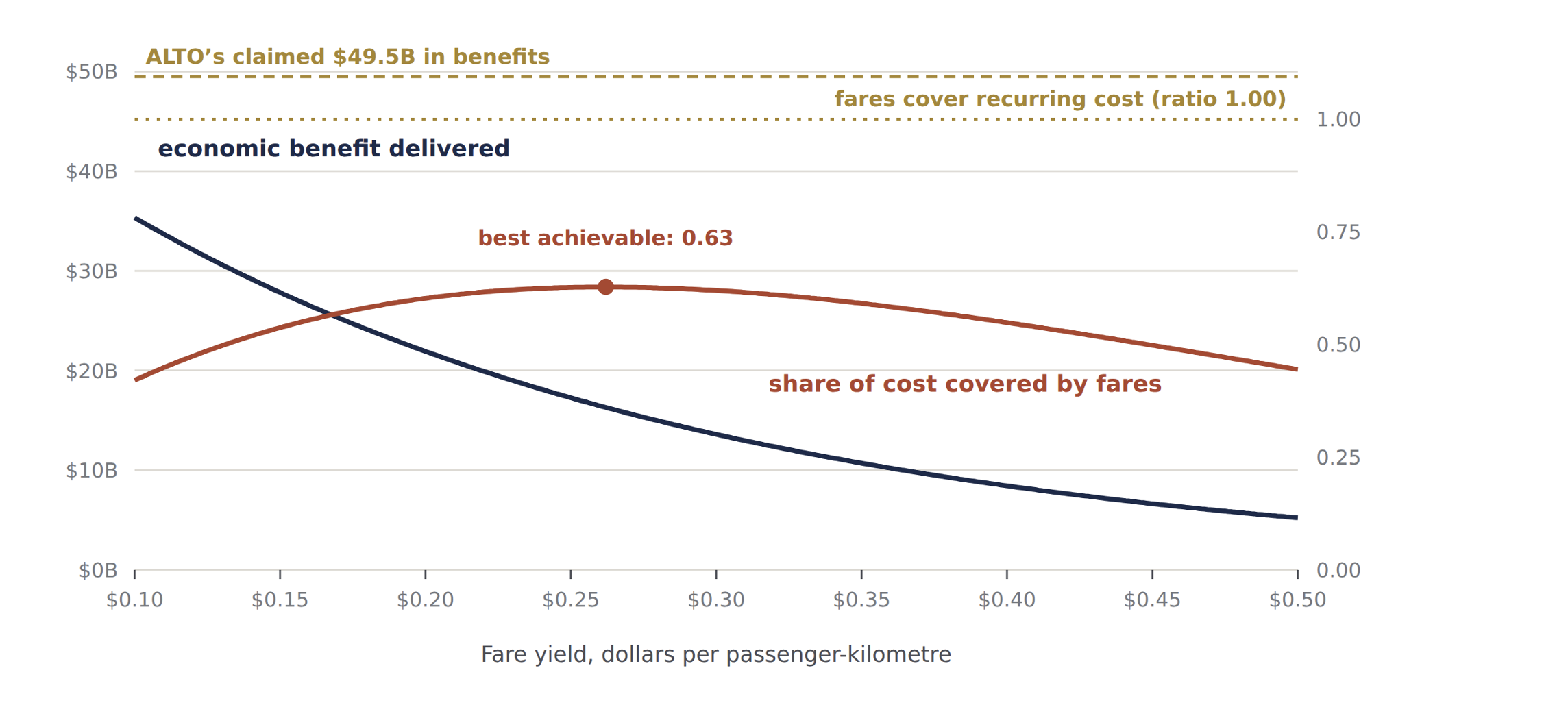
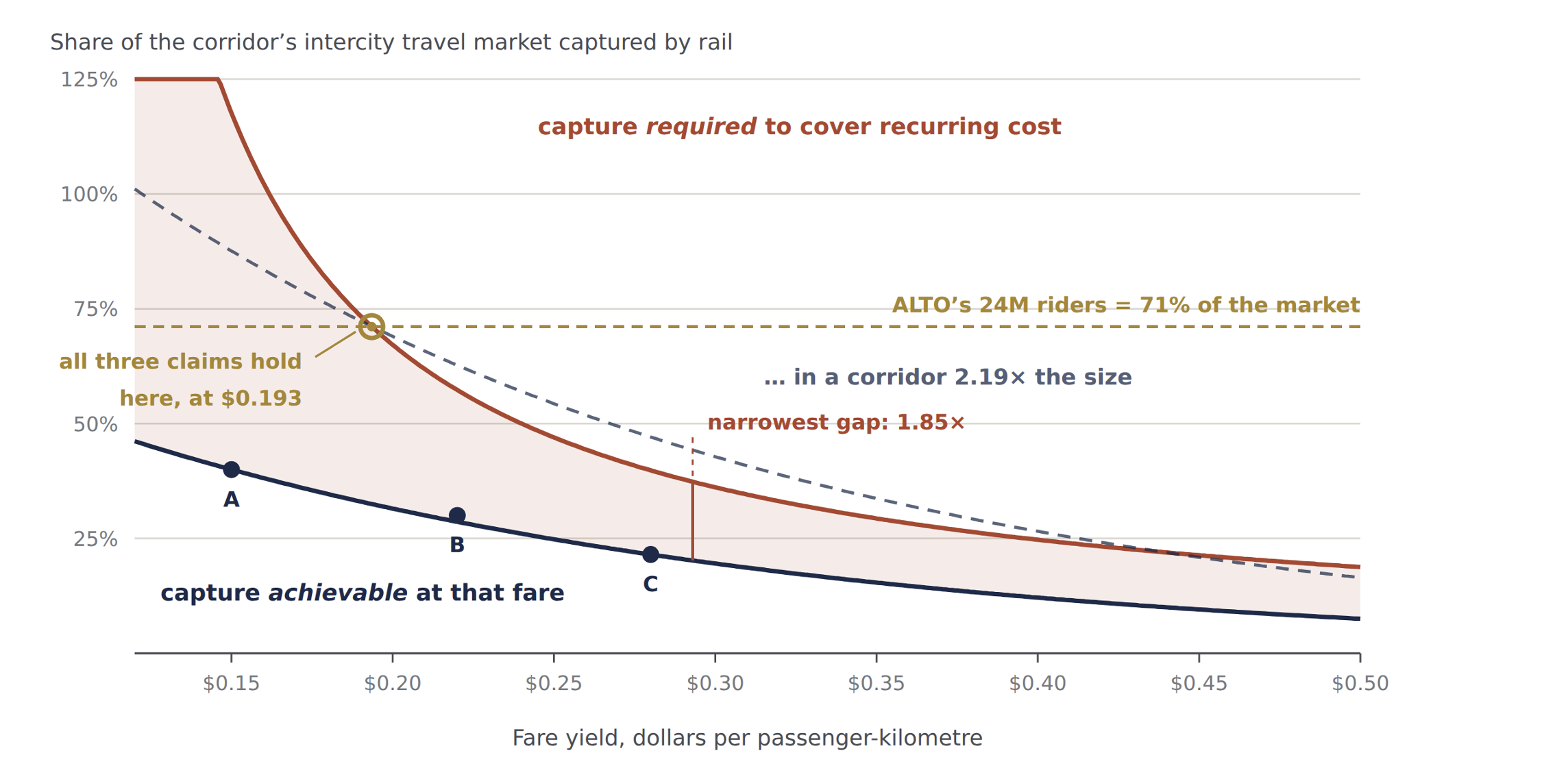
    “Lower ridership and reduced economic benefits.” The benefit case rests on ridership the reference class does not support. ALTO’s 24-million-trip target sits outside the achievable modal-shift frontier of 5–12 million annual riders. No operating posture is subsidy-free; each requires roughly $1–3.5 billion per year. The central benefit-cost ratio is about 0.11. The “high benefit” half of the slogan is the half that does not survive checking.
    A Note on the Travel Times

    Estimated, not simulated

    There is a further problem with the speed claim, separate from how small the gain is. The faster journey times were never modelled for this corridor at all. A government record released under the Access to Information Act (file A-2025-00333) shows that the project office produced a detailed RailSys simulation only for the 177 km/h base case. Every faster journey time was a spreadsheet estimate, benchmarked to average speeds on intercity railways in other countries — described in the project’s own memorandum as “for information and comparison purposes” and left to be refined later.

    In other words, the under-three-hour trips that make high-speed rail attractive have no corridor-specific engineering behind them in the released record. The one number anyone actually drove through a model of the real line is the slow one.

    Read the full record

    The Initiative examines this in detail — the two methods, the journey-time tables, and how the speed ceiling was set as a policy target — in a companion research note, Estimated, Not Simulated, based on the same Access to Information release.

    The Carbon Case

    A carbon debt, not a carbon saving

    The video folds environmental benefit into ALTO’s column, on the assumption that faster, higher-ridership rail is the greener choice. The Initiative’s 50-year lifecycle analysis finds the opposite once construction and a decarbonising vehicle fleet are counted. ALTO’s build is a large one-time carbon debt before a single passenger boards — about 14.7 Mt CO₂e in the central construction estimate — and with fifty years of operations the lifecycle total lands at roughly 24 to 27 Mt CO₂e on Ontario’s current grid, and as much as 34 Mt if the grid leans more on gas.

    That debt only counts as a saving if the trips it captures would otherwise have been higher-carbon — and the payback math is unforgiving. At the ridership the corridor is most likely to see in its early years, around 4 million passengers a year, no scenario repays the construction debt within a credible horizon. Even at mature ridership, payback runs from a few decades to more than five hundred years, depending on how clean the grid is.

    The comparison only worsens with time. By the 2040s, when ALTO might open, much of the car fleet will be electric — and an electric car carrying 1.2 people already emits about 10 g CO₂e per passenger-kilometre, below ALTO’s all-in emissions at every ridership level on today’s grid. Diverting existing VIA Rail passengers, at roughly 25 g/pkm, saves nothing at all. ALTO’s carbon case rests on displacing gasoline cars and short-haul flights — not the fleet that will actually be on the road when it opens.

    Most of that debt is greenfield construction. An approach that runs on existing corridors — as High Performance Rail does — avoids the bulk of it, and the single largest carbon lever, shifting freight off congested track, is available whatever the trains’ speed or traction.

    Why the Gap Is Real

    The cost difference is structural, not arithmetic

    The five-fold difference in the Initiative’s model is not an accounting artefact. A 300 km/h design forces a new dedicated greenfield alignment — grade separation, gentle curves, continuous fencing, and large-scale land acquisition — through terrain that scores high on both engineering complexity and community friction. Both the government’s high-frequency plan and the Initiative’s HPR instead run on or alongside existing corridors, which is why each comes in well below the high-speed option. In the Initiative’s model, the gap between high-speed rail and HPR splits roughly evenly between physical engineering and community friction — the cost of the land, the disruption, and the opposition that a new high-speed right-of-way creates.

    The Bottom Line

    High cost, low benefit — for whom?

    The video’s thesis — that high-frequency rail is high cost and low benefit while high-speed rail delivers both — is contradicted by the government’s own record. High-frequency rail was a fully studied, dedicated-track plan, priced at $27.7 billion in 2021 and a fraction of that in its original form, and due to be carrying passengers now. The decision to replace it with a 300 km/h, $60–90-billion project was taken without a published comparison; the video supplies the missing conclusion after the fact.

    On the evidence available, the high-cost option is the one that was chosen. The lower-cost alternatives — the government’s own, and the Initiative’s — were set aside without being weighed in public. That is the question the slogan invites, turned back on itself: high cost, low benefit, for whom?

    Sources

    Primary documents

    1.
    ALTO, Fast Forward: Shaping Canada’s Future with a High-Speed Rail Network (March 2025) — cost ranges, travel times, and ridership targets, main text and Annex B. altotrain.ca
    2.
    Joint Project Office High Frequency Rail Project, Business Case Update, V.002 (December 10, 2021) — dedicated-track design, $27.7 billion costing, and four-year construction estimate.
    3.
    The Globe and Mail, “Transport Canada reviewing studies on Via Rail expansion” (July 2017) — the original 2016 high-frequency concept at roughly $4–6 billion. theglobeandmail.com
    4.
    “VIA HFR-TGF Journey Times” memorandum and accompanying email chain (August–September 2023), released under the Access to Information Act as file A-2025-00333 — simulated base case versus estimated higher-speed times.
    5.
    ALTO HSR Citizen Research Initiative, ALTO Financial Analysis (methodology paper and supporting research notes) — cost-per-kilometre model, ridership frontier, subsidy spectrum, benefit-cost ratio, and lifecycle carbon. ALTO-Financial-Analysis.pdf
    6.
    ALTO HSR Citizen Research Initiative, 50-Year Lifecycle CO₂ Budget — Parametric Analysis (March 2026) — construction, operational, payback, and modal-comparison figures, drawing on HS2, UIC, and international HSR lifecycle studies.
    7.
    Statements examined: public video by an ALTO Vice-President (June 2026).
  • The bill that has to balance

    The Bill That Has to Balance

    A plain-language guide to how we evaluated the cost of the proposed ALTO high-speed rail line — starting from one simple rule that every railway in the world has to obey, and following it through to a number the government’s own claims do not match.

    ⚠ What this is

    This is the readable version of a longer technical paper. The full document and slide deck show every calculation; this post explains, in everyday terms, what we did, why, and what we found — with no maths background assumed.

    The short version: the project’s likely capital cost is roughly double what the government has stated; the trains cannot pay for themselves at any realistic ticket price; and the project’s headline ridership target of 24 million passengers a year sits outside the range that any comparable line has ever achieved.

    The one idea to take away

    Every operating railway in the world has a bill that has to balance every year. What it costs to build and run the line on one side; where the money to cover that comes from on the other. The money can only come from three places: ticket sales, a government subsidy, or value captured from land near the stations.

    You can argue about any single number. What you cannot do is leave one side of the bill short. If a proponent quotes you a low cost and a high number of riders but never tells you the subsidy, the subsidy is simply the part of the bill they haven’t shown you — it doesn’t disappear. Our whole method is just: fill in every blank on the bill using independent evidence, and see what the missing number turns out to be.

    Read in full
    A Framework for Independent Evaluation of the ALTO HSR Project
    The complete methodology, every rubric and dataset, and a slide deck version — all published and reproducible
    All documents Full PDF Slide deck
    Start Here

    The bill every railway has to balance

    Imagine your household budget. Whatever you spend has to be matched by money coming in — from your salary, your savings, a loan. A railway is no different, just bigger. There are two kinds of cost: the enormous one-time cost of building the line (paid off gradually, like a mortgage), and the ongoing cost of running it every year — staff, electricity, maintenance, replacing worn-out trains.

    Those costs have to be paid for. There are only three sources. Here is the whole thing on one line:

    The annual fiscal ledger

    Cost to build (yearly share) + cost to run = ticket sales + government subsidy + land value capture

    The left side is what the railway costs each year. The right side is where that money comes from. The two sides must be equal — that’s what “balance” means.

    In plain terms

    “Land value capture” means a railway can sometimes raise money from the rise in nearby land prices that a new station creates — for example by developing land around the station. It’s a real tool, but a modest one in Canada, and ALTO has named no such mechanism. So for ALTO that third source is effectively zero, which leaves only two: tickets and subsidy.

    Here is the consequence that does all the work. Once you’ve pinned down the cost, the ticket revenue, and the land capture using evidence, the subsidy isn’t a choice anyone gets to make — it’s whatever is left over to make the bill balance. It’s a leftover, not a decision. That single insight is why a project can claim to be “self-sustaining” and still, on its own numbers, need billions of dollars of public money a year. The subsidy was always there; it just wasn’t written down.

    The Method

    Seven steps to fill in the blanks

    To fill in each part of that bill honestly, we built a seven-step process. Each step answers one question using published evidence rather than the project’s own marketing, and each step shows its work so that anyone who disagrees can re-run it with their own assumptions. Here is what each step asked, and what it found for ALTO.

    1

    How hard is this to build?

    Engineering complexity, compared to rail lines around the world

    We scored the corridor’s technical difficulty against an international database of comparable projects. ALTO lands in the upper “High” band — among the most demanding corridors anywhere in the world. Hard things cost more and run late more often; this matters for every number that follows.

    2

    How smooth will getting it approved and built be?

    Community, consultation and consent risk

    We measured the friction the project faces from communities, landowners and the consultation process. The score lands in the band where comparable megaprojects’ cost overruns tend to cluster — another reason to expect the final bill to climb.

    3

    What will it really cost to build?

    Capital cost, calibrated against similar projects

    The government states $75 billion. Comparing ALTO to a reference class of similar railways and adjusting for its difficulty, our central estimate is $143 billion — nearly double — with a worst-case ceiling of $264 billion. The stated budget sits at the very bottom of the plausible range.

    4

    What will it cost to run, every year?

    Operating cost, built up from the actual assets

    Adding up staff, operations, maintenance and replacing trains as they wear out gives about $2.15 billion a year. To cover just that running cost from fares, the line would need roughly 12.5 million passengers a year — and even then it only recovers about 80 cents of every dollar.

    5

    How many people would actually ride it?

    Realistic ridership, and the subsidy that follows

    Based on how many travellers comparable lines actually pull off the roads and out of the air, a realistic range is 5 to 12 million riders a year, with a sensible target near 8 million. ALTO’s headline figure of 24 million sits outside that range entirely.

    6

    Is it worth it?

    Benefits weighed against costs

    Weighing all the benefits against all the costs gives a ratio of about 0.11 — roughly eleven cents of benefit for every dollar spent. To make the 24-million target pay, tickets would need to cost between $381 and $1,596 — and 24 million riders is unreachable anyway.

    7

    Would a serious gatekeeper approve it?

    Tested against Norway’s independent project-review system

    Norway runs big projects through two independent quality gates before funding. Run through those gates, ALTO fails most of the criteria at both stages — described as a textbook example of exactly the kind of project the Norwegian system was built to catch.

    What “reference class” means

    Rather than trust a project’s own optimistic forecast, you line it up against a large group of similar projects that have already been built, and ask: what actually happened to those? It is one of the most reliable ways known to forecast cost and ridership, precisely because it sidesteps wishful thinking.

    The Headline Figures

    Three numbers that frame the whole thing

    Cost to build
    $143B
    Our central estimate — against a stated budget of $75B
    Value for money
    11¢
    Of benefit returned per dollar spent (a benefit-cost ratio of 0.11)
    Ridership gap
    24M
    The stated target — against a realistic ceiling near 12M

    None of these is a guess plucked from the air. Each one is the output of one of the seven steps above, and each step publishes the data and the scoring behind it. The point of putting them together is simple: a project whose costs are understated, whose value-for-money is low, and whose ridership is overstated does not become viable just because its three weaknesses are described in separate documents.

    The Part Nobody Mentions

    No ticket price makes the bill disappear

    Here is where the “bill that has to balance” idea pays off. There is a temptation to think the subsidy could be designed away — charge higher fares, or fill more seats. So we tested the three obvious strategies. In every case, a large public subsidy remains. The only thing that changes is how the cost is split between the passenger and the taxpayer.

    Charge premium fares
    ~$1B / yr

    Trade-off:High ticket prices, so fewer riders. Lowest subsidy — but still about a billion a year.

    Match airline fares
    ~$2B / yr

    Trade-off:Prices in line with flying. A moderate middle path — roughly two billion a year.

    Deep discounts, fill seats
    ~$3.5B / yr

    Trade-off:Cheap tickets, more riders — but the lowest fares mean the largest subsidy.

    Notice what this means. Choosing among these isn’t a choice between “subsidised” and “unsubsidised” — every option is subsidised. It’s only a choice about who pays: the rider at the ticket window, or the taxpayer through the public purse. That is a perfectly legitimate political decision to make out in the open. What isn’t legitimate is pretending the choice doesn’t exist.

    And that is exactly why one specific government claim does not hold up. On 22 April 2026, the government stated the operation would be “financially self-sustaining” — meaning fares alone would cover running costs. But no realistic level of ridership produces enough ticket money to cover the $2.15 billion annual running cost. Measured against every comparable high-speed line operating in the world, that claim simply isn’t consistent with the evidence.

    The Bottom Line

    What the filled-in bill shows

    Put the seven steps together and the picture is consistent, not cherry-picked:

    Roughly double the cost

    The likely cost to build is about twice the stated budget — and the stated figure sits at the bottom edge of what’s plausible.

    Cannot pay its own way

    At no realistic fare do ticket sales cover even the cost of running the trains, let alone building the line.

    Eleven cents on the dollar

    The central value-for-money ratio is about 0.11 — far below the level at which a project is normally considered worthwhile.

    A ridership target out of reach

    The 24-million figure lies outside the range any comparable line has achieved, and the subsidy is required no matter what.

    Measured against Norway’s independent review standard — one of the most respected gatekeeping systems for large public projects — ALTO fails the majority of the tests at both the early-concept stage and the pre-funding stage.

    In Fairness

    This is a recommendation, not a verdict

    It matters how this is meant to be read. The seven-step process produces a recommendation, not a decision. The decision belongs to elected officials and the public — ideally informed by an independent authority such as the Parliamentary Budget Officer.

    The purpose of all this work is narrow and, we hope, fair: to put a balanced, contestable record on the table, so that the choice about which rail corridor Canada builds rests on evidence rather than on headline numbers. Every step publishes its rubric, its scoring, and its data. If you disagree with any finding, you are invited to re-run it under your own assumptions — that openness is the whole point.

    A good public investment can survive this kind of scrutiny. The questions below are the ones any major rail proposal should be able to answer plainly.

    1. On cost: If the stated budget sits at the bottom of the plausible range, what is the realistic central figure — and what happens to the case if the cost lands there?
    2. On the subsidy: Since fares cannot cover running costs at any realistic ridership, what annual public subsidy is the government planning for, and who decided how to split the cost between riders and taxpayers?
    3. On ridership: What evidence supports 24 million riders a year when comparable lines top out far below that — and what does the business case look like at a realistic 8 to 12 million?

    None of these questions presupposes opposition to passenger rail, which many people support. Each asks only that the project state plainly what its own numbers imply — so the public can weigh a real proposal rather than a hopeful one.

    Read the full framework
    A Framework for Independent Evaluation of the ALTO HSR Project
    The complete methodology, the seven-stage pipeline, and every rubric, score and dataset — published and reproducible
    All documents Download PDF
  • Cost of running the train

    The Cost of Running the Train

    What it costs to run a high-speed corridor every year — and the ridership it would take to pay for it.

    ◆ Operating-Cost Methodology

    The debate over a high-speed corridor usually fixes on the construction price tag. But a corridor that is built still has to be run — maintained, staffed, energised, and periodically re-equipped — for as long as it operates. That recurring cost is a separate question from the capital cost, and it is answered by a separate methodology.

    This brief sets out that methodology in three parts: the cost of keeping the fixed assets in service, the cost of running trains on them, and the cost of replacing the trains when they wear out. It then asks the single question those three costs raise together: how many passengers would the corridor need to carry to cover them?

    Critical Finding

    For a 1,000 km dedicated high-speed corridor under Canadian operating conditions, the three recurring cost streams sum to approximately $2.15 billion per year at baseline service. To cover that from fare revenue at the modelled fare and load factor, the corridor would need to carry approximately 12.5 million passengers per year. At the modelled baseline service level, fare revenue recovers only 80 per cent of recurring cost — a $439 million annual deficit, incurred before a single dollar of construction debt is serviced.

    This brief builds each of the three cost streams from international benchmarks, stacks them, and derives the break-even ridership. The point is not a verdict on the project. It is to give the reader a structure for testing any published operating-cost or ridership claim against the arithmetic that governs it.

    The Structure

    Three cost streams, three different shapes

    Recurring lifecycle cost is not one number. It is three streams with fundamentally different drivers, and they respond to traffic in opposite ways. Modelling them as a single line item — the common “O&M” or “lifecycle cost” figure — hides the structure that decides whether cost recovery is achievable at all.

    Stream 1 · Maintenance
    Keeping the assets in service
    $1.27B
    per year, MID
    Track, signalling, electrification, structures, stations — inspected, maintained, and periodically renewed. Driven by the existence of the assets, not the traffic on them. 77 per cent fixed.
    Stream 2 · Operations
    Running the trains
    $700M
    per year, MID
    Crew, energy, rolling-stock servicing, station staffing, dispatching, commercial and overhead. Driven by the act of running trains. 69 per cent variable.
    Stream 3 · Fleet capital
    Replacing the trains
    $180M
    per year, MID
    Trainsets wear out after 25–35 years and must be replaced. The acquisition cost is not one-time — it is the first cycle of a periodic recapitalisation, annuitised here for comparability.

    The first two streams have opposite sensitivity to traffic. Maintenance is dominated by the cost of having the assets there at all: patrol, inspection, and age-based renewal continue whether eighty trains run or two hundred. Operations is dominated by the cost of activity: more trains mean more crew-hours, more energy, more servicing. The third stream, fleet capital, is set by the size of the fleet needed to deliver peak service — it does not scale with utilisation at all.

    This opposite-shape structure is why a single bundled cost figure cannot be audited. A reader given only a total cannot tell how much of it is fixed — and the fixed share is precisely what determines how the cost behaves as ridership changes.

    Stream 01 · Infrastructure Maintenance

    The cost of keeping the assets in service

    Infrastructure maintenance has two parts that must be modelled separately. Routine maintenance is annual recurring spend on inspection and preventive and corrective work. Renewal is the periodic capital replacement of long-life components — rail, ballast, contact wire, signalling electronics — annuitised over each asset’s useful life. Conflating the two is the most common business-case error in long-life infrastructure analysis; omitting the renewal annuity understates real lifecycle cost by 40 to 60 per cent.

    $1.27B
    annual maintenance + renewal at the MID central scenario
    $1.08B–$1.52B LOW–HIGH envelope
    77%
    of the maintenance line is fixed — independent of traffic
    a floor of ~$980M/yr that no ridership reduces
    3–10×
    ALTO’s per-train-km infrastructure cost vs mature European peers
    $37–$77/train-km across 40–100 trains/day

    Applied to the worked example — a 1,000 km dedicated double-track corridor at 300 km/h, under an Eastern Canadian climate-and-terrain uplift of 1.375 — the maintenance-plus-renewal total is approximately $1.27 billion per year, or $1.27 million per route-kilometre. Stripping the Canadian uplift leaves an underlying figure of about $920k per route-km, which sits at the top end of the European HSR range — the appropriate position given Canadian labour rates and the absence of a domestic HSR supply chain.

    The structurally important fact is the fixed-cost floor. About $980 million of the annual total is incurred regardless of how many trains run. No ridership scenario reduces it. This is the single most important number for the alternative-framework comparison: a corridor that already exists and is already being maintained for other traffic does not add a fresh fixed-cost floor of this size merely because passenger services are layered onto it.

    Download Note 1
    O&M Note 1: Infrastructure Maintenance Costs for HSR (PDF)
    Cost structure, calculation formula, full asset inventory, Canadian adjustment factors, sensitivity envelope, and the seven-question diagnostic framework — 11 pages
    Download PDF
    Stream 02 · Operations

    The cost of running the trains

    Operating cost decomposes into eight categories. Three — traincrew, traction energy, and rolling-stock light and intermediate servicing — scale directly with train-kilometres. Three — station operations, network control, and insurance — are largely fixed. One (commercial) scales with revenue, and one (general and administrative overhead) is applied as a markup on direct costs. Where infrastructure is dominated by the existence of assets, operations is dominated by the act of running trains.

    $700M
    annual operating cost at the MID baseline service level
    $24 per train-km at 80 trains/day
    69%
    of operating cost is variable — it scales with traffic
    the mirror image of the maintenance line
    51%
    of operating cost sits in just three categories
    crew, rolling-stock servicing, station operations

    At the baseline 80 trains per day, total operating cost is approximately $700 million per year, or $24 per train-km after an Ontario-grid climate uplift. Three categories — traincrew, rolling-stock servicing, and station operations — account for just over half the total. Any cost-reduction strategy that does not touch those three addresses only half of operating cost.

    Two findings cut against common assumptions. Energy is small: traction power is only about 6 per cent of operating cost, so grid decarbonisation or efficiency gains will not materially move the operating line — the environmental argument for high-speed rail rests on modal shift and embodied emissions, not on operating-energy savings. And stations are the largest fixed line: at roughly $18 million per staffed station per year, each additional intermediate stop adds about that much to the fixed-cost floor regardless of how many trains call there. Station-count decisions are not cost-free.

    The alternative-framework comparison matters less here than it does for maintenance. Operating cost per train-km is largely independent of whether the corridor is dedicated high-speed track or shared with other services — so the structural cost advantage of the High Performance Rail (HPR) framework lives in the infrastructure line, not the operations line.

    Download Note 2
    O&M Note 2: Operating Costs for HSR (PDF)
    The eight cost categories, unit-cost parameters, fixed/variable decomposition, frequency sensitivity, and the operating-cost diagnostic framework — 9 pages
    Download PDF
    Stream 03 + Combination · Cost Recovery

    Stacking the three — and the break-even it implies

    The third stream is the fleet itself. Trainsets retire after 25 to 35 years; the acquisition cost is therefore the first cycle of a recurring recapitalisation. For a 30-trainset fleet at roughly $70 million per set — about $2.1 billion of fleet capital — annuitised over a conservative 25-year life at the Treasury Board reference discount rate, the annual fleet-replacement annuity is approximately $180 million per year. Whether the assumed life is 25 or 35 years moves this by only about 10 per cent; what matters is that the cost exists at all, not the exact horizon.

    Summing the three streams at the MID baseline gives the full recurring picture:

    Combined recurring cost — 1,000 km corridor, 80 trains/day, MID
    M · $1.27B
    O · $700M
    F · $180M
    Maintenance & renewal — $1.27B (59%) Operations — $700M (33%) Fleet capital — $180M (8%)
    Total recurring lifecycle cost ≈ $2.15 billion per year · 40-year present value ≈ $28.6 billion

    Collected into a single function of service frequency, combined cost is approximately $1.38 billion in fixed cost plus $9.6 million per train-per-day. Revenue rises along a different line, set by fare yield, seats, load factor, and corridor length. Whether the two lines cross — and at what passenger volume — is the cost-recovery question.

    Break-Even Condition
    Annual fare revenue=Maintenance+Operations+Fleet capital
    ridership × fare=$1.27B+$700M+$180M

    At the modelled fare yield of $0.20 per passenger-kilometre and a 65 per cent load factor, the lines cross at approximately 12.5 million full-corridor passenger trips per year. Below that ridership, the corridor cannot cover its recurring cost from fares — before any allowance for construction debt.

    Service / metric (MID)Value
    Total combined recurring cost (M + O + F)$2,147M / yr
    Fare revenue at 80 trains/day ($0.20/pkm, 65% LF)$1,708M / yr
    Annual deficit at baseline service−$439M / yr
    Cost recovery ratio at baseline0.80
    Break-even ridership12.5M pax / yr
    At baseline service, fare revenue recovers 80 per cent of recurring cost. The $439M deficit is incurred before any construction debt service or return on capital.

    Including fleet replacement raises the break-even by about 15 per cent — from 10.9 million pax/yr on an operations-and-maintenance-only basis to 12.5 million once the trains themselves are paid for. The effect is mechanical: every dollar added to the fixed-cost floor needs roughly 8.5 cents of additional annual contribution to recover.

    Download Note 3
    O&M Note 3: Combined Cost Recovery for ALTO HSR (PDF)
    Fleet-capital methodology, the combined three-stream model, break-even derivation, the yield × load-factor sensitivity matrix, and the cost-recovery diagnostic framework — 16 pages
    Download PDF
    How Fragile Is the Break-Even?

    It moves sharply with fare and load factor

    The 12.5-million figure is not a constant. It depends heavily on two assumptions a business case can set at will unless they are disclosed and benchmarked: the average fare yield, and the average load factor. A modest reduction in either pushes the required ridership up steeply.

    Fare yield ($/pax-km)LF 55%LF 65%LF 75%
    $0.1531.422.919.1
    $0.1818.715.313.5
    $0.20 (MID baseline)14.712.511.3
    $0.2311.19.89.1
    $0.269.08.17.6
    Break-even ridership in millions of full-corridor passenger trips per year. MID baseline ($0.20 yield, 65% LF) highlighted at 12.5M.

    A 25 per cent cut in yield — from $0.20 to $0.15 per passenger-kilometre — nearly doubles the break-even ridership at baseline load factor, from 12.5 to 22.9 million. This matters because $0.20 per passenger-kilometre is already above the European average: SNCF’s TGV and Trenitalia’s Frecciarossa run nearer €0.14 with higher load factors on long-haul routes. A Canadian assumption above the European benchmark requires explicit justification from route economics, demographics, and competing-mode pricing — it cannot simply be asserted.

    Why this matters

    The international record on rail demand forecasts is not encouraging: across a large sample of projects, nine in ten rail forecasts overestimated ridership, with an average overestimation around 100 per cent in the first decade. A break-even at 12.5 million leaves little margin to absorb that kind of forecasting error — and the margin shrinks further at any fare below the modelled $0.20.

    The Honest Answer

    Can the corridor pay to run itself?

    At the modelled baseline, no — not from fares alone. The corridor would need to carry roughly 12.5 million passengers a year to cover its recurring cost, and at the baseline service level it recovers only 80 per cent, running a $439 million annual deficit. And this is the easy half of the cost question. Break-even here is computed on recurring lifecycle cost only.

    The construction cost has not entered yet. At the proponent’s own $60–90 billion estimate, construction debt service alone would add on the order of $2.5 to $5 billion per year — several times the entire operating-and-maintenance surplus available at any plausible service level. The recurring cost recovers, at best, the cost of running the corridor; it does not begin to recover the cost of building it.

    This is not, in itself, an argument against the project. Most large rail systems in the world close their gaps through public subsidy and have done so for over a century. The question the methodology forces is narrower and more answerable: is the recurring cost being disclosed honestly, separated into its three streams, with the fare and load-factor assumptions stated and benchmarked — so that a reader can check whether the ridership forecast clears the break-even the arithmetic requires?

    A reader who knows the cost has three streams, knows the fixed-cost floor cannot be reduced by running more trains, and knows where the break-even sits can ask, at every turn, what the missing terms are. That is what this brief is for.

    For the Next Federal Statement

    Three questions to ask of any operating-cost claim

    Each follows directly from the methodology. None presupposes opposition to any project. Each is the kind of question the arithmetic requires to be answered before a reader can form a judgment.

    1. Are the three streams disclosed separately?

    Maintenance, operations, and fleet capital have different drivers and opposite sensitivities to traffic. A single bundled “O&M” or “lifecycle cost” figure cannot be audited. In particular: is rolling-stock replacement amortised into the recurring line, or quietly treated as one-time acquisition capital? Omitting it understates recurring cost by around 10 per cent.

    2. What fare yield and load factor are assumed?

    Both must be stated and benchmarked. A yield above $0.20 per passenger-kilometre sits above the European average and requires demographic, competitive, and route-specific justification. Without these two numbers, a ridership figure cannot be tested against break-even at all.

    3. What is the cost-recovery ratio at the central ridership forecast?

    Below 1.0, recurring cost cannot be self-funded from fares. Between 1.0 and 1.2 is a thin margin highly exposed to the normal range of forecasting error. And whatever surplus exists above break-even is the only resource available to service construction debt — which is the far larger number.

    None of these questions presupposes a view about whether the corridor should be built. Each is the kind of question a reasonable reader would ask before forming one — and each is a question the published materials have so far not been pressed to answer in the terms the arithmetic requires.

    Sources

    The three notes and their evidence base

    This brief synthesises the three operating-cost research notes produced by the Initiative. Each is available in full below, with the complete derivations, parameter tables, sensitivity analyses, and diagnostic checklists summarised here.

    1.ALTO HSR Citizen Research Initiative, O&M Note 1: Infrastructure Maintenance Costs for HSR, May 2026 — cost structure, calculation formula, asset inventory, Canadian adjustment factors, frequency sensitivity, diagnostic framework.
    2.ALTO HSR Citizen Research Initiative, O&M Note 2: Operating Costs for HSR, May 2026 — the eight operating-cost categories, unit-cost parameters, fixed/variable decomposition, operations-versus-infrastructure elasticities.
    3.ALTO HSR Citizen Research Initiative, O&M Note 3: Combined Cost Recovery for ALTO HSR, May 2026 — fleet-capital methodology, the combined three-stream model, break-even derivation, yield × load-factor sensitivity matrix.
    4.Primary cost benchmarks — California High-Speed Rail Authority, 2024 Business Plan O&M and lifecycle cost models; SNCF Réseau and SNCF Voyageurs annual financial reports; Renfe / ADIF Alta Velocidad annual accounts; UIC Lasting Infrastructure Cost Benchmarking; Federal Railroad Administration HSIPR Best Practices.
    5.Methodology and discount rates — Treasury Board of Canada Secretariat, Canada’s Cost-Benefit Analysis Guide; EU Directive 2012/34/EU and Implementing Regulation 2015/909; CATRIN Deliverable D8; IRG-Rail direct-cost reports.
    6.Demand-forecasting accuracy — Flyvbjerg, Skamris Holm and Buhl, “How (In)accurate Are Demand Forecasts in Public Works Projects?” Journal of the American Planning Association 71, no. 2 (2005); and related reference-class forecasting literature.
    7.ALTO HSR Citizen Research Initiative, Reading the Answer and Reading the Footnote, May 2026 — companion briefs reading the Q-923 cost and ridership claims, and the cost-estimate classification, against the academic record.
  • Reading the ledger

    Reading the Ledger

    The single equation every operating rail corridor has to balance — and what it tells us about ALTO.

    ◆ Foundational Framework

    Most public discussion of major rail projects gets lost in the detail of individual numbers — capital cost, ridership, ticket price, subsidy, projected GDP impact. Each is presented as a standalone claim, defended or contested on its own terms. The result is a debate that produces heat without resolution.

    There is a simpler approach. Every operating rail corridor in the world, public or private, has to balance the same equation every year. The five terms in that equation are not negotiable; the equation is an accounting identity. What is negotiable is which terms are filled in, which are left implicit, and which are quietly set to zero by the proponent’s framing.

    Critical Finding

    Every operating rail corridor has to balance the same five-term equation every year. Choose any three of the four right-hand terms, and the fourth is fixed by arithmetic — not by political assertion. ALTO’s published materials supply numbers for some of the five terms, leave others implicit, and assume one — land value capture — is zero. The result, when written out, does not balance.

    This brief sets out the equation, walks through what anchors each of its five terms, and applies it to ALTO. The point is not to settle the project on a single number. It is to give the reader a structure for reading any major rail project’s published materials and asking the simple question: do the numbers balance?

    Download Full Methodology Paper
    A Framework for Independent Evaluation of the ALTO HSR Project (PDF)
    The annual fiscal ledger framework, the seven-stage analytical pipeline, and the supporting research notes underpinning each ledger term — the full apparatus this brief summarises

    Download PDF

    The Equation

    The five terms every corridor balances

    The ledger looks like this:

    The Annual Fiscal Ledger
    Capex × CRF+O&M and fleet capital=Ridership × Fare+Public subsidy+Land value capture
    annual debt service+annual operating cost=annual farebox+annual subsidy+annual LVC

    In words: the cost of running the corridor in a given year — debt service on the capital outlay, plus operations and maintenance, plus the periodic replacement of the train fleet — must equal the revenue collected from those who ride, plus the public subsidy required to close any remaining gap, plus whatever supplementary revenue is captured from land value uplift around stations.

    The identity is an accounting truism. What makes it analytically useful is that each of its five terms is independently anchored. None can be set at will. Each has a defensible value that emerges from a specific empirical or engineering methodology, rather than from political assertion. A claim that does not specify all five terms is incomplete by construction.

    The five terms group naturally into three sections. The cost side has two: capital service and operating cost. The earned revenue side has one: farebox. The gap-closing section has two: public subsidy and land value capture. Each section is anchored by a distinct methodology, and each gives a particular reader a particular handle on the project.

    Section 01 · The Cost Side

    What it costs to run the corridor each year

    The two cost terms — capital service and operating cost — are anchored by entirely separate methodologies. Both have to be answered before any debate about ticket prices or ridership begins.

    ~$4.9B
    annual capital service at the proponent-stated capex
    $75B capex, 5% / 30-yr CRF
    ~$9.3B
    annual capital service at the reference-class central capex
    $143B central RCF estimate
    ~$2.15B
    annual operating cost: O&M + fleet capital
    Stage 4 bottom-up at MID service

    Capital service (Capex × CRF) is the annual cost of paying back the capital outlay. It is the capital expenditure multiplied by the capital recovery factor, which reflects the cost of capital and the amortisation period. At the proponent-stated $75 billion capex and a representative 5% / 30-year CRF, this is approximately $4.9 billion per year. At the reference-class-adjusted central capex of $143 billion — derived from international cost-overrun patterns calibrated by the corridor’s engineering and community complexity — the same calculation produces approximately $9.3 billion per year.

    Operating cost (O&M and fleet capital) is the annual recurring cost of running the corridor, built bottom-up from corridor asset inventory and service-level inputs across three streams: infrastructure maintenance and renewals, operating categories (traincrew, traction energy, station operations, network control, commercial, insurance, general overhead), and the periodic replacement of trainsets. At MID service intensity this produces approximately $2.15 billion per year — $1.27 billion in infrastructure maintenance, $700 million in operations, and $180 million in fleet capital recapitalisation. International comparators (SNCF Réseau, Network Rail HS1, California HSRA, Spanish ADIF) are used at the end of the build for cross-validation, not as the primary estimating method.

    The crucial methodological point: operating cost is built independently of capital cost. The bottom-up engineering estimate of recurring annual cost does not depend on whatever capex figure the proponent adopts. It is therefore independent of the optimism bias that pervades capital cost estimation in the cost-overrun reference class.

    Why this matters

    A reader who is told only the capital cost has been given half the cost picture. A reader who is told operating cost will be covered by farebox has been given an answer that depends on the next section. Neither of these is a complete account of the cost side of the ledger.

    Section 02 · The Earned Revenue

    What the corridor can actually sell

    The earned revenue side of the ledger has one term: farebox. It is the only revenue source that can in principle be raised by selling something to a willing buyer; everything else on the right-hand side is either a transfer from the treasury or a charge on third parties.

    ~$1.3B
    annual farebox revenue at the welfare-efficient operating point
    Regime B: ~8M riders at fare parity with air
    5–12M
    annual ridership envelope across the operating-regime spectrum
    Stage 5 modal-shift frontier
    24–43M
    ridership figures in ALTO’s published materials
    all sit outside the achievable frontier

    Farebox revenue (Ridership × Fare) is the product of two variables that cannot be chosen independently. Raising fares reduces ridership along the air-rail and road-rail modal-shift S-curves; lowering fares reduces revenue per rider. The achievable combinations of ridership, fare, and corresponding subsidy lie on a one-dimensional frontier through a four-variable space. Choose any one variable, and the other three are fixed by the modal-shift relationships and the corridor’s demographics.

    For ALTO, the modal-shift frontier produces three discrete operating regimes. Regime A (heavy subsidy, deep fare discount to air) lands at approximately 12 million annual riders, $5 billion annual operating subsidy. Regime B (welfare-efficient, fare parity with air) lands at approximately 8 million annual riders, $2 billion annual operating subsidy, with peak fare revenue of approximately $1.29 billion. Regime C (minimal subsidy, yield-managed premium fare) lands at approximately 5 million annual riders, $1 billion annual operating subsidy.

    The Government’s published ridership figures — 24 million annually in some materials, 1.21 billion trips over the first 40 years (averaging approximately 30 million annually) and 43 million annually by 2084 in the Q-923 reply — all sit outside this achievable frontier. The reply’s $100 billion fare-revenue projection over the same forty-year window implies an average fare of approximately $83 per trip, a (fare, ridership) pair the modal-shift framework does not produce.

    Why this matters

    A claim that pairs a ridership figure with no specified fare, or a fare with no specified ridership, is not internally consistent. The two are linked by the corridor’s modal-shift mathematics. The frontier is the single-degree-of-freedom constraint that makes this so — and it is the analytical reason ALTO’s headline ridership figures cannot be defended on the modal-shift evidence.

    Section 03 · The Gap Closers

    What closes the gap between cost and earned revenue

    If farebox revenue does not equal cost — and at every operating point on the modal-shift frontier for ALTO, it does not — the gap has to be closed by something. Two instruments are available.

    $3.6–10.2B
    implied annual public subsidy across the cost and operating-regime range
    the residual that closes the ledger
    5–15%
    share of capital service typically funded by LVC in international comparators
    HS1, Crossrail, MTR, Japan
    $0
    land value capture under ALTO’s currently published scope
    no disclosed LVC instrument

    Public subsidy is the dominant gap-closer in every operational HSR network in the world. Every HSR system except the four highest-density Japanese and Chinese trunks operates with a structural annual operating subsidy on top of capital service support. Even those four required the full capital outlay from public funding. Public subsidy is the residual term in the ledger: whatever closes the gap between annual cost and the sum of farebox plus LVC. It is bounded below by zero (the corridor cannot pay passengers to board) and above by total cost.

    Land value capture is the only large-scale supplementary mechanism with an empirical track record. The known instruments — HS1’s station-area development uplift, Crossrail’s Business Rate Supplement, Hong Kong’s MTR Rail+Property model, Japan’s private-railway joint development arrangements — produce typically five to fifteen per cent of capital service requirements across these comparators. The remainder, in every case, closes through public subsidy.

    ALTO’s published materials disclose no LVC mechanism. Bill C-15 (the High-Speed Rail Network Act) provides streamlined expropriation and right-of-first-refusal authority but no betterment levy, tax-increment financing district, special assessment district, joint development framework, or air-rights regime. The forecast 60,000 to 63,000 new residential units around stations is invoked as a downstream property-tax benefit accruing to municipalities — not as a financing source for the corridor. The Senior Director, Commercial and First Nations Financial Participation role addresses Indigenous equity in Alto itself, not station-area land value capture.

    Under the current published scope, therefore, the LVC term is zero. The entire gap closes through public subsidy.

    Why this matters

    A claim that does not name a mechanism for closing the gap is implicitly claiming that public subsidy will close it. A claim that the corridor will be “self-sustaining” is a claim about a specific term — operating cost coverage by farebox — that says nothing about the much larger term of capital service. The reader who treats “self-sustaining” as a description of the project’s lifetime public cost is reading it against the narrowest available technical definition.

    Side by Side · ALTO’s Ledger

    The published numbers, written out

    Plug ALTO’s published numbers into the equation. The result, in central-case figures for the full corridor at maturity, looks like this:

    Ledger term What ALTO has disclosed
    Capex × CRF — annual capital service. At the proponent-stated $75B capex and a representative 5% / 30-yr CRF, approximately $4.9B per year. At the reference-class central capex ($143B), approximately $9.3B per year. ALTO has disclosed the capex range ($60–90B, AACE Class 5), but has not disclosed the annual capital service figure or the amortisation assumption behind it. The Q-923 reply addressed in Reading the Answer describes operations as “self-sustaining”, a claim that is silent on capital service.
    Term status:Capex disclosed, debt service not
    O&M and fleet capital — annual operating cost, built bottom-up from corridor asset inventory at MID service: ~$2.15B per year. ALTO refers in Q-923 to bottom-up O&M built from operational benchmarks and lifecycle profiles, but no figure has been published. The Stage 4 bottom-up engineering estimate in the methodology paper supplies a defensible ~$2.15B per year.
    Term status:Method described, figure not disclosed
    Ridership × Fare — annual farebox revenue. At the welfare-efficient operating point (Regime B), approximately $1.29B per year. ALTO has disclosed multiple, non-reconciled ridership figures (24M annually, 30M average over forty years, 43M by 2084). Average implied fare of ~$83 per trip from the Q-923 $100B / 40-year revenue figure sits outside the corridor’s achievable modal-shift frontier.
    Term status:Ridership figures non-reconciled and off-frontier
    Land value capture — supplementary revenue from station-area land value uplift. International comparators fund 5–15% of capital service this way. No disclosed mechanism. The forecast 60,000–63,000 new residential units around stations is invoked as a downstream property-tax benefit accruing to municipalities, not as a financing source. The LVC term is zero by default.
    Term status:No mechanism disclosed
    Public subsidy — the residual that closes the gap. With LVC at zero, this is approximately $5.76B per year at proponent-stated capex; approximately $10.16B per year at the reference-class central. Not disclosed in any form. The Q-923 reply asserts operations will be “financially self-sustaining” and “eliminating the need for ongoing operating subsidies.” That framing speaks to the operating cost term, which is the smaller of the two cost terms. It does not speak to the capital service term, which is approximately twice as large.
    Term status:Not disclosed; framed as zero

    At the reference-class central capex of $143 billion, the implied annual subsidy rises to approximately $10.16 billion. At the proponent-stated capex but the high-ridership operating regime (Regime A), the implied subsidy is approximately $3.6 billion per year — lower than the welfare-efficient case because Regime A places a heavier subsidy directly on the operating account, with a larger fare-revenue base offsetting some of it.

    None of these subsidy figures appears in ALTO’s published materials. None appears in the Government’s response to Order Paper Question Q-923. The framing speaks to the operating cost term, which is the smaller of the two cost terms. It does not speak to the capital service term, which is approximately twice as large.

    The Honest Answer

    Does the equation balance?

    Not in any of the operating regimes the modal-shift frontier permits. The corridor at any defensible operating posture produces fare revenue substantially below the sum of capital service and operating cost. The gap, in central-case figures, is between $3.6 billion and $10.2 billion per year — corresponding to a 60-year present value, at standard social discount rates, of roughly $80 billion to $230 billion.

    This is not, in itself, an argument against the project. Most large infrastructure projects in most countries close their gaps through public subsidy and have done so since the nineteenth century. The question is not whether the gap exists — the equation guarantees that it does — but whether the gap is being honestly disclosed and whether the public benefit justifies its size.

    The first half of that question can be answered by reading the published materials carefully. The second half is the political-economy judgment that the institutional process is supposed to support.

    What the methodology developed here does is make the first half answerable. The equation forces the disclosure. Every term is independently anchored, and a published claim that does not specify all five terms is incomplete by construction. A reader who knows what the equation looks like can ask, at every turn, what the missing terms are.

    For the Next Federal Statement

    Three questions to ask of any major rail project

    Each question follows naturally from the ledger framework. None presupposes opposition to any project. Each is the kind of question the equation requires to be answered before any reader can form a judgment.

    1. On the cost side

    What is the annual capital service figure at the stated capex, and over what amortisation period? What is the annual operating cost figure at the planned service level? Are the two reported separately, or aggregated under a single label that conflates them?

    2. On the revenue side

    At what fare is the stated ridership achievable on the relevant modal-shift S-curves? Does the (fare, ridership) pair sit on the corridor’s achievable frontier, or does it require modal-shift behaviour the international evidence does not support?

    3. On the closing terms

    What is the implied annual public subsidy at the stated capex, operating cost, and farebox revenue? Is land value capture being assumed as a financing source? If so, through what disclosed instrument? If not, is the LVC term acknowledged to be zero, and the subsidy term enlarged correspondingly?

    None of these questions presupposes a view about whether ALTO should be built. Each is the kind of question a reasonable reader would ask before forming a view. Each is also the kind of question the parliamentary record has so far not been pressed to answer in the terms the equation requires.

    Sources

    Methodology and supporting documents

    This brief is a synthesis of the analytical methodology developed in the Initiative’s full methodology paper, A Framework for Independent Evaluation of the ALTO HSR Project (May 2026). The methodology paper contains the detailed derivations, reference-class calibrations, and stage-by-stage rubrics summarised here.

    1.ALTO HSR Citizen Research Initiative, A Framework for Independent Evaluation of the ALTO HSR Project (Methodology Paper), May 2026 — the annual fiscal ledger framework, Section 2; the seven-stage analytical pipeline, Sections 3 through 7.
    2.Capital service calibration — CAPEX Notes 1 through 4: Engineering Complexity Rubric; ALTO Engineering Complexity Scorecard; Community Friction and HSR Cost (international comparative analysis); Engineering Complexity and Community Friction as joint predictors of HSR cost.
    3.Operating cost — O&M Notes 1 through 3: Infrastructure Maintenance Costs for HSR; Operating Costs for HSR; Combined Cost Recovery for ALTO HSR.
    4.Modal-shift frontier — MS Notes 1 through 4: Air-rail modal-shift S-curve; Road-rail modal-shift S-curve; ALTO HSR ridership envelope 2035–2080; Subsidy frontier and optimisation.
    5.Land value capture analysis — Methodology Paper, Section 2 (LVC paragraph); LVC Note 1 (assessing the $12 billion claim in the McGill TRAM financial model).
    6.Order Paper Question Q-923, 45th Parliament, 1st session. Asked by Philip Lawrence MP (Northumberland–Clarke), March 5, 2026; answered by the Minister of Transport, April 22, 2026; reply signed by Mike Kelloway, Parliamentary Secretary. ourcommons.ca
    7.ALTO HSR Citizen Research Initiative, Reading the Answer (Cost & Ridership Brief), May 2026 — the companion brief reading the three numerical claims in Q-923 against the academic record.
    8.ALTO HSR Citizen Research Initiative, Reading the Footnote (Cost Estimation Brief), May 2026 — the companion brief on the AACE Class 5 classification and what it implies for the $60–90 billion figure.
    9.ALTO HSR Citizen Research Initiative, The Report That Vanished (Parliamentary Process Brief), May 2026 — the parliamentary record into which the Q-923 reply was placed.