ALTO HSR Citizen Research Initiative · Brief · September 2026
Procured, and Then?
ALTO commissioned the outside view. Whether it changed anything is the one question the record does not answer.
Independent, non-partisan research · citizenresearch.ca
In Plain Language
The standard fix for over-optimistic infrastructure forecasts is to check them against what comparable projects actually cost and carried, rather than trusting the project’s own bottom-up numbers. That check is called reference-class forecasting, and ALTO commissioned one. It hired the firm founded by the researcher who developed the method.
That is to ALTO’s credit. But commissioning a check and acting on it are different things, and only one document would show which happened: a comparison putting ALTO’s own published figures beside the ones the check produced. The Initiative asked for that record. The response was extended to 18 September 2026, with notice that a third party would be consulted — a step the Act provides for where an institution intends to release records that may contain a supplier’s commercial information.
Meanwhile, in June 2026, ALTO published two studies putting large dollar values on the project’s benefits. Neither sets those benefits against what the line would cost. This brief looks at all three documents and asks what they show about how the project’s numbers are being assembled — and what a single unredacted release would settle.
Chapter 1 of the HPR Research Report sets out the method this brief relies on, so it is only summarised here. Large infrastructure forecasts miss in a consistent direction: costs come in high, benefits come in low. The established corrective is to stop treating a project as unique and instead compare it against the recorded outcomes of projects like it. The technique has a name — reference-class forecasting — and a literature behind it.
In 2024 ALTO issued an advance contract award notice, PAS240625-002-00, for reference-class forecasting, should-cost and should-schedule modelling, and a series of Challenge Boards. An advance contract award notice is the instrument used when a department intends to award without competition, on the basis that only one supplier can do the work. The named supplier was Oxford Global Projects, the consultancy founded by Bent Flyvbjerg and Alexander Budzier.
This is worth stating plainly, because it cuts against the easy criticism. ALTO did not ignore the outside view. It went out and procured it, from the people who developed it.
02 · The Question
Buying the instrument is not the same as letting it bind
Reference-class forecasting corrects a forecast only if the number it produces is permitted to move the decision. A should-cost that is commissioned, delivered and then filed next to an unchanged inside-view estimate has not corrected anything. The method’s own literature is explicit that the failure mode is not the absence of the outside view but its subordination — the number produced, and then declined.
So the decisive record is not the existence of the forecast. It is the comparison: does ALTO’s published capital cost reflect its own reference-class should-cost, or diverge from it? One document would answer that — the inside view and the outside view set side by side.
A test, not an accusation
This yields something better than a claim about anyone’s conduct: a prediction that can be checked. If the commissioned reference-class figures are more conservative than the numbers ALTO has published, the outside view was procured but not applied. If they match, the Initiative’s cost critique weakens accordingly.
We do not know which. Nothing in this brief asserts that ALTO set the analysis aside. The point is that the question is answerable, that a single document answers it, and that the document exists.
03 · The Clock
The record will arrive after the decision has moved on
The Initiative requested the reference-class records under access to information — the workbook, the should-cost and should-schedule outputs, and above all any document setting the inside view beside the outside view. Request A-2026-0004 was met in June 2026 with a ninety-day extension carrying the response to 18 September 2026, together with a notice invoking third-party consultation under section 27.
Section 27 consultation is a routine step, and it is worth being precise about which way it points. The section applies where the head of an institution intends to disclose a record that may contain a third party’s commercial information: the notice tells that third party of the intention to release and gives it twenty days to make representations against disclosure, and invoking the section is what permits the response time to be extended. The notice on A-2026-0004 therefore records that Alto has turned its mind to releasing the reference-class records and has given Oxford Global Projects the opportunity to object. It is not a signal that the material will be withheld.
What remains is a question of timing rather than intent. The third party may object and the institution may then withhold some of the figures; equally it may not. What can be said is the sequence: the record capable of testing the decision will arrive after further commitment has been made. What it contains, the disclosure itself will settle.
Why timing decides this
An outside-view check disciplines a decision only while the decision is still open. Once enough money is committed, the arithmetic changes: the cost of stopping is subtracted from the cost of continuing, and a project can show better value for money the more has already been spent on it. Britain’s High Speed Two reached exactly that point — the National Audit Office found in June 2026 that the ratio for completing the programme had risen even as the programme grew more expensive, because the estimated cost of cancelling had more than quadrupled.
The cheapest moment to apply the test is before that crossover, not after it.
04 · The Benefit Case
Two studies, no cost side
In June 2026, two months after the consultation closed, ALTO released two commissioned studies. A computable general equilibrium assessment by Aviseo Consulting reports a national real GDP gain of about $24.4 billion a year. A corridor tourism study by CPCS with HDR adds up to $3.9 billion in GDP and 43,000 jobs.
Neither nets a cost. The macroeconomic study excludes construction and operating expenditure by design; the tourism study has no cost side to exclude. Both are benefit totals unaccompanied by the outlay required to obtain them. Both, to their credit, describe their outputs as illustrative and order-of-magnitude rather than forecasts, and make the largest figures conditional on tourism policy the railway itself does not deliver.
The scenario range has a floor and no ceiling on the downside
Each study is built as a fan of scenarios, from pessimistic to optimistic. In both, the entire fan sits above zero. The macro study reports welfare increasing in every scenario; the tourism study’s weakest case is still $177 million and two thousand jobs. The modelled question is how large the gain is, never whether there is a loss.
Adverse mechanisms are identified but do not reach the total
The tourism study acknowledges that faster trains shorten stays and convert overnight visits into day trips, and shows length of stay falling in several cities. The aggregate rises regardless.
The two studies disagree, and each resolves the disagreement upward
The macro study omits domestic tourism on the ground that it is largely substitution from other household spending, with little net effect on national output. The tourism study builds most of its $33.7-billion base, and most of its headline uplift, from precisely that in-corridor domestic travel — counted through gross multipliers that assume no such displacement. The two treatments diverge, and in each case the treatment adopted is the one that yields the larger figure for that study.
The studies import the literature’s upside but not its realisation record
Both studies draw their benefit magnitudes from the international high-speed rail literature — the same comparison set the Initiative uses. What they import is the size of the upside. What they do not import is that literature’s record on realisation: rail benefits arriving at about two-thirds of forecast, and passenger numbers overstated by roughly a hundred per cent.
Each of the four observations above is a description of what the documents contain. Taken together they describe a benefit case in which every point of divergence has resolved in the same direction — which is the pattern the forecasting literature says to look for, and the reason an independent outside-view comparison matters more, not less, once numbers of this size are in circulation. The same two studies are examined in detail in the Initiative’s briefs Two Point Two Trillion and At Face Value.
05 · The Ask
Publish the comparison
The Initiative’s recommendation is narrow and does not require anyone to accept a word of its own analysis.
01
Release the comparison in full. ALTO should publish its reference-class should-cost and should-schedule outputs alongside its published capital cost and benefit-cost figures, unredacted. The outside view was commissioned to be seen, not filed.
02
Publish the benefit studies against a cost. A $24.4-billion annual benefit figure is not interpretable without the outlay required to obtain it. The two June 2026 studies should be accompanied by an appraisal that nets one against the other.
03
Apply the test before further commitment. The window in which an outside-view check can still change a decision is open now. It narrows with every disbursement.
It requires one document to be made public. The framework behind the request is set out in full in Chapter 1 of the HPR Research Report; what ought to be built instead is the subject of the chapters that follow it.
How to read this brief
Every figure attributed to Alto, Aviseo, CPCS, the National Audit Office or a published paper is quoted from the source listed below and can be checked there. Nothing else here is a calculation of ours: the argument rests on what the documents contain and on the sequence of dates, not on a competing estimate.
Where a record has not been released, this brief says so rather than inferring its contents, and makes no claim about why any extension was taken or any figure was or was not published. The prediction in section 02 is stated in both directions and will be settled by the disclosure, not by us.
Sources
Documents relied on
1
Alto (VIA HFR – VIA TGF Inc.). Advance Contract Award Notice PAS240625-002-00 — project management and control expertise; pre-identified supplier Oxford Global Projects UK Limited. 2024.
2
Alto (VIA HFR – VIA TGF Inc.). Notice of extension, Access to Information request A-2026-0004. June 2026. On file with the Initiative.
3
Aviseo Consulting. An Overview of the Structural Economic Impacts of Alto: Computable General Equilibrium Modelling Approach to Assessing High-Speed Rail in the Toronto–Québec City Corridor. Prepared for Alto. June 2026.
4
CPCS, in association with HDR. Tourism in the Alto Corridor: Current Conditions and Potential Impacts. Prepared for Alto. June 2026.
5
National Audit Office. High Speed Two reset. Report by the Comptroller and Auditor General, Session 2026-27, HC 52. London: National Audit Office, June 2026.
6
Flyvbjerg, Bent. “Quality Control and Due Diligence in Project Management: Getting Decisions Right by Taking the Outside View.” International Journal of Project Management 31, no. 5 (2013): 760–774.
7
Flyvbjerg, Bent. “Top-Ten Behavioral Biases in Project Management: An Overview.” Project Management Journal 52, no. 6 (2021): 531–546.
ALTO makes three promises about the high-speed railway. All three depend on one number it has never published — the price of a ticket.
ALTO HSR Citizen Research Initiative · Fare and Ridership Note 1 · Published August 2026
The argument in plain terms
ALTO promises three things at once: that 24 million people a year will ride the new railway; that they will save 9.3 billion hours of travel time, worth $49.5 billion; and that ticket sales will cover the cost of running and maintaining the line. Each promise sits in a different part of the report, backed by different evidence.
All three depend on one number the report never gives: the price of a ticket. Cheap tickets fill trains, which is what the first two promises need. Expensive tickets bring in the revenue the third promise needs. A fare cannot be cheap and expensive at the same time, so the three promises pull against one another.
Work out the single fare at which all three could hold, and it comes to about 19 cents per kilometre travelled — roughly $83 for a typical 428-kilometre journey. At that price the railway breaks even only if 24 million people ride it, and 24 million people ride it only if the corridor is generating about 74 million intercity trips a year, by all modes. On ALTO’s own population figures, the corridor will generate about 34 million.
So making all three promises at once means making a fourth one that is never stated: that by 2055 the corridor would have to be generating more than twice the intercity travel that ALTO’s own population figures produce. Nobody forecasts travel on that scale, and that is exactly the difficulty.
⚠ How to read the fares on this page
Fares here are given per kilometre travelled, because that is how railway revenue is calculated. A passenger-kilometre is simply one traveller going one kilometre, so a fare of $0.15 per kilometre means a passenger pays 15 cents for every kilometre of their journey. Multiply by 428 km — the average journey — for a rough ticket price: $0.15 is about $64, $0.22 about $94, $0.28 about $120, and the $0.193 break-even fare about $83.
Modal Shift Notes and O&M Notes, referred to throughout, are earlier papers in this series and are available at citizenresearch.ca.
2.19×
how much more intercity travel the corridor would have to generate for all three promises to hold: 73.9 million trips a year against 33.7 million forecast
§6.1
$0.193
the only fare at which all three could hold — about $83 a journey. At that price the railway carries about 11 million riders, not 24 million
§6.1
63%
the most of its running costs the railway can recover from fares at any price. Fares pay about 63 cents of every dollar; the rest comes from the public
§8
Download
Three Claims, One Fare — Full Brief (PDF)
The complete arithmetic, set out step by step, with every figure sourced so that any part of it can be checked or rejected
Where this comes from. ALTO is the company proposing the high-speed railway. In August 2026 it published a report, Canada’s Moment: The Economic Opportunity of High-Speed Rail, making the three claims set out below. This page is a plain-language version of an independent check of those claims against published population and travel data — in effect, a fact-check of ALTO’s report. Every step of the arithmetic is shown so that any part of it can be rejected.
Three numbers do the persuasive work in ALTO’s report Canada’s Moment. They appear in different chapters, rest on different evidence, and are never set side by side. Put side by side, they turn out to want opposite things from the price of a ticket.
The Promise
What it needs the ticket price to do
1. Ridership. 24 million passengers a year by 2055, rising after that.
Be low. The cheaper the ticket, the more people ride — and for a family of three or more, driving already costs almost nothing extra.
2. Economic benefit. 9.3 billion hours of travel time saved, worth $49.5 billion.
Be low. Every benefit counted in the appraisal — time, car costs, safety, congestion, emissions — depends on how many people actually switch to the train.
3. Paying its own way. “The railway pays for its own operations and maintenance.”
Be high. Most of the cost of running the railway stays the same whether the trains are full or empty, so covering it depends on how much each passenger pays.
The first two promises pull the fare down. The third pulls it up. That is not a criticism of high-speed rail; every high-speed railway ever built faces the same squeeze. The criticism is that the report presents all three as true at the same time without ever showing the fare that would deliver them.
Why These Are One Promise
Everything runs through the ticket price
Picture a single dial: the price of a ticket. Turning that one dial moves all three of ALTO’s claims at the same time, because all three are calculated from it. Turn the price down and more people ride, which automatically raises the total hours saved, because total hours saved is just hours per person multiplied by the number of people. But turn the price down and each ticket brings in less money, so covering the railway’s costs gets harder. The three claims are not three separate discoveries. They are three readings taken off the same dial — and ALTO’s report never shows you the setting it used.
The fare is not a detail to be settled later, once the business case is agreed. It is the number the business case turns on. It enters the arithmetic twice, pulling in opposite directions, and everything else follows automatically.
1 — The fare sets how many people ride
The fare sets how expensive the train is next to driving or flying, which sets the share of trips that choose rail. Apply that share to the total number of intercity trips in the corridor and you have annual ridership.
2 — Ridership sets both the benefits and the revenue
Riders multiplied by the length of the average journey gives total passenger-kilometres. That single quantity drives the hours saved and the ticket revenue. There is no way to improve one without damaging the other.
3 — So the first two promises are the same promise
If the hours saved per passenger are held at ALTO’s own figure, the economic benefit is simply the number of riders multiplied by a fixed amount. The $49.5 billion is the 24 million riders, restated in dollars. That leaves two propositions, not three: one about demand, one about covering costs.
Three numbers agreeing is not three checks passing
If one team checked ridership, another checked time savings and a third checked whether fares cover costs — each using its own method — and all three agreed, that would mean something. That is not what happens here. All three start from the same unpublished ticket price, so of course they agree. They are three shadows cast by the same object. They will always line up, and their lining up is no evidence that the object is the right shape.
4 — And two propositions have one joint answer
Two equations with two unknowns — the fare and the number of riders — will usually have a solution. The claims are not inconsistent with one another. The question is what that solution demands of the corridor.
The Travel Market
How much intercity travel there is to win
The corridor’s total travel market is its population multiplied by the number of intercity trips each resident makes on the routes the railway would serve. Modal Shift Note 3 puts the 2025 corridor population at about 14.9 million across the cities directly served, growing at 1.0 per cent a year, and puts intercity travel at about 1.68 trips per resident per year.
20.1M
people living in the corridor in 2055, on the central growth path
Modal Shift Note 3
33.7M
intercity trips a year in 2055, by every mode — car, air, bus and rail combined
20.1M × 1.68 trips each
71%
the share of that entire market ALTO’s 24 million riders would represent
24.0M ÷ 33.7M
Seventy-one per cent of all intercity travel — car, air, bus and rail together — is a share no high-speed railway is known to have won. It is worth being precise about this, because the famous European figures look higher and are not the same measure. Roughly 75 per cent of Madrid–Barcelona travellers choose the train over the plane, and more than 80 per cent on Madrid–Seville; those are shares of the rail-and-air market, which excludes the car. Against a car that costs its driver almost nothing extra to fill, no comparable share of the whole market has been recorded. Nor is 71 per cent a forecast that fails at some fares and works at others. As the sections below show, no fare produces it.
What Each Ticket Price Delivers
Three realistic fare levels, and what each one buys
Modal Shift Note 3 sets out three combinations of fare and subsidy spanning the realistic range of policy, and reports the share of the market each one wins. The dollar figures are this note’s translation of those descriptions into a fare per kilometre; Note 3 publishes no dollar figures, so the translation is an inference. Every figure below uses the version most favourable to the project.
The Fare Level
What it delivers
A — Heavy subsidy. $0.15 per km (about $64 a journey). Fares held at today’s VIA Rail levels, with $2.5–4.5 billion a year of public money covering construction costs.
13.5 million riders a year — 38–42% of the market. $27.8 billion of benefit against the $49.5 billion claimed. Fares cover 54% of running costs.
All three promises:Not met
B — Moderate subsidy. $0.22 per km (about $94 a journey). Fares matched to airfares, with $1.5–2.5 billion a year of public money covering construction costs. The arrangement the published business case appears to assume.
10.1 million riders a year — 28–32% of the market. $20.9 billion of benefit. Fares cover 64% of running costs — the best result available at any price.
All three promises:Not met
C — Minimal subsidy. $0.28 per km (about $120 a journey). Fares set by a private operator to maximise revenue, above airfare levels, with $0.5–1.5 billion a year of residual public support. Closest to a commercially structured P3; ALTO has published no payment mechanism.
7.3 million riders a year — 20–23% of the market. $15.0 billion of benefit. Fares cover 63% of running costs.
All three promises:Not met
ALTO as published. No fare stated anywhere in the report.
24.0 million riders a year — 71% of the market. $49.5 billion of benefit. Fares cover 100% of running costs.
Fare required to produce this:Never published
Even on the most generous treatment — the heaviest subsidy, mature ridership rather than the slower build-up of the opening years, and ALTO’s own hours saved per passenger accepted exactly as published — the economic benefit is $27.8 billion, not $49.5 billion. That is a reduction of 44 per cent arising from the ridership side alone.
Paying the Running Costs
Why cheap tickets cannot fix the finances
Think of a gym. It pays rent whether 10 people turn up or 1,000 — that cost is fixed. It also buys more towels and cleaning supplies as more people come — that cost varies with use. A railway works the same way, and the split matters more than it might sound.
Running a railway costs money in two ways. Some costs stay the same however many people ride — track, structures, signalling, stations, head office, and buying the trains. Others grow with the number of trains you run. On ALTO’s own figures, spread over the life of the assets at its own 3.5 per cent rate, the fixed block is $1,130 million a year, and 61 per cent of the total cost does not move with ridership at all.
That is why cutting fares to fill the trains does not fix the finances. It helps a little at first — more passengers spread across the same fixed cost — and then makes matters worse, because each extra passenger is paying less. Cost recovery does not simply improve as fares rise. It improves, peaks, and then falls back.
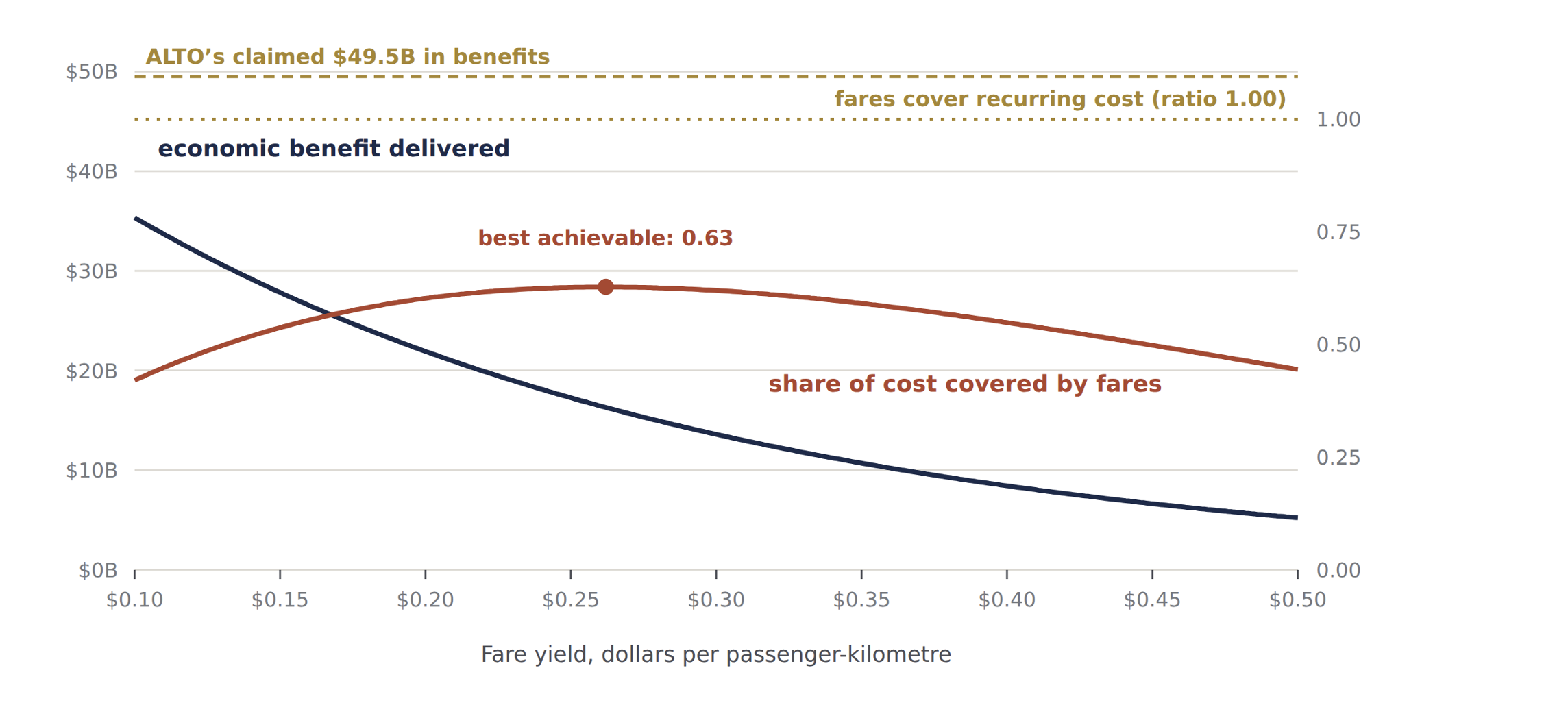
Figure 2. Neither promise is ever reached. The economic benefit delivered (navy, left axis) and the share of running costs covered by fares (rust, right axis), at each fare. The two gold lines are ALTO’s two claims. Benefit falls steadily as fares rise; cost recovery rises, peaks well short of covering everything, then falls away as riders drop off. The fare that comes closest to one claim is far from the other. The chart shows cost recovery as a ratio, so its peak of 0.63 is the 63 per cent described here, and the gold line at 1.00 is fares covering costs in full.
The ceiling is about two-thirds
The turning point sits at a fare near $0.26 per kilometre, where fares cover about 63 per cent of running costs. The best of the three published levels reaches 64 per cent. At no price in the corridor as forecast do fares cover the cost of running the railway. Fares pay about 63 cents of every dollar; the remaining 37 cents comes from the public, every year, forever.
And the best fare for the finances is the worst for the benefits
The fare that comes closest to paying for the railway delivers roughly $16 billion of the claimed $49.5 billion in benefits. The fare that comes closest to one promise is nowhere near the fare that delivers the other.
Against the cost of building it, nothing reaches a dollar
Construction of roughly $75 billion, spread across 2027–2037 and discounted at 3.5 per cent, is worth about $57 billion in today’s dollars. Measured against that, every dollar returns 49 cents of benefit at fare level A, 36 cents at level B and 26 cents at level C. ALTO’s own published benefits return 86 cents — and that failure is ALTO’s own arithmetic, not this note’s. None of these figures counts the operating shortfall above, which the public would have to fund on top.
The Three Promises Joined Up
There is exactly one answer, and it is about the corridor
The obvious next step is to check the promises one at a time and report that none of them survives. That is true, and it is set out below. But it is the weaker exercise, because it invites the reply that the whole thing is merely a disagreement with three forecasts.
A short detour, because the next step depends on it. Suppose you are told two things about a bag of marbles: it holds 18 marbles, and there are twice as many red ones as blue. Neither fact on its own tells you how many are red. Put them together and there is exactly one answer — 12 red and 6 blue. Two facts, each loose on its own, can lock onto a single exact answer once you require both to be true at the same time.
The same move works on the railway. “24 million riders” is one fact. “Fares alone cover the running costs” is another. Neither tells you the ticket price by itself — plenty of low prices might draw 24 million riders, plenty of high ones might cover costs. Require both at the same price, and as with the marbles there is only one price where that is possible.
The stronger exercise is to solve the two propositions together and ask what corridor would satisfy them. Covering costs fixes a relationship between the fare and the number of riders; so does the ridership promise. Two equations, two unknowns, one answer.
The one fare, and the one market, that satisfy all three
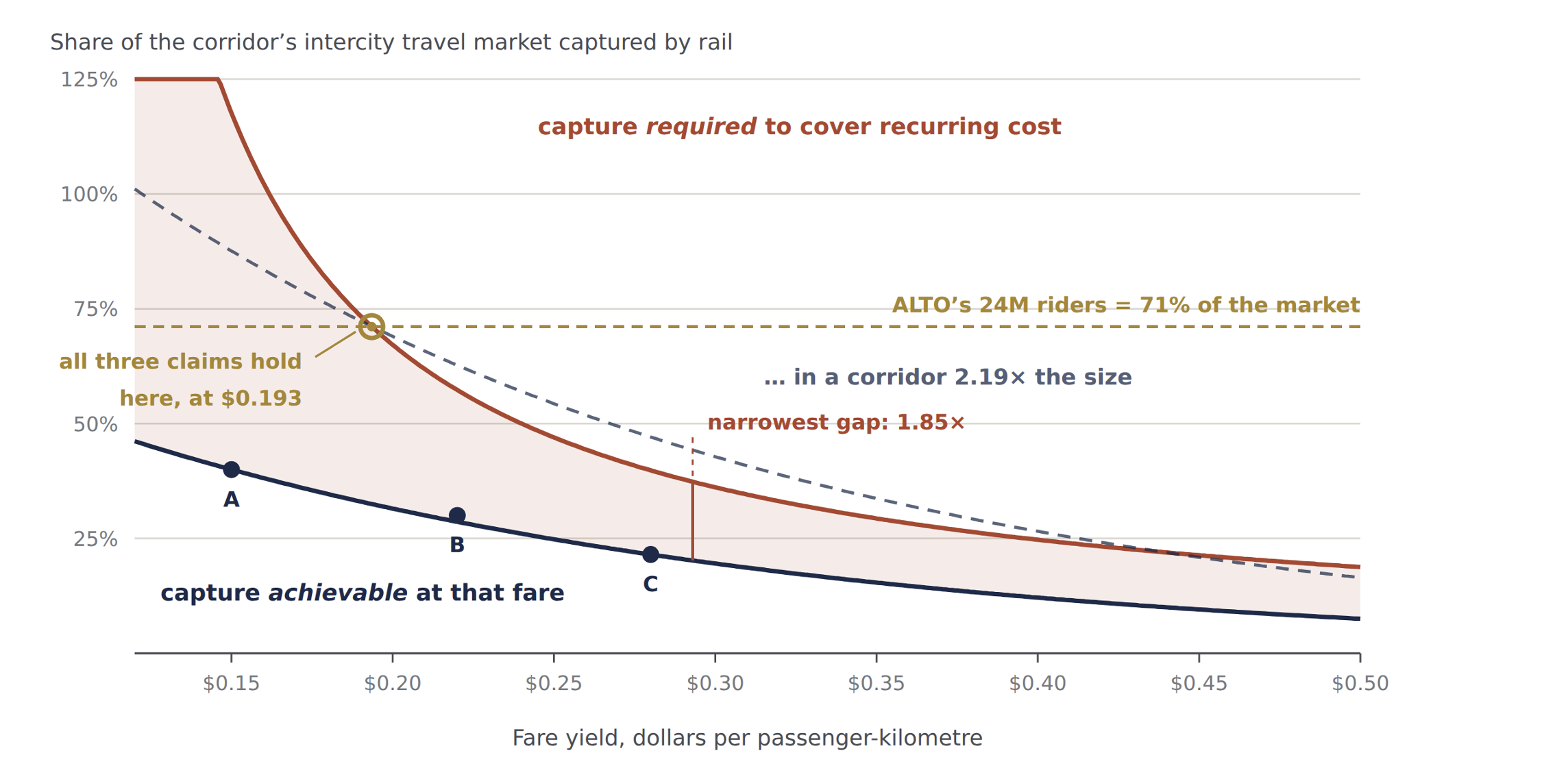
Covering 100 per cent of running costs at exactly 24 million riders requires a fare of $0.1935 per kilometre. At that fare the train wins 32.5 per cent of the market. For 32.5 per cent to equal 24 million riders, the corridor must be generating 73.9 million intercity trips a year. It is forecast to generate 33.7 million. The ratio is 2.19×.
There is only one such point, and it is worth being clear about why. Above $0.193 the railway covers its costs but carries fewer than 24 million people; below it, it carries more but cannot pay for them. Only at $0.193 do the two meet, and where they meet is fixed by the size of the market. The three promises do not contradict each other. They contradict the corridor.
That unstated assertion has a value, and it can be put in whichever units a reader finds easiest to judge:
Expressed as
Required by the three promises, against the forecast
Intercity trips a year, all modes
73.9 million required, against 33.7 million forecast — 2.19×
People living in the corridor in 2055
44.0 million required, against 20.1 million forecast — more people on the Toronto–Québec City axis alone than live in Canada today
Intercity trips per resident, per year
3.68 required, against 1.68 — corridor residents travelling more than twice as often as the evidence supports, at a time when remote and hybrid working push the other way
Annual population growth, 2025–2055
3.7 per cent a year sustained for three decades, against a central forecast of 1.0 per cent and a high forecast of 1.6
Anyone wishing to defend all three promises therefore has exactly one thing to defend, and it is a claim about demand rather than about engineering or financing. Cheaper construction, faster trains and a different discount rate do not reach it. Only a larger travel market does.
The Gap That Does Not Close
No ticket price escapes the problem
Within the corridor as forecast, is there some fare — between the three levels above, or beyond them — that escapes the problem? There is not, and the reason is structural rather than a matter of forecasting.
Two things happen at once as the price goes up. The number of riders the railway needs in order to break even falls gently and steadily, like walking down a slope — each rider is worth more, so fewer are needed, but that effect fades out gradually. The number of riders available falls away sharply, because once the train costs about what driving costs, people stop switching to it very quickly. A gentle slope and a cliff do not meet.
Put more precisely: raising the fare lowers the number of riders needed to break even, because each remaining passenger contributes more. But raising the fare also lowers the number of riders available, and it does so faster. The first effect tails off gradually. The second accelerates, because once the train loses its price advantage over a car that costs almost nothing extra to fill, passengers fall away sharply. The second effect always wins.
Figure 1. The two curves never meet at any fare. The rust curve is the share of the market the railway would need to cover its running costs; the solid navy curve is the share it can actually win. The shaded area between them is the gap. The dashed navy curve is the same demand curve in a corridor generating 2.19 times as much travel — it touches the rust curve at exactly one point, $0.193, and that point sits on the gold line marking the 71 per cent share ALTO’s 24-million forecast implies. The chart labels this share “capture”, and the fare “fare yield, dollars per passenger-kilometre”.
At this fare
Market share needed, against market share achievable
$0.15 per km — fare level A about $64 a journey
Needs 117.7% of the entire intercity market. Can win 40%. The railway would have to carry more trips than exist in the corridor at all, across every mode, simply to cover its running costs.
$0.22 per km — fare level B about $94 a journey
Needs 57.3%. Can win 30%.
$0.28 per km — fare level C about $120 a journey
Needs 39.8%. Can win 21.5%. This is as close as the gap ever comes: 1.85×, at about $0.29.
$0.40 per km about $171 a journey
Needs 24.7%. Can win 12.1%. The gap has started widening again as the ridership base collapses.
Read the last figures as the size of the gap: at every fare, the railway needs between roughly twice and three times the market share it can actually win. There is no fare at which it closes.
What Would Have To Change
Fixing one promise at a time
These are the terms a proponent is most likely to reply in. Three of the four turn out not to reach the joint answer at all.
A larger travel market — reaches all three
A corridor population of 34.0 million by 2055, or 2.85 trips per resident, brings 24 million riders within reach. Covering the running costs as well takes the 44.0 million of the joint answer. This is the only repair that reaches all three promises.
Longer journeys — does not move ridership
An average journey of 793–1,259 km, against the 428 km assumed — meaning essentially every passenger riding Toronto to Québec City end to end, and at fare level A a journey longer than the line itself. It would help cover costs. It puts nobody extra on a train.
Lower running costs — covers costs only
Running costs 37–46 per cent below the O&M Note estimates, with the fixed block down from $1,130 million to about $564 million. Again, nothing on the cost side puts passengers on trains.
A stronger switch to rail — the same claim in different units
The whole demand curve lifted by a factor of 2.19 at every fare. This is arithmetically identical to a bigger market, and equally a claim about demand.
This is the asymmetry the brief turns on. Repairs on the cost side rescue the cost-covering promise and leave the ridership promise exactly where it was, because nothing on the cost side puts passengers on trains. Only a larger travel market reaches all three, and both routes to one — more people, or a greater willingness to switch — are the same claim in different units.
Where Things Stand · August 2026
Summary ledger
Taking the promises one at a time, in the corridor as forecast, at every fare examined:
Not met
24 million riders a year. The ceiling across the whole fare range is 13.5 million. At the break-even fare of $0.193 it is about 11 million.
Not met
$49.5 billion in economic benefits. The ceiling is $27.8 billion, and that figure accepts ALTO’s own hours saved per passenger without challenge.
Not met
Fares cover the cost of running and maintaining the railway. The ceiling is 63–64 per cent, at any price, in the corridor as forecast.
Robust
The ceiling on cost recovery is the solid half of this finding. It sits inside the range of fares the modelling actually covers, and needs no projection beyond it.
Softer
The ceilings on riders and benefits involve projecting beyond the tested range at fares below $0.15, and a proponent is entitled to challenge them. The joint answer at $0.193 does not depend on any such projection.
Answerable
A proponent who accepts a 73.9-million-trip corridor is entitled to hold all three promises at once — and should be asked to say so plainly.
The three promises are not logically inconsistent with one another, and this brief does not claim they are. There is a genuine joint answer. The difficulty is that the answer describes a corridor that does not exist — and that the fourth promise, the one about how much travel the corridor generates, is the only one ALTO has never had to defend, because it has never been stated.
That distinction is not a technicality. A single claim that says “this project needs more than twice the travel demand anyone forecasts” invites immediate scrutiny. Three separately sourced numbers that merely happen to agree do not. Splitting one unproven assumption across three chapters is what allowed it to travel through public debate unchallenged — and catching that before tens of billions of public dollars are committed is the whole point of a review like this one.
Download Full Brief
Three Claims, One Fare (PDF)
The complete arithmetic with every step shown, for anyone who wants to check or reject any part of it
The translation of the three fare levels into dollars is an inference
Modal Shift Note 3 defines the three levels by how much subsidy they need and how they compare with airfares, not in dollars per kilometre. The $0.15, $0.22 and $0.28 figures are this brief’s reading of what those descriptions imply. Anyone who rejects the reading should supply the fares the business case actually assumes — and the conclusion holds across the whole range of fares, not only at those three points.
The 428-kilometre average journey is an assumption
Carried over from revised O&M Note 3. It matters a great deal: revenue and hours saved both rise and fall with it.
The construction cost figure is not ALTO’s
The $75 billion is the midpoint of the $60–90 billion range used elsewhere in this series. ALTO publishes no comparable figure. The returns per dollar should be read as indicative, and they measure benefits against construction cost alone.
Nothing here depends on the 9.3-billion-hour figure being correct
It is held at ALTO’s own value throughout. If it is correct, the findings stand as stated. If it turns out to be overstated, the benefit column falls further still and every conclusion here becomes firmer, not weaker.
The model of the train service is coarse
A single 450-seat train type, uniformly 65 per cent full over a 1,000-kilometre corridor, is a simplification. A real railway would vary train length and frequency by section, which would cut the ridership-related costs somewhat when ridership is low. It would not touch the fixed costs, which is where the problem lies.
Sources
Primary documents and companion notes
1.
ALTO, Canada’s Moment: The Economic Opportunity of High-Speed Rail, August 2026. The 24-million ridership forecast, the 9.3 billion hours of travel time saved and the $49.5 billion total benefit figure at a 3.5 per cent discount rate.
2.
ALTO, Canada’s Moment, August 2026. The claim appears three times: in the chief executive’s foreword, where revenues are expected to cover all operating and maintenance costs and to offset the ongoing public subsidies conventional passenger rail has historically required; in the executive summary, where operating revenues are expected to fully cover operating and maintenance costs, transitioning passenger rail from a publicly subsidised service to a commercially viable operation; and in the financial chapter, where the project is expected to operate on a self-sustaining basis. The same chapter distinguishes day-to-day operating costs from initial capital investment and lifecycle costs, and states that revenues do not cover all costs once those are included — the distinction examined in revised O&M Note 3, which finds the claim true for day-to-day operations alone, marginal once renewals are included, and failing once the trains themselves have to be replaced.
3.
Modal Shift Note 3 — corridor population, starting point and growth path; intercity trips per resident. The 1.68 figure is the 2025 baseline; the working range is 1.6–1.8. Using 1.68 is marginally conservative against this brief’s own conclusion.
4.
Modal Shift Note 3 — market shares of 38–42, 28–32 and 20–23 per cent for the three fare levels, which Note 3 calls Regimes A, B and C.
5.
Revised O&M Note 3 — infrastructure $1,016M, operations $700M and fleet $127M a year, spread over the life of the assets at 3.5 per cent real; the fixed and variable split giving $1,130M fixed and $8.91M for each train per day.
6.
Statistics Canada, The Daily, 17 June 2026 — Canada’s total population estimated at 41,417,056 on 1 April 2026, a decrease of 55,025 over the preceding quarter.
7.
Fare levels, service assumptions and the joint solution are set out in full in the PDF brief, including the two equations solved simultaneously in §6.1.
ALTO’s benefits page, set against independent estimates for the corridor — and against the cost figure it never states.
ALTO HSR Citizen Research Initiative · Economic Brief · Published July 2026 · ALTO consultation closed April 24, 2026
⚠ What the page does not say
ALTO’s “Discover Alto’s Many Benefits” page presents at least nine distinct benefit figures — GDP, jobs, tourism, road decongestion, emissions avoided, and annual ridership. It states no capital cost, no operating subsidy, and no benefit-cost ratio anywhere on the page. ALTO benefits page
Every figure on the page is a numerator. The one number that would let a reader judge whether the benefits are worth the spending — the cost of the project — appears nowhere on it.
Critical Finding
The page is built on a single asymmetry: benefits are presented gross, and the cost side is absent. Restore the denominator and the picture inverts. On ALTO’s own official $60–90 billion cost the benefit-cost ratio is only about 0.1; on the Initiative’s higher independent estimate, about 0.06 — against roughly 0.44 for the lower-speed HPPR alternative. Whichever cost figure you use, the benefits recover a dime or less on the dollar, far short of the 1.0 a project needs to break even; the page asks readers to evaluate the project on numerator alone.
On the page’s own headline figures, the ridership claim of up to 24 million passengers by 2055 is roughly 2.6 times the Initiative’s central estimate, and the sustainability claim inverts under full-lifecycle carbon accounting: the Initiative finds ALTO a net emitter of about 15 million tonnes CO₂e over fifty years, while HPPR is a net carbon sink.
This is the standard presentation pattern of optimism bias documented in megaproject appraisal: gross benefits foregrounded, costs and risks kept off the page, and ceiling figures — “up to” — offered as though they were expectations.
The Frame
Benefits gross, cost absent
The GDP line is the clearest instance. The page reports a 1.1 per cent increase in Canada’s GDP, valued at $24.5 billion “in today’s value” — a figure discounted to the present without disclosing the capital sum it is being discounted against. The Initiative’s ECI/CFI cost model puts ALTO at approximately $143 million per kilometre central; over a corridor of roughly one thousand kilometres, the capital envelope is an order of magnitude larger than any single benefit line quoted on the page. The HPPR spine, by contrast, is modelled at roughly $28–40 million per kilometre. ALTO’s own official figure, stated elsewhere, is $60–90 billion for the corridor; the conclusion here does not turn on whose estimate you take, since even on that lower number the benefit-cost ratio is only about 0.1, and on the Initiative’s estimate about 0.06.
Presented this way, the benefits cannot be wrong — only incomplete. A gross benefit is a real quantity; it simply says nothing about whether the project earns it back. That judgement requires the two numbers the page withholds: the cost, and the ridership assumption most of the other benefits depend on.
Comparison
The page’s claims against the corridor’s numbers
Each row sets a figure as ALTO states it beside the corresponding finding from the Initiative’s modelling.
ALTO’s Claim
The Initiative’s Finding
Ridership. Up to 24 million passengers annually by 2055.
The Initiative’s central estimate is approximately 9.2 million in 2055, rising to about 12.5 million by 2080 — roughly 2.6 times lower than the page’s figure. “Up to” marks a ceiling, not an expectation, and the figure coincides exactly with the page’s own 2041 corridor population of 24 million, inviting readers to conflate people in the corridor with trips captured.
Emissions. 100% electric — the equivalent of removing about 100,000 cars from the road each year.
“100% electric” describes operational emissions only. Counted over its full lifecycle — the embodied carbon of a 300+ km/h greenfield build, against a ridership that is itself overstated — the Initiative finds ALTO a net emitter of roughly +15 Mt CO₂e over fifty years. The lower-speed HPPR alternative, built largely on existing alignment, is a net carbon sink.
Economic impact. 1.1% increase in Canada’s GDP ($24.5 billion in today’s value).
A gross benefit stated with no cost and no netting, discounted to present value without disclosing the capital figure behind it. Set against the Initiative’s cost model, the corresponding benefit-cost ratio is approximately 0.06.
Jobs. Over 50,000 during construction; a further 5,000 once operational.
Construction employment is a project input — a cost — not a benefit. Counting it on the benefit ledger is double-counting, among the most reliably flagged errors in megaproject business cases. The 5,000 operational jobs are a genuine recurring effect; the 50,000 construction jobs are not a benefit at all.
Road decongestion. Valued at $570 million.
The figure scales directly off ridership. If the 24 million capture is roughly 2.6 times high, the decongestion benefit is proportionally overstated. Induced demand refilling freed road capacity is not addressed.
Tourism. Approximately $800 million in revenue each year.
A gross figure with no displacement netting — spending that would have occurred anyway, or shifted from elsewhere in the corridor, is not removed.
Travel times. Toronto–Montréal ~3h; Ottawa–Montréal ~1h; Montréal–Québec City ~1h30.
These times are the payoff of the 300+ km/h greenfield alignment that drives both the ~$143M/km cost and the community disruption the page does not mention. HPPR achieves competitive times at 180–240 km/h for a fraction of the cost.
Cost of the project.
Stated nowhere on the page. ALTO’s own official range, given elsewhere, is $60–90 billion; the Initiative’s independent estimate is higher, at roughly $143 million per kilometre. This is the number against which every benefit above would have to be weighed — and the one the benefits page omits.
Three Inversions
Where the page’s strongest claims turn over
The sustainability claim inverts under lifecycle accounting
The page’s environmental case rests on ALTO being “100% electric.” That describes how the trains are powered, not what building the line costs in carbon. A 300+ km/h greenfield corridor — concrete, steel, tunnelling, geofoam, land conversion — carries a large embodied-carbon debt that operational electricity does not offset, particularly once the offset is recomputed against realistic rather than headline ridership. The Initiative’s finding is a net carbon deficit of roughly +15 Mt CO₂e over fifty years, while the lower-speed HPPR alternative is a net sink. The single most quotable line on the page — sustainability — is the one the accounting reverses.
“Up to 24 million” is a ceiling offered as an expectation
The headline ridership number does the persuasive work of the page, and “up to” is doing the work inside it. The Initiative’s central estimate is about 9.2 million passengers in 2055. Systematic overstatement of rail ridership at the appraisal stage is one of the best-documented patterns in the megaproject-forecasting literature, and this figure fits it squarely. The Initiative’s brief The Anatomy of an Optimistic Forecast sets out the mechanism in full.
Construction jobs are counted on the wrong side of the ledger
The page presents “over 50,000 jobs during construction” as a benefit. In a proper appraisal, construction labour is an input the project pays for — part of its cost, not part of its return. Presenting it as a benefit counts the same money twice. This is standard in the appraisal literature, and it is one of the easier errors for a general reader to check.
Three Numbers
What restoring the denominator shows
2.6×
the page’s 2055 ridership claim over the Initiative’s central estimate
Initiative ridership modelling
+15 Mt
net CO₂e over fifty years — ALTO as emitter, not saver, on a lifecycle basis
Initiative lifecycle carbon analysis
0.06–0.1
benefit-cost ratio for ALTO — on the Initiative’s estimate and on ALTO’s own $60–90B; both far below 1.0 (HPPR ~0.44)
Initiative cost & benefit model
None of these three figures appears on ALTO’s benefits page. Each is derived from the page’s own claims once the cost and the ridership assumption are made explicit.
Where things stand · July 2026
Summary ledger
Against the benefit claims as the page presents them:
Overstated
Ridership — “up to 24 million by 2055” is roughly 2.6 times the Initiative’s central estimate of ~9.2 million.
Contradicted
Emissions — the “100% electric” sustainability claim reverses to a net +15 Mt CO₂e deficit once lifecycle carbon is counted.
Omitted
Benefit-cost ratio — no BCR is stated anywhere; the Initiative’s central case is ~0.06.
Omitted
Capital cost — no cost figure appears on the page; central estimate ~$143M/km.
Miscounted
Construction jobs — presented as a benefit; they are a cost input, and counting them double-counts.
Overstated
Decongestion and tourism — gross figures that scale off the overstated ridership, with no netting for displacement or induced demand.
Omitted
Land and community impact — the disruption the 300+ km/h alignment requires is absent from the benefits page entirely.
The page is titled “Discover Alto’s Many Benefits.” The benefits are real as gross figures; what the page withholds is the cost against which they would have to be set, the ridership assumption most of them depend on, and the lifecycle accounting that reverses its environmental claim. Read with those three restored, the case the page makes for the project is substantially weaker than the case it appears to make.
ALTO HSR Citizen Research Initiative, lifecycle carbon analysis — ALTO net +15 Mt CO₂e over fifty years; HPPR net sink.
5.
ALTO HSR Citizen Research Initiative, ECI/CFI cost model (ALTO ~$143M/km central; HPPR spine ~$28–40M/km) and benefit-cost analysis (ALTO ~0.06 on the Initiative’s cost and ~0.1 on ALTO’s own $60–90B; HPPR ~0.44).
6.
ALTO HSR Citizen Research Initiative, “The Anatomy of an Optimistic Forecast” and “A Straighter Line,” citizenresearch.ca.
7.
Bent Flyvbjerg, on optimism bias and reference-class forecasting in the appraisal of major infrastructure projects.
ALTO has published its own tourism study. It studies only the seven station cities — and counts none of the costs.
ALTO HSR Citizen Research Initiative · Tourism Brief · Published June 2026 · ALTO consultation closed April 24, 2026
⚠ New Release: ALTO Commissions a Tourism Study
In June 2026 ALTO released “Tourism in the Alto Corridor: Current Conditions and Potential Impacts,” prepared for ALTO by the consultancy CPCS in association with HDR. It is the first time the project has placed a tourism analysis on the public record. The report’s headline is that ALTO “could contribute an additional $1 billion to GDP annually, and support 11,500 more jobs under a medium coordination scenario.”
The report carries the standard commissioned-work disclaimer — the opinions “are those of the authors and do not necessarily reflect the views of Alto” — and is dated June 2026, after the April 24 consultation deadline had already closed. It is a gross-benefit study of the seven station cities. It does not measure a single cost.
Critical Finding
ALTO’s own consultant has now confirmed, in writing, the distinction this initiative has argued from the start: tourism benefits accrue to stations, not to the tracks between them. The report studies only the six Census Metropolitan Areas that contain the seven proposed stations — Toronto, Peterborough, Ottawa-Gatineau, Montreal, Trois-Rivières, and Québec City. The rural landscapes the corridor would traverse without stopping — Frontenac, Leeds & Grenville, the entire RTO 9 region — are outside the study’s frame entirely.
The report is a benefits-only document. It contains no construction-phase impacts, no tourism losses, and no accounting for visitors who shift away from non-station regions toward station hubs — even though the report itself concedes that smaller places that fail to differentiate “will limit gains — or even risk losing activity to larger centres.” The study answers one question: how much tourism might the seven stops gain? It never asks the second: what does the corridor cost the regions it passes through?
The much-quoted “$1 billion / 11,500 jobs” is the medium scenario, not the central case. The low scenario is +$177 million and roughly 2,000 jobs. Even the medium figure is contingent on dedicated tourism policy, last-mile connections, and destination readiness across the corridor — none of which ALTO controls or funds. The report concedes the foundational caveat in its own words: “HSR alone is rarely sufficient to generate sustained tourism development.”
Download
Benefits for Stations, Costs for the Corridor — Full Brief (PDF)
A point-by-point reading of ALTO’s tourism study against the cost side it omits, with the evidence from this initiative’s earlier tourism research
A commissioned, benefits-only study of the seven stops
“Tourism in the Alto Corridor” combines three things: a baseline profile of tourism in the six station CMAs; a review of international case studies on high-speed rail and tourism; and three illustrative scenarios that vary the level of tourism-policy coordination from low to high. Its baseline finding is that tourism in those CMAs already generates over $31 billion in visitor spending, contributes about $33.7 billion to GDP, and supports more than 377,000 jobs, with Toronto and Montreal accounting for the largest shares.
The forward-looking finding — the one ALTO’s communications will lead with — is that additional tourism spending under the project could add to GDP and jobs. But the three scenarios produce very different numbers, and the report is explicit that they are “illustrative and should not be interpreted as forecasts.”
+$177M
added GDP / ~2,000 jobs — low coordination scenario
CPCS for ALTO, p.23
+$1.0B
added GDP / 11,500 jobs — medium coordination scenario (the headline)
CPCS for ALTO, p.23
+$3.9B
added GDP / 43,000 jobs — high coordination scenario
CPCS for ALTO, p.23
The single most important sentence in the document appears on page 7: the destinations “most likely to be affected by a high-speed rail service are the urban areas where stations are located.” That premise defines the study’s entire scope. Everything that follows is built on the six station CMAs. The communities between them — the ones with no station — are not modelled, not measured, and not mentioned in the results.
What ALTO’s Consultant Concedes
The report admits the bypass risk in its own words
This initiative has argued throughout the consultation that high-speed rail creates a station/no-station divide: stations create tourism, tracks do not. ALTO’s commissioned study does not contradict that argument. In several places, it states it.
What the report says
What it means for the corridor regions
“The travel and tourism destinations most likely to be affected by a high-speed rail service are the urban areas where stations are located.” (p.7) The study is then built only on the six station CMAs.
The regions the southern corridor would cross without a station — Frontenac, Leeds & Grenville, Lennox & Addington, the RTO 9 region — are outside the analytical frame. The study cannot show a benefit for them because it never looks at them.
Smaller municipalities that fail to differentiate and coordinate “will limit gains — or even risk losing activity to larger centres.” (p.18)
This is the bypass / agglomeration effect, conceded. The report frames it as a risk that supportive policy might manage. For a region with tracks and no station, it is the predictable default, not a managed exception.
“HSR alone is rarely sufficient to generate sustained tourism development; realized impacts depend on coordinated local strategies.” (p.18)
Even the modelled gains require destination marketing, event programming, accommodation, and last-mile connections that ALTO neither funds nor controls. Absent that coordination, the report’s own logic points to the low scenario or below.
International tourist numbers see “limited to no change” (p.22 note); nearly all modelled gains are in-corridor domestic visitors making shorter trips.
The projected uplift is largely Ontario and Quebec residents travelling more within their own provinces — a reshuffling of where Canadians already spend, not clearly net-new national tourism. The report never tests whether this is displacement.
Read together, these are not stray caveats. They are the analytical spine of the report. ALTO’s consultant has confirmed the station/no-station distinction, conceded that non-station places can lose activity, and acknowledged that the benefits depend on conditions outside ALTO’s gift.
Update · July 2026
A second commissioned study, and what it says about the first
This brief was published in June 2026, days after ALTO released the CPCS tourism study. On July 13, 2026 ALTO published a second commissioned economic study — An Overview of the Structural Economic Impacts of Alto, prepared by Aviseo Consulting — alongside a blog post summarising it. That study answers a question this brief left open, and it answers it against ALTO’s own tourism claim.
The displacement question, answered by ALTO’s other consultant
This brief noted that the modelled tourism gains are largely in-corridor domestic visitors, that international numbers show limited to no change, and that the CPCS report never tests whether this is displacement rather than net-new national tourism.
The Aviseo study does test it, and reaches the opposite conclusion. It counts international tourism only, on the stated ground that increased domestic tourism would at least partly reflect substitution from existing household expenditure, with limited net effect at the macroeconomic level. In its own words, the driver of national GDP is the net inflow of foreign spending.
The category that produces the CPCS headline is therefore the category ALTO’s other consultant sets aside as largely a reshuffling of money Canadians would have spent anyway.
Aviseo — $0.8 billion
CPCS — $1.0 billion
International visitors only. Domestic tourism excluded as substitution with limited national effect. Estimated using a general equilibrium model, which nets out activity displaced from elsewhere in the economy.
Medium scenario driven predominantly by in-corridor domestic travel. Estimated using Statistics Canada input-output multipliers including induced effects, which aggregate gross activity without netting displacement.
Result:Two figures that cannot be combined
A third figure circulates alongside them. ALTO’s FAQ page advertises $800 million a year in tourism revenue. That corresponds to Aviseo’s contribution-to-GDP figure, which is a value-added measure rather than revenue, and matches no revenue figure in either report.
In the base case, two station cities receive nothing
This brief established that the rural corridor regions are outside the study’s frame. The per-city results, at Tables 13 and 15 of the CPCS report, show that the scope problem does not stop at the regions left out. It reaches two of the station cities that were included.
City
Additional annual tourism spending
Toronto
$37M under low coordination; up to $1,500M under high
Québec City
$50M under low coordination; up to $500M under high
Montréal (incl. Laval)
$44M under low coordination; up to $900M under high
Ottawa-Gatineau
$21M under low coordination; up to $560M under high
Trois-Rivières
$0 under low coordination; up to $25M under high
Peterborough
$0 under low coordination; up to $35M under high
Low coordination:Nothing for the two smallest station cities
The GDP table records the same outcome: under low coordination Peterborough remains unchanged at $475 million and Trois-Rivières unchanged at $318 million. Even under full corridor-wide policy coordination, Peterborough reaches up to $35 million against Toronto’s $1.5 billion — a ratio of roughly 43 to 1.
The blog post with which ALTO announced this study is titled “How High-Speed Rail Will Boost Tourism from Big Cities to Small Towns.”
The summary reverses the report’s own caution
This brief quoted the report’s statement that its scenarios are illustrative and should not be interpreted as forecasts. ALTO’s June 8 blog post describes the same scenarios as forecasts, says the report contains tangible projections, and states that ALTO engaged CPCS to provide real-world, objective results. It reports the medium scenario figures and does not mention the low scenario at all.
An unreported finding: faster trains can reduce hotel revenue
Under low coordination, business tourism spending falls in Montréal, Ottawa-Gatineau and Québec City, as high-speed rail converts overnight business trips into same-day return trips. The report cites the Paris–Lyon case, where average stays fell from 2.3 nights to 1.7 once same-day return became practical. This appears in no public summary of the study.
The Initiative examines the second study, the treatment of both in ALTO’s public materials, and the arithmetic of the 1.1 per cent GDP claim in a companion economics brief. Two Point Two Trillion
The Cost Side
Everything the study does not count
A tourism impact assessment that names a benefit but no cost is a half-ledger. The report’s title promises “potential impacts”; what it delivers is potential gains at the seven stops. The costs documented in this initiative’s earlier research — and in submissions from affected regions — appear nowhere in it.
Cost the corridor imposes
How ALTO’s tourism study treats it
Construction-phase disruption. Eight to ten years of blasting, dust, night lighting, truck traffic, road closures, and trail severance through tourism-dependent rural areas — documented in this initiative’s RTO 9 submission and the snowmobile-trail brief.
Absent. The scenarios model an operating railway “if Alto were in service today.” The decade of construction that precedes any operating benefit is not in the analysis at all.
Treatment:Not counted
Trail and active-tourism loss. The Cataraqui Trail (a 104 km segment of the Trans-Canada Trail) and the organized snowmobile network of OFSC Districts 1, 2 and 6 — an estimated $220–270 million in direct expenditure and $450–540 million in total annual activity — run through the corridor.
Absent. The study’s tourism universe is the six metropolitan CMAs. Rural rail-trail and winter-tourism economies are not in its scope, so their potential loss does not register against the modelled urban gains.
Treatment:Not counted
The at-risk regional economy. RTO 9 recorded $1.8 billion in tourism spending in the first nine months of 2024; the Rideau Heritage Route sustains roughly $695 million in GDP and 8,744 jobs. Both sit in the southern corridor’s path.
Absent. Neither figure appears. The regions that generate them are not among the six CMAs studied, so the report’s GDP and jobs gains are not netted against any of this exposure.
Treatment:Not counted
VIA Rail displacement — regional and national. MP Scott Reid has confirmed in writing that either corridor option is likely to reduce VIA ridership and trigger service cuts through Kingston, Brockville, and other southeastern Ontario towns — the low-carbon access mode visitors use to reach these destinations without a car. The risk is also national: then–NDP transport critic Taylor Bachrach (Skeena–Bulkley Valley) warned that VIA earns more than 80% of its revenue and carries more than 90% of its passengers on the Quebec City–Windsor corridor, and that handing that corridor to a private operator would leave VIA with “a fraction of the revenue” it uses to cross-subsidize long-distance rural routes across the Prairies, the West, and the Maritimes.
Absent. The report does not consider the loss of existing rail access to non-station communities, even as it counts new rail access as a benefit to station communities. Nor does it weigh the wider risk to the national VIA network that the corridor’s revenue currently helps sustain.
Treatment:Not counted
Visitors drawn away from non-station regions. The bypass effect the report concedes on page 18 — activity migrating to larger centres with stations.
Conceded but not quantified. The report names the risk and then models only the upside at the stations that would gain. The corresponding loss elsewhere is acknowledged in prose and excluded from the numbers.
Treatment:Acknowledged, not measured
How Robust Are the Numbers?
Assumption-driven scenarios, not forecasts
Even taken on its own terms, the report’s headline number is softer than it will sound in a press release. Five features of the method are worth keeping in view.
The headline is the middle scenario, not a central estimate
The “$1 billion / 11,500 jobs” figure is the medium coordination scenario. It requires dedicated tourism policy in every city, improved last-mile connections, and rising convention and event activity. The report’s own framing makes clear these are conditions to be met, not outcomes of the railway itself.
The gains are scenario assumptions, not a Canadian model
The arrival, length-of-stay, and spending percentages in Appendix B are judgmental selections from the international literature, applied to Canadian baseline data. They are not derived from a Canadian demand model or validated against Canadian outturns. The outputs are functions of the chosen inputs.
No reference-class or outturn discipline
The tourism uplift is bracketed by three policy scenarios chosen to span a positive range. There is no reference-class comparison to what comparable HSR projects actually delivered — the same optimism-friendly structure this initiative has critiqued in ALTO’s ridership and cost work.
Shorter stays can reduce spending even as arrivals rise
The report concedes that average length of stay falls in some cities even in the medium scenario, as shorter-staying in-corridor visitors displace longer-staying international ones, and that accommodation spending can drop even when arrival counts go up.
The report’s own “structural differences” section undercuts transfer
Page 19 lists the reasons the European evidence may not transfer to Canada: dispersed attractions, lower base tourism, car-dominant travel (85–98% of corridor visitors drive today; train is about 6% to Toronto and ~2% elsewhere), and an immature rail network. It concludes “early impacts may take longer to be realized.”
The Marketing Contradiction
The study quietly undercuts ALTO’s own food-tourism ad
ALTO has been running a Facebook campaign inviting travellers to “embark on a culinary adventure from Toronto to Quebec City,” with the tagline that “Canadian food tourism is getting a whole lot easier — and faster.” The implication is broad, corridor-wide benefit.
ALTO’s own commissioned study says something narrower. Benefits concentrate at stations. Non-station areas may lose activity. The food-tourism landscapes of Eastern Ontario — the farms, trails, and agri-tourism the ad’s imagery evokes — sit in a corridor the train would pass through without stopping. The campaign and page 18 of the report cannot both be the whole story. We covered the food-tourism ad when it first appeared; the new study now sits in tension with it.
Read More
Our earlier tourism research
This brief draws on two longer pieces of research published on this site. Both predate ALTO’s study and document the cost side it leaves out.
Measuring ALTO’s tourism study against what an honest tourism assessment of the corridor would have to show:
Confirmed
Benefits accrue to stations, not tracks. ALTO’s consultant builds the entire study on the six station CMAs and states that station cities are the destinations most likely to be affected (p.7).
Confirmed
Non-station places can lose activity. The report concedes the bypass / agglomeration risk in its own words (p.18).
Confirmed
HSR alone is not sufficient. Benefits depend on policy coordination, last-mile connections, and destination readiness that ALTO does not fund (p.18).
Confirmed
The scope problem reaches inside the study. Under low coordination, Peterborough and Trois-Rivières — two of the six CMAs the report does cover — receive $0 additional tourism spending and $0 additional GDP (Tables 13 and 15).
Soft
The headline figure is the medium scenario, not a central estimate; the low scenario is roughly one-sixth of it. The numbers are scenario assumptions, explicitly “not forecasts.”
Soft
Gains are largely in-corridor domestic, with international numbers showing little change — raising an unanswered displacement question.
Omitted
Construction-phase disruption (8–10 years): not in the analysis.
Omitted
Trail and winter-tourism loss (Cataraqui Trail; OFSC Districts 1/2/6, $450–540M total activity): not in scope.
Omitted
At-risk regional economy (RTO 9 $1.8B; Rideau Heritage Route $695M GDP / 8,744 jobs): not netted against modelled gains.
Omitted
VIA Rail displacement: loss of existing rail access to non-station communities not considered — nor the national risk to VIA, which earns 80%+ of its revenue on this corridor.
Omitted
Bypass losses: conceded in prose (p.18) but excluded from the numbers.
Contradicted
ALTO’s two consultants disagree on the headline category. The Aviseo study (July 2026) counts international tourism only, treating domestic tourism as substitution with limited net national effect — the category that drives the CPCS figure. The two estimates use methods that cannot be combined.
Reversed
“Should not be interpreted as forecasts.” ALTO’s own June 8 blog post describes the same scenarios as forecasts and tangible projections giving real-world, objective results, and reports the medium scenario alone.
ALTO has now produced its own tourism study, and it confirms three things this initiative has argued throughout. Tourism benefits accrue to stations, not to tracks. The rural corridor regions are not in the study. And the report contains no cost side at all. ALTO’s consultant has, in effect, validated the station/no-station distinction while declining to measure the half of the ledger that falls on Eastern Ontario. A benefits-only study of the seven stops is not a tourism impact assessment of the corridor.
Download Full Brief
Benefits for Stations, Costs for the Corridor (PDF)
Complete reading of ALTO’s tourism study for decision-makers, RTO 9, MTCG, MPs, and constituents tracking the tourism file
CPCS, in association with HDR, for ALTO. Tourism in the Alto Corridor: Current Conditions and Potential Impacts. June 2026. (Scenario results, pp.21–24; policy-coordination conclusions, p.18; study scope, p.7; structural differences, p.19; baseline, p.5.)
Submission to RTO 9 — ALTO High-Speed Rail Southern Corridor: Tourism & Economic Impacts for Southeastern Ontario. February 2026. (RTO 9 regional tourism spending, Jan–Sep 2024.)
5.
OFSC 2022–2023 Economic Impact Study (Harry Cummings & Associates, using the Ontario Ministry of Tourism TREIM model); district-level apportionment for Districts 1, 2 and 6.
6.
MP Scott Reid, correspondence to constituents (2026), re: VIA Rail displacement risk from HSR corridor selection.
7.
CBC News, “NDP warns privatizing high-speed rail from Toronto to Quebec could kill passenger trains in rest of Canada,” February 19, 2025 — carries MP Taylor Bachrach’s warning and VIA’s corridor revenue and passenger shares. cbc.ca
8.
ALTO, “Embark on a culinary adventure from Toronto to Quebec City” — Facebook advertisement, February 2026 (alto-hsr.ca).
A plain-language guide to how we evaluated the cost of the proposed ALTO high-speed rail line — starting from one simple rule that every railway in the world has to obey, and following it through to a number the government’s own claims do not match.
ALTO HSR Citizen Research Initiative · Financial Framework · Published May 2026
⚠ What this is
This is the readable version of a longer technical paper. The full document and slide deck show every calculation; this post explains, in everyday terms, what we did, why, and what we found — with no maths background assumed.
The short version: the project’s likely capital cost is roughly double what the government has stated; the trains cannot pay for themselves at any realistic ticket price; and the project’s headline ridership target of 24 million passengers a year sits outside the range that any comparable line has ever achieved.
The one idea to take away
Every operating railway in the world has a bill that has to balance every year. What it costs to build and run the line on one side; where the money to cover that comes from on the other. The money can only come from three places: ticket sales, a government subsidy, or value captured from land near the stations.
You can argue about any single number. What you cannot do is leave one side of the bill short. If a proponent quotes you a low cost and a high number of riders but never tells you the subsidy, the subsidy is simply the part of the bill they haven’t shown you — it doesn’t disappear. Our whole method is just: fill in every blank on the bill using independent evidence, and see what the missing number turns out to be.
Read in full
A Framework for Independent Evaluation of the ALTO HSR Project
The complete methodology, every rubric and dataset, and a slide deck version — all published and reproducible
Imagine your household budget. Whatever you spend has to be matched by money coming in — from your salary, your savings, a loan. A railway is no different, just bigger. There are two kinds of cost: the enormous one-time cost of building the line (paid off gradually, like a mortgage), and the ongoing cost of running it every year — staff, electricity, maintenance, replacing worn-out trains.
Those costs have to be paid for. There are only three sources. Here is the whole thing on one line:
The annual fiscal ledger
Cost to build (yearly share) + cost to run=ticket sales + government subsidy + land value capture
The left side is what the railway costs each year. The right side is where that money comes from. The two sides must be equal — that’s what “balance” means.
In plain terms
“Land value capture” means a railway can sometimes raise money from the rise in nearby land prices that a new station creates — for example by developing land around the station. It’s a real tool, but a modest one in Canada, and ALTO has named no such mechanism. So for ALTO that third source is effectively zero, which leaves only two: tickets and subsidy.
Here is the consequence that does all the work. Once you’ve pinned down the cost, the ticket revenue, and the land capture using evidence, the subsidy isn’t a choice anyone gets to make — it’s whatever is left over to make the bill balance. It’s a leftover, not a decision. That single insight is why a project can claim to be “self-sustaining” and still, on its own numbers, need billions of dollars of public money a year. The subsidy was always there; it just wasn’t written down.
The Method
Seven steps to fill in the blanks
To fill in each part of that bill honestly, we built a seven-step process. Each step answers one question using published evidence rather than the project’s own marketing, and each step shows its work so that anyone who disagrees can re-run it with their own assumptions. Here is what each step asked, and what it found for ALTO.
1
How hard is this to build?
Engineering complexity, compared to rail lines around the world
We scored the corridor’s technical difficulty against an international database of comparable projects. ALTO lands in the upper “High” band — among the most demanding corridors anywhere in the world. Hard things cost more and run late more often; this matters for every number that follows.
2
How smooth will getting it approved and built be?
Community, consultation and consent risk
We measured the friction the project faces from communities, landowners and the consultation process. The score lands in the band where comparable megaprojects’ cost overruns tend to cluster — another reason to expect the final bill to climb.
3
What will it really cost to build?
Capital cost, calibrated against similar projects
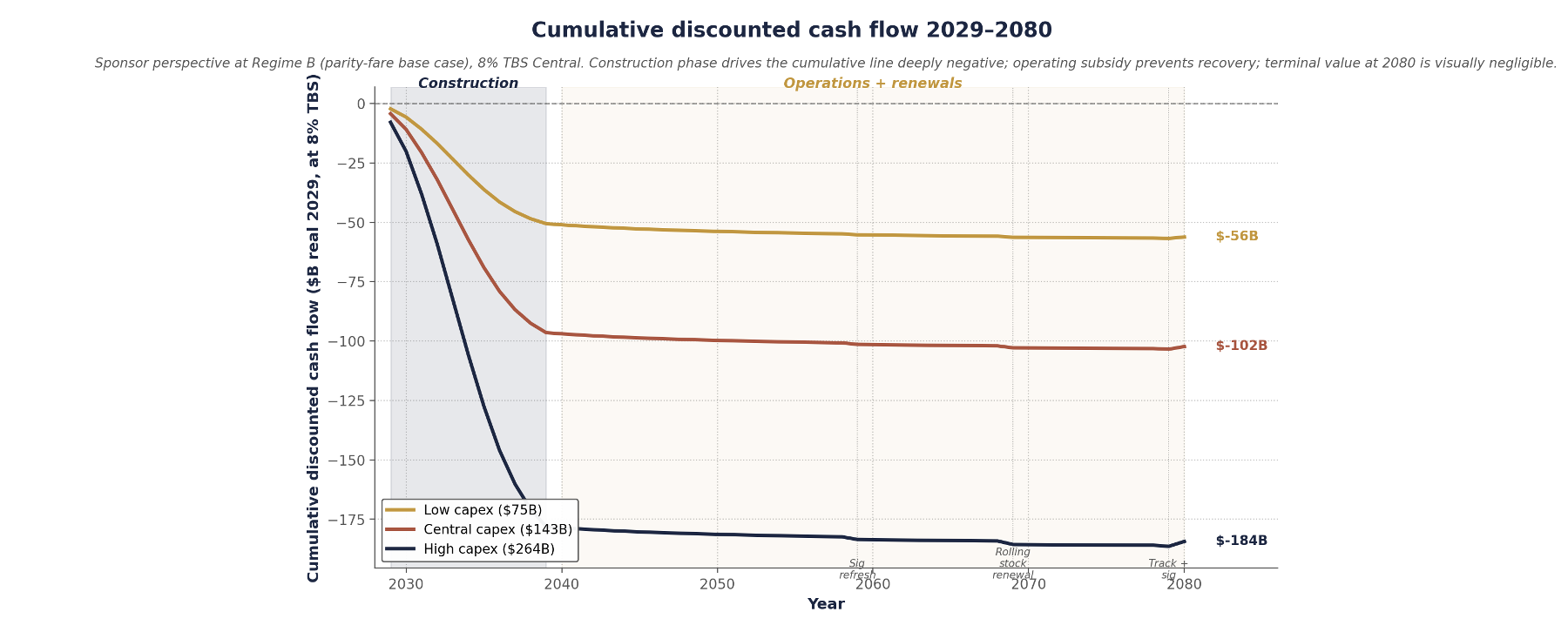
The government states $75 billion. Comparing ALTO to a reference class of similar railways and adjusting for its difficulty, our central estimate is $143 billion — nearly double — with a worst-case ceiling of $264 billion. The stated budget sits at the very bottom of the plausible range.
4
What will it cost to run, every year?
Operating cost, built up from the actual assets
Adding up staff, operations, maintenance and replacing trains as they wear out gives about $2.15 billion a year. To cover just that running cost from fares, the line would need roughly 12.5 million passengers a year — and even then it only recovers about 80 cents of every dollar.
5
How many people would actually ride it?
Realistic ridership, and the subsidy that follows
Based on how many travellers comparable lines actually pull off the roads and out of the air, a realistic range is 5 to 12 million riders a year, with a sensible target near 8 million. ALTO’s headline figure of 24 million sits outside that range entirely.
6
Is it worth it?
Benefits weighed against costs
Weighing all the benefits against all the costs gives a ratio of about 0.11 — roughly eleven cents of benefit for every dollar spent. To make the 24-million target pay, tickets would need to cost between $381 and $1,596 — and 24 million riders is unreachable anyway.
7
Would a serious gatekeeper approve it?
Tested against Norway’s independent project-review system
Norway runs big projects through two independent quality gates before funding. Run through those gates, ALTO fails most of the criteria at both stages — described as a textbook example of exactly the kind of project the Norwegian system was built to catch.
What “reference class” means
Rather than trust a project’s own optimistic forecast, you line it up against a large group of similar projects that have already been built, and ask: what actually happened to those? It is one of the most reliable ways known to forecast cost and ridership, precisely because it sidesteps wishful thinking.
The Headline Figures
Three numbers that frame the whole thing
Cost to build
$143B
Our central estimate — against a stated budget of $75B
Value for money
11¢
Of benefit returned per dollar spent (a benefit-cost ratio of 0.11)
Ridership gap
24M
The stated target — against a realistic ceiling near 12M
None of these is a guess plucked from the air. Each one is the output of one of the seven steps above, and each step publishes the data and the scoring behind it. The point of putting them together is simple: a project whose costs are understated, whose value-for-money is low, and whose ridership is overstated does not become viable just because its three weaknesses are described in separate documents.
The Part Nobody Mentions
No ticket price makes the bill disappear
Here is where the “bill that has to balance” idea pays off. There is a temptation to think the subsidy could be designed away — charge higher fares, or fill more seats. So we tested the three obvious strategies. In every case, a large public subsidy remains. The only thing that changes is how the cost is split between the passenger and the taxpayer.
Charge premium fares
~$1B / yr
Trade-off:High ticket prices, so fewer riders. Lowest subsidy — but still about a billion a year.
Match airline fares
~$2B / yr
Trade-off:Prices in line with flying. A moderate middle path — roughly two billion a year.
Deep discounts, fill seats
~$3.5B / yr
Trade-off:Cheap tickets, more riders — but the lowest fares mean the largest subsidy.
Notice what this means. Choosing among these isn’t a choice between “subsidised” and “unsubsidised” — every option is subsidised. It’s only a choice about who pays: the rider at the ticket window, or the taxpayer through the public purse. That is a perfectly legitimate political decision to make out in the open. What isn’t legitimate is pretending the choice doesn’t exist.
And that is exactly why one specific government claim does not hold up. On 22 April 2026, the government stated the operation would be “financially self-sustaining” — meaning fares alone would cover running costs. But no realistic level of ridership produces enough ticket money to cover the $2.15 billion annual running cost. Measured against every comparable high-speed line operating in the world, that claim simply isn’t consistent with the evidence.
The Bottom Line
What the filled-in bill shows
Put the seven steps together and the picture is consistent, not cherry-picked:
Roughly double the cost
The likely cost to build is about twice the stated budget — and the stated figure sits at the bottom edge of what’s plausible.
Cannot pay its own way
At no realistic fare do ticket sales cover even the cost of running the trains, let alone building the line.
Eleven cents on the dollar
The central value-for-money ratio is about 0.11 — far below the level at which a project is normally considered worthwhile.
A ridership target out of reach
The 24-million figure lies outside the range any comparable line has achieved, and the subsidy is required no matter what.
Measured against Norway’s independent review standard — one of the most respected gatekeeping systems for large public projects — ALTO fails the majority of the tests at both the early-concept stage and the pre-funding stage.
In Fairness
This is a recommendation, not a verdict
It matters how this is meant to be read. The seven-step process produces a recommendation, not a decision. The decision belongs to elected officials and the public — ideally informed by an independent authority such as the Parliamentary Budget Officer.
The purpose of all this work is narrow and, we hope, fair: to put a balanced, contestable record on the table, so that the choice about which rail corridor Canada builds rests on evidence rather than on headline numbers. Every step publishes its rubric, its scoring, and its data. If you disagree with any finding, you are invited to re-run it under your own assumptions — that openness is the whole point.
A good public investment can survive this kind of scrutiny. The questions below are the ones any major rail proposal should be able to answer plainly.
On cost: If the stated budget sits at the bottom of the plausible range, what is the realistic central figure — and what happens to the case if the cost lands there?
On the subsidy: Since fares cannot cover running costs at any realistic ridership, what annual public subsidy is the government planning for, and who decided how to split the cost between riders and taxpayers?
On ridership: What evidence supports 24 million riders a year when comparable lines top out far below that — and what does the business case look like at a realistic 8 to 12 million?
None of these questions presupposes opposition to passenger rail, which many people support. Each asks only that the project state plainly what its own numbers imply — so the public can weigh a real proposal rather than a hopeful one.
Read the full framework
A Framework for Independent Evaluation of the ALTO HSR Project
The complete methodology, the seven-stage pipeline, and every rubric, score and dataset — published and reproducible
Citizen Research Initiative · Financial Analysis · NPV Note 1
NPV and BCR Projections for ALTO
A deterministic net-present-value analysis over 2029–2080 across three capital-cost scenarios, three operating regimes, and four discount rates — thirty-six combinations, every one of them strongly negative.
ALTO HSR Citizen Research Initiative · NPV Note 1 · Net Present Value Analysis 2029–2080 · Published May 2026 · updated June 2026
⚠ Headline Finding
Across 36 combinations of capital-cost scenario, operating regime, and discount rate, ALTO produces a financial NPV between −$50 billion and −$246 billion in real 2029 CAD. At the Treasury Board central 8% rate and the welfare-efficient Regime B posture, NPV is −$56B at $75B capex, −$102B at $143B, and −$184B at $264B.
The benefit-cost ratio across the 9-cell capex×regime grid runs from 0.030 to 0.107 — every cell at least nine times below the 1.0 break-even threshold. Capital cost is the dominant driver; operating regime is second-order; the discount rate changes magnitudes but not the direction.
Executive Summary
This report evaluates financial and combined NPV over a 52-year horizon, integrating the engineering operating-cost build of the Cost-of-Running-the-Train work with the modal-shift subsidy frontier — a coupled analysis in which ridership, fare, operating cost, and operating subsidy are determined jointly along the corridor’s achievable frontier.
Three capital-cost scenarios bracket the plausible range: a low case at ALTO’s published $75B (~P2.5 of the reference class), a central case at $143B (the reference-class mean under Flyvbjerg’s overrun distribution), and a high case at $264B (the P97.5). Three operating regimes from the subsidy frontier set the achievable operating points: premium (Regime C, 6.1M pax), parity-with-air (Regime B, 8.2M, the revenue peak), and deep-discount (Regime A, 11.2M, near the modal-shift ceiling).
Cost-recovery break-even from fares alone sits at 117 trains/day, or 12.5 million annual passengers at the reference yield — above the modal-shift ceiling. All three regimes operate below it and require ongoing federal operating subsidy. The PV of that subsidy stream is structurally independent of capital cost ($4.6B at Regime C to $7.6B at Regime A at 8%). And the 24-million-by-2055 figure in ALTO’s public materials sits outside every operating point on the frontier and is not modellable under any defensible parameter combination.
Download
NPV Note 1 — NPV and BCR Projections for ALTO (PDF)
The full report with all six figures and nine tables: the three capital scenarios, the three operating regimes, the four discount-rate NPV tables, the operating-subsidy stream, the economic overlay, the benefit-cost grid, and the methodology and parameter appendices
This report presents an NPV analysis of ALTO over 2029–2080, in real 2029 Canadian dollars from the project-sponsor perspective, with a parallel economic overlay for passenger and external benefits. The objective is a defensible quantitative basis for evaluating the project against the standard Treasury Board cost-benefit framework.
The framework integrates two pieces of prior work. Annual operating cost is built from the lifecycle methodology of the operating-cost note — infrastructure maintenance, train operations, and fleet recapitalisation. Ridership, fare, and operating subsidy are determined jointly by the three operating regimes of the subsidy-frontier note, which establish the achievable points on the corridor’s modal-shift frontier. Capital cost is treated through reference-class forecasting, with three scenarios spanning the empirical distribution of cost outturns on comparable HSR megaprojects. Operations are assumed to commence in 2040 after an eleven-year construction period; cash flows include capex during construction, operating cost and ramped fare revenue, three lump-sum renewals at operating years 20/30/40, and a terminal residual at 2080.
−$102B
Financial NPV, base case ($143B capex × Regime B × 8%)
0.030–0.107
Benefit-cost ratio across the 9-cell grid — all ≥9× below break-even
~94%
Share of the negative present value driven by capital cost alone
2 · Capital Cost
Three scenarios from the reference class
Capital cost is the largest single quantity in the analysis and the dominant source of NPV uncertainty. Three scenarios span the plausible range, calibrated by reference-class forecasting on the international HSR cost database (log-normal, mulog = 4.963, sigmalog = 0.312).
Low — $75B
ALTO’s published figure (the centre of the $60–90B Fast Forward range). Sits at ~P2.5 of the reference class — a lower-tail estimate consistent with megaproject optimism bias. Predates the HFR→HSR scope expansion and carries no published contingency.
Central — $143B
The reference-class mean. Applying Flyvbjerg’s 44.7% average rail overrun to the baseline, plus ALTO’s engineering-complexity premium (composite 73–81), gives the modal outcome — the appropriate base case for procurement decisions.
High — $264B
The P97.5 — exceeded by ~1 HSR project in 40. Not a theoretical bound: HS2 Phase 1 (~+250%), California HSR (~+200%), and HSL-Zuid (228%) all approached it. The corridor’s geology and the Canadian P3 record make it a realistic case.
The three scenarios are not equally probable: under the calibrated distribution, the proponent’s figure has roughly a 2.5% chance of being achieved or undercut, the central scenario is the modal outcome, and the high scenario reflects upper-tail risk. Treating $75B as the planning case would require ALTO to be delivered with cost discipline materially better than every comparable international HSR megaproject — a claim for which no evidence has been adduced.
3 · Operating Regimes
Three points on the achievable frontier
The three operating regimes derive from the subsidy frontier. Each is an internally consistent point on the corridor’s achievable modal-shift frontier, with ridership, fare, revenue, and subsidy following from a single fare posture. No operating point produces high ridership at low subsidy.
Table 2. Operating regime parameters (central 2055 demographic anchor). Operating subsidy = max(0, operating cost − fare revenue). Mature values shown; in operating years 2040–2047 ridership and revenue ramp from 50% to 100% of mature values.
Parameter
Regime C — premium
Regime B — parity
Regime A — discount
Rail-to-air fare ratio
1.4
1.0
0.55
Average fare ($/trip)
$207
$157
$96
Mature ridership (M pax/yr)
6.1
8.2
11.2
Modal share captured
22%
30%
40%
Annual fare revenue ($M)
$1,260
$1,290
$1,080
Annual operating cost ($M)
$1,928
$2,116
$2,385
Annual operating subsidy ($M)
$668
$826
$1,305
Regime B is the welfare-efficient point under standard cost-benefit assumptions — simultaneously the revenue-maximising point and the per-rider welfare-efficient point. A profit-maximising private operator and a welfare-maximising public authority applying marginal analysis would converge on it, even if they would disagree on whether to operate the corridor at all. Regime A, at 11.2M, approaches the modal-shift ceiling of ~12M; pushing beyond would require corridor-external policy (highway tolls, fuel pricing, aviation limits). The 24-million figure sits above the ceiling — reaching it would require doubling modal share to ~80%, far below cost recovery, and is not modellable as a financial NPV.
4 · Operating Cost & Break-even
Why fares can’t cover cost
Annual operating cost follows the engineering build: $1,381M fixed (infrastructure maintenance $980M + fixed operating $221M + fleet recapitalisation annuity $180M) plus ~$26 per train-km variable, equivalent to $89.7M per million annual passengers at the 450-seat, 65% load-factor convention. Crucially, this cost is driven by service intensity, not by what the infrastructure cost to build — a $264B corridor running 80 trains/day costs essentially the same to operate as a $75B one.
Cost recovery from fares alone, at the reference yield of $0.20/passenger-km, requires approximately 117 trains per day — 12.5 million annual passengers. That threshold sits above the modal-shift ceiling of ~12M. All three regimes operate below it and therefore require ongoing federal operating subsidy.
Figure 1. Cost-recovery break-even and the three operating regimes. The navy cost line is the engineering build; the dashed terracotta line is reference-yield revenue, crossing cost at 117 trains/day (12.5M pax). The solid terracotta curve is the modal-shift revenue line, Laffer-peaked at ~$1.29B near Regime B and sitting below the reference line because the framework requires sub-reference fares to capture modal share. The vertical gap between each regime’s cost square and revenue diamond is the annual operating subsidy. The modal-shift revenue curve never crosses the cost curve at any achievable ridership — cost recovery from fares alone is unreachable, even at the deep-discount Regime A.
5 · Financial NPV
Strongly negative across all 36 cells
Financial NPV is strongly negative across all 36 combinations of capex scenario, operating regime, and discount rate. The base case — central capex × Regime B × 8% — is −$102.3B, of which the capital component accounts for ~94%.
Figure 2. Cumulative discounted cash flow, 2029–2080, sponsor perspective at the Regime B base case, 8% TBS Central. Construction 2029–2039 drives the cumulative line deeply negative under all three capex scenarios; operating subsidy outflows from 2040 prevent recovery, and the lines flatten toward their terminal NPV. The small dips mark the renewals at 2059/2069/2079; the terminal residual at 2080 gives a slight upward inflection. Final values are −$56B, −$102B, and −$184B at Low, Central, and High capex.
Table 3. Financial NPV at 8% TBS Central ($B real 2029). Figures in parentheses are negative. The grid is monotonically more negative moving down (capex rising) and weakly more negative moving across (regime premium→discount), reflecting that higher ridership produces both higher operating cost and higher operating subsidy.
Capital cost scenario
Regime C
Regime B
Regime A
Low — $75B
($55.4)
($56.2)
($58.5)
Central — $143B
($101.5)
($102.3)
($104.6)
High — $264B
($183.6)
($184.4)
($186.6)
Figure 3. Present value decomposition by capex scenario, Regime B, 8% TBS Central. PV of capital cost (navy) dominates the negative side at every level, growing from $51B at Low to $178B at High. PV of operating cost (terracotta) is identical across scenarios at $11.2B — structurally decoupled from construction outturn. On the benefit side, PV of fare revenue is $5.8B and capex-independent; the economic overlay is $0.76B. Benefits cover only ~6% of total costs at the central scenario.
The pattern holds across every discount rate. At 5% (HM Treasury Green Book) the base case is −$121.2B; at 3% (long-horizon Treasury), −$136.8B; at 10% (private-capital opportunity cost), −$92.4B. Lower rates produce more negative figures, because the cash-flow profile is dominated by front-loaded capex and operating-subsidy outflows rather than long-dated revenue. The full sensitivity tables are below.
Tables 4–6. Financial NPV at 5%, 3%, and 10% ($B real 2029), all three with the Central×Regime B base case marked. At no defensible discount rate does NPV approach break-even.
Discount rate & capex
Regime C
Regime B
Regime A
5% — Low $75B
($66.8)
($68.4)
($72.9)
5% — Central $143B
($119.6)
($121.2)
($125.6)
5% — High $264B
($213.4)
($215.0)
($219.5)
3% — Low $75B
($77.1)
($79.8)
($87.2)
3% — Central $143B
($134.1)
($136.8)
($144.2)
3% — High $264B
($235.6)
($238.2)
($245.7)
10% — Low $75B
($49.7)
($50.2)
($51.7)
10% — Central $143B
($91.9)
($92.4)
($93.9)
10% — High $264B
($167.0)
($167.5)
($169.0)
Figure 4. NPV sensitivity tornado — parameter swings from the base case (Central capex × Regime B × 8%, NPV −$102.3B). Gold bars improve NPV, terracotta bars worsen it. Capital cost dwarfs every other input, with a $130B swing across the Low–High range. Discount rate is next. All operating-side parameters combined — operating cost, fare yield, renewals, terminal value, yield erosion, and regime choice — produce swings of at most a few billion each, more than an order of magnitude below the capex effect.
6 · Operating Subsidy
Decoupled from capital cost
The PV of the operating-subsidy stream is structurally independent of capital cost under the engineering build — operating cost is driven by service intensity, not construction outturn. The same subsidy values apply at all three capex scenarios.
Table 7. PV of operating-subsidy stream by discount rate and regime ($B real 2029, 2040–2080). Subsidy is capex-independent — identical at all three capex scenarios. Corresponding mature annual subsidies: $668M (C), $826M (B), $1,305M (A).
Discount rate
Regime C
Regime B
Regime A
3% (long-horizon)
$14.2
$16.9
$24.3
5% (Green Book)
$8.7
$10.3
$14.7
8% (TBS Central)
$4.6
$5.4
$7.6
10% (private capital)
$3.1
$3.7
$5.2
The corridor would impose an ongoing federal operating contribution of roughly $700 million to $1.3 billion per year over four decades, on top of the federal share of capital service. Adding capital service (federal share 50%, 6% blended cost of capital, 40-year amortisation) of ~$2.5B/yr at Low, $4.8B at Central, and $8.8B at High, the full annual federal cost at Regime B ranges from ~$3.3B to ~$9.6B per year — a full-cost-per-rider of $405 to $1,171, five to fourteen times the federal value-of-time benefit per rider.
Figure 5. Annual federal cost commitment by capex scenario, Regime B mature operations — capital service (federal share 50%, 6% blended cost of capital, 40-year amortisation) stacked with the $0.83B/yr operating subsidy. Total federal cash commitment ranges from $3.32B/yr at the proponent capex to $9.60B/yr at the upper reference-class capex. Per rider at 8.2M annual passengers, $405 to $1,171 — five to fourteen times the federal value-of-time benefit per rider. Real 2029 dollars.
7 · Economic Overlay & BCR
An order of magnitude below break-even
The economic overlay adds five benefit categories (passenger time savings, modal-shift GHG, accident reduction, local externalities) and one cost (embodied construction carbon). It is small relative to the financial cash flow: even at Regime A, the largest overlay of $1.94B is ~1/50th of the central financial NPV. It does not move the directional finding.
Table 8. Economic overlay components at 8% TBS ($B PV). The embodied-carbon debit of $2.48B is regime-invariant — it depends on corridor characteristics, not operating posture. Regime C’s total is slightly negative because passenger benefits at 6.1M pax don’t offset it.
Component
Regime C
Regime B
Regime A
Passenger time savings
$1.28
$1.72
$2.35
Modal-shift GHG savings
$0.10
$0.14
$0.19
Embodied carbon (debit)
($2.48)
($2.48)
($2.48)
Accident reduction
$0.88
$1.18
$1.61
Local externalities
$0.15
$0.20
$0.27
Total economic overlay
($0.07)
$0.76
$1.94
Table 9. Benefit-cost ratio at 8% TBS Central. All values an order of magnitude below the 1.0 break-even threshold. Corner-to-corner range 0.030 (High×C) to 0.107 (Low×A). The capex axis explains >80% of the variation; the regime axis <20%.
Capital cost scenario
Regime C
Regime B
Regime A
Low — $75B
0.092
0.106
0.107
Central — $143B
0.053
0.061
0.062
High — $264B
0.030
0.035
0.036
The most favourable cell anywhere — Low capex × Regime A — requires conjoining ALTO’s own optimistic capex with the deep-discount posture that maximises ridership; neither half is publicly committed to. Under the central reference-class capex, the highest achievable BCR is 0.062, about one-sixteenth of break-even. For context, the Ontario provincial HSR study of 2016 rejected a comparable 300 km/h scope at a reported BCR of 0.70 — this analysis finds the ALTO option materially worse than the level at which Ontario rejected comparable scope a decade earlier.
8 · The 24-Million Problem
A target outside the frontier
The 24-million-by-2055 figure in ALTO’s public materials sits outside the achievable frontier. The modal-shift ceiling is ~12 million annual passengers — at Regime A, capturing 40% of the addressable market. Reaching 24 million would require doubling modal share to ~80%, which means fares well below cost recovery plus structural changes to the corridor’s competitive position against car and air that go beyond any operating posture.
Figure 6. ALTO’s public ridership target vs. the modal-shift achievable frontier. The three regimes (C 6.1M, B 8.2M, A 11.2M) occupy the frontier between ~5 and 12 million; the cost-recovery break-even at 12.5M sits just outside the ceiling. ALTO’s 24-million target sits ~11.5 million passengers — nearly twofold — beyond the ceiling. The gap is not bridgeable under the modal-shift framework: it would require ~80% modal share against air and road, for which there is no precedent in the international HSR record on a comparable corridor.
The 24-million figure is therefore not a defensible operating point and is not modellable as a financial NPV under the regime framework. Public communication that pairs the 24-million target with operating-cost or subsidy figures drawn from other points on the frontier is internally inconsistent — the corridor cannot simultaneously achieve 24-million ridership and the operating subsidy of any regime on the frontier.
9 · Conclusions
The viability question is a capex question
Negative across every combination
Financial NPV ranges from −$55B to −$187B at 8%; the central case is −$102B. BCR runs 0.030–0.107 — every cell at least nine times below break-even. The probability of positive NPV under any defensible scenario is negligible.
Capital cost dominates
Low→High capex swings NPV by ~$130B at 8%; Regime C→A swings it by only ~$3B. The choice of operating regime is second-order once capital is committed. The first-order question is whether to commit the capital.
Operating subsidy is decoupled
Operating cost is driven by service intensity, not construction outturn — a corridor running 80 trains/day costs the same to operate whether built at $75B or $264B. The subsidy stream can be planned independently of the capital outturn.
An HPR review is warranted
The single largest lever for project economics is cost containment, and the reference class gives no basis for assuming ALTO beats it. An independent review of the High Performance Rail alternative — a lower-capex configuration delivering comparable user benefits over the same corridor — is warranted before any corridor-selection decision.
Proceeding with ALTO at any defensible parameter combination would impose a significant net cost on Canadian public finances over the analysis horizon, even after accounting for non-financial passenger and environmental benefits. The High Performance Rail framework — 200 km/h electrified passenger rail along the Highway 401 corridor, using existing rail corridor rather than greenfield HSR construction — would not attract the same reference-class capital premium, and an independent review should compare the two on the same NPV framework, with HPR producing materially less negative NPV and materially higher BCR across every defensible parameter combination.
The procurement and cost-control decision is by far the most consequential single decision affecting the corridor’s financial outcome. The choice of operating regime is substantive for transport policy but does not move the financial NPV by more than a few per cent. The viability question is a capex question.
Download Full Report
NPV Note 1 — NPV and BCR Projections for ALTO (PDF)
Reference document with all six figures, nine tables, the full methodology, and the parameter and reference appendices
The analysis is conducted from the project-sponsor perspective in real 2029 CAD over 2029–2080 (period 0 = 2029), counting direct cash flows: capex, operating cost, renewals, fare revenue, and terminal residual. Capex is allocated across 2029–2039 on an eleven-year S-curve (3% in 2029, peaking at 13% in 2034–35, tapering to 6% in 2039). Three renewals are modelled — signalling at operating year 20 (4% of capex), rolling stock at year 30 (12%), combined track-and-signalling at year 40 (8%) — and a terminal residual at 2080 of 40% of capex. Demand ramps from 50% of mature ridership in 2040 to 100% by 2047; real fare yield erodes 0.5%/yr.
Operating cost follows the engineering build: $1,381M fixed plus $26/train-km variable (equivalently $89.7M per million annual passengers at 450 seats × 65% load factor × 1,000 km), calibrated against the California HSR 2024 Business Plan O&M model, SNCF Réseau and SNCF Voyageurs reports, ADIF AV accounts, and the UIC LICB series. Capital cost scenarios ($75B / $143B / $264B) come from Flyvbjerg reference-class forecasting on the international HSR cost database (log-normal, mulog = 4.963, sigmalog = 0.312) with corridor-specific complexity adjustments. The economic overlay uses 1.75 h saved per trip at $25/h, modal-shift GHG of 113 kt/yr at the Regime B baseline valued at $250/t, embodied construction carbon of 14.69 Mt, accident reduction at $30/pax, and local externalities at $5/pax; network and agglomeration effects are excluded. The analysis is deterministic across the 36-cell grid; a probabilistic overlay would refine the central tendency but not change the directional finding.
Sources
Principal sources
1.
Treasury Board of Canada Secretariat. Canada’s Cost-Benefit Analysis Guide for Regulatory Proposals (2022) and Policy on Cost-Benefit Analysis — social opportunity cost of capital as the central 8% discount rate.
2.
HM Treasury (UK). The Green Book: Central Government Guidance on Appraisal and Evaluation (2022) — the 5% reference for long-lived infrastructure. — and Boardman, Moore & Vining, “The Social Discount Rate for Canada,” Canadian Public Policy 36(3), 2010.
3.
Flyvbjerg, B., Holm, M.K. & Buhl, S.L. — reference-class forecasting and the rail-project cost-overrun record (mean ~44.7% overrun): JAPA 68(3), 2002; JAPA 71(2), 2005; and Megaprojects and Risk (Cambridge, 2003).
4.
California High-Speed Rail Authority. 2024 Business Plan: Operations and Maintenance Cost Model. — UIC Lasting Infrastructure Cost Benchmarking (LICB); ADIF AV Management Report 2022; SNCF Réseau and SNCF Voyageurs Rapport financier annuel 2024.
5.
Transport Canada. High-Speed Rail Initiative briefing materials, Section 08 (2025–2026). — ALTO Fast Forward (Cadence consortium, March 2025); ALTO Pre-Development Agreement (signed 19 March 2025).
6.
European Court of Auditors. A European high-speed rail network: not a reality but an ineffective patchwork. Special Report 19/2018.
Citizen Research Initiative · Modal Shift Analysis · Note 4
The Subsidy Frontier and the ALTO Operating Trilemma
High ridership and low subsidy are mutually exclusive on this corridor. A continuous-spectrum framework relating subsidy, fare revenue, ridership and net public cost — and the structural reason the published 24-million target sits outside every operating point on the frontier.
ALTO HSR Citizen Research Initiative · Modal Shift Note 4 · Published May 2026
⚠ What This Note Examines
This note extends Notes 1, 2 and 3 from three discrete regimes to a continuous subsidy spectrum, relating four quantities along it: annual operating subsidy, ridership, fare revenue, and net public cost. It identifies the welfare-efficient and revenue-maximising operating points, and adds full-cost accounting across three capital-cost scenarios.
The result is the corridor’s operating trilemma: high ridership, low subsidy, and P3 break-even cannot be achieved simultaneously. The choice among them is a single-degree-of-freedom political-economy decision — one that the published business case does not make explicit.
Bottom Line
The modal-shift framework from Notes 1 and 2, combined with the demographics of Note 3, produces a fixed frontier of (subsidy, ridership) combinations. The corridor cannot simultaneously deliver Regime A ridership (11–12 million) at Regime C subsidy levels ($0.5–1.5 billion/yr). Any public communication implying otherwise is selecting figures from different points on the frontier and presenting them as one outcome.
Ridership rises concavely with subsidy — from ~5M at $0.3B/yr to ~12M at $5B, hitting diminishing returns as it approaches the modal-shift ceiling. Revenue is hump-shaped, peaking at ~$1.29 billion at $1.9 billion subsidy. The marginal net public cost per added rider has a U-shaped minimum at ~$400/rider near Regime B. Different objectives select different optima: maximising revenue or minimising per-rider cost → Regime B; minimising total public cost → Regime C; maximising ridership under a fiscal cap → Regime A.
And the P3 break-even corner is structurally unreachable: against an achievable peak fare revenue of $1.29 billion, P3 break-even revenue is ~$4.3 to $5.0 billion — a gap of $3.17 billion/yr at peak revenue, even under the proponent’s own $75B capex base case. ALTO’s published 24-million-by-2055 target sits outside every point on the frontier and is incompatible with any defensible operating-regime choice.
The full note with all four figures and two tables: the trilemma, the ternary locus, the four-panel frontier, the scissors chart, the five optimisation objectives, and the full-cost accounting across three capital scenarios
The corridor faces three ideal objectives that cannot be reconciled: high ridership (at the level of ALTO’s public targets), low subsidy (operating surplus), and P3 break-even (revenue covering operating cost plus private capital service). Every point inside the realistic operating frontier is achievable under some combination of fare, subsidy and modal-shift parameters; every point outside it is structurally infeasible.
Figure 1. The ALTO operating trilemma. The dashed outer triangle marks the three ideal corners; the solid inner triangle is the realistic operating frontier. Regimes A and C approach their respective corners but cannot reach them; Regime B sits on the frontier edge, achieving the revenue peak. The P3 break-even corner is structurally unreachable: operating cost (~$1.8–2.5B/yr) plus private capital service ($2.49B/yr at the $75B base case) puts break-even revenue at ~$4.3–5.0B/yr, against an achievable peak of $1.29B at Regime B — a $3.17B/yr gap that operating-posture choice alone cannot close.Figure 2. The operating locus in objective space, ternary view. Each operating point is mapped to barycentric coordinates of its normalised achievement of the three objectives. Two features stand out: the locus is a one-dimensional curve, not a region — the corridor has only one operational degree of freedom (the subsidy level); and it tracks the low-subsidy ↔ high-ridership edge closely, never entering the P3 break-even wedge. The maximum P3 score along the locus is ~0.30 under the $75B base case. The trilemma is not three symmetric tradeoffs but a single dominant tradeoff (ridership ↔ subsidy) with P3 break-even as a structurally unreachable third axis.
1 · Framework
From three regimes to a continuous spectrum
Note 3 developed three discrete regimes — A (heavy subsidy), B (moderate, at parity with air), C (minimal, P3 yield management) — producing aggregate corridor modal shares of ~40, 30 and 22% and requiring annual operating subsidies of ~$3.5B, $2.0B and $1.0B. This note extends that to a continuous subsidy spectrum to identify the optimisation properties of the corridor’s operating posture.
The framework relates four quantities along the spectrum: annual subsidy (the federal operating contribution for the chosen fare posture), ridership (the resulting modal shift across air, road and existing rail), fare revenue (riders × average fare), and net public cost (subsidy minus revenue, negative meaning self-financing). Each is anchored on Note 3’s central demographic 2055 scenario (corridor population 20.1 million, addressable trips 34.2 million). The mapping from subsidy to fare ratio is a smooth logistic reproducing the three regime anchors — ~1.3 at $1.0B (deep premium), ~1.0 at $2.0B (parity), ~0.6 at $3.5B (deep discount) — and the mapping from fare ratio to per-mode capture comes directly from the Note 1 and Note 2 S-curves.
2 · The Frontier
Ridership, revenue, and net public cost vs subsidy
Disaggregating the relationships folded together in Note 3’s regime summary reveals the corridor’s subsidy frontier across the continuous spectrum, with the three regime anchors (C, B, A) marked.
Figure 3. The subsidy frontier at the central 2055 anchor. (a) Ridership rises concavely from ~5M at $0.3B to ~12M at $5B — diminishing returns toward the modal-shift ceiling. (b) Fare revenue peaks near $1.9B subsidy at ~$1.29B, then declines as fare cuts overwhelm ridership gains — a Laffer-like structure. (c) Net public cost crosses zero near $1.3B subsidy: below it the corridor runs a surplus, above it a net outlay rising to ~$4B at $5B subsidy. (d) Marginal net public cost per added rider has a U-shaped minimum of ~$400/rider near Regime B, rising to ~$1,000 at Regime A. The ~$85/rider reference line is an illustrative federal value-of-time figure.
Ridership is concave
The first dollars of subsidy buy many riders (the steep part of the S-curves); the last buy few (the saturating top). Marginal effectiveness falls sixfold — ~2.5M riders per $B at the low end, ~0.4M per $B at the high end.
Revenue is hump-shaped
At low subsidy the corridor is in the premium-fare zone where each rider pays more, so revenue rises with ridership; past the $1.29B peak, the fare reduction overwhelms the ridership gain.
Net cost flips at ~$1.3B
Net public cost transitions cleanly from negative (revenue exceeds subsidy) to positive at ~$1.3B subsidy — between the Regime C anchor ($1.0B) and Regime B ($2.0B).
3 · The Scissors
Revenue and subsidy versus ridership
Plotting the same data with ridership on the horizontal axis shows how subsidy and revenue diverge as the corridor moves up the ridership scale — and overlays the federal capital service ($2.49B/yr at the $75B base case), so each regime shows three quantities: operating subsidy, fare revenue, and full federal cost.
Figure 4. Subsidy and revenue against ridership, central 2055 anchor. The two curves form a scissors: subsidy (navy) rises convexly while revenue (terracotta) is essentially flat. At Regime C (6.1M riders) the corridor returns a ~$260M operating surplus — full federal cost ~$2.23B with capital service added. At Regime B (8.2M) it needs ~$710M net operating outlay — full federal cost ~$3.20B. At Regime A (11.2M), ~$2.42B net outlay — full federal cost ~$4.91B. Capital service exceeds operating subsidy at every regime, even under the proponent’s base case. The chart caps at the ~12M modal-shift ceiling; beyond it, each added rider requires sharply rising per-rider subsidy.
The scissors structure has direct policy implications. Below ~6.5 million annual passengers the corridor runs a net public revenue surplus — fare revenue exceeds the subsidy needed. Above that it crosses into net-public-cost territory, rising convexly with the target. By 11 million (near Regime A) the corridor needs ~$2.4 billion annually in net public outlay above its fare revenue. Beyond 11.5 million the curve steepens sharply — pushing toward the 24-million public target would require an entirely different operating regime than any of the three considered here.
4 · Optimisation
Five objectives, five different optima
The frontier supports several distinct optimisation objectives that each select a different operating posture. There is no single “optimal” point without first specifying the criterion.
Table 1. Optimal operating posture under different objective functions, central 2055 anchor. The five candidate optima span Regime C (minimum total public cost), Regime B (revenue peak, per-rider welfare efficiency), an intermediate position (total welfare under moderate social-value assumptions), and Regime A (maximum ridership). “Total welfare” includes ridership × value-of-time × emissions avoided − net public cost, and is strongly sensitive to the assumed social value per rider.
Objective
Optimal regime
Riders 2055
Subsidy
Revenue
Net public cost
Maximise fare revenue
Regime B (parity)
~8M
$1.9–2.0B
$1.29B (peak)
+$0.7B
Min. net cost per rider
Regime B (parity)
~8M
$1.9–2.0B
$1.29B
$400 marginal
Min. total net cost
Regime C (yield mgmt)
~6M
$0.5–1.5B
$1.26B
+$0.2B or surplus
Max. ridership s.t. cap
Regime A (heavy)
~11M+
$3.5B+
$1.08B
+$2.4B
Max. total welfare
Between B and A
~9M
$2.5B
$1.2B
+$1.3B
Four observations follow. Revenue-maximisation and per-rider welfare-efficiency converge on Regime B — not coincidentally, since the same marginal-revenue-equals-marginal-cost condition defines both the Laffer peak and the marginal-cost-per-rider minimum. Minimum-total-net-public-cost points to Regime C or below, where the corridor runs a small surplus but carries only 5–6 million riders — approximately the posture implied by the Cadence consortium’s announced commercial structure. Ridership-maximisation under a fiscal cap points to Regime A or beyond — but reaching the 24-million target would require pushing past Regime A into subsidy well above $5B/yr and modal share above the 40% ceiling, not feasible under the modal-shift framework. And total-welfare-maximisation is strongly sensitive to the assumed social value per rider: at the illustrative ~$85/rider federal value the optimum is at or below Regime C; only at a high $400/rider — crediting network effects, large emissions externalities, and agglomeration benefits — does it move between B and A.
There is no single “optimal” operating posture without specifying the criterion. The corridor decision is not one quantitative question but three sequential ones: whether to build at all, what fare posture to operate under, and how to communicate the chosen posture transparently.
5 · Full-Cost Accounting
Capital service dominates the operating choice
The subsidy frontier above considers operating subsidy only — but capital cost service dominates the corridor’s total fiscal commitment, and the capital cost itself is deeply uncertain. ALTO’s materials cite ~$60–90 billion, prepared without reference-class adjustment. The CRI’s reference-class analysis (Flyvbjerg methodology on the international HSR cost database, with corridor-specific complexity premia) produces three scenario points: $75B as the proponent-stated P50, $143B as the reference-class-adjusted P50 (after the 44.7% average rail-project overrun), and $264B as the P95 worst case — with the proponent’s $75B sitting at roughly the 25th percentile of the distribution.
Table 2. Full federal cost implications across three capital cost scenarios. Full annual federal cost = federal share of capital debt service + Regime B operating subsidy of $2.0B/yr (the welfare-efficient point). Full cost per rider = full federal cost ÷ 8M annual riders (Regime B central 2055). Debt service at 6% blended cost of capital, 40-year amortisation, 50% federal share.
Capital cost scenario
Total capital
Annual debt service
Federal share (50%)
Full annual federal cost
Full cost / rider
ALTO proponent-stated
$75B
$4.5B
$2.3B
$4.3B
$540
CRI reference-class central
$143B
$8.6B
$4.3B
$6.3B
$790
CRI P95 worst-case
$264B
$15.8B
$7.9B
$9.9B
$1,240
Capital dominates operating
Even at $75B, federal capital service ($2.3B/yr) exceeds Regime B’s operating subsidy ($2.0B). At $143B it’s more than double; at $264B, ~four times. The full-cost optimisation is dominated by the capital assumption, not the operating regime.
6 to 14× the benefit
Full cost per rider spans $540–$1,240. Against an illustrative ~$85/rider value-of-time, the corridor is 6 to 14× more expensive than the public benefit. Even generous $200–250/rider social values stay 2–6× below full cost.
Decide before committing
Once the capital is sunk, the A/B/C choice is second-order. The first-order question — whether to build at all — turns on which capital scenario materialises, and the realistic expected value sits between $143B and $264B.
ALTO’s composite engineering complexity score is 73–81 (upper part of the High band, approaching Extreme) — the Frontenac Arch crossing, the Napanee Limestone Plain karst, the Leda clay segment, the St-Lawrence crossing, and a Canadian P3 delivery record that includes Eglinton Crosstown (+280%), the Confederation Line (+57%), and the Ontario Line (+250% scope-adjusted). Under Flyvbjerg reference-class forecasting, a corridor at this complexity cannot be reliably costed from the lower-complexity international comparators the proponent’s estimate appears to draw on. The realistic expected capital cost is between $143B and $264B, producing a benefit-cost ratio materially below 1.0 across the full plausible range.
6 · Implications
What this means for the corridor decision
The subsidy choice is a policy decision, not a technical one
The same physical infrastructure produces materially different outcomes depending on the operating point. Regime C gives ~6M riders at a small surplus; Regime A gives 11M at $2.4B net public cost. That choice should be made explicit in the public business case rather than implicit in the procurement structure.
The welfare-efficient point sits near Regime B
Parity with air, ~$1.9–2.0B operating subsidy, ~8M riders, ~$400/rider marginal net public cost — also the revenue-maximising point. A welfare-maximising government and a revenue-maximising operator would converge on similar fares. The business case does not specify which objective is being applied.
Third, and most important: the public ridership targets cannot be reached from any operating point on the frontier developed here. The 24-million-by-2055 figure would require modal share above the 40% ceiling under heavy subsidy, plus upper-case demographic growth, plus full-corridor mature operation in 2055 — three conditions the modal-shift literature does not support simultaneously. The frontier brackets the realistic operating space; ALTO’s published targets sit outside it. An independent review should ask which point on the frontier the corridor is actually targeting, and what fiscal commitment and modal-shift assumptions that point implies.
High ridership, low subsidy, and P3 break-even cannot be achieved at once. The 24-million target is not the welfare-efficient operating point under any reasonable parameter choice — it is achievable, if at all, only under heroic assumptions about every operating, demographic, and modal-shift variable simultaneously.
The framework anchors on Note 3’s central demographic 2055 scenario (corridor population 20.1 million, addressable trips 34.2 million at 1.7 trips per capita) with the regime-coupled phase-maturity factor (Regime C ≈ 0.80, B ≈ 0.88, A ≈ 0.94, following a smooth logistic asymptoting to ≈ 0.96). The market structure is air 15%, existing rail 10%, road 75% of the addressable pool. The mapping from operating subsidy S ($B) to fare ratio r is a logistic, r(S) = 0.4 + 1.3 / (1 + exp(S − 1.8)), calibrated to the three regime anchors; the mapping from fare ratio to per-mode capture comes from the Note 1 air–rail S-curve at 3.0 h and the Note 2 road–rail S-curve at τ = 0.5. Average air fare $160 one-way; rail revenue = riders × (air fare × r). Net public cost = subsidy − revenue.
Capital cost scenarios ($75B / $143B / $264B) are derived from Flyvbjerg reference-class forecasting on the international HSR cost database with corridor-specific complexity adjustments (composite engineering complexity score 73–81). Capital service is computed at 6% blended cost of capital (combining federal debt service and private equity return), 40-year amortisation, 50% federal share. The CRI’s full capital cost analysis is documented separately at citizenresearch.ca.
ALTO HSR Citizen Research Initiative (2026). ALTO ridership envelope, 2035–2080 (Note 3) — the population, trip-generation and regime inputs this note’s frontier is built on.
4.
Statistics Canada (2026). Population Projections for Canada (2025 to 2075), catalogue 17-20-0003, released 27 January 2026.
5.
Transport Canada (2024). Guide to Benefit-Cost Analysis of Transportation Investments — value-of-time and emissions valuation parameters. — and Treasury Board of Canada Secretariat (2007). Canadian Cost-Benefit Analysis Guide: Regulatory Proposals.
6.
Flyvbjerg, B., Holm, M.S. & Buhl, S. — reference-class forecasting and the international rail-project cost-overrun database (44.7% average overrun).
7.
ALTO HSR Citizen Research Initiative companion material: the Modal Shift & Ridership synthesis brief, which sets this note alongside Notes 1, 2 and 3.
The single equation every operating rail corridor has to balance — and what it tells us about ALTO.
ALTO HSR Citizen Research Initiative · Methodology Brief · Published May 2026
◆ Foundational Framework
Most public discussion of major rail projects gets lost in the detail of individual numbers — capital cost, ridership, ticket price, subsidy, projected GDP impact. Each is presented as a standalone claim, defended or contested on its own terms. The result is a debate that produces heat without resolution.
There is a simpler approach. Every operating rail corridor in the world, public or private, has to balance the same equation every year. The five terms in that equation are not negotiable; the equation is an accounting identity. What is negotiable is which terms are filled in, which are left implicit, and which are quietly set to zero by the proponent’s framing.
Critical Finding
Every operating rail corridor has to balance the same five-term equation every year. Choose any three of the four right-hand terms, and the fourth is fixed by arithmetic — not by political assertion. ALTO’s published materials supply numbers for some of the five terms, leave others implicit, and assume one — land value capture — is zero. The result, when written out, does not balance.
This brief sets out the equation, walks through what anchors each of its five terms, and applies it to ALTO. The point is not to settle the project on a single number. It is to give the reader a structure for reading any major rail project’s published materials and asking the simple question: do the numbers balance?
Download Full Methodology Paper
A Framework for Independent Evaluation of the ALTO HSR Project (PDF)
The annual fiscal ledger framework, the seven-stage analytical pipeline, and the supporting research notes underpinning each ledger term — the full apparatus this brief summarises
In words: the cost of running the corridor in a given year — debt service on the capital outlay, plus operations and maintenance, plus the periodic replacement of the train fleet — must equal the revenue collected from those who ride, plus the public subsidy required to close any remaining gap, plus whatever supplementary revenue is captured from land value uplift around stations.
The identity is an accounting truism. What makes it analytically useful is that each of its five terms is independently anchored. None can be set at will. Each has a defensible value that emerges from a specific empirical or engineering methodology, rather than from political assertion. A claim that does not specify all five terms is incomplete by construction.
The five terms group naturally into three sections. The cost side has two: capital service and operating cost. The earned revenue side has one: farebox. The gap-closing section has two: public subsidy and land value capture. Each section is anchored by a distinct methodology, and each gives a particular reader a particular handle on the project.
Section 01 · The Cost Side
What it costs to run the corridor each year
The two cost terms — capital service and operating cost — are anchored by entirely separate methodologies. Both have to be answered before any debate about ticket prices or ridership begins.
~$4.9B
annual capital service at the proponent-stated capex
$75B capex, 5% / 30-yr CRF
~$9.3B
annual capital service at the reference-class central capex
$143B central RCF estimate
~$2.15B
annual operating cost: O&M + fleet capital
Stage 4 bottom-up at MID service
Capital service (Capex × CRF) is the annual cost of paying back the capital outlay. It is the capital expenditure multiplied by the capital recovery factor, which reflects the cost of capital and the amortisation period. At the proponent-stated $75 billion capex and a representative 5% / 30-year CRF, this is approximately $4.9 billion per year. At the reference-class-adjusted central capex of $143 billion — derived from international cost-overrun patterns calibrated by the corridor’s engineering and community complexity — the same calculation produces approximately $9.3 billion per year.
Operating cost (O&M and fleet capital) is the annual recurring cost of running the corridor, built bottom-up from corridor asset inventory and service-level inputs across three streams: infrastructure maintenance and renewals, operating categories (traincrew, traction energy, station operations, network control, commercial, insurance, general overhead), and the periodic replacement of trainsets. At MID service intensity this produces approximately $2.15 billion per year — $1.27 billion in infrastructure maintenance, $700 million in operations, and $180 million in fleet capital recapitalisation. International comparators (SNCF Réseau, Network Rail HS1, California HSRA, Spanish ADIF) are used at the end of the build for cross-validation, not as the primary estimating method.
The crucial methodological point: operating cost is built independently of capital cost. The bottom-up engineering estimate of recurring annual cost does not depend on whatever capex figure the proponent adopts. It is therefore independent of the optimism bias that pervades capital cost estimation in the cost-overrun reference class.
Why this matters
A reader who is told only the capital cost has been given half the cost picture. A reader who is told operating cost will be covered by farebox has been given an answer that depends on the next section. Neither of these is a complete account of the cost side of the ledger.
Section 02 · The Earned Revenue
What the corridor can actually sell
The earned revenue side of the ledger has one term: farebox. It is the only revenue source that can in principle be raised by selling something to a willing buyer; everything else on the right-hand side is either a transfer from the treasury or a charge on third parties.
~$1.3B
annual farebox revenue at the welfare-efficient operating point
Regime B: ~8M riders at fare parity with air
5–12M
annual ridership envelope across the operating-regime spectrum
Stage 5 modal-shift frontier
24–43M
ridership figures in ALTO’s published materials
all sit outside the achievable frontier
Farebox revenue (Ridership × Fare) is the product of two variables that cannot be chosen independently. Raising fares reduces ridership along the air-rail and road-rail modal-shift S-curves; lowering fares reduces revenue per rider. The achievable combinations of ridership, fare, and corresponding subsidy lie on a one-dimensional frontier through a four-variable space. Choose any one variable, and the other three are fixed by the modal-shift relationships and the corridor’s demographics.
For ALTO, the modal-shift frontier produces three discrete operating regimes. Regime A (heavy subsidy, deep fare discount to air) lands at approximately 12 million annual riders, $5 billion annual operating subsidy. Regime B (welfare-efficient, fare parity with air) lands at approximately 8 million annual riders, $2 billion annual operating subsidy, with peak fare revenue of approximately $1.29 billion. Regime C (minimal subsidy, yield-managed premium fare) lands at approximately 5 million annual riders, $1 billion annual operating subsidy.
The Government’s published ridership figures — 24 million annually in some materials, 1.21 billion trips over the first 40 years (averaging approximately 30 million annually) and 43 million annually by 2084 in the Q-923 reply — all sit outside this achievable frontier. The reply’s $100 billion fare-revenue projection over the same forty-year window implies an average fare of approximately $83 per trip, a (fare, ridership) pair the modal-shift framework does not produce.
Why this matters
A claim that pairs a ridership figure with no specified fare, or a fare with no specified ridership, is not internally consistent. The two are linked by the corridor’s modal-shift mathematics. The frontier is the single-degree-of-freedom constraint that makes this so — and it is the analytical reason ALTO’s headline ridership figures cannot be defended on the modal-shift evidence.
Section 03 · The Gap Closers
What closes the gap between cost and earned revenue
If farebox revenue does not equal cost — and at every operating point on the modal-shift frontier for ALTO, it does not — the gap has to be closed by something. Two instruments are available.
$3.6–10.2B
implied annual public subsidy across the cost and operating-regime range
the residual that closes the ledger
5–15%
share of capital service typically funded by LVC in international comparators
HS1, Crossrail, MTR, Japan
$0
land value capture under ALTO’s currently published scope
no disclosed LVC instrument
Public subsidy is the dominant gap-closer in every operational HSR network in the world. Every HSR system except the four highest-density Japanese and Chinese trunks operates with a structural annual operating subsidy on top of capital service support. Even those four required the full capital outlay from public funding. Public subsidy is the residual term in the ledger: whatever closes the gap between annual cost and the sum of farebox plus LVC. It is bounded below by zero (the corridor cannot pay passengers to board) and above by total cost.
Land value capture is the only large-scale supplementary mechanism with an empirical track record. The known instruments — HS1’s station-area development uplift, Crossrail’s Business Rate Supplement, Hong Kong’s MTR Rail+Property model, Japan’s private-railway joint development arrangements — produce typically five to fifteen per cent of capital service requirements across these comparators. The remainder, in every case, closes through public subsidy.
ALTO’s published materials disclose no LVC mechanism. Bill C-15 (the High-Speed Rail Network Act) provides streamlined expropriation and right-of-first-refusal authority but no betterment levy, tax-increment financing district, special assessment district, joint development framework, or air-rights regime. The forecast 60,000 to 63,000 new residential units around stations is invoked as a downstream property-tax benefit accruing to municipalities — not as a financing source for the corridor. The Senior Director, Commercial and First Nations Financial Participation role addresses Indigenous equity in Alto itself, not station-area land value capture.
Under the current published scope, therefore, the LVC term is zero. The entire gap closes through public subsidy.
Why this matters
A claim that does not name a mechanism for closing the gap is implicitly claiming that public subsidy will close it. A claim that the corridor will be “self-sustaining” is a claim about a specific term — operating cost coverage by farebox — that says nothing about the much larger term of capital service. The reader who treats “self-sustaining” as a description of the project’s lifetime public cost is reading it against the narrowest available technical definition.
Side by Side · ALTO’s Ledger
The published numbers, written out
Plug ALTO’s published numbers into the equation. The result, in central-case figures for the full corridor at maturity, looks like this:
Ledger term
What ALTO has disclosed
Capex × CRF — annual capital service. At the proponent-stated $75B capex and a representative 5% / 30-yr CRF, approximately $4.9B per year. At the reference-class central capex ($143B), approximately $9.3B per year.
ALTO has disclosed the capex range ($60–90B, AACE Class 5), but has not disclosed the annual capital service figure or the amortisation assumption behind it. The Q-923 reply addressed in Reading the Answer describes operations as “self-sustaining”, a claim that is silent on capital service.
Term status:Capex disclosed, debt service not
O&M and fleet capital — annual operating cost, built bottom-up from corridor asset inventory at MID service: ~$2.15B per year.
ALTO refers in Q-923 to bottom-up O&M built from operational benchmarks and lifecycle profiles, but no figure has been published. The Stage 4 bottom-up engineering estimate in the methodology paper supplies a defensible ~$2.15B per year.
Term status:Method described, figure not disclosed
Ridership × Fare — annual farebox revenue. At the welfare-efficient operating point (Regime B), approximately $1.29B per year.
ALTO has disclosed multiple, non-reconciled ridership figures (24M annually, 30M average over forty years, 43M by 2084). Average implied fare of ~$83 per trip from the Q-923 $100B / 40-year revenue figure sits outside the corridor’s achievable modal-shift frontier.
Term status:Ridership figures non-reconciled and off-frontier
Land value capture — supplementary revenue from station-area land value uplift. International comparators fund 5–15% of capital service this way.
No disclosed mechanism. The forecast 60,000–63,000 new residential units around stations is invoked as a downstream property-tax benefit accruing to municipalities, not as a financing source. The LVC term is zero by default.
Term status:No mechanism disclosed
Public subsidy — the residual that closes the gap. With LVC at zero, this is approximately $5.76B per year at proponent-stated capex; approximately $10.16B per year at the reference-class central.
Not disclosed in any form. The Q-923 reply asserts operations will be “financially self-sustaining” and “eliminating the need for ongoing operating subsidies.” That framing speaks to the operating cost term, which is the smaller of the two cost terms. It does not speak to the capital service term, which is approximately twice as large.
Term status:Not disclosed; framed as zero
At the reference-class central capex of $143 billion, the implied annual subsidy rises to approximately $10.16 billion. At the proponent-stated capex but the high-ridership operating regime (Regime A), the implied subsidy is approximately $3.6 billion per year — lower than the welfare-efficient case because Regime A places a heavier subsidy directly on the operating account, with a larger fare-revenue base offsetting some of it.
None of these subsidy figures appears in ALTO’s published materials. None appears in the Government’s response to Order Paper Question Q-923. The framing speaks to the operating cost term, which is the smaller of the two cost terms. It does not speak to the capital service term, which is approximately twice as large.
The Honest Answer
Does the equation balance?
Not in any of the operating regimes the modal-shift frontier permits. The corridor at any defensible operating posture produces fare revenue substantially below the sum of capital service and operating cost. The gap, in central-case figures, is between $3.6 billion and $10.2 billion per year — corresponding to a 60-year present value, at standard social discount rates, of roughly $80 billion to $230 billion.
This is not, in itself, an argument against the project. Most large infrastructure projects in most countries close their gaps through public subsidy and have done so since the nineteenth century. The question is not whether the gap exists — the equation guarantees that it does — but whether the gap is being honestly disclosed and whether the public benefit justifies its size.
The first half of that question can be answered by reading the published materials carefully. The second half is the political-economy judgment that the institutional process is supposed to support.
What the methodology developed here does is make the first half answerable. The equation forces the disclosure. Every term is independently anchored, and a published claim that does not specify all five terms is incomplete by construction. A reader who knows what the equation looks like can ask, at every turn, what the missing terms are.
For the Next Federal Statement
Three questions to ask of any major rail project
Each question follows naturally from the ledger framework. None presupposes opposition to any project. Each is the kind of question the equation requires to be answered before any reader can form a judgment.
1. On the cost side
What is the annual capital service figure at the stated capex, and over what amortisation period? What is the annual operating cost figure at the planned service level? Are the two reported separately, or aggregated under a single label that conflates them?
2. On the revenue side
At what fare is the stated ridership achievable on the relevant modal-shift S-curves? Does the (fare, ridership) pair sit on the corridor’s achievable frontier, or does it require modal-shift behaviour the international evidence does not support?
3. On the closing terms
What is the implied annual public subsidy at the stated capex, operating cost, and farebox revenue? Is land value capture being assumed as a financing source? If so, through what disclosed instrument? If not, is the LVC term acknowledged to be zero, and the subsidy term enlarged correspondingly?
None of these questions presupposes a view about whether ALTO should be built. Each is the kind of question a reasonable reader would ask before forming a view. Each is also the kind of question the parliamentary record has so far not been pressed to answer in the terms the equation requires.
Sources
Methodology and supporting documents
This brief is a synthesis of the analytical methodology developed in the Initiative’s full methodology paper, A Framework for Independent Evaluation of the ALTO HSR Project (May 2026). The methodology paper contains the detailed derivations, reference-class calibrations, and stage-by-stage rubrics summarised here.
1.ALTO HSR Citizen Research Initiative, A Framework for Independent Evaluation of the ALTO HSR Project (Methodology Paper), May 2026 — the annual fiscal ledger framework, Section 2; the seven-stage analytical pipeline, Sections 3 through 7.
2.Capital service calibration — CAPEX Notes 1 through 4: Engineering Complexity Rubric; ALTO Engineering Complexity Scorecard; Community Friction and HSR Cost (international comparative analysis); Engineering Complexity and Community Friction as joint predictors of HSR cost.
3.Operating cost — O&M Notes 1 through 3: Infrastructure Maintenance Costs for HSR; Operating Costs for HSR; Combined Cost Recovery for ALTO HSR.
4.Modal-shift frontier — MS Notes 1 through 4: Air-rail modal-shift S-curve; Road-rail modal-shift S-curve; ALTO HSR ridership envelope 2035–2080; Subsidy frontier and optimisation.
5.Land value capture analysis — Methodology Paper, Section 2 (LVC paragraph); LVC Note 1 (assessing the $12 billion claim in the McGill TRAM financial model).
6.Order Paper Question Q-923, 45th Parliament, 1st session. Asked by Philip Lawrence MP (Northumberland–Clarke), March 5, 2026; answered by the Minister of Transport, April 22, 2026; reply signed by Mike Kelloway, Parliamentary Secretary. ourcommons.ca
7.ALTO HSR Citizen Research Initiative, Reading the Answer (Cost & Ridership Brief), May 2026 — the companion brief reading the three numerical claims in Q-923 against the academic record.
8.ALTO HSR Citizen Research Initiative, Reading the Footnote (Cost Estimation Brief), May 2026 — the companion brief on the AACE Class 5 classification and what it implies for the $60–90 billion figure.
9.ALTO HSR Citizen Research Initiative, The Report That Vanished (Parliamentary Process Brief), May 2026 — the parliamentary record into which the Q-923 reply was placed.