Tag: HFR

  • A friendly witness

    ALTO HSR Citizen Research Initiative · Research Brief

    A Friendly Witness

    How a supportive submission to ALTO lists the things the project cannot deliver.

    Critical Finding

    Trajectoire Québec’s memoir endorses high-speed rail. But its nine recommendations describe downtown stations, affordable fares, more intermediate stops, preserved conventional service, and seamless local integration — the specification of a high-frequency conventional railway, not of a 300 km/h greenfield line. Measured against ALTO’s actual design, the memoir substantively meets none of its own recommendations, leaves one open (passenger experience), and runs into structural conflict, adverse economics, or the project’s own premise on the rest. The friendliest submission on the consultation file reads as a list of the project’s gaps.

    Two of the adverse assessments depend on ALTO’s unpublished plans — whether airport stations appear, and how central the endpoint stations finally sit — and could improve. The others follow from physics and economics: the severance and peripheral siting a grade-separated 250+ km/h alignment entails, and the cost and ridership figures in the Initiative’s reference-class work.

    Download
    A Friendly Witness — Full Brief (PDF)
    Recommendation-by-recommendation assessment of Trajectoire Québec’s memoir against ALTO’s actual design
    Download PDF
    The Endorsement

    An endorsement built on a poll, not a case

    Trajectoire was an early backer of VIA Rail’s high-frequency proposal (the TGF). Its memoir now supports high-speed rail — but conditionally, “dans la mesure où” the project delivers accessibility, integration, and equity. The memoir’s own narrative traces the shift from high-frequency to high-speed not to a technical or economic case but to a 2024 opinion poll it cites — 92 per cent preferring high-speed over high-frequency — and to the stated preferences of local mayors. What the organization asks for did not change when its endorsement did. It wanted a frequent, reliable, affordable, well-connected interurban railway before the pivot, and it wants one still. The recommendations describe that railway; the endorsement sits on top of it.

    9
    recommendations in Trajectoire’s memoir
    memoir summary of recommendations
    ~0.07
    ALTO benefit–cost ratio, central estimate
    Initiative reference-class analysis
    43 → 54
    community friction, before → after the consultation
    Initiative friction index
    Recommendation by Recommendation

    Nine recommendations, measured against the design

    The memoir’s own summary lists nine recommendations. Set against the design ALTO is advancing and the Initiative’s research record, each resolves into a verdict.

    Trajectoire’s RecommendationWhat ALTO’s Design Delivers
    1. Downtown stations, universally accessible, integrated with local and interurban networks. Central stations sit inside existing transit networks, enabling efficient connections and reducing car dependence to reach the train.A grade-separated alignment engineered for 250+ km/h — the speed all three RFP bidders independently proposed — cannot be threaded into dense downtowns at a cost the project will bear, which pushes stations toward the periphery. Trajectoire’s own examples — the pull of the downtown Palais station over Sainte-Foy, the car-inducing effect of Ottawa’s out-of-centre station — are the pattern ALTO’s design tends toward, not away from.
    Assessment:Structural conflict
    2. Urban integration with no impassable barriers for pedestrians and cyclists. The network should knit into the urban fabric without severing pedestrian and cycle routes or forcing long detours.High-speed track must be fully grade-separated and fenced along its length. That severance is the impassable barrier the recommendation asks the project to avoid — a condition of running trains at that speed, not an incidental feature. The Initiative’s forward friction measure captures the gap: a high-performance spine scores roughly 29 against ALTO’s ~65.
    Assessment:Structural conflict
    3. Affordable and accessible to all. A publicly funded project should serve the whole population, with fares that keep the train competitive with the car for youth, families, and seniors.Central cost near $143 million per kilometre, a benefit–cost ratio around 0.07, and low ridership (~0.29 trips per capita) in the Initiative’s reference-class work create structural pressure toward premium, cost-recovery fares — the opposite of the equity pricing the recommendation requires.
    Assessment:Contrary to the economics
    4. Tight cost control; private participation if needed; no crowding-out of urban transit. The project must not consume the federal funding that urban transit networks depend on.The same economics point to fiscal displacement — the exact crowding-out the recommendation fears. Nothing in the record indicates the tight cost control it asks for.
    Assessment:Contrary to the economics
    5. Stations at Montréal-Trudeau (YUL) and Québec / Jean-Lesage (YQB) airports. Direct airport connections would capture regional and international travellers and spare them a transfer.As far as ALTO’s public plan shows, airport stations are not included. This verdict depends on plans ALTO has not fully published and could change.
    Assessment:Not in the plan
    6. Amend ALTO’s mandate to provide more intermediate stations. More stops would broaden ridership and build social acceptance along the corridor.Every intermediate stop erodes the journey-time advantage that is the sole justification for a 300 km/h greenfield line over higher-frequency upgrades. The recommendation therefore asks the government to partially unwind the project’s premise. Trajectoire half-concedes this, proposing passing loops so express trains can overtake local ones.
    Assessment:Against the premise
    7. Preserve and improve conventional interurban service on the existing network. The corridor service Trajectoire once championed under the high-frequency banner must not be degraded.A separate greenfield line does nothing, on its own, to preserve or improve VIA’s conventional service. The Initiative has documented a benchmark substitution in ALTO’s costing material, where the high-frequency baseline is replaced by an undifferentiated “Conventional Rail.” The dual-asset move that would satisfy this — a new spine that also frees the legacy network — is the HPR framework’s, and ALTO does not offer it.
    Assessment:Unaddressed
    8. European / Asian-standard passenger experience, distinct from air travel. Simple ticketing, clear information, easy baggage, no airport-style check-in.An operational choice made late in delivery. The record gives no signal either way; it is fair to call this undetermined.
    Assessment:Open
    9. Secure social acceptability through rigorous, proactive consultation. Acceptability must be built through genuine, early, influential consultation.Community friction, on the Initiative’s index, rose from 43 to 54 after the consultation round — the process increased opposition rather than building acceptability. Measured against that movement, a supportive organization’s polite call for better consultation is a finding that the consultation so far has failed its own test.
    Assessment:Failing
    The Pattern

    A supportive submission describes a different train

    Set the recommendations beside one another and a single shape emerges.

    The recommendations describe high-frequency rail

    Downtown access, more stops, affordable fares, network integration, preserved conventional service — item by item, this is the value proposition of high-frequency conventional rail, the case the Initiative advances under the HPR framework, restated by an organization convinced it is endorsing something else.

    Even the friendly witness describes the gaps

    The friendliest submission on the consultation record describes the project by what it lacks. That matters precisely because the witness is favourable: the gap between what ALTO is and what its supporters want is not a partisan artifact. It is visible even to those cheering the train on.

    Structural, not merely contingent

    Two adverse verdicts — airport stations and endpoint centrality — depend on ALTO’s unpublished plans and could improve. The rest follow from the design itself: the severance and peripheral siting a grade-separated 250+ km/h alignment entails, and the cost and ridership economics in the Initiative’s reference-class work. Those move only with the choice of technology.

    Where Things Stand · July 2026

    Summary ledger

    In summary, against the recommendations in the memoir:

    Open
    Passenger experience (Rec 8): undetermined — an operational choice made late in delivery.
    Not met
    Downtown, accessible, integrated stations (Rec 1): structural conflict with a grade-separated high-speed alignment.
    Not met
    Urban integration without severance (Rec 2): the fenced, grade-separated corridor is itself the barrier.
    Not met
    Affordable fares for all (Rec 3): the economics push toward premium, cost-recovery pricing.
    Not met
    Cost control; no crowding-out of urban transit (Rec 4): the economics point to fiscal displacement.
    Not met
    Airport stations at YUL and YQB (Rec 5): not in the public plan — contingent on ALTO’s plans.
    Not met
    More intermediate stations (Rec 6): against the express premise of a 300 km/h line.
    Not met
    Preserve / improve conventional service (Rec 7): a separate greenfield line does not deliver it; the dual-asset HPR move is absent.
    Not met
    Social acceptability via consultation (Rec 9): friction rose 43 → 54 after the consultation round.

    Trajectoire Québec supports the train. Its recommendations, read against ALTO’s actual design, are not — in the main — met by the project as scoped. The organization is not asking for tweaks to a design it accepts; it is describing, recommendation by recommendation, a high-frequency railway that the high-speed greenfield line was never built to be.

    Download Full Brief
    A Friendly Witness (PDF)
    Recommendation-by-recommendation analysis for decision-makers, MPs, and constituents tracking the consultation record
    Download PDF
    Source

    The submission assessed

    1.
    Trajectoire Québec, Train à grande vitesse entre Québec et Toronto : une occasion à saisir pour améliorer les transports interurbains au Québec. Memoir presented to ALTO, 24 April 2026. trajectoire.quebec
    2.
    Assessment draws on the Initiative’s research record — the reference-class cost and ridership models, the community friction index, and Privy Council Office briefing note A-2025-00015, which confirms that all three RFP bidders independently proposed 250+ km/h greenfield alignments.
    ALTO HSR Citizen Research Initiative · Note de recherche

    Un témoin bienveillant

    Comment un mémoire favorable à ALTO énumère ce que le projet ne peut offrir.

    Constat essentiel

    Le mémoire de Trajectoire Québec appuie le train à grande vitesse. Mais ses neuf recommandations décrivent des gares en centre-ville, des tarifs abordables, davantage de gares intermédiaires, le maintien du service conventionnel et une intégration locale fluide — le cahier des charges d’un train à grande fréquence conventionnel, non d’une ligne neuve à 300 km/h. Mesuré à la conception réelle d’ALTO, le mémoire ne satisfait substantiellement aucune de ses propres recommandations, en laisse une ouverte (l’expérience client) et se heurte, pour le reste, à un conflit structurel, à une économie défavorable ou à la prémisse même du projet. Le mémoire le plus bienveillant du dossier se lit comme une liste des lacunes du projet.

    Deux des constats défavorables dépendent des plans non publiés d’ALTO — la présence de gares aéroportuaires et le degré de centralité des gares terminales — et pourraient s’améliorer. Les autres découlent de la physique et de l’économie : la coupure et l’implantation périphérique qu’entraîne un tracé dénivelé à 250 km/h et plus, ainsi que les chiffres de coûts et d’achalandage établis par les travaux de l’Initiative sur classe de référence.

    Télécharger
    Un témoin bienveillant — note complète (PDF)
    Évaluation, recommandation par recommandation, du mémoire de Trajectoire Québec au regard de la conception réelle d’ALTO
    Télécharger le PDF
    L’appui

    Un appui fondé sur un sondage, non sur un argumentaire

    Trajectoire a été l’un des premiers appuis de la proposition de train à grande fréquence de VIA Rail (le TGF). Son mémoire soutient désormais le train à grande vitesse — mais de façon conditionnelle, « dans la mesure où » le projet assure accessibilité, intégration et équité. Le récit même du mémoire attribue le passage de la grande fréquence à la grande vitesse non pas à un argumentaire technique ou économique, mais à un sondage de 2024 qu’il cite — 92 % préférant la grande vitesse à la grande fréquence — et aux préférences exprimées par des maires. Ce que l’organisme réclame n’a pas changé lorsque son appui, lui, a changé : un train interurbain fréquent, fiable, abordable et bien connecté. Les recommandations décrivent ce train; l’appui repose par-dessus.

    9
    recommandations dans le mémoire de Trajectoire
    sommaire des recommandations
    ~0,07
    ratio avantages-coûts d’ALTO, estimation centrale
    analyse sur classe de référence de l’Initiative
    43 → 54
    friction communautaire, avant → après la consultation
    indice de friction de l’Initiative
    Recommandation par recommandation

    Neuf recommandations, mesurées à la conception

    Le sommaire du mémoire énumère lui-même neuf recommandations. Mises en regard de la conception qu’ALTO fait avancer et des travaux de l’Initiative, chacune se résout en un constat.

    La recommandation de TrajectoireCe que la conception d’ALTO livre
    1. Gares en centre-ville, universellement accessibles, intégrées aux réseaux locaux et interurbains. Les gares centrales s’inscrivent dans les réseaux de transport existants, facilitant les correspondances et réduisant la dépendance à l’auto pour accéder au train.Un tracé dénivelé conçu pour 250 km/h et plus — la vitesse que les trois soumissionnaires ont proposée de façon indépendante — ne peut être inséré dans des centres-villes denses à un coût que le projet acceptera d’assumer, ce qui repousse les gares vers la périphérie. Les exemples mêmes de Trajectoire — l’attrait de la gare du Palais plutôt que de Sainte-Foy, l’effet incitatif à l’automobile de la gare excentrée d’Ottawa — sont le motif vers lequel la conception d’ALTO tend, et non dont elle s’éloigne.
    Constat :Conflit structurel
    2. Intégration urbaine sans barrières infranchissables pour piétons et cyclistes. Le réseau doit s’intégrer au tissu urbain sans couper les cheminements piétons et cyclables ni imposer de longs détours.Une voie à grande vitesse doit être intégralement dénivelée et clôturée sur toute sa longueur. Cette coupure est la barrière infranchissable que la recommandation demande d’éviter — une condition de la vitesse, non un détail. La mesure de friction prospective de l’Initiative résume l’écart : une dorsale à haute performance obtient environ 29, contre environ 65 pour ALTO.
    Constat :Conflit structurel
    3. Abordable et accessible à toutes et tous. Un projet financé par des fonds publics doit servir toute la population, avec des tarifs qui gardent le train compétitif face à l’auto pour les jeunes, les familles et les aînés.Un coût central près de 143 millions de dollars le kilomètre, un ratio avantages-coûts d’environ 0,07 et un achalandage faible (~0,29 déplacement par habitant) dans les travaux de l’Initiative créent une pression structurelle vers des tarifs élevés, de recouvrement des coûts — l’inverse de la tarification équitable qu’exige la recommandation.
    Constat :Contredit par l’économie
    4. Contrôle serré des coûts; participation privée au besoin; pas d’éviction du transport urbain. Le projet ne doit pas absorber le financement fédéral dont dépendent les réseaux de transport urbain.La même économie pointe vers une éviction budgétaire — précisément le risque que redoute la recommandation. Rien au dossier n’indique le contrôle serré des coûts qu’elle réclame.
    Constat :Contredit par l’économie
    5. Gares aux aéroports de Montréal-Trudeau (YUL) et de Québec / Jean-Lesage (YQB). Des correspondances aéroportuaires directes capteraient les voyageurs régionaux et internationaux en leur épargnant un transfert.À ce que montre le plan public d’ALTO, les gares aéroportuaires ne figurent pas. Ce constat dépend de plans qu’ALTO n’a pas entièrement publiés et pourrait changer.
    Constat :Absent du projet
    6. Modifier le mandat d’ALTO pour prévoir plus de gares intermédiaires. Plus d’arrêts élargiraient l’achalandage et bâtiraient l’acceptabilité le long du corridor.Chaque arrêt intermédiaire érode l’avantage de temps de parcours, seule justification d’une ligne neuve à 300 km/h plutôt que d’améliorations à plus haute fréquence. La recommandation demande donc au gouvernement de défaire en partie la prémisse du projet. Trajectoire le concède à demi, en proposant des voies d’évitement pour que les express dépassent les trains locaux.
    Constat :Contraire à la prémisse
    7. Préserver et améliorer le service interurbain conventionnel sur le réseau existant. Le service du corridor existant — celui que Trajectoire a autrefois défendu sous la bannière de la grande fréquence — ne doit pas être dégradé.Une ligne neuve et distincte ne fait rien, à elle seule, pour préserver ou améliorer le service conventionnel de VIA. L’Initiative a documenté une substitution de référentiel dans les documents de coûts d’ALTO, où le scénario à grande fréquence est remplacé par un « rail conventionnel » indifférencié. L’approche à double actif qui satisferait cette recommandation — une dorsale neuve qui libère aussi le réseau patrimonial — relève du cadre HPR, et ALTO ne l’offre pas.
    Constat :Non traité
    8. Expérience client aux standards européens et asiatiques, distincte de l’avion. Billetterie simple, information claire, bagages faciles, sans enregistrement de type aéroportuaire.Un choix opérationnel arrêté tard dans la réalisation. Le dossier n’offre aucun signal dans un sens ou dans l’autre; il est juste de le dire indéterminé.
    Constat :Indéterminé
    9. Assurer l’acceptabilité sociale par des consultations rigoureuses et proactives. L’acceptabilité se bâtit par une consultation réelle, précoce et capable d’influer sur le projet.La friction communautaire, selon l’indice de l’Initiative, est passée de 43 à 54 après le cycle de consultation — le processus a accru l’opposition au lieu de bâtir l’acceptabilité. Mesuré à ce mouvement, l’appel poli d’un organisme favorable à de meilleures consultations est le constat que la consultation a jusqu’ici échoué à son propre test.
    Constat :En échec
    Le motif

    Un mémoire favorable décrit un autre train

    Placez les recommandations les unes à côté des autres et une seule forme se dégage.

    Les recommandations décrivent un train à grande fréquence

    Accès au centre-ville, plus de gares, tarifs abordables, intégration aux réseaux, maintien du service conventionnel — point par point, c’est la proposition de valeur du train à grande fréquence conventionnel, la thèse que l’Initiative défend sous le cadre HPR, reformulée par un organisme convaincu d’appuyer autre chose.

    Même le témoin bienveillant décrit les lacunes

    Le mémoire le plus bienveillant du dossier décrit le projet par ce qui lui manque. Cela compte précisément parce que le témoin est favorable : l’écart entre ce qu’ALTO est et ce que ses partisans souhaitent n’est pas un artefact partisan. Il est visible même pour ceux qui encouragent le train.

    Structurel, non simplement contingent

    Deux constats défavorables — gares aéroportuaires et centralité des terminus — dépendent des plans non publiés d’ALTO et pourraient s’améliorer. Les autres découlent de la conception elle-même : la coupure et l’implantation périphérique qu’entraîne un tracé dénivelé à 250 km/h et plus, ainsi que l’économie des coûts et de l’achalandage des travaux de l’Initiative. Ceux-là ne bougent qu’avec le choix technologique.

    Où en sommes-nous · juillet 2026

    Bilan récapitulatif

    En résumé, au regard des recommandations du mémoire :

    Indéterminé
    Expérience client (rec. 8) : indéterminée — choix opérationnel arrêté tard.
    Non satisfait
    Gares centrales, accessibles, intégrées (rec. 1) : conflit structurel avec un tracé dénivelé à grande vitesse.
    Non satisfait
    Intégration urbaine sans coupure (rec. 2) : le corridor clôturé et dénivelé est lui-même la barrière.
    Non satisfait
    Tarifs abordables pour tous (rec. 3) : l’économie pousse vers une tarification de recouvrement.
    Non satisfait
    Contrôle des coûts; pas d’éviction du transport urbain (rec. 4) : l’économie pointe vers l’éviction budgétaire.
    Non satisfait
    Gares aéroportuaires à YUL et YQB (rec. 5) : absentes du plan public — tributaire des plans d’ALTO.
    Non satisfait
    Plus de gares intermédiaires (rec. 6) : contraire à la prémisse express d’une ligne à 300 km/h.
    Non satisfait
    Préserver / améliorer le service conventionnel (rec. 7) : une ligne neuve distincte ne le livre pas; le geste à double actif du cadre HPR est absent.
    Non satisfait
    Acceptabilité sociale par la consultation (rec. 9) : la friction est passée de 43 à 54 après la consultation.

    Trajectoire Québec appuie le train. Ses recommandations, lues au regard de la conception réelle d’ALTO, ne sont pas — pour l’essentiel — satisfaites par le projet tel que défini. L’organisme ne demande pas des retouches à une conception qu’il accepte; il décrit, recommandation par recommandation, un train à grande fréquence que la ligne neuve à grande vitesse n’a jamais été conçue pour être.
    Télécharger la note complète
    Un témoin bienveillant (PDF)
    Analyse, recommandation par recommandation, pour les décideurs, les députés et les citoyens qui suivent le dossier
    Télécharger le PDF
    Source

    Le mémoire évalué

    1.
    Trajectoire Québec, Train à grande vitesse entre Québec et Toronto : une occasion à saisir pour améliorer les transports interurbains au Québec. Mémoire présenté à ALTO, 24 avril 2026. trajectoire.quebec
    2.
    L’évaluation s’appuie sur les travaux de l’Initiative — les modèles de coûts et d’achalandage sur classe de référence, l’indice de friction communautaire, et la note d’information A-2025-00015 du Bureau du Conseil privé, qui confirme que les trois soumissionnaires ont proposé de façon indépendante des tracés neufs à 250 km/h et plus.
  • Winter, Ice and the Weather Envelope

    ALTO HSR Citizen Research · Technical Brief

    Wind, Ice & the Weather Envelope

    Winter snow is not the only weather that shapes a high-speed railway. The faster a line is built to run, the more it must spend to stay reliable when the weather turns — and the government’s own record shows this question was raised, and left unanswered.

    ⚠ On the record: the speed-in-winter question was answered in 2020

    An October 2020 Ministerial Briefing, released under the Access to Information Act, found that the government’s advisers could not identify any high-speed rail system that operates at 300 km/h in −30 °C conditions. The only cold-climate comparator they identified — China’s Harbin–Dalian line — reduces speed from 350 km/h to 250 km/h in winter. The finding was briefed to ministers more than four years before the project was announced. ATIA A-2024-004

    In June 2026, the tabled government answer to a Parliamentary question on winter-weather readiness confirmed that, “at this point in the design process,” Alto has not commissioned a comparative freezing-rain, snow, or ice assessment, nor a full winter-weather cost analysis, and that its freezing-rain reliability targets are “currently in development.” Sessional Paper 8555-451-1191

    Why this brief

    High-speed rail runs successfully in some of the world’s harshest weather — but never for free, and never without operating rules that slow or stop trains when conditions demand it. Every mature operator lives inside a “weather envelope”: the range of conditions in which full-speed service is safe. Crosswinds, tornadoes, freezing rain, and heat all sit at its edges.

    Because wind forces grow with the square of speed, and because cold, ice, and heat mitigation all cost more the faster and longer the line, the decisive question is not whether high-speed rail can run here. It is how fast the line should be designed to run, and whether the weather-hardening that speed requires has been counted. This brief draws on published engineering research, the operating experience of networks in Japan, China, and Europe, and the project’s own record released under the Access to Information Act. It is not an argument against high-speed rail.

    300 km/h
    the speed Alto advertises — “even in winter”
    Alto promotion, Feb 2026
    250 km/h
    winter speed of the only cold-climate HSR comparator identified (Harbin–Dalian)
    Ministerial Briefing, Oct 2020
    2020
    the year the government’s advisers flagged the 300 km/h cold-weather limit — over four years before the project was announced
    Ministerial Briefing, Oct 2020
    Download
    Weather & the Speed Decision (PDF)
    Crosswind, tornado, and freezing-rain reliability analysis, with the documented record
    Download PDF
    On the Record

    The question was examined internally — and never reconciled in public

    This is not only an inference from international experience. Documents released under the Access to Information Act show the federal government examined exactly this question years before the project was announced — and in June 2026 the government confirmed to Parliament that Alto has not yet commissioned either a comparative winter-weather assessment or a full winter-weather cost analysis.

    What is advertisedWhat the record shows
    “300 km/h or more. Even in winter.” Alto’s public promotion assumes consistent 300 km/h running, and the advertised journey times depend on it. The October 2020 Ministerial Briefing found no HSR system was identified that operates at 300 km/h in −30 °C. The only cold-climate comparator, Harbin–Dalian, reduces 350 → 250 km/h in winter.
    Reliability is “designed into every kilometre,” with “heated switches to de-icing systems.” The June 2026 answer confirms that, “at this point in the design process,” Alto has not commissioned a comparative freezing-rain / snow / ice assessment or a full winter-weather cost analysis; reliability targets for freezing-rain conditions are “currently in development.”
    A 300 km/h specification is presented as the project’s baseline. The May 2025 Corporate Plan contains no cold-climate operating standard, and the 2020 finding has never been publicly addressed.

    Two further items on the record bear directly on the speed choice. First, the procurement was structured as a speed comparison: each of the three bidders was required to submit both an enhanced-conventional option (up to 200 km/h) and a high-speed option (300+ km/h). A slower, cheaper design was therefore a live, formally-evaluated alternative — not a hypothetical. Second, the 2011 EcoTrain feasibility study of a Windsor–Quebec City high-speed service concluded that the full Québec City–Windsor corridor would not be financially viable on a standalone commercial basis and would require substantial public funding — though it found the Montréal–Ottawa–Toronto segment could generate net economic benefit. When a corridor’s commercial case is that fragile, avoidable cost — including over-specifying speed and the weather-hardening it demands — matters more, not less.

    Why this matters for speed and cost

    The gap is now a matter of record. The government’s own briefing established that 300 km/h has not been demonstrated in extreme cold, and that the nearest cold-climate line runs slower in winter — yet the advertised journey times assume full speed year-round, and Alto has confirmed it has not commissioned the comparative assessment or full winter-weather cost analysis that would test the assumption. A lower-speed option was on the table and formally costed. That is precisely the speed-and-cost question this brief is about, and it remains open.

    Wind & Crosswind

    The everyday wind risk is overturning — and it scales with speed

    For a high-speed train, the routine wind hazard is not a dramatic storm but a strong steady crosswind catching the train side-on. Aerodynamic side and lift forces rise with the square of the combined train-and-wind speed, so a lighter modern trainset at line speed becomes sensitive to winds that would barely trouble a slower, heavier train. The failure mode that governs design is overturning, not wheel-climb derailment.

    The threshold is closer than it looks

    In one published dynamic simulation, a high-speed vehicle running at 300 km/h overturned when the crosswind reached roughly 24 m/s (about 86 km/h) — a strong gale, but far short of tornado strength. Chinese railway practice treats an overturning coefficient above 0.8 as the danger threshold, and the overturning coefficient in these conditions typically runs about twice the derailment coefficient. Crosswind-induced overturning has been blamed for derailments in China, Japan, Belgium, and Switzerland.

    The speed lever

    Because the force grows with the square of speed, a line designed for 300 km/h is markedly more wind-sensitive than one designed for, say, 250. A higher design speed means the safe crosswind threshold is crossed more often — so a faster line needs more wind fencing, more sensor coverage, and lives with more frequent speed restrictions. Exposure is also geometry: viaducts and high embankments are the danger zones, cuttings and tunnels are sheltered, and running fast across open, elevated country is the most demanding combination of all.

    The mitigation is well proven — anemometer networks feeding automatic speed control, backed by physical wind barriers on exposed stretches. After a December 2005 derailment on the Uetsu Line, Japan’s JR East revised wind-based speed limits system-wide and installed windbreak fences and a strong-wind warning system; porous barriers can cut a train’s crosswind response by around a quarter. China’s Lanzhou–Xinjiang line runs long wind-fenced sections through the Gobi’s windy zones. None of it is free, and the bill rises with the speed being protected.

    Tornadoes

    Rare, extreme, and hard to see coming

    Tornadoes break the crosswind playbook, and it is worth being precise about why: they are managed by avoidance, not by building a train that can survive one. An EF2 tornado carries winds well above 180 km/h and EF3 higher still — far beyond the ~85–100 km/h band where overturning becomes likely. No practical trainset or wind fence keeps a train upright through a direct strike at speed.

    Detection is the hard part

    Fixed anemometer grids are calibrated for the prevailing winds that blow along the line. A tornado is a narrow, fast-moving, erratic feature that a line-side sensor network may never register before a train is in it — the opposite of the seismic case, where Japan’s earthquake system gets seconds of warning and automatically cuts power and brakes. Even a near miss throws trees and debris onto the alignment.

    The corridor sits in Canada’s tornado belt

    Most Ontario tornadoes are concentrated in a narrow corridor from Windsor to Ottawa and into parts of southern Quebec — the geography the proposed line traverses. Tornadoes up to F4 have been documented in the region; the 2018 National Capital outbreak produced a high-end EF3, and Canada records an estimated 230 tornadoes a year. The mainstream response is warning-triggered service suspension — hold the trains — not survivability engineering.

    In proportion, the tornado question is a genuine but low-frequency tail risk managed through hold procedures — the more dramatic hazard, but the smaller line item. Routine crosswind exposure, which shows up as everyday speed restrictions, is the larger and more quantifiable one.

    Freezing Rain

    Freezing rain is an electrical problem as much as a track problem

    Snow can be ploughed and blown clear. Freezing rain cannot — and its most serious target on an electrified line is not the rail but the overhead wire, the single power path for the whole train. Ice on the contact wire degrades the pantograph’s ability to collect current; it can flash over insulators, set the wire into large-amplitude “galloping” oscillations, and cause arcing — in severe cases, disconnection. Freezing rain is a recognised cause of equipment malfunction and delay wherever winters hover near 0 °C — precisely the St. Lawrence Valley profile documented in our Winter Weather analysis.

    The mitigation is real, proven, and continuous — which is another way of saying it is a permanent cost line. France’s SNCF illustrates the toolkit: electric switch heaters, resistive heating circuits that keep catenary above freezing, a fleet of de-icing “scraper” locomotives, and a hydrophobic anti-icing lubricant on the contact wire. China’s purpose-built cold line pairs catenary de-icing with turnout snow-melting and a dedicated snow-and-ice monitoring system. Freezing rain is beaten by equipment plus surveillance plus standing procedures — all carrying capital and maintenance cost that scales with the length of exposed line.

    And a second question: which de-icing method?

    Mitigating ice raises a choice with its own consequences. Alto’s own winter-operations material lists chemical de-icing using “glycol- or saline-based solutions,” while its June 2026 Parliamentary answer instead illustrates winter mitigation with electric methods — ice-breaking equipment and running high current through the catenary to melt ice. Glycol and chloride de-icers carry serious environmental constraints over the Frontenac Arch and Napanee karst, where contaminants can reach the aquifer before any collection point exists.

    As our De-Icing analysis sets out, that pushes the corridor toward electric heating as the primary de-icing technology on sensitive sections — effective, but a permanent energy and cost load. The freezing-rain problem and the environmental problem point at the same answer, and the same bill.

    Heat & Water

    The other ends of the envelope

    Summer heat and rail buckling

    Continuously welded rail expands in extreme heat and can buckle (“sun kink”). Operators manage this with real-time rail-temperature monitoring, heat-related speed-limit orders, and — in some networks — spraying track with water. A corridor with a >70 °C annual temperature swing, like the cold-climate reference lines, must design for both extremes at once.

    Heavy rain and flooding

    Intense rainfall drives washouts, embankment and slope failure, and landslides — which is why high-speed operators monitor rainfall and river levels alongside wind, and impose speed controls or shutdowns when thresholds are crossed.

    What It Costs

    Weather-proof is achievable — the reference projects show the price tag

    The strongest evidence that severe-weather high-speed rail works is also the strongest evidence that it is expensive and route-specific. Two reference cases are instructive.

    China · Harbin–DalianJapan · Shinkansen
    The world’s first alpine high-speed line runs through a −40 °C to +40 °C range. To beat frost heave, 70% of the line was built on viaduct and about 20% of the at-grade track was rebuilt before opening. Final cost ran roughly 25% over budget. It historically dropped to 250 km/h in winter and, even after resolving frost heave, runs a unified 300 km/h year-round — still below its 350 km/h design speed. Snow-related cancellations were cut from a 1976 peak of 635 to essentially zero since 1994 — but only through sprinkler systems, slab track, snow-removal teams, and undercarriage sensors, and delays of 10–20 minutes still occur in snow. A high-speed train has derailed in blizzard conditions (Akita, 2013, no injuries). Reliability is engineered; it is not free.

    The lesson is not that weather makes high-speed rail impossible — it plainly does not. It is that weather resilience is a design choice priced in both dollars and speed: a purpose-built cold line still ran over budget, and still ran slower in winter until the problems were solved. The faster the promised service, the steeper both penalties climb. That is why weather belongs inside the speed-and-cost decision, and why those figures should be visible in a public business case.

    And the cost-risk itself is unquantified

    The un-commissioned winter-weather cost analysis sits inside a capital estimate the government describes as preliminary. Asked in June 2026 for its estimate of the risk of Alto exceeding $90 billion, the government replied that it has no quantitative estimate of that likelihood, or of any overrun amount, because the cited $60–90 billion is “a preliminary, high-level planning range and not a final project budget.” Un-costed weather-hardening therefore sits within a capital range whose own overrun risk has not been quantified.

    Where things stand · July 2026

    The winter-weather accountability ledger

    Measured against what a defensible 300 km/h “even in winter” claim would require:

    Not shown
    A precedent for 300 km/h operation in extreme cold. The government’s own advisers could not identify one in October 2020; the nearest comparator reduces to 250 km/h in winter.
    Not commissioned
    A comparative freezing-rain / snow / ice assessment. Alto states it has not commissioned one “at this point in the design process.”
    Not commissioned
    A full winter-weather cost analysis. Alto states it has not commissioned one; winter costs are to be folded into operating-cost estimates instead.
    Absent
    A cold-climate operating standard. The May 2025 Corporate Plan contains none.
    In development
    Freezing-rain reliability targets. Stated to be still in development.
    On record
    A lower-speed alternative. The procurement required an enhanced-conventional (up to 200 km/h) option alongside the high-speed one — a slower, cheaper design was formally evaluated.

    Questions for the process

    What design speed is being committed to, and how much of the capital cost is weather-hardening for that speed — wind fencing, catenary de-icing, switch and pantograph heating?
    What weather-related speed-restriction and service-suspension frequency sits behind the advertised journey times — would passengers actually see 300 km/h as often as promised?
    Given that a lower-speed option was formally evaluated, has the speed-versus-weather-cost trade-off been quantified and published — and why was the higher speed chosen?
    Since the comparative winter-weather assessment and full cost analysis have not yet been commissioned, when will they be undertaken and published — and will that happen before design speed and cost decisions are locked in?
    Have the severe-weather cost overruns seen on comparable projects (Harbin–Dalian, ~25% over budget) been reflected in contingency and risk provisions?
    Sources

    Primary documents and research

    1.Ministerial Briefing to the responsible Ministers, October 2020 — cold-climate high-speed rail operating limits (“unable to identify an HSR system that operates at 300 km/h in −30 °C”; Harbin–Dalian 350 → 250 km/h in winter). Released under the Access to Information Act, file ATIA A-2024-004 (Canada Infrastructure Bank release, November 2025).
    2.Written reply to a Parliamentary question on the HFR-to-HSR shift and winter-weather readiness, House of Commons Sessional Paper 8555-451-1191 (asked by Scott Reid, Lanark–Frontenac; tabled June 17, 2026). Alto has not commissioned a comparative freezing-rain / snow / ice assessment (n) or a full winter-weather cost analysis (p) “at this point in the design process”; freezing-rain reliability targets “currently in development” (o); enhanced-conventional (up to 200 km/h) vs high-speed (300+ km/h) bid structure (a); 2011 EcoTrain finding (h); $60–90B vs $45–75B Class 5 cost ranges (i, j); no quantitative estimate of the risk of exceeding $90B (k). ourcommons.ca
    3.EcoTrain consortium, Updated Feasibility Study of a High Speed Rail Service in the Quebec City–Windsor Corridor — Final Report (2011) — full corridor not financially viable on a standalone commercial basis, requiring substantial public funding; Montréal–Ottawa–Toronto segment could generate net economic benefit. citizenresearch.ca (PDF)
    4.Zhu, L. et al. “Study on the safety of operating high-speed railway vehicles subjected to crosswinds.” Journal of Zhejiang University-SCIENCE A. jzus.zju.edu.cn
    5.“Effect of the wind speed on aerodynamic behaviours during the acceleration of a high-speed train under crosswinds.” J. Wind Engineering & Industrial Aerodynamics (2023). sciencedirect.com
    6.“Crosswind Stability of High-Speed Train in Unsteady Wind Conditions.” IntechOpen (2025). intechopen.com
    7.“Mitigating crosswind response of a high-speed train passing the end of windbreak walls.” ScienceDirect (2024). sciencedirect.com
    8.JR East. “Measures to Reduce Service Disruptions when Restrictions are in Force due to Strong Winds” (2006), re: 25 Dec 2005 Uetsu Line derailment. jreast.co.jp
    9.Wikipedia. “Tornado Alley” (Windsor–Ottawa corridor; 2018 National Capital outbreak). en.wikipedia.org
    10.Global News. “Ontario is now Canada’s tornado hot spot” (2024). globalnews.ca
    11.Wikipedia. “List of tornadoes by province (Canada)” (~230/year estimated). en.wikipedia.org
    12.“Electrical-thermal conduction and distribution characteristics of the catenary system … electrothermal ice-melting.” Applied Thermal Engineering (2025). sciencedirect.com
    13.“Numerical Simulation … Ice Formation on Electrified Railway Contact Lines.” Infrastructures (MDPI, 2025). mdpi.com
    14.Nilsson, F. et al. “Modelling anti-icing of railway overhead catenary wires by resistive heating.” Int. J. Heat and Mass Transfer (2019) — icing types; SNCF thermal ice-prevention. sciencedirect.com
    15.SNCF Group. “Protecting the network and trains from extreme cold” (switch heaters, catenary heating, de-icing scrapers, anti-icing lubricant). groupe-sncf.com
    16.Wikipedia. “Harbin–Dalian high-speed railway” (frost heave; 70% viaduct; alpine EMUs; 25% over budget). en.wikipedia.org
    17.Global Times. “China’s first high-speed railway built for extreme cold … 1 billion passenger trips” (2025) — turnout heating, unified year-round timetable. globaltimes.cn
    18.Wikipedia. “Shinkansen” (snow sprinklers; Jōetsu slab track; Akita 2013 blizzard derailment; UrEDAS). en.wikipedia.org
    19.Toyo Keizai. “Why Heavy Snow is no Match for the Tokaido Shinkansen” (2016) — cancellations 635 (1976) to ~0 since 1994. toyokeizai.net
    20.“A Rail-Temperature-Prediction Model Based on Machine Learning.” Sensors (2021) — buckling, speed limits, water spraying. ncbi.nlm.nih.gov
    21.Alto, “Winter Operations Require Winter Readiness,” altotrain.ca blog (2026) — lists chemical de-icing using “glycol- or saline-based solutions.” altotrain.ca
  • Sixth in NA

    Sixth in North America

    What the ranking actually measures — and the route it does not describe.

    ⚠ Source: Disclosed under the Access to Information Act

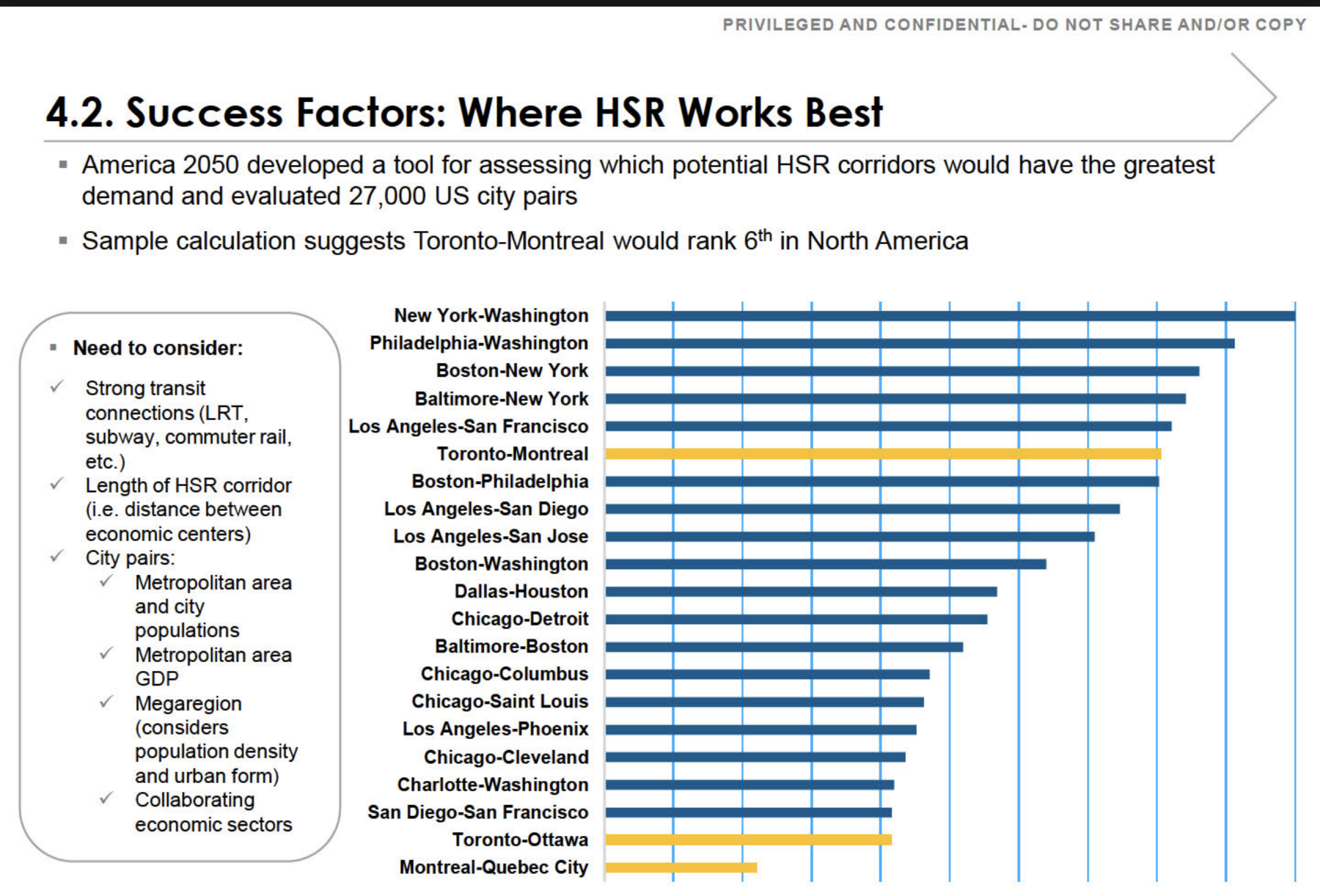
    The slide below is page 206 of a 294-page record released by the Canada Infrastructure Bank under access request A-2022-005 — a request for all studies, analyses, and reports related to the federal government’s high-frequency and high-speed rail file, disclosed in part. The briefing deck it belongs to is stamped “Privileged and Confidential — Do Not Share and/or Copy,” and its own footer marks it “DRAFT.” Adjacent pages were withheld under the Act’s economic-interest and advice exemptions (s. 18 and s. 21). The deck, as disclosed, is posted in full here: Ministerial Briefing — HFR and HSR (PDF).

    The marking is part of the point: this is a draft analysis the department preferred not be seen, and it is the evidence being used to vouch for the corridor.

    Briefing slide: Success Factors, Where HSR Works Best, ranking North American city pairs by high-speed rail demand
    Section 4.2, “Success Factors: Where HSR Works Best.” Page 206 of the Canada Infrastructure Bank release, A-2022-005 (disclosed in part; marked DRAFT). The three highlighted bars are Toronto–Montreal, Toronto–Ottawa, and Montreal–Quebec City.
    The finding in brief

    The slide ranks Toronto–Montreal sixth among North American city pairs for high-speed rail demand. The ranking is real. What it measures is the market between two endpoint metros — not the route now being built.

    The number describes the direct Toronto–Montreal corridor. The alignment taking shape runs Toronto–Peterborough–Kingston–Ottawa–Montreal — a longer, meandering route. On the very methodology the slide cites, every one of those detours lowers the score rather than raising it. And the segment actually proceeding first, Ottawa–Montreal, does not appear on the chart at all.

    The Methodology

    What the ranking measures

    The “sixth in North America” figure comes from America 2050’s screen of tens of thousands of city pairs, a methodology published in full by the Regional Plan Association. It scores the market between two endpoint metros: downtown employment, population density, transit reach, and the existing air and road travel between them. On those inputs Toronto–Montreal scores well. The endpoints are large, dense, and already heavily travelled.

    Two features of that method decide everything that follows, and both are explicit in the source.

    It is calculated per mile. Adding distance without adding a major generator pulls a corridor’s score down, not up. The screen normalizes precisely so that longer routes cannot coast on length.

    Intermediate stations only help when they are themselves large. The report is clear that longer corridors out-rank shorter ones only when the cities in between are medium or large generators. Otherwise the additional miles are a penalty. The top-ranked corridor on the chart, New York–Washington, scores as it does because the dense intermediate cities of Philadelphia and Baltimore sit directly on the shortest path between the endpoints.

    The Route

    The corridor on the chart is not the corridor being built

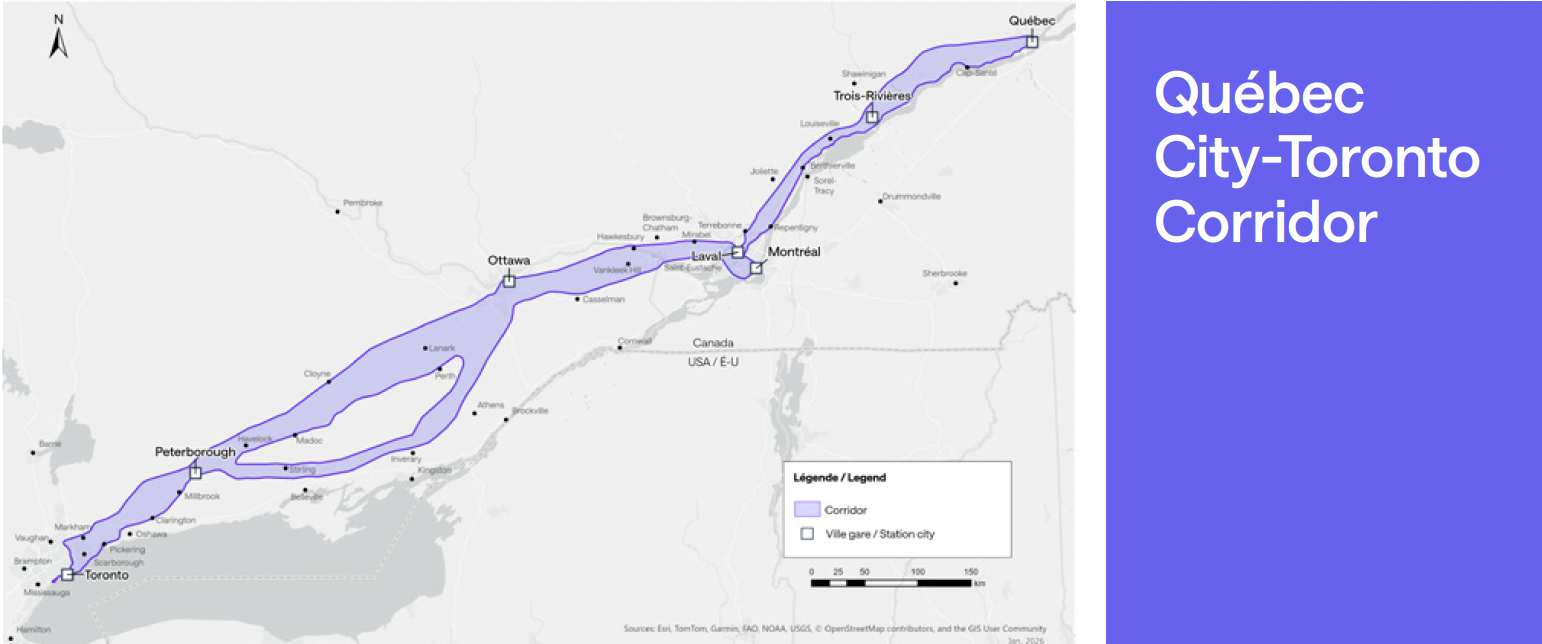
    The favourable score belongs to the direct Toronto–Montreal market — the existing lakeshore line, the shortest path, with a dense string of intermediate communities along it. The alignment now taking shape is the opposite of that. From Toronto it runs north to Peterborough; then — assuming the Kingston stop and southern routing the federal government added to its consideration in June 2026 come to pass — it doubles back south to Kingston, climbs north again to Ottawa, and drops south once more to Montreal. The result is a corridor that zigzags between its cities rather than running directly between its endpoints.

    Map of the projected Toronto to Quebec City corridor showing the route meandering north and south between cities rather than following a direct line
    The projected Toronto–Quebec City corridor. Rather than following the direct lakeshore line, the alignment meanders — north to Peterborough, south to Kingston, north to Ottawa, south to Montreal, and on toward Quebec City.
    The direct corridor (what the bar scores)The alignment being built
    Toronto–Montreal, direct. The existing Lake Ontario lakeshore line, on the order of 540 km — the shortest path between the two endpoints. Toronto–Peterborough–Kingston–Ottawa–Montreal. Roughly 610 km via Ottawa — about 13 per cent longer for the identical endpoints, and longer still with a Kingston dogleg. (This path assumes the Kingston stop and southern routing added to federal consideration in June 2026 proceed.)
    Dense intermediate string. Oshawa, Cobourg, Belleville, Kingston — population and employment added steadily along the path. Sparse flanks, weak axis. Peterborough is small and the stretches on either side of it are thinly populated; reaching Ottawa means importing the Toronto–Ottawa axis the same chart ranks near the bottom.
    Highest possible per-mile score for these two endpoints. A lower per-mile score: more kilometres, less density per kilometre, and a low-scoring leg folded in.

    There is a particular irony in Kingston. It is the natural intermediate city on the direct corridor — precisely the stop that would have helped the Toronto–Montreal score. The chosen alignment runs north to bypass it. Now it is being considered for re-inclusion, bolted back onto a route designed to avoid it.

    On the Method’s Own Terms

    What each detour does to the score

    Re-run the published methodology on the alignment actually on the table, and the per-mile score falls below the sixth-place bar. Each of the route’s defining choices works against it:

    Length is a straight penalty

    Per-mile normalization spreads the same Toronto and Montreal endpoint demand over more kilometres. A longer, more circuitous route scores lower for the identical endpoints — that is what the normalization is designed to do.

    Peterborough adds miles faster than density

    Intermediate stops only lift the score if they add population and employment per kilometre faster than the corridor’s average. Peterborough is too small, and the stretches on either side are sparse, so it adds length faster than it adds riders — a net penalty.

    A Kingston dogleg is more of the same

    Re-adding the one city the alignment was routed to avoid means a southern detour off the northern line: a modest generator bought with extra kilometres — again, length outpacing density.

    Reaching Ottawa imports a weak leg

    Ottawa is the one genuine generator among the added stops. But reaching it is the Toronto–Ottawa axis the same chart already ranks near the bottom of its field. The detour swaps the strong direct Toronto–Montreal axis for a leg the deck itself scores as weak.

    Sequencing

    What is actually being built first

    There is a further mismatch between the headline number and the build. The first segment to proceed is not Toronto–Montreal at all — it is Ottawa–Montreal, confirmed in December 2025 as the opening phase, with construction targeted for 2029. Ottawa–Montreal does not appear anywhere on the chart.

    And by the government’s own account, it was chosen first not for demand but for buildability: a relatively short and straight portion of the overall route, since high-speed trains do not handle curves well — the same logic that led California to build its first section across the flat Central Valley, avoiding tunnelling and urban construction. A constructability rationale, not a ridership one.

    The corridor that scores sixth, Toronto–Montreal, is only realized once the full line is complete — including the Toronto–Ottawa leg that sits near the bottom of this very chart — work not expected to finish until the 2040s. So the headline ranking and the actual build diverge twice over: the number describes a market the first segment does not deliver, assembled from legs the chart scores unevenly, with the strongest part of the case deferred to last.

    In plain language

    Strip away the methodology and the point is simple. The federal government’s own briefing says high-speed rail makes the most sense between Toronto and Montreal — two large cities with heavy travel between them. It says nothing in favour of the winding route now being built.

    That route keeps collecting stops the demand evidence does not support: north to Peterborough, a proposed southern dogleg to Kingston, and Trois-Rivières on the Quebec leg. Each one adds distance and cost while the case for the line still rests on the direct Toronto–Montreal market. When stations are added that do not earn their place on the numbers, the usual explanation is political — spreading the visible benefits of a marquee project across as many communities as possible to assemble support for it.

    This is one of the central problems with the project, and it is a familiar one. Bent Flyvbjerg’s research on megaprojects — the body of work behind this Initiative’s reference-class approach — finds that large infrastructure projects routinely run over budget and under-deliver because their scope and routing are shaped by political bargaining and the need to sell the project, rather than by the demand evidence. A corridor designed around who gets a station rather than where the riders are is precisely the pattern that research warns about.

    In Summary

    What the slide does and does not say

    The “sixth in North America” finding endorses a Toronto–Montreal market. It says nothing in favour of the Peterborough-routed, Kingston-doglegged, Ottawa-and-Montreal-served alignment. On the methodology’s own terms, those inclusions are exactly the choices it would mark down.

    A strong endpoint market is a real asset. It is not the same thing as a strong route — and a briefing that uses the first to vouch for the second is measuring the wrong thing. That the slide is marked “DRAFT,” and that adjacent pages were withheld under the Act’s economic-interest and advice exemptions, only sharpens the question: this is the analysis on the record, and on its own terms it does not say what it is being used to say.

    A note on method. The deck describes its result as a “sample calculation.” The disclosed page does not show how the path was drawn or scored. The standard America 2050 methodology and the headline result both point to the direct corridor as the basis for the sixth-place figure; if the underlying calculation is obtained, the path it used is the detail to confirm.

    Anticipated Objection

    “Doesn’t the line serve all those city pairs — Toronto–Ottawa, Ottawa–Montreal, Montreal–Quebec — not just Toronto–Montreal? Combine them and the project makes sense.”

    It is true that a corridor serves a whole matrix of city pairs, not only its endpoints. But that observation concedes the point rather than answering it. The “sixth in North America” figure is the score for the direct Toronto–Montreal pair. The moment the case leans on Toronto–Ottawa, Ottawa–Quebec, and Toronto–Quebec, it is no longer resting on that figure — and those are precisely the legs the same chart rates weakest: Toronto–Ottawa sits second from the bottom, Montreal–Quebec City is last, and Ottawa–Quebec, Toronto–Quebec, and Ottawa–Montreal do not appear on it at all.

    Two things make “combine the figures” fail on the slide’s own terms. The bars are demand-strength rankings — built from population, GDP, density, and corridor length — not passenger counts that can be summed; a sixth-place pair plus a near-last pair does not add up to a stronger corridor. And because the screen normalizes per mile, stringing the one strong pair onto a longer, detouring alignment spreads the same demand across more track-kilometres, which lowers the score rather than raising it.

    The logic in fact argues for the line this brief describes. If the goal is to capture Toronto–Montreal and the markets in between, the alignment that does it best is the direct lakeshore corridor — it serves the sixth-place pair at full strength and threads a dense string of real intermediate cities (Oshawa, Cobourg, Belleville, Kingston) on the way. Adding up the pairs does not rescue the meandering route; it makes the case for the direct one.

    Sources

    Primary documents and statements

    1.
    Canada Infrastructure Bank, completed access-to-information release A-2022-005 (disclosed in part), “Success Factors: Where HSR Works Best,” draft briefing slide, page 206. Released under the Access to Information Act; deck marked “Privileged and Confidential — Do Not Share and/or Copy” and “DRAFT.” View the disclosed deck (PDF)
    2.
    America 2050 / Regional Plan Association, High-Speed Rail in America, January 2011 — the published methodology scoring rail corridors by ridership demand on a per-mile basis.
    3.
    America 2050, Where High-Speed Rail Works Best — the precursor study of city pairs that the briefing slide reproduces.
    4.
    Transport Canada / Alto, “Full speed ahead: Ottawa–Montreal chosen as starting point for Alto High-Speed Rail,” December 12, 2025. canada.ca · altotrain.ca
    5.
    “First segment of Canadian high-speed rail to be built between Montreal, Ottawa,” Trains, December 12, 2025 — carries the Minister of Transport’s rationale for selecting the segment as a short, straight portion of the route. trains.com
    6.
    “Ottawa-Montreal chosen as 1st segment of promised high-speed rail line,” CBC News, December 12, 2025 — remaining segments (Quebec City–Montreal and Ottawa–Toronto) to begin at a later, unspecified date. CBC News
    7.
    Federal government statement, June 22, 2026, indicating an additional stop at Kingston would be considered for the corridor.
    8.
    Bent Flyvbjerg, Nils Bruzelius & Werner Rothengatter, Megaprojects and Risk: An Anatomy of Ambition (Cambridge University Press, 2003); Flyvbjerg, “Survival of the Unfittest: Why the Worst Infrastructure Gets Built — and What We Can Do About It,” Oxford Review of Economic Policy 25, no. 3 (2009): 344–367; and Flyvbjerg, “Design by Deception: The Politics of Megaproject Approval,” Harvard Design Magazine no. 22 (2005) — on strategic misrepresentation, perverse incentives, and the political shaping of megaproject scope and routing.
  • High cost, low benefit claim

    High Cost, Low Benefit — For Whom?

    An ALTO Vice-President says the rail alternative would cost about as much as high-speed rail without the benefits. The government’s own record — and ALTO’s own document — say otherwise.

    In short

    In a recent public video, an ALTO Vice-President argues that high-frequency rail would still need dedicated track, would therefore cost about as much as high-speed rail, and would deliver less — a “high cost, low benefit” option. The claim runs against the public record. The government’s own reports costed a dedicated-track high-frequency railway far below high-speed rail, and judged it buildable in a fraction of the time. What shifted that cost to “similar” has never been made public.

    On the benefit side, ALTO’s case rests on ridership the international reference class does not support. Tested against ALTO’s own document and the Initiative’s financial analysis, the high-cost option turns out to be the one being built.

    Download
    High Cost, Low Benefit — For Whom?
    The full research brief, with sources (PDF)
    Download PDF
    The Argument

    What the video claims

    The argument is a single chain. High-frequency rail, the video says, is often presented as the cheaper alternative — but it would still require new dedicated track, so its cost would rise to roughly that of high-speed rail, while delivering lower travel-time, ridership, and economic benefits. The conclusion offered to viewers is that high-frequency rail is a “high cost, low benefit” option, while high-speed rail delivers both speed and frequency.

    It is a clean story. Two problems sit beneath it before any single figure is examined.

    It claims a cost convergence the record contradicts

    The video is right that high-frequency rail needs dedicated track — it does not claim trains would share track with freight. Its claim is that building that dedicated track pushes the cost up to roughly high-speed rail’s. The government’s own reports say otherwise, on both cost and time. A dedicated-track, electrified high-frequency railway was costed at $27.7 billion in the December 2021 Business Case — and roughly $4–6 billion in its original 2016 form — and judged buildable in about four years. High-speed rail is now costed at $60–90 billion, on a build horizon stretching into the 2040s. What evidence moved high-frequency rail’s cost and schedule up to “similar” has never been explained, and no side-by-side comparison has been made public.

    It never engages the alternative the Initiative proposes

    The video treats high-frequency rail as the only alternative to high-speed rail. The Initiative’s proposal is different again: High Performance Rail (HPR) builds dedicated passenger track along existing transportation corridors — such as the CN right-of-way and the Highway 401 — and frees the Kingston Subdivision for freight. It is neither the government’s old high-frequency plan nor ALTO’s high-speed one, and ALTO has never assessed it.

    Tested Against the Record

    Three claims, three answers

    $27.7B
    what a dedicated-track high-frequency railway was costed at — against $60–90B for high-speed rail
    2021 JPO Business Case
    the cost-per-kilometre gap between ALTO and High Performance Rail in the Initiative’s model
    $142M vs $28M per km
    0.11
    ALTO’s central benefit-cost ratio — well below the 1.0 that marks a project that pays its way
    Initiative methodology paper

    The video makes three factual claims — on cost, on speed, and on benefit. Each can be checked against ALTO’s own published document and the Initiative’s analysis.

    The claim in the videoWhat the record shows
    “It would cost on a similar scale to high-speed rail.” Contradicted by the public record. The government’s own 2021 Business Case put a dedicated-track high-frequency railway at $27.7 billion, against ALTO’s $60–90 billion. Even ALTO’s own Annex B places its “conventional rail” comparator 20–30% below high-speed rail. The Initiative’s reference-class model — a regression across more than forty international projects — puts ALTO at $142M/km and HPR at $28M/km, a five-fold gap. “Similar scale” holds on none of these.
    “Without significantly faster travel times.” Conventional speed already captures most of the benefit. A 177 km/h dedicated-track service was set to cut Toronto–Ottawa from over four hours to about two hours fifty. By ALTO’s own travel-time table, going to 300 km/h saves only a further 17 minutes on Toronto–Ottawa, 19 on Ottawa–Montréal, and 25 on Montréal–Québec. Most of the time saving comes from leaving freight-priority track — not from the extra speed.
    “Lower ridership and reduced economic benefits.” The benefit case rests on ridership the reference class does not support. ALTO’s 24-million-trip target sits outside the achievable modal-shift frontier of 5–12 million annual riders. No operating posture is subsidy-free; each requires roughly $1–3.5 billion per year. The central benefit-cost ratio is about 0.11. The “high benefit” half of the slogan is the half that does not survive checking.
    A Note on the Travel Times

    Estimated, not simulated

    There is a further problem with the speed claim, separate from how small the gain is. The faster journey times were never modelled for this corridor at all. A government record released under the Access to Information Act (file A-2025-00333) shows that the project office produced a detailed RailSys simulation only for the 177 km/h base case. Every faster journey time was a spreadsheet estimate, benchmarked to average speeds on intercity railways in other countries — described in the project’s own memorandum as “for information and comparison purposes” and left to be refined later.

    In other words, the under-three-hour trips that make high-speed rail attractive have no corridor-specific engineering behind them in the released record. The one number anyone actually drove through a model of the real line is the slow one.

    Read the full record

    The Initiative examines this in detail — the two methods, the journey-time tables, and how the speed ceiling was set as a policy target — in a companion research note, Estimated, Not Simulated, based on the same Access to Information release.

    The Carbon Case

    A carbon debt, not a carbon saving

    The video folds environmental benefit into ALTO’s column, on the assumption that faster, higher-ridership rail is the greener choice. The Initiative’s 50-year lifecycle analysis finds the opposite once construction and a decarbonising vehicle fleet are counted. ALTO’s build is a large one-time carbon debt before a single passenger boards — about 14.7 Mt CO₂e in the central construction estimate — and with fifty years of operations the lifecycle total lands at roughly 24 to 27 Mt CO₂e on Ontario’s current grid, and as much as 34 Mt if the grid leans more on gas.

    That debt only counts as a saving if the trips it captures would otherwise have been higher-carbon — and the payback math is unforgiving. At the ridership the corridor is most likely to see in its early years, around 4 million passengers a year, no scenario repays the construction debt within a credible horizon. Even at mature ridership, payback runs from a few decades to more than five hundred years, depending on how clean the grid is.

    The comparison only worsens with time. By the 2040s, when ALTO might open, much of the car fleet will be electric — and an electric car carrying 1.2 people already emits about 10 g CO₂e per passenger-kilometre, below ALTO’s all-in emissions at every ridership level on today’s grid. Diverting existing VIA Rail passengers, at roughly 25 g/pkm, saves nothing at all. ALTO’s carbon case rests on displacing gasoline cars and short-haul flights — not the fleet that will actually be on the road when it opens.

    Most of that debt is greenfield construction. An approach that runs on existing corridors — as High Performance Rail does — avoids the bulk of it, and the single largest carbon lever, shifting freight off congested track, is available whatever the trains’ speed or traction.

    Why the Gap Is Real

    The cost difference is structural, not arithmetic

    The five-fold difference in the Initiative’s model is not an accounting artefact. A 300 km/h design forces a new dedicated greenfield alignment — grade separation, gentle curves, continuous fencing, and large-scale land acquisition — through terrain that scores high on both engineering complexity and community friction. Both the government’s high-frequency plan and the Initiative’s HPR instead run on or alongside existing corridors, which is why each comes in well below the high-speed option. In the Initiative’s model, the gap between high-speed rail and HPR splits roughly evenly between physical engineering and community friction — the cost of the land, the disruption, and the opposition that a new high-speed right-of-way creates.

    The Bottom Line

    High cost, low benefit — for whom?

    The video’s thesis — that high-frequency rail is high cost and low benefit while high-speed rail delivers both — is contradicted by the government’s own record. High-frequency rail was a fully studied, dedicated-track plan, priced at $27.7 billion in 2021 and a fraction of that in its original form, and due to be carrying passengers now. The decision to replace it with a 300 km/h, $60–90-billion project was taken without a published comparison; the video supplies the missing conclusion after the fact.

    On the evidence available, the high-cost option is the one that was chosen. The lower-cost alternatives — the government’s own, and the Initiative’s — were set aside without being weighed in public. That is the question the slogan invites, turned back on itself: high cost, low benefit, for whom?

    Sources

    Primary documents

    1.
    ALTO, Fast Forward: Shaping Canada’s Future with a High-Speed Rail Network (March 2025) — cost ranges, travel times, and ridership targets, main text and Annex B. altotrain.ca
    2.
    Joint Project Office High Frequency Rail Project, Business Case Update, V.002 (December 10, 2021) — dedicated-track design, $27.7 billion costing, and four-year construction estimate.
    3.
    The Globe and Mail, “Transport Canada reviewing studies on Via Rail expansion” (July 2017) — the original 2016 high-frequency concept at roughly $4–6 billion. theglobeandmail.com
    4.
    “VIA HFR-TGF Journey Times” memorandum and accompanying email chain (August–September 2023), released under the Access to Information Act as file A-2025-00333 — simulated base case versus estimated higher-speed times.
    5.
    ALTO HSR Citizen Research Initiative, ALTO Financial Analysis (methodology paper and supporting research notes) — cost-per-kilometre model, ridership frontier, subsidy spectrum, benefit-cost ratio, and lifecycle carbon. ALTO-Financial-Analysis.pdf
    6.
    ALTO HSR Citizen Research Initiative, 50-Year Lifecycle CO₂ Budget — Parametric Analysis (March 2026) — construction, operational, payback, and modal-comparison figures, drawing on HS2, UIC, and international HSR lifecycle studies.
    7.
    Statements examined: public video by an ALTO Vice-President (June 2026).
  • Estimated not simulated

    Estimated, Not Simulated

    The journey times behind ALTO were drawn from a spreadsheet of international averages — not from a model of the actual corridor. What that distinction means, and who set the target.

    Critical Finding

    A government record released under the Access to Information Act shows that, of the journey times prepared for the project, only the slowest case was produced by an actual simulation of the railway. That case was a 110 mph (177 km/h) train — a roughly four-hour Toronto–Montréal trip. Every faster time, including those near the speeds ALTO now markets, came from a spreadsheet that applied average speeds borrowed from intercity railways in other countries.

    The technical memorandum describes those faster figures, in its own words, as “for information and comparison purposes.” And the email chain attached to it records the most senior Transport Canada official on the file directing that the times not assume Toronto speeds above 160 mph (257 km/h), because a higher figure was “not the intent of the Government.” The journey time, in other words, was managed as a policy and cost target — not derived as an engineering result.

    The Record

    What the document is

    The release (A-2025-00333) was obtained under the Access to Information Act and provided to the Initiative. It consists of an email chain dated August 30 to September 4, 2023 among Transport Canada and Via HFR / Via TGF officials and their technical advisers, together with the attached memorandum “VIA HFR-TGF Journey Times.” It dates from the procurement period, when the project was still a high-frequency rail (HFR) programme under Transport Canada’s lead, before the February 2025 announcement re-scoped it as high-speed rail at 300 km/h.

    The memorandum is the engineering note that sits beneath the project’s headline travel times. It is explicit about how those times were calculated — and it used two very different methods for two different parts of the answer.

    The Distinction That Matters

    Two ways to get a journey time

    A train’s journey time is the single number a project like this is sold on — “Toronto to Montréal in X hours.” There are two fundamentally different ways to produce that number, and they are not equally reliable.

    A simulation builds a digital twin of the real railway and “drives” a train along it. The software knows the actual track: every curve that forces the train to slow, every hill, every station stop, where the signals are, how fast the specific train accelerates and brakes, and whether other trains — including freight — are in the way. It runs the trip second by second on that line and reports how long it genuinely takes. The memorandum names the tool used for this: RailSys, drawing on the JPO’s 2021 Rail Operational Summary Report. It is the railway equivalent of a flight simulator, or of a mapping app with live traffic.

    A spreadsheet estimate does something far cruder: it takes the distance, assumes an average speed borrowed from how fast trains run in other countries, and divides one by the other. It never looks at this corridor’s actual geometry, terrain, urban approaches, or shared freight track. The memorandum is candid that its faster figures are of this kind — an “estimated calculation based on the maximum permissible speed,” provided “for information and comparison purposes.”

    Simulation — the RailSys toolSpreadsheet estimate
    Drives the actual route. Models every curve, gradient, station stop, signal and conflicting train on the real Toronto–Québec line, second by second. Distance ÷ an assumed average speed. Takes the route length and an average operating speed benchmarked to comparable intercity rail abroad, and divides.
    Knows the corridor. A curve too tight for high speed shows up as a slower section; a freight train ahead shows up as lost minutes. Constraints surface before construction, not after. Blind to the corridor. Cannot see this line’s curves, hills, city approaches or freight sharing. The memorandum labels its outputs indicative only.
    What ALTO simulated. Only the 110 mph (177 km/h) base case — roughly a four-hour Toronto–Montréal trip. What ALTO estimated. Every faster time, including the 160 and 186 mph figures (257 and 300 km/h) closest to the marketed speeds.

    The difference is the difference between “we modelled it and it works” and “we estimated it from comparables.” The first is a tested result for this railway. The second is an educated guess that a later, detailed study would have to confirm.

    What Was Actually Run

    The only simulated number is the slow one

    ~4 hrs
    the only Toronto–Montréal time actually simulated (110 mph / 177 km/h base case)
    RailSys, per the memorandum
    Spreadsheet
    the source of every faster journey time on the page
    benchmarked to foreign averages
    160 mph
    (257 km/h) — the speed ceiling set as “the intent of the Government”
    TC official, Aug–Sept 2023

    The memorandum’s own tables make the gap plain. The single time it produced by simulation — the 110 mph (177 km/h) base case — is roughly 3:59 to 4:19 for Toronto–Montréal. The faster times on the same page, for a 186 mph (300 km/h) or 160 mph (257 km/h) train, run from about 2:40 to 3:10. But those faster figures are the spreadsheet ones. The four-hour trip is the only number anyone actually drove through the model. The under-three-hour trips that make high-speed rail attractive were never simulated for this corridor.

    This matters because the public ALTO project is now built on 300 km/h (186 mph) running. Even the “calculated” 186 mph (300 km/h) times in this 2023 record trace back to the spreadsheet, not the simulator — and the simulator was only ever pointed at the slow case.

    A second problem: not the door-to-door time

    There is a second issue with these numbers, separate from how they were produced. Every figure here — simulated or estimated — is a train-in-motion time, measured platform to platform. It is not the door-to-door time that decides whether a traveller picks rail over flying, and door-to-door time depends on something ALTO has not settled: where the stations are. With downtown stations at both ends the corridor is competitive; with the suburban or peri-urban stations most consistent with the project’s cost structure, the advantage over air narrows or disappears. A separate academic submission to the consultation went further, noting that ALTO’s published times do not appear to even include the time for a stop in Ottawa — so the in-motion figures may be understated before the door-to-door question is reached. We treat that in full in The Station Location Problem and The Last Mile; the point here is narrower — the headline time is an estimate, and even taken at face value it is not the number that matters.

    Who Set the Target

    The journey time as a government decision

    The instruction to hold the journey times down did not come from a technician. The email chain records that when a Toronto figure was put forward assuming sustained speeds above 160 mph (257 km/h), a Transport Canada official objected that it “assumes a full journey time from Toronto at speed greater than 160, which is not the intent of the Government,” and explained that the intent was to have bidders identify the segments with the lowest marginal cost for higher speed. The exchange closes on September 4, 2023 with the project director’s note: “No change to journey time agreed by Vincent.”

    That official is Vincent Robitaille. According to Transport Canada’s own published biography, Robitaille has served as Assistant Deputy Minister – High Frequency Rail since December 2021 — the month the project’s governance passed to a Transport Canada–led integrated team — and he leads that team. His background before the role was in commercial policy and financing, not rail engineering: from 2018 to 2021 he was Director General of Transport Canada’s Centre of Excellence on Strategic Investments, working on the commercial elements and alternative financing of major transportation investments, and before that he led the public-private-partnership procurement of the new Champlain Bridge Corridor in Montréal. His credentials are financial and project-management designations (CFA, PMP, Certified Director, and an MBA). Transport Canada

    Why the background is relevant, not incidental

    This is an observation of record, not of motive. The person defining the journey-time ceiling as the Government’s intent — and steering bidders toward “the lowest marginal cost” rather than the fastest trip — is the project’s most senior Transport Canada official, whose professional expertise is procurement and project financing. It is consistent with a journey time being treated as a commercial and cost target to be managed, rather than an engineering output to be measured. The released record shows the target being set; it does not require any inference about why.

    Two Years Later

    The same official, now selling the fast times

    In a public podcast interview in December 2025, Robitaille — by then leading the project for Transport Canada — described the corridor to a general audience in precisely the terms the 2023 record could not support with simulation: Montréal reachable in well under current rail times, a city you could reach for a day trip and return the same evening, trains “every half an hour,” the corridor as “commuting distance.” Those are the fast, frequent-service figures — the ones drawn from the spreadsheet.

    The internal record from 2023 shows the same official holding the specification below those speeds — directing that journey times not assume sustained running above 160 mph (257 km/h), because faster was “not the intent of the Government” — and relying on benchmarked estimates for anything quicker. The public pitch and the internal caution are two years apart and point in opposite directions. The travel times now used to sell the project are of the kind the same official described internally, in 2023, as indicative.

    The Bottom Line

    A promise, or an estimate?

    When a government tells the public “this train will get you there in X hours,” people reasonably assume engineers modelled the actual route and confirmed it. This record shows that, for the fast times, they did not. They did the back-of-an-envelope version — distance against speeds observed in other countries — and said so internally. A spreadsheet estimate is a hope; a simulation is the closest thing to a tested promise. The faster ALTO travels in its marketing, the further it gets from the only journey time anyone actually ran.

    One caveat, stated plainly so the point is not overdrawn. The memorandum does say these estimates were always meant to be refined through later design and operational modelling by the eventual private partner. So the fair claim is not that the numbers were invented. It is that the detailed validation was deferred, and that as of this 2023 record the project’s faster journey times — including those near what is marketed today — had no corridor-specific engineering behind them, only benchmarked estimates. No simulation of high-speed running on the Toronto–Québec line appears anywhere in the released record.

    Sources

    Primary documents

    1.
    Transport Canada / Via HFR (Via TGF), “VIA HFR-TGF Journey Times” (HFR JT note 20230831) and accompanying email chain, August 30 – September 4, 2023. Released under the Access to Information Act as file A-2025-00333.
    2.
    Joint Project Office, Phase 2C Rail Operational Summary Report (2021) — the RailSys simulation source referenced in the memorandum for the 110 mph (177 km/h) base case.
    3.
    Transport Canada, Briefing Documents 2025, biography: “Vincent Robitaille — Assistant Deputy Minister – High Frequency Rail.” tc.canada.ca
    4.
    “From Bridges to Trains: Career lessons with Vincent Robitaille,” The Supply Chain Ambassador podcast, premiered December 3, 2025. Public interview; transcript auto-generated. youtube.com