The More You Look, the Worse It Gets
Thirty studies of high-speed rail in this corridor, across fifty-six years. One simple pattern runs through all of them.
The people building the railway say it will pay for itself. The one independent study in 2026 that actually checked the math — using the builders’ own cost estimates — found a hole of about $53 billion over fifty years.
That’s not a fluke. It’s the pattern. For fifty-six years, the case for this railway has looked best in exactly the studies with the most to gain from building it.
We read thirty major studies of high-speed rail in this corridor, from 1970 to today, and asked every one the same set of questions — with all the dollar figures put on a level footing.
The verdict almost always matches who paid for the study. Equipment makers, the proponent and paid advocates say build it. Independent governments say wait. And every single study that actually runs the finances finds the same thing: ticket sales can’t cover the cost, so the public pays most of the bill.
The numbers that look great — low costs, huge ridership, big climate wins — come from the promoters. The numbers that survive an independent look are far more sober. The closer and more independent the analysis, the weaker the case.
Thirty studies. Same questions. Fifty-six years.
We didn’t cherry-pick. We took thirty of the major studies of this railway — going right back to a 1970 federal commission — and put the same 34 questions to all of them, so the answers line up side by side across the decades.
The studies come from every side: equipment makers, government task forces, a Crown corporation, universities, Transport Canada, and the builders themselves. That range is the whole point — it lets us tell a real change in the corridor apart from a change in who’s doing the asking.
Nine things every reader should know
Read across all thirty studies, nine patterns keep showing up. Here they are in plain terms.
1The answer depends on who paid for the study
Line up the verdicts and it’s impossible to miss. The build-it studies come from equipment makers, from a Crown corporation that wanted to run the trains, from the proponent, and from paid advocates. Every independent government that looked said wait. Building new is the sponsors’ answer — not what fifty-six years of evidence actually points to.
2It has never paid for itself. Not once.
Every study that runs the money lands in the same spot: fares can’t cover the cost, and taxpayers foot most of the bill. VIA’s own 1984 numbers came out negative. In 1995, three governments agreed the public would cover 70–75%. In 2026, an independent model put the public subsidy at about $53 billion over fifty years — and found the railway wouldn’t even break even until year 44. The promise that it’ll fund itself is the single most optimistic claim in the whole record.
3The closer you look, the more it costs
Whenever a promoter and an independent body price the same thing, the promoter’s number is lower — and the price climbs as the estimate gets more serious. A 2026 advocacy paper gets the cost down to $63 billion only by assuming rock-bottom construction prices, about a third of our own central estimate of roughly $143 million per kilometre. The cheaper the headline, the thinner the math underneath it.
4The ridership numbers don’t hold up
The passenger forecasts are shakier than they look — and academics, an airline, Parliament and Transport Canada have all said so. One 1994 study showed the forecast could swing fivefold just by changing a single modelling choice, on the same data. Transport Canada’s own reviewers called the assumptions “optimistic and aggressive.” And the biggest numbers always belong to the promoters.
5The freight idea is good — with one catch
Splitting passengers and freight onto the corridor’s two parallel tracks, and freeing up freight capacity as a bonus, is a genuinely sound idea — it was proposed back in 2002. The catch: at the time, the freight railways said they didn’t need the extra capacity. It’s a strong argument, as long as it’s honest about that condition.
6Going faster barely helps
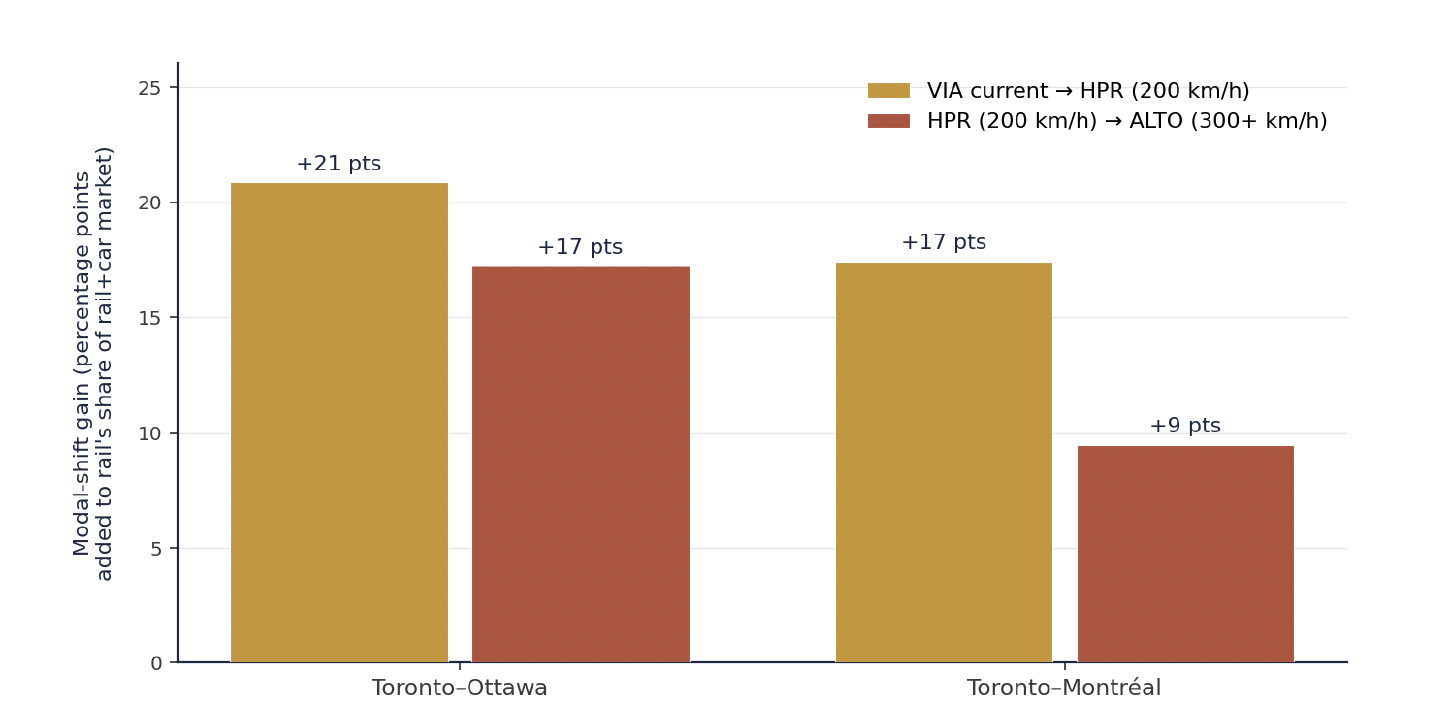
Study after study finds that top speed buys almost no extra riders — one found just an 8% jump going all the way from 300 to 400 km/h, another only about 9% from 200 to 300. So the level-headed studies settle far lower: a 2002 plan judged 240 km/h fast enough, and even the independent 2026 model assumes trains averaging just 200–250 km/h. The “top speed everywhere” designs are the outliers — a moderate railway of roughly 180–240 km/h carries nearly the same riders for far less money, and that’s where the evidence actually sits.
7We’ve seen this financing risk before
Having a private partner build and run the railway while the public owns the assets isn’t new — and neither is the warning. Both Parliament (1998) and Transport Canada (2003) flagged the same danger decades ago: deals like this can hand the risk to taxpayers and the reward to investors, with a rosy headline resting on one convenient assumption.
8The climate math only counts the good half
For decades, no study counted carbon at all. Now they do — but only the savings from getting people out of cars and planes. The huge emissions from pouring hundreds of kilometres of concrete and steel and clearing land? Left out. Count both sides honestly and this design adds emissions for decades. That’s the difference between a climate win and a climate cost.
9When the numbers fail, out comes “nation-building”
There’s a move that shows up again and again: when the dollars-and-cents case comes up short, in come national unity, regional growth, and keeping up with other countries. One 2016 report recommended extending the line even at a benefit-cost ratio of 0.24 — about 24 cents of benefit for every dollar spent. These arguments can be fair. But they do the heaviest lifting exactly where the economics are weakest.
What the promoters say vs. what independent studies find
All nine findings come down to one contrast. Same railway, same engineering — but the promoters’ numbers and the independent record split apart at every point that matters, and they split the same way every time.
| What the promoters say | What independent studies find |
|---|---|
| Build it new. Equipment makers, a Crown corporation that wanted the contract, the proponent, and paid advocates all say go ahead. | Wait. Every independent government that studied it held off; the reviews and the airlines said upgrade what’s there instead. |
| The verdict:Build vs Wait | |
| It’ll pay for itself. The 2025 prospectus says the trains will turn a profit — the rosiest claim in fifty-six years. | Taxpayers pay most of it. From 1984 to 2026, every study that runs the money says fares can’t cover the cost. The 2026 independent model: about $53 billion in public subsidy over fifty years. |
| The money:Self-funding vs ~$53B public | |
| As low as $63 billion. A 2026 paper reaches that number by assuming bargain construction prices. | More like $80–90 billion. The proponent’s own range tops out at $90 billion; independent build-ups land near $80 billion. Costs rise the closer you look. |
| Price tag:~$63B vs ~$80–90B | |
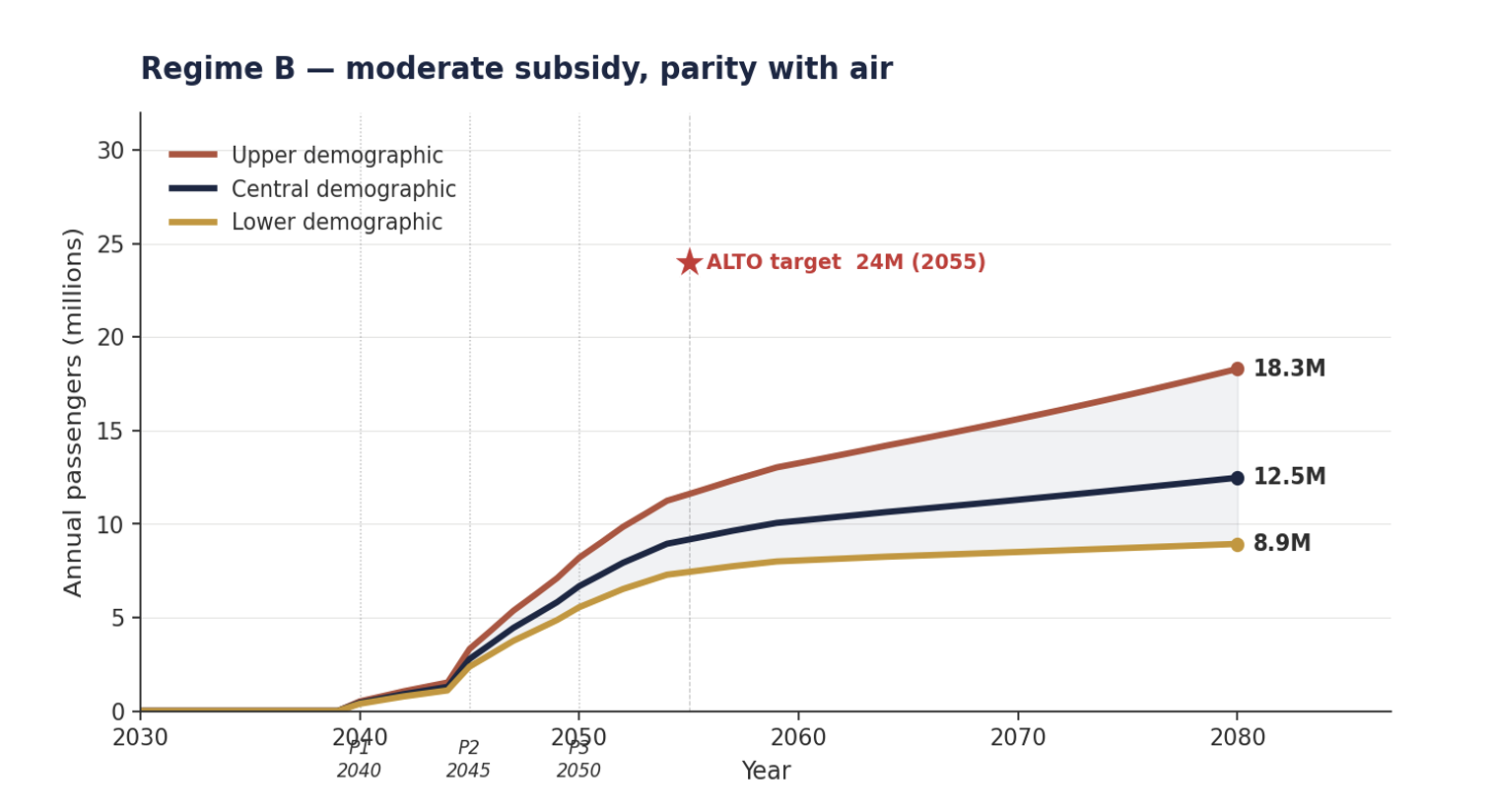
| 24 to 56 million riders. The 2025–2026 figures are the highest ever produced for this line. | About half that. The only recent independent, survey-based forecast lands near 10 million a year — right in line with fifty years of history. |
| Yearly riders:~24–56M vs ~10M | |
| A big climate win. The proponent headlines a 39-megatonne cut — counting only the savings from fewer car and plane trips. | A climate cost, for decades. The emissions from building it — concrete, steel, cleared land — are left out entirely. Count both sides and it adds emissions. |
| On carbon:Half the ledger vs The whole ledger | |
Same railway. Forecasts from 6 million to 56 million.
Put the passenger forecasts next to each other and they span almost tenfold — for one railway line. The high numbers always come from the promoters. The one to trust is the recent independent forecast built on an actual survey of travellers.
| Study (year) | Who produced it | Yearly riders | Basis |
|---|---|---|---|
| Air Canada / CP (1993) | Airline / railway | 5.8 M | the low end of the record |
| Task Force (1991) | Governments | 7.8 M | full corridor |
| Tri-government (1995) | Governments | 10–12 M | full corridor |
| EcoTrain (2011) | Governments | 10–11 M | full corridor |
| Lynx (1998) | Private consortium | 11.1 M | Québec City–Toronto |
| SNCF (2010) | Equipment maker | up to 22.5 M | best-case scenario |
| ALTO prospectus (2025) | Proponent | 24–43 M | full network |
| Advocacy paper (2026) | Paid advocacy | 42–56 M | the highest ever |
| McGill (2026) | Independent | ~10 M | survey-based, 2050 |
The numbers aren’t perfectly apples-to-apples — they cover different routes and years — which is part of the point. The takeaway is simple: the independent, survey-based forecast is about half the proponent’s.
Five takeaways
The current project sits right at the meeting point of every pattern above. The prospectus is the most upbeat sales pitch in the whole record. The most careful independent 2026 work finds a multi-billion-dollar hole. And the one favourable outside verdict is reached only by pairing the cheapest possible construction cost with the highest ridership ever forecast for the line. Here’s what that adds up to.
What the record points to
What to insist on
All thirty studies, at a glance
Here’s the whole set, oldest to newest. Read the two right-hand columns together — who did the study, and what they concluded — and Finding 1 jumps out: the “build it” verdicts belong to the sellers and the promoters; the governments that were truly independent said wait.
| Year | Study — who did it | Independent of the builder? | Verdict |
|---|---|---|---|
| 1970 | Intercity Passenger Transport Study — CTC | Federal | Upgrade |
| 1984 | High-Speed Passenger Rail in Canada — VIA | Crown corp | Mixed |
| 1990 | Review of Previous Studies — TRANSURB | Consultant | Wait |
| 1990 | A Pragmatic Approach (SPRINTOR) — ABB | Equipment maker | Upgrade |
| 1990 | The Canadian TGV Project — Bombardier / GEC Alsthom | Equipment maker | Build new |
| 1991 | Rapid Train Task Force — Ontario / Québec | Governments | Wait |
| 1991 | Competition in Rail Carriage — Berkowitz | Academic | Build new |
| 1992 | FAST TRACKS — VIA (advocacy) | Crown corp | Build new |
| 1993 | HST Market Assessment — Air Canada / CP | Airline / railway | Upgrade |
| 1994 | Demand-model re-estimate — Gaudry & Le Leyzour | Academic | No verdict |
| 1995 | Industrial Strategy (Vol II) — Simpson-Guerin | Consultant | No verdict |
| 1995 | Routing & Costing Study — SNC-Lavalin / Delcan | Consultant | No verdict |
| 1995 | Québec–Ontario HSR, Final Report — tri-gov | Governments | Wait |
| 1998 | The Lynx Proposal — Lynx consortium | Private consortium | Build new |
| 2002 | VIAFast — VIA Rail | Crown corp | Upgrade |
| 2003 | VIAFast validation — IBI for Transport Canada | Gov’t reviewer | No verdict |
| 2009 | Infrastructure and the Economy — Martin Prosperity Inst. | Academic | Build new |
| 2010 | Socio-Economic Study of HSR — SNCF | Equipment maker | Build new |
| 2011 | Updated Feasibility (EcoTrain) — tri-government | Governments | Wait |
| 2014 | Toronto–Kitchener–London HSR — Schabas | Consultant | Build new |
| 2015 | Future of Passenger Rail — Library of Parliament | Parliament / indep. | Upgrade |
| 2016 | Preliminary Business Case — SDG (Steer) | Consultant | Build new |
| 2016 | High Speed Rail in Ontario — Special Advisor | Provincial | Build new |
| 2021 | Toronto–Montreal Analysis — Munk School | Academic | Build new |
| 2022 | Speed and Frequency — Alstom | Equipment maker | Build new |
| 2025 | All Aboard — C.D. Howe Institute | Advocacy | Build new |
| 2025 | Fast Forward — ALTO (the proponent) | Proponent | Build new |
| 2026 | Conceptual Design & Business Case — Schabas | Advocacy | Build new |
| 2026 | Corridorwide Survey & Financial Analysis — McGill | Academic | No verdict |
| 2026 | Eastern Ontario Route (Hwy 401) — Schabas & Antinucci | Advocacy | Build new |
“Advocacy” means a document written to argue a case — a sales prospectus, a think-tank brief, or paid expert advocacy. “No verdict” means the study analysed the question but didn’t take a build/don’t-build position.
Where the sober numbers come from
The full list is above. If you read just a few, read the independent ones — the counterweight to the sales pitch.