Author: admin

  • Bound before briefed

    City of Kingston: Bound Before Briefed

    Britain spent a decade learning what happens when councils sign confidentiality agreements with a high-speed rail promoter. The lessons were on the record. Kingston signed on 10 July, three days before this brief reached councillors.

    ⚠ Update · The agreement has been signed

    This brief sets out the questions Kingston City Council should have asked before entering a non-disclosure agreement with ALTO. By the time it reached councillors, on Monday, July 13, the agreement had already been signed — the Whig-Standard reported that the City signed on Friday, July 10, and the signing became public on July 14. Whig-Standard

    The document’s title turns out to be literal. Councillors were bound on the Friday and briefed on the Monday — bound by an agreement the City says applies to them personally, three days before the questions below were put in front of them. The brief did not arrive too early to matter. It arrived after the decision it was meant to inform.

    Two facts from that reporting change the picture materially. First, a City spokesperson confirmed that the agreement binds city staff and councillors alike — every person who receives technical information from ALTO. Second, asked whether the City had a choice, the same spokesperson said: “This is not optional.”

    The analysis below is the brief as sent to councillors, unchanged. The questions it raises were answerable before Friday. That they are printed here after the signing, rather than asked before it, is the point.

    Critical Finding

    Of the five questions this brief puts to Council, one has already been answered, and answered badly. The agreement binds elected members, not merely officers. A councillor who receives technical information about the corridor cannot discuss it with the constituents whose land that corridor may cross. The remaining four — whether the agreement expires, what precisely it covers, whether MFIPPA and open-meeting obligations are expressly preserved, and what ALTO would actually have withheld without it — remain unanswered on the public record.

    A second finding sits underneath the first. ALTO describes these agreements as instruments that enable two-way data sharing and productive collaboration. HS2 Ltd, facing the same criticism in Britain, said its agreements were mutual and entered into by consent. The City of Kingston says the agreement was not optional. A contract that one party had no choice but to sign is not a collaboration. Both characterisations cannot be true, and it is the City — not the critics — that has contradicted the promoter.

    Kingston’s neighbours faced the identical request and treated it as a decision. Two eastern Ontario counties have now refused ALTO’s confidentiality agreement outright, both unanimously, both on the public record — the United Counties of Prescott and Russell in May, and the United Counties of Stormont, Dundas and Glengarry on June 15. Frontenac County voted formally on April 15 to oppose the proposed corridors through the county. Whether Kingston’s agreement was ever put to its own elected representatives — by motion, in open or closed session — has not been established on the public record.

    The most important fact in this brief is the one that follows from that. SDG refused the agreement and then published ALTO’s presentation to the public. The choice Kingston was offered — sign and be informed, or refuse and be ignorant — is not a real choice. A council next door declined to sign and released the material anyway.

    Download
    City of Kingston: Bound Before Briefed — Full Brief (PDF)
    The briefing note circulated to Kingston City Council, reproduced as issued, with a dated note recording that the agreement was signed before it arrived. Ten-minute read.
    Download PDF
    What was signed

    “This is not optional”

    The agreement was executed on Friday, July 10, between the City of Kingston and ALTO, the Crown corporation developing the corridor. ALTO’s account of why is straightforward and, in its own terms, reasonable: planning work is not final; early concepts, technical analysis and emerging ideas are still being refined; and sharing preliminary material without its full context could give the impression that decisions have already been made. Confidentiality agreements, the corporation says, are used widely in the infrastructure industry and structure these discussions so that evolving information can be shared. Whig-Standard

    The Mayor’s defence follows the same line. Such agreements are common in major infrastructure planning; they allow technical information to be shared so that municipalities can provide informed input; the agreement is not an endorsement of any particular route or station location; and the City remains committed to transparency and will share information publicly when it is able to.

    Set against that framing, the City spokesperson’s own words do a great deal of work. The agreement applies to all city staff and councillors who receive technical information from ALTO. It was required in order for the City to receive any technical information at all. And it was not optional.

    A confidentiality agreement that one party had no choice but to sign is not a collaboration. It is a condition of entry.

    This is the distinction the British record turns on, and it is worth being precise about it. The objection is not that confidential material was shared confidentially. It is that information was withheld until silence was promised — that access to the facts was made conditional on a commitment not to use them. That is not a description of HS2. It is now, on the City’s own account, a description of Kingston.

    Part One · The mechanism

    Access conditioned on silence

    In Britain, councils were not handed material and then asked to protect the commercially sensitive parts of it. They were told they could see nothing at all unless they signed first. Many were required to sign before they could engage with HS2 Ltd on the questions that mattered most locally — where stations might go, how they would be designed, and which route the promoter preferred. Warwickshire County Council could not receive early design updates until it had signed. New Civil Engineer Warwickshire World

    A council’s capacity to scrutinise the promoter is made conditional on a promise not to tell the people it represents what that scrutiny has revealed.

    The council does not become better informed in any way it can act upon. It becomes better informed and simultaneously disabled from using the information in the one forum where a council is supposed to act: in public, on the record, in front of the residents whose homes and farms lie in the corridor.

    That is the general case. In Kingston it now has a specific and uncomfortable form. Because the agreement binds councillors rather than officers alone, a member of Council who is briefed on the alignment cannot discuss what they have learned with the constituent whose property it crosses. The representative becomes an insider. Whatever else the agreement achieves, it removes from thirteen elected people the ability to do the thing they were elected to do.

    Part Two · The scale, and the creep

    Four agreements became three hundred and thirty-nine

    Freedom of Information disclosures eventually forced HS2 Ltd to reveal how far the practice had spread. The progression was four agreements in 2012–13, ten in 2014, twenty-seven in 2015, thirty-four in 2016, seventy-one in 2017, and one hundred and twelve in 2018. New Civil Engineer

    4
    confidentiality agreements signed in 2012–13, at the outset
    HS2 Ltd, via FOI
    112
    signed in 2018 alone, as the practice took hold
    HS2 Ltd, via FOI
    339
    bodies bound, by the figure cited in the House of Lords
    Hansard

    HS2 Ltd then resisted disclosing who had signed for eighteen months, releasing the list of 253 organisations only after the Information Commissioner intervened. A further thirty-eight agreements with individuals were never named. By the end, the signatories included dozens of councils, the Health and Safety Executive, the National Trust, Historic England, and five universities.

    The circle of people who could speak freely about a public project — funded by the public, running through the public’s communities — had been drawn so tightly that supporters of the scheme in the House of Lords questioned why so many organisations needed to be bound at all.

    The creep has already begun here

    Reporting on the Prescott and Russell decision confirms that ALTO requires every landholder who permits field survey access to sign a non-disclosure agreement, not only municipalities. The first agreement is never the last. It establishes the template, the precedent, and the expectation — for this municipality, for the next one down the corridor, for landowners, consultants and agencies, and for every subsequent phase of the project. Tribune-Express

    Part Three · The terms

    Twenty-six of twenty-eight had no end date

    Of the twenty-eight English local authorities identified, the Town and Country Planning Association found that twenty-six had agreements with no end date. New Civil Engineer

    No sunset clause. No automatic release on publication of the environmental assessment. No expiry when the route was confirmed and the commercial sensitivity had evaporated. Silence in perpetuity, over material that in most cases became public anyway — simply later, and on the promoter’s timetable rather than the community’s.

    This is the single most consequential drafting failure in the entire British record, and it is also the easiest to prevent. An officer negotiating in good faith, focused on getting the data flowing, will not necessarily notice that the agreement never expires. Whether Kingston’s agreement contains an expiry date is not, at the time of writing, on the public record. It is a one-word answer, and the City can give it today.

    Part Four · Both sides, fairly stated

    The promoter’s case, and what the record shows

    Nothing in this brief argues that no confidentiality is ever warranted. The argument is narrower: the terms matter enormously, the English terms were bad, and they were bad in ways that were entirely avoidable if identified in advance.

    What the promoter saysWhat the British record shows
    The agreements are mutual and entered into by consent. ALTO describes instruments that enable two-way data sharing and support productive collaboration on planning. The City of Kingston’s own spokesperson says the agreement was not optional and was required to receive any technical information at all. HS2 Ltd made the identical “mutual and consensual” claim about agreements that councils could not decline without being cut off.
    Confidentiality protects residents from unnecessary blight and confusion. Sharing early information without full context could suggest decisions have been made. Note the shape of the argument: the secrecy is offered as a protection for the affected. It is worth asking whether residents in the corridor, given the choice, would prefer to be protected from knowing. In Britain, the discovery of the agreements produced anger, not relief.
    These agreements are common in major infrastructure. They allow municipalities to give informed input. They are common. That is the finding, not the defence. The Raynsford Review examined precisely this common practice and concluded that it corroded public trust in the project it was meant to protect.
    The agreement is not an endorsement of any route or station. The City will share information publicly when it is able to. “When we are able to” is the operative phrase, and its meaning is set by a document the public has not seen. If the agreement has no expiry, the answer is: at the promoter’s discretion, indefinitely.

    The most honest defence of signing came, in Britain, from Doncaster. The council signed because it relied on HS2’s data to scrutinise and challenge the design; without signing, exposing the route’s damaging effects would have been harder still and might have produced more blight rather than less. Doncaster Free Press That is not a foolish argument, and it should not be caricatured. It is the argument of a body that has accepted the promoter’s framing of the available choices — sign and be informed, or refuse and be ignorant. Whether that framing was tested is not something the public record shows.

    Prescott and Russell tested it. So did Stormont, Dundas and Glengarry. Both refused — and neither is, on the available evidence, less informed about ALTO than Kingston is. One of them has published the promoter’s presentation. Kingston cannot.

    Part Five · The independent verdicts

    What Britain concluded, in public, before Kingston signed

    The Raynsford Review (Town and Country Planning Association, 2018)

    Led by a former construction minister, this review of the English planning system found that the agreements undermine public trust in major infrastructure. It criticised the widespread use of confidentiality agreements by the HS2 company and identified a corrosive public sense that planning no longer protects people’s interests. It found that the agreements created real anger among local politicians and deeper resentment in affected communities once their existence came to light.

    Raynsford’s line — the most useful distinction in the literature

    Raynsford did not oppose confidentiality as such. He accepted the case for it where competing route options are under assessment and public knowledge could inflate land prices — and opposed it where it undermines public trust or may shield inappropriate relationships between developers and those making decisions. The test is not whether confidentiality is ever justified. It is whether this confidentiality, on these terms, for this long, is.

    The House of Lords — criticism from the project’s own supporters

    Baroness Kramer, a consistent advocate of HS2, argued that the presumption must always be transparency, with confidentiality as the exception, and that the slow release of information on cost, land and compensation had harmed the project and generated suspicion. Lord Berkeley proposed an independent assessor to review every HS2 confidentiality agreement against a presumption of public accountability. The people who most wanted HS2 built were among the loudest voices warning that the secrecy was destroying its public licence.

    The culture did not stay in its lane

    HS2 Ltd paid roughly £1.67 million in settlement agreements to forty-eight former employees from April 2016, with confidentiality clauses written in; a number of whistleblowers were among them. The company also redacted the names of attendees from its board minutes, against the Information Commissioner’s stated presumption in favour of naming those acting in a professional capacity. In the English record, confidentiality practice did not stay confined to route data. New Civil Engineer

    Part Six · The neighbours

    The same request, refused twice next door

    ALTO has made materially the same approach to municipalities across the corridor: access to technical material, in exchange for a confidentiality agreement, plus permission to enter municipal land for field survey. What distinguishes Kingston is not the request. It is the response, and the process by which the response was reached.

    United Counties of Prescott and Russell — refused, May 2026

    All eight mayors on the UCPR council voted against a resolution that would have granted ALTO access to counties’ land for survey work and committed the Counties to a non-disclosure agreement. Each mayor declared their position on a registered vote. Warden Mario Zanth, mayor of Clarence-Rockland, directed the CAO to inform ALTO that the council did not want the corporation on its territory, having refused both the confidentiality agreement and land access. Zanth’s stated objection was that the corporation demanded secrecy before it would disclose the technical details municipalities were asking about — the chemistry of de-icing fluids and the risk to wells, the electricity supply, and other questions of direct local consequence. Tribune-Express ONFR

    United Counties of Stormont, Dundas and Glengarry — refused, June 15, 2026

    SDG Counties Council unanimously rejected both ALTO’s request to access counties-owned land for environmental and technical study and its request that SDG sign a non-disclosure agreement — an agreement that would have prohibited councillors and staff from discussing with the public any details of their meetings and communications with the corporation. Council was given three options: full access, partial access, or none. It chose none, without further debate. North Glengarry Mayor Jamie MacDonald grounded his objection in accountability, saying of the agreement: “Here they’re telling us we can’t share any information in them.” The Review

    Frontenac County — a formal, public vote on the corridor, April 15, 2026

    Frontenac County Council formally voted to oppose the proposed high-speed rail corridors through the county, favouring routes along existing rail lines or the Highway 401 corridor. The resolution cited disruption to residential areas, agricultural lands and environmentally sensitive features; impacts on municipal infrastructure including road closures; risks to emergency response times; and uncertainty about the long-term financial implications for municipalities. Council supported a Kingston stop and called for no expropriation west of Ottawa until the Ottawa–Montreal segment nears completion. County of Frontenac

    City of Kingston — signed July 10; the authorising process is not on the public record

    Whether the agreement was authorised by a motion of Council — in open session, or in closed session with a reporting-out resolution — or executed by staff under delegated signing authority without coming to Council at all, has not been established. The distinction is not academic. An agreement authorised by a recorded vote is a decision residents can argue with. One signed under delegated authority means the City bound itself, and its councillors, on a matter of plain public interest without the body accountable for that interest ever recording a view.

    The choice Kingston was offered is not a real choice

    The case for signing rests entirely on a premise: that a council which refuses the agreement is left in the dark. The City spokesperson put it plainly — the agreement was required in order to receive any technical information at all, and it was not optional.

    That premise has been tested next door, and it failed. SDG refused the agreement, refused land access, and then shared ALTO’s presentation with the public. From that published material, residents of SDG can now learn what ALTO intends: that field sampling across the corridor is scheduled for the fourth quarter of 2026 and will feed the impact assessment; that the surveys cover wetlands, forests, avian wildlife, and fish and wildlife habitat; that archaeology, cultural heritage, and “sensitive receptors” such as parks, schools and hospitals are treated as socio-economic components; and that noise, vibration, hydrogeology, soil quality and surface water are the physical components under examination. The Review

    A council that refused to sign has told its residents more about ALTO’s plans than a council that signed is now permitted to.

    This is not a rhetorical point. It is the whole argument, and it can be verified by anyone with a browser. The bargain Kingston accepted — silence in exchange for information — was offered on the premise that there was no alternative. Two neighbouring counties declined it, and one of them proceeded to put the promoter’s own material on the public record. The alternative existed. Kingston did not take it, and has not explained why.

    One further detail of timing deserves an answer. The Eastern Ontario Wardens’ Caucus — the body through which these counties have been coordinating their response — was scheduled to discuss ALTO at a meeting in Kingston, in July. Kingston signed on July 10.

    The Initiative has written to Kingston city councillors asking a single question, answerable in one sentence: was the agreement authorised by resolution of Council, and if so, what is the resolution number and date — or was it executed under delegated authority, and under which by-law? We will publish the answer when we receive it, whatever it is.

    Part Seven · Where things stand

    Five questions, one answered

    These are the five questions the brief puts to Council. None is hostile. Each was answerable by staff in a sentence — before Friday. This is their status as of publication.

    Answered
    Who is bound — officers, or members? Both. The City confirms the agreement applies to all staff and councillors who receive technical information. This is the outcome the brief identifies as the most serious: an agreement that binds elected members converts representatives into insiders.
    Unanswered
    Does it expire? No sunset date has been disclosed. Twenty-six of the twenty-eight English councils signed agreements with no end date at all.
    Unanswered
    What, exactly, is covered? Whether the agreement is confined to genuinely commercial and personal information, or reaches route alignment, station siting, cost and community impact, has not been disclosed.
    Unanswered
    Are the statutory carve-outs express? Whether the agreement expressly preserves the City’s obligations under MFIPPA and the open-meeting provisions of the Municipal Act has not been disclosed. A municipality cannot lawfully contract out of those duties — but a poorly drafted agreement can create a chilling effect that operates as though it had.
    Unanswered
    What was actually being withheld without it? ALTO is a federal entity subject to the Access to Information Act. If the material behind the agreement is disclosable in due course regardless, the agreement is not buying confidentiality. It is buying delay.
    Outstanding
    How many of these has ALTO already signed? With municipalities, agencies, consultants and landowners — and on what terms? In Britain, that number was the story. It went from four to more than three hundred while nobody was counting.
    Every question above can be answered without disclosing a single confidential fact. The terms of an agreement are not the contents of an agreement.

    This is the point on which the whole matter turns, and it is worth stating without heat. Publishing the agreement — its duration, its scope, whom it binds, what it carves out — discloses nothing ALTO has a legitimate interest in protecting. It reveals no alignment, no cost, no property. A city genuinely committed to transparency, and unable to say more about the substance, can nonetheless say everything about the instrument. That it has not yet done so is a choice, and it is a choice the City can reverse this week.

    Download Full Brief
    City of Kingston: Bound Before Briefed (PDF)
    The briefing note as circulated to Kingston City Council — the full British record, the Ontario statutory overlay and the five questions in their original form, prefaced by a dated note on the 10 July signing
    Download PDF
    The English record

    The confidentiality did not protect HS2

    Refusal was never the only alternative to signature, and this brief did not urge it. An agreement that would survive scrutiny is time-limited — expiring on a defined public milestone; scope-limited — confined to genuinely commercial and personal information, with alignment, cost and impact data expressly excluded; statute-preserving — with explicit carve-outs for MFIPPA and open-meeting duties; officer-bound, not member-bound; and publicly disclosed — the agreement itself, if not its contents, placed on the public record.

    Every one of those five terms exists because HS2 lacked it. None of them costs the promoter anything to which it is entitled. Four of the five can still be secured by amendment, and the fifth — publication of the instrument — requires nothing from ALTO at all.

    The English record offers one final observation, and it is not a partisan one. The confidentiality did not protect the project. It corroded HS2’s public licence, hardened the opposition, and left even the scheme’s allies defending a company against the impression that it had something to conceal. Kingston has signed. It has not yet explained. Those are different things, and only one of them is now beyond recall.

    How to read this brief

    Every figure and finding about HS2 is quoted from the sources listed below and can be checked there: the yearly counts of confidentiality agreements, the 253 organisations named after the Information Commissioner intervened, the 26 of 28 English councils with no end date, the settlement figures, and the Raynsford Review and House of Lords findings. The Kingston facts — the 10 July signing, that the agreement binds councillors as well as staff, and the City’s statement that it was not optional — are as reported by the Whig-Standard.

    The statutory points about MFIPPA, the Municipal Act and the Access to Information Act are research, not legal advice, and are offered as questions for the City Solicitor rather than as conclusions. Where something has not been published or answered, this brief says so rather than inferring it, and makes no claim about anyone’s motives in signing.

    Sources

    Primary documents and reporting

    1.
    Elliot Ferguson, “Kingston signs non-disclosure agreement for high-speed rail talks,” The Kingston Whig-Standard, July 14, 2026. thewhig.com
    2.
    “UCPR denies ALTO access to lands, rejects request for NDA,” Tribune-Express, reporting the United Counties of Prescott and Russell council session of May 27, 2026. tribune-express.ca
    3.
    “TGV : Prescott-Russell bloque Alto et refuse de signer une entente de confidentialité,” ONFR / TFO, May 2026 — carries Warden Mario Zanth’s directive to the CAO and his stated reasons. onfr.tfo.org
    4.
    James Morgan, “SDG Council rejects Alto request for land access and NDA,” The Review, June 23, 2026 — reporting the unanimous SDG Counties Council decision of June 15, the terms of the proposed agreement, and the public release of ALTO’s presentation. thereview.ca
    5.
    County of Frontenac, “Council votes to oppose Alto routes through Frontenac County,” April 15, 2026. frontenaccounty.ca
    6.
    “Exclusive: HS2 ramps up use of gagging orders,” New Civil Engineer, July 1, 2019 — the year-by-year progression of agreements and the TCPA finding that 26 of 28 local authority agreements had no end date. newcivilengineer.com
    7.
    “Revealed: the 253 companies and public bodies to sign HS2 gagging orders,” New Civil Engineer, November 16, 2020 — the signatory list released after the Information Commissioner’s intervention. newcivilengineer.com
    8.
    “Exclusive: HS2 paid £1.67m to silence ex-employees,” New Civil Engineer, October 14, 2019. newcivilengineer.com
    9.
    Nick Raynsford, Planning 2020: Final Report of the Raynsford Review of Planning in England, Town and Country Planning Association, November 2018. Reported context on the HS2 confidentiality agreements: Warwickshire World
    10.
    Christian Wolmar, “HS2 likes to keep things secret,” December 2020 — carries the Raynsford distinction between legitimate and illegitimate confidentiality, and the board-minute redactions. christianwolmar.co.uk
    11.
    House of Lords debate on HS2 confidentiality agreements — contributions of Baroness Kramer and Lord Berkeley, Hansard. Hansard record
    12.
    “Doncaster Council signed non-disclosure agreement with HS2 bosses,” Doncaster Free Press — the fullest published statement of a council’s reasons for signing. doncasterfreepress.co.uk
    13.
    Municipal Freedom of Information and Protection of Privacy Act, R.S.O. 1990, c. M.56; Municipal Act, 2001, S.O. 2001, c. 25, s. 239 (open meetings); Access to Information Act, R.S.C. 1985, c. A-1. Statutory points in this brief are offered as questions for the City Solicitor, not as legal conclusions.
  • A friendly witness

    ALTO HSR Citizen Research Initiative · Research Brief

    A Friendly Witness

    How a supportive submission to ALTO lists the things the project cannot deliver.

    Critical Finding

    Trajectoire Québec’s memoir endorses high-speed rail. But its nine recommendations describe downtown stations, affordable fares, more intermediate stops, preserved conventional service, and seamless local integration — the specification of a high-frequency conventional railway, not of a 300 km/h greenfield line. Measured against ALTO’s actual design, the memoir substantively meets none of its own recommendations, leaves one open (passenger experience), and runs into structural conflict, adverse economics, or the project’s own premise on the rest. The friendliest submission on the consultation file reads as a list of the project’s gaps.

    Two of the adverse assessments depend on ALTO’s unpublished plans — whether airport stations appear, and how central the endpoint stations finally sit — and could improve. The others follow from physics and economics: the severance and peripheral siting a grade-separated 250+ km/h alignment entails, and the cost and ridership figures in the Initiative’s reference-class work.

    Download
    A Friendly Witness — Full Brief (PDF)
    Recommendation-by-recommendation assessment of Trajectoire Québec’s memoir against ALTO’s actual design
    Download PDF
    The Endorsement

    An endorsement built on a poll, not a case

    Trajectoire was an early backer of VIA Rail’s high-frequency proposal (the TGF). Its memoir now supports high-speed rail — but conditionally, “dans la mesure où” the project delivers accessibility, integration, and equity. The memoir’s own narrative traces the shift from high-frequency to high-speed not to a technical or economic case but to a 2024 opinion poll it cites — 92 per cent preferring high-speed over high-frequency — and to the stated preferences of local mayors. What the organization asks for did not change when its endorsement did. It wanted a frequent, reliable, affordable, well-connected interurban railway before the pivot, and it wants one still. The recommendations describe that railway; the endorsement sits on top of it.

    9
    recommendations in Trajectoire’s memoir
    memoir summary of recommendations
    ~0.07
    ALTO benefit–cost ratio, central estimate
    Initiative reference-class analysis
    43 → 54
    community friction, before → after the consultation
    Initiative friction index
    Recommendation by Recommendation

    Nine recommendations, measured against the design

    The memoir’s own summary lists nine recommendations. Set against the design ALTO is advancing and the Initiative’s research record, each resolves into a verdict.

    Trajectoire’s RecommendationWhat ALTO’s Design Delivers
    1. Downtown stations, universally accessible, integrated with local and interurban networks. Central stations sit inside existing transit networks, enabling efficient connections and reducing car dependence to reach the train.A grade-separated alignment engineered for 250+ km/h — the speed all three RFP bidders independently proposed — cannot be threaded into dense downtowns at a cost the project will bear, which pushes stations toward the periphery. Trajectoire’s own examples — the pull of the downtown Palais station over Sainte-Foy, the car-inducing effect of Ottawa’s out-of-centre station — are the pattern ALTO’s design tends toward, not away from.
    Assessment:Structural conflict
    2. Urban integration with no impassable barriers for pedestrians and cyclists. The network should knit into the urban fabric without severing pedestrian and cycle routes or forcing long detours.High-speed track must be fully grade-separated and fenced along its length. That severance is the impassable barrier the recommendation asks the project to avoid — a condition of running trains at that speed, not an incidental feature. The Initiative’s forward friction measure captures the gap: a high-performance spine scores roughly 29 against ALTO’s ~65.
    Assessment:Structural conflict
    3. Affordable and accessible to all. A publicly funded project should serve the whole population, with fares that keep the train competitive with the car for youth, families, and seniors.Central cost near $143 million per kilometre, a benefit–cost ratio around 0.07, and low ridership (~0.29 trips per capita) in the Initiative’s reference-class work create structural pressure toward premium, cost-recovery fares — the opposite of the equity pricing the recommendation requires.
    Assessment:Contrary to the economics
    4. Tight cost control; private participation if needed; no crowding-out of urban transit. The project must not consume the federal funding that urban transit networks depend on.The same economics point to fiscal displacement — the exact crowding-out the recommendation fears. Nothing in the record indicates the tight cost control it asks for.
    Assessment:Contrary to the economics
    5. Stations at Montréal-Trudeau (YUL) and Québec / Jean-Lesage (YQB) airports. Direct airport connections would capture regional and international travellers and spare them a transfer.As far as ALTO’s public plan shows, airport stations are not included. This verdict depends on plans ALTO has not fully published and could change.
    Assessment:Not in the plan
    6. Amend ALTO’s mandate to provide more intermediate stations. More stops would broaden ridership and build social acceptance along the corridor.Every intermediate stop erodes the journey-time advantage that is the sole justification for a 300 km/h greenfield line over higher-frequency upgrades. The recommendation therefore asks the government to partially unwind the project’s premise. Trajectoire half-concedes this, proposing passing loops so express trains can overtake local ones.
    Assessment:Against the premise
    7. Preserve and improve conventional interurban service on the existing network. The corridor service Trajectoire once championed under the high-frequency banner must not be degraded.A separate greenfield line does nothing, on its own, to preserve or improve VIA’s conventional service. The Initiative has documented a benchmark substitution in ALTO’s costing material, where the high-frequency baseline is replaced by an undifferentiated “Conventional Rail.” The dual-asset move that would satisfy this — a new spine that also frees the legacy network — is the HPR framework’s, and ALTO does not offer it.
    Assessment:Unaddressed
    8. European / Asian-standard passenger experience, distinct from air travel. Simple ticketing, clear information, easy baggage, no airport-style check-in.An operational choice made late in delivery. The record gives no signal either way; it is fair to call this undetermined.
    Assessment:Open
    9. Secure social acceptability through rigorous, proactive consultation. Acceptability must be built through genuine, early, influential consultation.Community friction, on the Initiative’s index, rose from 43 to 54 after the consultation round — the process increased opposition rather than building acceptability. Measured against that movement, a supportive organization’s polite call for better consultation is a finding that the consultation so far has failed its own test.
    Assessment:Failing
    The Pattern

    A supportive submission describes a different train

    Set the recommendations beside one another and a single shape emerges.

    The recommendations describe high-frequency rail

    Downtown access, more stops, affordable fares, network integration, preserved conventional service — item by item, this is the value proposition of high-frequency conventional rail, the case the Initiative advances under the HPR framework, restated by an organization convinced it is endorsing something else.

    Even the friendly witness describes the gaps

    The friendliest submission on the consultation record describes the project by what it lacks. That matters precisely because the witness is favourable: the gap between what ALTO is and what its supporters want is not a partisan artifact. It is visible even to those cheering the train on.

    Structural, not merely contingent

    Two adverse verdicts — airport stations and endpoint centrality — depend on ALTO’s unpublished plans and could improve. The rest follow from the design itself: the severance and peripheral siting a grade-separated 250+ km/h alignment entails, and the cost and ridership economics in the Initiative’s reference-class work. Those move only with the choice of technology.

    Where Things Stand · July 2026

    Summary ledger

    In summary, against the recommendations in the memoir:

    Open
    Passenger experience (Rec 8): undetermined — an operational choice made late in delivery.
    Not met
    Downtown, accessible, integrated stations (Rec 1): structural conflict with a grade-separated high-speed alignment.
    Not met
    Urban integration without severance (Rec 2): the fenced, grade-separated corridor is itself the barrier.
    Not met
    Affordable fares for all (Rec 3): the economics push toward premium, cost-recovery pricing.
    Not met
    Cost control; no crowding-out of urban transit (Rec 4): the economics point to fiscal displacement.
    Not met
    Airport stations at YUL and YQB (Rec 5): not in the public plan — contingent on ALTO’s plans.
    Not met
    More intermediate stations (Rec 6): against the express premise of a 300 km/h line.
    Not met
    Preserve / improve conventional service (Rec 7): a separate greenfield line does not deliver it; the dual-asset HPR move is absent.
    Not met
    Social acceptability via consultation (Rec 9): friction rose 43 → 54 after the consultation round.

    Trajectoire Québec supports the train. Its recommendations, read against ALTO’s actual design, are not — in the main — met by the project as scoped. The organization is not asking for tweaks to a design it accepts; it is describing, recommendation by recommendation, a high-frequency railway that the high-speed greenfield line was never built to be.

    Download Full Brief
    A Friendly Witness (PDF)
    Recommendation-by-recommendation analysis for decision-makers, MPs, and constituents tracking the consultation record
    Download PDF
    Source

    The submission assessed

    1.
    Trajectoire Québec, Train à grande vitesse entre Québec et Toronto : une occasion à saisir pour améliorer les transports interurbains au Québec. Memoir presented to ALTO, 24 April 2026. trajectoire.quebec
    2.
    Assessment draws on the Initiative’s research record — the reference-class cost and ridership models, the community friction index, and Privy Council Office briefing note A-2025-00015, which confirms that all three RFP bidders independently proposed 250+ km/h greenfield alignments.
    ALTO HSR Citizen Research Initiative · Note de recherche

    Un témoin bienveillant

    Comment un mémoire favorable à ALTO énumère ce que le projet ne peut offrir.

    Constat essentiel

    Le mémoire de Trajectoire Québec appuie le train à grande vitesse. Mais ses neuf recommandations décrivent des gares en centre-ville, des tarifs abordables, davantage de gares intermédiaires, le maintien du service conventionnel et une intégration locale fluide — le cahier des charges d’un train à grande fréquence conventionnel, non d’une ligne neuve à 300 km/h. Mesuré à la conception réelle d’ALTO, le mémoire ne satisfait substantiellement aucune de ses propres recommandations, en laisse une ouverte (l’expérience client) et se heurte, pour le reste, à un conflit structurel, à une économie défavorable ou à la prémisse même du projet. Le mémoire le plus bienveillant du dossier se lit comme une liste des lacunes du projet.

    Deux des constats défavorables dépendent des plans non publiés d’ALTO — la présence de gares aéroportuaires et le degré de centralité des gares terminales — et pourraient s’améliorer. Les autres découlent de la physique et de l’économie : la coupure et l’implantation périphérique qu’entraîne un tracé dénivelé à 250 km/h et plus, ainsi que les chiffres de coûts et d’achalandage établis par les travaux de l’Initiative sur classe de référence.

    Télécharger
    Un témoin bienveillant — note complète (PDF)
    Évaluation, recommandation par recommandation, du mémoire de Trajectoire Québec au regard de la conception réelle d’ALTO
    Télécharger le PDF
    L’appui

    Un appui fondé sur un sondage, non sur un argumentaire

    Trajectoire a été l’un des premiers appuis de la proposition de train à grande fréquence de VIA Rail (le TGF). Son mémoire soutient désormais le train à grande vitesse — mais de façon conditionnelle, « dans la mesure où » le projet assure accessibilité, intégration et équité. Le récit même du mémoire attribue le passage de la grande fréquence à la grande vitesse non pas à un argumentaire technique ou économique, mais à un sondage de 2024 qu’il cite — 92 % préférant la grande vitesse à la grande fréquence — et aux préférences exprimées par des maires. Ce que l’organisme réclame n’a pas changé lorsque son appui, lui, a changé : un train interurbain fréquent, fiable, abordable et bien connecté. Les recommandations décrivent ce train; l’appui repose par-dessus.

    9
    recommandations dans le mémoire de Trajectoire
    sommaire des recommandations
    ~0,07
    ratio avantages-coûts d’ALTO, estimation centrale
    analyse sur classe de référence de l’Initiative
    43 → 54
    friction communautaire, avant → après la consultation
    indice de friction de l’Initiative
    Recommandation par recommandation

    Neuf recommandations, mesurées à la conception

    Le sommaire du mémoire énumère lui-même neuf recommandations. Mises en regard de la conception qu’ALTO fait avancer et des travaux de l’Initiative, chacune se résout en un constat.

    La recommandation de TrajectoireCe que la conception d’ALTO livre
    1. Gares en centre-ville, universellement accessibles, intégrées aux réseaux locaux et interurbains. Les gares centrales s’inscrivent dans les réseaux de transport existants, facilitant les correspondances et réduisant la dépendance à l’auto pour accéder au train.Un tracé dénivelé conçu pour 250 km/h et plus — la vitesse que les trois soumissionnaires ont proposée de façon indépendante — ne peut être inséré dans des centres-villes denses à un coût que le projet acceptera d’assumer, ce qui repousse les gares vers la périphérie. Les exemples mêmes de Trajectoire — l’attrait de la gare du Palais plutôt que de Sainte-Foy, l’effet incitatif à l’automobile de la gare excentrée d’Ottawa — sont le motif vers lequel la conception d’ALTO tend, et non dont elle s’éloigne.
    Constat :Conflit structurel
    2. Intégration urbaine sans barrières infranchissables pour piétons et cyclistes. Le réseau doit s’intégrer au tissu urbain sans couper les cheminements piétons et cyclables ni imposer de longs détours.Une voie à grande vitesse doit être intégralement dénivelée et clôturée sur toute sa longueur. Cette coupure est la barrière infranchissable que la recommandation demande d’éviter — une condition de la vitesse, non un détail. La mesure de friction prospective de l’Initiative résume l’écart : une dorsale à haute performance obtient environ 29, contre environ 65 pour ALTO.
    Constat :Conflit structurel
    3. Abordable et accessible à toutes et tous. Un projet financé par des fonds publics doit servir toute la population, avec des tarifs qui gardent le train compétitif face à l’auto pour les jeunes, les familles et les aînés.Un coût central près de 143 millions de dollars le kilomètre, un ratio avantages-coûts d’environ 0,07 et un achalandage faible (~0,29 déplacement par habitant) dans les travaux de l’Initiative créent une pression structurelle vers des tarifs élevés, de recouvrement des coûts — l’inverse de la tarification équitable qu’exige la recommandation.
    Constat :Contredit par l’économie
    4. Contrôle serré des coûts; participation privée au besoin; pas d’éviction du transport urbain. Le projet ne doit pas absorber le financement fédéral dont dépendent les réseaux de transport urbain.La même économie pointe vers une éviction budgétaire — précisément le risque que redoute la recommandation. Rien au dossier n’indique le contrôle serré des coûts qu’elle réclame.
    Constat :Contredit par l’économie
    5. Gares aux aéroports de Montréal-Trudeau (YUL) et de Québec / Jean-Lesage (YQB). Des correspondances aéroportuaires directes capteraient les voyageurs régionaux et internationaux en leur épargnant un transfert.À ce que montre le plan public d’ALTO, les gares aéroportuaires ne figurent pas. Ce constat dépend de plans qu’ALTO n’a pas entièrement publiés et pourrait changer.
    Constat :Absent du projet
    6. Modifier le mandat d’ALTO pour prévoir plus de gares intermédiaires. Plus d’arrêts élargiraient l’achalandage et bâtiraient l’acceptabilité le long du corridor.Chaque arrêt intermédiaire érode l’avantage de temps de parcours, seule justification d’une ligne neuve à 300 km/h plutôt que d’améliorations à plus haute fréquence. La recommandation demande donc au gouvernement de défaire en partie la prémisse du projet. Trajectoire le concède à demi, en proposant des voies d’évitement pour que les express dépassent les trains locaux.
    Constat :Contraire à la prémisse
    7. Préserver et améliorer le service interurbain conventionnel sur le réseau existant. Le service du corridor existant — celui que Trajectoire a autrefois défendu sous la bannière de la grande fréquence — ne doit pas être dégradé.Une ligne neuve et distincte ne fait rien, à elle seule, pour préserver ou améliorer le service conventionnel de VIA. L’Initiative a documenté une substitution de référentiel dans les documents de coûts d’ALTO, où le scénario à grande fréquence est remplacé par un « rail conventionnel » indifférencié. L’approche à double actif qui satisferait cette recommandation — une dorsale neuve qui libère aussi le réseau patrimonial — relève du cadre HPR, et ALTO ne l’offre pas.
    Constat :Non traité
    8. Expérience client aux standards européens et asiatiques, distincte de l’avion. Billetterie simple, information claire, bagages faciles, sans enregistrement de type aéroportuaire.Un choix opérationnel arrêté tard dans la réalisation. Le dossier n’offre aucun signal dans un sens ou dans l’autre; il est juste de le dire indéterminé.
    Constat :Indéterminé
    9. Assurer l’acceptabilité sociale par des consultations rigoureuses et proactives. L’acceptabilité se bâtit par une consultation réelle, précoce et capable d’influer sur le projet.La friction communautaire, selon l’indice de l’Initiative, est passée de 43 à 54 après le cycle de consultation — le processus a accru l’opposition au lieu de bâtir l’acceptabilité. Mesuré à ce mouvement, l’appel poli d’un organisme favorable à de meilleures consultations est le constat que la consultation a jusqu’ici échoué à son propre test.
    Constat :En échec
    Le motif

    Un mémoire favorable décrit un autre train

    Placez les recommandations les unes à côté des autres et une seule forme se dégage.

    Les recommandations décrivent un train à grande fréquence

    Accès au centre-ville, plus de gares, tarifs abordables, intégration aux réseaux, maintien du service conventionnel — point par point, c’est la proposition de valeur du train à grande fréquence conventionnel, la thèse que l’Initiative défend sous le cadre HPR, reformulée par un organisme convaincu d’appuyer autre chose.

    Même le témoin bienveillant décrit les lacunes

    Le mémoire le plus bienveillant du dossier décrit le projet par ce qui lui manque. Cela compte précisément parce que le témoin est favorable : l’écart entre ce qu’ALTO est et ce que ses partisans souhaitent n’est pas un artefact partisan. Il est visible même pour ceux qui encouragent le train.

    Structurel, non simplement contingent

    Deux constats défavorables — gares aéroportuaires et centralité des terminus — dépendent des plans non publiés d’ALTO et pourraient s’améliorer. Les autres découlent de la conception elle-même : la coupure et l’implantation périphérique qu’entraîne un tracé dénivelé à 250 km/h et plus, ainsi que l’économie des coûts et de l’achalandage des travaux de l’Initiative. Ceux-là ne bougent qu’avec le choix technologique.

    Où en sommes-nous · juillet 2026

    Bilan récapitulatif

    En résumé, au regard des recommandations du mémoire :

    Indéterminé
    Expérience client (rec. 8) : indéterminée — choix opérationnel arrêté tard.
    Non satisfait
    Gares centrales, accessibles, intégrées (rec. 1) : conflit structurel avec un tracé dénivelé à grande vitesse.
    Non satisfait
    Intégration urbaine sans coupure (rec. 2) : le corridor clôturé et dénivelé est lui-même la barrière.
    Non satisfait
    Tarifs abordables pour tous (rec. 3) : l’économie pousse vers une tarification de recouvrement.
    Non satisfait
    Contrôle des coûts; pas d’éviction du transport urbain (rec. 4) : l’économie pointe vers l’éviction budgétaire.
    Non satisfait
    Gares aéroportuaires à YUL et YQB (rec. 5) : absentes du plan public — tributaire des plans d’ALTO.
    Non satisfait
    Plus de gares intermédiaires (rec. 6) : contraire à la prémisse express d’une ligne à 300 km/h.
    Non satisfait
    Préserver / améliorer le service conventionnel (rec. 7) : une ligne neuve distincte ne le livre pas; le geste à double actif du cadre HPR est absent.
    Non satisfait
    Acceptabilité sociale par la consultation (rec. 9) : la friction est passée de 43 à 54 après la consultation.

    Trajectoire Québec appuie le train. Ses recommandations, lues au regard de la conception réelle d’ALTO, ne sont pas — pour l’essentiel — satisfaites par le projet tel que défini. L’organisme ne demande pas des retouches à une conception qu’il accepte; il décrit, recommandation par recommandation, un train à grande fréquence que la ligne neuve à grande vitesse n’a jamais été conçue pour être.

    Télécharger la note complète
    Un témoin bienveillant (PDF)
    Analyse, recommandation par recommandation, pour les décideurs, les députés et les citoyens qui suivent le dossier
    Télécharger le PDF
    Source

    Le mémoire évalué

    1.
    Trajectoire Québec, Train à grande vitesse entre Québec et Toronto : une occasion à saisir pour améliorer les transports interurbains au Québec. Mémoire présenté à ALTO, 24 avril 2026. trajectoire.quebec
    2.
    L’évaluation s’appuie sur les travaux de l’Initiative — les modèles de coûts et d’achalandage sur classe de référence, l’indice de friction communautaire, et la note d’information A-2025-00015 du Bureau du Conseil privé, qui confirme que les trois soumissionnaires ont proposé de façon indépendante des tracés neufs à 250 km/h et plus.
  • The Stations that aren’t there

    The Stations That Aren’t There

    The tourism ALTO’s line leaves at the station — and the small-town visitor economy an integrated network could reach instead.

    ⚠ A short list of city stops

    ALTO’s mandate fixes seven stations — Toronto, Peterborough, Ottawa, Laval, Montréal, Trois-Rivières, and Québec City — only five of them between the endpoints, and every one a city rather than a recreational town. To hold 300+ km/h, the dedicated new alignment stops as little as possible: the original eastern-Ontario option ran a straight line with no stop between Peterborough and Ottawa. Alto FAQ

    After consultation, the government signalled in June 2026 a strong preference for a more southerly route nearer Highway 401 with a potential Kingston stop, keeping the northern corridor alive but deprioritised; the final alignment is still being assessed. Either way the pattern holds — a handful of city stops, and access by car: ALTO’s own pitch is that most residents east of Peterborough would be within a 25-minute drive of a station. The small towns and shorelines that draw the corridor’s leisure travel sit off the line. CBC

    Critical Finding

    ALTO frames tourism as a metro-connectivity product: faster links between big cities. But the corridor’s large, capturable, and better-distributed tourism opportunity is the opposite trip — domestic leisure travel from the four metros out to smaller towns and recreational areas. That market is already huge, overwhelmingly intra-provincial, mostly same-day, and almost entirely car-dependent.

    This is not small towns instead of big cities. A faster, more reliable High Performance trunk improves the metro trip too — most of the way, since the large gain is over today’s freight-delayed VIA service, not over ALTO. An integrated network reaches the metro market and the small-town market; ALTO’s express spine reaches the first, marginally faster, and by geometry bypasses the second — and can draw activity toward its hub stations rather than distributing it.

    On transparent, adjustable assumptions (a fifteen-minute station catchment, scenario ranges for capture and induced demand), an integrated network could plausibly generate an illustrative band of roughly $30 million to $640 million a year in net-new, locally-retained small-town tourism spending. These are scenario figures, not a forecast; the point is that the benefit is real, net-new rather than displaced, and lands in the communities the express line skips.

    The Market

    A large market, already on the road

    1 in 3
    domestic trips is for holidays, leisure or recreation — the market ALTO’s frame overlooks
    StatCan National Travel Survey
    ~14%
    of domestic travel spending goes to gas and vehicle operation — the leisure market is car-locked
    StatCan National Travel Survey
    ~$200M
    illustrative central net-new small-town tourism per year an integrated network could capture (band ~$30M to ~$640M)
    Initiative scenario

    The domestic leisure market the corridor sits inside is very large. About one in three domestic trips by Canadians is for holidays, leisure or recreation — on the order of ninety-five million such trips nationally in a normal pre-pandemic year — and travel within Canada has since climbed to new highs, with tens of billions of dollars spent each quarter.

    In Ontario, domestic travellers made roughly 116 million visits in a recent full year, over 93 per cent of them Ontarians travelling within their own province; Quebec is the second most-visited province. Most of this travel is same-day — in Ontario about two-thirds — and a same-day trip already means a journey of at least forty kilometres each way.

    And it is car travel. Gas and vehicle operation is consistently one of the three largest categories of domestic travel spending, at around 14 per cent — a direct measure of how car-locked leisure travel to non-metro destinations currently is. Per-visit spending is modest (same-day visits average roughly $70 in Ontario and $75 in Quebec) but the volume is the story.

    This is the demand pool. It is intra-provincial, high-frequency, price-sensitive, and today almost entirely dependent on the private car — which is precisely the market a convenient, well-priced, integrated rail network could convert, and precisely the market a metro-to-metro express line does not address.

    The Geography

    Where the leisure map meets the line

    The test the Initiative applied is simple: which of the corridor’s recreational regions fall within a fifteen-minute reach of a station ALTO is mandated to build? On that test, most do not.

    Recreational regionRelationship to the ALTO line
    Prince Edward County (ON)No station. The nearest existing rail town, Belleville, is bypassed by the northern alignment. Unserved.
    Thousand Islands / Gananoque (ON)Hinges on the Kingston stop, under assessment since June 2026 on the preferred southern route. If confirmed, Kingston would interconnect the existing VIA station and serve as a genuine gateway — though access stays a drive-to-station model. Conditional.
    Northumberland shore — Cobourg, Port Hope (ON)The line routes inland via Peterborough, away from the lakeshore towns and their existing rail. Unserved.
    Kawarthas (ON)Peterborough is a mandated stop and a genuine gateway. Served.
    Rideau corridor — Perth, Westport, Smiths Falls (ON)Off the alignment; no station. Unserved.
    Eastern Townships / Cantons-de-l’Est (QC)South of Montréal, off the Québec-bound line. Unserved.
    Mauricie (QC)Trois-Rivières is a mandated stop and a gateway. Served.
    Charlevoix (QC)Northeast of Québec City, far beyond the line’s end. Unserved.
    Laurentians / Mont-Tremblant (QC)North of Laval; the resort areas lie well beyond any mandated station. Unserved.

    Three of the stops are real recreational gateways, and this brief counts them as such: Peterborough for the Kawarthas, Trois-Rivières for the Mauricie, and — if confirmed — Kingston for the Thousand Islands. But even among these, ALTO’s own materials place Peterborough and Trois-Rivières at the city’s edge, near highways rather than in the centre; only a Kingston stop, reusing the existing VIA station, would set a visitor down in the town itself. The pattern is nonetheless clear: the station set is a list of cities, and whether the eastern-Ontario segment runs north or on the preferred southern line, it stops at cities and passes the belt of small towns and shorelines where corridor residents actually spend their leisure time.

    The Mechanism

    An express spine concentrates; it does not distribute

    Two features of a 300+ km/h line work against dispersed tourism. The first is stop spacing. High speed is only worth building if the train rarely stops; every added station erodes the time saving that justifies the cost. A line optimised for Toronto–Montréal in about three hours cannot also be a network of small-town halts — the two objectives are in direct tension, and the metros win.

    The second is the straw effect (sometimes the tunnel effect), one of the better-documented findings in high-speed-rail economics: fast, few-stop lines tend to concentrate activity in their terminal cities and can draw it out of the places they pass. For tourism specifically, a traveller moved from metro to metro in three hours has no reason to stop in between, and the towns without a platform capture nothing. The honest reading is therefore not that ALTO is merely unhelpful to small-town tourism, but that its geometry can be actively adverse to it.

    An integrated High Performance network works the other way. A trunk at 180–240 km/h on existing corridors, with regional feeders and timed local connections, trades a little top speed for many more points of access — and it is the access, not the speed, that unlocks the leisure trip.

    Couldn’t ALTO just add the last-mile links?

    It could, and it says it will: ALTO has publicly stated it wants the network interconnected with the REM and metro in Montréal and Laval, the LRT and VIA in Ottawa, and the same in Kingston. Municipal and regional-transit integration is a policy choice open to any operator, not a property of one technology. But last-mile links work on top of stations — they amplify access at stops that exist; they cannot create a stop where the line does not run. And ALTO’s own access model is drive-to-station: its selling point for the Kingston option is that most residents east of Peterborough would be within a 25-minute drive of a platform — car-dependent access, the opposite of the car-free leisure trip. The binding constraint is the number and placement of stops, and no shuttle programme changes it.

    The comparison is both-and, not either-or

    High Performance Rail does not trade the metro trip away to reach the small towns; it improves both. A more frequent, more reliable trunk on dedicated track would substantially boost metro-to-metro leisure travel over today’s freight-delayed VIA service — and most of that gain comes from leaving freight-priority track, not from the final increment of speed. The Initiative’s own analysis finds ALTO’s extra 17 to 25 minutes per city pair is a small addition to a benefit High Performance Rail has already largely captured. So an integrated network reaches the metro market and the small-town market; ALTO reaches the first, marginally faster, and forecloses the second.

    Even where ALTO stops, the platform tends to sit outside the centre

    The design privileges speed over central access, and the station choices show it. The one true downtown terminal, Montréal, depends on a tunnel of more than ten kilometres under the Rivière des Prairies and Mount Royal — costed by a McGill analysis at over a billion dollars a kilometre, some 12 to 18 per cent of the whole $60–90 billion budget. As the single most expensive discrete element on the line, with a suburban Laval station already built into the first phase, it is the obvious thing to defer or drop if costs run over — as, on megaproject form, they will. The others already point the same way: by ALTO’s own CEO, Toronto’s first station will be suburban, opening ahead of any downtown stop; the Transport Minister has set aside the historic downtown Ottawa station on cost and geology grounds; Québec City’s central Gare du Palais is largely ruled out as too slow; and Peterborough, Trois-Rivières and Laval are sited near highways and open land to hold the 300 km/h line. Should the Montréal tunnel go the way of the others, not one of the four major anchors would be left with a secure downtown station. Where the design builds fresh for speed, the platform lands outside town and the visitor arrives by car — the opposite of the car-free leisure trip. The one honest exception is reuse: at Ottawa’s Tremblay hub and a possible Kingston on the VIA line, ALTO leans on an existing transit-connected station and access works — which is exactly the High Performance model of keeping the platform where the town already is.

    The Estimate

    A transparent scenario, not a forecast

    The following is deliberately built as visible arithmetic. Every input is a parameter the reader can change; the three columns are a low, central, and high scenario rather than a single prediction. The catchment is set at the fifteen-minute reach used for the geography test above.

    Parameter (annual, at maturity)LowCentralHigh
    Addressable leisure-trip pool — metro origin, destination within 15 min of a networked station3.0M6.0M9.0M
    × Rail capture of addressable car trips10%20%30%
    = Shifted rail trips0.30M1.20M2.70M
    × Induced-demand uplift+10%+25%+40%
    = Rail leisure trips at maturity0.33M1.50M3.78M
    × Net local spend per trip (blended same-day / overnight)$90$130$170
    = Annual net-new local tourism spend~$30M~$195M~$640M

    Illustrative scenario arithmetic. Each parameter is an input, not an observation; the central column is one plausible path through the band, not a point forecast. Pool figures represent a single-digit-millions slice of the corridor’s tens of millions of annual leisure trips.

    Read as a band, an integrated network plausibly captures somewhere between a few tens of millions and roughly $640 million a year in net-new, locally-retained small-town tourism spending, with a central illustrative figure near $200 million. The width of that band is the honest expression of the uncertainty; narrowing it is a modelling exercise, not a rhetorical one. What matters for the comparison with ALTO is not that the high scenario approaches ALTO’s $800 million claim, but that these are net-new and locally-retained dollars — not the gross, un-netted, metro-concentrated figure ALTO reports — and that they land in the communities the express line bypasses.

    The Reference Class

    Integration is the unlock — the Swiss test

    The case that rail can distribute tourism to small towns is not hypothetical; it is the everyday reality of the most integrated networks. Switzerland is the standing proof of concept: timed-transfer scheduling, a single ticketing system, and regional and postbus connections that reach valley and lakeside towns make car-free leisure travel the default rather than the exception, and tourism spending is spread across small communities precisely because the network reaches and connects them. The United Kingdom’s community-rail partnerships show the same mechanism at modest scale, turning secondary lines into local visitor economies.

    The reference class also carries its warning, which this brief states plainly: where fast lines are built without that integration, the straw effect can leave intermediate places worse off, as parts of the Japanese experience show. The lesson is consistent in both directions. It is integration — ticketing, timed connections, and last-mile links — not raw speed, that determines whether rail distributes tourism or concentrates it. That is a choice about network design, and it is the choice an express spine makes in one direction and an integrated High Performance network makes in the other.

    The Condition

    The benefit is conditional, and the brief says so

    This estimate carries a load-bearing assumption, and honesty requires naming it. The entire small-town dividend depends on the last mile actually existing: a train to a rural station accomplishes little if the visitor still needs a car on arrival. The captured trips in the scenario above are conditional on shuttles, regional transit, bike and e-bike hire, and timed connections being built and funded alongside the line. Where that integration is absent, capture rates collapse toward the low column. This condition is not unique to the alternative — ALTO’s own city stations need last-mile links too, and it is pursuing them; the difference is reach, since integration can only amplify the stops a network has, and an integrated network simply has more of them, closer to the destinations.

    Three further limits keep the estimate disciplined. Some premier recreational areas — dispersed cottage country, backcountry, and lakes reached only by private road — are intrinsically car-shaped and fall outside the addressable set at any catchment. Leisure demand is sharply peaked by season and weekend, which is capacity-inefficient and weakens the operating economics rather than strengthening them. And the induced-demand component is the softest parameter in the model; over-reading it would repeat exactly the optimism bias the Initiative documents in ALTO’s own forecasts. The scenario is built to resist that temptation, which is why the low column is deliberately austere.

    Where things stand · July 2026

    Summary ledger

    On the tourism question, measured against ALTO’s own framing:

    Overlooked
    Market — one in three domestic trips is leisure, and the corridor’s small-town leisure economy is large and car-locked. ALTO’s frame addresses metro-to-metro travel, not this market.
    Bypassed
    Geography — most recreational regions fall outside a fifteen-minute reach of any ALTO station; whether the line runs north or on the preferred southern route, it stops only at cities. Peterborough, Trois-Rivières, and (if confirmed) Kingston are the exceptions.
    Adverse
    Mechanism — an express spine concentrates activity in hub cities and can draw it out of bypassed towns (the straw effect), rather than distributing it.
    Available
    Alternative — an integrated High Performance network reaches the metro market (most of ALTO’s benefit, over VIA) and the small-town market: an illustrative central ~$200M a year in net-new local spend, band ~$30M to ~$640M.
    Conditional
    Condition — the dividend is contingent on last-mile integration being built and funded; absent it, capture falls to the low scenario.

    ALTO reports an $800 million annual tourism benefit as a gross figure, concentrated in the metros its line connects. This brief does not dispute that rail generates tourism value between the metros — High Performance Rail delivers most of that too, over today’s VIA service, and at a fraction of the cost. It adds the value ALTO leaves out: the leisure trip out of the city to the small town. One approach captures both markets; the other captures the first, marginally faster, and skips the second. The difference is a network built to stop, not a spine built to skip.

    Download Full Brief
    The Stations That Aren’t There (PDF)
    Small-town tourism and the express spine — the full brief with sources.
    Download PDF
    Sources

    Documents and data

    1.
    ALTO, Frequently Asked Questions and About Alto — the seven federally mandated stations (Toronto, Peterborough, Ottawa, Laval, Montréal, Trois-Rivières, Québec City). altotrain.ca
    2.
    CBC News, coverage of the ALTO route, schedule and land-access surveys, March 2026 — station list, Ottawa–Montréal first phase, and concerns from communities on existing rail routes. cbc.ca
    3.
    The Canadian Press, “Toronto area could get two high-speed rail stations,” April 30, 2026 — seven mandated stops, a possible eighth in the Toronto suburbs, and the 72-trains-per-day service concept.
    4.
    CBC News and Ottawa Business Journal, June 22–23, 2026 — the government’s stated preference for a southern route with a potential Kingston stop interconnecting VIA, the “25-minute drive” catchment claim, and ALTO’s stated intent to connect with the REM, metro, LRT and VIA. cbc.ca obj.ca
    5.
    Station-siting reporting, 2026: ALTO network map (Peterborough near major roadways with bus connections; a northern approach studied at Trois-Rivières owing to downtown density; a Mount Royal tunnel to reach downtown Montréal). altotrain.ca The Canadian Press and The Globe and Mail on Toronto’s suburban-first station opening ahead of a downtown stop; The Globe and Mail and CBC on the Transport Minister setting aside the historic downtown Ottawa station in favour of the existing Tremblay VIA/O-Train hub; and Imbleau largely ruling out Québec City’s Gare du Palais. theglobeandmail.com cbc.ca On the downtown Montréal tunnel — more than ten kilometres, costed by a McGill analysis via The Canadian Press at over CA$1 billion per kilometre, or 12 to 18 per cent of the project budget: trains.com
    6.
    Statistics Canada, National Travel Survey — domestic leisure-trip volumes, same-day share, mode, and expenditure categories (including gas and vehicle operation). Tables 24-10-0070-01 and 24-10-0071-01. statcan.gc.ca
    7.
    Statistics Canada, The Daily, National Travel Survey and Visitor Travel Survey, 2025 quarters — recent domestic tourism spending and per-visit averages for Ontario and Quebec. statcan.gc.ca
    8.
    Reference class (qualitative): the Swiss integrated rail and travel system (timed transfers, single ticketing, regional and postbus links); the United Kingdom’s Community Rail Partnerships; and the high-speed-rail “straw / tunnel effect” literature, including Japanese Shinkansen studies.
    9.
    ALTO HSR Citizen Research Initiative, modal-shift research notes and the scenario methodology set out in this brief — fifteen-minute station catchment, and low / central / high ranges for rail capture, induced demand, and per-trip local spend.
  • One missing number

    Many Benefits, One Missing Number

    ALTO’s benefits page, set against independent estimates for the corridor — and against the cost figure it never states.

    ⚠ What the page does not say

    ALTO’s “Discover Alto’s Many Benefits” page presents at least nine distinct benefit figures — GDP, jobs, tourism, road decongestion, emissions avoided, and annual ridership. It states no capital cost, no operating subsidy, and no benefit-cost ratio anywhere on the page. ALTO benefits page

    Every figure on the page is a numerator. The one number that would let a reader judge whether the benefits are worth the spending — the cost of the project — appears nowhere on it.

    Critical Finding

    The page is built on a single asymmetry: benefits are presented gross, and the cost side is absent. Restore the denominator and the picture inverts. On ALTO’s own official $60–90 billion cost the benefit-cost ratio is only about 0.1; on the Initiative’s higher independent estimate, about 0.06 — against roughly 0.44 for the lower-speed HPPR alternative. Whichever cost figure you use, the benefits recover a dime or less on the dollar, far short of the 1.0 a project needs to break even; the page asks readers to evaluate the project on numerator alone.

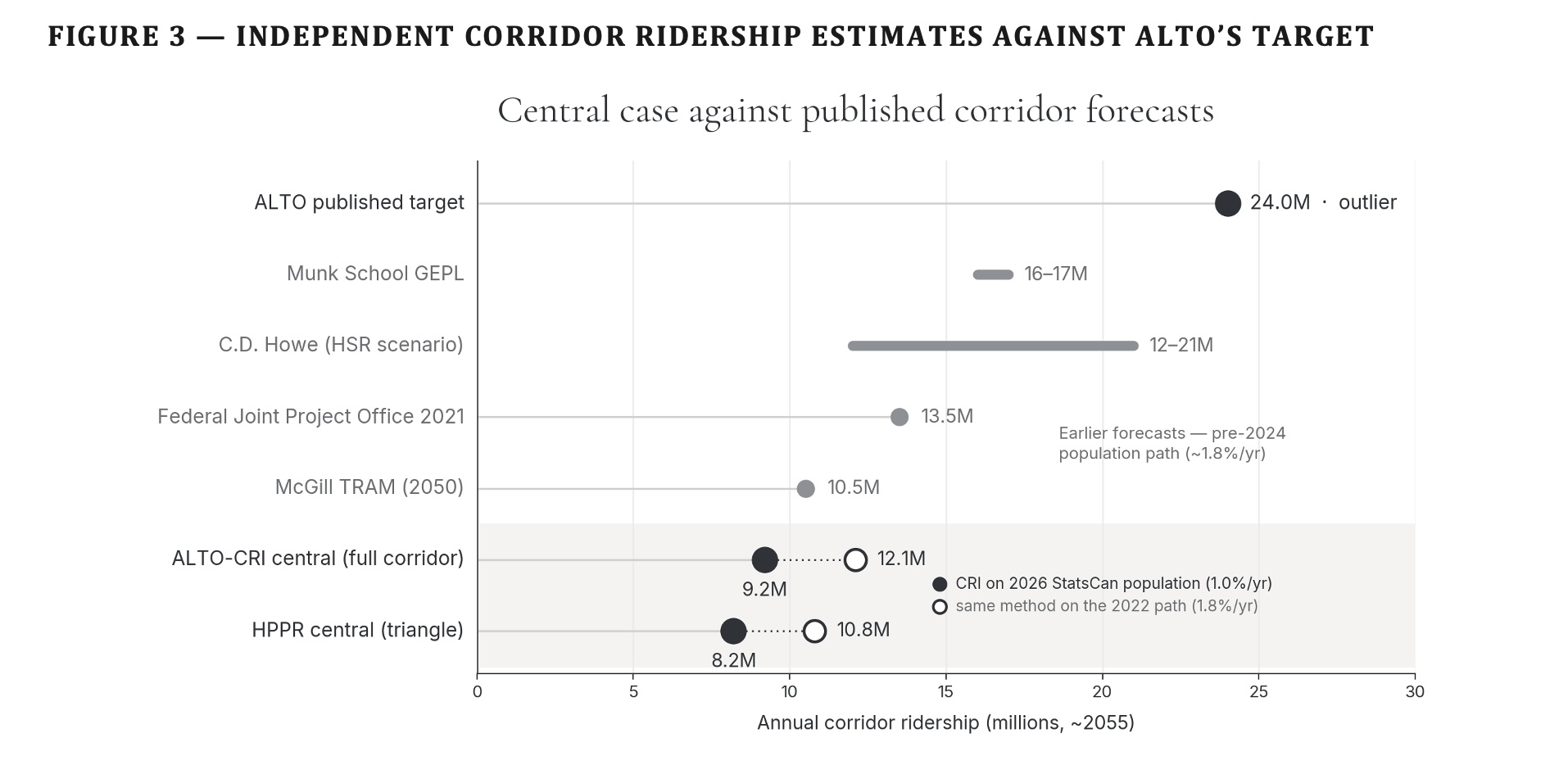
    On the page’s own headline figures, the ridership claim of up to 24 million passengers by 2055 is roughly 2.6 times the Initiative’s central estimate, and the sustainability claim inverts under full-lifecycle carbon accounting: the Initiative finds ALTO a net emitter of about 15 million tonnes CO₂e over fifty years, while HPPR is a net carbon sink.

    This is the standard presentation pattern of optimism bias documented in megaproject appraisal: gross benefits foregrounded, costs and risks kept off the page, and ceiling figures — “up to” — offered as though they were expectations.

    The Frame

    Benefits gross, cost absent

    The GDP line is the clearest instance. The page reports a 1.1 per cent increase in Canada’s GDP, valued at $24.5 billion “in today’s value” — a figure discounted to the present without disclosing the capital sum it is being discounted against. The Initiative’s ECI/CFI cost model puts ALTO at approximately $143 million per kilometre central; over a corridor of roughly one thousand kilometres, the capital envelope is an order of magnitude larger than any single benefit line quoted on the page. The HPPR spine, by contrast, is modelled at roughly $28–40 million per kilometre. ALTO’s own official figure, stated elsewhere, is $60–90 billion for the corridor; the conclusion here does not turn on whose estimate you take, since even on that lower number the benefit-cost ratio is only about 0.1, and on the Initiative’s estimate about 0.06.

    Presented this way, the benefits cannot be wrong — only incomplete. A gross benefit is a real quantity; it simply says nothing about whether the project earns it back. That judgement requires the two numbers the page withholds: the cost, and the ridership assumption most of the other benefits depend on.

    Comparison

    The page’s claims against the corridor’s numbers

    Each row sets a figure as ALTO states it beside the corresponding finding from the Initiative’s modelling.

    ALTO’s ClaimThe Initiative’s Finding
    Ridership. Up to 24 million passengers annually by 2055. The Initiative’s central estimate is approximately 9.2 million in 2055, rising to about 12.5 million by 2080 — roughly 2.6 times lower than the page’s figure. “Up to” marks a ceiling, not an expectation, and the figure coincides exactly with the page’s own 2041 corridor population of 24 million, inviting readers to conflate people in the corridor with trips captured.
    Emissions. 100% electric — the equivalent of removing about 100,000 cars from the road each year. “100% electric” describes operational emissions only. Counted over its full lifecycle — the embodied carbon of a 300+ km/h greenfield build, against a ridership that is itself overstated — the Initiative finds ALTO a net emitter of roughly +15 Mt CO₂e over fifty years. The lower-speed HPPR alternative, built largely on existing alignment, is a net carbon sink.
    Economic impact. 1.1% increase in Canada’s GDP ($24.5 billion in today’s value). A gross benefit stated with no cost and no netting, discounted to present value without disclosing the capital figure behind it. Set against the Initiative’s cost model, the corresponding benefit-cost ratio is approximately 0.06.
    Jobs. Over 50,000 during construction; a further 5,000 once operational. Construction employment is a project input — a cost — not a benefit. Counting it on the benefit ledger is double-counting, among the most reliably flagged errors in megaproject business cases. The 5,000 operational jobs are a genuine recurring effect; the 50,000 construction jobs are not a benefit at all.
    Road decongestion. Valued at $570 million. The figure scales directly off ridership. If the 24 million capture is roughly 2.6 times high, the decongestion benefit is proportionally overstated. Induced demand refilling freed road capacity is not addressed.
    Tourism. Approximately $800 million in revenue each year. A gross figure with no displacement netting — spending that would have occurred anyway, or shifted from elsewhere in the corridor, is not removed.
    Travel times. Toronto–Montréal ~3h; Ottawa–Montréal ~1h; Montréal–Québec City ~1h30. These times are the payoff of the 300+ km/h greenfield alignment that drives both the ~$143M/km cost and the community disruption the page does not mention. HPPR achieves competitive times at 180–240 km/h for a fraction of the cost.
    Cost of the project. Stated nowhere on the page. ALTO’s own official range, given elsewhere, is $60–90 billion; the Initiative’s independent estimate is higher, at roughly $143 million per kilometre. This is the number against which every benefit above would have to be weighed — and the one the benefits page omits.
    Three Inversions

    Where the page’s strongest claims turn over

    The sustainability claim inverts under lifecycle accounting

    The page’s environmental case rests on ALTO being “100% electric.” That describes how the trains are powered, not what building the line costs in carbon. A 300+ km/h greenfield corridor — concrete, steel, tunnelling, geofoam, land conversion — carries a large embodied-carbon debt that operational electricity does not offset, particularly once the offset is recomputed against realistic rather than headline ridership. The Initiative’s finding is a net carbon deficit of roughly +15 Mt CO₂e over fifty years, while the lower-speed HPPR alternative is a net sink. The single most quotable line on the page — sustainability — is the one the accounting reverses.

    “Up to 24 million” is a ceiling offered as an expectation

    The headline ridership number does the persuasive work of the page, and “up to” is doing the work inside it. The Initiative’s central estimate is about 9.2 million passengers in 2055. Systematic overstatement of rail ridership at the appraisal stage is one of the best-documented patterns in the megaproject-forecasting literature, and this figure fits it squarely. The Initiative’s brief The Anatomy of an Optimistic Forecast sets out the mechanism in full.

    Construction jobs are counted on the wrong side of the ledger

    The page presents “over 50,000 jobs during construction” as a benefit. In a proper appraisal, construction labour is an input the project pays for — part of its cost, not part of its return. Presenting it as a benefit counts the same money twice. This is standard in the appraisal literature, and it is one of the easier errors for a general reader to check.

    Three Numbers

    What restoring the denominator shows

    2.6×
    the page’s 2055 ridership claim over the Initiative’s central estimate
    Initiative ridership modelling
    +15 Mt
    net CO₂e over fifty years — ALTO as emitter, not saver, on a lifecycle basis
    Initiative lifecycle carbon analysis
    0.06–0.1
    benefit-cost ratio for ALTO — on the Initiative’s estimate and on ALTO’s own $60–90B; both far below 1.0 (HPPR ~0.44)
    Initiative cost & benefit model

    None of these three figures appears on ALTO’s benefits page. Each is derived from the page’s own claims once the cost and the ridership assumption are made explicit.

    Where things stand · July 2026

    Summary ledger

    Against the benefit claims as the page presents them:

    Overstated
    Ridership — “up to 24 million by 2055” is roughly 2.6 times the Initiative’s central estimate of ~9.2 million.
    Contradicted
    Emissions — the “100% electric” sustainability claim reverses to a net +15 Mt CO₂e deficit once lifecycle carbon is counted.
    Omitted
    Benefit-cost ratio — no BCR is stated anywhere; the Initiative’s central case is ~0.06.
    Omitted
    Capital cost — no cost figure appears on the page; central estimate ~$143M/km.
    Miscounted
    Construction jobs — presented as a benefit; they are a cost input, and counting them double-counts.
    Overstated
    Decongestion and tourism — gross figures that scale off the overstated ridership, with no netting for displacement or induced demand.
    Omitted
    Land and community impact — the disruption the 300+ km/h alignment requires is absent from the benefits page entirely.

    The page is titled “Discover Alto’s Many Benefits.” The benefits are real as gross figures; what the page withholds is the cost against which they would have to be set, the ridership assumption most of them depend on, and the lifecycle accounting that reverses its environmental claim. Read with those three restored, the case the page makes for the project is substantially weaker than the case it appears to make.

    Sources

    Documents and analysis

    1.
    ALTO, “Discover Alto’s Many Benefits,” altotrain.ca, page reviewed July 2026. altotrain.ca
    2.
    ALTO, “Fast Forward: Shaping Canada’s Future with a High-Speed Train,” the explanatory document referenced from the benefits page.
    3.
    ALTO HSR Citizen Research Initiative, ridership envelope modelling — central estimates: ALTO ~9.2M (2055) / ~12.5M (2080); HPPR ~8.2M (2055) / ~10.4M (2080).
    4.
    ALTO HSR Citizen Research Initiative, lifecycle carbon analysis — ALTO net +15 Mt CO₂e over fifty years; HPPR net sink.
    5.
    ALTO HSR Citizen Research Initiative, ECI/CFI cost model (ALTO ~$143M/km central; HPPR spine ~$28–40M/km) and benefit-cost analysis (ALTO ~0.06 on the Initiative’s cost and ~0.1 on ALTO’s own $60–90B; HPPR ~0.44).
    6.
    ALTO HSR Citizen Research Initiative, “The Anatomy of an Optimistic Forecast” and “A Straighter Line,” citizenresearch.ca.
    7.
    Bent Flyvbjerg, on optimism bias and reference-class forecasting in the appraisal of major infrastructure projects.
  • Undressing the addressable market

    Technical Brief · Corridor Demand

    Undressing the Addressable Market

    Alto’s demand case, read against the corridor’s roadside counts, its current population path, and the international reference class.

    ⚠ New Finding · The 95-million figure has no published source

    Alto’s April 2026 commentary states that “ninety-five million intercity trips take place each year between the cities Alto will serve,” rising to 140 million by 2049. The figure has been repeated across government communications and press coverage since. It does not appear in Alto’s own explanatory document Fast Forward (March 2025), the Corporate Plan Summary 2024-25 to 2028-29, or the June 2026 What We Heard consultation report. No independent analyst — C.D. Howe, the Munk School, McGill TRAM — has adopted it. The denominator that anchors Alto’s modest-quarter framing is stated in a commentary without any published derivation.

    Key Finding

    95 M → ~25 M.  Alto’s 95-million-intercity-trips figure counts every trip, by every mode, over every distance, across the whole corridor. The market a high-speed line can realistically serve — the longer, station-to-station journeys where rail competes with air and car — is roughly a quarter of it, about 25 million a year; the rest is short, regional, and off-corridor travel no train could carry.

    Central independent ridership sits at 8–9 million a year, rising toward 10 at maturity — less than half of Alto’s 24-million target. The three markets a fast service actually converts (car, air, and existing rail) sum to about that level. The reference-class floor from comparable car-dependent corridors is 4–5 million. Alto’s 24-million target stands alone above every published independent forecast.

    Download
    Undressing the Addressable Market — Full Brief (PDF)
    Technical brief with methodology, tables, figures, and full source citations

    Download PDF

    The Claim

    Alto’s demand case, in its own words

    In an April 17, 2026 opinion piece published in the Toronto Star and La Presse and reproduced on altotrain.ca, Alto’s chief executive set out the demand case for the Toronto–Québec City high-speed line. Its central figures are a headline market of ninety-five million intercity trips a year across the corridor, rising to one hundred and forty million by 2049; a population of eighteen million reaching twenty-two million within fifteen years; and a target of twenty-four million annual passengers by 2055, presented as consistent with international outcomes. The piece is framed to reassure — its very title insists that high-speed rail is no leap of faith.

    This brief tests the claim on its own terms. It does not dispute that the corridor is large, that it is growing, or that its intercity system is under strain — all three are true. It disputes the inference the commentary draws from them: that a twenty-four-million forecast is therefore measured, modest, and safe.

    Read against three independent bodies of evidence — the corridor’s roadside traffic counts, the population path Statistics Canada now projects, and the international record of what comparable high-speed lines actually carry — the demand case rests on optimistic framing rather than measurement. Where the commentary offers large round numbers and a single favourable analogue, the evidence points to central ridership near a third of the headline, and to a growth story built on a population Canada has already walked back.

    What the Evidence Shows

    Six findings

    The findings rest on four independent methods, each built to be reproducible from public data: a reference class of comparable corridors, a modal-shift ridership model, a market-by-market demand build-up, and a re-basing on Statistics Canada’s current population. A fifth lens — the standard appraisal treatment of optimism bias — governs how all four are read.

    Central independent ridership is 8–9 million a year, not 24

    Rising toward 10 at maturity. The risk-adjusted floor from comparable car-dependent corridors is 4–5 million. Alto’s 24-million target sits above every published independent forecast of the corridor.

    The demand builds from three real sources, not a 95-million abstraction

    The market a fast service actually converts is measurable: the cars crossing the corridor, the air travellers on the competitive pairs, and the existing VIA riders it retains. Added together — roughly 2.8–3.5 million from car, 1.7–2.0 million from air, and about 3.3 million retained rail (VIA’s directly reported 2025 Corridor East ridership) — they come to about 8 to 9 million. The 95-million figure is an all-modes, all-pairs total that no service captures.

    The 95-million figure itself is unsourced

    Stated in the commentary without citation, and absent from Fast Forward (March 2025), the Corporate Plan Summary 2024-25 to 2028-29, and the June 2026 What We Heard consultation report. No independent analyst has adopted it. The denominator that anchors the modest-quarter framing is not just broad but unpublished.

    The demand-growth story reverses the per-capita trend

    Ninety-five to one hundred and forty million over 2026–2049 is about 1.7 per cent a year, faster than the corridor’s own population growth. The gap implies rising travel per resident — against the grain of hybrid work and videoconferencing.

    The population base is the pre-cap one

    Twenty-two million in fifteen years extrapolates the 2015–2025 immigration surge. Statistics Canada’s January 2026 projection is lower; on the current path the corridor is about 6.3 million people smaller by 2055 than the counterfactual Alto’s numbers assume.

    The one comparator offered is a best case

    Madrid–Barcelona is among the strongest high-speed successes on record. The honest reference class — the full distribution of high-speed outcomes, many of which undershot their forecasts — brackets the answer far below 24 million.

    Method 1 · Reference Class

    What comparable corridors actually carry

    Rather than model the corridor from assumptions, the reference-class method asks what corridors with similar car dependence, density, and trip lengths actually achieve once fast rail opens. Each candidate corridor is scored on a Car Dependency Index (CDI) — a composite of car mode share, population density, and transit provision at the endpoints. The Toronto–Québec City corridor’s high car dependence places it with reference cases that, rescaled to this line, carry the equivalent of roughly 4 to 5 million corridor trips a year at maturity. This is the risk-adjusted floor: what the evidence says the corridor is most likely to do before any speed, fare, or density assumption is layered on.

    Figure 1 — Comparable intercity-rail corridors plotted by their Car Dependency Index against annual ridership; the Toronto–Québec City corridor's high car dependence places it with reference cases carrying 4 to 5 million corridor trips a year.
    Figure 1 — The reference class: ridership against car dependency. Comparable intercity-rail corridors scored by their Car Dependency Index. The Toronto–Québec City corridor’s high car dependence places it with reference cases that, rescaled to this line, carry the equivalent of roughly 4 to 5 million corridor trips a year — the risk-adjusted floor.
    Methods 2 & 3 · The Three Markets

    Demand, counted not modelled

    A fast service on this corridor draws from three distinct current populations: the car market, the air market on the competitive city pairs, and the existing rail riders. Each is measurable from public data. Because they are distinct populations, they add without double-counting.

    The car market is read at the Highway 401 screenline where it crosses into Québec, after Ottawa-bound traffic has left via Highway 416 and Cornwall-local traffic has loaded, stripped of the 30 to 35 per cent commercial-truck share and short regional trips: roughly 8.8 to 11.0 million end-to-end car person-trips a year across the triangle at an occupancy of 2.0. Applying the road-market capture rates converts these into the rail ridership the car market alone would yield.

    Table 1 — Rail ridership drawn from the car market: per-leg car person-trips and rail capture rates for Toronto–Montréal, Ottawa–Toronto, and Ottawa–Montréal, summing to 2.8–3.5 million rail passengers per year from the car market.
    Table 1 — Rail ridership drawn from the car market. Capture rates are road-market shares from the modal-shift analysis at a moderate-fare regime; they express rail’s share of the combined car-and-rail market. Only Toronto–Montréal is confirmed by roadside counts; the Ottawa legs are demand-sized.

    The car market is only one of three. A fast corridor service also draws from the air travellers on the same city pairs, and it retains the passengers already riding the train. The corridor air market on the competitive pairs — Toronto–Montréal, Toronto–Ottawa, and the smaller Ottawa–Montréal — is on the order of 2.5 to 3.0 million point-to-point passengers a year, of which a fast train on these distances captures about two-thirds.

    Existing conventional rail is now reported directly in VIA’s 2025 annual results: 3.34 million passengers a year on the Corridor East service group (Québec City–Montréal–Ottawa–Toronto), within a Québec City–Windsor corridor total of 4.18 million. Essentially all of the triangle share is retained by a faster, more reliable service. VIA’s audited subsidy figures also fix the shape of the trip-length distribution: 48.51 dollars per passenger over 0.22 dollars per passenger-mile is an average trip of about 355 kilometres — roughly a third of the end-to-end corridor distance. Even the passengers already choosing rail are, on average, taking journeys well short of the full corridor.

    Table 2 — Where the corridor's rail ridership comes from: diversion from car (2.8–3.5M), diversion from air (1.7–2.0M), and existing VIA rail retained (~3.3M), summing to a central total of approximately 8–9 million rail passengers per year.
    Table 2 — Where the corridor’s rail ridership comes from (central). Car, air, and existing-rail travellers are distinct current populations, so the three sources add without double-counting. The rail line uses VIA’s Corridor East service group directly, rather than deriving a triangle share of the wider Québec City–Windsor total. The total is the central case around 2055; it rises toward 10 million at maturity as the ramp completes, and remains far below 24 million.
    Method 4 · The Population Basis

    The 6.3-million deficit

    Every ridership figure scales with the population beneath it, so the choice of population path is decisive. The brief uses Statistics Canada’s January 2026 projection (catalogue 17-20-0003), which incorporates the 2024–25 federal Immigration Levels Plan.

    Against the pre-2024 growth path that older corridor forecasts — and the commentary’s twenty-two-million figure — assume, this is materially lower: the corridor reaches about 19.8 million by 2055 on the current path, versus 26.1 million on the counterfactual, a deficit of 6.3 million. Because ridership scales with population, a forecast on the old path is inflated by roughly the same proportion the population has been cut — before any question of mode share or capture even arises.

    Figure 2 — Corridor population time series 2015–2060 showing four trajectories: pre-2024 counterfactual reaching 26.1M by 2055; Statistics Canada January 2026 central projection reaching 19.8M; high-growth 23.1M; low-growth 17.4M. Alto's CEO's 22M-in-fifteen-years forecast is marked as an outlier above the current path.
    Figure 2 — Corridor population: the 6.3-million deficit. The pre-2024 counterfactual (~1.8%/yr) reaches 26.1 million by 2055; Statistics Canada’s post-cap January 2026 projection (~1.0%/yr) reaches 19.8 million — a 6.3-million gap that every ridership figure scales with. The open diamond marks Alto’s own forecast of 22 million within fifteen years; its implied ~1.35%/yr growth runs above the current path.
    Triangulation

    Where Alto’s target sits against every independent forecast

    The three methods converge. The demand-side build-up sums to about 8 to 9 million a year; the bottom-up modal-shift model lands in the same place; the reference class puts a floor near 4 to 5 million. Set beside the full band of independent corridor estimates, Alto’s 24-million target stands alone above every one.

    Figure 3 — Independent corridor ridership estimates around 2055. Alto's published target of 24.0M is shown as an outlier above every independent forecast: Munk School 16–17M, C.D. Howe 12–21M, Federal Joint Project Office 13.5M, McGill TRAM 10.5M, and the Initiative's own central case at 9.2–12.1M.
    Figure 3 — Independent corridor ridership estimates against Alto’s target. Annual corridor ridership around 2055. Alto’s 24-million target stands alone above every independent forecast — the Munk School, C.D. Howe, the Joint Project Office, and McGill — and above the Initiative’s own central case (filled markers). The open markers plot the Initiative’s method on the pre-2024 population Alto’s numbers assume; even then it stays within the published band, so the distance is population basis, not method.
    The Claim, Audited

    Where the 95-million figure appears — and where it doesn’t

    A demand denominator on which a $60–90 billion capital commitment rests should be reproducible from published sources. Alto’s is not. The ninety-five-million and one-hundred-and-forty-million figures are stated in the April 2026 commentary without citation and are absent from every canonical planning document the corporation has published.

    PresentImbleau, M., “High-speed rail is not a leap of faith: why it matters for Canada’s growth” — Op-ed, Toronto Star and La Presse, April 17, 2026; reproduced on altotrain.ca. The single document in which the 95-million and 140-million figures appear. Stated without citation, methodology, or reference to any underlying study.

    AbsentFast Forward: Shaping Canada’s Future with a High-Speed Rail Network (March 2025) — Alto’s own public-facing explanatory document. Discusses ridership growth from ~3 million (2024) to 24 million (2055) and 43 million (2084), but does not reference the 95-million intercity-trip figure or provide any market-total denominator on that scale.

    AbsentVIA HFR – VIA TGF Inc., Corporate Plan Summary 2024-25 to 2028-29 (November 2024) — the corporation’s tabled planning document referenced by the Library of Parliament backgrounder on the project. Contains ridership targets (“17 million by 2059” for HFR, before the HSR rebrand) but no 95-million total-market figure.

    AbsentJune 2026 What We Heard Report on the corridor study area — Alto’s own summary of the January–April 2026 consultation, running to more than 130 pages. Does not reference a 95-million figure.

    AbsentQuarterly Financial Reports through Q3 2025-26 — Alto’s mandatory reporting to Parliament. Does not reference a 95-million figure.

    AbsentIndependent published analyses of the corridor — the C.D. Howe Institute’s All Aboard study (March 2026), the Munk School Global Economic Policy Lab’s HSR analysis, Transportation Research at McGill’s corridor demand modelling, and Michael Schabas’s Senate submission on Bill C-15 (January 2026, 65 pp.). None uses the 95-million figure.

    The finding does not, on its own, resolve whether the 95-million figure is defensible. It resolves whether the figure is auditable. On the public record as it stands, it is not: no derivation has been published, no methodology has been described, and no independent source has adopted it.

    Recommendation

    Three things follow

    The demand case that anchors a 1,000-kilometre corridor, a $60–90 billion capital commitment, and a multi-decade delivery programme cannot responsibly rest on figures that have not been made auditable. Three steps would meet the standard.

    Release the demand model for independent audit

    A forecast that anchors an alignment and a multi-decade capital commitment cannot responsibly remain unpublished. In particular, the derivation of the ninety-five-million and one-hundred-and-forty-million intercity-trip figures cited in the April 2026 commentary should be published alongside the underlying model.

    Adjust toward the reference class and current population

    Standard megaproject appraisal requires promoter forecasts to be adjusted toward the reference class rather than accepted at face value. Alto’s should also be re-based on Statistics Canada’s January 2026 population projection, rather than the pre-2024 path the current forecast assumes.

    Size the corridor decision to the audited demand

    Not to a ninety-five-million headline or a twenty-four-million target that no independent method reaches. High-speed rail need not be a leap of faith. But the demand case as currently stated is closer to one than the corridor’s own numbers allow.

    Download Full Brief
    Undressing the Addressable Market (PDF)
    Full methodology, tables, figures, basis and limitations, and complete source citations

    Download PDF

    Sources

    Primary documents and data

    Every figure in this analysis is drawn from the public sources or companion analyses set out below and is reproducible from them. Sources are grouped by the claim or quantity they support.

    1.The claim examined. Imbleau, M., President and Chief Executive Officer of Alto. “High-speed rail is not a leap of faith: why it matters for Canada’s growth.” Commentary, altotrain.ca, April 17, 2026. altotrain.ca. The source, stated without further citation, of the ninety-five-million and one-hundred-and-forty-million intercity-trip figures, the eighteen-to-twenty-two-million population claim, and the twenty-four-million passenger target for 2055.

    2.Alto planning documents in which the 95-million figure does not appear. Alto, Fast Forward: Shaping Canada’s Future with a High-Speed Rail Network (March 2025). VIA HFR – VIA TGF Inc., Corporate Plan Summary 2024-25 – 2028-29. Alto, June 2026 What We Heard Report on the corridor study area public consultation. All at altotrain.ca.

    3.Companion research, Citizen Research Initiative. Intercity Car Trips Between Toronto, Ottawa and Montréal (2026) — road-side measurement of end-to-end car travel at the Highway 401 Québec-boundary screenline, the per-leg car person-trips of Table 1, and the road-market capture rates of Table 2. HPR Research Report — Ridership (2026) — the demand reference class and Car Dependency Index (Figure 1); the modal-shift model, R = P × μ × s × φ(t); the population basis (Figure 2) and the 6.3-million deficit; and the triangulation against independent forecasts (Figure 3). All at citizenresearch.ca.

    4.Traffic and travel-demand data. Ministry of Transportation of Ontario, Provincial Highways Traffic Volumes — annual average daily traffic on Highway 401, sections between the Highway 416 interchange and the Québec boundary. VIA Rail Canada, 2025 Annual Report (Montréal, March 2026): 4.40 million passengers system-wide and 986 million passenger-miles; 4.18 million on the Québec City–Windsor corridor and 3.34 million on the Corridor East service group; audited service-group subsidy figures implying an average Corridor East trip of about 355 kilometres. Statistics Canada, Air passenger traffic at Canadian airports (table 23-10-0253), together with airport-authority passenger statistics for Toronto Pearson, Montréal–Trudeau, and Ottawa Macdonald–Cartier. Transport Canada, Transportation in Canada annual report.

    5.Population. Statistics Canada, Population Projections for Canada, Provinces and Territories, January 2026 vintage (catalogue 17-20-0003), which incorporates the 2024–25 federal Immigration Levels Plan; and Census of Population, 2021, for the corridor’s census-metropolitan-area populations. These underpin the 19.8-million (post-cap) and 26.1-million (pre-2024 counterfactual) 2055 corridor figures and the 6.3-million deficit.

    6.Comparator corridor forecasts. Transport Canada and the EcoTrain consortium, Updated Feasibility Study of a High-Speed Rail Service in the Québec City–Windsor Corridor (2011). Federal Joint Project Office and the VIA High Frequency Rail baseline (2021). Transportation Research at McGill (TRAM), corridor demand modelling. C.D. Howe Institute (2026), high-speed-rail scenario. Munk School Global Economic Policy Lab, corridor demand. Schabas, M., Alto High-Speed Rail: Conceptual Design and Business Case, Senate submission on Bill C-15 (January 2026). These supply the independent ridership band of Figure 3.

    7.Forecasting method and optimism bias. B. Flyvbjerg, “Survival of the Unfittest: Why the Worst Infrastructure Gets Built — and What We Can Do About It” (Oxford Review of Economic Policy, 2009), and related work establishing reference-class forecasting; B. Flyvbjerg and D. Gardner, How Big Things Get Done (2023). HM Treasury (United Kingdom), The Green Book and its supplementary guidance on optimism bias. Oxford Global Projects, reference-class forecasting datasets and practice. UK National Audit Office, successive reports on High Speed 2 (HS2) documenting systematic optimism in demand forecasts and cost escalation.

    ALTO HSR Citizen Research Initiative  ·  citizenresearch.ca  ·  Corridor Demand Brief  ·  July 2026
    Independent, non-partisan research on the proposed Toronto–Québec City high-speed rail corridor.
  • The more you look

    The More You Look, the Worse It Gets — ALTO HSR Citizen Research Initiative

    The More You Look, the Worse It Gets

    Thirty studies of high-speed rail in this corridor, across fifty-six years. One simple pattern runs through all of them.

    ⚠ The bottom line, up front

    The people building the railway say it will pay for itself. The one independent study in 2026 that actually checked the math — using the builders’ own cost estimates — found a hole of about $53 billion over fifty years.

    That’s not a fluke. It’s the pattern. For fifty-six years, the case for this railway has looked best in exactly the studies with the most to gain from building it.

    In one minute

    We read thirty major studies of high-speed rail in this corridor, from 1970 to today, and asked every one the same set of questions — with all the dollar figures put on a level footing.

    The verdict almost always matches who paid for the study. Equipment makers, the proponent and paid advocates say build it. Independent governments say wait. And every single study that actually runs the finances finds the same thing: ticket sales can’t cover the cost, so the public pays most of the bill.

    The numbers that look great — low costs, huge ridership, big climate wins — come from the promoters. The numbers that survive an independent look are far more sober. The closer and more independent the analysis, the weaker the case.

    Read the full report
    Corridor Rail Studies, 1970–2026 — A Cross-Decade Analysis
    Thirty studies, thirty-four dimensions, nine findings, with the full evidence tables
    Download PDF
    How we know

    Thirty studies. Same questions. Fifty-six years.

    We didn’t cherry-pick. We took thirty of the major studies of this railway — going right back to a 1970 federal commission — and put the same 34 questions to all of them, so the answers line up side by side across the decades.

    30
    major studies of this railway, read into one matrix
    1970–2026
    34
    questions asked of every single study
    so the answers compare
    56
    years of studies, all priced in today’s dollars
    a level playing field

    The studies come from every side: equipment makers, government task forces, a Crown corporation, universities, Transport Canada, and the builders themselves. That range is the whole point — it lets us tell a real change in the corridor apart from a change in who’s doing the asking.

    What we found

    Nine things every reader should know

    Read across all thirty studies, nine patterns keep showing up. Here they are in plain terms.

    1The answer depends on who paid for the study

    Line up the verdicts and it’s impossible to miss. The build-it studies come from equipment makers, from a Crown corporation that wanted to run the trains, from the proponent, and from paid advocates. Every independent government that looked said wait. Building new is the sponsors’ answer — not what fifty-six years of evidence actually points to.

    2It has never paid for itself. Not once.

    Every study that runs the money lands in the same spot: fares can’t cover the cost, and taxpayers foot most of the bill. VIA’s own 1984 numbers came out negative. In 1995, three governments agreed the public would cover 70–75%. In 2026, an independent model put the public subsidy at about $53 billion over fifty years — and found the railway wouldn’t even break even until year 44. The promise that it’ll fund itself is the single most optimistic claim in the whole record.

    3The closer you look, the more it costs

    Whenever a promoter and an independent body price the same thing, the promoter’s number is lower — and the price climbs as the estimate gets more serious. A 2026 advocacy paper gets the cost down to $63 billion only by assuming rock-bottom construction prices, about a third of our own central estimate of roughly $143 million per kilometre. The cheaper the headline, the thinner the math underneath it.

    4The ridership numbers don’t hold up

    The passenger forecasts are shakier than they look — and academics, an airline, Parliament and Transport Canada have all said so. One 1994 study showed the forecast could swing fivefold just by changing a single modelling choice, on the same data. Transport Canada’s own reviewers called the assumptions “optimistic and aggressive.” And the biggest numbers always belong to the promoters.

    5The freight idea is good — with one catch

    Splitting passengers and freight onto the corridor’s two parallel tracks, and freeing up freight capacity as a bonus, is a genuinely sound idea — it was proposed back in 2002. The catch: at the time, the freight railways said they didn’t need the extra capacity. It’s a strong argument, as long as it’s honest about that condition.

    6Going faster barely helps

    Study after study finds that top speed buys almost no extra riders — one found just an 8% jump going all the way from 300 to 400 km/h, another only about 9% from 200 to 300. So the level-headed studies settle far lower: a 2002 plan judged 240 km/h fast enough, and even the independent 2026 model assumes trains averaging just 200–250 km/h. The “top speed everywhere” designs are the outliers — a moderate railway of roughly 180–240 km/h carries nearly the same riders for far less money, and that’s where the evidence actually sits.

    7We’ve seen this financing risk before

    Having a private partner build and run the railway while the public owns the assets isn’t new — and neither is the warning. Both Parliament (1998) and Transport Canada (2003) flagged the same danger decades ago: deals like this can hand the risk to taxpayers and the reward to investors, with a rosy headline resting on one convenient assumption.

    8The climate math only counts the good half

    For decades, no study counted carbon at all. Now they do — but only the savings from getting people out of cars and planes. The huge emissions from pouring hundreds of kilometres of concrete and steel and clearing land? Left out. Count both sides honestly and this design adds emissions for decades. That’s the difference between a climate win and a climate cost.

    9When the numbers fail, out comes “nation-building”

    There’s a move that shows up again and again: when the dollars-and-cents case comes up short, in come national unity, regional growth, and keeping up with other countries. One 2016 report recommended extending the line even at a benefit-cost ratio of 0.24 — about 24 cents of benefit for every dollar spent. These arguments can be fair. But they do the heaviest lifting exactly where the economics are weakest.

    The gap, side by side

    What the promoters say vs. what independent studies find

    All nine findings come down to one contrast. Same railway, same engineering — but the promoters’ numbers and the independent record split apart at every point that matters, and they split the same way every time.

    What the promoters sayWhat independent studies find
    Build it new. Equipment makers, a Crown corporation that wanted the contract, the proponent, and paid advocates all say go ahead. Wait. Every independent government that studied it held off; the reviews and the airlines said upgrade what’s there instead.
    The verdict:Build  vs  Wait
    It’ll pay for itself. The 2025 prospectus says the trains will turn a profit — the rosiest claim in fifty-six years. Taxpayers pay most of it. From 1984 to 2026, every study that runs the money says fares can’t cover the cost. The 2026 independent model: about $53 billion in public subsidy over fifty years.
    The money:Self-funding  vs  ~$53B public
    As low as $63 billion. A 2026 paper reaches that number by assuming bargain construction prices. More like $80–90 billion. The proponent’s own range tops out at $90 billion; independent build-ups land near $80 billion. Costs rise the closer you look.
    Price tag:~$63B  vs  ~$80–90B
    24 to 56 million riders. The 2025–2026 figures are the highest ever produced for this line. About half that. The only recent independent, survey-based forecast lands near 10 million a year — right in line with fifty years of history.
    Yearly riders:~24–56M  vs  ~10M
    A big climate win. The proponent headlines a 39-megatonne cut — counting only the savings from fewer car and plane trips. A climate cost, for decades. The emissions from building it — concrete, steel, cleared land — are left out entirely. Count both sides and it adds emissions.
    On carbon:Half the ledger  vs  The whole ledger
    Ridership

    Same railway. Forecasts from 6 million to 56 million.

    Put the passenger forecasts next to each other and they span almost tenfold — for one railway line. The high numbers always come from the promoters. The one to trust is the recent independent forecast built on an actual survey of travellers.

    ~10M
    independent, survey-based forecast for 2050
    McGill, 2026
    24–43M
    the proponent’s own forecast
    ALTO prospectus, 2025
    42–56M
    the highest numbers ever produced for this line
    2026 advocacy paper
    Study (year)Who produced itYearly ridersBasis
    Air Canada / CP (1993)Airline / railway5.8 Mthe low end of the record
    Task Force (1991)Governments7.8 Mfull corridor
    Tri-government (1995)Governments10–12 Mfull corridor
    EcoTrain (2011)Governments10–11 Mfull corridor
    Lynx (1998)Private consortium11.1 MQuébec City–Toronto
    SNCF (2010)Equipment makerup to 22.5 Mbest-case scenario
    ALTO prospectus (2025)Proponent24–43 Mfull network
    Advocacy paper (2026)Paid advocacy42–56 Mthe highest ever
    McGill (2026)Independent~10 Msurvey-based, 2050

    The numbers aren’t perfectly apples-to-apples — they cover different routes and years — which is part of the point. The takeaway is simple: the independent, survey-based forecast is about half the proponent’s.

    What it means

    Five takeaways

    The current project sits right at the meeting point of every pattern above. The prospectus is the most upbeat sales pitch in the whole record. The most careful independent 2026 work finds a multi-billion-dollar hole. And the one favourable outside verdict is reached only by pairing the cheapest possible construction cost with the highest ridership ever forecast for the line. Here’s what that adds up to.

    What the record points to

    Building new from scratch is the sponsors’ pick, not the safe reading of history. Fifty-six years of evidence leans toward upgrading what exists — or waiting for a full, honest costing.
    Expect the public to pay most of it. Three governments said 70–75% back in 1995, and every financial study since has landed in the same place.
    A moderate-speed, lower-cost railway fits the evidence better. Extra speed barely adds riders, and costs balloon the closer you look. Both have been true for decades.

    What to insist on

    Get the ridership numbers independently checked before trusting them. A single forecast from the people who want to build it isn’t enough — the best studies in the record always used more than one independent forecaster.
    Make the freight case — but be upfront about the catch. The idea is sound; its real value depends on the freight railways actually wanting the freed-up capacity. Say so plainly.
    The evidence

    All thirty studies, at a glance

    Here’s the whole set, oldest to newest. Read the two right-hand columns together — who did the study, and what they concluded — and Finding 1 jumps out: the “build it” verdicts belong to the sellers and the promoters; the governments that were truly independent said wait.

    YearStudy — who did itIndependent of the builder?Verdict
    1970Intercity Passenger Transport Study — CTCFederalUpgrade
    1984High-Speed Passenger Rail in Canada — VIACrown corpMixed
    1990Review of Previous Studies — TRANSURBConsultantWait
    1990A Pragmatic Approach (SPRINTOR) — ABBEquipment makerUpgrade
    1990The Canadian TGV Project — Bombardier / GEC AlsthomEquipment makerBuild new
    1991Rapid Train Task Force — Ontario / QuébecGovernmentsWait
    1991Competition in Rail Carriage — BerkowitzAcademicBuild new
    1992FAST TRACKS — VIA (advocacy)Crown corpBuild new
    1993HST Market Assessment — Air Canada / CPAirline / railwayUpgrade
    1994Demand-model re-estimate — Gaudry & Le LeyzourAcademicNo verdict
    1995Industrial Strategy (Vol II) — Simpson-GuerinConsultantNo verdict
    1995Routing & Costing Study — SNC-Lavalin / DelcanConsultantNo verdict
    1995Québec–Ontario HSR, Final Report — tri-govGovernmentsWait
    1998The Lynx Proposal — Lynx consortiumPrivate consortiumBuild new
    2002VIAFast — VIA RailCrown corpUpgrade
    2003VIAFast validation — IBI for Transport CanadaGov’t reviewerNo verdict
    2009Infrastructure and the Economy — Martin Prosperity Inst.AcademicBuild new
    2010Socio-Economic Study of HSR — SNCFEquipment makerBuild new
    2011Updated Feasibility (EcoTrain) — tri-governmentGovernmentsWait
    2014Toronto–Kitchener–London HSR — SchabasConsultantBuild new
    2015Future of Passenger Rail — Library of ParliamentParliament / indep.Upgrade
    2016Preliminary Business Case — SDG (Steer)ConsultantBuild new
    2016High Speed Rail in Ontario — Special AdvisorProvincialBuild new
    2021Toronto–Montreal Analysis — Munk SchoolAcademicBuild new
    2022Speed and Frequency — AlstomEquipment makerBuild new
    2025All Aboard — C.D. Howe InstituteAdvocacyBuild new
    2025Fast Forward — ALTO (the proponent)ProponentBuild new
    2026Conceptual Design & Business Case — SchabasAdvocacyBuild new
    2026Corridorwide Survey & Financial Analysis — McGillAcademicNo verdict
    2026Eastern Ontario Route (Hwy 401) — Schabas & AntinucciAdvocacyBuild new

    “Advocacy” means a document written to argue a case — a sales prospectus, a think-tank brief, or paid expert advocacy. “No verdict” means the study analysed the question but didn’t take a build/don’t-build position.

    The independent studies to trust

    Where the sober numbers come from

    The full list is above. If you read just a few, read the independent ones — the counterweight to the sales pitch.

    1.
    Québec–Ontario High Speed Rail Project, Final Report — three governments together, 1995. Concluded the public would cover 70–75% of the cost, and a private-only version couldn’t be financed.
    2.
    VIAFast validation — IBI Group for Transport Canada, 2003. The government’s own reviewers, who flagged “optimistic and aggressive” ridership assumptions.
    3.
    Updated Feasibility Study (EcoTrain) — three governments, 2011. The most recent independent-government study; it said wait.
    4.
    Future of Passenger Rail in Canada — Library of Parliament, 2015. Recommended upgrading service rather than building new.
    5.
    Corridorwide Survey & Financial Analysis — Transportation Research at McGill, 2026. The independent study behind the $53-billion subsidy figure and the ~10-million ridership forecast.
  • Winter, Ice and the Weather Envelope

    ALTO HSR Citizen Research · Technical Brief

    Wind, Ice & the Weather Envelope

    Winter snow is not the only weather that shapes a high-speed railway. The faster a line is built to run, the more it must spend to stay reliable when the weather turns — and the government’s own record shows this question was raised, and left unanswered.

    ⚠ On the record: the speed-in-winter question was answered in 2020

    An October 2020 Ministerial Briefing, released under the Access to Information Act, found that the government’s advisers could not identify any high-speed rail system that operates at 300 km/h in −30 °C conditions. The only cold-climate comparator they identified — China’s Harbin–Dalian line — reduces speed from 350 km/h to 250 km/h in winter. The finding was briefed to ministers more than four years before the project was announced. ATIA A-2024-004

    In June 2026, the tabled government answer to a Parliamentary question on winter-weather readiness confirmed that, “at this point in the design process,” Alto has not commissioned a comparative freezing-rain, snow, or ice assessment, nor a full winter-weather cost analysis, and that its freezing-rain reliability targets are “currently in development.” Sessional Paper 8555-451-1191

    Why this brief

    High-speed rail runs successfully in some of the world’s harshest weather — but never for free, and never without operating rules that slow or stop trains when conditions demand it. Every mature operator lives inside a “weather envelope”: the range of conditions in which full-speed service is safe. Crosswinds, tornadoes, freezing rain, and heat all sit at its edges.

    Because wind forces grow with the square of speed, and because cold, ice, and heat mitigation all cost more the faster and longer the line, the decisive question is not whether high-speed rail can run here. It is how fast the line should be designed to run, and whether the weather-hardening that speed requires has been counted. This brief draws on published engineering research, the operating experience of networks in Japan, China, and Europe, and the project’s own record released under the Access to Information Act. It is not an argument against high-speed rail.

    300 km/h
    the speed Alto advertises — “even in winter”
    Alto promotion, Feb 2026
    250 km/h
    winter speed of the only cold-climate HSR comparator identified (Harbin–Dalian)
    Ministerial Briefing, Oct 2020
    2020
    the year the government’s advisers flagged the 300 km/h cold-weather limit — over four years before the project was announced
    Ministerial Briefing, Oct 2020
    Download
    Weather & the Speed Decision (PDF)
    Crosswind, tornado, and freezing-rain reliability analysis, with the documented record
    Download PDF
    On the Record

    The question was examined internally — and never reconciled in public

    This is not only an inference from international experience. Documents released under the Access to Information Act show the federal government examined exactly this question years before the project was announced — and in June 2026 the government confirmed to Parliament that Alto has not yet commissioned either a comparative winter-weather assessment or a full winter-weather cost analysis.

    What is advertisedWhat the record shows
    “300 km/h or more. Even in winter.” Alto’s public promotion assumes consistent 300 km/h running, and the advertised journey times depend on it. The October 2020 Ministerial Briefing found no HSR system was identified that operates at 300 km/h in −30 °C. The only cold-climate comparator, Harbin–Dalian, reduces 350 → 250 km/h in winter.
    Reliability is “designed into every kilometre,” with “heated switches to de-icing systems.” The June 2026 answer confirms that, “at this point in the design process,” Alto has not commissioned a comparative freezing-rain / snow / ice assessment or a full winter-weather cost analysis; reliability targets for freezing-rain conditions are “currently in development.”
    A 300 km/h specification is presented as the project’s baseline. The May 2025 Corporate Plan contains no cold-climate operating standard, and the 2020 finding has never been publicly addressed.

    Two further items on the record bear directly on the speed choice. First, the procurement was structured as a speed comparison: each of the three bidders was required to submit both an enhanced-conventional option (up to 200 km/h) and a high-speed option (300+ km/h). A slower, cheaper design was therefore a live, formally-evaluated alternative — not a hypothetical. Second, the 2011 EcoTrain feasibility study of a Windsor–Quebec City high-speed service concluded that the full Québec City–Windsor corridor would not be financially viable on a standalone commercial basis and would require substantial public funding — though it found the Montréal–Ottawa–Toronto segment could generate net economic benefit. When a corridor’s commercial case is that fragile, avoidable cost — including over-specifying speed and the weather-hardening it demands — matters more, not less.

    Why this matters for speed and cost

    The gap is now a matter of record. The government’s own briefing established that 300 km/h has not been demonstrated in extreme cold, and that the nearest cold-climate line runs slower in winter — yet the advertised journey times assume full speed year-round, and Alto has confirmed it has not commissioned the comparative assessment or full winter-weather cost analysis that would test the assumption. A lower-speed option was on the table and formally costed. That is precisely the speed-and-cost question this brief is about, and it remains open.

    Wind & Crosswind

    The everyday wind risk is overturning — and it scales with speed

    For a high-speed train, the routine wind hazard is not a dramatic storm but a strong steady crosswind catching the train side-on. Aerodynamic side and lift forces rise with the square of the combined train-and-wind speed, so a lighter modern trainset at line speed becomes sensitive to winds that would barely trouble a slower, heavier train. The failure mode that governs design is overturning, not wheel-climb derailment.

    The threshold is closer than it looks

    In one published dynamic simulation, a high-speed vehicle running at 300 km/h overturned when the crosswind reached roughly 24 m/s (about 86 km/h) — a strong gale, but far short of tornado strength. Chinese railway practice treats an overturning coefficient above 0.8 as the danger threshold, and the overturning coefficient in these conditions typically runs about twice the derailment coefficient. Crosswind-induced overturning has been blamed for derailments in China, Japan, Belgium, and Switzerland.

    The speed lever

    Because the force grows with the square of speed, a line designed for 300 km/h is markedly more wind-sensitive than one designed for, say, 250. A higher design speed means the safe crosswind threshold is crossed more often — so a faster line needs more wind fencing, more sensor coverage, and lives with more frequent speed restrictions. Exposure is also geometry: viaducts and high embankments are the danger zones, cuttings and tunnels are sheltered, and running fast across open, elevated country is the most demanding combination of all.

    The mitigation is well proven — anemometer networks feeding automatic speed control, backed by physical wind barriers on exposed stretches. After a December 2005 derailment on the Uetsu Line, Japan’s JR East revised wind-based speed limits system-wide and installed windbreak fences and a strong-wind warning system; porous barriers can cut a train’s crosswind response by around a quarter. China’s Lanzhou–Xinjiang line runs long wind-fenced sections through the Gobi’s windy zones. None of it is free, and the bill rises with the speed being protected.

    Tornadoes

    Rare, extreme, and hard to see coming

    Tornadoes break the crosswind playbook, and it is worth being precise about why: they are managed by avoidance, not by building a train that can survive one. An EF2 tornado carries winds well above 180 km/h and EF3 higher still — far beyond the ~85–100 km/h band where overturning becomes likely. No practical trainset or wind fence keeps a train upright through a direct strike at speed.

    Detection is the hard part

    Fixed anemometer grids are calibrated for the prevailing winds that blow along the line. A tornado is a narrow, fast-moving, erratic feature that a line-side sensor network may never register before a train is in it — the opposite of the seismic case, where Japan’s earthquake system gets seconds of warning and automatically cuts power and brakes. Even a near miss throws trees and debris onto the alignment.

    The corridor sits in Canada’s tornado belt

    Most Ontario tornadoes are concentrated in a narrow corridor from Windsor to Ottawa and into parts of southern Quebec — the geography the proposed line traverses. Tornadoes up to F4 have been documented in the region; the 2018 National Capital outbreak produced a high-end EF3, and Canada records an estimated 230 tornadoes a year. The mainstream response is warning-triggered service suspension — hold the trains — not survivability engineering.

    In proportion, the tornado question is a genuine but low-frequency tail risk managed through hold procedures — the more dramatic hazard, but the smaller line item. Routine crosswind exposure, which shows up as everyday speed restrictions, is the larger and more quantifiable one.

    Freezing Rain

    Freezing rain is an electrical problem as much as a track problem

    Snow can be ploughed and blown clear. Freezing rain cannot — and its most serious target on an electrified line is not the rail but the overhead wire, the single power path for the whole train. Ice on the contact wire degrades the pantograph’s ability to collect current; it can flash over insulators, set the wire into large-amplitude “galloping” oscillations, and cause arcing — in severe cases, disconnection. Freezing rain is a recognised cause of equipment malfunction and delay wherever winters hover near 0 °C — precisely the St. Lawrence Valley profile documented in our Winter Weather analysis.

    The mitigation is real, proven, and continuous — which is another way of saying it is a permanent cost line. France’s SNCF illustrates the toolkit: electric switch heaters, resistive heating circuits that keep catenary above freezing, a fleet of de-icing “scraper” locomotives, and a hydrophobic anti-icing lubricant on the contact wire. China’s purpose-built cold line pairs catenary de-icing with turnout snow-melting and a dedicated snow-and-ice monitoring system. Freezing rain is beaten by equipment plus surveillance plus standing procedures — all carrying capital and maintenance cost that scales with the length of exposed line.

    And a second question: which de-icing method?

    Mitigating ice raises a choice with its own consequences. Alto’s own winter-operations material lists chemical de-icing using “glycol- or saline-based solutions,” while its June 2026 Parliamentary answer instead illustrates winter mitigation with electric methods — ice-breaking equipment and running high current through the catenary to melt ice. Glycol and chloride de-icers carry serious environmental constraints over the Frontenac Arch and Napanee karst, where contaminants can reach the aquifer before any collection point exists.

    As our De-Icing analysis sets out, that pushes the corridor toward electric heating as the primary de-icing technology on sensitive sections — effective, but a permanent energy and cost load. The freezing-rain problem and the environmental problem point at the same answer, and the same bill.

    Heat & Water

    The other ends of the envelope

    Summer heat and rail buckling

    Continuously welded rail expands in extreme heat and can buckle (“sun kink”). Operators manage this with real-time rail-temperature monitoring, heat-related speed-limit orders, and — in some networks — spraying track with water. A corridor with a >70 °C annual temperature swing, like the cold-climate reference lines, must design for both extremes at once.

    Heavy rain and flooding

    Intense rainfall drives washouts, embankment and slope failure, and landslides — which is why high-speed operators monitor rainfall and river levels alongside wind, and impose speed controls or shutdowns when thresholds are crossed.

    What It Costs

    Weather-proof is achievable — the reference projects show the price tag

    The strongest evidence that severe-weather high-speed rail works is also the strongest evidence that it is expensive and route-specific. Two reference cases are instructive.

    China · Harbin–DalianJapan · Shinkansen
    The world’s first alpine high-speed line runs through a −40 °C to +40 °C range. To beat frost heave, 70% of the line was built on viaduct and about 20% of the at-grade track was rebuilt before opening. Final cost ran roughly 25% over budget. It historically dropped to 250 km/h in winter and, even after resolving frost heave, runs a unified 300 km/h year-round — still below its 350 km/h design speed. Snow-related cancellations were cut from a 1976 peak of 635 to essentially zero since 1994 — but only through sprinkler systems, slab track, snow-removal teams, and undercarriage sensors, and delays of 10–20 minutes still occur in snow. A high-speed train has derailed in blizzard conditions (Akita, 2013, no injuries). Reliability is engineered; it is not free.

    The lesson is not that weather makes high-speed rail impossible — it plainly does not. It is that weather resilience is a design choice priced in both dollars and speed: a purpose-built cold line still ran over budget, and still ran slower in winter until the problems were solved. The faster the promised service, the steeper both penalties climb. That is why weather belongs inside the speed-and-cost decision, and why those figures should be visible in a public business case.

    And the cost-risk itself is unquantified

    The un-commissioned winter-weather cost analysis sits inside a capital estimate the government describes as preliminary. Asked in June 2026 for its estimate of the risk of Alto exceeding $90 billion, the government replied that it has no quantitative estimate of that likelihood, or of any overrun amount, because the cited $60–90 billion is “a preliminary, high-level planning range and not a final project budget.” Un-costed weather-hardening therefore sits within a capital range whose own overrun risk has not been quantified.

    Where things stand · July 2026

    The winter-weather accountability ledger

    Measured against what a defensible 300 km/h “even in winter” claim would require:

    Not shown
    A precedent for 300 km/h operation in extreme cold. The government’s own advisers could not identify one in October 2020; the nearest comparator reduces to 250 km/h in winter.
    Not commissioned
    A comparative freezing-rain / snow / ice assessment. Alto states it has not commissioned one “at this point in the design process.”
    Not commissioned
    A full winter-weather cost analysis. Alto states it has not commissioned one; winter costs are to be folded into operating-cost estimates instead.
    Absent
    A cold-climate operating standard. The May 2025 Corporate Plan contains none.
    In development
    Freezing-rain reliability targets. Stated to be still in development.
    On record
    A lower-speed alternative. The procurement required an enhanced-conventional (up to 200 km/h) option alongside the high-speed one — a slower, cheaper design was formally evaluated.

    Questions for the process

    What design speed is being committed to, and how much of the capital cost is weather-hardening for that speed — wind fencing, catenary de-icing, switch and pantograph heating?
    What weather-related speed-restriction and service-suspension frequency sits behind the advertised journey times — would passengers actually see 300 km/h as often as promised?
    Given that a lower-speed option was formally evaluated, has the speed-versus-weather-cost trade-off been quantified and published — and why was the higher speed chosen?
    Since the comparative winter-weather assessment and full cost analysis have not yet been commissioned, when will they be undertaken and published — and will that happen before design speed and cost decisions are locked in?
    Have the severe-weather cost overruns seen on comparable projects (Harbin–Dalian, ~25% over budget) been reflected in contingency and risk provisions?
    Sources

    Primary documents and research

    1.Ministerial Briefing to the responsible Ministers, October 2020 — cold-climate high-speed rail operating limits (“unable to identify an HSR system that operates at 300 km/h in −30 °C”; Harbin–Dalian 350 → 250 km/h in winter). Released under the Access to Information Act, file ATIA A-2024-004 (Canada Infrastructure Bank release, November 2025).
    2.Written reply to a Parliamentary question on the HFR-to-HSR shift and winter-weather readiness, House of Commons Sessional Paper 8555-451-1191 (asked by Scott Reid, Lanark–Frontenac; tabled June 17, 2026). Alto has not commissioned a comparative freezing-rain / snow / ice assessment (n) or a full winter-weather cost analysis (p) “at this point in the design process”; freezing-rain reliability targets “currently in development” (o); enhanced-conventional (up to 200 km/h) vs high-speed (300+ km/h) bid structure (a); 2011 EcoTrain finding (h); $60–90B vs $45–75B Class 5 cost ranges (i, j); no quantitative estimate of the risk of exceeding $90B (k). ourcommons.ca
    3.EcoTrain consortium, Updated Feasibility Study of a High Speed Rail Service in the Quebec City–Windsor Corridor — Final Report (2011) — full corridor not financially viable on a standalone commercial basis, requiring substantial public funding; Montréal–Ottawa–Toronto segment could generate net economic benefit. citizenresearch.ca (PDF)
    4.Zhu, L. et al. “Study on the safety of operating high-speed railway vehicles subjected to crosswinds.” Journal of Zhejiang University-SCIENCE A. jzus.zju.edu.cn
    5.“Effect of the wind speed on aerodynamic behaviours during the acceleration of a high-speed train under crosswinds.” J. Wind Engineering & Industrial Aerodynamics (2023). sciencedirect.com
    6.“Crosswind Stability of High-Speed Train in Unsteady Wind Conditions.” IntechOpen (2025). intechopen.com
    7.“Mitigating crosswind response of a high-speed train passing the end of windbreak walls.” ScienceDirect (2024). sciencedirect.com
    8.JR East. “Measures to Reduce Service Disruptions when Restrictions are in Force due to Strong Winds” (2006), re: 25 Dec 2005 Uetsu Line derailment. jreast.co.jp
    9.Wikipedia. “Tornado Alley” (Windsor–Ottawa corridor; 2018 National Capital outbreak). en.wikipedia.org
    10.Global News. “Ontario is now Canada’s tornado hot spot” (2024). globalnews.ca
    11.Wikipedia. “List of tornadoes by province (Canada)” (~230/year estimated). en.wikipedia.org
    12.“Electrical-thermal conduction and distribution characteristics of the catenary system … electrothermal ice-melting.” Applied Thermal Engineering (2025). sciencedirect.com
    13.“Numerical Simulation … Ice Formation on Electrified Railway Contact Lines.” Infrastructures (MDPI, 2025). mdpi.com
    14.Nilsson, F. et al. “Modelling anti-icing of railway overhead catenary wires by resistive heating.” Int. J. Heat and Mass Transfer (2019) — icing types; SNCF thermal ice-prevention. sciencedirect.com
    15.SNCF Group. “Protecting the network and trains from extreme cold” (switch heaters, catenary heating, de-icing scrapers, anti-icing lubricant). groupe-sncf.com
    16.Wikipedia. “Harbin–Dalian high-speed railway” (frost heave; 70% viaduct; alpine EMUs; 25% over budget). en.wikipedia.org
    17.Global Times. “China’s first high-speed railway built for extreme cold … 1 billion passenger trips” (2025) — turnout heating, unified year-round timetable. globaltimes.cn
    18.Wikipedia. “Shinkansen” (snow sprinklers; Jōetsu slab track; Akita 2013 blizzard derailment; UrEDAS). en.wikipedia.org
    19.Toyo Keizai. “Why Heavy Snow is no Match for the Tokaido Shinkansen” (2016) — cancellations 635 (1976) to ~0 since 1994. toyokeizai.net
    20.“A Rail-Temperature-Prediction Model Based on Machine Learning.” Sensors (2021) — buckling, speed limits, water spraying. ncbi.nlm.nih.gov
    21.Alto, “Winter Operations Require Winter Readiness,” altotrain.ca blog (2026) — lists chemical de-icing using “glycol- or saline-based solutions.” altotrain.ca
  • Ready to tender

    Ready to Tender, Not Yet Approved

    Cadence has opened the procurement for the first segment of ALTO — while its own notice says the project is not yet approved.

    ⚠ What the document says

    On June 23, 2026, Cadence — the private partner chosen to develop ALTO — published a Preliminary Notice to Market for the Ottawa–Montreal segment, the first part of the line to be built. It sets out the contracts, the delivery models, and a tendering schedule that starts this summer. Cadence PNM

    The same notice states that construction has “no official launch date” and that the entire build-and-operate phase is “subject to the government of Canada’s final confirmation of the investment.” In other words: the machinery to build this is being switched on before the decision to build it — and the money to pay for it — has been confirmed.

    The point in one sentence

    You do not need an access-to-information request to see this one. It is a public document, unredacted, published by the developer itself — and on its own pages it does two things at once: it commits the construction industry to a two-year tendering calendar for the project’s biggest contracts, and it confirms that the project is not yet funded, not yet finally approved, and does not yet have a confirmed start date.

    This is the same sequence this Initiative has documented at every earlier stage: the commitment comes first, the decision that would justify it comes later. What is new is that it is now happening in the open, in the developer’s own words, rather than in a briefing note released years after the fact.

    None of this settles whether high-speed rail should be built. It is a question about order of operations — whether a project should be this far into procurement before the public analysis, the final business case, and the funding decision are in place.

    Read the source
    Cadence Preliminary Notice to Market — Central Segment
    A public document (document no. ALTO-CPDP-00000-PW-080000-500BC10-000001F), issued June 2026 by Projet Cadence Rail s.e.c. Available in French and English.
    Download PDF
    What it is

    A tender calendar, not a green light

    A “Preliminary Notice to Market” is a signal to construction firms: here is the work that is coming, here is roughly when it will be tendered, start putting your teams together. Cadence is careful to say it is not a formal call for bids and not a commitment to buy anything. That caution is worth taking at face value — but it cuts both ways. The document is not a decision to proceed; it is the paperwork that gets the supply chain ready to proceed. And it is being issued now, ahead of the decision that determines whether there is anything to proceed to.

    The notice is explicit about that gap. It says construction is “contemplated to begin in 2029–2030, although no official launch date has been confirmed,” and that the build-and-operate phase — the phase where the line actually gets built — happens only “subject to the government of Canada’s final confirmation of the investment.” Yet the tendering timetable it publishes does not wait for that confirmation. It begins in the summer of 2026.

    Summer
    2026
    first major tender opens (trains), with stations and the Montreal tunnel to follow through 2027
    Cadence PNM, Table 2
    2029–30
    construction “contemplated,” but with no confirmed start date
    Cadence PNM
    Not yet
    federal investment decision — the build phase is “subject to” it
    Cadence PNM

    The order here is the whole story. Under any ordinary reading of how a public project should work, the sequence is: decide whether to build it, confirm the money, then tender the work. This notice runs two of those steps in parallel — the tendering starts while the decision and the money are still described, on the same pages, as outstanding.

    The Two Columns

    What the notice commits to, and what it leaves open

    The clearest way to read the document is to line up what it treats as fixed enough to build a procurement schedule around against what it says is still undecided. Both columns are drawn from the same notice.

    Treated as ready to tenderStill described as undecided
    The contract packages. The notice sets out more than seventeen contract packages (WP1–WP17) — trains, signalling, stations, the Montreal access tunnel, two major bridges, and the track itself — each with a delivery model already assigned.The final route. The “more precise corridor” is still promised for autumn 2026. For the Toronto–Ottawa segment, the notice leaves open the choice between a northern route through the Canadian Shield and a southern route through farmland — unresolved.
    The timetable. A tender calendar running from summer 2026 (trains) through 2027–2028 (tunnel, bridges, civil works), package by package.The start date. Construction has no confirmed launch date; 2029–2030 is described only as “contemplated.”
    The delivery company. A dedicated entity, “InfraCo,” led by CDPQ Infra, is to be the contracting party for all the builders, with a second company, “OpCo,” to run operations.The funding. The entire build-and-operate phase is “subject to the government of Canada’s final confirmation of the investment” — which the notice does not report as having been given.
    The technical spec. Design speed of 320 km/h; full electrification; no level crossings; a twin-bore tunnel roughly 15 km long and 9 m wide under the Riviere des Prairies and Mount Royal into Montreal.The business case. No final business case has been published. The government’s own answer to Parliament in June 2026 was that the cost-benefit, net-present-value, and 30-year subsidy figures are “not finalized.”

    Read together, the two columns describe a project detailed enough to hand contractors a two-year work plan, and unsettled enough that its route, its price, its business case, and its go-ahead are all still open. Those are not usually true of the same project at the same time.

    The Machinery

    What is actually being tendered

    The notice divides the first segment into more than seventeen work packages. Most people following this issue do not need the package numbers — but the shape of the list matters, because it shows how much of the hardest and most expensive work is being brought to market before its design is finished.

    The trains and the systems come first

    The first tender out the door, in summer 2026, is for the rolling stock — roughly 60 trainsets. The signalling and control systems follow in the autumn. These are network-wide contracts: they are written for the first segment but carry options to extend to the rest of the line later.

    The tunnel and bridges are tendered before they are fully designed

    The single most demanding piece — the Montreal access tunnel, a twin-bore ~15 km bore under a river and a mountain into the downtown — is brought to market on an early-involvement basis because its design and ground conditions are not yet settled. Two major bridges (the Riviere des Mille-Iles and the Ottawa River) are in the same position. The riskiest, priciest work is being tendered at the point where the least is known about it.

    The benefit numbers arrive without a source

    The notice repeats headline figures — $24.5 billion a year in GDP, more than 50,000 construction jobs, 5,000 operating jobs — with no study, method, or citation attached to any of them. They are stated as facts in a document whose own government has told Parliament the underlying cost-benefit analysis is not finished.

    Who Runs It

    Who is in the room

    The notice confirms the structure of the group that would build and run the line. This is a matter of public record from the document itself; it is set out here as fact, not as accusation.

    Cadence is a consortium. The notice names CDPQ Infra (the infrastructure arm of Quebec’s public pension fund) as the lead infrastructure and equity member, with Air Canada as an equity member; SYSTRA and AtkinsRealis as the design leads; and Keolis and SNCF Voyageurs as the operations leads. The new delivery company, “InfraCo,” would be led by CDPQ Infra and would sit above and contract with all the individual builders.

    Two features are worth noting plainly, both straight from the document. First, the same consortium that is designing the strategy also sits atop the company that will award and manage the contracts — while the notice’s own rules bar consortium members from bidding on the major contracts and require engineering firms to take part “as subcontractors.” Second, Air Canada — the airline whose routes this train is meant to compete with — is an equity holder in the developer, a position the notice describes by reference to the airline’s experience linking its flights with rail in Europe. Readers can weigh what those arrangements mean; the point here is only that the developer’s own notice puts them on the record.

    The Fine Print

    Three things easy to miss

    The contracts would be in English only

    The notice contemplates publishing the major contracts in English only, with French “courtesy versions” available on request — a notable choice for a federal project running through Quebec and Ontario. It justifies this by pointing to the English-language agreement Cadence signed with Alto.

    You may not talk to the people who run it — except through Cadence

    Firms taking part in the procurement are told they “must refrain from any direct communication” with “Project Stakeholders” — a category the notice defines to include landowners and communities — except as Cadence permits, on pain of disqualification.

    A federal law puts the project largely beyond local jurisdiction

    The notice cites the High-Speed Rail Act, which declares the railway a “work for the general advantage of Canada.” That designation places the project under federal jurisdiction and applies provincial and municipal law only “to the extent that such laws may validly apply” — the mechanism that narrows what municipalities and provinces can require.

    None of these is hidden. They are in the notice, in plain sentences. They are collected here because, together, they describe a procurement that is moving quickly, keeping tight control of who may speak to whom, and operating under a statute that limits local say — all before the funding decision the same document says is still to come.

    Where things stand · July 2026

    Summary ledger

    Reading the notice against the question a citizen would reasonably ask — is this project actually decided? — here is where the document leaves things.

    Under way
    Procurement. Tendering for the first segment’s major contracts begins summer 2026 and runs through 2028.
    Under way
    Delivery structure. InfraCo (led by CDPQ Infra) and OpCo are to be set up as the contracting and operating companies.
    Stated but unsourced
    Benefits. $24.5B annual GDP, 50,000+ construction jobs, 5,000 operating jobs — asserted with no study or method attached.
    Not yet done
    Final route. The precise corridor is promised for autumn 2026; the Toronto–Ottawa north/south choice is left open.
    Not yet done
    Business case. No final business case published; the government told Parliament the cost-benefit, NPV, and subsidy figures are “not finalized.”
    Not yet done
    Start date. Construction has no confirmed launch date; 2029–2030 is only “contemplated.”
    Not yet done
    The go-ahead. The build-and-operate phase is “subject to the government of Canada’s final confirmation of the investment” — not reported as given.

    The top of that list is moving. The bottom of it is not. A procurement this advanced usually means a project this decided — and by the developer’s own account, this one is not. The notice asks the construction market to get ready to build something the government has not yet committed to build, at a price no one has finalized, on a route not yet chosen. The reasonable question for anyone following this is not whether the train is a good idea. It is why the building has started before the deciding.

    Sources

    Primary documents

    1.
    Projet Cadence Rail s.e.c., Preliminary Notice to Market / Avis préalable au marché — Alto Project Central Segment, document no. ALTO-CPDP-00000-PW-080000-500BC10-000001F, dated June 23, 2026 (cover) / June 22, 2026 (milestone table). A public document issued in French and English. All quotations and figures in this brief — the tender schedule (Table 2), the “no official launch date” and “subject to…final confirmation of the investment” language, the WP1–WP17 package structure, the InfraCo/OpCo and consortium structure, the 320 km/h and tunnel specifications, the English-only contract approach, the stakeholder-communication restriction, and the GDP and jobs figures — are drawn from this notice. citizenresearch.ca (PDF)
    2.
    Government of Canada, response to Order Paper Question Q-1191 (Scott Reid, Lanark–Frontenac), House of Commons, tabled June 17, 2026 — source for the statement that the project’s cost-benefit, net-present-value, and 30-year subsidy figures are “not finalized.”
    3.
    ALTO / Cadence, statements that a more precise corridor is to be unveiled in autumn 2026, referenced in the notice’s appendix and in prior public communications.

    This brief summarizes a single public document in plain language. It does not argue that high-speed rail should or should not be built; it examines the order in which this procurement is proceeding relative to the decisions that would authorize it. A fuller treatment of the notice appears in the Initiative’s Accountability Record.

  • Nanos research analysis July 2

    Polling note · ALTO HSR Citizen Research Initiative

    Public priority for ALTO: split nationally, divided by geography

    A June 2026 Nanos survey for CTV News finds Canadians evenly divided on whether building the Toronto–Québec City high-speed line should be a federal priority — with real support confined to the corridor it would serve, and firm resistance in the West.

    Nanos Research asked 1,051 Canadians, between June 26 and 28, 2026, to rate on a 0-to-10 scale how much of a priority it is for the Government of Canada to build the ALTO high-speed rail project. The question told respondents the line would be Canada’s first high-speed railway and that the estimated cost is between $60 and $90 billion, drawing on both public and private investment. The margin of error is ±3.0 percentage points, 19 times out of 20.

    How much of a priority is building ALTO? Public priority for the Toronto–Québec City high-speed rail line, on a 0–10 scale A. National distribution, all 0–10 responses 0% 5% 10% 15% 20% 25% 22.9 0 3.8 1 5.7 2 5.3 3 4.1 4 8.2 5 7.6 6 13.2 7 7.9 8 6 9 11.3 10 “Not at all” “Very high” ◂ Low priority (0–3): 38% Neutral (4–6): 20% High priority (7–10): 38% ▸ Twice as many place it at 0 (23%) as at 10 (11%); median 5, mean 4.8. Balanced bands, but the intensity sits at the bottom. B. Regional lean — low vs. high priority (neutral and unsure omitted) lower ← priority → higher Quebec 33% 48% ▲ mean 5.4 Ontario 35% 43% mean 5.2 Atlantic 33% 38% mean 4.8 Canada 38% 38% mean 4.8 (national) British Columbia 41% 31% mean 4.1 Prairies 50% ▲ 21% ▼ mean 3.4 ▲ / ▼ significantly above / below the national result. Corridor provinces lean positive; the West leans negative. Source: Nanos Research for CTV News (“Power Play”), n=1,051 Canadians, June 26–28, 2026; margin of error ±3.0 pp, 19/20. Full report and data tables: nanos.co. Chart: ALTO HSR Citizen Research Initiative · citizenresearch.ca

    A national tie — with the intensity at the bottom

    On the collapsed scale the country divides almost exactly in half: 38% rate building ALTO a high priority (7–10) and 38% a low priority (0–3), with 20% neutral and 4% unsure. The mean is 4.8, just below the scale’s midpoint. But the full distribution is not symmetric. The single most common answer is “0 — not at all a priority,” chosen by 23% — roughly twice the 11% who pick “10 — very high priority.” The high side is more spread across 7 through 10; the low side is anchored at the floor. Where the poll registers deprioritization, it tends to be firm.

    Support concentrated in the corridor

    Priority tracks geography closely. In Quebec, 48% call it a high priority — significantly above the national figure — and Ontario is similar at 43%; both corridor provinces sit above the midpoint on the mean. Outside the corridor the pattern reverses: in the Prairies a majority (50%) rate it a low priority and only 21% a high one, the sole region where “not a priority” is an outright majority; British Columbia leans the same way (41% low, 31% high). Atlantic Canada sits close to the national average. Statistically, the defensible reading is that the corridor provinces lean positive and the West leans negative — individual provinces within each bloc are not clearly distinguishable from one another.

    Other differences

    Men are more favourable than women (mean 5.0 versus 4.6; 42% high priority versus 35%), a gap that holds up under direct testing. Age, by contrast, is essentially flat — younger and older Canadians rate the project about the same.

    How to read it

    Two cautions. First, the question measures priority, not approval: it asks where ALTO ranks against everything else the federal government could spend on, so a respondent can favour high-speed rail in principle and still place it low against competing demands. Second, the question anchored respondents to the project’s own cost estimate of $60–90 billion; survey responses are sensitive to the figures a question supplies, and this is the lower end of the plausible range. Regional subgroups also carry wider margins of error (roughly ±5 to ±10 points) than the national result, so fine distinctions within a region should be read with care.

    Data source. Nanos Research for CTV News, “Power Play” June omnibus. RDD dual-frame hybrid telephone and online survey of 1,051 Canadians aged 18+, June 26–28, 2026; margin of error ±3.0 percentage points, 19/20; weighted by age and gender (2021 Census) and geographically stratified.
     •  Full report (PDF): https://nanos.co/wp-content/uploads/2026/07/2026-3086-CTV-June-PowerPlay-Report.pdf
     •  Detailed data tables (Excel): https://nanosresearch.sharepoint.com/:x:/s/NanosSharedProjects/IQBHe5k3wYL4RaW7ViFAsbIiATFRJyps7gut2JBtXmC1lvY?e=EVZ84C
     •  Methodology & more polling: nanos.co
    Figures in this note and chart are drawn from the published data tables for question 2026-3086; the 0–10 distribution, subgroup breakdowns, and significance testing are as released.
    ALTO HSR Citizen Research Initiative  ·  Independent & non-partisan  ·  citizenresearch.ca  ·  This note summarizes third-party polling; it is descriptive and does not represent an endorsement or a voting-intention finding.
  • Freight and the Vanishing train

    The Freight Dividend and the Vanishing Train

    Alto’s own freight report builds its economic case on removing passenger trains from the shared Toronto–Montreal corridor — the same line VIA Rail runs through Eastern Ontario.

    ⚠ Companion to “VIA Rail on the Kingston Subdivision”

    In April 2026 we set out how Alto would foreseeably erode intercity passenger service on the Kingston Subdivision. Alto’s own June 2026 freight report now supplies the missing piece from the proponent’s side: a business case in which that erosion is not a risk to be managed but a source of value to be captured. Read the April brief →

    The finding in brief

    In June 2026 Alto published a report, High-Speed Rail and Freight Capacity (CPCS in association with HDR), whose central benefit is the capacity freed by lowering the number of passenger trains on the shared CN corridor between Toronto and Montreal — the Kingston Subdivision that carries VIA Rail through Oshawa, Cobourg, Belleville, Kingston, Brockville and Cornwall.

    The benefit grows as passenger service shrinks. In the report’s own words it “would be shared between passenger and freight, depending on the level of passenger rail services that may be maintained on the CN corridor.” The party positioned to decide how much survives is Alto’s own development partner, the Cadence consortium — also slated to operate the corridor’s existing passenger trains. The risk falls squarely on VIA Rail.

    The report is right about one thing: separating passenger and freight traffic relieves both. But Alto achieves that separation by removing the passengers. A dedicated passenger spine along the same corridor achieves the same separation while keeping the lakeshore served — the constructive alternative set out below.

    ↓ Download the full brief (PDF)

    The Freight Report

    What the report claims

    The report’s stated purpose is to show how Alto could “generate economic and strategic benefits for freight rail by lowering passenger traffic on the shared corridor.” It documents that the Toronto–Montreal segment runs on CN-owned track with a passenger-to-freight mix close to 50-50, and that passenger trains — because of higher speeds and precise scheduling — consume more track capacity than freight trains.

    From this it assembles a set of claimed freight benefits: deferred or avoided capital investment in the CN corridor; headroom to “protect for” 55 per cent higher freight volumes over 30 years; induced freight demand and mode shift; new rail-adjacent industrial development; and roughly $90 million a year in avoided societal costs from shifting one daily intermodal train off Highway 401. Every one of these flows from the same source: fewer passenger trains on the shared line.

    The Mechanism

    The benefit is the removal of passenger trains

    The report is explicit that the enabling condition is fewer passenger trains, and it ties the size of the avoided-investment benefit directly to how much passenger service is cut: the benefit “would be shared between passenger and freight, depending on the level of passenger rail services that may be maintained on the CN corridor.” Read plainly, the fewer passenger paths retained on the Kingston Subdivision, the larger the freight benefit Alto can claim.

    The report then treats the retreat of passenger rail as an inducement to development, suggesting that reducing the volume of passenger trains may signal to industry that rail-adjacent parcels have become more desirable. Yet the same report opens with a disclaimer that its introduction is “not assumed to result in the discontinuation of local passenger rail services.” These two positions cannot both hold at full strength: the benefit is defined as the capacity released by removing passenger trains, while the disclaimer promises they will not be removed. The gap is bridged only by soft language — and by recasting intercity trains as “local offerings” that feed the high-speed line.

    Who Benefits, and How

    Who gains from fewer VIA trains

    Freight does gain — that much is the report’s central claim: CN, the freight railway, avoids the spending it would otherwise need to expand its own line. But CN does not decide how much VIA service survives, and it is not the only party that gains. The consortium positioned to make that decision, Cadence, runs no freight and earns nothing from it — its stake is in Alto. So the pressure to thin VIA’s service comes not from freight alone, but from four further interests the report’s framing keeps in the background.

    Alto’s ridership depends on it

    Cadence is paid to fill Alto, whose business case rests on very high ridership: a target of 24 million passengers a year by 2055 — roughly eight times the three million or so the corridor carries today. The only independent modelling of the route (University of Toronto’s Munk School) projects about 9 to 10 million, and a reference-class adjustment for the ~65 per cent overstatement typical of rail forecasts lands near 8 million. As a single concessionaire with no open-access competition, Cadence has every reason to price for yield, not volume — making a cheaper conventional train on the same corridor competition to be minimized, not preserved.

    It makes the case for building Alto look better

    The report’s headline “avoided investment” benefit is explicitly larger the more passenger service is cut, inflating the benefit-cost ratio used to justify the project — the very project that gives the consortium’s contract its reason to exist.

    It lowers the subsidy the government pays

    VIA Rail’s Toronto–Montreal corridor service ran an operating shortfall of about $117 million in 2025 — roughly $50 of public subsidy per passenger, at a corridor cost-recovery ratio near two-thirds (VIA Rail, 2025 Annual Report). Shrinking that service, or folding it into the Alto concession, reduces what the federal funder pays; the party deciding the corridor’s future is also the party writing that cheque.

    It sheds the cost of using CN’s track

    Passenger trains on the Kingston Subdivision run on CN-owned track under access and cost-sharing arrangements — including, as the report notes, payments to CN to maintain track at passenger speeds. Moving intercity trains onto Alto’s dedicated line sheds those payments.

    The gains flow to Cadence, to CN, and to the federal treasury. VIA Rail — and the passengers between Toronto and Montreal — bear the loss.

    The Consequence

    The risk to VIA Rail

    What Alto describes is two passenger railways on one corridor. A dedicated high-speed line, built and operated by Cadence, would carry the fast intercity market. What remains on the Kingston Subdivision — the trains that serve Oshawa through Cornwall — is left as a residual “local” service, running between freight trains on CN-owned track, with no committed frequency and no protected floor.

    Under the project’s public-private structure, even that residual service is not assured to remain with VIA Rail: the existing corridor passenger operations, designated the “Local Services” in the procurement, are slated to pass to the same Cadence consortium as feeders to the high-speed line. And this is not a distant hypothetical. VIA Rail’s corridor on-time performance has already collapsed — from 72 per cent to 30 per cent inside a single year — as passenger trains are squeezed on infrastructure the operator does not own.

    The National Dimension

    The risk reaches the whole network

    The danger does not stop at the lakeshore. The Quebec City–Windsor corridor is not merely VIA Rail’s busiest route — it is the financial engine of the entire national network. More than 90 per cent of VIA’s passengers, and about 80 per cent of its revenue, come from this one corridor (VIA Rail, 2025 Annual Report). That revenue is what helps sustain the long-distance and regional trains connecting the rest of the country — Vancouver and Prince Rupert, the Prairies, Churchill, and the Maritimes.

    Hand the corridor’s ridership and revenue to a private consortium, and VIA is left, in the words of the federal NDP transport critic Taylor Bachrach, with “the crumbs” — a fraction of the revenue it uses to operate rail across Canada. Alto’s own answer is that corridor services will “eventually” be “integrated with Alto services into a single network”; asked what the loss of that revenue would mean for VIA, the proponent did not say. The choice being made on the busiest corridor, in other words, quietly decides the future of passenger trains in places thousands of kilometres away. CBC News reported the warning.

    A Constructive Alternative

    A straighter, quieter line

    The freight report identifies a real prize: separating passenger and freight traffic on the Toronto–Montreal corridor relieves the mixed-traffic conflict that degrades both. The question is how that separation is achieved. Alto achieves it by removing the passengers — routing a 300 km/h greenfield line inland through Peterborough and Ottawa, past the lakeshore communities entirely, and leaving VIA’s corridor service to wither.

    There is a straighter, quieter way to reach the same result. Build a dedicated, lower-speed passenger spine along the existing Toronto–Montreal transportation corridor — the lakeshore route the CN Kingston Subdivision and Highway 401 already follow. Give passengers their own tracks, engineered for reliable service at conventional-to-higher-performance speeds (up to about 200 km/h), and the passenger–freight conflict is resolved the same way — by separation — but without deleting the service the corridor’s communities depend on. The strong Toronto–Montreal market runs fast and reliably on the direct line; Ottawa and Quebec City are reached on upgraded existing track; and Kingston, Cobourg, Belleville, Brockville and Cornwall stay on the intercity network rather than being bypassed. The routing and demand-density case for this spine is set out in our companion brief, A Straighter Line. And because the spine stays in public hands, the fare revenue from the country’s busiest corridor keeps flowing to VIA rather than to a private concession — sustaining, rather than starving, the national network it helps fund.

    Alto as plannedA dedicated passenger spine
    A 300 km/h greenfield line detouring inland via Peterborough and Ottawa, roughly 900 km of all-new track.A direct passenger line along the existing lakeshore corridor, far less new build, largely alongside the rail line and Highway 401 already there.
    Cobourg, Belleville, Kingston, Brockville and Cornwall are bypassed entirely.The lakeshore communities stay on the intercity network, served on the way through.
    Today’s VIA corridor service is demoted to a residual “Local Service,” slated to the private concession, with no protected floor.The corridor service is the spine — upgraded, reliable, and kept in the public interest.
    Freight relief is delivered by removing passenger trains from the shared line.Freight relief is delivered by giving passengers their own dedicated line within the existing corridor.
    Operated by a single private consortium pricing for premium yield, with a $60–90 billion cost baseline.Operated in the public interest at affordable conventional fares, at a fraction of the greenfield cost.
    Corridor fare revenue flows to the private concession, weakening the cross-subsidy that helps fund VIA’s national network.Corridor revenue stays in the public system, where it can keep supporting long-distance and regional service across Canada.
    In plain language

    The freight report is right that passengers and freight should not have to fight over the same tracks. But there are two ways to end that fight: take the passengers away, or give them their own line. Alto takes them away — and prices the loss as a benefit.

    The alternative keeps the trains and separates the traffic: a dedicated passenger spine down the existing Toronto–Montreal corridor, reliable and affordable, serving the lakeshore towns Alto would leave behind. It delivers the genuine freight dividend the report identifies — without the vanishing train.

    Sources

    Primary sources

    1
    High-Speed Rail and Freight Capacity: Potential Freight Benefits of Alto (June 2026). Prepared for Alto by CPCS in association with HDR. Cited pages: 5, 6, 8, 11, 18, 19. Read the report.
    2
    VIA Rail on the Kingston Subdivision: Service Erosion, Funding Collapse, and the National Rail Risk from ALTO HSR (April 2026). ALTO HSR Citizen Research Initiative. Read the brief.
    3
    VIA Rail Canada, 2025 Annual Report — Toronto–Montreal corridor operating shortfall of roughly $117 million, per-passenger subsidy of about $50, and corridor cost recovery near two-thirds.
    4
    On the ridership targets: this Initiative’s ridership analysis, setting Alto’s stated 24 million (2055) and 43 million (2084) figures against the corridor’s current ridership of roughly three million; the University of Toronto Munk School (Global Economic Policy Lab) independent projection of about 9 to 10 million; and the reference-class forecasting literature (Flyvbjerg) finding rail ridership overstated by an average of 65 per cent.
    5
    On the operating model and the transfer of corridor “Local Services” to the private consortium: Government of Canada, “Canada is getting high-speed rail” (news release, 19 February 2025); Transport Action Canada, “Cadence wins $3.9B High-Speed Rail development contract” (2025).
    6
    On the national-network risk: A. Kurjata, “NDP warns privatizing high-speed rail from Toronto to Quebec could kill passenger trains in rest of Canada,” CBC News (19 February 2025) — corridor revenue as roughly 80 per cent of VIA’s total; MP Taylor Bachrach’s warning on cross-subsidy of national service.
    7
    A Straighter Line (June 2026). ALTO HSR Citizen Research Initiative — routing and reference-class demand-density analysis for the dedicated passenger spine.