An ALTO Vice-President says the rail alternative would cost about as much as high-speed rail without the benefits. The government’s own record — and ALTO’s own document — say otherwise.
ALTO HSR Citizen Research Initiative · Analysis · June 2026
In short
In a recent public video, an ALTO Vice-President argues that high-frequency rail would still need dedicated track, would therefore cost about as much as high-speed rail, and would deliver less — a “high cost, low benefit” option. The claim runs against the public record. The government’s own reports costed a dedicated-track high-frequency railway far below high-speed rail, and judged it buildable in a fraction of the time. What shifted that cost to “similar” has never been made public.
On the benefit side, ALTO’s case rests on ridership the international reference class does not support. Tested against ALTO’s own document and the Initiative’s financial analysis, the high-cost option turns out to be the one being built.
The argument is a single chain. High-frequency rail, the video says, is often presented as the cheaper alternative — but it would still require new dedicated track, so its cost would rise to roughly that of high-speed rail, while delivering lower travel-time, ridership, and economic benefits. The conclusion offered to viewers is that high-frequency rail is a “high cost, low benefit” option, while high-speed rail delivers both speed and frequency.
It is a clean story. Two problems sit beneath it before any single figure is examined.
It claims a cost convergence the record contradicts
The video is right that high-frequency rail needs dedicated track — it does not claim trains would share track with freight. Its claim is that building that dedicated track pushes the cost up to roughly high-speed rail’s. The government’s own reports say otherwise, on both cost and time. A dedicated-track, electrified high-frequency railway was costed at $27.7 billion in the December 2021 Business Case — and roughly $4–6 billion in its original 2016 form — and judged buildable in about four years. High-speed rail is now costed at $60–90 billion, on a build horizon stretching into the 2040s. What evidence moved high-frequency rail’s cost and schedule up to “similar” has never been explained, and no side-by-side comparison has been made public.
It never engages the alternative the Initiative proposes
The video treats high-frequency rail as the only alternative to high-speed rail. The Initiative’s proposal is different again: High Performance Rail (HPR) builds dedicated passenger track along existing transportation corridors — such as the CN right-of-way and the Highway 401 — and frees the Kingston Subdivision for freight. It is neither the government’s old high-frequency plan nor ALTO’s high-speed one, and ALTO has never assessed it.
Tested Against the Record
Three claims, three answers
$27.7B
what a dedicated-track high-frequency railway was costed at — against $60–90B for high-speed rail
2021 JPO Business Case
5×
the cost-per-kilometre gap between ALTO and High Performance Rail in the Initiative’s model
$142M vs $28M per km
0.11
ALTO’s central benefit-cost ratio — well below the 1.0 that marks a project that pays its way
Initiative methodology paper
The video makes three factual claims — on cost, on speed, and on benefit. Each can be checked against ALTO’s own published document and the Initiative’s analysis.
The claim in the video
What the record shows
“It would cost on a similar scale to high-speed rail.”
Contradicted by the public record. The government’s own 2021 Business Case put a dedicated-track high-frequency railway at $27.7 billion, against ALTO’s $60–90 billion. Even ALTO’s own Annex B places its “conventional rail” comparator 20–30% below high-speed rail. The Initiative’s reference-class model — a regression across more than forty international projects — puts ALTO at $142M/km and HPR at $28M/km, a five-fold gap. “Similar scale” holds on none of these.
“Without significantly faster travel times.”
Conventional speed already captures most of the benefit. A 177 km/h dedicated-track service was set to cut Toronto–Ottawa from over four hours to about two hours fifty. By ALTO’s own travel-time table, going to 300 km/h saves only a further 17 minutes on Toronto–Ottawa, 19 on Ottawa–Montréal, and 25 on Montréal–Québec. Most of the time saving comes from leaving freight-priority track — not from the extra speed.
“Lower ridership and reduced economic benefits.”
The benefit case rests on ridership the reference class does not support. ALTO’s 24-million-trip target sits outside the achievable modal-shift frontier of 5–12 million annual riders. No operating posture is subsidy-free; each requires roughly $1–3.5 billion per year. The central benefit-cost ratio is about 0.11. The “high benefit” half of the slogan is the half that does not survive checking.
A Note on the Travel Times
Estimated, not simulated
There is a further problem with the speed claim, separate from how small the gain is. The faster journey times were never modelled for this corridor at all. A government record released under the Access to Information Act (file A-2025-00333) shows that the project office produced a detailed RailSys simulation only for the 177 km/h base case. Every faster journey time was a spreadsheet estimate, benchmarked to average speeds on intercity railways in other countries — described in the project’s own memorandum as “for information and comparison purposes” and left to be refined later.
In other words, the under-three-hour trips that make high-speed rail attractive have no corridor-specific engineering behind them in the released record. The one number anyone actually drove through a model of the real line is the slow one.
Read the full record
The Initiative examines this in detail — the two methods, the journey-time tables, and how the speed ceiling was set as a policy target — in a companion research note, Estimated, Not Simulated, based on the same Access to Information release.
The Carbon Case
A carbon debt, not a carbon saving
The video folds environmental benefit into ALTO’s column, on the assumption that faster, higher-ridership rail is the greener choice. The Initiative’s 50-year lifecycle analysis finds the opposite once construction and a decarbonising vehicle fleet are counted. ALTO’s build is a large one-time carbon debt before a single passenger boards — about 14.7 Mt CO₂e in the central construction estimate — and with fifty years of operations the lifecycle total lands at roughly 24 to 27 Mt CO₂e on Ontario’s current grid, and as much as 34 Mt if the grid leans more on gas.
That debt only counts as a saving if the trips it captures would otherwise have been higher-carbon — and the payback math is unforgiving. At the ridership the corridor is most likely to see in its early years, around 4 million passengers a year, no scenario repays the construction debt within a credible horizon. Even at mature ridership, payback runs from a few decades to more than five hundred years, depending on how clean the grid is.
The comparison only worsens with time. By the 2040s, when ALTO might open, much of the car fleet will be electric — and an electric car carrying 1.2 people already emits about 10 g CO₂e per passenger-kilometre, below ALTO’s all-in emissions at every ridership level on today’s grid. Diverting existing VIA Rail passengers, at roughly 25 g/pkm, saves nothing at all. ALTO’s carbon case rests on displacing gasoline cars and short-haul flights — not the fleet that will actually be on the road when it opens.
Most of that debt is greenfield construction. An approach that runs on existing corridors — as High Performance Rail does — avoids the bulk of it, and the single largest carbon lever, shifting freight off congested track, is available whatever the trains’ speed or traction.
Why the Gap Is Real
The cost difference is structural, not arithmetic
The five-fold difference in the Initiative’s model is not an accounting artefact. A 300 km/h design forces a new dedicated greenfield alignment — grade separation, gentle curves, continuous fencing, and large-scale land acquisition — through terrain that scores high on both engineering complexity and community friction. Both the government’s high-frequency plan and the Initiative’s HPR instead run on or alongside existing corridors, which is why each comes in well below the high-speed option. In the Initiative’s model, the gap between high-speed rail and HPR splits roughly evenly between physical engineering and community friction — the cost of the land, the disruption, and the opposition that a new high-speed right-of-way creates.
The Bottom Line
High cost, low benefit — for whom?
The video’s thesis — that high-frequency rail is high cost and low benefit while high-speed rail delivers both — is contradicted by the government’s own record. High-frequency rail was a fully studied, dedicated-track plan, priced at $27.7 billion in 2021 and a fraction of that in its original form, and due to be carrying passengers now. The decision to replace it with a 300 km/h, $60–90-billion project was taken without a published comparison; the video supplies the missing conclusion after the fact.
On the evidence available, the high-cost option is the one that was chosen. The lower-cost alternatives — the government’s own, and the Initiative’s — were set aside without being weighed in public. That is the question the slogan invites, turned back on itself: high cost, low benefit, for whom?
Sources
Primary documents
1.
ALTO, Fast Forward: Shaping Canada’s Future with a High-Speed Rail Network (March 2025) — cost ranges, travel times, and ridership targets, main text and Annex B. altotrain.ca
2.
Joint Project Office High Frequency Rail Project, Business Case Update, V.002 (December 10, 2021) — dedicated-track design, $27.7 billion costing, and four-year construction estimate.
3.
The Globe and Mail, “Transport Canada reviewing studies on Via Rail expansion” (July 2017) — the original 2016 high-frequency concept at roughly $4–6 billion. theglobeandmail.com
4.
“VIA HFR-TGF Journey Times” memorandum and accompanying email chain (August–September 2023), released under the Access to Information Act as file A-2025-00333 — simulated base case versus estimated higher-speed times.
5.
ALTO HSR Citizen Research Initiative, ALTO Financial Analysis (methodology paper and supporting research notes) — cost-per-kilometre model, ridership frontier, subsidy spectrum, benefit-cost ratio, and lifecycle carbon. ALTO-Financial-Analysis.pdf
6.
ALTO HSR Citizen Research Initiative, 50-Year Lifecycle CO₂ Budget — Parametric Analysis (March 2026) — construction, operational, payback, and modal-comparison figures, drawing on HS2, UIC, and international HSR lifecycle studies.
7.
Statements examined: public video by an ALTO Vice-President (June 2026).
For the first time, ALTO has had to list its contractors by name. The picture is of a head office — not a railway.
ALTO HSR Citizen Research Initiative · Source: Written Question Q-1087, House of Commons (Sessional Paper 8555-451-1087, tabled June 5, 2026)
In plain terms
A Member of Parliament asked the federal government, in writing, five basic questions about ALTO: how much public money it has received, what its budget is, how it is organized, how many people it employs, and every contract it has signed worth more than $10,000. The government’s written answer was tabled in the House of Commons on June 5, 2026.
The answer is the most detailed look yet at where ALTO’s money has gone — and the first time its contracts have been disclosed by vendor. What it shows: after more than three years and roughly a quarter-billion dollars, the money has gone into building an organization — staff, software, advisers, and communications — and almost none of it into building a railway.
What a written question is — and what this one asked
In Canada’s Parliament, any MP can put a question to the government in writing. The government is then required to research it and table a formal written answer, which becomes part of the public record. It is one of the main tools MPs have for getting specific facts out of departments and Crown corporations that do not otherwise publish them.
This question — numbered Q-1087 — was asked on April 20, 2026 by Michael Barrett, the MP for Leeds–Grenville–Thousand Islands–Rideau Lakes, and answered on June 5, 2026 on behalf of the Minister of Transport. It asked ALTO five things:
Total funding: how much money ALTO has received from the government since it was created.
Operating budget: ALTO’s yearly budget, broken down by type of spending.
Structure: how the corporation is organized.
Employees: how many people it employs, broken down by position.
Contracts: every contract over $10,000 — with the date, amount, vendor, what was bought, and the start and end dates.
The full question and the government’s answer are on the House of Commons website (link at the foot of this page).
The Answer
Four numbers that tell the story
$266M
Received from the government since ALTO was created in November 2022 (precisely $265,976,355)
~11%
Share of that money that appears as listed contracts (~$29.5M of ~200 contracts). The rest is mostly salaries and smaller spending
216
Employees — of whom 67 (about a third) are directors or above, and only 7 are managers
1
Engineering contract among nearly 200 — the rest is software, advisers, recruitment, and communications
The first figure is the eye-catching one, but it needs care: receiving $266 million is not the same as wasting it. Most of that money pays the people who work at ALTO and covers spending too small to be listed. The point is what it is being spent on — and the contract list answers that plainly.
Where the Contracts Go
Software, advisers, and communications — not track
ALTO listed close to 200 contracts over $10,000. Grouped by what they paid for, the pattern is clear. (The groupings below are ours; the figures are ALTO’s.)
What the contract paid for
Share
In plain terms
Software & IT systems
25%
Software licences and one large $4.09M IT system build — the single biggest contract
Strategic & management advice
23%
Outside consultants advising the corporation on how to run itself and the project
Individual consultants
13%
Named and self-employed contractors
Data & mapping
7%
Land-registry data and GIS mapping — growing sharply in 2025–26
Communications, branding & polling
6%
PR firms, design agencies, video, and opinion surveys
Executive recruitment
6%
Headhunting firms hired to build out the senior team
Indigenous engagement
4%
Consultation and advisory work
Engineering
2.5%
A single engineering consulting contract
There are no contracts for civil works, track, signalling, or trains — the things a railway is made of.
The most expensive single thing ALTO has bought is not a piece of railway. It is a computer system.
What It Adds Up To
An organization, not yet a railway
The numbers describe a head office that is still hiring, buying software, and shaping its public image. For 216 people there are 23 executives — a CEO, 9 chiefs, and 13 vice-presidents — but only 7 managers. ALTO has spent far more telling its story and standing itself up than on the engineering a railway actually requires.
This is the same pattern our earlier analysis found inside ALTO’s own corporate plan, where communications staff outnumbered environmental scientists 18 to 1. Q-1087 now confirms that pattern with named contracts. After more than three years and a quarter-billion dollars, ALTO is a fully-staffed, executive-heavy organization — and the railway it exists to plan is still entirely on paper.
A Companion Disclosure
What ALTO paid itself in bonuses
A second written question — Q-1058, asked by Andrew Scheer and answered on June 1, 2026 — required every federal Crown corporation to report the bonuses it paid. ALTO’s answer is striking for an organization that has yet to lay a metre of track.
$2.76M
Paid in bonuses, for a short-term incentive covering roughly the first half of 2025
100%
Of ALTO staff — every executive and every non-executive employee — received a bonus
~30×
ALTO’s bonus pool compared with VIA Rail’s in the same disclosure
$1M+
Potential annual compensation for ALTO’s chief executive
ALTO reported paying $2,758,967.68 in bonuses to 134 people: all 18 of its executives and all 116 of its below-executive staff. The executives shared about $1.23 million (an average near $68,000 each); everyone else shared about $1.53 million (an average near $13,000 each). The payment covers January 1 to July 16, 2025, which ALTO describes as its most recent short-term incentive payment.
The same parliamentary return lets us set ALTO beside the railway it is meant to complement.
Crown corporation
Bonuses paid
Recipients
Trains running?
ALTO
$2,758,968
134 — 100% of staff
None — still in planning
VIA Rail Canada
$95,500
10
National network, ~3,500 staff
VIA Rail’s bonus program reaches only a small group of managers; ALTO’s reaches its entire staff. ALTO, which runs no trains, paid out roughly thirty times what the operating national railway did.
The pattern starts at the top. According to ALTO’s own business plan summary, reported in May 2025, chief executive Martin Imbleau’s base salary falls between roughly $562,000 and $661,000, with an incentive worth up to 65% of that base — a potential total above $1 million a year. ALTO’s six other top executives have base salaries of $170,000 to $330,000, with bonuses of up to 40%.
ALTO’s chief executive can earn more than $1 million a year. The head of VIA Rail, who runs an actual national railway with some 3,500 employees, earns about $575,000.
One Figure to Read Carefully
The operating budget is almost certainly missing three zeros
The answer reports ALTO’s 2026–27 operating budget as $710,158 — $549,754 for operating costs and $160,404 for capital. Read at face value, that is impossible: salaries alone for 216 employees run into the tens of millions of dollars a year.
What almost certainly happened
Government financial statements are routinely presented “in thousands of dollars.” Read that way, $710,158 becomes about $710 million — which closely matches the roughly $695 million that ALTO’s own corporate plan projects for 2026–27. The likeliest explanation is simply that the answer dropped the “in thousands” notation. The substance is the more important point: ALTO’s operating budget for a single pre-construction year, before any track is laid, is on the order of $700 million.
Read More
The fuller picture
Q-1087 confirms, with named contracts, what ALTO’s own planning documents already implied. Our budget analysis sets out the full $3.9-billion pre-construction spending plan, the workforce breakdown, and the cost-estimate accuracy problem behind it.
Written Question Q-1087, House of Commons of Canada — Sessional Paper 8555-451-1087, tabled June 5, 2026 (asked by Michael Barrett, MP; answered on behalf of the Minister of Transport). Funding received, workforce by position, and all contracts over $10,000. ourcommons.ca/written-questions/45-1/q-1087
Written Question Q-1058, House of Commons of Canada — Sessional Paper 8555-451-1058, tabled June 1, 2026 (asked by Andrew Scheer, MP). Bonuses awarded at Crown corporations, 2025–26, including the ALTO and VIA Rail figures used above. ourcommons.ca/written-questions/45-1/q-1058
Executive compensation ranges: ALTO (VIA TGF) business plan summary, as reported by Le Journal de Québec, May 26, 2025 — base-salary and incentive ranges for the chief executive and senior executives, and the VIA Rail chief-executive comparison.
A plain-language guide to how we evaluated the cost of the proposed ALTO high-speed rail line — starting from one simple rule that every railway in the world has to obey, and following it through to a number the government’s own claims do not match.
ALTO HSR Citizen Research Initiative · Financial Framework · Published May 2026
⚠ What this is
This is the readable version of a longer technical paper. The full document and slide deck show every calculation; this post explains, in everyday terms, what we did, why, and what we found — with no maths background assumed.
The short version: the project’s likely capital cost is roughly double what the government has stated; the trains cannot pay for themselves at any realistic ticket price; and the project’s headline ridership target of 24 million passengers a year sits outside the range that any comparable line has ever achieved.
The one idea to take away
Every operating railway in the world has a bill that has to balance every year. What it costs to build and run the line on one side; where the money to cover that comes from on the other. The money can only come from three places: ticket sales, a government subsidy, or value captured from land near the stations.
You can argue about any single number. What you cannot do is leave one side of the bill short. If a proponent quotes you a low cost and a high number of riders but never tells you the subsidy, the subsidy is simply the part of the bill they haven’t shown you — it doesn’t disappear. Our whole method is just: fill in every blank on the bill using independent evidence, and see what the missing number turns out to be.
Read in full
A Framework for Independent Evaluation of the ALTO HSR Project
The complete methodology, every rubric and dataset, and a slide deck version — all published and reproducible
Imagine your household budget. Whatever you spend has to be matched by money coming in — from your salary, your savings, a loan. A railway is no different, just bigger. There are two kinds of cost: the enormous one-time cost of building the line (paid off gradually, like a mortgage), and the ongoing cost of running it every year — staff, electricity, maintenance, replacing worn-out trains.
Those costs have to be paid for. There are only three sources. Here is the whole thing on one line:
The annual fiscal ledger
Cost to build (yearly share) + cost to run=ticket sales + government subsidy + land value capture
The left side is what the railway costs each year. The right side is where that money comes from. The two sides must be equal — that’s what “balance” means.
In plain terms
“Land value capture” means a railway can sometimes raise money from the rise in nearby land prices that a new station creates — for example by developing land around the station. It’s a real tool, but a modest one in Canada, and ALTO has named no such mechanism. So for ALTO that third source is effectively zero, which leaves only two: tickets and subsidy.
Here is the consequence that does all the work. Once you’ve pinned down the cost, the ticket revenue, and the land capture using evidence, the subsidy isn’t a choice anyone gets to make — it’s whatever is left over to make the bill balance. It’s a leftover, not a decision. That single insight is why a project can claim to be “self-sustaining” and still, on its own numbers, need billions of dollars of public money a year. The subsidy was always there; it just wasn’t written down.
The Method
Seven steps to fill in the blanks
To fill in each part of that bill honestly, we built a seven-step process. Each step answers one question using published evidence rather than the project’s own marketing, and each step shows its work so that anyone who disagrees can re-run it with their own assumptions. Here is what each step asked, and what it found for ALTO.
1
How hard is this to build?
Engineering complexity, compared to rail lines around the world
We scored the corridor’s technical difficulty against an international database of comparable projects. ALTO lands in the upper “High” band — among the most demanding corridors anywhere in the world. Hard things cost more and run late more often; this matters for every number that follows.
2
How smooth will getting it approved and built be?
Community, consultation and consent risk
We measured the friction the project faces from communities, landowners and the consultation process. The score lands in the band where comparable megaprojects’ cost overruns tend to cluster — another reason to expect the final bill to climb.
3
What will it really cost to build?
Capital cost, calibrated against similar projects
The government states $75 billion. Comparing ALTO to a reference class of similar railways and adjusting for its difficulty, our central estimate is $143 billion — nearly double — with a worst-case ceiling of $264 billion. The stated budget sits at the very bottom of the plausible range.
4
What will it cost to run, every year?
Operating cost, built up from the actual assets
Adding up staff, operations, maintenance and replacing trains as they wear out gives about $2.15 billion a year. To cover just that running cost from fares, the line would need roughly 12.5 million passengers a year — and even then it only recovers about 80 cents of every dollar.
5
How many people would actually ride it?
Realistic ridership, and the subsidy that follows
Based on how many travellers comparable lines actually pull off the roads and out of the air, a realistic range is 5 to 12 million riders a year, with a sensible target near 8 million. ALTO’s headline figure of 24 million sits outside that range entirely.
6
Is it worth it?
Benefits weighed against costs
Weighing all the benefits against all the costs gives a ratio of about 0.11 — roughly eleven cents of benefit for every dollar spent. To make the 24-million target pay, tickets would need to cost between $381 and $1,596 — and 24 million riders is unreachable anyway.
7
Would a serious gatekeeper approve it?
Tested against Norway’s independent project-review system
Norway runs big projects through two independent quality gates before funding. Run through those gates, ALTO fails most of the criteria at both stages — described as a textbook example of exactly the kind of project the Norwegian system was built to catch.
What “reference class” means
Rather than trust a project’s own optimistic forecast, you line it up against a large group of similar projects that have already been built, and ask: what actually happened to those? It is one of the most reliable ways known to forecast cost and ridership, precisely because it sidesteps wishful thinking.
The Headline Figures
Three numbers that frame the whole thing
Cost to build
$143B
Our central estimate — against a stated budget of $75B
Value for money
11¢
Of benefit returned per dollar spent (a benefit-cost ratio of 0.11)
Ridership gap
24M
The stated target — against a realistic ceiling near 12M
None of these is a guess plucked from the air. Each one is the output of one of the seven steps above, and each step publishes the data and the scoring behind it. The point of putting them together is simple: a project whose costs are understated, whose value-for-money is low, and whose ridership is overstated does not become viable just because its three weaknesses are described in separate documents.
The Part Nobody Mentions
No ticket price makes the bill disappear
Here is where the “bill that has to balance” idea pays off. There is a temptation to think the subsidy could be designed away — charge higher fares, or fill more seats. So we tested the three obvious strategies. In every case, a large public subsidy remains. The only thing that changes is how the cost is split between the passenger and the taxpayer.
Charge premium fares
~$1B / yr
Trade-off:High ticket prices, so fewer riders. Lowest subsidy — but still about a billion a year.
Match airline fares
~$2B / yr
Trade-off:Prices in line with flying. A moderate middle path — roughly two billion a year.
Deep discounts, fill seats
~$3.5B / yr
Trade-off:Cheap tickets, more riders — but the lowest fares mean the largest subsidy.
Notice what this means. Choosing among these isn’t a choice between “subsidised” and “unsubsidised” — every option is subsidised. It’s only a choice about who pays: the rider at the ticket window, or the taxpayer through the public purse. That is a perfectly legitimate political decision to make out in the open. What isn’t legitimate is pretending the choice doesn’t exist.
And that is exactly why one specific government claim does not hold up. On 22 April 2026, the government stated the operation would be “financially self-sustaining” — meaning fares alone would cover running costs. But no realistic level of ridership produces enough ticket money to cover the $2.15 billion annual running cost. Measured against every comparable high-speed line operating in the world, that claim simply isn’t consistent with the evidence.
The Bottom Line
What the filled-in bill shows
Put the seven steps together and the picture is consistent, not cherry-picked:
Roughly double the cost
The likely cost to build is about twice the stated budget — and the stated figure sits at the bottom edge of what’s plausible.
Cannot pay its own way
At no realistic fare do ticket sales cover even the cost of running the trains, let alone building the line.
Eleven cents on the dollar
The central value-for-money ratio is about 0.11 — far below the level at which a project is normally considered worthwhile.
A ridership target out of reach
The 24-million figure lies outside the range any comparable line has achieved, and the subsidy is required no matter what.
Measured against Norway’s independent review standard — one of the most respected gatekeeping systems for large public projects — ALTO fails the majority of the tests at both the early-concept stage and the pre-funding stage.
In Fairness
This is a recommendation, not a verdict
It matters how this is meant to be read. The seven-step process produces a recommendation, not a decision. The decision belongs to elected officials and the public — ideally informed by an independent authority such as the Parliamentary Budget Officer.
The purpose of all this work is narrow and, we hope, fair: to put a balanced, contestable record on the table, so that the choice about which rail corridor Canada builds rests on evidence rather than on headline numbers. Every step publishes its rubric, its scoring, and its data. If you disagree with any finding, you are invited to re-run it under your own assumptions — that openness is the whole point.
A good public investment can survive this kind of scrutiny. The questions below are the ones any major rail proposal should be able to answer plainly.
On cost: If the stated budget sits at the bottom of the plausible range, what is the realistic central figure — and what happens to the case if the cost lands there?
On the subsidy: Since fares cannot cover running costs at any realistic ridership, what annual public subsidy is the government planning for, and who decided how to split the cost between riders and taxpayers?
On ridership: What evidence supports 24 million riders a year when comparable lines top out far below that — and what does the business case look like at a realistic 8 to 12 million?
None of these questions presupposes opposition to passenger rail, which many people support. Each asks only that the project state plainly what its own numbers imply — so the public can weigh a real proposal rather than a hopeful one.
Read the full framework
A Framework for Independent Evaluation of the ALTO HSR Project
The complete methodology, the seven-stage pipeline, and every rubric, score and dataset — published and reproducible
Norway has spent twenty-five years subjecting every major public investment to mandatory independent review at two decision gates. Measured against that standard, ALTO’s $75 billion figure has not yet cleared the first gate — and the conceptual choice between the corridor alternatives has never been independently reviewed at all.
ALTO HSR Citizen Research Initiative · International Precedent Brief · Published May 2026
⚠ What This Brief Examines
Since 2000, Norway has run a mandatory two-gate external Quality Assurance scheme — QA1 on the choice of concept, QA2 on cost estimates before funding — under its Ministry of Finance, for every major public investment project.
This brief sets out how the scheme works, what twenty-five years of evidence across roughly 160 reviewed projects shows about whether independent review improves cost discipline, and what that working institutional template implies for the ALTO corridor decision and for the High Performance Rail (HPR) alternative the Initiative has advocated.
Headline Finding
Twenty-five years of operating evidence shows that systematic external review materially improves cost discipline: roughly three-quarters of post-QA2 projects have been delivered within their parliamentary cost frame, against pre-QA cost overruns documented at 59 to 183 percent on Norwegian transport projects.
ALTO’s published $75 billion cost figure is a concept-stage estimate that, by Norwegian standards, has been subjected to neither external concept-stage review (QA1) nor stochastic pre-budget cost validation (QA2). A federal investment of ALTO’s scale would unambiguously fall within mandatory independent review under any institutional design comparable to Norway’s.
Download
Norway’s Quality Assurance Scheme as Precedent — Full Research Note (PDF)
Reference note for federal decision-makers, parliamentarians, journalists, and residents along the corridor
Norway’s Quality Assurance scheme — kvalitetssikringsordningen, rendered in English as QA1 and QA2 — was established in 2000 by the Ministry of Finance in response to a recurring pattern of cost overruns and weak strategic justification on megaprojects through the 1980s and 1990s. It was built with two objectives: to avoid budget overruns on projects already under construction, and to filter out flawed investment cases that should not have been started at all.
In its initial form (2000–2005) the scheme was QA2 only — assurance of cost estimates immediately before parliamentary approval. From 2005, QA1 was added as an upstream gate covering the choice of conceptual solution itself, before a project enters preliminary design. The two-gate structure has been substantially unchanged since, with periodic recalibration through Ministry of Finance circulars; the current governing circular is R-108/23, superseded in part by R-108/25.
The scheme is mandatory. It applies to all government investment projects above a threshold of roughly one billion Norwegian kroner — about CAD 130 million in 2026 terms — and about CAD 39 million for digitalisation projects. The petroleum sector is exempt; state enterprises such as Bane NOR, Nye veier and Statnett run parallel internal regimes that mirror the central scheme. Essentially every Norwegian federal infrastructure investment of comparable scale to ALTO would face mandatory external review at two decision points.
2000
Scheme established; QA1 concept gate added 2005
~$130M
Mandatory threshold (CAD); ~$39M for digital projects
2 gates
QA1 on concept choice; QA2 on cost before funding
Section 2 · The Two Review Gates
One gate on the concept, one on the cost
The scheme’s power lies in where it intervenes: once on whether the right concept has been chosen, and again on whether the cost presented to Parliament is honest. Each gate has a defined deliverable and a defined methodological standard.
QA1 — Quality assurance of concept choice
Performed before Cabinet decides to start a pre-project. The proponent must prepare a Conceptual Appraisal (KVU), and the external reviewer assesses whether the alternatives analysis is genuine — whether the do-nothing case and conceptually different options were evaluated rigorously, rather than treated as nominal foils to a predetermined preference. The recommendation goes to Cabinet on the public record.
QA2 — Quality assurance of cost
Performed before the project goes to Parliament for funding. Its core is stochastic cost estimation: not a single figure but a probability distribution, with the budgeted cost normally set at P85 and a P50 target committing the executing agency — because deterministic estimates are systematically skewed and under-assure against overrun.
The KVU underlying a QA1 review must contain a defined set of elements, and the reviewer checks each:
A needs analysis identifying the underlying problem the project is intended to address.
A goals and objectives statement specifying the societal outcomes the project is meant to deliver.
A requirements analysis identifying functional and operational specifications.
An alternatives analysis covering at minimum the zero option (do nothing) plus at least two conceptually different alternatives.
A cost-benefit analysis covering each alternative.
QA2 adds a forward-looking management challenge assessment of operational, procurement, scope and schedule risk, and produces a project-specific reduction list (kuttliste) — pre-identified scope items that can be removed during execution if costs trend toward the upper bound. This preserves flexibility within the parliamentary cost frame rather than requiring re-authorization for each overrun.
Section 3 · Who Reviews, and How Independence Is Preserved
The funding ministry picks the reviewer — not the proponent
The reviewers are external private-sector consultants on a Ministry of Finance framework agreement. The current framework (September 2023) covers seven consortia — including Holte Consulting, Menon Economics, A-2 Norge, Dovre Group Consulting and the Institute of Transport Economics. Use of a pre-approved consortium is compulsory; ad hoc retention outside the framework is not permitted. Several features preserve independence:
The Ministry of Finance selects the reviewer — not the project-proposing ministry — removing the conflict that arises when a proponent can choose its own reviewer.
Pre-defined methodology. The reviewer follows requirements set in the Ministry circular and cannot redefine scope or renegotiate methodology with the proponent.
Conflict-of-interest restrictions. A consortium that did concept-stage advisory work on a project is generally precluded from reviewing the same project.
Public reporting. QA reports are public documents (with limited commercial redactions) and are catalogued by NTNU’s Concept Research Programme, which has tracked every review since 2000.
The review itself is cheap relative to what it examines — typically a fraction of one percent of project capital cost — and is funded by the Ministry of Finance rather than charged against the project ministry.
Section 4 · The Empirical Record
Twenty-five years of evidence: review works
NTNU’s Concept Research Programme has tracked the cost performance of every project subject to the scheme since 2000 — roughly 160 QA2 reviews and 60 QA1 reviews, a sample large enough to draw robust conclusions. The finding is consistent: post-QA2 Norwegian projects substantially out-perform international cost-overrun benchmarks.
~75%
Of post-QA projects delivered within their parliamentary cost frame (Welde & Klakegg, 2022)
59–183%
Cost overruns on pre-QA Norwegian transport projects (Odeck, 2004)
45%
Mean rail cost overrun across 258 international projects (Flyvbjerg et al., 2003)
A multi-country study of Scandinavian rail and road projects completed 2008–2022 (Love et al., 2025) concludes they are generally delivered “on cost, over time” — within approved budgets, though often behind schedule. The introduction of mandatory external QA materially compressed the cost-overrun distribution.
The harder finding: front-end escalation persists
The more nuanced result concerns the front-end — the period between QA1 and QA2. Even with mandatory concept review, average cost escalation between the two gates has run at about 40 percent (Welde & Odeck, 2017). As a project moves from concept to detailed pre-design, scope clarification reveals cost drivers the initial estimate missed; Norway’s Planning and Building Act, which gives municipalities significant influence over alignment and siting, is a documented contributor. In response, the Ministry introduced a continuous change-log requirement in 2019, tightened further in the 2025 circular.
Implication for ALTO’s $75 billion
ALTO’s published $75 billion is a pre-QA1-equivalent estimate. The Norwegian record predicts ~40 percent escalation through the equivalent pre-project phase — which alone would lift the figure to roughly $105 billion, before any of the further adjustments the Initiative’s reference-class analysis applies.
Section 5 · Norway QA versus Canadian Practice
The gap is structural, not incidental
Set side by side with current Canadian federal practice, the differences are structural. The most consequential is at the concept gate: Canada has no equivalent of QA1 — no mandatory external review of conceptual alternatives before a project enters pre-design.
Feature
Norway QA1 / QA2
Canada (federal practice)
Mandatory threshold
≈ CAD 130M (NOK 1B); CAD 39M for IT
No threshold-triggered mandatory external QA
Concept-stage external review (QA1)
Required before Cabinet approves pre-project
Internal departmental review only; none mandatory
Pre-funding external review (QA2)
Required before Storting funding vote
Treasury Board review; not external; not stochastic by default
Cost basis for Parliament
P85 of probability distribution
Typically a deterministic point estimate
Reviewer selection
Ministry of Finance call-off against framework
Proposing department selects its own consultants
Public availability of report
Public document (with redactions)
Generally not published; subject to ATIP
Concept alternatives required
Zero option plus ≥ 2 different alternatives
Variable; not standardised
Track record
≈160 reviews; ~75% on budget
No comparable institutional record
ALTO is a paradigmatic example of the gap. The conceptual choice between high-speed rail (ALTO), high-frequency rail (HFR, the 2021 Joint Project Office concept), and high-performance rail (HPR, the Initiative’s alternative) has never been the subject of structured external review. Under Norwegian rules, that comparison would be the literal substantive content of QA1 — and Cabinet could not authorize a pre-project on any one concept without first having the comparison externally reviewed.
Section 6 · Application to the ALTO Decision
Five things a Norwegian review would find
Applying the Norway framework as an analytical lens to ALTO yields five specific findings.
1
The cost figure would not be acceptable to a Norwegian Parliament
QA2 requires the parliamentary cost frame to be set at P85 of a stochastic distribution. ALTO’s $75 billion is a deterministic point estimate — not acceptable as a funding basis by Norwegian standards, however rigorously derived internally. The Initiative’s reference-class range ($143B central; $264B P97.5) is a conservative analogue of what QA2 would produce.
2
The conceptual-alternatives requirement has not been met
QA1 requires the zero option plus at least two conceptually different alternatives. The comparison among ALTO, HFR and HPR has not been structured, has not been externally reviewed, and is not in public ALTO documentation. A QA1 reviewer would not have approved corridor selection on the documentation produced to date.
3
ALTO is the kind of investment QA1 exists to filter
The Initiative’s iso-BCR analysis finds a benefit-cost ratio of about 0.11 at central reference-class parameters — roughly eleven cents of benefit per dollar invested. That is the textbook profile of a flawed investment case, precisely what QA1 was built in 2000 to flag for substantive reconsideration.
4
The HPR alternative warrants concept-stage review
HPR — electrified passenger service along the Highway 401 corridor with freight relocated onto a parallel dedicated corridor — is a substantively different concept, developed to a level comparable to proponent-stage QA1 documentation. The next institutional step is an independent concept-stage review of all three alternatives before any final corridor selection.
5
An adapted Canadian framework is feasible and proven
Norway is not unique — comparable schemes operate in the UK, the Netherlands and at the European Investment Bank. The absence of a Canadian equivalent is a gap in institutional design, not a settled choice, and the design work is substantially complete in the English-language academic literature.
Section 7 · Recommendations
Three steps, project-specific to institutional
Three recommendations follow, ordered from immediately applicable to the ALTO decision through to broader federal investment governance.
Independent concept-stage review of the three corridor alternatives. Before any final corridor selection, the Department of Finance should commission an external review of ALTO, HFR and HPR modelled on QA1 — conducted by a consortium not previously engaged on any of the three, against pre-defined methodology, with a public report tabled before the Cabinet decision on the preferred concept.
Stochastic cost framing for any preferred concept. Whichever concept is chosen, the Treasury Board submission should rest on a probabilistic cost distribution, not a point estimate — with the parliamentary frame at P85, a P50 target committing the agency, and a documented reduction list. This is the QA2 standard and the minimum-acceptable framing for an investment of this scale.
A Canadian QA scheme. Canada lacks a federal equivalent of QA1/QA2, and the absence is structural. The 2021 JPO Business Case for HFR — still unreleased, with the Initiative’s Access to Information request pending — would under Norwegian design have been a public QA1 deliverable. Establishing a Canadian analogue would address a weakness documented across multiple Auditor General reports.
Where Things Stand
A working template, and an unreviewed decision
Norway has demonstrated, over twenty-five years and 160-odd projects, that mandatory independent review at the concept and cost gates materially improves how major public investments perform. Canada has no equivalent — and ALTO, a federal investment of paradigmatic scale and policy importance, is advancing toward corridor selection without its conceptual choice having been independently reviewed, and on a deterministic cost figure that by Norwegian standards could not anchor a funding vote. The template exists; the decision has not yet been tested against it.
Download Full Note
Norway’s Quality Assurance Scheme as Precedent (PDF)
Reference note for federal decision-makers, parliamentarians, journalists, and residents along the corridor
Norwegian Ministry of Finance.Circular R-108/23 (English translation R-108/25), “The State Project Model: Quality Assurance of Major Public Projects.” The current governing circular for the QA scheme.
2.
NTNU Concept Research Programme. “The QA Scheme — QA1 and QA2.” ntnu.edu/concept. Has tracked every QA review since the scheme’s inception in 2000.
3.
Samset, K., Volden, G.H., Olsson, N., & Kvalheim, E.V. (2015). “Governance Schemes for Major Public Investment Projects.” Concept Research Programme Report No. 47, NTNU.
4.
Welde, M., & Odeck, J. (2017). “Cost escalations in the front-end of projects — empirical evidence from Norwegian road projects.” Transport Reviews 37(5).
5.
Odeck, J., Welde, M., & Volden, G.H. (2015). “The impact of external quality assurance of cost estimates on cost overruns.” European Journal of Transport and Infrastructure Research 15(3).
6.
Welde, M., & Klakegg, O.J. (2022). “Cost performance in major public investment projects after external quality assurance.” Concept Research Programme. Source of the ~75% on-budget finding.
7.
Love, P.E.D., Ahiaga-Dagbui, D., et al. (2025). “On cost, over time: How Scandinavian transport infrastructure challenges conventional understanding of project delivery performance.” International Journal of Project Management.
8.
Christensen, T. (2011). “The Norwegian front-end governance regime of major public projects.” International Journal of Managing Projects in Business 4(2).
9.
Flyvbjerg, B., Skamris Holm, M.K., & Buhl, S.L. (2003). “How common and how large are cost overruns in transport infrastructure projects?” Transport Reviews 23(1), 71–88.
10.
Odeck, J. (2004). “Cost overruns in road construction — what are their sizes and determinants?” Transport Policy 11(1), 43–53.
11.
Initiative supporting documents:ALTO NPV Research Report (full NPV methodology and JPO 2021 comparison); ALTO Iso-BCR Research Note (the parameter space within which BCR = 1 is achievable); and ALTO NPV Analysis v3 (Excel model with iso-BCR sheets, discount-rate comparison, and Monte Carlo).
What the land value capture line in the McGill TRAM financial model actually rests on — and why a number doing the heaviest lifting in ALTO’s only public financial model is a planning placeholder, not a financing prospect.
ALTO HSR Citizen Research Initiative · Land Value Capture Brief · Published May 2026
⚠ What This Brief Examines
The McGill TRAM financial model assumes that land value capture — the public capture of property-value uplift around new stations — will contribute $12 billion toward ALTO’s capital cost, reducing the amount that must be borrowed from roughly $53 billion to $41.23 billion.
This brief traces that figure to its origin, tests it against the international precedents the model invokes, against the realised Canadian record, against the legal authorities ALTO actually holds, and against the timing of when capture revenue could plausibly arrive. On every test, the $12 billion comes apart.
Headline Finding
The $12 billion land value capture line is reverse-engineered from a 15-percent rule of thumb, not built from any property analysis. It contains no parcel-level valuation, no station-area market study, no comparable transactions, and no discounted cash flow.
A defensible figure for the present value of plausible station-area capture is in the low single billions — well under 5 percent of capital cost — and it accrues over decades rather than during the construction window when borrowing must actually be priced. The line is the difference between a model that reads as “tolerable on paper” and one that reads as “permanently subsidised.”
Download
Land Value Capture — Assessing the $12 Billion Claim (PDF)
Full research note for federal decision-makers, parliamentarians, journalists, and residents along the corridor
The $12 billion originates in the McGill TRAM financial analysis, where it is described as land and real estate development gains “equivalent to roughly 15 percent of the total cost.” Fifteen percent of the assumed $79.8 billion capital cost is $12 billion. The ratio is asserted; the dollar figure follows arithmetically.
That is the whole of its derivation. The report contains no parcel-level valuation, no station-area market analysis, no comparable transaction work, no discounted cash flow of expected development revenues, and no sensitivity analysis. Change the cost assumption and the “capture” number moves with it — without any change to the underlying property economics, because there are no underlying property economics in the figure to begin with.
The line is also structurally load-bearing. Remove it and the borrowed principal rises from $41.23 billion to roughly $53 billion. At the model’s own 8 percent rate over 50 years, that adds about $1.05 billion a year in debt service. The companion brief concedes the consequence directly: its “No LVC” scenario requires average annual subsidies of $2.12 billion and never reaches self-sufficiency by Year 50.
15%
Rule-of-thumb ratio applied to capital cost — the figure’s entire basis
$12B
The resulting line — with no property analysis behind it
$53B
Borrowed principal without the line, up from $41.23B
Section 2 · The Precedents
The international examples do not transfer
The TRAM brief grounds its capture case on three precedents — Hong Kong’s West Kowloon, an Australian East Coast HSR pre-feasibility study, and California’s High-Speed Rail. None is institutionally analogous to the ALTO corridor.
Hong Kong West Kowloon
The only case with realised capture at scale: a single super-prime tower site sold for HK$42.2 billion. But Hong Kong’s land is overwhelmingly state-owned under a colonial leasehold system, and the government grants development rights as a primary fiscal instrument. It bears no resemblance to Peterborough, Trois-Rivières, Laval, or even Ottawa-Gatineau.
Australia East Coast HSR
The cited evidence is a 2022 preliminary investigation with a near three-fold range ($43–126 billion), for a project that remains unbuilt. Citing an aspirational range from an unconstructed project as proof that ALTO can capture $12 billion is circular reasoning.
California HSR
Cited for proposed tax-increment financing concepts. After fifteen-plus years and over $13 billion of spending, California HSR has captured essentially zero, while costs escalated from $33 billion to over $128 billion. It is a cautionary precedent, not a supporting one.
Two precedents the brief omits are more directly relevant. The UK’s HS2 explicitly considered capture and recovered a negligible fraction of capital cost — property values along the route fell on construction blight, and the government spent more on compensation than it recouped. Brightline in Florida, the closest North-American analogue with vertically integrated real-estate interests, is in distress on its Private Activity Bonds despite favourable conditions: no winter operations, sustained population growth, and no expropriation politics.
The most relevant evidence is Canadian — and it comes from a source the federal government itself supports. A 2023 study by the University of Toronto’s Infrastructure Institute, prepared for and supported by the Canada Infrastructure Bank, surveyed the realised Canadian record:
Per-deal ceiling: realised Canadian capture deals — joint development and surplus land sales — have typically raised $30 million to $110 million, with only the largest sales in the most expensive markets exceeding that band.
Corridor analogue: Montréal’s REM, the closest comparable, raised a $512 million station-area contribution — covering just 7.4 percent of the project’s $6.9 billion cost, itself well below a 2014 estimate of up to 35 percent.
Single station: Vancouver’s Capstan Station, described as having near-ideal conditions for capture, raised only $32 million over nine years.
The Hong Kong verdict: the same CIB-supported study attributes West Kowloon’s success to a combination of factors unique to Hong Kong, and concludes the model is fundamentally different from most capture models.
A CIB-supported source thus reaches the same conclusion this note does: the marquee precedent does not transfer, and realised Canadian capture operates two to three orders of magnitude below the $12 billion line.
Section 3 · Canadian Institutional Constraints
The authorities required do not exist
Capture at the scale TRAM assumes requires legal authorities ALTO does not have and that no level of government has proposed. Property and land use are provincial jurisdiction. Municipal zoning, development charges, and the property tax base lie outside federal control. There is no Canadian equivalent of U.S. tax-increment financing as a station-area capture tool, and Ontario’s closest analogue — Section 37 / community benefits charges — generates modest, parcel-by-parcel sums and has been further constrained by recent provincial reform.
A structural obstacle compounds the jurisdictional one. The same CIB-supported study identifies fragmented land ownership as a core constraint: unlike Hong Kong’s state leasehold system, prime station-adjacent land in Canada is held by many separate owners. ALTO’s catchments — especially built-out central areas like Toronto Union and Montréal Central — are precisely this kind of fragmented holding, where capturing uplift at scale would first require slow, costly, politically fraught land assembly.
The brief’s recommendation that government “empower Alto to lead development and value capture within 2 km around the stations” implies development authority over roughly 88 km² of station catchment — about 12.6 km² around each of seven stations. No mechanism in Bill C-15, the Cadence consortium structure, or any published ALTO document contemplates this. The Bill C-15 expropriation provisions are scoped to the right-of-way, not to station catchments; acquiring 88 km² would be a separate expropriation programme of significant scale, with compensation costs the model never nets against the $12 billion gross.
On the procurement record
Housing and TOD intent does exist in the procurement. A federal housing and TOD presentation to bidders — released under access to information — sets out a four-pillar housing strategy and contemplates that Canada would acquire project lands and explore station-hub development with the developer partner. That intent carried forward into the ALTO procurement, which required a high-speed rail proposal from all bidders.
But the presentation is explicitly provisional throughout: “provisional guidelines,” requirements “to be refined,” an affordable-housing threshold “to be determined.” It attaches no budget, no land-assembly cost, no carrying-cost provision, and no capture-revenue target — and it describes a federal-acquisition-then-explore model that is the opposite of ALTO-led capture across catchments. The procurement confirms an intention to pursue TOD; it does not supply the costed mechanism on which the $12 billion depends.
Section 4 · Station-Level Realism Check
Even a generous bottom-up envelope falls short
The TRAM model is corridor-wide and does not allocate the $12 billion to specific stations. Spread across the seven announced stations, it implies an average of roughly $1.7 billion per station. A station-by-station review of catchment characteristics shows how implausible that is — most of the corridor’s stations serve small markets or are already built out, so most uplift would accrue to existing landowners rather than to a public capture programme.
Already built out
Toronto:$1.0–2.0B — incremental only
Montréal:$1.0–2.0B — incremental only
Note:Most uplift to existing owners
Small / thin markets
Ptbrgh:$0.1–0.3B — CMA ~90k
T-Rivières:$0.1–0.3B — CMA ~85k
Québec:$0.3–0.8B — heritage limits
Suburban / uncertain
Ottawa:$0.5–1.5B — core receding
Laval:$0.3–0.8B — greenfield TOD
Total:$3.3–7.7B gross envelope
Summed, a generous corridor-wide envelope — gross, undiscounted, spread over 20–30 years — reaches $3.3 to $7.7 billion. Even its upper bound falls short of the $12 billion the model requires. And that envelope still assumes full institutional empowerment of ALTO as a development corporation, which is not on the table, while ignoring both the carrying cost of land assembly and the compensation cost of catchment-area expropriation.
Section 5 · The Timing Mismatch
Most of the value, in present terms, is fictional
The model treats $12 billion as available during construction, to reduce the principal borrowed. In practice, capture accrues over decades. Land sales and development gains around new stations typically materialise five to fifteen years after a station opens, and construction on the full corridor is projected to take well over a decade. A realistic capture stream would produce most of its value between roughly 2040 and 2060 — long after the borrowing is priced.
Discounted at the model’s own 8 percent rate, $12 billion realised over Years 15–35 has a present value of only about $3 to $4 billion at financial close. That is the figure that can actually reduce the borrowing requirement. The remaining $8 to $9 billion in the arithmetic is, in present-value terms, fictional — and the construction debt still has to be priced against the full undiscounted principal.
$12B
Gross, undiscounted — as the model treats it
$3–4B
Present value at financial close, at the model’s own 8% rate
$8–9B
The remainder — fictional in present-value terms
Section 6 · Why It Matters
One line, three improvements, all of them collapse
The $12 billion capture line is the single most important — and least scrutinised — financing assumption in the only publicly available financial model for ALTO. It does three things at once, and all three depend on the same unsupported number.
1
It cuts the borrowed capital
From roughly $53 billion to $41 billion — the difference being the $12 billion the model assumes capture will supply.
2
It pulls self-sufficiency forward
From “never” to Year 48. Without the capture line, the companion brief’s own “No LVC” scenario never reaches self-sufficiency by Year 50.
3
It lowers the annual subsidy
From $2.12 billion to $1.23 billion a year on average — the gap between “tolerable on paper” and “permanently subsidised.”
Professor El-Geneidy has said publicly that the model uses “very generous” assumptions, particularly on demand, and that breakeven “can happen … but it requires a lot of work from the government to make it happen.” The capture assumption falls into the same category. Even on its own optimistic terms, the model shows cumulative subsidies of $61.6 billion through Year 50, on top of the initial $26.6 billion federal investment — a combined taxpayer exposure of $88.2 billion before any recovery from project revenues.
Where Things Stand
A placeholder, not a pillar
The $12 billion figure should be treated as a planning placeholder rather than a financing prospect. Any business case, public communication, or appraisal that relies on it as a stable revenue pillar is overstating ALTO’s financial position by an order of magnitude — at the present-value point that matters most, the moment construction debt is priced. The defensible number is in the low single billions, it arrives over decades, and it cannot be borrowed against today.
Download Full Note
Land Value Capture — Assessing the $12 Billion Claim (PDF)
Reference note for federal decision-makers, parliamentarians, journalists, and residents along the corridor
Zhang, B., Negm, H., & El-Geneidy, A. (2025). High-Speed Rail in Canada: Insights from a corridor-wide survey and a financial analysis. Transportation Research at McGill, McGill University. Updated January 2026. Source of the $79.8 billion capital cost, the 15-percent capture ratio, and the $41.23 billion borrowed-principal figure.
2.
El-Geneidy, A., et al. (December 2025). Importance of Land Value Capture regarding the Canada High-Speed Rail. Transportation Research at McGill, McGill University. Source of the “No LVC” scenario and the $2.12 billion average annual subsidy.
3.
Pettit, C., Thackway, W., & Wade, R. (2022). High Speed Rail Value Uplift Preliminary Investigation Report. City Futures Research Centre, UNSW Sydney. The Australian East Coast HSR pre-feasibility range.
4.
On the UK case see HM Treasury, Oakervee Review of HS2 (2020); on Brightline see filings under SEC EDGAR for Brightline Holdings LLC and reporting in Bond Buyer through 2025–2026.
5.
Siemiatycki, M., Fagan, D., & Arku, R. N. (April 2023). Land Value Capture Study: Paying for Transit-Oriented Communities. Infrastructure Institute, School of Cities, University of Toronto. Supported by the Canada Infrastructure Bank. Source of the $30–110 million per-deal range, the REM 7.4-percent figure, the Capstan Station case, and the fragmented-ownership finding.
6.
Infrastructure Canada (April 10, 2024). Housing and Transit-Oriented Development (TOD) — High Frequency Rail (HFR) Project, Subject-Specific Meeting #4B. Government of Canada. Released under the Access to Information Act, file A-2025-00223.
7.
El-Geneidy quoted in Canadian Affairs, “The high cost of high-speed rail” (January 9, 2026; corrected February 27, 2026).
Citizen Research Initiative · Financial Analysis · NPV Note 1
NPV and BCR Projections for ALTO
A deterministic net-present-value analysis over 2029–2080 across three capital-cost scenarios, three operating regimes, and four discount rates — thirty-six combinations, every one of them strongly negative.
ALTO HSR Citizen Research Initiative · NPV Note 1 · Net Present Value Analysis 2029–2080 · Published May 2026 · updated June 2026
⚠ Headline Finding
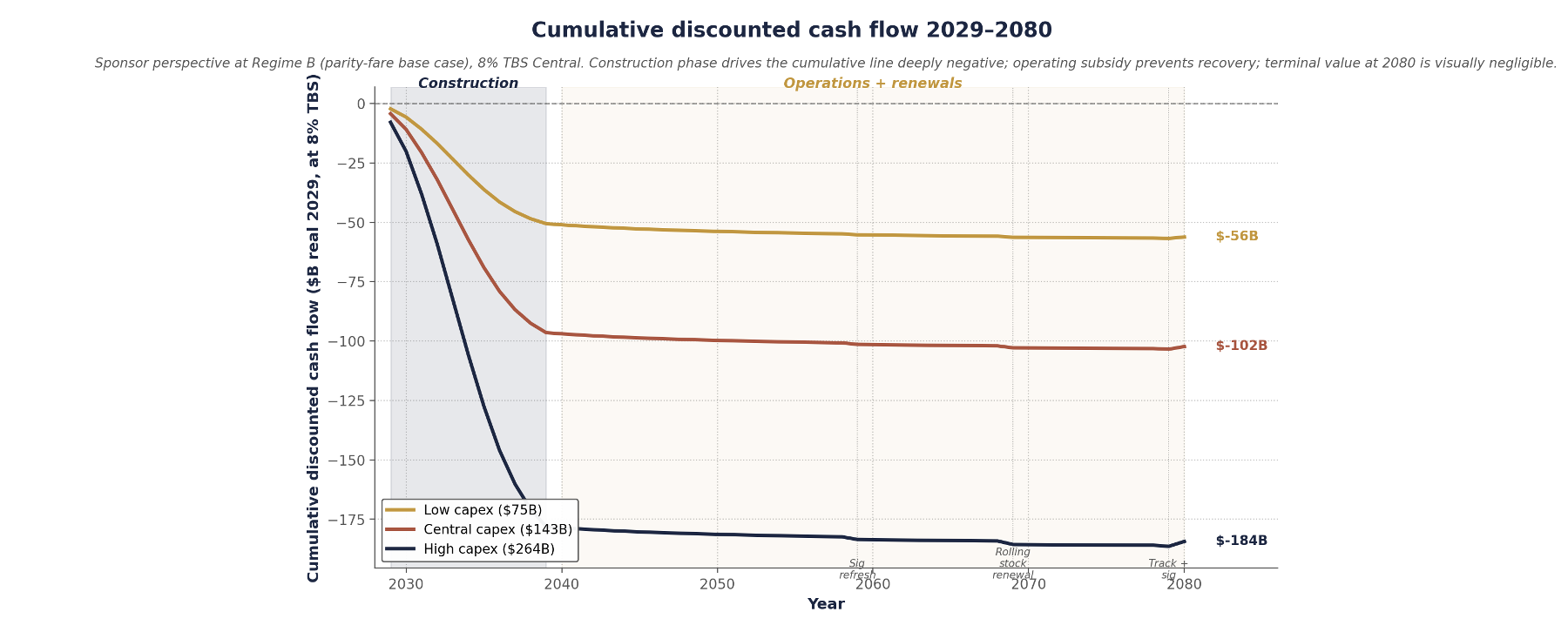
Across 36 combinations of capital-cost scenario, operating regime, and discount rate, ALTO produces a financial NPV between −$50 billion and −$246 billion in real 2029 CAD. At the Treasury Board central 8% rate and the welfare-efficient Regime B posture, NPV is −$56B at $75B capex, −$102B at $143B, and −$184B at $264B.
The benefit-cost ratio across the 9-cell capex×regime grid runs from 0.030 to 0.107 — every cell at least nine times below the 1.0 break-even threshold. Capital cost is the dominant driver; operating regime is second-order; the discount rate changes magnitudes but not the direction.
Executive Summary
This report evaluates financial and combined NPV over a 52-year horizon, integrating the engineering operating-cost build of the Cost-of-Running-the-Train work with the modal-shift subsidy frontier — a coupled analysis in which ridership, fare, operating cost, and operating subsidy are determined jointly along the corridor’s achievable frontier.
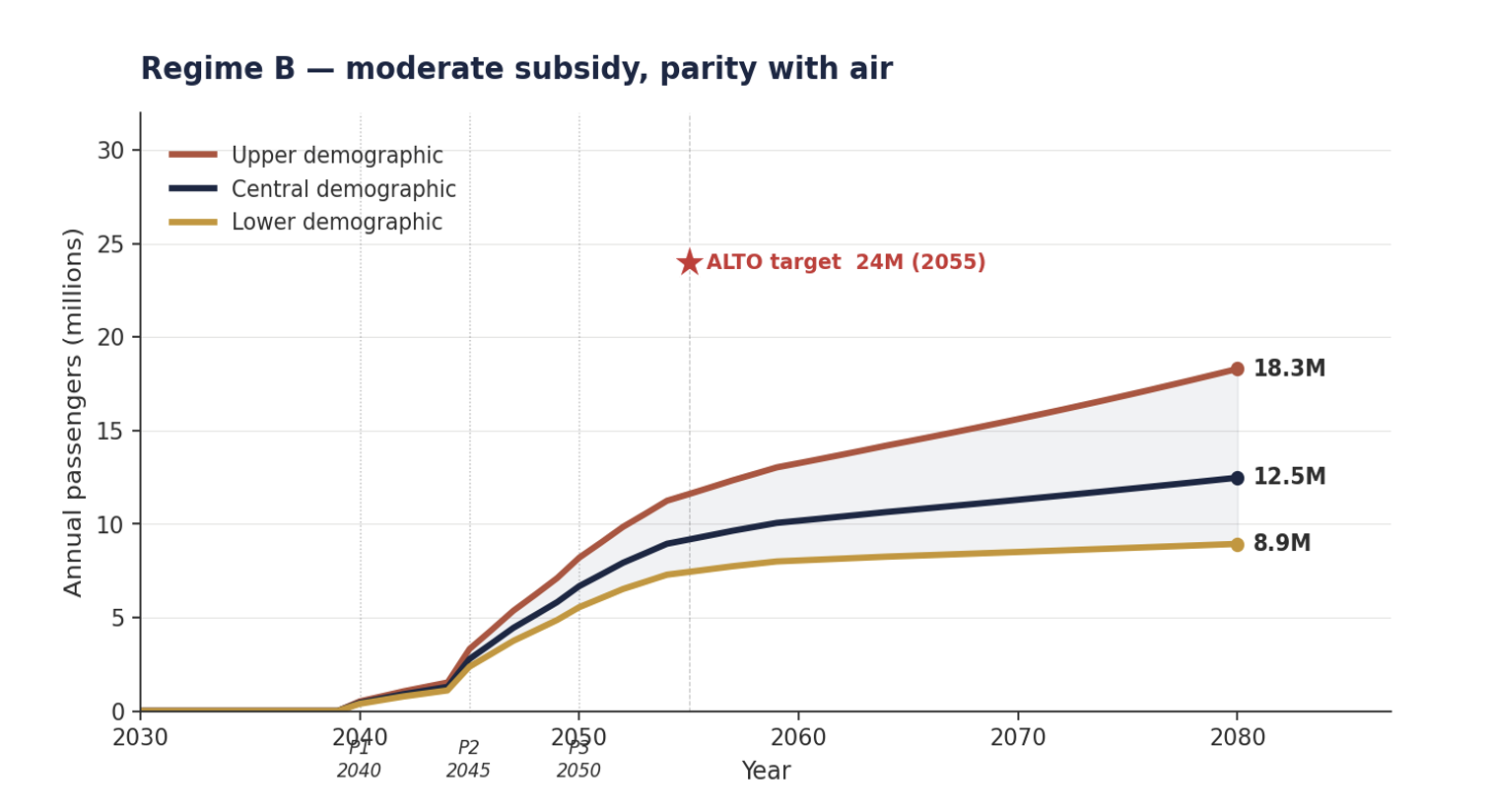
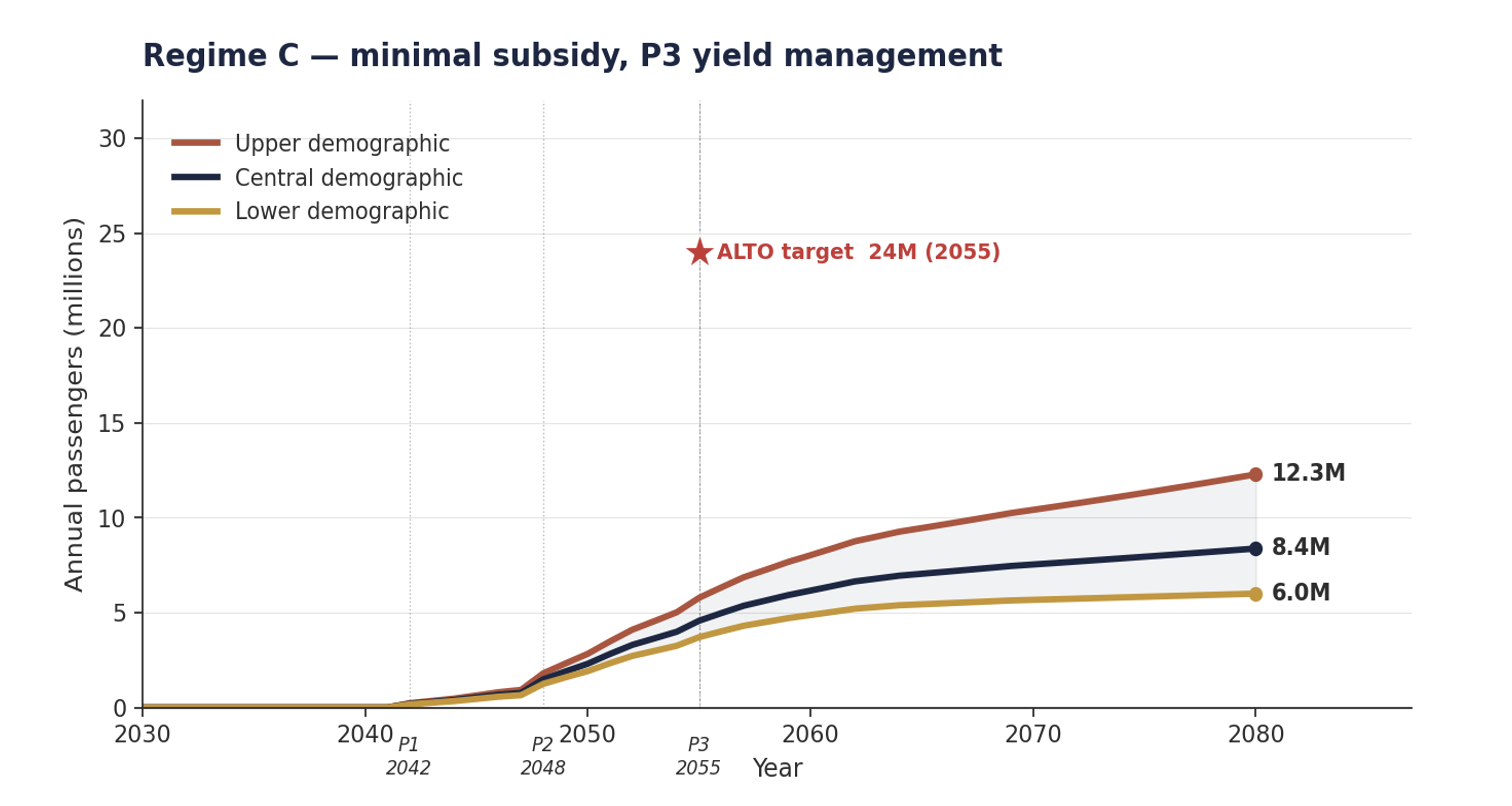
Three capital-cost scenarios bracket the plausible range: a low case at ALTO’s published $75B (~P2.5 of the reference class), a central case at $143B (the reference-class mean under Flyvbjerg’s overrun distribution), and a high case at $264B (the P97.5). Three operating regimes from the subsidy frontier set the achievable operating points: premium (Regime C, 6.1M pax), parity-with-air (Regime B, 8.2M, the revenue peak), and deep-discount (Regime A, 11.2M, near the modal-shift ceiling).
Cost-recovery break-even from fares alone sits at 117 trains/day, or 12.5 million annual passengers at the reference yield — above the modal-shift ceiling. All three regimes operate below it and require ongoing federal operating subsidy. The PV of that subsidy stream is structurally independent of capital cost ($4.6B at Regime C to $7.6B at Regime A at 8%). And the 24-million-by-2055 figure in ALTO’s public materials sits outside every operating point on the frontier and is not modellable under any defensible parameter combination.
Download
NPV Note 1 — NPV and BCR Projections for ALTO (PDF)
The full report with all six figures and nine tables: the three capital scenarios, the three operating regimes, the four discount-rate NPV tables, the operating-subsidy stream, the economic overlay, the benefit-cost grid, and the methodology and parameter appendices
This report presents an NPV analysis of ALTO over 2029–2080, in real 2029 Canadian dollars from the project-sponsor perspective, with a parallel economic overlay for passenger and external benefits. The objective is a defensible quantitative basis for evaluating the project against the standard Treasury Board cost-benefit framework.
The framework integrates two pieces of prior work. Annual operating cost is built from the lifecycle methodology of the operating-cost note — infrastructure maintenance, train operations, and fleet recapitalisation. Ridership, fare, and operating subsidy are determined jointly by the three operating regimes of the subsidy-frontier note, which establish the achievable points on the corridor’s modal-shift frontier. Capital cost is treated through reference-class forecasting, with three scenarios spanning the empirical distribution of cost outturns on comparable HSR megaprojects. Operations are assumed to commence in 2040 after an eleven-year construction period; cash flows include capex during construction, operating cost and ramped fare revenue, three lump-sum renewals at operating years 20/30/40, and a terminal residual at 2080.
−$102B
Financial NPV, base case ($143B capex × Regime B × 8%)
0.030–0.107
Benefit-cost ratio across the 9-cell grid — all ≥9× below break-even
~94%
Share of the negative present value driven by capital cost alone
2 · Capital Cost
Three scenarios from the reference class
Capital cost is the largest single quantity in the analysis and the dominant source of NPV uncertainty. Three scenarios span the plausible range, calibrated by reference-class forecasting on the international HSR cost database (log-normal, mulog = 4.963, sigmalog = 0.312).
Low — $75B
ALTO’s published figure (the centre of the $60–90B Fast Forward range). Sits at ~P2.5 of the reference class — a lower-tail estimate consistent with megaproject optimism bias. Predates the HFR→HSR scope expansion and carries no published contingency.
Central — $143B
The reference-class mean. Applying Flyvbjerg’s 44.7% average rail overrun to the baseline, plus ALTO’s engineering-complexity premium (composite 73–81), gives the modal outcome — the appropriate base case for procurement decisions.
High — $264B
The P97.5 — exceeded by ~1 HSR project in 40. Not a theoretical bound: HS2 Phase 1 (~+250%), California HSR (~+200%), and HSL-Zuid (228%) all approached it. The corridor’s geology and the Canadian P3 record make it a realistic case.
The three scenarios are not equally probable: under the calibrated distribution, the proponent’s figure has roughly a 2.5% chance of being achieved or undercut, the central scenario is the modal outcome, and the high scenario reflects upper-tail risk. Treating $75B as the planning case would require ALTO to be delivered with cost discipline materially better than every comparable international HSR megaproject — a claim for which no evidence has been adduced.
3 · Operating Regimes
Three points on the achievable frontier
The three operating regimes derive from the subsidy frontier. Each is an internally consistent point on the corridor’s achievable modal-shift frontier, with ridership, fare, revenue, and subsidy following from a single fare posture. No operating point produces high ridership at low subsidy.
Table 2. Operating regime parameters (central 2055 demographic anchor). Operating subsidy = max(0, operating cost − fare revenue). Mature values shown; in operating years 2040–2047 ridership and revenue ramp from 50% to 100% of mature values.
Parameter
Regime C — premium
Regime B — parity
Regime A — discount
Rail-to-air fare ratio
1.4
1.0
0.55
Average fare ($/trip)
$207
$157
$96
Mature ridership (M pax/yr)
6.1
8.2
11.2
Modal share captured
22%
30%
40%
Annual fare revenue ($M)
$1,260
$1,290
$1,080
Annual operating cost ($M)
$1,928
$2,116
$2,385
Annual operating subsidy ($M)
$668
$826
$1,305
Regime B is the welfare-efficient point under standard cost-benefit assumptions — simultaneously the revenue-maximising point and the per-rider welfare-efficient point. A profit-maximising private operator and a welfare-maximising public authority applying marginal analysis would converge on it, even if they would disagree on whether to operate the corridor at all. Regime A, at 11.2M, approaches the modal-shift ceiling of ~12M; pushing beyond would require corridor-external policy (highway tolls, fuel pricing, aviation limits). The 24-million figure sits above the ceiling — reaching it would require doubling modal share to ~80%, far below cost recovery, and is not modellable as a financial NPV.
4 · Operating Cost & Break-even
Why fares can’t cover cost
Annual operating cost follows the engineering build: $1,381M fixed (infrastructure maintenance $980M + fixed operating $221M + fleet recapitalisation annuity $180M) plus ~$26 per train-km variable, equivalent to $89.7M per million annual passengers at the 450-seat, 65% load-factor convention. Crucially, this cost is driven by service intensity, not by what the infrastructure cost to build — a $264B corridor running 80 trains/day costs essentially the same to operate as a $75B one.
Cost recovery from fares alone, at the reference yield of $0.20/passenger-km, requires approximately 117 trains per day — 12.5 million annual passengers. That threshold sits above the modal-shift ceiling of ~12M. All three regimes operate below it and therefore require ongoing federal operating subsidy.
Figure 1. Cost-recovery break-even and the three operating regimes. The navy cost line is the engineering build; the dashed terracotta line is reference-yield revenue, crossing cost at 117 trains/day (12.5M pax). The solid terracotta curve is the modal-shift revenue line, Laffer-peaked at ~$1.29B near Regime B and sitting below the reference line because the framework requires sub-reference fares to capture modal share. The vertical gap between each regime’s cost square and revenue diamond is the annual operating subsidy. The modal-shift revenue curve never crosses the cost curve at any achievable ridership — cost recovery from fares alone is unreachable, even at the deep-discount Regime A.
5 · Financial NPV
Strongly negative across all 36 cells
Financial NPV is strongly negative across all 36 combinations of capex scenario, operating regime, and discount rate. The base case — central capex × Regime B × 8% — is −$102.3B, of which the capital component accounts for ~94%.
Figure 2. Cumulative discounted cash flow, 2029–2080, sponsor perspective at the Regime B base case, 8% TBS Central. Construction 2029–2039 drives the cumulative line deeply negative under all three capex scenarios; operating subsidy outflows from 2040 prevent recovery, and the lines flatten toward their terminal NPV. The small dips mark the renewals at 2059/2069/2079; the terminal residual at 2080 gives a slight upward inflection. Final values are −$56B, −$102B, and −$184B at Low, Central, and High capex.
Table 3. Financial NPV at 8% TBS Central ($B real 2029). Figures in parentheses are negative. The grid is monotonically more negative moving down (capex rising) and weakly more negative moving across (regime premium→discount), reflecting that higher ridership produces both higher operating cost and higher operating subsidy.
Capital cost scenario
Regime C
Regime B
Regime A
Low — $75B
($55.4)
($56.2)
($58.5)
Central — $143B
($101.5)
($102.3)
($104.6)
High — $264B
($183.6)
($184.4)
($186.6)
Figure 3. Present value decomposition by capex scenario, Regime B, 8% TBS Central. PV of capital cost (navy) dominates the negative side at every level, growing from $51B at Low to $178B at High. PV of operating cost (terracotta) is identical across scenarios at $11.2B — structurally decoupled from construction outturn. On the benefit side, PV of fare revenue is $5.8B and capex-independent; the economic overlay is $0.76B. Benefits cover only ~6% of total costs at the central scenario.
The pattern holds across every discount rate. At 5% (HM Treasury Green Book) the base case is −$121.2B; at 3% (long-horizon Treasury), −$136.8B; at 10% (private-capital opportunity cost), −$92.4B. Lower rates produce more negative figures, because the cash-flow profile is dominated by front-loaded capex and operating-subsidy outflows rather than long-dated revenue. The full sensitivity tables are below.
Tables 4–6. Financial NPV at 5%, 3%, and 10% ($B real 2029), all three with the Central×Regime B base case marked. At no defensible discount rate does NPV approach break-even.
Discount rate & capex
Regime C
Regime B
Regime A
5% — Low $75B
($66.8)
($68.4)
($72.9)
5% — Central $143B
($119.6)
($121.2)
($125.6)
5% — High $264B
($213.4)
($215.0)
($219.5)
3% — Low $75B
($77.1)
($79.8)
($87.2)
3% — Central $143B
($134.1)
($136.8)
($144.2)
3% — High $264B
($235.6)
($238.2)
($245.7)
10% — Low $75B
($49.7)
($50.2)
($51.7)
10% — Central $143B
($91.9)
($92.4)
($93.9)
10% — High $264B
($167.0)
($167.5)
($169.0)
Figure 4. NPV sensitivity tornado — parameter swings from the base case (Central capex × Regime B × 8%, NPV −$102.3B). Gold bars improve NPV, terracotta bars worsen it. Capital cost dwarfs every other input, with a $130B swing across the Low–High range. Discount rate is next. All operating-side parameters combined — operating cost, fare yield, renewals, terminal value, yield erosion, and regime choice — produce swings of at most a few billion each, more than an order of magnitude below the capex effect.
6 · Operating Subsidy
Decoupled from capital cost
The PV of the operating-subsidy stream is structurally independent of capital cost under the engineering build — operating cost is driven by service intensity, not construction outturn. The same subsidy values apply at all three capex scenarios.
Table 7. PV of operating-subsidy stream by discount rate and regime ($B real 2029, 2040–2080). Subsidy is capex-independent — identical at all three capex scenarios. Corresponding mature annual subsidies: $668M (C), $826M (B), $1,305M (A).
Discount rate
Regime C
Regime B
Regime A
3% (long-horizon)
$14.2
$16.9
$24.3
5% (Green Book)
$8.7
$10.3
$14.7
8% (TBS Central)
$4.6
$5.4
$7.6
10% (private capital)
$3.1
$3.7
$5.2
The corridor would impose an ongoing federal operating contribution of roughly $700 million to $1.3 billion per year over four decades, on top of the federal share of capital service. Adding capital service (federal share 50%, 6% blended cost of capital, 40-year amortisation) of ~$2.5B/yr at Low, $4.8B at Central, and $8.8B at High, the full annual federal cost at Regime B ranges from ~$3.3B to ~$9.6B per year — a full-cost-per-rider of $405 to $1,171, five to fourteen times the federal value-of-time benefit per rider.
Figure 5. Annual federal cost commitment by capex scenario, Regime B mature operations — capital service (federal share 50%, 6% blended cost of capital, 40-year amortisation) stacked with the $0.83B/yr operating subsidy. Total federal cash commitment ranges from $3.32B/yr at the proponent capex to $9.60B/yr at the upper reference-class capex. Per rider at 8.2M annual passengers, $405 to $1,171 — five to fourteen times the federal value-of-time benefit per rider. Real 2029 dollars.
7 · Economic Overlay & BCR
An order of magnitude below break-even
The economic overlay adds five benefit categories (passenger time savings, modal-shift GHG, accident reduction, local externalities) and one cost (embodied construction carbon). It is small relative to the financial cash flow: even at Regime A, the largest overlay of $1.94B is ~1/50th of the central financial NPV. It does not move the directional finding.
Table 8. Economic overlay components at 8% TBS ($B PV). The embodied-carbon debit of $2.48B is regime-invariant — it depends on corridor characteristics, not operating posture. Regime C’s total is slightly negative because passenger benefits at 6.1M pax don’t offset it.
Component
Regime C
Regime B
Regime A
Passenger time savings
$1.28
$1.72
$2.35
Modal-shift GHG savings
$0.10
$0.14
$0.19
Embodied carbon (debit)
($2.48)
($2.48)
($2.48)
Accident reduction
$0.88
$1.18
$1.61
Local externalities
$0.15
$0.20
$0.27
Total economic overlay
($0.07)
$0.76
$1.94
Table 9. Benefit-cost ratio at 8% TBS Central. All values an order of magnitude below the 1.0 break-even threshold. Corner-to-corner range 0.030 (High×C) to 0.107 (Low×A). The capex axis explains >80% of the variation; the regime axis <20%.
Capital cost scenario
Regime C
Regime B
Regime A
Low — $75B
0.092
0.106
0.107
Central — $143B
0.053
0.061
0.062
High — $264B
0.030
0.035
0.036
The most favourable cell anywhere — Low capex × Regime A — requires conjoining ALTO’s own optimistic capex with the deep-discount posture that maximises ridership; neither half is publicly committed to. Under the central reference-class capex, the highest achievable BCR is 0.062, about one-sixteenth of break-even. For context, the Ontario provincial HSR study of 2016 rejected a comparable 300 km/h scope at a reported BCR of 0.70 — this analysis finds the ALTO option materially worse than the level at which Ontario rejected comparable scope a decade earlier.
8 · The 24-Million Problem
A target outside the frontier
The 24-million-by-2055 figure in ALTO’s public materials sits outside the achievable frontier. The modal-shift ceiling is ~12 million annual passengers — at Regime A, capturing 40% of the addressable market. Reaching 24 million would require doubling modal share to ~80%, which means fares well below cost recovery plus structural changes to the corridor’s competitive position against car and air that go beyond any operating posture.
Figure 6. ALTO’s public ridership target vs. the modal-shift achievable frontier. The three regimes (C 6.1M, B 8.2M, A 11.2M) occupy the frontier between ~5 and 12 million; the cost-recovery break-even at 12.5M sits just outside the ceiling. ALTO’s 24-million target sits ~11.5 million passengers — nearly twofold — beyond the ceiling. The gap is not bridgeable under the modal-shift framework: it would require ~80% modal share against air and road, for which there is no precedent in the international HSR record on a comparable corridor.
The 24-million figure is therefore not a defensible operating point and is not modellable as a financial NPV under the regime framework. Public communication that pairs the 24-million target with operating-cost or subsidy figures drawn from other points on the frontier is internally inconsistent — the corridor cannot simultaneously achieve 24-million ridership and the operating subsidy of any regime on the frontier.
9 · Conclusions
The viability question is a capex question
Negative across every combination
Financial NPV ranges from −$55B to −$187B at 8%; the central case is −$102B. BCR runs 0.030–0.107 — every cell at least nine times below break-even. The probability of positive NPV under any defensible scenario is negligible.
Capital cost dominates
Low→High capex swings NPV by ~$130B at 8%; Regime C→A swings it by only ~$3B. The choice of operating regime is second-order once capital is committed. The first-order question is whether to commit the capital.
Operating subsidy is decoupled
Operating cost is driven by service intensity, not construction outturn — a corridor running 80 trains/day costs the same to operate whether built at $75B or $264B. The subsidy stream can be planned independently of the capital outturn.
An HPR review is warranted
The single largest lever for project economics is cost containment, and the reference class gives no basis for assuming ALTO beats it. An independent review of the High Performance Rail alternative — a lower-capex configuration delivering comparable user benefits over the same corridor — is warranted before any corridor-selection decision.
Proceeding with ALTO at any defensible parameter combination would impose a significant net cost on Canadian public finances over the analysis horizon, even after accounting for non-financial passenger and environmental benefits. The High Performance Rail framework — 200 km/h electrified passenger rail along the Highway 401 corridor, using existing rail corridor rather than greenfield HSR construction — would not attract the same reference-class capital premium, and an independent review should compare the two on the same NPV framework, with HPR producing materially less negative NPV and materially higher BCR across every defensible parameter combination.
The procurement and cost-control decision is by far the most consequential single decision affecting the corridor’s financial outcome. The choice of operating regime is substantive for transport policy but does not move the financial NPV by more than a few per cent. The viability question is a capex question.
Download Full Report
NPV Note 1 — NPV and BCR Projections for ALTO (PDF)
Reference document with all six figures, nine tables, the full methodology, and the parameter and reference appendices
The analysis is conducted from the project-sponsor perspective in real 2029 CAD over 2029–2080 (period 0 = 2029), counting direct cash flows: capex, operating cost, renewals, fare revenue, and terminal residual. Capex is allocated across 2029–2039 on an eleven-year S-curve (3% in 2029, peaking at 13% in 2034–35, tapering to 6% in 2039). Three renewals are modelled — signalling at operating year 20 (4% of capex), rolling stock at year 30 (12%), combined track-and-signalling at year 40 (8%) — and a terminal residual at 2080 of 40% of capex. Demand ramps from 50% of mature ridership in 2040 to 100% by 2047; real fare yield erodes 0.5%/yr.
Operating cost follows the engineering build: $1,381M fixed plus $26/train-km variable (equivalently $89.7M per million annual passengers at 450 seats × 65% load factor × 1,000 km), calibrated against the California HSR 2024 Business Plan O&M model, SNCF Réseau and SNCF Voyageurs reports, ADIF AV accounts, and the UIC LICB series. Capital cost scenarios ($75B / $143B / $264B) come from Flyvbjerg reference-class forecasting on the international HSR cost database (log-normal, mulog = 4.963, sigmalog = 0.312) with corridor-specific complexity adjustments. The economic overlay uses 1.75 h saved per trip at $25/h, modal-shift GHG of 113 kt/yr at the Regime B baseline valued at $250/t, embodied construction carbon of 14.69 Mt, accident reduction at $30/pax, and local externalities at $5/pax; network and agglomeration effects are excluded. The analysis is deterministic across the 36-cell grid; a probabilistic overlay would refine the central tendency but not change the directional finding.
Sources
Principal sources
1.
Treasury Board of Canada Secretariat. Canada’s Cost-Benefit Analysis Guide for Regulatory Proposals (2022) and Policy on Cost-Benefit Analysis — social opportunity cost of capital as the central 8% discount rate.
2.
HM Treasury (UK). The Green Book: Central Government Guidance on Appraisal and Evaluation (2022) — the 5% reference for long-lived infrastructure. — and Boardman, Moore & Vining, “The Social Discount Rate for Canada,” Canadian Public Policy 36(3), 2010.
3.
Flyvbjerg, B., Holm, M.K. & Buhl, S.L. — reference-class forecasting and the rail-project cost-overrun record (mean ~44.7% overrun): JAPA 68(3), 2002; JAPA 71(2), 2005; and Megaprojects and Risk (Cambridge, 2003).
4.
California High-Speed Rail Authority. 2024 Business Plan: Operations and Maintenance Cost Model. — UIC Lasting Infrastructure Cost Benchmarking (LICB); ADIF AV Management Report 2022; SNCF Réseau and SNCF Voyageurs Rapport financier annuel 2024.
5.
Transport Canada. High-Speed Rail Initiative briefing materials, Section 08 (2025–2026). — ALTO Fast Forward (Cadence consortium, March 2025); ALTO Pre-Development Agreement (signed 19 March 2025).
6.
European Court of Auditors. A European high-speed rail network: not a reality but an ineffective patchwork. Special Report 19/2018.
Citizen Research Initiative · Modal Shift Analysis · Note 4
The Subsidy Frontier and the ALTO Operating Trilemma
High ridership and low subsidy are mutually exclusive on this corridor. A continuous-spectrum framework relating subsidy, fare revenue, ridership and net public cost — and the structural reason the published 24-million target sits outside every operating point on the frontier.
ALTO HSR Citizen Research Initiative · Modal Shift Note 4 · Published May 2026
⚠ What This Note Examines
This note extends Notes 1, 2 and 3 from three discrete regimes to a continuous subsidy spectrum, relating four quantities along it: annual operating subsidy, ridership, fare revenue, and net public cost. It identifies the welfare-efficient and revenue-maximising operating points, and adds full-cost accounting across three capital-cost scenarios.
The result is the corridor’s operating trilemma: high ridership, low subsidy, and P3 break-even cannot be achieved simultaneously. The choice among them is a single-degree-of-freedom political-economy decision — one that the published business case does not make explicit.
Bottom Line
The modal-shift framework from Notes 1 and 2, combined with the demographics of Note 3, produces a fixed frontier of (subsidy, ridership) combinations. The corridor cannot simultaneously deliver Regime A ridership (11–12 million) at Regime C subsidy levels ($0.5–1.5 billion/yr). Any public communication implying otherwise is selecting figures from different points on the frontier and presenting them as one outcome.
Ridership rises concavely with subsidy — from ~5M at $0.3B/yr to ~12M at $5B, hitting diminishing returns as it approaches the modal-shift ceiling. Revenue is hump-shaped, peaking at ~$1.29 billion at $1.9 billion subsidy. The marginal net public cost per added rider has a U-shaped minimum at ~$400/rider near Regime B. Different objectives select different optima: maximising revenue or minimising per-rider cost → Regime B; minimising total public cost → Regime C; maximising ridership under a fiscal cap → Regime A.
And the P3 break-even corner is structurally unreachable: against an achievable peak fare revenue of $1.29 billion, P3 break-even revenue is ~$4.3 to $5.0 billion — a gap of $3.17 billion/yr at peak revenue, even under the proponent’s own $75B capex base case. ALTO’s published 24-million-by-2055 target sits outside every point on the frontier and is incompatible with any defensible operating-regime choice.
The full note with all four figures and two tables: the trilemma, the ternary locus, the four-panel frontier, the scissors chart, the five optimisation objectives, and the full-cost accounting across three capital scenarios
The corridor faces three ideal objectives that cannot be reconciled: high ridership (at the level of ALTO’s public targets), low subsidy (operating surplus), and P3 break-even (revenue covering operating cost plus private capital service). Every point inside the realistic operating frontier is achievable under some combination of fare, subsidy and modal-shift parameters; every point outside it is structurally infeasible.
Figure 1. The ALTO operating trilemma. The dashed outer triangle marks the three ideal corners; the solid inner triangle is the realistic operating frontier. Regimes A and C approach their respective corners but cannot reach them; Regime B sits on the frontier edge, achieving the revenue peak. The P3 break-even corner is structurally unreachable: operating cost (~$1.8–2.5B/yr) plus private capital service ($2.49B/yr at the $75B base case) puts break-even revenue at ~$4.3–5.0B/yr, against an achievable peak of $1.29B at Regime B — a $3.17B/yr gap that operating-posture choice alone cannot close.Figure 2. The operating locus in objective space, ternary view. Each operating point is mapped to barycentric coordinates of its normalised achievement of the three objectives. Two features stand out: the locus is a one-dimensional curve, not a region — the corridor has only one operational degree of freedom (the subsidy level); and it tracks the low-subsidy ↔ high-ridership edge closely, never entering the P3 break-even wedge. The maximum P3 score along the locus is ~0.30 under the $75B base case. The trilemma is not three symmetric tradeoffs but a single dominant tradeoff (ridership ↔ subsidy) with P3 break-even as a structurally unreachable third axis.
1 · Framework
From three regimes to a continuous spectrum
Note 3 developed three discrete regimes — A (heavy subsidy), B (moderate, at parity with air), C (minimal, P3 yield management) — producing aggregate corridor modal shares of ~40, 30 and 22% and requiring annual operating subsidies of ~$3.5B, $2.0B and $1.0B. This note extends that to a continuous subsidy spectrum to identify the optimisation properties of the corridor’s operating posture.
The framework relates four quantities along the spectrum: annual subsidy (the federal operating contribution for the chosen fare posture), ridership (the resulting modal shift across air, road and existing rail), fare revenue (riders × average fare), and net public cost (subsidy minus revenue, negative meaning self-financing). Each is anchored on Note 3’s central demographic 2055 scenario (corridor population 20.1 million, addressable trips 34.2 million). The mapping from subsidy to fare ratio is a smooth logistic reproducing the three regime anchors — ~1.3 at $1.0B (deep premium), ~1.0 at $2.0B (parity), ~0.6 at $3.5B (deep discount) — and the mapping from fare ratio to per-mode capture comes directly from the Note 1 and Note 2 S-curves.
2 · The Frontier
Ridership, revenue, and net public cost vs subsidy
Disaggregating the relationships folded together in Note 3’s regime summary reveals the corridor’s subsidy frontier across the continuous spectrum, with the three regime anchors (C, B, A) marked.
Figure 3. The subsidy frontier at the central 2055 anchor. (a) Ridership rises concavely from ~5M at $0.3B to ~12M at $5B — diminishing returns toward the modal-shift ceiling. (b) Fare revenue peaks near $1.9B subsidy at ~$1.29B, then declines as fare cuts overwhelm ridership gains — a Laffer-like structure. (c) Net public cost crosses zero near $1.3B subsidy: below it the corridor runs a surplus, above it a net outlay rising to ~$4B at $5B subsidy. (d) Marginal net public cost per added rider has a U-shaped minimum of ~$400/rider near Regime B, rising to ~$1,000 at Regime A. The ~$85/rider reference line is an illustrative federal value-of-time figure.
Ridership is concave
The first dollars of subsidy buy many riders (the steep part of the S-curves); the last buy few (the saturating top). Marginal effectiveness falls sixfold — ~2.5M riders per $B at the low end, ~0.4M per $B at the high end.
Revenue is hump-shaped
At low subsidy the corridor is in the premium-fare zone where each rider pays more, so revenue rises with ridership; past the $1.29B peak, the fare reduction overwhelms the ridership gain.
Net cost flips at ~$1.3B
Net public cost transitions cleanly from negative (revenue exceeds subsidy) to positive at ~$1.3B subsidy — between the Regime C anchor ($1.0B) and Regime B ($2.0B).
3 · The Scissors
Revenue and subsidy versus ridership
Plotting the same data with ridership on the horizontal axis shows how subsidy and revenue diverge as the corridor moves up the ridership scale — and overlays the federal capital service ($2.49B/yr at the $75B base case), so each regime shows three quantities: operating subsidy, fare revenue, and full federal cost.
Figure 4. Subsidy and revenue against ridership, central 2055 anchor. The two curves form a scissors: subsidy (navy) rises convexly while revenue (terracotta) is essentially flat. At Regime C (6.1M riders) the corridor returns a ~$260M operating surplus — full federal cost ~$2.23B with capital service added. At Regime B (8.2M) it needs ~$710M net operating outlay — full federal cost ~$3.20B. At Regime A (11.2M), ~$2.42B net outlay — full federal cost ~$4.91B. Capital service exceeds operating subsidy at every regime, even under the proponent’s base case. The chart caps at the ~12M modal-shift ceiling; beyond it, each added rider requires sharply rising per-rider subsidy.
The scissors structure has direct policy implications. Below ~6.5 million annual passengers the corridor runs a net public revenue surplus — fare revenue exceeds the subsidy needed. Above that it crosses into net-public-cost territory, rising convexly with the target. By 11 million (near Regime A) the corridor needs ~$2.4 billion annually in net public outlay above its fare revenue. Beyond 11.5 million the curve steepens sharply — pushing toward the 24-million public target would require an entirely different operating regime than any of the three considered here.
4 · Optimisation
Five objectives, five different optima
The frontier supports several distinct optimisation objectives that each select a different operating posture. There is no single “optimal” point without first specifying the criterion.
Table 1. Optimal operating posture under different objective functions, central 2055 anchor. The five candidate optima span Regime C (minimum total public cost), Regime B (revenue peak, per-rider welfare efficiency), an intermediate position (total welfare under moderate social-value assumptions), and Regime A (maximum ridership). “Total welfare” includes ridership × value-of-time × emissions avoided − net public cost, and is strongly sensitive to the assumed social value per rider.
Objective
Optimal regime
Riders 2055
Subsidy
Revenue
Net public cost
Maximise fare revenue
Regime B (parity)
~8M
$1.9–2.0B
$1.29B (peak)
+$0.7B
Min. net cost per rider
Regime B (parity)
~8M
$1.9–2.0B
$1.29B
$400 marginal
Min. total net cost
Regime C (yield mgmt)
~6M
$0.5–1.5B
$1.26B
+$0.2B or surplus
Max. ridership s.t. cap
Regime A (heavy)
~11M+
$3.5B+
$1.08B
+$2.4B
Max. total welfare
Between B and A
~9M
$2.5B
$1.2B
+$1.3B
Four observations follow. Revenue-maximisation and per-rider welfare-efficiency converge on Regime B — not coincidentally, since the same marginal-revenue-equals-marginal-cost condition defines both the Laffer peak and the marginal-cost-per-rider minimum. Minimum-total-net-public-cost points to Regime C or below, where the corridor runs a small surplus but carries only 5–6 million riders — approximately the posture implied by the Cadence consortium’s announced commercial structure. Ridership-maximisation under a fiscal cap points to Regime A or beyond — but reaching the 24-million target would require pushing past Regime A into subsidy well above $5B/yr and modal share above the 40% ceiling, not feasible under the modal-shift framework. And total-welfare-maximisation is strongly sensitive to the assumed social value per rider: at the illustrative ~$85/rider federal value the optimum is at or below Regime C; only at a high $400/rider — crediting network effects, large emissions externalities, and agglomeration benefits — does it move between B and A.
There is no single “optimal” operating posture without specifying the criterion. The corridor decision is not one quantitative question but three sequential ones: whether to build at all, what fare posture to operate under, and how to communicate the chosen posture transparently.
5 · Full-Cost Accounting
Capital service dominates the operating choice
The subsidy frontier above considers operating subsidy only — but capital cost service dominates the corridor’s total fiscal commitment, and the capital cost itself is deeply uncertain. ALTO’s materials cite ~$60–90 billion, prepared without reference-class adjustment. The CRI’s reference-class analysis (Flyvbjerg methodology on the international HSR cost database, with corridor-specific complexity premia) produces three scenario points: $75B as the proponent-stated P50, $143B as the reference-class-adjusted P50 (after the 44.7% average rail-project overrun), and $264B as the P95 worst case — with the proponent’s $75B sitting at roughly the 25th percentile of the distribution.
Table 2. Full federal cost implications across three capital cost scenarios. Full annual federal cost = federal share of capital debt service + Regime B operating subsidy of $2.0B/yr (the welfare-efficient point). Full cost per rider = full federal cost ÷ 8M annual riders (Regime B central 2055). Debt service at 6% blended cost of capital, 40-year amortisation, 50% federal share.
Capital cost scenario
Total capital
Annual debt service
Federal share (50%)
Full annual federal cost
Full cost / rider
ALTO proponent-stated
$75B
$4.5B
$2.3B
$4.3B
$540
CRI reference-class central
$143B
$8.6B
$4.3B
$6.3B
$790
CRI P95 worst-case
$264B
$15.8B
$7.9B
$9.9B
$1,240
Capital dominates operating
Even at $75B, federal capital service ($2.3B/yr) exceeds Regime B’s operating subsidy ($2.0B). At $143B it’s more than double; at $264B, ~four times. The full-cost optimisation is dominated by the capital assumption, not the operating regime.
6 to 14× the benefit
Full cost per rider spans $540–$1,240. Against an illustrative ~$85/rider value-of-time, the corridor is 6 to 14× more expensive than the public benefit. Even generous $200–250/rider social values stay 2–6× below full cost.
Decide before committing
Once the capital is sunk, the A/B/C choice is second-order. The first-order question — whether to build at all — turns on which capital scenario materialises, and the realistic expected value sits between $143B and $264B.
ALTO’s composite engineering complexity score is 73–81 (upper part of the High band, approaching Extreme) — the Frontenac Arch crossing, the Napanee Limestone Plain karst, the Leda clay segment, the St-Lawrence crossing, and a Canadian P3 delivery record that includes Eglinton Crosstown (+280%), the Confederation Line (+57%), and the Ontario Line (+250% scope-adjusted). Under Flyvbjerg reference-class forecasting, a corridor at this complexity cannot be reliably costed from the lower-complexity international comparators the proponent’s estimate appears to draw on. The realistic expected capital cost is between $143B and $264B, producing a benefit-cost ratio materially below 1.0 across the full plausible range.
6 · Implications
What this means for the corridor decision
The subsidy choice is a policy decision, not a technical one
The same physical infrastructure produces materially different outcomes depending on the operating point. Regime C gives ~6M riders at a small surplus; Regime A gives 11M at $2.4B net public cost. That choice should be made explicit in the public business case rather than implicit in the procurement structure.
The welfare-efficient point sits near Regime B
Parity with air, ~$1.9–2.0B operating subsidy, ~8M riders, ~$400/rider marginal net public cost — also the revenue-maximising point. A welfare-maximising government and a revenue-maximising operator would converge on similar fares. The business case does not specify which objective is being applied.
Third, and most important: the public ridership targets cannot be reached from any operating point on the frontier developed here. The 24-million-by-2055 figure would require modal share above the 40% ceiling under heavy subsidy, plus upper-case demographic growth, plus full-corridor mature operation in 2055 — three conditions the modal-shift literature does not support simultaneously. The frontier brackets the realistic operating space; ALTO’s published targets sit outside it. An independent review should ask which point on the frontier the corridor is actually targeting, and what fiscal commitment and modal-shift assumptions that point implies.
High ridership, low subsidy, and P3 break-even cannot be achieved at once. The 24-million target is not the welfare-efficient operating point under any reasonable parameter choice — it is achievable, if at all, only under heroic assumptions about every operating, demographic, and modal-shift variable simultaneously.
The framework anchors on Note 3’s central demographic 2055 scenario (corridor population 20.1 million, addressable trips 34.2 million at 1.7 trips per capita) with the regime-coupled phase-maturity factor (Regime C ≈ 0.80, B ≈ 0.88, A ≈ 0.94, following a smooth logistic asymptoting to ≈ 0.96). The market structure is air 15%, existing rail 10%, road 75% of the addressable pool. The mapping from operating subsidy S ($B) to fare ratio r is a logistic, r(S) = 0.4 + 1.3 / (1 + exp(S − 1.8)), calibrated to the three regime anchors; the mapping from fare ratio to per-mode capture comes from the Note 1 air–rail S-curve at 3.0 h and the Note 2 road–rail S-curve at τ = 0.5. Average air fare $160 one-way; rail revenue = riders × (air fare × r). Net public cost = subsidy − revenue.
Capital cost scenarios ($75B / $143B / $264B) are derived from Flyvbjerg reference-class forecasting on the international HSR cost database with corridor-specific complexity adjustments (composite engineering complexity score 73–81). Capital service is computed at 6% blended cost of capital (combining federal debt service and private equity return), 40-year amortisation, 50% federal share. The CRI’s full capital cost analysis is documented separately at citizenresearch.ca.
ALTO HSR Citizen Research Initiative (2026). ALTO ridership envelope, 2035–2080 (Note 3) — the population, trip-generation and regime inputs this note’s frontier is built on.
4.
Statistics Canada (2026). Population Projections for Canada (2025 to 2075), catalogue 17-20-0003, released 27 January 2026.
5.
Transport Canada (2024). Guide to Benefit-Cost Analysis of Transportation Investments — value-of-time and emissions valuation parameters. — and Treasury Board of Canada Secretariat (2007). Canadian Cost-Benefit Analysis Guide: Regulatory Proposals.
6.
Flyvbjerg, B., Holm, M.S. & Buhl, S. — reference-class forecasting and the international rail-project cost-overrun database (44.7% average overrun).
7.
ALTO HSR Citizen Research Initiative companion material: the Modal Shift & Ridership synthesis brief, which sets this note alongside Notes 1, 2 and 3.
Citizen Research Initiative · Modal Shift Analysis · Note 3
The Ridership Envelope for the ALTO Corridor, 2035–2080
What can the corridor actually carry? Population times trips-per-resident times modal share, scaled by a realistic phased opening — and measured against ALTO’s published 24-million target and every other independent forecast.
ALTO HSR Citizen Research Initiative · Modal Shift Note 3 · Published May 2026
⚠ What This Note Examines
This note builds a 45-year ridership envelope from three multiplicands — corridor population, per-capita intercity trips, and ALTO’s modal share under three fare-and-subsidy regimes — using the modal-shift machinery from the two companion notes on rail–air and rail–car substitution, and scaling the result by ALTO’s announced three-phase opening.
The resulting envelope is then compared against ALTO’s published forecasts, the McGill TRAM stated-preference projection, the Munk School GEPL model, the C.D. Howe scenario analysis, and the federal government’s own 2021 Joint Project Office business case.
Summary
The corridor population baseline is about 14.9 million across the directly-served CMAs in 2025. The 2024–25 federal cap on non-permanent residents produced a structural inflection — Toronto’s CMA shrank by ~1,000 people in 2024–25 after gaining 269,000 the year before — creating a credible lower trajectory (0.5%/yr) that did not exist in pre-2024 forecasts and bounding the upper trajectory (1.6%/yr) below pre-2024 expectations.
Three regimes span the policy envelope: heavy subsidy ($2.5–4.5B/yr, ~38–42% capture), moderate subsidy at parity with air ($1.5–2.5B/yr, ~28–32% — the canonical business-case configuration), and minimal subsidy under P3 yield management ($0.5–1.5B/yr, ~20–23%). The combined envelope at mature operation runs from 6.1 to 25.7 million by 2080, central case 12.5 million. The 2055 reading — ALTO’s headline year — is 3.7 to 17.2 million, central case 9.2 million; the corridor is not yet at mature operation in 2055 under the announced phasing.
ALTO’s published 24-million-by-2055 figure sits ~40% above the upper bound for 2055 and is incompatible with the announced phasing under any plausible ramp curve. Every forecast built from a disclosed methodology — TRAM, Munk GEPL, the federal JPO — sits within or close to the CRI envelope. ALTO’s published targets are the outlier against every other forecast for the corridor.
Download
Modal Shift Note 3 — Ridership Envelope Research Note (PDF)
The full note with all figures and tables: the population trajectories, the three regimes, the phasing and ramp framework, the 2035–2080 envelope, and the comparison with every published forecast
ALTO’s annual ridership in any year is the product of three quantities: the corridor population served, the average number of intercity trips each resident makes per year across air, rail and car, and ALTO’s share of those trips. Forecasting ridership therefore means forecasting each multiplicand and combining their realistic ranges into an envelope of outcomes.
The two companion notes supply the modal-share machinery. Note 1 derives the air-substitution S-curve and locates the corridor’s three rail scenarios on it at travel time and price. Note 2 extends the framework to road–rail under a North American calibration anchored on VIA’s 13% rail share against road, and develops the price-ratio, group-size, gas-price and reliability sensitivities. What the two notes do not provide is the population denominator that converts share into absolute volume, the per-capita trip generation that scales the market with demographic change, the temporal phasing that distinguishes opening-year from mature ridership, and the explicit fare-and-subsidy regimes. This note adds those four pieces.
Ridership = corridor population × intercity trips per capita × ALTO modal share, scaled by ramp-up. Each multiplicand has a defensible range. The envelope combines them.
2 · Population
The baseline and the 2024 demographic break
ALTO directly serves CMAs from Toronto to Québec City. The 2025 baseline is about 14.9 million — Toronto (7.10M), Montréal (4.62M), Ottawa-Gatineau (1.55M), Québec City (0.86M), plus the smaller served centres (~0.8M combined).
The 2024–25 demographic year produced a structural inflection. The federal Immigration Levels Plan announced in October 2024 was the first to cap temporary residents, requiring a multi-year drawdown. The effect on the two largest CMAs was immediate: Toronto’s CMA shrank by ~1,000 people in 2024–25, following a gain of 269,000 the year before, and Greater Golden Horseshoe growth collapsed from ~313,000/yr to ~40,000. This is a structural break from the baseline pre-2024 forecasts assumed — it invalidates the linear extrapolation of the 2022–24 surge.
Table 1. Three population trajectories for the directly-served corridor CMAs, anchored on the 2025 baseline of ~14.9M. The central trajectory is the working assumption for the envelope; the upper and lower trajectories define the population-side bounds. Anchored on StatCan’s January 2026 projections (LG / M1 / HG scenarios) with a ~0.4-point corridor-CMA growth premium.
Trajectory
Annual growth
2050
2080
Driver
Lower
0.5%
16.9M
19.6M
NPR drawdown is structural; aging accelerates
Central
1.0%
19.1M
25.7M
NPR drawdown is one-off; immigration normalises
Upper
1.6%
22.2M
35.6M
Pre-2024 pace partly resumes after political cycle
Figure 1. Corridor population trajectories, 2025–2080, comparing pre-2024 (dashed) and post-2024 (solid) demographic assumptions on the same axis. The dashed lines represent the population input comparable published forecasts used; the solid lines reflect the 2024 federal cap and the StatCan data released January 2026. By 2080 the gap is striking — ~50M vs 35.6M (upper), 33.8M vs 25.7M (central), 23.1M vs 19.6M (lower). The post-2024 upper trajectory sits below the pre-2024 central across much of the horizon. Roughly 15 to 25% of the gap between the CRI envelope and the other forecasts is attributable to this single demographic correction alone.
The trajectories are anchored on Statistics Canada’s official projections (released 27 January 2026), with a ~0.4-point corridor-CMA growth premium reflecting the directly-served CMAs’ historically faster growth — population-weighted ~1.8%/yr over 2000–2025 against the national 1.23%, moderated for Quebec’s projected demographic-weight decline and the Western redirection of interprovincial migration. The 0.4-point premium is a deliberately conservative reading, chosen so the envelope is not vulnerable to the argument that it underweights the corridor’s growth advantage.
3 · Trip Generation
Per-capita intercity trips
The three principal pairs together carry ~19.9 million annual person-trips across air, rail and car (Note 2). Adding the secondary pairs and intermediate-station traffic brings the addressable market to about 25 million annual person-trips — against a 2025 population of 14.9 million, a per-capita rate of about 1.68 trips per resident per year.
Over a 45-year horizon, competing effects roughly cancel. Hybrid work has structurally reduced corridor business travel below the pre-pandemic baseline, and AI-mediated meetings continue to erode marginal demand for in-person business travel — the literature consistently finds business travel adjusts more elastically to communication technology than leisure travel does. On the supporting side, urbanisation, economic concentration into the corridor, and rising affluence in the secondary centres lift demand. The net effect is roughly stable to mildly declining; this note uses a range of 1.6 to 1.8 trips per capita, central case ~1.7.
4 · Modal Share by Regime
Three fare-and-subsidy regimes
ALTO’s share of the addressable market is the third multiplicand — and the dimension on which the corridor decision turns most directly. The aggregate share is a weighted blend across air, current rail and car markets on the three principal pairs, with realistic group composition (a mix of solo, couple and family travellers) rather than the solo-traveller readings that anchor the time-and-price geometry.
A
Heavy operating subsidy — low fares
Fares at VIA-equivalent levels (rail-to-air ratio 0.4–0.5; per-person rail-to-car ~1.0 solo), capital absorbed into the public account. Annual subsidy $2.5–4.5 billion. Captures ~85% of the air market, ~100% of existing VIA demand, ~22% of the rail+car market on a group-weighted basis. Aggregate share: ~38–42%.
B
Moderate subsidy — parity with air (canonical)
Fares at parity with air (rail-to-air ratio ~1.0; per-person rail-to-car ~2.0–2.4 solo). Annual subsidy $1.5–2.5 billion. Captures ~70% of air, ~95% of existing VIA demand, ~9–11% of rail+car. Aggregate share: ~28–32%. This is the configuration under which the 24-million headline is implicitly framed.
C
Minimal subsidy — P3 yield management
Fares above air parity (rail-to-air ratio 1.1–1.4; per-person rail-to-car 3–4 solo, above 12 for a family of four). Annual subsidy $0.5–1.5 billion — still positive, because the fully self-funded P3 model is not survivable arithmetic at any modal share consistent with the framework. Captures ~50% of air, ~80% of existing VIA demand, ~4% of rail+car. Aggregate share: ~20–23%.
Table 2. Three fare-and-subsidy regimes, with implied modal capture and aggregate share of corridor person-trips. The factor-of-two range across regimes operates independently of the infrastructure choice — the same physical asset produces double or half the ridership depending on the fare-and-subsidy decision. No regime delivers self-funding at any modal share consistent with the framework.
Regime
Fare structure
Annual subsidy
Air capture
Car capture
Aggregate share
A — Heavy
T–Mtl ~$80–130; rair ≈ 0.4–0.5
$2.5–4.5B/yr
~85%
~22%
38–42%
B — Moderate
T–Mtl ~$150–220; rair ≈ 0.9–1.0
$1.5–2.5B/yr
~70%
~9–11%
28–32%
C — Minimal
T–Mtl ~$220–350+; rair ≈ 1.1–1.4
$0.5–1.5B/yr
~50%
~4%
20–23%
5 · Phasing & Ramp
Opening-year is not mature-year
Ridership in any specific year depends on three timing variables: the construction schedule, the segment opening sequence, and the ramp curve on each opened segment. The 2026–2034 period is consumed by consultation, environmental assessment, expropriation, design, P3 negotiation and enabling works — none of it revenue service. Canadian P3 megaproject experience (Eglinton Crosstown, Confederation Line, Ontario Line) suggests timelines slip rather than compress; the earliest plausible phased opening is ~2038, central scenario closer to 2040.
Phase 1 — Montréal–Ottawa
Opens first: shortest (~190 km), simplest engineering, but the smallest pair. Serves only the Ottawa–Montréal demand pool (~20% of corridor) — it cannot draw Toronto flows because Toronto isn’t connected yet. Early-year ridership is structurally small.
Phase 2 — Toronto extension
The demand inflection point. Adds ~450 km and unlocks Toronto–Ottawa and Toronto–Montréal — ~60% of corridor demand. Cumulative Phase 1+2 coverage is ~80%: the full Toronto–Ottawa–Montréal triangle. Plausible window 2042–2046.
Phase 3 — Québec City extension
The most schedule-vulnerable: the St-Lawrence crossing, Leda clay risk, an unsettled routing, and an unresolved federal-provincial cost-share with Québec. Adds the final ~20%. Window 2047–2052, with a credible permanently-deferred scenario.
The ramp curve in the North American context is meaningfully slower than European comparators. Madrid–Barcelona took ~4 years to decisively overtake the air bridge, under conditions far more favourable to rail than ALTO faces; Brightline Miami–Orlando remains in financial ramp-up with bond ratings downgraded to CCC+. The envelope is calibrated against the Brightline profile for the lower and central cases and Madrid–Barcelona for the upper case.
Table 3. Ramp factors applied to each opened segment — the fraction of that segment’s mature ridership realised in each year post-opening. Regime C (yield management) ramps slowest; Regime A (low fares) fastest. Applied separately to each phase, with each segment’s clock starting from its own opening year.
Years post-opening
Lower (Regime C)
Central (Regime B)
Upper (Regime A)
Year 1
15%
25%
35%
Year 3
35%
50%
65%
Year 5
55%
70%
80%
Year 8
75%
85%
92%
Year 10+
90%
95%
100%
Table 4. Phase opening schedule by scenario. The fare-and-subsidy regime correlates with delivery pace: heavily-funded projects face political pressure for early openings and federal cost-overrun absorption removes renegotiation friction; lean P3 structures slip. Phase 3 moves most widely because of the St-Lawrence crossing and the Québec cost-share. Defensible bounds extend each year by ±2–3.
Scenario
Regime
Phase 1 (Mtl–Ott)
Phase 2 (Ott–Tor)
Phase 3 (Mtl–QC)
Lower
C — minimal
2042
2048
2055
Central
B — moderate
2040
2045
2050
Upper
A — heavy
2038
2042
2046
Under the central scenario, the corridor is at ~29% of mature potential in 2045, ~65% in 2050, and ~88% in 2055 — genuine full-corridor maturity is not reached until around 2060. ALTO’s 24-million-by-2055 figure is incompatible with the announced phasing under any plausible ramp curve: the corridor cannot be mature in 2055 if Phase 3 only opens in 2050. If Phase 3 is permanently deferred but Phases 1–2 complete, mature ridership is ~4.9 to 20.5 million across regimes — the more credible of the downside readings given Québec’s negotiating position.
6 · The Envelope
Ridership, 2035–2080
Combining population, trip generation, regime and phasing produces the envelope below. The lower bound combines Regime C with the lower population trajectory and 1.6 trips/capita; the central case combines Regime B with the central trajectory and 1.7; the upper bound combines Regime A with the upper trajectory and 1.8 — each paired with its corresponding ramp curve and opening schedule.
9.2M
CRI central case at 2055 (Regime B)
3.7–17.2M
Full 2055 envelope across regimes and demographics
24M
ALTO’s published 2055 target — ~40% above the upper bound
Table 5. ALTO annual ridership envelope, 2035–2080, in millions, with the three-phase opening sequence and ramp applied. Lower: Regime C × lower population × 1.6 trips/cap. Central: Regime B × central × 1.7. Upper: Regime A × upper × 1.8. The 2040 figures reflect Phase 1 alone; 2045 reflects Phase 2 just opening; 2050 reflects Phase 3 just opening. Full-corridor maturity is reached around 2060, not 2055.
Year
Status
Lower (M)
Central (M)
Upper (M)
2035
Construction; no revenue service
0
0
0
2040
Phase 1 (Mtl–Ott) opening years
0
0.4
1.8
2045
Phase 1 maturing; Phase 2 opens
0.5
2.8
9.2
2050
Phase 1+2 maturing; Phase 3 opens
1.9
6.7
14.8
2055
Phase 1+2 mature; Phase 3 ramping
3.7
9.2
17.2
2060
All phases near-mature plus growth
4.8
10.2
18.7
2070
Mature plus sustained growth
5.8
11.3
21.9
2080
Mature plus full forecast growth
6.1
12.5
25.7
Figures 2a–2c plot the year-by-year trajectory under each regime separately. Within each figure, the three lines are the demographic trajectories; the spread within a figure shows demographic uncertainty, and the spread across the figures shows the fare-and-subsidy choice — a policy decision, not an infrastructure one. The 24-million target is marked on each as a reference.
Figure 2a. Regime A (heavy subsidy, VIA-equivalent fares, $2.5–4.5B/yr). Aggregate share 38–42%. Phase openings 2038/2042/2046. The 2055 readings are 11.0 / 13.6 / 17.2M; the 2080 readings 12.5 / 17.5 / 25.7M. Even the most favourable combination — Regime A with upper demographic growth — leaves the 24M target ~40% above the trajectory at 2055.Figure 2b. Regime B (moderate subsidy, parity with air, $1.5–2.5B/yr) — the canonical configuration under which the published business case is implicitly framed. Aggregate share 28–32%. Phase openings 2040/2045/2050. The 2055 readings are 7.4 / 9.2 / 11.6M; the 2080 readings 8.9 / 12.5 / 18.3M. The target sits above the achievable range by a factor of ~2.1 to 3.2 at 2055.Figure 2c. Regime C (minimal subsidy, P3 yield management, fares above air parity, $0.5–1.5B/yr) — the configuration most consistent with the consortium’s announced commercial structure. Aggregate share 20–23%. Phase openings 2042/2048/2055. The 2055 readings are 3.7 / 4.6 / 5.8M; the 2080 readings 6.1 / 8.5 / 12.4M. Even the upper demographic falls below the McGill TRAM projection at 2055.
Three patterns emerge. The regime choice (a policy lever) shifts 2080 central ridership by a factor of ~2 — 17.5M (A), 12.5M (B), 8.5M (C). The demographic choice shifts it by another factor of ~2 — 12.5M (lower) to 25.7M (upper) under Regime A. And the 24-million target sits above every plausible 2055 trajectory in every figure: the closest reading, Regime A with upper growth, produces 17.2M — 28% below the target. Reaching 24M by 2055 requires the most favourable regime, a demographic trajectory above the upper case, and a corridor fully mature by 2055 — three conditions that cannot all hold under the announced phasing. The Regime A upper trajectory does reach the 24M neighbourhood — but a full quarter-century later, in 2080.
7 · Comparison
ALTO’s target is the outlier
The CRI envelope can be placed alongside the other published forecasts for the same corridor. The pattern is unambiguous: every forecast built from a disclosed methodology clusters near the CRI envelope, and ALTO’s public targets stand alone above all of them.
Table 6. Published and modelled ridership forecasts for the corridor. Not strictly comparable across columns — ALTO’s 2055 figure assumes full-corridor completion well before 2055; the Munk GEPL figures are Toronto–Montréal scaled to a corridor equivalent; C.D. Howe applies sensitivity analysis to VIA’s forecasts; the JPO 2021 figure is for the predecessor HFR 177 km/h spec. The pattern is robust: every disclosed-methodology forecast sits within or close to the upper end of the CRI envelope, and well below the ALTO public targets.
Source
Method
By 2050
By 2055
By ~2080–85
ALTO public targets
Not disclosed
—
24M (2055)
43M (2084)
ALTO Corporate Plan
Treasury Board filing (incl. Local Services)
—
17M (2059)
—
McGill TRAM
Stated-preference survey, n ≈ 8,300
10.5M
—
~19.7M (yr 50)
Munk School GEPL
Disclosed logit with induced demand
~16–17M
~18–19M
—
C.D. Howe
Scenario analysis on VIA’s forecasts
12–21M
—
—
Federal JPO 2021
Pre-procurement business case (HFR spec)
~13.5M
—
—
Flyvbjerg adjustment
ALTO −65% reference class
—
8.4M (from 24M)
15M (from 43M)
CRI envelope
Modal-shift × population × regime
1.9 / 6.7 / 14.8
3.7 / 9.2 / 17.2
6.1 / 12.5 / 25.7
The dispersion among the disclosed-methodology forecasts is narrow — TRAM at 10.5M by 2050, Munk GEPL at 16–17M corridor-equivalent, the JPO 2021 at 13.5M, and C.D. Howe’s 12–21M range all sit in the same zone. The CRI central case sits on the conservative side of this cluster; the CRI upper bound sits centrally within it. The dispersion between the cluster and ALTO’s public targets, by contrast, is wide: the 24-million figure is ~40% above the CRI upper bound for that year, more than double the TRAM number, and 14% above the top of the C.D. Howe range. Notably, ALTO’s own Corporate Plan figure of 17M by 2059 — filed with Treasury Board — is ~30% below its public 24M figure and closer to the CRI upper bound; the reconciliation of the two ALTO figures is not publicly disclosed.
Every forecast for the corridor built from a disclosed methodology — TRAM survey, Munk GEPL logit, federal JPO business case — sits within or close to the CRI envelope. ALTO’s 24-million public target sits 40 per cent above the upper bound at 2055 and is the outlier in the published literature.
8 · Why the Gap
Why the CRI envelope sits below the cluster
The CRI central case sits below the disclosed-methodology cluster, and its upper bound sits centrally within it. This is not a forecasting error in those studies — they were built for different purposes, finalised on different timelines, and applied different assumptions where the modal-shift literature offers latitude. Six factors account for the bulk of the divergence, in roughly descending order of impact.
1. The 2024 demographic inflection is post-cutoff for every other forecast
The single largest source. Every published forecast was finalised before the federal NPR caps produced observable effects. The January 2026 StatCan data was not available to any of them. ~15–25% of the gap, before any other consideration.
2. North-American modal-shift recalibration
The comparators use European-anchored elasticities. Note 2 recalibrates the rail–car curve against VIA’s ~13% road share, shifting the inflection from τ₀ = 0.65 to 0.46. ~15–25% of the gap, largest on the road-substitutable share.
3. Explicit phased opening
The CRI envelope models each phase’s own opening date and ramp; the comparators assume an implicit step-change to maturity. ~30–40% of the gap at the 2050–2055 horizon specifically, converging by 2070–2080.
4. Group-composition weighting
Family and 3+ travel essentially cannot be captured by rail at any defensible fare. Most models use an average traveller; the CRI weights across realistic solo/couple/family proportions. ~5–15% of the gap, largest on the car-substitutable share.
5. Canadian P3 vs European open-access pricing
Madrid–Barcelona’s gains came from open-access competition (25–50% fare cuts). The Cadence monopoly concession, with Air Canada’s equity stake, eliminates that mechanism. ~10–20% of the gap, largest on the lower-end scenarios.
6. Bottom-up vs top-down or stated-preference
ALTO’s targets are top-down (subject to the Flyvbjerg ~65% optimism bias); TRAM is stated-preference (overstates realised behaviour). The CRI is built bottom-up from observed VIA shares. ~5–15% of the gap, operating as a multiplier on the rest.
Taken together, the six factors are not independent surprises pushing the same way — they are mostly visible to the other forecasts too, but each embedded different assumptions where the literature offers latitude. The CRI envelope’s central case sits below the cluster because it applies all six defensible positions at once; its upper bound, by construction, relaxes the unfavourable end of each while staying internally consistent, and sits centrally within the cluster. By 2080, when the demographic, phasing and ramp factors have all played out, the CRI upper bound of 20.7M sits in the centre of the published cluster’s mature-state range. None of the comparators is wrong; each answers a different question. The CRI envelope answers a sixth: what realised annual ridership is consistent with current empirical evidence, the announced phasing, and the modal-shift literature applied to the Canadian context.
Download Full Note
Modal Shift Note 3 — Ridership Envelope Research Note (PDF)
Reference document with the full framework, all six tables, the four figures, and the complete source list
Statistics Canada (27 January 2026). Population projections for Canada (catalogue 17-20-0003; dashboard 71-607-X-2022015), LG / M1 / HG scenarios. — and the 2024–25 demographic estimates and the federal Immigration Levels Plan (October 2024) cap on non-permanent residents.
2.
El-Geneidy, A. et al. — Transportation Research at McGill (TRAM), stated-preference corridor projection (March 2026), n ≈ 8,300. tram.mcgill.ca
3.
Munk School Global Economic Policy Lab, University of Toronto — disclosed logit corridor model with induced demand.
4.
Jones & Fariha (February 2025). All Aboard. C.D. Howe Institute scenario analysis. cdhowe.org
5.
Federal Joint Project Office (2021) pre-procurement business case (HFR 177 km/h specification), released through Access to Information, November 2025.
6.
Flyvbjerg, B., Holm, M.S. & Buhl, S. — meta-analysis of rail-project ridership forecast accuracy (mean ~65% overstatement).
7.
VIA Rail Canada Annual Report 2023; corridor person-trip volumes and modal shares as developed in Note 2, Table 1. — and Brightline Florida (2024–2026) ridership reports and KBRA bond rating actions; Madrid–Barcelona AVE ramp and open-access pricing record.
8.
ALTO public communications (the Imbleau / Fast Forward 24- and 43-million figures) and the ALTO Corporate Plan filed with Treasury Board (17M by 2059, including Local Services).
What the published 24-million target implies for how many travellers must abandon air and car for the train — and what the modal-shift evidence, the demographic baseline, and the operating-subsidy frontier say is actually reachable on the corridor.
ALTO HSR Citizen Research Initiative · Modal Shift & Ridership Brief · Published May 2026
⚠ What This Brief Synthesises
This brief draws together four CRI research notes — on rail–air substitution (Note 1), rail–car substitution (Note 2), the ALTO ridership envelope (Note 3), and the operating-subsidy frontier (Note 4) — into a single test of one number: ALTO’s published target of 24 million annual passengers by 2055.
Each note is built from the same starting point as the proponent’s own forecasts, but corrected for two things older studies omit: the North-American calibration of modal-shift behaviour, and the 2024 federal cap on non-permanent residents that broke the corridor’s demographic trajectory.
Headline Finding
ALTO’s published target of 24 million annual passengers by 2055 sits 2.6× above the CRI central case of 9.2 million, and is incompatible with every other independent forecast for the corridor.
The gap is not a matter of optimism versus pessimism. Reaching 24M requires a modal share above the ceiling the modal-shift curves allow in a North-American setting; it assumes a population trajectory the federal government’s own immigration policy has already foreclosed; and pushing ridership toward the target through deeply discounted fares drives operating subsidy past $5 billion a year. The target fails three independent feasibility tests at once.
Download
ALTO Ridership Against the Modal-Shift Evidence — Full Slide Deck (PDF)
Seven slides synthesising the modal-shift S-curves, the price families, the 2055 ridership envelope, and the three-test verdict on the 24-million target
Note 4The operating-subsidy frontier — the trilemma of ridership, subsidy and P3 break-even, and why 24M sits off the frontier
The Question
How many people would actually have to switch?
A ridership target is, underneath, a claim about behaviour. To carry 24 million passengers a year, the corridor must persuade a very large share of the people now flying or driving between Toronto, Ottawa, Montreal and Quebec City to take the train instead. That share — the modal shift — is the quantity every forecast turns on, and it is the quantity this brief examines first.
Modal shift is not a free parameter. Decades of evidence from operating high-speed lines show it follows a predictable shape: rail captures most of the market on short, fast journeys and loses it on long ones, with a sharp transition in between. The question for ALTO is not whether modal shift happens — it plainly does — but how high the curve can realistically reach on this corridor, in this country, at the fares the project would have to charge.
Three forces set that ceiling: the journey-time geometry against air, the harder competition against the car in a North-American setting, and the price the traveller actually faces. The notes treat each in turn before combining them into a ridership envelope and testing the 24-million figure against it.
Note 1 · Rail vs Air
Modal shift versus air follows a logistic S-curve
Against air, rail’s market share is governed almost entirely by station-to-station journey time. The relationship is a logistic S-curve: below about two hours rail dominates, between two and four hours the two modes compete and infrastructure quality is decisive, and beyond about five hours rail share collapses to only the price-sensitive or rail-loyal traveller. The inflection point — where rail and air split the market evenly — sits at roughly 3.5 hours.
< 2 h
Rail dominates — near-full capture of the rail+air market
2–4 h
Competitive zone — 60–80% rail share, infrastructure decisive
> 5 h
Rail share collapses — only price-sensitive or rail-loyal travellers
This is not theory. The world’s operating high-speed lines trace the same curve, and they are the empirical anchors the note is calibrated against:
Paris–Lyon (TGV): rail share rose from 40% to 72% after high-speed service opened.
Madrid–Barcelona (AVE): roughly 75% rail share at a 2 h 30 min journey time.
Madrid–Seville: rail share rose from 16% to 52%.
Beijing–Shanghai: 1,318 km covered in 4 h 18 min, rail-dominant despite the distance.
For ALTO, the implication is straightforward: the air-substitution share the corridor can win is bounded by where each city-pair sits on this curve. Pairs that fall inside the two-to-four-hour competitive zone can deliver strong rail capture; pairs that fall outside it cannot, regardless of how the target is set.
Note 2 · Rail vs Car
Modal shift versus the car is harder in North America
The car is the larger and more stubborn competitor, and here the North-American context shifts the whole curve against rail. The note re-calibrates the rail-vs-car S-curve on VIA Rail’s observed performance — a rail share of roughly 13% against road — and finds the inflection point moves sharply left: from τ = 0.65 in the European setting to τ = 0.46 in the North-American one, a 19-point shift.
Why North America shifts the curve
Toll-free highways run the 401/A20 corridor end to end. Fuel taxes are roughly one-third of European levels. There is no congestion charging anywhere in Canada. And family-car economics are decisive: per-person car cost divides among the occupants, while rail charges per ticket.
What this does to predicted share
The same corridor that would capture a healthy rail share in Europe captures materially less here. The gap between the European and North-American readings is the single largest correction separating the CRI work from the older forecasts.
Carried through to the ALTO city-pairs, the North-American calibration produces predicted rail shares of the rail+car market that sit well below the European equivalents:
ALTO Toronto–Ottawa (τ ≈ 0.44): about 51% North-American versus 67% European.
ALTO Toronto–Montreal (τ ≈ 0.56): about 41% North-American versus 58% European.
HPR on both pairs (τ ≈ 0.65–0.67): about 33% North-American versus 50% European.
The lesson is that a forecast borrowed from European experience — as the older studies effectively are — systematically overstates how much of the road market the corridor can win. The car does not behave here the way it behaves there.
Notes 1 & 2 · Price
Price shifts the whole modal-shift curve
Journey time fixes the shape of the S-curve; price selects which curve in the family the corridor actually sits on. The relevant variable is the fare-to-comparator price ratio (r) — rail’s price relative to the air fare or the per-person car cost it competes with. A lower ratio lifts the entire curve; a higher ratio depresses it.
Elasticity differs by mode
Road–rail substitution is more price-sensitive than air–rail (γ = 1.5 versus 1.0). Travellers deciding between train and car respond more sharply to fare changes than those choosing between train and plane.
Group travel hurts rail
Per-person car cost divides among the occupants; rail charges per ticket. A family of four therefore faces an effective price ratio roughly four times higher than a solo traveller — pushing them down the curve toward the car.
The note maps three fare regimes onto the curve family. Regime A (r ≈ 0.55) is deeply discounted, lifting share but requiring heavy subsidy. Regime B (r ≈ 1.0) sets fares at parity with air. Regime C (r ≈ 1.4) prices above the comparator. Each selects a different curve — and, as Note 4 shows, a different point on the subsidy frontier. The crucial consequence is that the high-share outcomes the 24-million target needs are only available at the discounted end, where the fares no longer cover the cost of carrying the passenger.
Note 3 · The Ridership Envelope
The 2055 envelope is 3.7 to 17.2 million
Combining the modal-shift ceiling with the corridor’s demographics produces a ridership envelope, not a single number. The framework is deliberately transparent: ridership = population × per-capita trips × modal share × ramp-up. Each input is drawn from published data and stated openly.
9.2M
CRI central case at 2055, Regime B (fares at parity with air)
3.7–17.2M
Full 2055 ridership envelope across regimes and demographic paths
24M
ALTO’s published target — 2.6× the central case
The demographic inputs are post-2024 and this is where the CRI analysis departs most sharply from the others. The corridor population is 14.9 million (2025), residents make about 1.68 intercity trips each, and StatCan’s low / medium / high growth scenarios run at 0.5% / 1.0% / 1.6% per year. Critically, these trajectories reflect the 2024 federal cap on non-permanent residents — a structural break the older forecasts predate.
Under Regime B, the central reading is 9.2 million in 2055, rising to a central 12.5 million by 2080 within an 8.9–18.3 million envelope. ALTO’s 24-million target sits above the top of the 2055 envelope entirely — not at its optimistic edge, but beyond it.
Regime B ridership envelope, 2030–2080. The central demographic path reaches 9.2M in 2055 and 12.5M in 2080; the ALTO target of 24M (2055) sits above the upper bound of the envelope. Figure from Note 3 — Ridership envelope for the ALTO corridor.
Note 3 · The Comparison
The 24M target is the outlier
Set against the independent literature, the pattern is unambiguous: every other forecast clusters near the CRI central case, and the 24-million target stands alone above all of them. The reason the CRI figure sits lower than the academic studies is not methodological pessimism — it is one correction the others have not made.
The immigration inflection
The 2024–25 federal cap on non-permanent residents broke the corridor’s demographic trajectory, lowering the central forecast relative to pre-2024 expectations. Only the CRI analysis incorporates the NPR cap.
Pre-cap demographics elsewhere
All the independent forecasts — including the 2025 McGill and C.D. Howe studies — rest on pre-2024 population assumptions. They model a population surge that federal policy has since foreclosed.
Structural travel decline
Hybrid work and AI-mediated meetings structurally reduce corridor business travel below the pre-2020 baseline — a head-wind absent from the older forecasts entirely.
In other words, the daylight between ALTO’s target and the independent consensus is not a disagreement about how good high-speed rail is. It is the difference between forecasts built on a demographic future that is no longer the official plan and a forecast built on the one that is.
The Verdict
The 24-million target fails three independent feasibility tests
Each note tests the target from a different direction. The target does not fail one of them narrowly — it fails all three, and each failure is sufficient on its own.
1
Modal-shift framework
Reaching 24M requires a modal share above the 40 per cent ceiling implied by the North-American-calibrated S-curves in Notes 1 and 2. Even ALTO’s heaviest-subsidy regime, with deeply discounted fares, plateaus near 11–12 million annual riders at the modal-shift ceiling.
2
Demographic baseline
The 2024 federal Immigration Levels Plan capped non-permanent residents, producing a structural break in corridor population growth. Pre-2024 forecasts assumed continued surge; post-2024 trajectories are materially lower. 15–25 per cent of the gap to ALTO is demographic alone.
3
Subsidy frontier
Pushing past Regime A toward 24M requires operating subsidy above $5 billion per year, with full federal cost approaching $7 billion per year under the proponent’s own $75B capex base case — outside any defensible operating-regime choice on the corridor.
Side by Side
Three tests, one number
Read together, the three tests converge from independent premises on the same conclusion. They are not three versions of one argument; they are three different constraints, each of which the target violates.
Modal-shift ceiling
Limit:~40% share ceiling (NA-calibrated)
Reaches:~11–12M even at heaviest subsidy
vs 24M?Falls short by half
Demographic baseline
Limit:Post-2024 NPR cap; 0.5–1.6%/yr growth
Reaches:9.2M central; 3.7–17.2M envelope
vs 24M?Above the upper bound
Subsidy frontier
Limit:Defensible operating regimes (A–C)
Reaches:24M needs >$5B/yr operating subsidy
vs 24M?Outside any defensible regime
The convergence is the point. A target that merely sat at the optimistic edge of one analysis could be defended as ambition. A target that exceeds the modal-shift ceiling, sits above the demographic envelope, and requires an indefensible operating subsidy is not ambitious — it is, on the evidence of all four notes, 2.6× above what the corridor can carry.
For the next federal statement
Three questions to ask
Where the next federal or proponent statement on ALTO ridership is concerned — whether in a business case, a consultation report, or a public communication — three questions follow directly from the notes.
On modal share: What rail share of the rail+air and rail+car markets does the 24-million target assume on each city-pair, and is that share calibrated on North-American or European travel behaviour?
On demographics: Does the ridership forecast incorporate the 2024 federal cap on non-permanent residents, or does it rest on pre-2024 population assumptions that the cap has since superseded?
On subsidy: At the fare level required to reach the target, what is the projected annual operating subsidy — and how does it compare with the $5 billion-plus the subsidy frontier implies under the proponent’s own capex base case?
None of these questions presupposes opposition to passenger rail, which is a widely shared public good. Each asks only that the project reconcile its headline number with the same evidence base — modal-shift behaviour, the demographic baseline, and the operating economics — that every other forecast for the corridor is built on.
Download Full Deck
ALTO Ridership Against the Modal-Shift Evidence (PDF)
Reference deck for federal decision-makers, parliamentarians, journalists, and residents along the corridor
As of May 2026, ALTO’s public ridership figure is 24 million annual passengers by 2055. The independent evidence base — modal-shift behaviour calibrated to North America, a demographic baseline corrected for the 2024 immigration cap, and an operating-subsidy frontier built from the proponent’s own cost figures — places the corridor’s central case at 9.2 million. The two numbers are not a matter of optimism versus caution. The lower one incorporates evidence the higher one omits, and only the higher one has been put to the public.
Sources
Underlying notes and references
1.
Note 1 — Modal shift between high-speed rail and air on the ALTO corridor. ALTO HSR Citizen Research Initiative. Source of the logistic rail–air S-curve, the 3.5-hour inflection, the short-haul / competitive-zone / long-haul thresholds, and the Paris–Lyon, Madrid–Barcelona, Madrid–Seville and Beijing–Shanghai empirical anchors.
2.
Note 2 — Modal shift between rail and car on the ALTO corridor. ALTO HSR Citizen Research Initiative. Source of the North-American-calibrated rail–car S-curve anchored on VIA Rail’s ~13% road share, the inflection shift from τ = 0.65 (EU) to τ = 0.46 (NA), and the predicted rail shares for the Toronto–Ottawa, Toronto–Montreal and HPR city-pairs.
3.
Note 3 — Ridership envelope for the ALTO corridor, 2035–2080. ALTO HSR Citizen Research Initiative. Source of the ridership framework (population × per-capita trips × modal share × ramp-up), the post-2024 demographic inputs reflecting the federal NPR cap, the 9.2M central case, and the 3.7–17.2M envelope.
4.
Note 4 — Operating-subsidy frontier for the ALTO corridor. ALTO HSR Citizen Research Initiative. Source of the Regime A/B/C fare mapping, the subsidy frontier corrected to be operating-cost-consistent, and the >$5B/yr operating subsidy (~$7B/yr full federal cost) implied by pushing ridership toward 24M under the $75B capex base case.
5.
El-Geneidy, A., et al. Transportation Research at McGill (TRAM), McGill University (2025). Independent corridor ridership forecast built on pre-2024 population assumptions. tram.mcgill.ca
6.
C.D. Howe Institute (2025). Independent assessment of the high-speed rail corridor, using pre-2024 demographic inputs. cdhowe.org
7.
Statistics Canada — population projections (low-growth / medium / high-growth scenarios) and the corridor population base; and the 2024 Immigration Levels Plan establishing the cap on non-permanent residents. statcan.gc.ca
8.
ALTO HSR Citizen Research Initiative companion briefs: Reading the Answer (cost, ridership and subsidy claims) and The Report That Vanished. This brief is intended to be read alongside them.
Citizen Research Initiative · Modal Shift Analysis · Note 2
Modal Shift Between Rail and Car on the ALTO Corridor
The car competes with rail at every distance, costs are weighed on fuel rather than full economics, and a full car of four tilts the comparison decisively toward driving. Why North American road–rail substitution is structurally harder — and how much of it ALTO’s speed actually buys.
ALTO HSR Citizen Research Initiative · Modal Shift Note 2 · Published May 2026
⚠ What This Note Examines
This note applies the evidence on rail–car substitution to the two principal corridor pairs — Toronto–Ottawa and Toronto–Montréal — in the North American context, comparing current VIA Rail, a High Performance Rail (HPR) alternative at 200 km/h, and ALTO at 300+ km/h.
The road–rail comparison differs structurally from the rail–air analysis in Note 1: the car carries no fixed access penalty, perceived driving cost is dominated by fuel rather than full lifecycle cost, group travel decisively favours the car, and modal choice is more responsive to price than to time.
Summary
The right competitive variable is not absolute rail time but the ratio τ of rail time to car drive time: τ = 0.5 means rail takes half as long as driving, τ = 1.0 means equal time. Because car drive time scales with distance, the same τ implies the same competitive geometry on any route length.
The corridor’s road-substitutable demand is far larger than its air-substitutable demand — highway flow on the 401 between Toronto, Kingston, Ottawa and Montréal is several times the corridor’s annual air person-trips. Three structural features make North-American competition harder than European comparators: the 401/A20 is toll-free end-to-end, there is no congestion charging anywhere in Canada, and per-person car cost divides among occupants while rail charges per ticket. A family of four faces a per-person rail-to-car price ratio four times higher than a solo traveller.
Under canonical conditions — solo traveller, current Canadian gas prices, near-parity pricing — on a North-American–calibrated curve anchored on VIA’s ~13% rail share, the model predicts ALTO captures about 51% of the rail+car market on Toronto–Ottawa and 41% on Toronto–Montréal; HPR captures about 33% on both. European-equivalent upper bounds — readings that would apply only if North American transport policy shifted toward European fuel taxes, tolls and station-area land use — are 67% and 58% for ALTO and around 50% for HPR.
Download
Modal Shift Note 2 — Road–Rail Research Note (PDF)
The full 26-page note with all eleven figures, the European and North-American calibrations, the group-size and gas-price levers, the reliability analysis, and the methodology and sources
The literature on rail–car substitution differs sharply from the rail–air literature. The car carries no fixed time penalty equivalent to airport access, security and downtown-airport transit; parked at origin and arriving at destination, it has near-zero access cost on both ends, and its line-haul time degrades only slightly across the 100–1,000 km range. The result is that car competes against rail at every distance — including short-haul corridors where rail would dominate the air comparison.
The right measure is therefore not absolute rail journey time but the ratio of rail time to car time. Defining τ = (rail time) ÷ (car drive time at 100 km/h) gives a distance-invariant measure of rail’s advantage: τ = 0.5 means rail takes half as long as driving; τ = 1.0 means equal time; τ > 1.0 means rail is slower. A 3-hour rail journey on a 540 km route (τ = 0.56) is competitively equivalent to a 1.5-hour journey on a 270 km route. This is the key structural difference from the rail-vs-air analysis, where rail’s fixed advantage at the access stage means absolute time is what matters.
Figure 1. Modal-shift S-curve for rail–car substitution, plotting rail’s predicted share of the combined rail+car market against the time ratio τ = (rail journey time) ÷ (car drive time at 100 km/h). Logistic curve fitted with inflection at τ = 0.65 (rail captures 50% at price parity when ~35% faster than driving). Three zones: rail decisively faster (τ < 0.5); the competitive zone (0.5 < τ < 1.0); and rail slower than driving (τ > 1.0). Calibrated against the TGV Paris–Lyon pre/post comparison.
The European calibration in Figure 1 represents what rail can achieve under conditions that favour modal shift — high fuel taxes, congestion charging, dense feeder transit, central stations, and a cultural baseline of rail use. North American conditions are systematically less favourable, and the same τ produces lower rail shares.
Figure 1b. North-American–calibrated S-curve, anchored on current VIA Rail service (~13% rail share of the rail+car market at τ ≈ 1.0). The faded grey dashed curve is the European calibration from Figure 1. Inflection shifts left from τ = 0.65 to τ = 0.46: under North American conditions, rail must be ~54% faster than driving — rather than 35% — to capture half the market at parity. Equivalent to a constant utility penalty α ≈ 0.67 reflecting toll-free highways, low fuel taxes, free parking, dispersed land use, weak feeder transit, and a cultural autonomy preference.
Read together, Figures 1 and 1b bracket the realistic range. The European curve represents what is achievable in principle if rail-favourable conditions were created; the NA curve gives what is achievable under prevailing structural conditions. The remainder of this note uses the NA calibration, with European-equivalent figures quoted alongside where the comparison is informative. The gap between them is policy-relevant: roughly 10 to 15 percentage points of modal share depend not on which infrastructure is built but on whether the broader transport-policy environment supports modal shift.
Empirical anchors and the North American context
The Paris–Lyon TGV cut journey time from ~4 hours to under 2 and lifted rail’s share against road from ~30% to ~67% — a 37-point shift. Madrid–Barcelona AVE and Tokyo–Osaka Shinkansen deliver comparable shares against parallel highways. But all operate under conditions the corridor does not share. North America carries none of these reinforcements: the 401/A20 is toll-free end-to-end, Canadian fuel taxes are roughly one-third of European levels, there is no congestion charging in any Canadian city, and land use at both ends is car-oriented. The cross-elasticity literature confirms rail and car barely substitute — a 10% rise in fuel prices produces only a 1 to 4% rise in transit ridership.
Rail’s competitive position against the car turns on the time ratio τ, not absolute journey time. The North American absence of tolls, congestion charges, and high fuel taxes means realised modal share will likely sit substantially below the European-anchored model’s predictions.
2 · Price
Elasticity, group size, and perceived cost
The road–rail price comparison differs from rail–air in three ways: the elasticity of substitution is higher, the per-person ratio depends decisively on group size, and the cost of driving travellers actually weigh is the perceived cost (mostly fuel), not the full economic cost. The same logit form applies, but with a larger price coefficient (γ = 1.5 against 1.0 for rail–air), reflecting own-price elasticities of −1.0 to −1.6 for leisure demand against −0.4 to −0.7 for business.
European price family
Figure 2a shows the curve family at six price ratios under the European calibration. The wide range (0.5 to 8.0) reflects that group travel can drive the per-person ratio well above 5 even at parity-pricing intentions, since car cost divides among occupants while rail fare does not.
North American price family
Figure 2b applies the same six ratios under the NA calibration (τ₀ = 0.46). Each curve sits 15 to 20 points below its European counterpart at every τ. This family drives the corridor predictions in the rest of the note.
Figure 2a. Family of road–rail S-curves at six rail-to-car-per-person price ratios (r = rail fare ÷ car cost per person), European calibration. The middle navy curve at r = 1.0 is price parity. The family spans 0.5 to 8.0, reflecting that group travel can push the per-person ratio well above 5.Figure 2b. The same six ratios under the North American calibration (τ₀ = 0.46). Each curve sits 15 to 20 points below its European counterpart. This family is used throughout the rest of the note.
Perceived versus full cost of driving
Drivers compare rail fare against the perceived cost of driving, not the full economic cost. On Toronto–Montréal, one-way fuel for a typical car (9.4 L/100 km at ~$1.65/L) is about $84; the full economic cost — depreciation, insurance, maintenance — is more than three times that, around $300. But fixed costs are not perceived at the moment of choice; the car is owned regardless. A VIA Economy fare of ~$80 against perceived car cost of $84 produces a price ratio near 1.0 for a solo traveller. Against full cost the same fare would imply a ratio of 0.27 — and would predict a far larger rail share than the corridor actually carries, the empirical tell that perceived cost is the right input.
The group-size effect
Cars carry one to four passengers at a single fuel cost; rail charges per ticket. The per-person rail-to-car ratio is therefore ~1.0 for a solo traveller, 1.9 for a couple, 2.9 for three, and 3.8 for a full car of four. Family travel and any leisure trip with two or more travellers structurally favours the car — a multiplier with no analogue in the rail–air comparison. At parity pricing, ALTO’s Toronto–Ottawa share drops from ~51% solo to ~12% for a family of four; on Toronto–Montréal from 41% to 8%.
Gas price as a modal-shift lever
Because perceived car cost is dominated by fuel, the price ratio is sensitive to gas prices in a way the air comparison is not. A swing from $1.30 to $2.00/L — well within historic range — moves the solo Toronto–Montréal ratio from 1.21 to 0.79. Carbon pricing and fuel-tax policy are levers on rail modal share that operate as strongly as line-haul speed, at much lower capital cost.
Group-size effects can suppress predicted rail share by 75 to 90 per cent; gas-price swings can move it by 10 to 20 percentage points. These dimensions matter as much as infrastructure choice.
3 · Travel Time on the Corridor
Where the corridor sits on the curve
The same two principal pairs carry the bulk of rail-substitutable demand, but the absolute road flow is very large. The 401 between Toronto, Kingston, Ottawa and Montréal carries tens of millions of person-trips a year — several times the corridor’s air person-trips. Even a small percentage shift represents a meaningful absolute volume.
Table 1. Approximate annual person-trip volumes (both directions) by mode on each principal pair, and resulting current modal shares. Order-of-magnitude estimates (±25% air/rail, ±30% car). Bus volumes excluded for clarity.
City pair
Air
Rail (VIA)
Car
Rail share of rail+air
Rail share of rail+car
Toronto–Montréal
~1.9 M
~800 K
~6 M
~30%
~13%
Toronto–Ottawa
~0.9 M
~800 K
~4.5 M
~47%
~14%
Ottawa–Montréal
~0.45 M
~525 K
~4 M
~54%
~12%
Three observations follow. The road-substitutable market dwarfs the air-substitutable market on every pair — car volumes are three to ten times rail+air combined. Current rail-vs-air shares are already meaningful (~30% on Toronto–Montréal, ~half on the shorter pairs), but rail-vs-car shares sit in the 12 to 14% range across all three. And the structural similarity of road–rail shares despite very different distances confirms the τ-normalisation: current VIA service produces τ values close to 1.0 on every pair.
Table 2. Approximate segment-level travel times for car (driving on 401/A20, no congestion) alongside rail under three scenarios. *Toronto–Montréal under current VIA runs 5 h 13 min on the 538 km direct routing; the parallel car drive is ~5 h 30 min.
City pair
Distance
Car (401)
VIA current
HPR (200 km/h)
ALTO (300+ km/h)
Toronto–Ottawa
~450 km
~4 h 30 min
~4 h 30 min
~2 h 55 min
~2 h
Toronto–Montréal
~540 km
~5 h 30 min
5 h 13 min*
~3 h 38 min
~3 h
Ottawa–Montréal
~190 km
~2 h
~1 h 55 min
~1 h 30 min
~1 h
Figure 3. Modal-shift progression for Toronto–Montréal under the three rail scenarios, plotted on the North-American–calibrated S-curve at solo traveller and near-parity pricing. Predicted rail share of the rail+car market rises from ~15% under VIA, to 32% under HPR, to 41% under ALTO — a total gain of ~27 points, of which 17 points (about two-thirds) are captured by the HPR step alone.
Table 3. Predicted rail share of the combined rail+car market on each principal pair under each scenario (NA calibration, near-parity, solo, current gas, current VIA-equivalent fares). The VIA shares match the Table 1 anchors, validating the calibration. HPR/ALTO values are order-of-magnitude estimates.
City pair
VIA current
HPR (200 km/h)
ALTO (300+ km/h)
Toronto–Ottawa
~13%
~34%
~51%
Toronto–Montréal
~15%
~32%
~41%
These are the time-only readings under the most favourable price configuration. Real corridor traffic is a mix of solo, couple and family travel, with fares that may rise above current VIA levels if HPR or ALTO recover more capital from passengers. Section 4 produces a more realistic envelope.
4 · Price and Group Size on the Corridor
Where the corridor sits on the price axis
Figure 3 plotted the scenarios at price parity — the most favourable assumption for rail. But HPR and ALTO carry higher capital and operating costs than VIA’s shared-track service, and any realistic operating model recovers part of that from passengers. International HSR and the Brightline comparator place premium fares 30 to 80% above conventional rail. This analysis takes a moderate set: HPR at ~20% premium (r = 1.2), ALTO at ~50% premium (r = 1.5).
Figure 4. Toronto–Montréal under realistic scenario-specific fare premiums — VIA at r = 1.0, HPR at ~20% premium (r = 1.2), ALTO at ~50% premium (r = 1.5). Predicted shares: VIA 15%, HPR 26%, ALTO 28%. The total VIA → ALTO gain collapses from +27 points at parity to +13 points, with the HPR step doing essentially all the work (+12 pts) and the ALTO step adding only +1 to +2.
Three observations follow. First, ALTO’s modal-share advantage over HPR — already modest at parity (+9 points on Toronto–Montréal) — essentially disappears once realistic fare premiums are applied, the two converging to within a point of each other. Second, this is robust: sensitivity at ALTO premiums between 30 and 80% produces ALTO shares between 30 and 24%, all within a few points of the HPR 26% reading. Third, the HPR step from current VIA to a dedicated 200 km/h corridor at VIA-equivalent fares captures essentially all of the realistically achievable road–rail modal shift; ALTO’s 300+ km/h capability is real but largely cancelled by the fare premium needed to fund it.
Figure 5. Modal share as a function of per-person rail-to-car price ratio, travel time held fixed. Reference operating points combine the solo/current-gas baseline with the realistic premiums: VIA at r = 2.4, HPR at r = 2.8, ALTO at r = 3.6. Predicted shares: VIA ~4% on both pairs; HPR ~10% (Toronto–Ottawa) and ~9% (Toronto–Montréal); ALTO ~13% and ~9%. Share falls steeply as the ratio rises, reflecting the higher price coefficient.Figure 6. Modal share against group size (1 to 4 passengers per car), each scenario scaling linearly from its base ratio. Toronto–Ottawa solo shares of 4% (VIA), 10% (HPR), 13% (ALTO) fall to ~1% across all three for a family of four; Toronto–Montréal similarly. The HPR and ALTO lines converge rapidly — a couple essentially eliminates the ALTO advantage.
The rail-substitutable portion of corridor road traffic is concentrated on solo travellers paying single-person fares against per-person fuel costs. A second passenger halves rail share again; a car of three or four cannot be captured at any travel time or defensible fare. This narrows the realistic market to a small fraction of total road flow — predominantly business, single-traveller leisure, and downtown-to-downtown trips.
Figure 7. Modal share against gas price ($/L) at solo travel, anchored at the current ~$1.65/L (VIA r = 2.4, HPR r = 2.8, ALTO r = 3.6). A swing from $1.00 to $2.50 roughly triples rail share for each scenario, but absolute levels remain modest. HPR and ALTO converge almost exactly on Toronto–Montréal at all gas prices — fare premiums largely cancel ALTO’s speed advantage.
Two policy implications follow. The corridor’s modal-shift outcomes are not solely a function of which infrastructure is chosen — they also depend on fuel pricing, carbon pricing and the broader transport-policy environment. And the comparative performance of HPR and ALTO is roughly stable across the gas-price range, so the scenario comparison is robust to fuel-price assumptions even if the absolute levels are not.
5 · Reliability
On-time performance and reliability
Reliability operates as an effective time penalty whenever on-time performance (OTP) drops below a threshold travellers can rely on. Unreliable service makes travellers take an earlier departure than schedule alone requires, inflating their effective journey time by the buffer they carry. The model adds a utility term δ·(OTP_ref − OTP), with δ = 2.0 (the Wardman midpoint) and OTP_ref = 0.85 (VIA’s 2023 reported figure).
Figure 8. Rail share of the rail+car market for VIA Toronto–Ottawa and Toronto–Montréal as OTP varies from a 95% dedicated-track target down to a 50% stress-test floor. Reference points: dedicated-track target (95%), current VIA (85%), VIA’s 2021 figure (~67%, during heavy freight conflict), and a 50% stress test. As OTP erodes from 95 to 50%, Toronto–Ottawa share roughly halves (15.4% to 6.9%); Toronto–Montréal falls 17.2% to 7.8%.
Three points follow. OTP is a meaningful but not dominant lever — its dynamic range across the observed band is about ±5 points, comparable to a $0.50/L fuel swing or a solo-to-couple shift. OTP and price are partial substitutes: a 10-point OTP improvement is worth roughly a 14% fare cut, which is why Brightline advertises 92% OTP precisely to support a fare premium. And crucially, the OTP gain inheres in the dedicated-track step, not the speed step — both HPR and ALTO eliminate the freight-train conflicts on shared CN track that cause VIA’s reliability problems, so OTP is not a differentiator between them.
OTP erosion from 95 to 50 per cent halves VIA’s predicted rail share. The reliability gap between shared-track service and a dedicated alternative is real, but it is captured equally by HPR and ALTO — the speed step adds nothing to reliability.
6 · Where the Returns Sit
Where the modal-shift returns sit on the curve
Because the curve is logistic, the value of additional time savings depends on where a route starts. On Toronto–Ottawa under the NA calibration, moving from VIA (τ = 1.00, ~13%) to HPR (τ = 0.65, ~34%) approaches the inflection and delivers the largest single increment; the move to ALTO (τ = 0.44, ~51%) adds another as the curve crosses its inflection. On Toronto–Montréal, the moves go from VIA at ~15% to HPR at ~32% to ALTO at ~41%.
Figure 9. Decomposition of road–rail modal-shift gain by investment step (solo, near-parity, NA calibration). Gold bars show the gain from VIA to HPR; terracotta bars the additional gain from HPR to ALTO. The HPR step adds 21 points on Toronto–Ottawa and 17 on Toronto–Montréal; the ALTO step adds 17 and 9. Under the European calibration the comparable figures would be 27/23 (HPR) and 17/10 (ALTO).
17–21
Percentage points captured by the VIA → HPR step (NA, near-parity)
9–17
Additional points from HPR → ALTO — shrinking under realistic premiums
$2.5–8B
Incremental capital cost per percentage point of ALTO-only road–rail shift
The cost-effectiveness comparison is more challenging for ALTO than for HPR. ALTO’s $60–90 billion envelope is an incremental investment of $40–70 billion above the HPR option. Spread across the additional 9 to 17 points ALTO captures over HPR at canonical NA conditions, that works out to roughly $2.5 billion to $8 billion per percentage point — with the important caveat that road–rail shift, in absolute trip volumes, represents a much larger total person-trip diversion than the air–rail equivalent.
The corridor’s road traffic is several times its air traffic, and even an NA-realistic 30 to 50 per cent rail share of rail+car represents a larger absolute volume than full capture of the rail+air market.
7 · Implications
What this means for the corridor decision
Six conclusions follow from putting the road–rail evidence alongside the air–rail analysis.
Structurally different from rail-vs-air
The car competes at all distances; the competitive zone is narrower (1.5 to 3 hours); perceived cost is dominated by fuel; group travel tilts decisively toward driving; cross-elasticities are remarkably low; and structural North American conditions all suppress rail’s position relative to European comparators.
The road prize is bigger
Despite the headwinds, road-substitutable demand is far larger in absolute terms than air-substitutable demand. Even modest rail shares translate to large absolute diversions — between 1.4 and 3 million additional rail trips a year on the principal pairs. The road prize is bigger; it is just structurally harder to capture.
Policy levers rival infrastructure
Group size and fuel pricing are levers as substantial as the HPR/ALTO choice. Family travel suppresses rail share by ~75%; sustained higher fuel prices lift it by 15 to 30 points. Carbon pricing, fuel tax, congestion charging and parking pricing operate at much lower capital cost.
Reliability is a dedicated-track gain
OTP is substantial but bounded, and the gap between shared-track and dedicated service is captured by the move from VIA to either HPR or ALTO. The OTP step is inherent in the dedicated-track decision, not the speed decision.
Sixth, this is the regime in which the High Performance Rail framework is most defensible on modal-shift grounds. The HPR step from VIA’s shared-track service to a dedicated, electrified 200 km/h corridor at VIA-style fares captures the majority of the road–rail opportunity on both pairs — adding 21 points on Toronto–Ottawa and 17 on Toronto–Montréal. ALTO’s additional speed adds 9 to 17 points at solo, near-parity conditions, but those points cost $40–70 billion above HPR, and under realistic group-mix and price assumptions the incremental advantage shrinks further.
Taken together with the parallel rail–air analysis, the corridor decision turns on whether the right framework is being used. Modal-shift performance is multi-dimensional — time, price, group size, fuel cost, traveller type, structural context — and the headline time-only advantage that motivates ALTO’s case shrinks substantially once these dimensions are admitted. The High Performance Rail framework delivers the bulk of the corridor’s achievable modal-shift outcomes — on both the air market and the road market — at roughly a quarter of ALTO’s capital cost.
Download Full Note
Modal Shift Note 2 — Road–Rail Research Note (PDF)
Reference document with the full methodology, both calibrations, sensitivity analysis, and the complete source list
The S-curve is a standard logistic of the form S(τ) = 1 / (1 + exp(K·(τ − τ₀))), where S(τ) is rail’s share of the combined rail+car market as a function of the time ratio τ = (rail time) ÷ (car drive time at 100 km/h). The τ-normalisation is a meaningful departure from the absolute-time framing of the rail–air analysis: because the car comparator scales with distance, τ gives a distance-invariant measure of rail’s competitive position. Parameters are K = 3.5 and τ₀ = 0.65 (European). The price family adds a utility term: S(τ, r) = 1 / (1 + exp(K·(τ − τ₀) + γ·ln r)), with γ = 1.5 — larger than the rail–air γ = 1.0, reflecting higher own-price elasticities for car-vs-rail substitution. For group travel, r_effective = r_solo × n.
Two calibrations are presented. The European calibration (τ₀ = 0.65) is fitted to the TGV Paris–Lyon pre/post comparison. The North American calibration (τ₀ = 0.46) is anchored on current VIA’s ~13% rail share at τ ≈ 1.0; the two differ only in τ₀, the shift equivalent to a constant penalty α ≈ 0.67. The parameters are illustrative rather than predictive; sensitivity at K between 2.5 and 4.5, τ₀ between 0.40 and 0.75, and γ between 1.2 and 1.8 produces the same qualitative conclusions. An important caveat: the binary-logit model captures time-and-price geometry but not the structural North American factors — free parking, dispersed land use, weak feeder transit, family-travel norms, cultural autonomy preference — that suppress rail share. Model predictions should be read as upper bounds; realised share is likely 30 to 50% below them. Brightline Miami–Orlando, the closest North American analogue, is in extended ramp-up with bond ratings downgraded to CCC+, indirect confirmation that achievable shares emerge slowly here.
Sources
Principal sources
1.
ALTO HSR Citizen Research Initiative (2026). HPR Strategy, Chapter 4 — High Performance Passenger Rail (Express journey times). citizenresearch.ca
2.
VIA Rail Canada Annual Report 2023; published timetables, station-pair travel times and Economy fare ranges; ridership via Statista (2024) — Montréal–Ottawa–Toronto triangle at 2.1 million passengers.
3.
Cirium aviation analytics (2025), via Simple Flying — Toronto Pearson top destinations by capacity; ~930,000 one-way Toronto–Montréal seats on YYZ–YUL alone.
4.
Quebec City–Windsor Corridor reference data — ~108 flights per workday within the Toronto–Ottawa–Montréal triangle.
5.
Ministry of Transportation of Ontario (2019, 2024). Highway 401 Annual Average Daily Traffic counts; Toronto-area AADT exceeds 450,000 vehicles/day.
6.
Statistics Canada Tables 23-10-0253-01 (Air passenger traffic) and 51-204-X (Air Passenger Origin and Destination, Domestic).
7.
Currie, G. & Phung, J. (2007). Transit Ridership, Auto Gas Prices, and World Events. Transportation Research Record, 1992. — and Lago, A.M., Mayworm, P.D. & McEnroe, J.M. (1992). Ridership Response to Changes in Transit Services. Transportation Research Record, 818.
8.
Wardman, M. (2014). Price Elasticities of Surface Travel Demand: A Meta-analysis of UK Evidence. Journal of Transport Economics and Policy, 48.
9.
Mineta Transportation Institute (2017). Modal Shift and High-Speed Rail. P. Haas. — and Moeckel, R. et al. (2013). Mode Choice Modeling for Long-Distance Travel (nested logit, TSRC).
10.
Federal Highway Administration (2015). Analysis of Automobile Travel Demand Elasticities With Respect To Travel Cost. — and Litman, T. (VTPI). Transportation Elasticities.vtpi.org
11.
International Transport Forum (2019). Roundtable 176: What is the Value of Saving Travel Time? OECD/ITF.
12.
Brightline Florida (2024–2026). Monthly Revenue and Ridership Reports; KBRA bond rating actions. — and Geotab (2025). Travel Time vs. Toll Costs: Toronto’s 407 and 401.
13.
Ben-Akiva, M. & Lerman, S. (1985). Discrete Choice Analysis. MIT Press. — and Train, K. (2009). Discrete Choice Methods with Simulation, 2nd ed. Cambridge University Press.