Category: Briefs

  • Land Value Capture

    The $12 Billion That Isn’t There

    What the land value capture line in the McGill TRAM financial model actually rests on — and why a number doing the heaviest lifting in ALTO’s only public financial model is a planning placeholder, not a financing prospect.

    ⚠ What This Brief Examines

    The McGill TRAM financial model assumes that land value capture — the public capture of property-value uplift around new stations — will contribute $12 billion toward ALTO’s capital cost, reducing the amount that must be borrowed from roughly $53 billion to $41.23 billion.

    This brief traces that figure to its origin, tests it against the international precedents the model invokes, against the realised Canadian record, against the legal authorities ALTO actually holds, and against the timing of when capture revenue could plausibly arrive. On every test, the $12 billion comes apart.

    Headline Finding

    The $12 billion land value capture line is reverse-engineered from a 15-percent rule of thumb, not built from any property analysis. It contains no parcel-level valuation, no station-area market study, no comparable transactions, and no discounted cash flow.

    A defensible figure for the present value of plausible station-area capture is in the low single billions — well under 5 percent of capital cost — and it accrues over decades rather than during the construction window when borrowing must actually be priced. The line is the difference between a model that reads as “tolerable on paper” and one that reads as “permanently subsidised.”

    Download
    Land Value Capture — Assessing the $12 Billion Claim (PDF)
    Full research note for federal decision-makers, parliamentarians, journalists, and residents along the corridor
    Download Note
    Section 1 · Origin of the Figure

    A percentage, not a forecast

    The $12 billion originates in the McGill TRAM financial analysis, where it is described as land and real estate development gains “equivalent to roughly 15 percent of the total cost.” Fifteen percent of the assumed $79.8 billion capital cost is $12 billion. The ratio is asserted; the dollar figure follows arithmetically.

    That is the whole of its derivation. The report contains no parcel-level valuation, no station-area market analysis, no comparable transaction work, no discounted cash flow of expected development revenues, and no sensitivity analysis. Change the cost assumption and the “capture” number moves with it — without any change to the underlying property economics, because there are no underlying property economics in the figure to begin with.

    The line is also structurally load-bearing. Remove it and the borrowed principal rises from $41.23 billion to roughly $53 billion. At the model’s own 8 percent rate over 50 years, that adds about $1.05 billion a year in debt service. The companion brief concedes the consequence directly: its “No LVC” scenario requires average annual subsidies of $2.12 billion and never reaches self-sufficiency by Year 50.

    15%
    Rule-of-thumb ratio applied to capital cost — the figure’s entire basis
    $12B
    The resulting line — with no property analysis behind it
    $53B
    Borrowed principal without the line, up from $41.23B
    Section 2 · The Precedents

    The international examples do not transfer

    The TRAM brief grounds its capture case on three precedents — Hong Kong’s West Kowloon, an Australian East Coast HSR pre-feasibility study, and California’s High-Speed Rail. None is institutionally analogous to the ALTO corridor.

    Hong Kong West Kowloon

    The only case with realised capture at scale: a single super-prime tower site sold for HK$42.2 billion. But Hong Kong’s land is overwhelmingly state-owned under a colonial leasehold system, and the government grants development rights as a primary fiscal instrument. It bears no resemblance to Peterborough, Trois-Rivières, Laval, or even Ottawa-Gatineau.

    Australia East Coast HSR

    The cited evidence is a 2022 preliminary investigation with a near three-fold range ($43–126 billion), for a project that remains unbuilt. Citing an aspirational range from an unconstructed project as proof that ALTO can capture $12 billion is circular reasoning.

    California HSR

    Cited for proposed tax-increment financing concepts. After fifteen-plus years and over $13 billion of spending, California HSR has captured essentially zero, while costs escalated from $33 billion to over $128 billion. It is a cautionary precedent, not a supporting one.

    Two precedents the brief omits are more directly relevant. The UK’s HS2 explicitly considered capture and recovered a negligible fraction of capital cost — property values along the route fell on construction blight, and the government spent more on compensation than it recouped. Brightline in Florida, the closest North-American analogue with vertically integrated real-estate interests, is in distress on its Private Activity Bonds despite favourable conditions: no winter operations, sustained population growth, and no expropriation politics.

    The most relevant evidence is Canadian — and it comes from a source the federal government itself supports. A 2023 study by the University of Toronto’s Infrastructure Institute, prepared for and supported by the Canada Infrastructure Bank, surveyed the realised Canadian record:

    • Per-deal ceiling: realised Canadian capture deals — joint development and surplus land sales — have typically raised $30 million to $110 million, with only the largest sales in the most expensive markets exceeding that band.
    • Corridor analogue: Montréal’s REM, the closest comparable, raised a $512 million station-area contribution — covering just 7.4 percent of the project’s $6.9 billion cost, itself well below a 2014 estimate of up to 35 percent.
    • Single station: Vancouver’s Capstan Station, described as having near-ideal conditions for capture, raised only $32 million over nine years.
    • The Hong Kong verdict: the same CIB-supported study attributes West Kowloon’s success to a combination of factors unique to Hong Kong, and concludes the model is fundamentally different from most capture models.

    A CIB-supported source thus reaches the same conclusion this note does: the marquee precedent does not transfer, and realised Canadian capture operates two to three orders of magnitude below the $12 billion line.

    Section 3 · Canadian Institutional Constraints

    The authorities required do not exist

    Capture at the scale TRAM assumes requires legal authorities ALTO does not have and that no level of government has proposed. Property and land use are provincial jurisdiction. Municipal zoning, development charges, and the property tax base lie outside federal control. There is no Canadian equivalent of U.S. tax-increment financing as a station-area capture tool, and Ontario’s closest analogue — Section 37 / community benefits charges — generates modest, parcel-by-parcel sums and has been further constrained by recent provincial reform.

    A structural obstacle compounds the jurisdictional one. The same CIB-supported study identifies fragmented land ownership as a core constraint: unlike Hong Kong’s state leasehold system, prime station-adjacent land in Canada is held by many separate owners. ALTO’s catchments — especially built-out central areas like Toronto Union and Montréal Central — are precisely this kind of fragmented holding, where capturing uplift at scale would first require slow, costly, politically fraught land assembly.

    The brief’s recommendation that government “empower Alto to lead development and value capture within 2 km around the stations” implies development authority over roughly 88 km² of station catchment — about 12.6 km² around each of seven stations. No mechanism in Bill C-15, the Cadence consortium structure, or any published ALTO document contemplates this. The Bill C-15 expropriation provisions are scoped to the right-of-way, not to station catchments; acquiring 88 km² would be a separate expropriation programme of significant scale, with compensation costs the model never nets against the $12 billion gross.

    On the procurement record

    Housing and TOD intent does exist in the procurement. A federal housing and TOD presentation to bidders — released under access to information — sets out a four-pillar housing strategy and contemplates that Canada would acquire project lands and explore station-hub development with the developer partner. That intent carried forward into the ALTO procurement, which required a high-speed rail proposal from all bidders.

    But the presentation is explicitly provisional throughout: “provisional guidelines,” requirements “to be refined,” an affordable-housing threshold “to be determined.” It attaches no budget, no land-assembly cost, no carrying-cost provision, and no capture-revenue target — and it describes a federal-acquisition-then-explore model that is the opposite of ALTO-led capture across catchments. The procurement confirms an intention to pursue TOD; it does not supply the costed mechanism on which the $12 billion depends.

    Section 4 · Station-Level Realism Check

    Even a generous bottom-up envelope falls short

    The TRAM model is corridor-wide and does not allocate the $12 billion to specific stations. Spread across the seven announced stations, it implies an average of roughly $1.7 billion per station. A station-by-station review of catchment characteristics shows how implausible that is — most of the corridor’s stations serve small markets or are already built out, so most uplift would accrue to existing landowners rather than to a public capture programme.

    Already built out

    Toronto:$1.0–2.0B — incremental only

    Montréal:$1.0–2.0B — incremental only

    Note:Most uplift to existing owners

    Small / thin markets

    Ptbrgh:$0.1–0.3B — CMA ~90k

    T-Rivières:$0.1–0.3B — CMA ~85k

    Québec:$0.3–0.8B — heritage limits

    Suburban / uncertain

    Ottawa:$0.5–1.5B — core receding

    Laval:$0.3–0.8B — greenfield TOD

    Total:$3.3–7.7B gross envelope

    Summed, a generous corridor-wide envelope — gross, undiscounted, spread over 20–30 years — reaches $3.3 to $7.7 billion. Even its upper bound falls short of the $12 billion the model requires. And that envelope still assumes full institutional empowerment of ALTO as a development corporation, which is not on the table, while ignoring both the carrying cost of land assembly and the compensation cost of catchment-area expropriation.

    Section 5 · The Timing Mismatch

    Most of the value, in present terms, is fictional

    The model treats $12 billion as available during construction, to reduce the principal borrowed. In practice, capture accrues over decades. Land sales and development gains around new stations typically materialise five to fifteen years after a station opens, and construction on the full corridor is projected to take well over a decade. A realistic capture stream would produce most of its value between roughly 2040 and 2060 — long after the borrowing is priced.

    Discounted at the model’s own 8 percent rate, $12 billion realised over Years 15–35 has a present value of only about $3 to $4 billion at financial close. That is the figure that can actually reduce the borrowing requirement. The remaining $8 to $9 billion in the arithmetic is, in present-value terms, fictional — and the construction debt still has to be priced against the full undiscounted principal.

    $12B
    Gross, undiscounted — as the model treats it
    $3–4B
    Present value at financial close, at the model’s own 8% rate
    $8–9B
    The remainder — fictional in present-value terms
    Section 6 · Why It Matters

    One line, three improvements, all of them collapse

    The $12 billion capture line is the single most important — and least scrutinised — financing assumption in the only publicly available financial model for ALTO. It does three things at once, and all three depend on the same unsupported number.

    1

    It cuts the borrowed capital

    From roughly $53 billion to $41 billion — the difference being the $12 billion the model assumes capture will supply.

    2

    It pulls self-sufficiency forward

    From “never” to Year 48. Without the capture line, the companion brief’s own “No LVC” scenario never reaches self-sufficiency by Year 50.

    3

    It lowers the annual subsidy

    From $2.12 billion to $1.23 billion a year on average — the gap between “tolerable on paper” and “permanently subsidised.”

    Professor El-Geneidy has said publicly that the model uses “very generous” assumptions, particularly on demand, and that breakeven “can happen … but it requires a lot of work from the government to make it happen.” The capture assumption falls into the same category. Even on its own optimistic terms, the model shows cumulative subsidies of $61.6 billion through Year 50, on top of the initial $26.6 billion federal investment — a combined taxpayer exposure of $88.2 billion before any recovery from project revenues.

    Where Things Stand

    A placeholder, not a pillar

    The $12 billion figure should be treated as a planning placeholder rather than a financing prospect. Any business case, public communication, or appraisal that relies on it as a stable revenue pillar is overstating ALTO’s financial position by an order of magnitude — at the present-value point that matters most, the moment construction debt is priced. The defensible number is in the low single billions, it arrives over decades, and it cannot be borrowed against today.

    Download Full Note
    Land Value Capture — Assessing the $12 Billion Claim (PDF)
    Reference note for federal decision-makers, parliamentarians, journalists, and residents along the corridor
    Download Note
    Sources

    References

    1.
    Zhang, B., Negm, H., & El-Geneidy, A. (2025). High-Speed Rail in Canada: Insights from a corridor-wide survey and a financial analysis. Transportation Research at McGill, McGill University. Updated January 2026. Source of the $79.8 billion capital cost, the 15-percent capture ratio, and the $41.23 billion borrowed-principal figure.
    2.
    El-Geneidy, A., et al. (December 2025). Importance of Land Value Capture regarding the Canada High-Speed Rail. Transportation Research at McGill, McGill University. Source of the “No LVC” scenario and the $2.12 billion average annual subsidy.
    3.
    Pettit, C., Thackway, W., & Wade, R. (2022). High Speed Rail Value Uplift Preliminary Investigation Report. City Futures Research Centre, UNSW Sydney. The Australian East Coast HSR pre-feasibility range.
    4.
    On the UK case see HM Treasury, Oakervee Review of HS2 (2020); on Brightline see filings under SEC EDGAR for Brightline Holdings LLC and reporting in Bond Buyer through 2025–2026.
    5.
    Siemiatycki, M., Fagan, D., & Arku, R. N. (April 2023). Land Value Capture Study: Paying for Transit-Oriented Communities. Infrastructure Institute, School of Cities, University of Toronto. Supported by the Canada Infrastructure Bank. Source of the $30–110 million per-deal range, the REM 7.4-percent figure, the Capstan Station case, and the fragmented-ownership finding.
    6.
    Infrastructure Canada (April 10, 2024). Housing and Transit-Oriented Development (TOD) — High Frequency Rail (HFR) Project, Subject-Specific Meeting #4B. Government of Canada. Released under the Access to Information Act, file A-2025-00223.
    7.
    El-Geneidy quoted in Canadian Affairs, “The high cost of high-speed rail” (January 9, 2026; corrected February 27, 2026).
  • NPV

    Citizen Research Initiative · Financial Analysis · NPV Note 1

    NPV and BCR Projections for ALTO

    A deterministic net-present-value analysis over 2029–2080 across three capital-cost scenarios, three operating regimes, and four discount rates — thirty-six combinations, every one of them strongly negative.

    ⚠ Headline Finding

    Across 36 combinations of capital-cost scenario, operating regime, and discount rate, ALTO produces a financial NPV between −$50 billion and −$246 billion in real 2029 CAD. At the Treasury Board central 8% rate and the welfare-efficient Regime B posture, NPV is −$56B at $75B capex, −$102B at $143B, and −$184B at $264B.

    The benefit-cost ratio across the 9-cell capex×regime grid runs from 0.030 to 0.107 — every cell at least nine times below the 1.0 break-even threshold. Capital cost is the dominant driver; operating regime is second-order; the discount rate changes magnitudes but not the direction.

    Executive Summary

    This report evaluates financial and combined NPV over a 52-year horizon, integrating the engineering operating-cost build of the Cost-of-Running-the-Train work with the modal-shift subsidy frontier — a coupled analysis in which ridership, fare, operating cost, and operating subsidy are determined jointly along the corridor’s achievable frontier.

    Three capital-cost scenarios bracket the plausible range: a low case at ALTO’s published $75B (~P2.5 of the reference class), a central case at $143B (the reference-class mean under Flyvbjerg’s overrun distribution), and a high case at $264B (the P97.5). Three operating regimes from the subsidy frontier set the achievable operating points: premium (Regime C, 6.1M pax), parity-with-air (Regime B, 8.2M, the revenue peak), and deep-discount (Regime A, 11.2M, near the modal-shift ceiling).

    Cost-recovery break-even from fares alone sits at 117 trains/day, or 12.5 million annual passengers at the reference yield — above the modal-shift ceiling. All three regimes operate below it and require ongoing federal operating subsidy. The PV of that subsidy stream is structurally independent of capital cost ($4.6B at Regime C to $7.6B at Regime A at 8%). And the 24-million-by-2055 figure in ALTO’s public materials sits outside every operating point on the frontier and is not modellable under any defensible parameter combination.

    Download
    NPV Note 1 — NPV and BCR Projections for ALTO (PDF)
    The full report with all six figures and nine tables: the three capital scenarios, the three operating regimes, the four discount-rate NPV tables, the operating-subsidy stream, the economic overlay, the benefit-cost grid, and the methodology and parameter appendices
    Download PDF
    1 · Context

    What the analysis evaluates

    This report presents an NPV analysis of ALTO over 2029–2080, in real 2029 Canadian dollars from the project-sponsor perspective, with a parallel economic overlay for passenger and external benefits. The objective is a defensible quantitative basis for evaluating the project against the standard Treasury Board cost-benefit framework.

    The framework integrates two pieces of prior work. Annual operating cost is built from the lifecycle methodology of the operating-cost note — infrastructure maintenance, train operations, and fleet recapitalisation. Ridership, fare, and operating subsidy are determined jointly by the three operating regimes of the subsidy-frontier note, which establish the achievable points on the corridor’s modal-shift frontier. Capital cost is treated through reference-class forecasting, with three scenarios spanning the empirical distribution of cost outturns on comparable HSR megaprojects. Operations are assumed to commence in 2040 after an eleven-year construction period; cash flows include capex during construction, operating cost and ramped fare revenue, three lump-sum renewals at operating years 20/30/40, and a terminal residual at 2080.

    −$102B
    Financial NPV, base case ($143B capex × Regime B × 8%)
    0.030–0.107
    Benefit-cost ratio across the 9-cell grid — all ≥9× below break-even
    ~94%
    Share of the negative present value driven by capital cost alone
    2 · Capital Cost

    Three scenarios from the reference class

    Capital cost is the largest single quantity in the analysis and the dominant source of NPV uncertainty. Three scenarios span the plausible range, calibrated by reference-class forecasting on the international HSR cost database (log-normal, mulog = 4.963, sigmalog = 0.312).

    Low — $75B

    ALTO’s published figure (the centre of the $60–90B Fast Forward range). Sits at ~P2.5 of the reference class — a lower-tail estimate consistent with megaproject optimism bias. Predates the HFR→HSR scope expansion and carries no published contingency.

    Central — $143B

    The reference-class mean. Applying Flyvbjerg’s 44.7% average rail overrun to the baseline, plus ALTO’s engineering-complexity premium (composite 73–81), gives the modal outcome — the appropriate base case for procurement decisions.

    High — $264B

    The P97.5 — exceeded by ~1 HSR project in 40. Not a theoretical bound: HS2 Phase 1 (~+250%), California HSR (~+200%), and HSL-Zuid (228%) all approached it. The corridor’s geology and the Canadian P3 record make it a realistic case.

    The three scenarios are not equally probable: under the calibrated distribution, the proponent’s figure has roughly a 2.5% chance of being achieved or undercut, the central scenario is the modal outcome, and the high scenario reflects upper-tail risk. Treating $75B as the planning case would require ALTO to be delivered with cost discipline materially better than every comparable international HSR megaproject — a claim for which no evidence has been adduced.

    3 · Operating Regimes

    Three points on the achievable frontier

    The three operating regimes derive from the subsidy frontier. Each is an internally consistent point on the corridor’s achievable modal-shift frontier, with ridership, fare, revenue, and subsidy following from a single fare posture. No operating point produces high ridership at low subsidy.

    Table 2. Operating regime parameters (central 2055 demographic anchor). Operating subsidy = max(0, operating cost − fare revenue). Mature values shown; in operating years 2040–2047 ridership and revenue ramp from 50% to 100% of mature values.
    ParameterRegime C — premiumRegime B — parityRegime A — discount
    Rail-to-air fare ratio1.41.00.55
    Average fare ($/trip)$207$157$96
    Mature ridership (M pax/yr)6.18.211.2
    Modal share captured22%30%40%
    Annual fare revenue ($M)$1,260$1,290$1,080
    Annual operating cost ($M)$1,928$2,116$2,385
    Annual operating subsidy ($M)$668$826$1,305

    Regime B is the welfare-efficient point under standard cost-benefit assumptions — simultaneously the revenue-maximising point and the per-rider welfare-efficient point. A profit-maximising private operator and a welfare-maximising public authority applying marginal analysis would converge on it, even if they would disagree on whether to operate the corridor at all. Regime A, at 11.2M, approaches the modal-shift ceiling of ~12M; pushing beyond would require corridor-external policy (highway tolls, fuel pricing, aviation limits). The 24-million figure sits above the ceiling — reaching it would require doubling modal share to ~80%, far below cost recovery, and is not modellable as a financial NPV.

    4 · Operating Cost & Break-even

    Why fares can’t cover cost

    Annual operating cost follows the engineering build: $1,381M fixed (infrastructure maintenance $980M + fixed operating $221M + fleet recapitalisation annuity $180M) plus ~$26 per train-km variable, equivalent to $89.7M per million annual passengers at the 450-seat, 65% load-factor convention. Crucially, this cost is driven by service intensity, not by what the infrastructure cost to build — a $264B corridor running 80 trains/day costs essentially the same to operate as a $75B one.

    Cost recovery from fares alone, at the reference yield of $0.20/passenger-km, requires approximately 117 trains per day — 12.5 million annual passengers. That threshold sits above the modal-shift ceiling of ~12M. All three regimes operate below it and therefore require ongoing federal operating subsidy.

    Cost-recovery break-even chart: operating cost line crossing the reference-yield revenue line at 117 trains per day, with the three regime points and the modal-shift revenue curve never reaching cost recovery
    Figure 1. Cost-recovery break-even and the three operating regimes. The navy cost line is the engineering build; the dashed terracotta line is reference-yield revenue, crossing cost at 117 trains/day (12.5M pax). The solid terracotta curve is the modal-shift revenue line, Laffer-peaked at ~$1.29B near Regime B and sitting below the reference line because the framework requires sub-reference fares to capture modal share. The vertical gap between each regime’s cost square and revenue diamond is the annual operating subsidy. The modal-shift revenue curve never crosses the cost curve at any achievable ridership — cost recovery from fares alone is unreachable, even at the deep-discount Regime A.
    5 · Financial NPV

    Strongly negative across all 36 cells

    Financial NPV is strongly negative across all 36 combinations of capex scenario, operating regime, and discount rate. The base case — central capex × Regime B × 8% — is −$102.3B, of which the capital component accounts for ~94%.

    Cumulative discounted cash flow 2029-2080 under three capex scenarios, driven deeply negative during construction and flattening through operations
    Figure 2. Cumulative discounted cash flow, 2029–2080, sponsor perspective at the Regime B base case, 8% TBS Central. Construction 2029–2039 drives the cumulative line deeply negative under all three capex scenarios; operating subsidy outflows from 2040 prevent recovery, and the lines flatten toward their terminal NPV. The small dips mark the renewals at 2059/2069/2079; the terminal residual at 2080 gives a slight upward inflection. Final values are −$56B, −$102B, and −$184B at Low, Central, and High capex.
    Table 3. Financial NPV at 8% TBS Central ($B real 2029). Figures in parentheses are negative. The grid is monotonically more negative moving down (capex rising) and weakly more negative moving across (regime premium→discount), reflecting that higher ridership produces both higher operating cost and higher operating subsidy.
    Capital cost scenarioRegime CRegime BRegime A
    Low — $75B($55.4)($56.2)($58.5)
    Central — $143B($101.5)($102.3)($104.6)
    High — $264B($183.6)($184.4)($186.6)
    Present value decomposition by capex scenario: PV of capital cost dominating the negative side at every level, with operating cost identical across scenarios
    Figure 3. Present value decomposition by capex scenario, Regime B, 8% TBS Central. PV of capital cost (navy) dominates the negative side at every level, growing from $51B at Low to $178B at High. PV of operating cost (terracotta) is identical across scenarios at $11.2B — structurally decoupled from construction outturn. On the benefit side, PV of fare revenue is $5.8B and capex-independent; the economic overlay is $0.76B. Benefits cover only ~6% of total costs at the central scenario.

    The pattern holds across every discount rate. At 5% (HM Treasury Green Book) the base case is −$121.2B; at 3% (long-horizon Treasury), −$136.8B; at 10% (private-capital opportunity cost), −$92.4B. Lower rates produce more negative figures, because the cash-flow profile is dominated by front-loaded capex and operating-subsidy outflows rather than long-dated revenue. The full sensitivity tables are below.

    Tables 4–6. Financial NPV at 5%, 3%, and 10% ($B real 2029), all three with the Central×Regime B base case marked. At no defensible discount rate does NPV approach break-even.
    Discount rate & capexRegime CRegime BRegime A
    5% — Low $75B($66.8)($68.4)($72.9)
    5% — Central $143B($119.6)($121.2)($125.6)
    5% — High $264B($213.4)($215.0)($219.5)
    3% — Low $75B($77.1)($79.8)($87.2)
    3% — Central $143B($134.1)($136.8)($144.2)
    3% — High $264B($235.6)($238.2)($245.7)
    10% — Low $75B($49.7)($50.2)($51.7)
    10% — Central $143B($91.9)($92.4)($93.9)
    10% — High $264B($167.0)($167.5)($169.0)
    NPV sensitivity tornado: capital cost producing a $130 billion swing, dwarfing every other parameter
    Figure 4. NPV sensitivity tornado — parameter swings from the base case (Central capex × Regime B × 8%, NPV −$102.3B). Gold bars improve NPV, terracotta bars worsen it. Capital cost dwarfs every other input, with a $130B swing across the Low–High range. Discount rate is next. All operating-side parameters combined — operating cost, fare yield, renewals, terminal value, yield erosion, and regime choice — produce swings of at most a few billion each, more than an order of magnitude below the capex effect.
    6 · Operating Subsidy

    Decoupled from capital cost

    The PV of the operating-subsidy stream is structurally independent of capital cost under the engineering build — operating cost is driven by service intensity, not construction outturn. The same subsidy values apply at all three capex scenarios.

    Table 7. PV of operating-subsidy stream by discount rate and regime ($B real 2029, 2040–2080). Subsidy is capex-independent — identical at all three capex scenarios. Corresponding mature annual subsidies: $668M (C), $826M (B), $1,305M (A).
    Discount rateRegime CRegime BRegime A
    3% (long-horizon)$14.2$16.9$24.3
    5% (Green Book)$8.7$10.3$14.7
    8% (TBS Central)$4.6$5.4$7.6
    10% (private capital)$3.1$3.7$5.2

    The corridor would impose an ongoing federal operating contribution of roughly $700 million to $1.3 billion per year over four decades, on top of the federal share of capital service. Adding capital service (federal share 50%, 6% blended cost of capital, 40-year amortisation) of ~$2.5B/yr at Low, $4.8B at Central, and $8.8B at High, the full annual federal cost at Regime B ranges from ~$3.3B to ~$9.6B per year — a full-cost-per-rider of $405 to $1,171, five to fourteen times the federal value-of-time benefit per rider.

    Stacked annual federal cost commitment by capex scenario, combining capital service and operating subsidy, ranging from 3.3 to 9.6 billion per year
    Figure 5. Annual federal cost commitment by capex scenario, Regime B mature operations — capital service (federal share 50%, 6% blended cost of capital, 40-year amortisation) stacked with the $0.83B/yr operating subsidy. Total federal cash commitment ranges from $3.32B/yr at the proponent capex to $9.60B/yr at the upper reference-class capex. Per rider at 8.2M annual passengers, $405 to $1,171 — five to fourteen times the federal value-of-time benefit per rider. Real 2029 dollars.
    7 · Economic Overlay & BCR

    An order of magnitude below break-even

    The economic overlay adds five benefit categories (passenger time savings, modal-shift GHG, accident reduction, local externalities) and one cost (embodied construction carbon). It is small relative to the financial cash flow: even at Regime A, the largest overlay of $1.94B is ~1/50th of the central financial NPV. It does not move the directional finding.

    Table 8. Economic overlay components at 8% TBS ($B PV). The embodied-carbon debit of $2.48B is regime-invariant — it depends on corridor characteristics, not operating posture. Regime C’s total is slightly negative because passenger benefits at 6.1M pax don’t offset it.
    ComponentRegime CRegime BRegime A
    Passenger time savings$1.28$1.72$2.35
    Modal-shift GHG savings$0.10$0.14$0.19
    Embodied carbon (debit)($2.48)($2.48)($2.48)
    Accident reduction$0.88$1.18$1.61
    Local externalities$0.15$0.20$0.27
    Total economic overlay($0.07)$0.76$1.94
    Table 9. Benefit-cost ratio at 8% TBS Central. All values an order of magnitude below the 1.0 break-even threshold. Corner-to-corner range 0.030 (High×C) to 0.107 (Low×A). The capex axis explains >80% of the variation; the regime axis <20%.
    Capital cost scenarioRegime CRegime BRegime A
    Low — $75B0.0920.1060.107
    Central — $143B0.0530.0610.062
    High — $264B0.0300.0350.036

    The most favourable cell anywhere — Low capex × Regime A — requires conjoining ALTO’s own optimistic capex with the deep-discount posture that maximises ridership; neither half is publicly committed to. Under the central reference-class capex, the highest achievable BCR is 0.062, about one-sixteenth of break-even. For context, the Ontario provincial HSR study of 2016 rejected a comparable 300 km/h scope at a reported BCR of 0.70 — this analysis finds the ALTO option materially worse than the level at which Ontario rejected comparable scope a decade earlier.

    8 · The 24-Million Problem

    A target outside the frontier

    The 24-million-by-2055 figure in ALTO’s public materials sits outside the achievable frontier. The modal-shift ceiling is ~12 million annual passengers — at Regime A, capturing 40% of the addressable market. Reaching 24 million would require doubling modal share to ~80%, which means fares well below cost recovery plus structural changes to the corridor’s competitive position against car and air that go beyond any operating posture.

    ALTO public ridership target versus the modal-shift achievable frontier: the three regimes between 6 and 11 million, and the 24-million target nearly twice beyond the modal-shift ceiling
    Figure 6. ALTO’s public ridership target vs. the modal-shift achievable frontier. The three regimes (C 6.1M, B 8.2M, A 11.2M) occupy the frontier between ~5 and 12 million; the cost-recovery break-even at 12.5M sits just outside the ceiling. ALTO’s 24-million target sits ~11.5 million passengers — nearly twofold — beyond the ceiling. The gap is not bridgeable under the modal-shift framework: it would require ~80% modal share against air and road, for which there is no precedent in the international HSR record on a comparable corridor.

    The 24-million figure is therefore not a defensible operating point and is not modellable as a financial NPV under the regime framework. Public communication that pairs the 24-million target with operating-cost or subsidy figures drawn from other points on the frontier is internally inconsistent — the corridor cannot simultaneously achieve 24-million ridership and the operating subsidy of any regime on the frontier.

    9 · Conclusions

    The viability question is a capex question

    Negative across every combination

    Financial NPV ranges from −$55B to −$187B at 8%; the central case is −$102B. BCR runs 0.030–0.107 — every cell at least nine times below break-even. The probability of positive NPV under any defensible scenario is negligible.

    Capital cost dominates

    Low→High capex swings NPV by ~$130B at 8%; Regime C→A swings it by only ~$3B. The choice of operating regime is second-order once capital is committed. The first-order question is whether to commit the capital.

    Operating subsidy is decoupled

    Operating cost is driven by service intensity, not construction outturn — a corridor running 80 trains/day costs the same to operate whether built at $75B or $264B. The subsidy stream can be planned independently of the capital outturn.

    An HPR review is warranted

    The single largest lever for project economics is cost containment, and the reference class gives no basis for assuming ALTO beats it. An independent review of the High Performance Rail alternative — a lower-capex configuration delivering comparable user benefits over the same corridor — is warranted before any corridor-selection decision.

    Proceeding with ALTO at any defensible parameter combination would impose a significant net cost on Canadian public finances over the analysis horizon, even after accounting for non-financial passenger and environmental benefits. The High Performance Rail framework — 200 km/h electrified passenger rail along the Highway 401 corridor, using existing rail corridor rather than greenfield HSR construction — would not attract the same reference-class capital premium, and an independent review should compare the two on the same NPV framework, with HPR producing materially less negative NPV and materially higher BCR across every defensible parameter combination.

    The procurement and cost-control decision is by far the most consequential single decision affecting the corridor’s financial outcome. The choice of operating regime is substantive for transport policy but does not move the financial NPV by more than a few per cent. The viability question is a capex question.
    Download Full Report
    NPV Note 1 — NPV and BCR Projections for ALTO (PDF)
    Reference document with all six figures, nine tables, the full methodology, and the parameter and reference appendices
    Download PDF
    Methodology

    Framework and parameters

    The analysis is conducted from the project-sponsor perspective in real 2029 CAD over 2029–2080 (period 0 = 2029), counting direct cash flows: capex, operating cost, renewals, fare revenue, and terminal residual. Capex is allocated across 2029–2039 on an eleven-year S-curve (3% in 2029, peaking at 13% in 2034–35, tapering to 6% in 2039). Three renewals are modelled — signalling at operating year 20 (4% of capex), rolling stock at year 30 (12%), combined track-and-signalling at year 40 (8%) — and a terminal residual at 2080 of 40% of capex. Demand ramps from 50% of mature ridership in 2040 to 100% by 2047; real fare yield erodes 0.5%/yr.

    Operating cost follows the engineering build: $1,381M fixed plus $26/train-km variable (equivalently $89.7M per million annual passengers at 450 seats × 65% load factor × 1,000 km), calibrated against the California HSR 2024 Business Plan O&M model, SNCF Réseau and SNCF Voyageurs reports, ADIF AV accounts, and the UIC LICB series. Capital cost scenarios ($75B / $143B / $264B) come from Flyvbjerg reference-class forecasting on the international HSR cost database (log-normal, mulog = 4.963, sigmalog = 0.312) with corridor-specific complexity adjustments. The economic overlay uses 1.75 h saved per trip at $25/h, modal-shift GHG of 113 kt/yr at the Regime B baseline valued at $250/t, embodied construction carbon of 14.69 Mt, accident reduction at $30/pax, and local externalities at $5/pax; network and agglomeration effects are excluded. The analysis is deterministic across the 36-cell grid; a probabilistic overlay would refine the central tendency but not change the directional finding.

    Sources

    Principal sources

    1.
    Treasury Board of Canada Secretariat. Canada’s Cost-Benefit Analysis Guide for Regulatory Proposals (2022) and Policy on Cost-Benefit Analysis — social opportunity cost of capital as the central 8% discount rate.
    2.
    HM Treasury (UK). The Green Book: Central Government Guidance on Appraisal and Evaluation (2022) — the 5% reference for long-lived infrastructure. — and Boardman, Moore & Vining, “The Social Discount Rate for Canada,” Canadian Public Policy 36(3), 2010.
    3.
    Flyvbjerg, B., Holm, M.K. & Buhl, S.L. — reference-class forecasting and the rail-project cost-overrun record (mean ~44.7% overrun): JAPA 68(3), 2002; JAPA 71(2), 2005; and Megaprojects and Risk (Cambridge, 2003).
    4.
    California High-Speed Rail Authority. 2024 Business Plan: Operations and Maintenance Cost Model. — UIC Lasting Infrastructure Cost Benchmarking (LICB); ADIF AV Management Report 2022; SNCF Réseau and SNCF Voyageurs Rapport financier annuel 2024.
    5.
    Transport Canada. High-Speed Rail Initiative briefing materials, Section 08 (2025–2026). — ALTO Fast Forward (Cadence consortium, March 2025); ALTO Pre-Development Agreement (signed 19 March 2025).
    6.
    European Court of Auditors. A European high-speed rail network: not a reality but an ineffective patchwork. Special Report 19/2018.
    7.
    ALTO HSR Citizen Research Initiative companion notes: the operating-cost engineering build and the subsidy frontier on which this NPV analysis is built; and the ridership envelope and modal-shift synthesis that establish the achievable frontier.
  • Modal shift subsidy

    Citizen Research Initiative · Modal Shift Analysis · Note 4

    The Subsidy Frontier and the ALTO Operating Trilemma

    High ridership and low subsidy are mutually exclusive on this corridor. A continuous-spectrum framework relating subsidy, fare revenue, ridership and net public cost — and the structural reason the published 24-million target sits outside every operating point on the frontier.

    ⚠ What This Note Examines

    This note extends Notes 1, 2 and 3 from three discrete regimes to a continuous subsidy spectrum, relating four quantities along it: annual operating subsidy, ridership, fare revenue, and net public cost. It identifies the welfare-efficient and revenue-maximising operating points, and adds full-cost accounting across three capital-cost scenarios.

    The result is the corridor’s operating trilemma: high ridership, low subsidy, and P3 break-even cannot be achieved simultaneously. The choice among them is a single-degree-of-freedom political-economy decision — one that the published business case does not make explicit.

    Bottom Line

    The modal-shift framework from Notes 1 and 2, combined with the demographics of Note 3, produces a fixed frontier of (subsidy, ridership) combinations. The corridor cannot simultaneously deliver Regime A ridership (11–12 million) at Regime C subsidy levels ($0.5–1.5 billion/yr). Any public communication implying otherwise is selecting figures from different points on the frontier and presenting them as one outcome.

    Ridership rises concavely with subsidy — from ~5M at $0.3B/yr to ~12M at $5B, hitting diminishing returns as it approaches the modal-shift ceiling. Revenue is hump-shaped, peaking at ~$1.29 billion at $1.9 billion subsidy. The marginal net public cost per added rider has a U-shaped minimum at ~$400/rider near Regime B. Different objectives select different optima: maximising revenue or minimising per-rider cost → Regime B; minimising total public cost → Regime C; maximising ridership under a fiscal cap → Regime A.

    And the P3 break-even corner is structurally unreachable: against an achievable peak fare revenue of $1.29 billion, P3 break-even revenue is ~$4.3 to $5.0 billion — a gap of $3.17 billion/yr at peak revenue, even under the proponent’s own $75B capex base case. ALTO’s published 24-million-by-2055 target sits outside every point on the frontier and is incompatible with any defensible operating-regime choice.

    Download
    Modal Shift Note 4 — Subsidy Frontier & Optimisation (PDF)
    The full note with all four figures and two tables: the trilemma, the ternary locus, the four-panel frontier, the scissors chart, the five optimisation objectives, and the full-cost accounting across three capital scenarios
    Download PDF
    The Trilemma

    No operating regime achieves all three objectives

    The corridor faces three ideal objectives that cannot be reconciled: high ridership (at the level of ALTO’s public targets), low subsidy (operating surplus), and P3 break-even (revenue covering operating cost plus private capital service). Every point inside the realistic operating frontier is achievable under some combination of fare, subsidy and modal-shift parameters; every point outside it is structurally infeasible.

    The ALTO operating trilemma: a dashed outer triangle of three ideal objectives with a smaller solid feasible operating region inside, and Regimes A, B, C positioned within it
    Figure 1. The ALTO operating trilemma. The dashed outer triangle marks the three ideal corners; the solid inner triangle is the realistic operating frontier. Regimes A and C approach their respective corners but cannot reach them; Regime B sits on the frontier edge, achieving the revenue peak. The P3 break-even corner is structurally unreachable: operating cost (~$1.8–2.5B/yr) plus private capital service ($2.49B/yr at the $75B base case) puts break-even revenue at ~$4.3–5.0B/yr, against an achievable peak of $1.29B at Regime B — a $3.17B/yr gap that operating-posture choice alone cannot close.
    The operating locus in objective space, ternary view: a one-dimensional curve tracking the low-subsidy to high-ridership edge, never entering the P3 break-even corner
    Figure 2. The operating locus in objective space, ternary view. Each operating point is mapped to barycentric coordinates of its normalised achievement of the three objectives. Two features stand out: the locus is a one-dimensional curve, not a region — the corridor has only one operational degree of freedom (the subsidy level); and it tracks the low-subsidy ↔ high-ridership edge closely, never entering the P3 break-even wedge. The maximum P3 score along the locus is ~0.30 under the $75B base case. The trilemma is not three symmetric tradeoffs but a single dominant tradeoff (ridership ↔ subsidy) with P3 break-even as a structurally unreachable third axis.
    1 · Framework

    From three regimes to a continuous spectrum

    Note 3 developed three discrete regimes — A (heavy subsidy), B (moderate, at parity with air), C (minimal, P3 yield management) — producing aggregate corridor modal shares of ~40, 30 and 22% and requiring annual operating subsidies of ~$3.5B, $2.0B and $1.0B. This note extends that to a continuous subsidy spectrum to identify the optimisation properties of the corridor’s operating posture.

    The framework relates four quantities along the spectrum: annual subsidy (the federal operating contribution for the chosen fare posture), ridership (the resulting modal shift across air, road and existing rail), fare revenue (riders × average fare), and net public cost (subsidy minus revenue, negative meaning self-financing). Each is anchored on Note 3’s central demographic 2055 scenario (corridor population 20.1 million, addressable trips 34.2 million). The mapping from subsidy to fare ratio is a smooth logistic reproducing the three regime anchors — ~1.3 at $1.0B (deep premium), ~1.0 at $2.0B (parity), ~0.6 at $3.5B (deep discount) — and the mapping from fare ratio to per-mode capture comes directly from the Note 1 and Note 2 S-curves.

    2 · The Frontier

    Ridership, revenue, and net public cost vs subsidy

    Disaggregating the relationships folded together in Note 3’s regime summary reveals the corridor’s subsidy frontier across the continuous spectrum, with the three regime anchors (C, B, A) marked.

    Four-panel subsidy frontier: ridership vs subsidy, revenue vs subsidy, net public cost vs subsidy, and marginal cost per added rider
    Figure 3. The subsidy frontier at the central 2055 anchor. (a) Ridership rises concavely from ~5M at $0.3B to ~12M at $5B — diminishing returns toward the modal-shift ceiling. (b) Fare revenue peaks near $1.9B subsidy at ~$1.29B, then declines as fare cuts overwhelm ridership gains — a Laffer-like structure. (c) Net public cost crosses zero near $1.3B subsidy: below it the corridor runs a surplus, above it a net outlay rising to ~$4B at $5B subsidy. (d) Marginal net public cost per added rider has a U-shaped minimum of ~$400/rider near Regime B, rising to ~$1,000 at Regime A. The ~$85/rider reference line is an illustrative federal value-of-time figure.

    Ridership is concave

    The first dollars of subsidy buy many riders (the steep part of the S-curves); the last buy few (the saturating top). Marginal effectiveness falls sixfold — ~2.5M riders per $B at the low end, ~0.4M per $B at the high end.

    Revenue is hump-shaped

    At low subsidy the corridor is in the premium-fare zone where each rider pays more, so revenue rises with ridership; past the $1.29B peak, the fare reduction overwhelms the ridership gain.

    Net cost flips at ~$1.3B

    Net public cost transitions cleanly from negative (revenue exceeds subsidy) to positive at ~$1.3B subsidy — between the Regime C anchor ($1.0B) and Regime B ($2.0B).

    3 · The Scissors

    Revenue and subsidy versus ridership

    Plotting the same data with ridership on the horizontal axis shows how subsidy and revenue diverge as the corridor moves up the ridership scale — and overlays the federal capital service ($2.49B/yr at the $75B base case), so each regime shows three quantities: operating subsidy, fare revenue, and full federal cost.

    Scissors chart: operating subsidy rising convexly with ridership while fare revenue stays flat, with full federal cost and the three regimes marked against a modal-shift ceiling near 12 million
    Figure 4. Subsidy and revenue against ridership, central 2055 anchor. The two curves form a scissors: subsidy (navy) rises convexly while revenue (terracotta) is essentially flat. At Regime C (6.1M riders) the corridor returns a ~$260M operating surplus — full federal cost ~$2.23B with capital service added. At Regime B (8.2M) it needs ~$710M net operating outlay — full federal cost ~$3.20B. At Regime A (11.2M), ~$2.42B net outlay — full federal cost ~$4.91B. Capital service exceeds operating subsidy at every regime, even under the proponent’s base case. The chart caps at the ~12M modal-shift ceiling; beyond it, each added rider requires sharply rising per-rider subsidy.

    The scissors structure has direct policy implications. Below ~6.5 million annual passengers the corridor runs a net public revenue surplus — fare revenue exceeds the subsidy needed. Above that it crosses into net-public-cost territory, rising convexly with the target. By 11 million (near Regime A) the corridor needs ~$2.4 billion annually in net public outlay above its fare revenue. Beyond 11.5 million the curve steepens sharply — pushing toward the 24-million public target would require an entirely different operating regime than any of the three considered here.

    4 · Optimisation

    Five objectives, five different optima

    The frontier supports several distinct optimisation objectives that each select a different operating posture. There is no single “optimal” point without first specifying the criterion.

    Table 1. Optimal operating posture under different objective functions, central 2055 anchor. The five candidate optima span Regime C (minimum total public cost), Regime B (revenue peak, per-rider welfare efficiency), an intermediate position (total welfare under moderate social-value assumptions), and Regime A (maximum ridership). “Total welfare” includes ridership × value-of-time × emissions avoided − net public cost, and is strongly sensitive to the assumed social value per rider.
    ObjectiveOptimal regimeRiders 2055SubsidyRevenueNet public cost
    Maximise fare revenueRegime B (parity)~8M$1.9–2.0B$1.29B (peak)+$0.7B
    Min. net cost per riderRegime B (parity)~8M$1.9–2.0B$1.29B$400 marginal
    Min. total net costRegime C (yield mgmt)~6M$0.5–1.5B$1.26B+$0.2B or surplus
    Max. ridership s.t. capRegime A (heavy)~11M+$3.5B+$1.08B+$2.4B
    Max. total welfareBetween B and A~9M$2.5B$1.2B+$1.3B

    Four observations follow. Revenue-maximisation and per-rider welfare-efficiency converge on Regime B — not coincidentally, since the same marginal-revenue-equals-marginal-cost condition defines both the Laffer peak and the marginal-cost-per-rider minimum. Minimum-total-net-public-cost points to Regime C or below, where the corridor runs a small surplus but carries only 5–6 million riders — approximately the posture implied by the Cadence consortium’s announced commercial structure. Ridership-maximisation under a fiscal cap points to Regime A or beyond — but reaching the 24-million target would require pushing past Regime A into subsidy well above $5B/yr and modal share above the 40% ceiling, not feasible under the modal-shift framework. And total-welfare-maximisation is strongly sensitive to the assumed social value per rider: at the illustrative ~$85/rider federal value the optimum is at or below Regime C; only at a high $400/rider — crediting network effects, large emissions externalities, and agglomeration benefits — does it move between B and A.

    There is no single “optimal” operating posture without specifying the criterion. The corridor decision is not one quantitative question but three sequential ones: whether to build at all, what fare posture to operate under, and how to communicate the chosen posture transparently.
    5 · Full-Cost Accounting

    Capital service dominates the operating choice

    The subsidy frontier above considers operating subsidy only — but capital cost service dominates the corridor’s total fiscal commitment, and the capital cost itself is deeply uncertain. ALTO’s materials cite ~$60–90 billion, prepared without reference-class adjustment. The CRI’s reference-class analysis (Flyvbjerg methodology on the international HSR cost database, with corridor-specific complexity premia) produces three scenario points: $75B as the proponent-stated P50, $143B as the reference-class-adjusted P50 (after the 44.7% average rail-project overrun), and $264B as the P95 worst case — with the proponent’s $75B sitting at roughly the 25th percentile of the distribution.

    Table 2. Full federal cost implications across three capital cost scenarios. Full annual federal cost = federal share of capital debt service + Regime B operating subsidy of $2.0B/yr (the welfare-efficient point). Full cost per rider = full federal cost ÷ 8M annual riders (Regime B central 2055). Debt service at 6% blended cost of capital, 40-year amortisation, 50% federal share.
    Capital cost scenarioTotal capitalAnnual debt serviceFederal share (50%)Full annual federal costFull cost / rider
    ALTO proponent-stated$75B$4.5B$2.3B$4.3B$540
    CRI reference-class central$143B$8.6B$4.3B$6.3B$790
    CRI P95 worst-case$264B$15.8B$7.9B$9.9B$1,240

    Capital dominates operating

    Even at $75B, federal capital service ($2.3B/yr) exceeds Regime B’s operating subsidy ($2.0B). At $143B it’s more than double; at $264B, ~four times. The full-cost optimisation is dominated by the capital assumption, not the operating regime.

    6 to 14× the benefit

    Full cost per rider spans $540–$1,240. Against an illustrative ~$85/rider value-of-time, the corridor is 6 to 14× more expensive than the public benefit. Even generous $200–250/rider social values stay 2–6× below full cost.

    Decide before committing

    Once the capital is sunk, the A/B/C choice is second-order. The first-order question — whether to build at all — turns on which capital scenario materialises, and the realistic expected value sits between $143B and $264B.

    ALTO’s composite engineering complexity score is 73–81 (upper part of the High band, approaching Extreme) — the Frontenac Arch crossing, the Napanee Limestone Plain karst, the Leda clay segment, the St-Lawrence crossing, and a Canadian P3 delivery record that includes Eglinton Crosstown (+280%), the Confederation Line (+57%), and the Ontario Line (+250% scope-adjusted). Under Flyvbjerg reference-class forecasting, a corridor at this complexity cannot be reliably costed from the lower-complexity international comparators the proponent’s estimate appears to draw on. The realistic expected capital cost is between $143B and $264B, producing a benefit-cost ratio materially below 1.0 across the full plausible range.

    6 · Implications

    What this means for the corridor decision

    The subsidy choice is a policy decision, not a technical one

    The same physical infrastructure produces materially different outcomes depending on the operating point. Regime C gives ~6M riders at a small surplus; Regime A gives 11M at $2.4B net public cost. That choice should be made explicit in the public business case rather than implicit in the procurement structure.

    The welfare-efficient point sits near Regime B

    Parity with air, ~$1.9–2.0B operating subsidy, ~8M riders, ~$400/rider marginal net public cost — also the revenue-maximising point. A welfare-maximising government and a revenue-maximising operator would converge on similar fares. The business case does not specify which objective is being applied.

    Third, and most important: the public ridership targets cannot be reached from any operating point on the frontier developed here. The 24-million-by-2055 figure would require modal share above the 40% ceiling under heavy subsidy, plus upper-case demographic growth, plus full-corridor mature operation in 2055 — three conditions the modal-shift literature does not support simultaneously. The frontier brackets the realistic operating space; ALTO’s published targets sit outside it. An independent review should ask which point on the frontier the corridor is actually targeting, and what fiscal commitment and modal-shift assumptions that point implies.

    High ridership, low subsidy, and P3 break-even cannot be achieved at once. The 24-million target is not the welfare-efficient operating point under any reasonable parameter choice — it is achievable, if at all, only under heroic assumptions about every operating, demographic, and modal-shift variable simultaneously.
    Download Full Note
    Modal Shift Note 4 — Subsidy Frontier & Optimisation (PDF)
    Reference document with all four figures, both tables, the five optimisation objectives, the full-cost accounting, and the methodology and parameters
    Download PDF
    Methodology

    Framework and parameters

    The framework anchors on Note 3’s central demographic 2055 scenario (corridor population 20.1 million, addressable trips 34.2 million at 1.7 trips per capita) with the regime-coupled phase-maturity factor (Regime C ≈ 0.80, B ≈ 0.88, A ≈ 0.94, following a smooth logistic asymptoting to ≈ 0.96). The market structure is air 15%, existing rail 10%, road 75% of the addressable pool. The mapping from operating subsidy S ($B) to fare ratio r is a logistic, r(S) = 0.4 + 1.3 / (1 + exp(S − 1.8)), calibrated to the three regime anchors; the mapping from fare ratio to per-mode capture comes from the Note 1 air–rail S-curve at 3.0 h and the Note 2 road–rail S-curve at τ = 0.5. Average air fare $160 one-way; rail revenue = riders × (air fare × r). Net public cost = subsidy − revenue.

    Capital cost scenarios ($75B / $143B / $264B) are derived from Flyvbjerg reference-class forecasting on the international HSR cost database with corridor-specific complexity adjustments (composite engineering complexity score 73–81). Capital service is computed at 6% blended cost of capital (combining federal debt service and private equity return), 40-year amortisation, 50% federal share. The CRI’s full capital cost analysis is documented separately at citizenresearch.ca.

    Sources

    Principal sources

    2.
    ALTO HSR Citizen Research Initiative (2026). Modal shift between rail and car on the ALTO corridor (Note 2).
    3.
    ALTO HSR Citizen Research Initiative (2026). ALTO ridership envelope, 2035–2080 (Note 3) — the population, trip-generation and regime inputs this note’s frontier is built on.
    4.
    Statistics Canada (2026). Population Projections for Canada (2025 to 2075), catalogue 17-20-0003, released 27 January 2026.
    5.
    Transport Canada (2024). Guide to Benefit-Cost Analysis of Transportation Investments — value-of-time and emissions valuation parameters. — and Treasury Board of Canada Secretariat (2007). Canadian Cost-Benefit Analysis Guide: Regulatory Proposals.
    6.
    Flyvbjerg, B., Holm, M.S. & Buhl, S. — reference-class forecasting and the international rail-project cost-overrun database (44.7% average overrun).
    7.
    ALTO HSR Citizen Research Initiative companion material: the Modal Shift & Ridership synthesis brief, which sets this note alongside Notes 1, 2 and 3.
  • Modal shift ridership

    Citizen Research Initiative · Modal Shift Analysis · Note 3

    The Ridership Envelope for the ALTO Corridor, 2035–2080

    What can the corridor actually carry? Population times trips-per-resident times modal share, scaled by a realistic phased opening — and measured against ALTO’s published 24-million target and every other independent forecast.

    ⚠ What This Note Examines

    This note builds a 45-year ridership envelope from three multiplicands — corridor population, per-capita intercity trips, and ALTO’s modal share under three fare-and-subsidy regimes — using the modal-shift machinery from the two companion notes on rail–air and rail–car substitution, and scaling the result by ALTO’s announced three-phase opening.

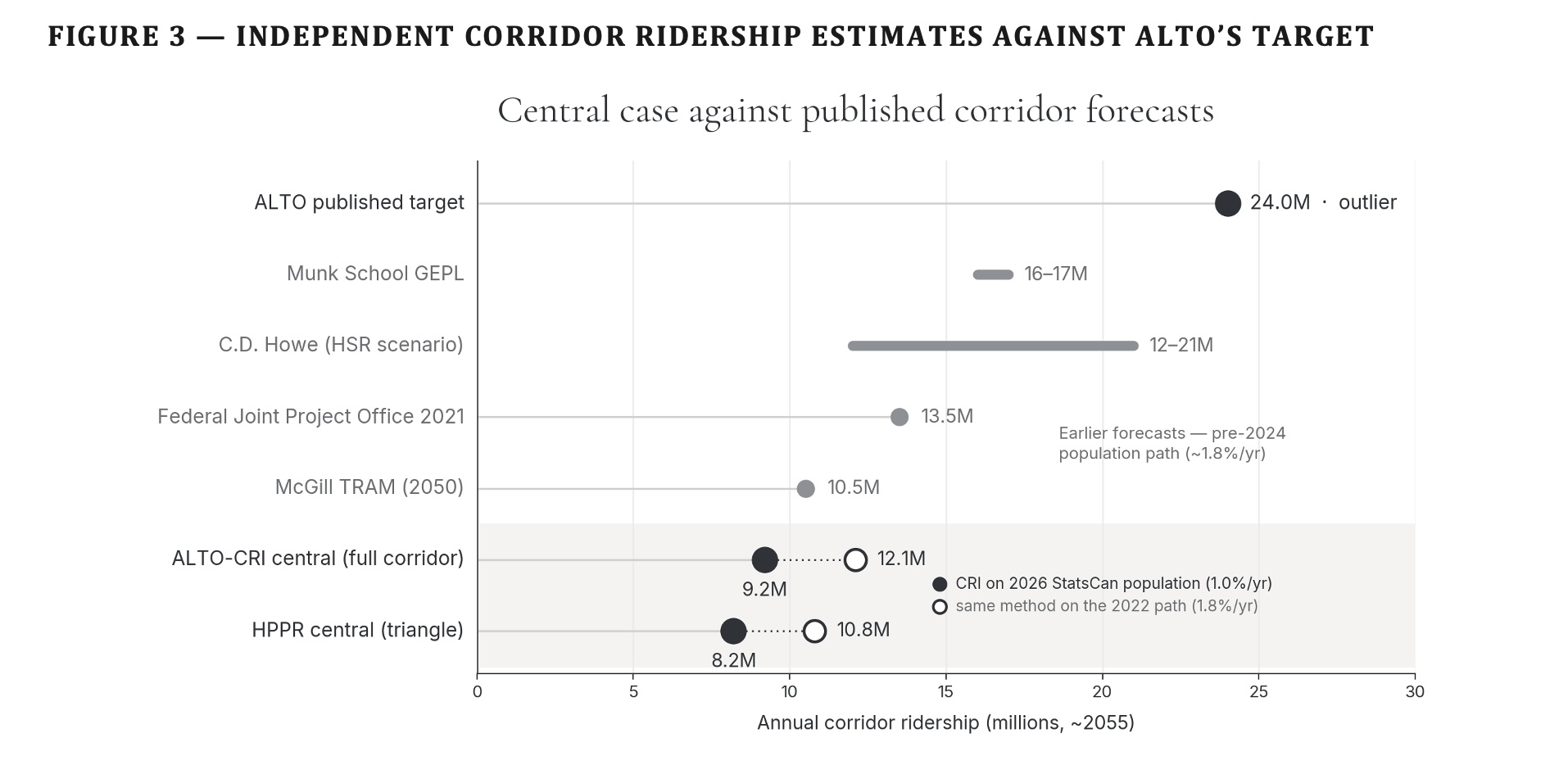
    The resulting envelope is then compared against ALTO’s published forecasts, the McGill TRAM stated-preference projection, the Munk School GEPL model, the C.D. Howe scenario analysis, and the federal government’s own 2021 Joint Project Office business case.

    Summary

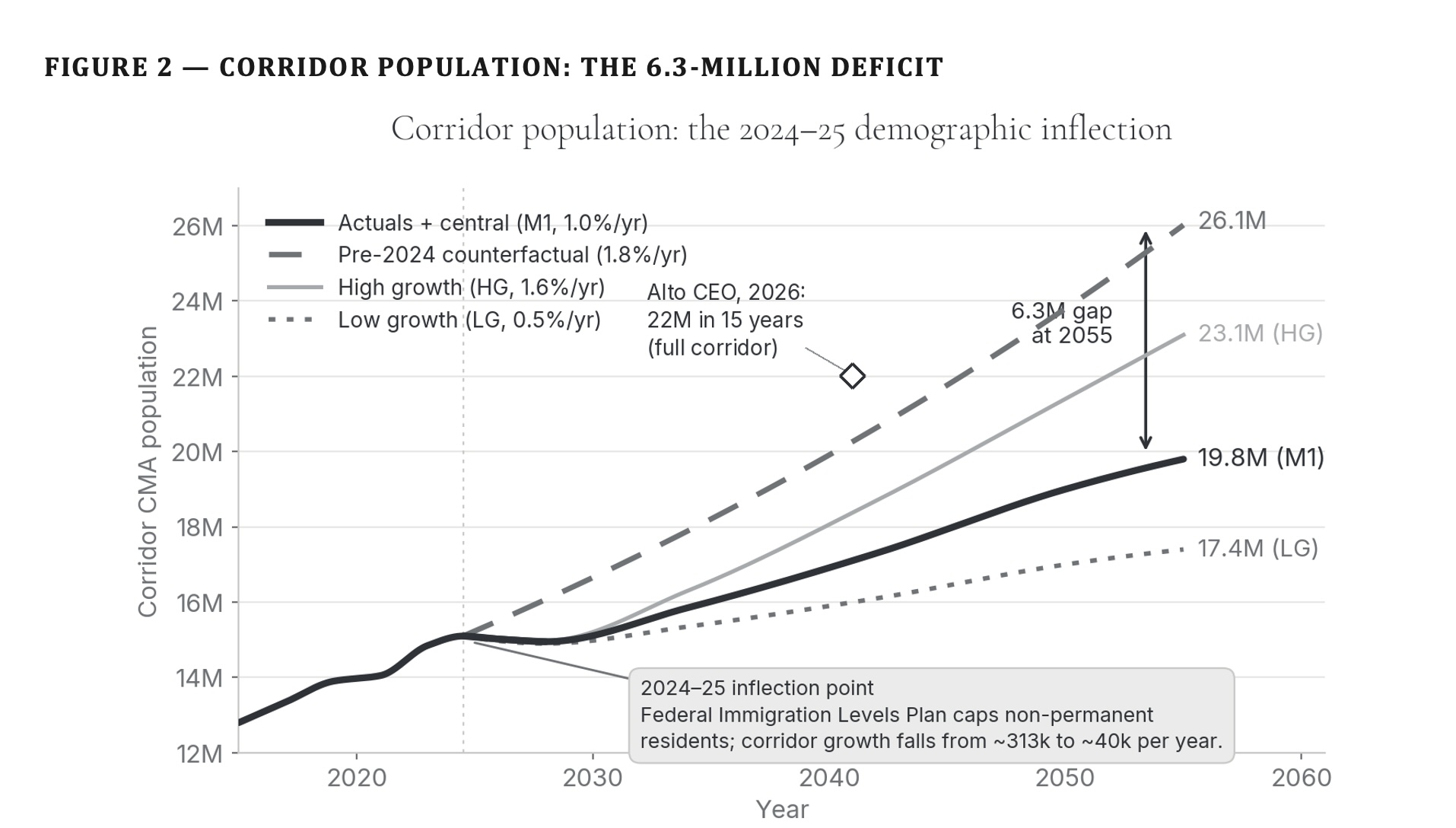
    The corridor population baseline is about 14.9 million across the directly-served CMAs in 2025. The 2024–25 federal cap on non-permanent residents produced a structural inflection — Toronto’s CMA shrank by ~1,000 people in 2024–25 after gaining 269,000 the year before — creating a credible lower trajectory (0.5%/yr) that did not exist in pre-2024 forecasts and bounding the upper trajectory (1.6%/yr) below pre-2024 expectations.

    Three regimes span the policy envelope: heavy subsidy ($2.5–4.5B/yr, ~38–42% capture), moderate subsidy at parity with air ($1.5–2.5B/yr, ~28–32% — the canonical business-case configuration), and minimal subsidy under P3 yield management ($0.5–1.5B/yr, ~20–23%). The combined envelope at mature operation runs from 6.1 to 25.7 million by 2080, central case 12.5 million. The 2055 reading — ALTO’s headline year — is 3.7 to 17.2 million, central case 9.2 million; the corridor is not yet at mature operation in 2055 under the announced phasing.

    ALTO’s published 24-million-by-2055 figure sits ~40% above the upper bound for 2055 and is incompatible with the announced phasing under any plausible ramp curve. Every forecast built from a disclosed methodology — TRAM, Munk GEPL, the federal JPO — sits within or close to the CRI envelope. ALTO’s published targets are the outlier against every other forecast for the corridor.

    Download
    Modal Shift Note 3 — Ridership Envelope Research Note (PDF)
    The full note with all figures and tables: the population trajectories, the three regimes, the phasing and ramp framework, the 2035–2080 envelope, and the comparison with every published forecast
    Download PDF
    1 · Framework

    Three multiplicands

    ALTO’s annual ridership in any year is the product of three quantities: the corridor population served, the average number of intercity trips each resident makes per year across air, rail and car, and ALTO’s share of those trips. Forecasting ridership therefore means forecasting each multiplicand and combining their realistic ranges into an envelope of outcomes.

    The two companion notes supply the modal-share machinery. Note 1 derives the air-substitution S-curve and locates the corridor’s three rail scenarios on it at travel time and price. Note 2 extends the framework to road–rail under a North American calibration anchored on VIA’s 13% rail share against road, and develops the price-ratio, group-size, gas-price and reliability sensitivities. What the two notes do not provide is the population denominator that converts share into absolute volume, the per-capita trip generation that scales the market with demographic change, the temporal phasing that distinguishes opening-year from mature ridership, and the explicit fare-and-subsidy regimes. This note adds those four pieces.

    Ridership = corridor population × intercity trips per capita × ALTO modal share, scaled by ramp-up. Each multiplicand has a defensible range. The envelope combines them.
    2 · Population

    The baseline and the 2024 demographic break

    ALTO directly serves CMAs from Toronto to Québec City. The 2025 baseline is about 14.9 million — Toronto (7.10M), Montréal (4.62M), Ottawa-Gatineau (1.55M), Québec City (0.86M), plus the smaller served centres (~0.8M combined).

    The 2024–25 demographic year produced a structural inflection. The federal Immigration Levels Plan announced in October 2024 was the first to cap temporary residents, requiring a multi-year drawdown. The effect on the two largest CMAs was immediate: Toronto’s CMA shrank by ~1,000 people in 2024–25, following a gain of 269,000 the year before, and Greater Golden Horseshoe growth collapsed from ~313,000/yr to ~40,000. This is a structural break from the baseline pre-2024 forecasts assumed — it invalidates the linear extrapolation of the 2022–24 surge.

    Table 1. Three population trajectories for the directly-served corridor CMAs, anchored on the 2025 baseline of ~14.9M. The central trajectory is the working assumption for the envelope; the upper and lower trajectories define the population-side bounds. Anchored on StatCan’s January 2026 projections (LG / M1 / HG scenarios) with a ~0.4-point corridor-CMA growth premium.
    TrajectoryAnnual growth20502080Driver
    Lower0.5%16.9M19.6MNPR drawdown is structural; aging accelerates
    Central1.0%19.1M25.7MNPR drawdown is one-off; immigration normalises
    Upper1.6%22.2M35.6MPre-2024 pace partly resumes after political cycle
    Corridor population: pre-2024 versus post-2024 trajectories, 2025 to 2080, showing the demographic correction the federal cap on non-permanent residents introduced
    Figure 1. Corridor population trajectories, 2025–2080, comparing pre-2024 (dashed) and post-2024 (solid) demographic assumptions on the same axis. The dashed lines represent the population input comparable published forecasts used; the solid lines reflect the 2024 federal cap and the StatCan data released January 2026. By 2080 the gap is striking — ~50M vs 35.6M (upper), 33.8M vs 25.7M (central), 23.1M vs 19.6M (lower). The post-2024 upper trajectory sits below the pre-2024 central across much of the horizon. Roughly 15 to 25% of the gap between the CRI envelope and the other forecasts is attributable to this single demographic correction alone.

    The trajectories are anchored on Statistics Canada’s official projections (released 27 January 2026), with a ~0.4-point corridor-CMA growth premium reflecting the directly-served CMAs’ historically faster growth — population-weighted ~1.8%/yr over 2000–2025 against the national 1.23%, moderated for Quebec’s projected demographic-weight decline and the Western redirection of interprovincial migration. The 0.4-point premium is a deliberately conservative reading, chosen so the envelope is not vulnerable to the argument that it underweights the corridor’s growth advantage.

    3 · Trip Generation

    Per-capita intercity trips

    The three principal pairs together carry ~19.9 million annual person-trips across air, rail and car (Note 2). Adding the secondary pairs and intermediate-station traffic brings the addressable market to about 25 million annual person-trips — against a 2025 population of 14.9 million, a per-capita rate of about 1.68 trips per resident per year.

    Over a 45-year horizon, competing effects roughly cancel. Hybrid work has structurally reduced corridor business travel below the pre-pandemic baseline, and AI-mediated meetings continue to erode marginal demand for in-person business travel — the literature consistently finds business travel adjusts more elastically to communication technology than leisure travel does. On the supporting side, urbanisation, economic concentration into the corridor, and rising affluence in the secondary centres lift demand. The net effect is roughly stable to mildly declining; this note uses a range of 1.6 to 1.8 trips per capita, central case ~1.7.

    4 · Modal Share by Regime

    Three fare-and-subsidy regimes

    ALTO’s share of the addressable market is the third multiplicand — and the dimension on which the corridor decision turns most directly. The aggregate share is a weighted blend across air, current rail and car markets on the three principal pairs, with realistic group composition (a mix of solo, couple and family travellers) rather than the solo-traveller readings that anchor the time-and-price geometry.

    A

    Heavy operating subsidy — low fares

    Fares at VIA-equivalent levels (rail-to-air ratio 0.4–0.5; per-person rail-to-car ~1.0 solo), capital absorbed into the public account. Annual subsidy $2.5–4.5 billion. Captures ~85% of the air market, ~100% of existing VIA demand, ~22% of the rail+car market on a group-weighted basis. Aggregate share: ~38–42%.

    B

    Moderate subsidy — parity with air (canonical)

    Fares at parity with air (rail-to-air ratio ~1.0; per-person rail-to-car ~2.0–2.4 solo). Annual subsidy $1.5–2.5 billion. Captures ~70% of air, ~95% of existing VIA demand, ~9–11% of rail+car. Aggregate share: ~28–32%. This is the configuration under which the 24-million headline is implicitly framed.

    C

    Minimal subsidy — P3 yield management

    Fares above air parity (rail-to-air ratio 1.1–1.4; per-person rail-to-car 3–4 solo, above 12 for a family of four). Annual subsidy $0.5–1.5 billion — still positive, because the fully self-funded P3 model is not survivable arithmetic at any modal share consistent with the framework. Captures ~50% of air, ~80% of existing VIA demand, ~4% of rail+car. Aggregate share: ~20–23%.

    Table 2. Three fare-and-subsidy regimes, with implied modal capture and aggregate share of corridor person-trips. The factor-of-two range across regimes operates independently of the infrastructure choice — the same physical asset produces double or half the ridership depending on the fare-and-subsidy decision. No regime delivers self-funding at any modal share consistent with the framework.
    RegimeFare structureAnnual subsidyAir captureCar captureAggregate share
    A — HeavyT–Mtl ~$80–130; rair ≈ 0.4–0.5$2.5–4.5B/yr~85%~22%38–42%
    B — ModerateT–Mtl ~$150–220; rair ≈ 0.9–1.0$1.5–2.5B/yr~70%~9–11%28–32%
    C — MinimalT–Mtl ~$220–350+; rair ≈ 1.1–1.4$0.5–1.5B/yr~50%~4%20–23%
    5 · Phasing & Ramp

    Opening-year is not mature-year

    Ridership in any specific year depends on three timing variables: the construction schedule, the segment opening sequence, and the ramp curve on each opened segment. The 2026–2034 period is consumed by consultation, environmental assessment, expropriation, design, P3 negotiation and enabling works — none of it revenue service. Canadian P3 megaproject experience (Eglinton Crosstown, Confederation Line, Ontario Line) suggests timelines slip rather than compress; the earliest plausible phased opening is ~2038, central scenario closer to 2040.

    Phase 1 — Montréal–Ottawa

    Opens first: shortest (~190 km), simplest engineering, but the smallest pair. Serves only the Ottawa–Montréal demand pool (~20% of corridor) — it cannot draw Toronto flows because Toronto isn’t connected yet. Early-year ridership is structurally small.

    Phase 2 — Toronto extension

    The demand inflection point. Adds ~450 km and unlocks Toronto–Ottawa and Toronto–Montréal — ~60% of corridor demand. Cumulative Phase 1+2 coverage is ~80%: the full Toronto–Ottawa–Montréal triangle. Plausible window 2042–2046.

    Phase 3 — Québec City extension

    The most schedule-vulnerable: the St-Lawrence crossing, Leda clay risk, an unsettled routing, and an unresolved federal-provincial cost-share with Québec. Adds the final ~20%. Window 2047–2052, with a credible permanently-deferred scenario.

    The ramp curve in the North American context is meaningfully slower than European comparators. Madrid–Barcelona took ~4 years to decisively overtake the air bridge, under conditions far more favourable to rail than ALTO faces; Brightline Miami–Orlando remains in financial ramp-up with bond ratings downgraded to CCC+. The envelope is calibrated against the Brightline profile for the lower and central cases and Madrid–Barcelona for the upper case.

    Table 3. Ramp factors applied to each opened segment — the fraction of that segment’s mature ridership realised in each year post-opening. Regime C (yield management) ramps slowest; Regime A (low fares) fastest. Applied separately to each phase, with each segment’s clock starting from its own opening year.
    Years post-openingLower (Regime C)Central (Regime B)Upper (Regime A)
    Year 115%25%35%
    Year 335%50%65%
    Year 555%70%80%
    Year 875%85%92%
    Year 10+90%95%100%
    Table 4. Phase opening schedule by scenario. The fare-and-subsidy regime correlates with delivery pace: heavily-funded projects face political pressure for early openings and federal cost-overrun absorption removes renegotiation friction; lean P3 structures slip. Phase 3 moves most widely because of the St-Lawrence crossing and the Québec cost-share. Defensible bounds extend each year by ±2–3.
    ScenarioRegimePhase 1 (Mtl–Ott)Phase 2 (Ott–Tor)Phase 3 (Mtl–QC)
    LowerC — minimal204220482055
    CentralB — moderate204020452050
    UpperA — heavy203820422046

    Under the central scenario, the corridor is at ~29% of mature potential in 2045, ~65% in 2050, and ~88% in 2055 — genuine full-corridor maturity is not reached until around 2060. ALTO’s 24-million-by-2055 figure is incompatible with the announced phasing under any plausible ramp curve: the corridor cannot be mature in 2055 if Phase 3 only opens in 2050. If Phase 3 is permanently deferred but Phases 1–2 complete, mature ridership is ~4.9 to 20.5 million across regimes — the more credible of the downside readings given Québec’s negotiating position.

    6 · The Envelope

    Ridership, 2035–2080

    Combining population, trip generation, regime and phasing produces the envelope below. The lower bound combines Regime C with the lower population trajectory and 1.6 trips/capita; the central case combines Regime B with the central trajectory and 1.7; the upper bound combines Regime A with the upper trajectory and 1.8 — each paired with its corresponding ramp curve and opening schedule.

    9.2M
    CRI central case at 2055 (Regime B)
    3.7–17.2M
    Full 2055 envelope across regimes and demographics
    24M
    ALTO’s published 2055 target — ~40% above the upper bound
    Table 5. ALTO annual ridership envelope, 2035–2080, in millions, with the three-phase opening sequence and ramp applied. Lower: Regime C × lower population × 1.6 trips/cap. Central: Regime B × central × 1.7. Upper: Regime A × upper × 1.8. The 2040 figures reflect Phase 1 alone; 2045 reflects Phase 2 just opening; 2050 reflects Phase 3 just opening. Full-corridor maturity is reached around 2060, not 2055.
    YearStatusLower (M)Central (M)Upper (M)
    2035Construction; no revenue service000
    2040Phase 1 (Mtl–Ott) opening years00.41.8
    2045Phase 1 maturing; Phase 2 opens0.52.89.2
    2050Phase 1+2 maturing; Phase 3 opens1.96.714.8
    2055Phase 1+2 mature; Phase 3 ramping3.79.217.2
    2060All phases near-mature plus growth4.810.218.7
    2070Mature plus sustained growth5.811.321.9
    2080Mature plus full forecast growth6.112.525.7

    Figures 2a–2c plot the year-by-year trajectory under each regime separately. Within each figure, the three lines are the demographic trajectories; the spread within a figure shows demographic uncertainty, and the spread across the figures shows the fare-and-subsidy choice — a policy decision, not an infrastructure one. The 24-million target is marked on each as a reference.

    Ridership trajectory under Regime A, heavy subsidy, low fares: lower, central and upper demographic lines against the 24-million ALTO target
    Figure 2a. Regime A (heavy subsidy, VIA-equivalent fares, $2.5–4.5B/yr). Aggregate share 38–42%. Phase openings 2038/2042/2046. The 2055 readings are 11.0 / 13.6 / 17.2M; the 2080 readings 12.5 / 17.5 / 25.7M. Even the most favourable combination — Regime A with upper demographic growth — leaves the 24M target ~40% above the trajectory at 2055.
    Ridership trajectory under Regime B, moderate subsidy, parity with air: the canonical business-case configuration against the 24-million target
    Figure 2b. Regime B (moderate subsidy, parity with air, $1.5–2.5B/yr) — the canonical configuration under which the published business case is implicitly framed. Aggregate share 28–32%. Phase openings 2040/2045/2050. The 2055 readings are 7.4 / 9.2 / 11.6M; the 2080 readings 8.9 / 12.5 / 18.3M. The target sits above the achievable range by a factor of ~2.1 to 3.2 at 2055.
    Ridership trajectory under Regime C, minimal subsidy, P3 yield management: fares above air parity against the 24-million target
    Figure 2c. Regime C (minimal subsidy, P3 yield management, fares above air parity, $0.5–1.5B/yr) — the configuration most consistent with the consortium’s announced commercial structure. Aggregate share 20–23%. Phase openings 2042/2048/2055. The 2055 readings are 3.7 / 4.6 / 5.8M; the 2080 readings 6.1 / 8.5 / 12.4M. Even the upper demographic falls below the McGill TRAM projection at 2055.

    Three patterns emerge. The regime choice (a policy lever) shifts 2080 central ridership by a factor of ~2 — 17.5M (A), 12.5M (B), 8.5M (C). The demographic choice shifts it by another factor of ~2 — 12.5M (lower) to 25.7M (upper) under Regime A. And the 24-million target sits above every plausible 2055 trajectory in every figure: the closest reading, Regime A with upper growth, produces 17.2M — 28% below the target. Reaching 24M by 2055 requires the most favourable regime, a demographic trajectory above the upper case, and a corridor fully mature by 2055 — three conditions that cannot all hold under the announced phasing. The Regime A upper trajectory does reach the 24M neighbourhood — but a full quarter-century later, in 2080.

    7 · Comparison

    ALTO’s target is the outlier

    The CRI envelope can be placed alongside the other published forecasts for the same corridor. The pattern is unambiguous: every forecast built from a disclosed methodology clusters near the CRI envelope, and ALTO’s public targets stand alone above all of them.

    Table 6. Published and modelled ridership forecasts for the corridor. Not strictly comparable across columns — ALTO’s 2055 figure assumes full-corridor completion well before 2055; the Munk GEPL figures are Toronto–Montréal scaled to a corridor equivalent; C.D. Howe applies sensitivity analysis to VIA’s forecasts; the JPO 2021 figure is for the predecessor HFR 177 km/h spec. The pattern is robust: every disclosed-methodology forecast sits within or close to the upper end of the CRI envelope, and well below the ALTO public targets.
    SourceMethodBy 2050By 2055By ~2080–85
    ALTO public targetsNot disclosed24M (2055)43M (2084)
    ALTO Corporate PlanTreasury Board filing (incl. Local Services)17M (2059)
    McGill TRAMStated-preference survey, n ≈ 8,30010.5M~19.7M (yr 50)
    Munk School GEPLDisclosed logit with induced demand~16–17M~18–19M
    C.D. HoweScenario analysis on VIA’s forecasts12–21M
    Federal JPO 2021Pre-procurement business case (HFR spec)~13.5M
    Flyvbjerg adjustmentALTO −65% reference class8.4M (from 24M)15M (from 43M)
    CRI envelopeModal-shift × population × regime1.9 / 6.7 / 14.83.7 / 9.2 / 17.26.1 / 12.5 / 25.7

    The dispersion among the disclosed-methodology forecasts is narrow — TRAM at 10.5M by 2050, Munk GEPL at 16–17M corridor-equivalent, the JPO 2021 at 13.5M, and C.D. Howe’s 12–21M range all sit in the same zone. The CRI central case sits on the conservative side of this cluster; the CRI upper bound sits centrally within it. The dispersion between the cluster and ALTO’s public targets, by contrast, is wide: the 24-million figure is ~40% above the CRI upper bound for that year, more than double the TRAM number, and 14% above the top of the C.D. Howe range. Notably, ALTO’s own Corporate Plan figure of 17M by 2059 — filed with Treasury Board — is ~30% below its public 24M figure and closer to the CRI upper bound; the reconciliation of the two ALTO figures is not publicly disclosed.

    Every forecast for the corridor built from a disclosed methodology — TRAM survey, Munk GEPL logit, federal JPO business case — sits within or close to the CRI envelope. ALTO’s 24-million public target sits 40 per cent above the upper bound at 2055 and is the outlier in the published literature.
    8 · Why the Gap

    Why the CRI envelope sits below the cluster

    The CRI central case sits below the disclosed-methodology cluster, and its upper bound sits centrally within it. This is not a forecasting error in those studies — they were built for different purposes, finalised on different timelines, and applied different assumptions where the modal-shift literature offers latitude. Six factors account for the bulk of the divergence, in roughly descending order of impact.

    1. The 2024 demographic inflection is post-cutoff for every other forecast

    The single largest source. Every published forecast was finalised before the federal NPR caps produced observable effects. The January 2026 StatCan data was not available to any of them. ~15–25% of the gap, before any other consideration.

    2. North-American modal-shift recalibration

    The comparators use European-anchored elasticities. Note 2 recalibrates the rail–car curve against VIA’s ~13% road share, shifting the inflection from τ₀ = 0.65 to 0.46. ~15–25% of the gap, largest on the road-substitutable share.

    3. Explicit phased opening

    The CRI envelope models each phase’s own opening date and ramp; the comparators assume an implicit step-change to maturity. ~30–40% of the gap at the 2050–2055 horizon specifically, converging by 2070–2080.

    4. Group-composition weighting

    Family and 3+ travel essentially cannot be captured by rail at any defensible fare. Most models use an average traveller; the CRI weights across realistic solo/couple/family proportions. ~5–15% of the gap, largest on the car-substitutable share.

    5. Canadian P3 vs European open-access pricing

    Madrid–Barcelona’s gains came from open-access competition (25–50% fare cuts). The Cadence monopoly concession, with Air Canada’s equity stake, eliminates that mechanism. ~10–20% of the gap, largest on the lower-end scenarios.

    6. Bottom-up vs top-down or stated-preference

    ALTO’s targets are top-down (subject to the Flyvbjerg ~65% optimism bias); TRAM is stated-preference (overstates realised behaviour). The CRI is built bottom-up from observed VIA shares. ~5–15% of the gap, operating as a multiplier on the rest.

    Taken together, the six factors are not independent surprises pushing the same way — they are mostly visible to the other forecasts too, but each embedded different assumptions where the literature offers latitude. The CRI envelope’s central case sits below the cluster because it applies all six defensible positions at once; its upper bound, by construction, relaxes the unfavourable end of each while staying internally consistent, and sits centrally within the cluster. By 2080, when the demographic, phasing and ramp factors have all played out, the CRI upper bound of 20.7M sits in the centre of the published cluster’s mature-state range. None of the comparators is wrong; each answers a different question. The CRI envelope answers a sixth: what realised annual ridership is consistent with current empirical evidence, the announced phasing, and the modal-shift literature applied to the Canadian context.

    Download Full Note
    Modal Shift Note 3 — Ridership Envelope Research Note (PDF)
    Reference document with the full framework, all six tables, the four figures, and the complete source list
    Download PDF
    Sources

    Principal sources

    1.
    Statistics Canada (27 January 2026). Population projections for Canada (catalogue 17-20-0003; dashboard 71-607-X-2022015), LG / M1 / HG scenarios. — and the 2024–25 demographic estimates and the federal Immigration Levels Plan (October 2024) cap on non-permanent residents.
    2.
    El-Geneidy, A. et al. — Transportation Research at McGill (TRAM), stated-preference corridor projection (March 2026), n ≈ 8,300. tram.mcgill.ca
    3.
    Munk School Global Economic Policy Lab, University of Toronto — disclosed logit corridor model with induced demand.
    4.
    Jones & Fariha (February 2025). All Aboard. C.D. Howe Institute scenario analysis. cdhowe.org
    5.
    Federal Joint Project Office (2021) pre-procurement business case (HFR 177 km/h specification), released through Access to Information, November 2025.
    6.
    Flyvbjerg, B., Holm, M.S. & Buhl, S. — meta-analysis of rail-project ridership forecast accuracy (mean ~65% overstatement).
    7.
    VIA Rail Canada Annual Report 2023; corridor person-trip volumes and modal shares as developed in Note 2, Table 1. — and Brightline Florida (2024–2026) ridership reports and KBRA bond rating actions; Madrid–Barcelona AVE ramp and open-access pricing record.
    8.
    ALTO public communications (the Imbleau / Fast Forward 24- and 43-million figures) and the ALTO Corporate Plan filed with Treasury Board (17M by 2059, including Local Services).
    9.
    ALTO HSR Citizen Research Initiative companion notes: Note 1 — rail–air substitution and Note 2 — rail–car substitution, which supply the modal-share machinery; and the Modal Shift & Ridership synthesis brief that sets this note alongside Notes 1, 2 and 4.
  • Modal shift synthesis

    ALTO Ridership Against the Modal-Shift Evidence

    What the published 24-million target implies for how many travellers must abandon air and car for the train — and what the modal-shift evidence, the demographic baseline, and the operating-subsidy frontier say is actually reachable on the corridor.

    ⚠ What This Brief Synthesises

    This brief draws together four CRI research notes — on rail–air substitution (Note 1), rail–car substitution (Note 2), the ALTO ridership envelope (Note 3), and the operating-subsidy frontier (Note 4) — into a single test of one number: ALTO’s published target of 24 million annual passengers by 2055.

    Each note is built from the same starting point as the proponent’s own forecasts, but corrected for two things older studies omit: the North-American calibration of modal-shift behaviour, and the 2024 federal cap on non-permanent residents that broke the corridor’s demographic trajectory.

    Headline Finding

    ALTO’s published target of 24 million annual passengers by 2055 sits 2.6× above the CRI central case of 9.2 million, and is incompatible with every other independent forecast for the corridor.

    The gap is not a matter of optimism versus pessimism. Reaching 24M requires a modal share above the ceiling the modal-shift curves allow in a North-American setting; it assumes a population trajectory the federal government’s own immigration policy has already foreclosed; and pushing ridership toward the target through deeply discounted fares drives operating subsidy past $5 billion a year. The target fails three independent feasibility tests at once.

    Download
    ALTO Ridership Against the Modal-Shift Evidence — Full Slide Deck (PDF)
    Seven slides synthesising the modal-shift S-curves, the price families, the 2055 ridership envelope, and the three-test verdict on the 24-million target
    Download Deck
    The Four Underlying Notes
    The Question

    How many people would actually have to switch?

    A ridership target is, underneath, a claim about behaviour. To carry 24 million passengers a year, the corridor must persuade a very large share of the people now flying or driving between Toronto, Ottawa, Montreal and Quebec City to take the train instead. That share — the modal shift — is the quantity every forecast turns on, and it is the quantity this brief examines first.

    Modal shift is not a free parameter. Decades of evidence from operating high-speed lines show it follows a predictable shape: rail captures most of the market on short, fast journeys and loses it on long ones, with a sharp transition in between. The question for ALTO is not whether modal shift happens — it plainly does — but how high the curve can realistically reach on this corridor, in this country, at the fares the project would have to charge.

    Three forces set that ceiling: the journey-time geometry against air, the harder competition against the car in a North-American setting, and the price the traveller actually faces. The notes treat each in turn before combining them into a ridership envelope and testing the 24-million figure against it.

    Note 1 · Rail vs Air

    Modal shift versus air follows a logistic S-curve

    Against air, rail’s market share is governed almost entirely by station-to-station journey time. The relationship is a logistic S-curve: below about two hours rail dominates, between two and four hours the two modes compete and infrastructure quality is decisive, and beyond about five hours rail share collapses to only the price-sensitive or rail-loyal traveller. The inflection point — where rail and air split the market evenly — sits at roughly 3.5 hours.

    < 2 h
    Rail dominates — near-full capture of the rail+air market
    2–4 h
    Competitive zone — 60–80% rail share, infrastructure decisive
    > 5 h
    Rail share collapses — only price-sensitive or rail-loyal travellers

    This is not theory. The world’s operating high-speed lines trace the same curve, and they are the empirical anchors the note is calibrated against:

    • Paris–Lyon (TGV): rail share rose from 40% to 72% after high-speed service opened.
    • Madrid–Barcelona (AVE): roughly 75% rail share at a 2 h 30 min journey time.
    • Madrid–Seville: rail share rose from 16% to 52%.
    • Beijing–Shanghai: 1,318 km covered in 4 h 18 min, rail-dominant despite the distance.

    For ALTO, the implication is straightforward: the air-substitution share the corridor can win is bounded by where each city-pair sits on this curve. Pairs that fall inside the two-to-four-hour competitive zone can deliver strong rail capture; pairs that fall outside it cannot, regardless of how the target is set.

    Note 2 · Rail vs Car

    Modal shift versus the car is harder in North America

    The car is the larger and more stubborn competitor, and here the North-American context shifts the whole curve against rail. The note re-calibrates the rail-vs-car S-curve on VIA Rail’s observed performance — a rail share of roughly 13% against road — and finds the inflection point moves sharply left: from τ = 0.65 in the European setting to τ = 0.46 in the North-American one, a 19-point shift.

    Why North America shifts the curve

    Toll-free highways run the 401/A20 corridor end to end. Fuel taxes are roughly one-third of European levels. There is no congestion charging anywhere in Canada. And family-car economics are decisive: per-person car cost divides among the occupants, while rail charges per ticket.

    What this does to predicted share

    The same corridor that would capture a healthy rail share in Europe captures materially less here. The gap between the European and North-American readings is the single largest correction separating the CRI work from the older forecasts.

    Carried through to the ALTO city-pairs, the North-American calibration produces predicted rail shares of the rail+car market that sit well below the European equivalents:

    • ALTO Toronto–Ottawa (τ ≈ 0.44): about 51% North-American versus 67% European.
    • ALTO Toronto–Montreal (τ ≈ 0.56): about 41% North-American versus 58% European.
    • HPR on both pairs (τ ≈ 0.65–0.67): about 33% North-American versus 50% European.

    The lesson is that a forecast borrowed from European experience — as the older studies effectively are — systematically overstates how much of the road market the corridor can win. The car does not behave here the way it behaves there.

    Notes 1 & 2 · Price

    Price shifts the whole modal-shift curve

    Journey time fixes the shape of the S-curve; price selects which curve in the family the corridor actually sits on. The relevant variable is the fare-to-comparator price ratio (r) — rail’s price relative to the air fare or the per-person car cost it competes with. A lower ratio lifts the entire curve; a higher ratio depresses it.

    Elasticity differs by mode

    Road–rail substitution is more price-sensitive than air–rail (γ = 1.5 versus 1.0). Travellers deciding between train and car respond more sharply to fare changes than those choosing between train and plane.

    Group travel hurts rail

    Per-person car cost divides among the occupants; rail charges per ticket. A family of four therefore faces an effective price ratio roughly four times higher than a solo traveller — pushing them down the curve toward the car.

    The note maps three fare regimes onto the curve family. Regime A (r ≈ 0.55) is deeply discounted, lifting share but requiring heavy subsidy. Regime B (r ≈ 1.0) sets fares at parity with air. Regime C (r ≈ 1.4) prices above the comparator. Each selects a different curve — and, as Note 4 shows, a different point on the subsidy frontier. The crucial consequence is that the high-share outcomes the 24-million target needs are only available at the discounted end, where the fares no longer cover the cost of carrying the passenger.

    Note 3 · The Ridership Envelope

    The 2055 envelope is 3.7 to 17.2 million

    Combining the modal-shift ceiling with the corridor’s demographics produces a ridership envelope, not a single number. The framework is deliberately transparent: ridership = population × per-capita trips × modal share × ramp-up. Each input is drawn from published data and stated openly.

    9.2M
    CRI central case at 2055, Regime B (fares at parity with air)
    3.7–17.2M
    Full 2055 ridership envelope across regimes and demographic paths
    24M
    ALTO’s published target — 2.6× the central case

    The demographic inputs are post-2024 and this is where the CRI analysis departs most sharply from the others. The corridor population is 14.9 million (2025), residents make about 1.68 intercity trips each, and StatCan’s low / medium / high growth scenarios run at 0.5% / 1.0% / 1.6% per year. Critically, these trajectories reflect the 2024 federal cap on non-permanent residents — a structural break the older forecasts predate.

    Under Regime B, the central reading is 9.2 million in 2055, rising to a central 12.5 million by 2080 within an 8.9–18.3 million envelope. ALTO’s 24-million target sits above the top of the 2055 envelope entirely — not at its optimistic edge, but beyond it.

    Ridership envelope chart for the ALTO corridor, 2030 to 2080, showing upper, central and lower demographic trajectories under Regime B against ALTO's 24-million target
    Regime B ridership envelope, 2030–2080. The central demographic path reaches 9.2M in 2055 and 12.5M in 2080; the ALTO target of 24M (2055) sits above the upper bound of the envelope. Figure from Note 3 — Ridership envelope for the ALTO corridor.
    Note 3 · The Comparison

    The 24M target is the outlier

    Set against the independent literature, the pattern is unambiguous: every other forecast clusters near the CRI central case, and the 24-million target stands alone above all of them. The reason the CRI figure sits lower than the academic studies is not methodological pessimism — it is one correction the others have not made.

    The immigration inflection

    The 2024–25 federal cap on non-permanent residents broke the corridor’s demographic trajectory, lowering the central forecast relative to pre-2024 expectations. Only the CRI analysis incorporates the NPR cap.

    Pre-cap demographics elsewhere

    All the independent forecasts — including the 2025 McGill and C.D. Howe studies — rest on pre-2024 population assumptions. They model a population surge that federal policy has since foreclosed.

    Structural travel decline

    Hybrid work and AI-mediated meetings structurally reduce corridor business travel below the pre-2020 baseline — a head-wind absent from the older forecasts entirely.

    In other words, the daylight between ALTO’s target and the independent consensus is not a disagreement about how good high-speed rail is. It is the difference between forecasts built on a demographic future that is no longer the official plan and a forecast built on the one that is.

    The Verdict

    The 24-million target fails three independent feasibility tests

    Each note tests the target from a different direction. The target does not fail one of them narrowly — it fails all three, and each failure is sufficient on its own.

    1

    Modal-shift framework

    Reaching 24M requires a modal share above the 40 per cent ceiling implied by the North-American-calibrated S-curves in Notes 1 and 2. Even ALTO’s heaviest-subsidy regime, with deeply discounted fares, plateaus near 11–12 million annual riders at the modal-shift ceiling.

    2

    Demographic baseline

    The 2024 federal Immigration Levels Plan capped non-permanent residents, producing a structural break in corridor population growth. Pre-2024 forecasts assumed continued surge; post-2024 trajectories are materially lower. 15–25 per cent of the gap to ALTO is demographic alone.

    3

    Subsidy frontier

    Pushing past Regime A toward 24M requires operating subsidy above $5 billion per year, with full federal cost approaching $7 billion per year under the proponent’s own $75B capex base case — outside any defensible operating-regime choice on the corridor.

    Side by Side

    Three tests, one number

    Read together, the three tests converge from independent premises on the same conclusion. They are not three versions of one argument; they are three different constraints, each of which the target violates.

    Modal-shift ceiling

    Limit:~40% share ceiling (NA-calibrated)

    Reaches:~11–12M even at heaviest subsidy

    vs 24M?Falls short by half

    Demographic baseline

    Limit:Post-2024 NPR cap; 0.5–1.6%/yr growth

    Reaches:9.2M central; 3.7–17.2M envelope

    vs 24M?Above the upper bound

    Subsidy frontier

    Limit:Defensible operating regimes (A–C)

    Reaches:24M needs >$5B/yr operating subsidy

    vs 24M?Outside any defensible regime

    The convergence is the point. A target that merely sat at the optimistic edge of one analysis could be defended as ambition. A target that exceeds the modal-shift ceiling, sits above the demographic envelope, and requires an indefensible operating subsidy is not ambitious — it is, on the evidence of all four notes, 2.6× above what the corridor can carry.

    For the next federal statement

    Three questions to ask

    Where the next federal or proponent statement on ALTO ridership is concerned — whether in a business case, a consultation report, or a public communication — three questions follow directly from the notes.

    1. On modal share: What rail share of the rail+air and rail+car markets does the 24-million target assume on each city-pair, and is that share calibrated on North-American or European travel behaviour?
    2. On demographics: Does the ridership forecast incorporate the 2024 federal cap on non-permanent residents, or does it rest on pre-2024 population assumptions that the cap has since superseded?
    3. On subsidy: At the fare level required to reach the target, what is the projected annual operating subsidy — and how does it compare with the $5 billion-plus the subsidy frontier implies under the proponent’s own capex base case?

    None of these questions presupposes opposition to passenger rail, which is a widely shared public good. Each asks only that the project reconcile its headline number with the same evidence base — modal-shift behaviour, the demographic baseline, and the operating economics — that every other forecast for the corridor is built on.

    Download Full Deck
    ALTO Ridership Against the Modal-Shift Evidence (PDF)
    Reference deck for federal decision-makers, parliamentarians, journalists, and residents along the corridor
    Download Deck
    Where Things Stand

    Two numbers, one of them public

    As of May 2026, ALTO’s public ridership figure is 24 million annual passengers by 2055. The independent evidence base — modal-shift behaviour calibrated to North America, a demographic baseline corrected for the 2024 immigration cap, and an operating-subsidy frontier built from the proponent’s own cost figures — places the corridor’s central case at 9.2 million. The two numbers are not a matter of optimism versus caution. The lower one incorporates evidence the higher one omits, and only the higher one has been put to the public.

    Sources

    Underlying notes and references

    1.
    Note 1 — Modal shift between high-speed rail and air on the ALTO corridor. ALTO HSR Citizen Research Initiative. Source of the logistic rail–air S-curve, the 3.5-hour inflection, the short-haul / competitive-zone / long-haul thresholds, and the Paris–Lyon, Madrid–Barcelona, Madrid–Seville and Beijing–Shanghai empirical anchors.
    2.
    Note 2 — Modal shift between rail and car on the ALTO corridor. ALTO HSR Citizen Research Initiative. Source of the North-American-calibrated rail–car S-curve anchored on VIA Rail’s ~13% road share, the inflection shift from τ = 0.65 (EU) to τ = 0.46 (NA), and the predicted rail shares for the Toronto–Ottawa, Toronto–Montreal and HPR city-pairs.
    3.
    Note 3 — Ridership envelope for the ALTO corridor, 2035–2080. ALTO HSR Citizen Research Initiative. Source of the ridership framework (population × per-capita trips × modal share × ramp-up), the post-2024 demographic inputs reflecting the federal NPR cap, the 9.2M central case, and the 3.7–17.2M envelope.
    4.
    Note 4 — Operating-subsidy frontier for the ALTO corridor. ALTO HSR Citizen Research Initiative. Source of the Regime A/B/C fare mapping, the subsidy frontier corrected to be operating-cost-consistent, and the >$5B/yr operating subsidy (~$7B/yr full federal cost) implied by pushing ridership toward 24M under the $75B capex base case.
    5.
    El-Geneidy, A., et al. Transportation Research at McGill (TRAM), McGill University (2025). Independent corridor ridership forecast built on pre-2024 population assumptions. tram.mcgill.ca
    6.
    C.D. Howe Institute (2025). Independent assessment of the high-speed rail corridor, using pre-2024 demographic inputs. cdhowe.org
    7.
    Statistics Canada — population projections (low-growth / medium / high-growth scenarios) and the corridor population base; and the 2024 Immigration Levels Plan establishing the cap on non-permanent residents. statcan.gc.ca
    8.
    ALTO HSR Citizen Research Initiative companion briefs: Reading the Answer (cost, ridership and subsidy claims) and The Report That Vanished. This brief is intended to be read alongside them.
  • Modal shift HSR car

    Citizen Research Initiative · Modal Shift Analysis · Note 2

    Modal Shift Between Rail and Car on the ALTO Corridor

    The car competes with rail at every distance, costs are weighed on fuel rather than full economics, and a full car of four tilts the comparison decisively toward driving. Why North American road–rail substitution is structurally harder — and how much of it ALTO’s speed actually buys.

    ⚠ What This Note Examines

    This note applies the evidence on rail–car substitution to the two principal corridor pairs — Toronto–Ottawa and Toronto–Montréal — in the North American context, comparing current VIA Rail, a High Performance Rail (HPR) alternative at 200 km/h, and ALTO at 300+ km/h.

    The road–rail comparison differs structurally from the rail–air analysis in Note 1: the car carries no fixed access penalty, perceived driving cost is dominated by fuel rather than full lifecycle cost, group travel decisively favours the car, and modal choice is more responsive to price than to time.

    Summary

    The right competitive variable is not absolute rail time but the ratio τ of rail time to car drive time: τ = 0.5 means rail takes half as long as driving, τ = 1.0 means equal time. Because car drive time scales with distance, the same τ implies the same competitive geometry on any route length.

    The corridor’s road-substitutable demand is far larger than its air-substitutable demand — highway flow on the 401 between Toronto, Kingston, Ottawa and Montréal is several times the corridor’s annual air person-trips. Three structural features make North-American competition harder than European comparators: the 401/A20 is toll-free end-to-end, there is no congestion charging anywhere in Canada, and per-person car cost divides among occupants while rail charges per ticket. A family of four faces a per-person rail-to-car price ratio four times higher than a solo traveller.

    Under canonical conditions — solo traveller, current Canadian gas prices, near-parity pricing — on a North-American–calibrated curve anchored on VIA’s ~13% rail share, the model predicts ALTO captures about 51% of the rail+car market on Toronto–Ottawa and 41% on Toronto–Montréal; HPR captures about 33% on both. European-equivalent upper bounds — readings that would apply only if North American transport policy shifted toward European fuel taxes, tolls and station-area land use — are 67% and 58% for ALTO and around 50% for HPR.

    Download
    Modal Shift Note 2 — Road–Rail Research Note (PDF)
    The full 26-page note with all eleven figures, the European and North-American calibrations, the group-size and gas-price levers, the reliability analysis, and the methodology and sources
    Download PDF
    1 · Travel Time

    The competitive zone for road

    The literature on rail–car substitution differs sharply from the rail–air literature. The car carries no fixed time penalty equivalent to airport access, security and downtown-airport transit; parked at origin and arriving at destination, it has near-zero access cost on both ends, and its line-haul time degrades only slightly across the 100–1,000 km range. The result is that car competes against rail at every distance — including short-haul corridors where rail would dominate the air comparison.

    The right measure is therefore not absolute rail journey time but the ratio of rail time to car time. Defining τ = (rail time) ÷ (car drive time at 100 km/h) gives a distance-invariant measure of rail’s advantage: τ = 0.5 means rail takes half as long as driving; τ = 1.0 means equal time; τ > 1.0 means rail is slower. A 3-hour rail journey on a 540 km route (τ = 0.56) is competitively equivalent to a 1.5-hour journey on a 270 km route. This is the key structural difference from the rail-vs-air analysis, where rail’s fixed advantage at the access stage means absolute time is what matters.

    Road-rail modal-shift S-curve plotting rail share of the rail+car market against the time ratio tau, European calibration
    Figure 1. Modal-shift S-curve for rail–car substitution, plotting rail’s predicted share of the combined rail+car market against the time ratio τ = (rail journey time) ÷ (car drive time at 100 km/h). Logistic curve fitted with inflection at τ = 0.65 (rail captures 50% at price parity when ~35% faster than driving). Three zones: rail decisively faster (τ < 0.5); the competitive zone (0.5 < τ < 1.0); and rail slower than driving (τ > 1.0). Calibrated against the TGV Paris–Lyon pre/post comparison.

    The European calibration in Figure 1 represents what rail can achieve under conditions that favour modal shift — high fuel taxes, congestion charging, dense feeder transit, central stations, and a cultural baseline of rail use. North American conditions are systematically less favourable, and the same τ produces lower rail shares.

    North-American-calibrated S-curve anchored on current VIA Rail's 13% rail share, with the European curve shown for comparison
    Figure 1b. North-American–calibrated S-curve, anchored on current VIA Rail service (~13% rail share of the rail+car market at τ ≈ 1.0). The faded grey dashed curve is the European calibration from Figure 1. Inflection shifts left from τ = 0.65 to τ = 0.46: under North American conditions, rail must be ~54% faster than driving — rather than 35% — to capture half the market at parity. Equivalent to a constant utility penalty α ≈ 0.67 reflecting toll-free highways, low fuel taxes, free parking, dispersed land use, weak feeder transit, and a cultural autonomy preference.

    Read together, Figures 1 and 1b bracket the realistic range. The European curve represents what is achievable in principle if rail-favourable conditions were created; the NA curve gives what is achievable under prevailing structural conditions. The remainder of this note uses the NA calibration, with European-equivalent figures quoted alongside where the comparison is informative. The gap between them is policy-relevant: roughly 10 to 15 percentage points of modal share depend not on which infrastructure is built but on whether the broader transport-policy environment supports modal shift.

    Empirical anchors and the North American context

    The Paris–Lyon TGV cut journey time from ~4 hours to under 2 and lifted rail’s share against road from ~30% to ~67% — a 37-point shift. Madrid–Barcelona AVE and Tokyo–Osaka Shinkansen deliver comparable shares against parallel highways. But all operate under conditions the corridor does not share. North America carries none of these reinforcements: the 401/A20 is toll-free end-to-end, Canadian fuel taxes are roughly one-third of European levels, there is no congestion charging in any Canadian city, and land use at both ends is car-oriented. The cross-elasticity literature confirms rail and car barely substitute — a 10% rise in fuel prices produces only a 1 to 4% rise in transit ridership.

    Rail’s competitive position against the car turns on the time ratio τ, not absolute journey time. The North American absence of tolls, congestion charges, and high fuel taxes means realised modal share will likely sit substantially below the European-anchored model’s predictions.
    2 · Price

    Elasticity, group size, and perceived cost

    The road–rail price comparison differs from rail–air in three ways: the elasticity of substitution is higher, the per-person ratio depends decisively on group size, and the cost of driving travellers actually weigh is the perceived cost (mostly fuel), not the full economic cost. The same logit form applies, but with a larger price coefficient (γ = 1.5 against 1.0 for rail–air), reflecting own-price elasticities of −1.0 to −1.6 for leisure demand against −0.4 to −0.7 for business.

    European price family

    Figure 2a shows the curve family at six price ratios under the European calibration. The wide range (0.5 to 8.0) reflects that group travel can drive the per-person ratio well above 5 even at parity-pricing intentions, since car cost divides among occupants while rail fare does not.

    North American price family

    Figure 2b applies the same six ratios under the NA calibration (τ₀ = 0.46). Each curve sits 15 to 20 points below its European counterpart at every τ. This family drives the corridor predictions in the rest of the note.

    Family of road-rail S-curves at six rail-to-car price ratios, European calibration
    Figure 2a. Family of road–rail S-curves at six rail-to-car-per-person price ratios (r = rail fare ÷ car cost per person), European calibration. The middle navy curve at r = 1.0 is price parity. The family spans 0.5 to 8.0, reflecting that group travel can push the per-person ratio well above 5.
    Family of road-rail S-curves at six price ratios, North American calibration
    Figure 2b. The same six ratios under the North American calibration (τ₀ = 0.46). Each curve sits 15 to 20 points below its European counterpart. This family is used throughout the rest of the note.

    Perceived versus full cost of driving

    Drivers compare rail fare against the perceived cost of driving, not the full economic cost. On Toronto–Montréal, one-way fuel for a typical car (9.4 L/100 km at ~$1.65/L) is about $84; the full economic cost — depreciation, insurance, maintenance — is more than three times that, around $300. But fixed costs are not perceived at the moment of choice; the car is owned regardless. A VIA Economy fare of ~$80 against perceived car cost of $84 produces a price ratio near 1.0 for a solo traveller. Against full cost the same fare would imply a ratio of 0.27 — and would predict a far larger rail share than the corridor actually carries, the empirical tell that perceived cost is the right input.

    The group-size effect

    Cars carry one to four passengers at a single fuel cost; rail charges per ticket. The per-person rail-to-car ratio is therefore ~1.0 for a solo traveller, 1.9 for a couple, 2.9 for three, and 3.8 for a full car of four. Family travel and any leisure trip with two or more travellers structurally favours the car — a multiplier with no analogue in the rail–air comparison. At parity pricing, ALTO’s Toronto–Ottawa share drops from ~51% solo to ~12% for a family of four; on Toronto–Montréal from 41% to 8%.

    Gas price as a modal-shift lever

    Because perceived car cost is dominated by fuel, the price ratio is sensitive to gas prices in a way the air comparison is not. A swing from $1.30 to $2.00/L — well within historic range — moves the solo Toronto–Montréal ratio from 1.21 to 0.79. Carbon pricing and fuel-tax policy are levers on rail modal share that operate as strongly as line-haul speed, at much lower capital cost.

    Group-size effects can suppress predicted rail share by 75 to 90 per cent; gas-price swings can move it by 10 to 20 percentage points. These dimensions matter as much as infrastructure choice.
    3 · Travel Time on the Corridor

    Where the corridor sits on the curve

    The same two principal pairs carry the bulk of rail-substitutable demand, but the absolute road flow is very large. The 401 between Toronto, Kingston, Ottawa and Montréal carries tens of millions of person-trips a year — several times the corridor’s air person-trips. Even a small percentage shift represents a meaningful absolute volume.

    Table 1. Approximate annual person-trip volumes (both directions) by mode on each principal pair, and resulting current modal shares. Order-of-magnitude estimates (±25% air/rail, ±30% car). Bus volumes excluded for clarity.
    City pairAirRail (VIA)CarRail share of rail+airRail share of rail+car
    Toronto–Montréal~1.9 M~800 K~6 M~30%~13%
    Toronto–Ottawa~0.9 M~800 K~4.5 M~47%~14%
    Ottawa–Montréal~0.45 M~525 K~4 M~54%~12%

    Three observations follow. The road-substitutable market dwarfs the air-substitutable market on every pair — car volumes are three to ten times rail+air combined. Current rail-vs-air shares are already meaningful (~30% on Toronto–Montréal, ~half on the shorter pairs), but rail-vs-car shares sit in the 12 to 14% range across all three. And the structural similarity of road–rail shares despite very different distances confirms the τ-normalisation: current VIA service produces τ values close to 1.0 on every pair.

    Table 2. Approximate segment-level travel times for car (driving on 401/A20, no congestion) alongside rail under three scenarios. *Toronto–Montréal under current VIA runs 5 h 13 min on the 538 km direct routing; the parallel car drive is ~5 h 30 min.
    City pairDistanceCar (401)VIA currentHPR (200 km/h)ALTO (300+ km/h)
    Toronto–Ottawa~450 km~4 h 30 min~4 h 30 min~2 h 55 min~2 h
    Toronto–Montréal~540 km~5 h 30 min5 h 13 min*~3 h 38 min~3 h
    Ottawa–Montréal~190 km~2 h~1 h 55 min~1 h 30 min~1 h
    Modal-shift progression for Toronto-Montreal under VIA, HPR and ALTO at solo, near-parity pricing on the NA-calibrated curve
    Figure 3. Modal-shift progression for Toronto–Montréal under the three rail scenarios, plotted on the North-American–calibrated S-curve at solo traveller and near-parity pricing. Predicted rail share of the rail+car market rises from ~15% under VIA, to 32% under HPR, to 41% under ALTO — a total gain of ~27 points, of which 17 points (about two-thirds) are captured by the HPR step alone.
    Table 3. Predicted rail share of the combined rail+car market on each principal pair under each scenario (NA calibration, near-parity, solo, current gas, current VIA-equivalent fares). The VIA shares match the Table 1 anchors, validating the calibration. HPR/ALTO values are order-of-magnitude estimates.
    City pairVIA currentHPR (200 km/h)ALTO (300+ km/h)
    Toronto–Ottawa~13%~34%~51%
    Toronto–Montréal~15%~32%~41%

    These are the time-only readings under the most favourable price configuration. Real corridor traffic is a mix of solo, couple and family travel, with fares that may rise above current VIA levels if HPR or ALTO recover more capital from passengers. Section 4 produces a more realistic envelope.

    4 · Price and Group Size on the Corridor

    Where the corridor sits on the price axis

    Figure 3 plotted the scenarios at price parity — the most favourable assumption for rail. But HPR and ALTO carry higher capital and operating costs than VIA’s shared-track service, and any realistic operating model recovers part of that from passengers. International HSR and the Brightline comparator place premium fares 30 to 80% above conventional rail. This analysis takes a moderate set: HPR at ~20% premium (r = 1.2), ALTO at ~50% premium (r = 1.5).

    Modal-shift progression for Toronto-Montreal with realistic fare premiums applied: VIA r=1.0, HPR r=1.2, ALTO r=1.5
    Figure 4. Toronto–Montréal under realistic scenario-specific fare premiums — VIA at r = 1.0, HPR at ~20% premium (r = 1.2), ALTO at ~50% premium (r = 1.5). Predicted shares: VIA 15%, HPR 26%, ALTO 28%. The total VIA → ALTO gain collapses from +27 points at parity to +13 points, with the HPR step doing essentially all the work (+12 pts) and the ALTO step adding only +1 to +2.

    Three observations follow. First, ALTO’s modal-share advantage over HPR — already modest at parity (+9 points on Toronto–Montréal) — essentially disappears once realistic fare premiums are applied, the two converging to within a point of each other. Second, this is robust: sensitivity at ALTO premiums between 30 and 80% produces ALTO shares between 30 and 24%, all within a few points of the HPR 26% reading. Third, the HPR step from current VIA to a dedicated 200 km/h corridor at VIA-equivalent fares captures essentially all of the realistically achievable road–rail modal shift; ALTO’s 300+ km/h capability is real but largely cancelled by the fare premium needed to fund it.

    Modal share as a function of per-person rail-to-car price ratio for each scenario on both Toronto pairs
    Figure 5. Modal share as a function of per-person rail-to-car price ratio, travel time held fixed. Reference operating points combine the solo/current-gas baseline with the realistic premiums: VIA at r = 2.4, HPR at r = 2.8, ALTO at r = 3.6. Predicted shares: VIA ~4% on both pairs; HPR ~10% (Toronto–Ottawa) and ~9% (Toronto–Montréal); ALTO ~13% and ~9%. Share falls steeply as the ratio rises, reflecting the higher price coefficient.
    Modal share as a function of group size from 1 to 4 passengers per car for each scenario
    Figure 6. Modal share against group size (1 to 4 passengers per car), each scenario scaling linearly from its base ratio. Toronto–Ottawa solo shares of 4% (VIA), 10% (HPR), 13% (ALTO) fall to ~1% across all three for a family of four; Toronto–Montréal similarly. The HPR and ALTO lines converge rapidly — a couple essentially eliminates the ALTO advantage.

    The rail-substitutable portion of corridor road traffic is concentrated on solo travellers paying single-person fares against per-person fuel costs. A second passenger halves rail share again; a car of three or four cannot be captured at any travel time or defensible fare. This narrows the realistic market to a small fraction of total road flow — predominantly business, single-traveller leisure, and downtown-to-downtown trips.

    Modal share as a function of gas price from $1.00 to $2.50 per litre for each scenario
    Figure 7. Modal share against gas price ($/L) at solo travel, anchored at the current ~$1.65/L (VIA r = 2.4, HPR r = 2.8, ALTO r = 3.6). A swing from $1.00 to $2.50 roughly triples rail share for each scenario, but absolute levels remain modest. HPR and ALTO converge almost exactly on Toronto–Montréal at all gas prices — fare premiums largely cancel ALTO’s speed advantage.

    Two policy implications follow. The corridor’s modal-shift outcomes are not solely a function of which infrastructure is chosen — they also depend on fuel pricing, carbon pricing and the broader transport-policy environment. And the comparative performance of HPR and ALTO is roughly stable across the gas-price range, so the scenario comparison is robust to fuel-price assumptions even if the absolute levels are not.

    5 · Reliability

    On-time performance and reliability

    Reliability operates as an effective time penalty whenever on-time performance (OTP) drops below a threshold travellers can rely on. Unreliable service makes travellers take an earlier departure than schedule alone requires, inflating their effective journey time by the buffer they carry. The model adds a utility term δ·(OTP_ref − OTP), with δ = 2.0 (the Wardman midpoint) and OTP_ref = 0.85 (VIA’s 2023 reported figure).

    Rail share of the rail+car market as on-time performance varies from 95% down to 50% for both Toronto pairs
    Figure 8. Rail share of the rail+car market for VIA Toronto–Ottawa and Toronto–Montréal as OTP varies from a 95% dedicated-track target down to a 50% stress-test floor. Reference points: dedicated-track target (95%), current VIA (85%), VIA’s 2021 figure (~67%, during heavy freight conflict), and a 50% stress test. As OTP erodes from 95 to 50%, Toronto–Ottawa share roughly halves (15.4% to 6.9%); Toronto–Montréal falls 17.2% to 7.8%.

    Three points follow. OTP is a meaningful but not dominant lever — its dynamic range across the observed band is about ±5 points, comparable to a $0.50/L fuel swing or a solo-to-couple shift. OTP and price are partial substitutes: a 10-point OTP improvement is worth roughly a 14% fare cut, which is why Brightline advertises 92% OTP precisely to support a fare premium. And crucially, the OTP gain inheres in the dedicated-track step, not the speed step — both HPR and ALTO eliminate the freight-train conflicts on shared CN track that cause VIA’s reliability problems, so OTP is not a differentiator between them.

    OTP erosion from 95 to 50 per cent halves VIA’s predicted rail share. The reliability gap between shared-track service and a dedicated alternative is real, but it is captured equally by HPR and ALTO — the speed step adds nothing to reliability.
    6 · Where the Returns Sit

    Where the modal-shift returns sit on the curve

    Because the curve is logistic, the value of additional time savings depends on where a route starts. On Toronto–Ottawa under the NA calibration, moving from VIA (τ = 1.00, ~13%) to HPR (τ = 0.65, ~34%) approaches the inflection and delivers the largest single increment; the move to ALTO (τ = 0.44, ~51%) adds another as the curve crosses its inflection. On Toronto–Montréal, the moves go from VIA at ~15% to HPR at ~32% to ALTO at ~41%.

    Decomposition of road-rail modal-shift gain by investment step: VIA to HPR versus HPR to ALTO on each pair
    Figure 9. Decomposition of road–rail modal-shift gain by investment step (solo, near-parity, NA calibration). Gold bars show the gain from VIA to HPR; terracotta bars the additional gain from HPR to ALTO. The HPR step adds 21 points on Toronto–Ottawa and 17 on Toronto–Montréal; the ALTO step adds 17 and 9. Under the European calibration the comparable figures would be 27/23 (HPR) and 17/10 (ALTO).
    17–21
    Percentage points captured by the VIA → HPR step (NA, near-parity)
    9–17
    Additional points from HPR → ALTO — shrinking under realistic premiums
    $2.5–8B
    Incremental capital cost per percentage point of ALTO-only road–rail shift

    The cost-effectiveness comparison is more challenging for ALTO than for HPR. ALTO’s $60–90 billion envelope is an incremental investment of $40–70 billion above the HPR option. Spread across the additional 9 to 17 points ALTO captures over HPR at canonical NA conditions, that works out to roughly $2.5 billion to $8 billion per percentage point — with the important caveat that road–rail shift, in absolute trip volumes, represents a much larger total person-trip diversion than the air–rail equivalent.

    The corridor’s road traffic is several times its air traffic, and even an NA-realistic 30 to 50 per cent rail share of rail+car represents a larger absolute volume than full capture of the rail+air market.
    7 · Implications

    What this means for the corridor decision

    Six conclusions follow from putting the road–rail evidence alongside the air–rail analysis.

    Structurally different from rail-vs-air

    The car competes at all distances; the competitive zone is narrower (1.5 to 3 hours); perceived cost is dominated by fuel; group travel tilts decisively toward driving; cross-elasticities are remarkably low; and structural North American conditions all suppress rail’s position relative to European comparators.

    The road prize is bigger

    Despite the headwinds, road-substitutable demand is far larger in absolute terms than air-substitutable demand. Even modest rail shares translate to large absolute diversions — between 1.4 and 3 million additional rail trips a year on the principal pairs. The road prize is bigger; it is just structurally harder to capture.

    Policy levers rival infrastructure

    Group size and fuel pricing are levers as substantial as the HPR/ALTO choice. Family travel suppresses rail share by ~75%; sustained higher fuel prices lift it by 15 to 30 points. Carbon pricing, fuel tax, congestion charging and parking pricing operate at much lower capital cost.

    Reliability is a dedicated-track gain

    OTP is substantial but bounded, and the gap between shared-track and dedicated service is captured by the move from VIA to either HPR or ALTO. The OTP step is inherent in the dedicated-track decision, not the speed decision.

    Sixth, this is the regime in which the High Performance Rail framework is most defensible on modal-shift grounds. The HPR step from VIA’s shared-track service to a dedicated, electrified 200 km/h corridor at VIA-style fares captures the majority of the road–rail opportunity on both pairs — adding 21 points on Toronto–Ottawa and 17 on Toronto–Montréal. ALTO’s additional speed adds 9 to 17 points at solo, near-parity conditions, but those points cost $40–70 billion above HPR, and under realistic group-mix and price assumptions the incremental advantage shrinks further.

    Taken together with the parallel rail–air analysis, the corridor decision turns on whether the right framework is being used. Modal-shift performance is multi-dimensional — time, price, group size, fuel cost, traveller type, structural context — and the headline time-only advantage that motivates ALTO’s case shrinks substantially once these dimensions are admitted. The High Performance Rail framework delivers the bulk of the corridor’s achievable modal-shift outcomes — on both the air market and the road market — at roughly a quarter of ALTO’s capital cost.

    Download Full Note
    Modal Shift Note 2 — Road–Rail Research Note (PDF)
    Reference document with the full methodology, both calibrations, sensitivity analysis, and the complete source list
    Download PDF
    Methodology

    Modelling approach

    The S-curve is a standard logistic of the form S(τ) = 1 / (1 + exp(K·(τ − τ₀))), where S(τ) is rail’s share of the combined rail+car market as a function of the time ratio τ = (rail time) ÷ (car drive time at 100 km/h). The τ-normalisation is a meaningful departure from the absolute-time framing of the rail–air analysis: because the car comparator scales with distance, τ gives a distance-invariant measure of rail’s competitive position. Parameters are K = 3.5 and τ₀ = 0.65 (European). The price family adds a utility term: S(τ, r) = 1 / (1 + exp(K·(τ − τ₀) + γ·ln r)), with γ = 1.5 — larger than the rail–air γ = 1.0, reflecting higher own-price elasticities for car-vs-rail substitution. For group travel, r_effective = r_solo × n.

    Two calibrations are presented. The European calibration (τ₀ = 0.65) is fitted to the TGV Paris–Lyon pre/post comparison. The North American calibration (τ₀ = 0.46) is anchored on current VIA’s ~13% rail share at τ ≈ 1.0; the two differ only in τ₀, the shift equivalent to a constant penalty α ≈ 0.67. The parameters are illustrative rather than predictive; sensitivity at K between 2.5 and 4.5, τ₀ between 0.40 and 0.75, and γ between 1.2 and 1.8 produces the same qualitative conclusions. An important caveat: the binary-logit model captures time-and-price geometry but not the structural North American factors — free parking, dispersed land use, weak feeder transit, family-travel norms, cultural autonomy preference — that suppress rail share. Model predictions should be read as upper bounds; realised share is likely 30 to 50% below them. Brightline Miami–Orlando, the closest North American analogue, is in extended ramp-up with bond ratings downgraded to CCC+, indirect confirmation that achievable shares emerge slowly here.

    Sources

    Principal sources

    1.
    ALTO HSR Citizen Research Initiative (2026). HPR Strategy, Chapter 4 — High Performance Passenger Rail (Express journey times). citizenresearch.ca
    2.
    VIA Rail Canada Annual Report 2023; published timetables, station-pair travel times and Economy fare ranges; ridership via Statista (2024) — Montréal–Ottawa–Toronto triangle at 2.1 million passengers.
    3.
    Cirium aviation analytics (2025), via Simple Flying — Toronto Pearson top destinations by capacity; ~930,000 one-way Toronto–Montréal seats on YYZ–YUL alone.
    4.
    Quebec City–Windsor Corridor reference data — ~108 flights per workday within the Toronto–Ottawa–Montréal triangle.
    5.
    Ministry of Transportation of Ontario (2019, 2024). Highway 401 Annual Average Daily Traffic counts; Toronto-area AADT exceeds 450,000 vehicles/day.
    6.
    Statistics Canada Tables 23-10-0253-01 (Air passenger traffic) and 51-204-X (Air Passenger Origin and Destination, Domestic).
    7.
    Currie, G. & Phung, J. (2007). Transit Ridership, Auto Gas Prices, and World Events. Transportation Research Record, 1992. — and Lago, A.M., Mayworm, P.D. & McEnroe, J.M. (1992). Ridership Response to Changes in Transit Services. Transportation Research Record, 818.
    8.
    Wardman, M. (2014). Price Elasticities of Surface Travel Demand: A Meta-analysis of UK Evidence. Journal of Transport Economics and Policy, 48.
    9.
    Mineta Transportation Institute (2017). Modal Shift and High-Speed Rail. P. Haas. — and Moeckel, R. et al. (2013). Mode Choice Modeling for Long-Distance Travel (nested logit, TSRC).
    10.
    Federal Highway Administration (2015). Analysis of Automobile Travel Demand Elasticities With Respect To Travel Cost. — and Litman, T. (VTPI). Transportation Elasticities. vtpi.org
    11.
    International Transport Forum (2019). Roundtable 176: What is the Value of Saving Travel Time? OECD/ITF.
    12.
    Brightline Florida (2024–2026). Monthly Revenue and Ridership Reports; KBRA bond rating actions. — and Geotab (2025). Travel Time vs. Toll Costs: Toronto’s 407 and 401.
    13.
    Ben-Akiva, M. & Lerman, S. (1985). Discrete Choice Analysis. MIT Press. — and Train, K. (2009). Discrete Choice Methods with Simulation, 2nd ed. Cambridge University Press.
    14.
    ALTO HSR Citizen Research Initiative companion notes: Note 1 — Modal shift between high-speed rail and air, and the Modal Shift & Ridership synthesis brief that sets this note alongside Notes 1, 3 and 4.
  • Modal shift HSR air

    Citizen Research Initiative · Modal Shift Analysis · Note 1

    Modal Shift Between High-Speed Rail and Air on the ALTO Corridor

    When does rail substitute for air — and how much of that substitution does ALTO’s 300+ km/h capability actually buy, once the price of the ticket is admitted into the analysis?

    ⚠ What This Note Examines

    This note applies the international evidence on rail–air substitution to the two corridor pairs that account for the bulk of air-substitutable demand — Toronto–Ottawa and Toronto–Montréal — and compares three scenarios on both travel time and price: current VIA Rail service, a High Performance Rail (HPR) alternative at 200 km/h, and ALTO at 300+ km/h.

    The headline question is not whether modal shift happens — the evidence is clear that it does — but where the modal-shift returns sit on the curve, and whether ALTO’s incremental speed is a cost-effective way to capture them.

    Summary

    The international literature converges on a logistic S-curve: rail captures the majority of the combined rail+air market on city pairs with station-to-station times of two to four hours, and rail’s share collapses rapidly above five hours. Both principal Toronto pairs fall inside that competitive zone under any modern dedicated-track scenario.

    The majority of the achievable modal shift on each pair is captured by moving from VIA’s current shared-track service to a dedicated, electrified HPR corridor at conventional 200 km/h speeds. ALTO’s additional 300+ km/h capability captures a further 19 to 20 percentage points at price parity — a real but residual gain.

    Once price enters the analysis, the picture shifts. Under canonical price assumptions — VIA at r ≈ 0.5, HPR at r ≈ 0.7, ALTO at r ≈ 1.0 — ALTO’s apparent 19–20-point time-only advantage shrinks to 11–13 points on the principal Toronto pairs. The cost-per-point of that incremental modal shift is several billion dollars; the cost-per-point of the larger HPR step that precedes it is much lower.

    Download
    Modal Shift Note 1 — Air–Rail Research Note (PDF)
    The full 16-page note with all seven figures, the segment-level travel-time and price analysis, and the methodology and sources
    Download PDF
    1 · Travel Time

    The competitive zone

    The empirical literature on rail–air substitution converges on a consistent set of travel-time thresholds. Studies in Europe, China and Japan identify a competitive break-even of roughly 400 to 600 km (about 2 to 3 hours door-to-door) for short-haul routes, beyond which aviation begins to regain a time advantage. Medium-distance corridors of 600 to 1,100 km show the greatest demand elasticity. Long-haul segments above 1,400 km show minimal substitution — typically below 10 per cent.

    The mechanism is the door-to-door time calculation. Below roughly 700 km, the overhead of reaching the airport, checking in, clearing security, boarding, taxiing and reaching the destination city centre adds enough that total air journey time matches or exceeds high-speed rail. Above this distance, air’s faster line-haul speed begins to dominate, and rail’s share falls steeply once journeys exceed about 4.5 hours.

    This relationship is conventionally modelled as a logistic S-curve. The shape is characteristic: under two hours rail captures essentially the entire air market; between three and four hours rail typically captures 60 to 80 per cent; between four and five hours rail’s share collapses; above five hours rail captures only a residual share. Frequency, station centrality, fare structure and reliability shift the curve up or down by several points but do not change its overall shape.

    Modal-shift S-curve: rail share of the combined rail+air market against station-to-station rail journey time, with short-haul, competitive and long-haul zones marked
    Figure 1. Modal-shift S-curve showing rail’s share of the combined rail+air market as a function of station-to-station rail journey time. Logistic curve fitted with inflection at 3.5 hours and steepness parameter k = 1.3. A short-haul band below 2 hours where rail dominates; a competitive zone between 2 and 4 hours where infrastructure investment can decisively shift modal share; and a long-haul band above 4 hours where rail’s share collapses. All major HSR services in the competitive zone achieve rail shares of 70 to 85 per cent on the rail-vs-air pair.

    Empirical anchors

    Three European routes anchor the baseline. On Paris–Lyon, the TGV cut travel time from almost four hours to about two; rail’s share of the rail+air market rose from 40 to 72 per cent, while air collapsed from 31 to 7 per cent. On Madrid–Seville (471 km, completed 1992), rail share rose from 16 to 52 per cent of all modes. The Madrid–Barcelona AVE — at 621 km and 2 h 30 min the cleanest modern parallel to ALTO’s longer pairs — now carries roughly 75 per cent of travellers on the rail-vs-air pair.

    Asian comparators reach further. The 2019 World Bank review found Chinese 350 km/h services remain competitive with air up to about 1,200 km. Beijing–Shanghai (1,318 km, 4 h 18 min) is the canonical case where high frequency and operating speed maintain rail dominance at distances that would normally favour air; Tokyo–Osaka (552 km, 2 h 22 min) is another textbook 80+ per cent rail-dominant pair.

    Rail wins decisively under three hours, competes strongly at three to four hours, and degrades rapidly after that — with high frequency and central-station access being decisive variables alongside line-haul time.
    2 · Price

    The elasticity factor

    The S-curve in Figure 1 holds prices implicitly at parity. Real modal choice is two-dimensional: passengers weigh both time and price, and the relative price of rail to air shifts the entire curve up or down. A logit choice model with a price-utility term captures this directly — each doubling of the rail-to-air price ratio shifts the curve’s inflection point earlier by an amount that depends on the price coefficient.

    Family of modal-shift S-curves at six rail-to-air price ratios from r=0.4 to r=2.0
    Figure 2. Family of modal-shift S-curves at six rail-to-air price ratios (r = rail price ÷ air price). The middle navy curve is the r = 1.0 parity case from Figure 1. Curves above it show rail priced below air — the whole curve lifts; curves below show rail priced above air, and a corresponding loss of share. The shift is symmetric in log-price.

    How to read the chart

    The simplest use of Figure 2 is as a lookup. Pick a travel time, pick the curve matching the route’s price ratio, and read off the predicted share. A 3-hour journey at parity (r = 1.0) sits at roughly 60 per cent; the same journey at half the air fare (r = 0.5) sits closer to 75 per cent; at 1.5× the air fare (r = 1.5) it drops to around 45 per cent. A faster service at a higher price can deliver lower share than a slower service at a lower price — the family shows how the two effects combine.

    Price sensitivity differs by traveller

    Business travellers show much lower price sensitivity than leisure travellers — elasticities of roughly −0.4 to −0.7 for business against −1.0 to −1.6 for leisure. Each curve is really a weighted average of a flatter business curve and a steeper leisure one.

    Air’s connecting-flight advantage

    Air retains a structural edge the simple model misses: the connecting-flight network. Travellers continuing to long-haul destinations face mode-switching friction at the hub. The modal-share envelope should be read as a ceiling for the rail-substitutable portion of the market, not the air market as a whole.

    On the empirical side, the high-share international routes combine competitive times with rail fares well below air: Madrid–Barcelona AVE Básico fares of €40–70 against air fares of €100–200 put the price ratio in the 0.4–0.6 band. Tokyo–Osaka is the contrasting case — prices roughly comparable (0.7–0.9), but central-station access and reliability sustain rail dominance without a price advantage.

    Modal share depends on time, price, traveller type, and itinerary structure. The family of S-curves captures the first two; the third and fourth shift the realistic envelope further.
    3 · Travel Time on the Corridor

    Where the corridor sits on the curve

    The corridor is not a single market. It is a sequence of overlapping city pairs whose distances place each segment in a different position on the curve. The bulk of air-substitutable demand is concentrated in two pairs: Toronto–Ottawa and Toronto–Montréal. The Toronto–Montréal air market alone runs 900,000+ annual seats. ALTO’s published target times — about 2 hours Toronto–Ottawa and just over 3 hours Toronto–Montréal — both fall inside the zone where international comparators capture 70 to 90 per cent of the rail+air market.

    VIA’s existing Corridor service sits well outside that zone. Toronto–Montréal averages 5 h 13 min over 538 km; Toronto–Ottawa runs 4 to 4.5 hours. Trains are limited to 160 km/h on track shared with CN freight — the principal cause of both slow line-haul speed and poor reliability (on-time performance around 67 per cent as of 2021). Yet the Corridor is VIA’s commercial backbone, contributing 81 per cent of revenue and 95 per cent of ridership.

    Table 1. Indicative travel times for the principal corridor city pairs under each scenario. HPR values are Express journey times published in the CRI HPR Strategy (a dedicated, electrified 401-corridor mainline at 200 km/h); ALTO values are the published targets for the 300+ km/h network. *Toronto–Montréal under current VIA service runs 5 h 13 min on the 538 km direct routing.
    City pairDistanceVIA currentHPR (200 km/h)ALTO (300+ km/h)
    Toronto–Ottawa~450 km~4 h 30 min~2 h 55 min~2 h
    Toronto–Montréal~540 km5 h 13 min*~3 h 38 min~3 h
    Ottawa–Montréal~190 km~1 h 55 min~1 h 30 min~1 h

    Plotted onto the S-curve, these times produce three pictures. Each panel highlights the two principal Toronto pairs under one scenario; the contrast between panels traces the modal-shift trajectory at price parity as corridor infrastructure improves.

    Current VIA Rail service plotted on the S-curve: Toronto-Ottawa at 21% and Toronto-Montreal at 10%
    Figure 3a. Current VIA Rail service. Both principal Toronto pairs sit well below the inflection point: Toronto–Ottawa at ~4 h 30 min captures around 21% of the rail+air market, and Toronto–Montréal at 5 h 13 min around 10%. The corridor’s air-substitutable demand is structurally outside the competitive zone.
    High Performance Rail at 200 km/h on the S-curve: Toronto-Ottawa at 68% and Toronto-Montreal at 46%
    Figure 3b. High Performance Rail at 200 km/h on a dedicated, electrified 401-corridor mainline (CRI HPR Strategy Express times). Toronto–Ottawa moves to ~68% rail share at price parity; Toronto–Montréal to ~46% — across the inflection but still in the steeper portion of the curve.
    ALTO at 300+ km/h on the S-curve: Toronto-Ottawa at 88% and Toronto-Montreal at 66%
    Figure 3c. ALTO at 300+ km/h on a dedicated 1,000 km HSR network (published targets). Toronto–Ottawa moves onto the upper plateau at ~88% rail share at price parity; Toronto–Montréal to ~66% — still on the steeper portion, where additional time savings continue to produce meaningful gains.
    Table 2. Predicted rail share of the combined rail+air market on each principal pair under each scenario, derived from the logistic curve in Figure 1 with prices held at parity. Order-of-magnitude estimates; actual shares would also depend on fare structure, frequency, reliability, station accessibility, and traveller mix.
    City pairVIA currentHPR (200 km/h)ALTO (300+ km/h)
    Toronto–Ottawa~21%~68%~88%
    Toronto–Montréal~10%~46%~66%

    These are the time-only readings — what each scenario would deliver if its fares matched air. In practice, fares depend on capital structure, and the three scenarios sit at quite different points on the price axis.

    4 · Price on the Corridor

    Where the corridor sits on the price axis

    Current VIA Toronto–Montréal Economy fares of $80–120 against Air Canada fares of $200–400 put VIA at a price ratio of roughly 0.5 — the same band as Madrid–Barcelona. The structural fare advantage is already in place; the binding constraint on current rail share is travel time, not price.

    Whether each new-build scenario preserves a fare advantage depends on capital-cost recovery. The CRI HPR Strategy estimates corridor capital in the order of $19 million/km — roughly $19–25 billion for the full Windsor–Montréal programme — producing annual debt service of $1.0–1.3 billion. Under the standard public-infrastructure subsidy model, HPR fares could plausibly sit at a modest premium over current VIA, placing HPR at r ≈ 0.7. ALTO’s $60–90 billion envelope produces debt service three to four times higher; under a fare cap holding the ratio at parity, ALTO settles at r ≈ 1.0, with subsidy absorbing the capital-cost gap.

    For the corridor’s three scenarios, plausible operating price ratios are: VIA at r ≈ 0.5 (current subsidised rail), HPR at r ≈ 0.7 (modest premium, partial capital recovery), ALTO at r ≈ 1.0 (parity with air, subsidy absorbing the larger debt-service gap).
    Modal share as a function of rail-to-air price ratio for each scenario on Toronto-Ottawa and Toronto-Montreal
    Figure 4. Modal share as a function of rail-to-air price ratio, with each scenario’s travel time held fixed at its published value. Markers indicate the canonical operating ratio: VIA at r = 0.5, HPR at r = 0.7, ALTO at r = 1.0. The vertical separation between lines shows how much share is driven by infrastructure; the slope of each line shows how price-sensitive that scenario is at its operating point.

    At their canonical ratios, the Toronto–Montréal scenarios deliver 18 per cent (VIA), 55 per cent (HPR) and 66 per cent (ALTO). ALTO retains an 11-point advantage over HPR — markedly smaller than the 20-point gap the price-parity readings imply, because ALTO’s higher capital cost drags its price ratio up the curve while HPR keeps a price advantage. On Toronto–Ottawa, both new-build scenarios sit high on the curve where price effects are smaller: ALTO ~88%, HPR ~75% — a 13-point gap. If HPR were held at the current VIA ratio (r ≈ 0.5), the gaps would close to 3 and 7 points respectively.

    The HPR pricing lever, with ALTO held at parity

    Fixing ALTO at parity and varying HPR’s fare relative to it puts the pricing decision directly in front of the reader.

    HPR and ALTO modal share as a function of the HPR-to-ALTO fare ratio, ALTO held at parity
    Figure 5. HPR and ALTO modal share as a function of the HPR-to-ALTO fare ratio, ALTO fixed at parity (r = 1.0). ALTO’s share appears as a flat reference; HPR’s varies along the gold curve. Markers show the canonical HPR/ALTO = 0.7 operating point.
    ALTO minus HPR modal-share differential as a function of the HPR-to-ALTO fare ratio
    Figure 6. ALTO − HPR modal-share differential. The gap rises from ~7 points (Toronto–Ottawa) and 3 points (Toronto–Montréal) at HPR/ALTO = 0.5, to 19–20 points at parity. The diamond marks the canonical 0.7 point: 12 points on Toronto–Ottawa, 11 on Toronto–Montréal.

    The two figures make explicit what the canonical readings imply: ALTO’s modal-shift advantage is highly contingent on HPR’s pricing model. Hold HPR fares near current VIA levels and the gap is 3 to 7 points; let them drift to 70 per cent of ALTO’s and the gap is 11 to 13; let them converge entirely and the full 19–20-point time-only advantage returns. The corridor decision is as much a question about HPR’s intended subsidy structure as about the choice of infrastructure — a question in the operator’s hands, not the engineer’s.

    5 · Where the Returns Sit

    Where the modal-shift returns sit on the curve

    Because the curve is logistic — flat at the top, steep in the middle, flat at the bottom — the value of additional time savings depends critically on where a route starts. On Toronto–Montréal, moving from VIA’s 5 h 13 min to HPR’s 3 h 38 min crosses much of the steep middle and delivers a large gain; the further move to ALTO’s 3-hour service stays in the steeper portion and adds a meaningful increment. On Toronto–Ottawa, HPR’s 2 h 55 min already places the route high on the curve, so ALTO’s 2-hour service produces smaller share gains.

    Decomposition of modal-shift gain by investment step: VIA to HPR versus HPR to ALTO on each principal pair
    Figure 7. Decomposition of modal-shift gain by investment step. Gold bars show the percentage-point gain from VIA to HPR; terracotta bars show the additional gain from HPR to ALTO. At price parity, the HPR step delivers 36–47 points across the two pairs; the additional ALTO step delivers 19–20 points.

    On Toronto–Ottawa, the VIA-to-HPR move captures an estimated 47 points of modal shift; the further HPR-to-ALTO move adds 19. On Toronto–Montréal, HPR captures 36 and ALTO adds 20. The HPR step delivers the majority of the achievable shift on both pairs (roughly 65 to 70 per cent of the total), but the residual ALTO increment is real at price parity.

    36–47
    Percentage points captured by the VIA → HPR step (at parity)
    19–20
    Additional points from HPR → ALTO at parity — 11–13 once priced
    $3–6B
    Incremental capital cost per percentage point of ALTO-only modal shift
    HPR delivers the majority of the achievable modal shift on both Toronto pairs at price parity. ALTO’s additional speed adds 19 to 20 percentage points — a residual that shrinks to 11 to 13 once the canonical price assumptions are applied.

    The cost-effectiveness comparison sharpens this. ALTO’s $60–90 billion envelope is an incremental investment of $40–70 billion above the HPR option. Spread across the 11 to 13 incremental points ALTO captures over HPR under realistic pricing, that works out to roughly $3 billion to $6 billion per percentage point — several times worse than the HPR step that precedes it.

    6 · Implications

    What this means for the corridor decision

    Four conclusions follow from putting the international literature, segment-level travel times, and the price dimension alongside one another.

    The opportunity is real and concentrated

    The corridor’s modal-shift potential is well-supported by international evidence and concentrated in two pairs — Toronto–Ottawa and Toronto–Montréal. Modelling the corridor as a single 1,000 km market obscures this. The real question is segment-level time and price, not headline line-haul speed.

    HPR does the larger part of the work

    On time alone, HPR’s Express times place both principal pairs into the upper portion of the curve. ALTO captures a real 19–20-point incremental gain — but residual relative to the larger HPR step, and several times more expensive per point of shift purchased.

    Price reduces ALTO’s advantage

    Under canonical ratios, ALTO’s advantage narrows from 20 points at parity to 11 points on Toronto–Montréal and 13 on Toronto–Ottawa. If HPR ran at the current VIA ratio, the gap would close further still — to 3 and 7 points.

    This is the HPR regime

    This is precisely where the literature finds frequency, reliability, station-centrality and price to matter more than headline speed. Capturing the bulk of the opportunity does not require operating at the global frontier of high-speed technology.

    The corridor is a textbook case of why high-speed-rail claims need to be unbundled. The modal-shift opportunity is genuine. The majority of it is captured by conventional high-performance speeds on a dedicated, electrified, reliable corridor priced competitively against air. ALTO’s additional 300+ km/h capability buys a real but reduced gain once realistic pricing is admitted — between 11 and 13 percentage points on the principal Toronto pairs, at an incremental capital cost of $40–70 billion. Whether the corridor decision turns on the right framework — segment-level, two-dimensional analysis of time and price — is what determines whether the public investment achieves the modal-shift outcome it is intended to produce.

    Download Full Note
    Modal Shift Note 1 — Air–Rail Research Note (PDF)
    Reference document with the full methodology, sensitivity analysis, and the complete source list
    Download PDF
    Methodology

    Modelling approach

    The S-curve is a standard logistic of the form S(t) = 1 / (1 + exp(k·(t − t₀))), where S(t) is rail’s share of the combined rail+air market as a function of station-to-station journey time t. The parameters are k = 1.3 and t₀ = 3.5 hours, calibrated by visual fit to the international comparator data. The family of curves adds a price-utility term: S(t, r) = 1 / (1 + exp(k·(t − t₀) + γ·ln r)), where r is the rail-to-air price ratio and γ = 1.0 the price coefficient.

    This binary-logit specification is the simplest defensible form of the time–price modal-choice model used routinely in transport demand work. More elaborate discrete-choice models add regressors for frequency, station access, reliability and demographics, but tend to confirm the same S-shaped relationship and the same direction of the price effect. The parameters here should be treated as illustrative rather than predictive; sensitivity analysis at k between 1.0 and 1.6, t₀ between 3.0 and 4.0 hours, and γ between 0.6 and 1.4 produces the same qualitative conclusions about HPR’s performance and ALTO’s price-driven degradation of the time advantage.

    Sources

    Principal sources

    1.
    ALTO HSR Citizen Research Initiative (2026). HPR Strategy, Chapter 4 — High Performance Passenger Rail (Express journey times). citizenresearch.ca
    2.
    International Council on Clean Transportation (2022). The bullet train to lower-carbon travel.
    3.
    Mineta Transportation Institute (2017). Modal Shift and High-Speed Rail: A Review of the Current Literature. P. Haas.
    4.
    World Bank Group (2019). China’s High-Speed Rail Development.
    5.
    Bergantino, A. & Madio, L. (2020). Intermodal competition and substitution: HSR versus air transport. Research in Transportation Economics, 79.
    6.
    AECOM (2011). High-Speed Rail Overseas Experience Report. C. Nash.
    7.
    Sun, X. et al. (2024). A review on research regarding HSR interactions with air transport. Transport Policy, 157.
    8.
    Wardman, M. (2014). Price Elasticities of Surface Travel Demand: A Meta-analysis of UK Evidence. Journal of Transport Economics and Policy, 48.
    9.
    Ben-Akiva, M. & Lerman, S. (1985). Discrete Choice Analysis: Theory and Application to Travel Demand. MIT Press. — and Train, K. (2009). Discrete Choice Methods with Simulation, 2nd ed. Cambridge University Press.
    10.
    Comisión Nacional de los Mercados y la Competencia (CNMC), annual rail market reports for Spain; VIA Rail Canada Annual Report 2023 and published timetables, travel times and Economy fare ranges; Alto Inc. published travel-time targets and corridor descriptions (February 2025 announcement).
    11.
    Energies (2025). Emission Reductions in the Aviation Sector: A Systematic Review of the Sustainability Impacts of Modal Shifts.
    12.
    ALTO HSR Citizen Research Initiative companion material: the Modal Shift & Ridership synthesis brief, which sets this note alongside Notes 2–4 (rail–car substitution, the ridership envelope, and the operating-subsidy frontier).
  • Acquiring the neighbourhood

    Acquiring the Neighbourhood

    What ALTO says publicly about land acquisition — the 60-metre right-of-way — and what a federal procurement document, released under Access to Information, shows the project was designed to do around its stations.

    ⚠ Document Under Analysis

    A Protected A federal slide deck — Subject-Specific Meeting #4B on Housing, dated April 10, 2024 — was released under Access to Information (file A-2025-00223, interim package). It was prepared for the consortia then bidding to become the project’s Private Developer Partner, roughly a year before the public consultations.

    The deck sets out a federal strategy to use the rail project as a vehicle for housing and Transit-Oriented Development around each of the proposed station locations. Its first pillar is to acquire station-area land and define a framework for its development. ALTO has made no public statement about land value capture or station-area land assembly, and frames acquisition publicly around the 60-metre right-of-way alone.

    Critical Finding

    The public discussion of ALTO expropriation runs together three different things. The first — the linear taking of a 60-metre right-of-way — is well documented. The second — fiscal and regulatory value-capture tools such as levies, charges and tax-increment financing — requires taking no one’s home. The third — station-area land assembly, in which a public body acquires a development portfolio around a station — does involve acquisition, and can reach beyond the operational footprint toward station-area homes; it is the variant urban residents have reason to watch.

    The released procurement deck shows that the third was designed into the project at the bidding stage. The honest qualification, drawn from the federal government’s own infrastructure bank, is that the financial payoff Canadian evidence supports for this kind of assembly is modest and market-dependent — which raises a value-for-money question, not only an expropriation one.

    Download
    Acquiring the Neighbourhood — Full Brief (PDF)
    The three takings — right-of-way, fiscal value capture, station-area assembly — set against the released A-2025-00223 procurement deck and the Canada Infrastructure Bank’s own land value capture evidence
    Download PDF
    The Question

    A procurement notice that asks for more than track

    In February 2026, Transport Canada published a tender for Financial Advisory Services to the high-speed rail initiative (solicitation T8080-240075). Among the advisory categories it lists are two that belong to a specific vocabulary: “Land value capture and community benefits advisory services” and “Transit-oriented Development and community benefits advisory services.” Transport Canada was, in other words, procuring the capacity to do land value capture — even though ALTO itself has said nothing public about it.

    Land value capture (LVC) is the principle that public investment — a new station — raises the value of nearby land, and that the public purse can reclaim part of that uplift to help pay for the investment that created it. It is a respectable idea with a long international history. The question this brief addresses is narrower and more practical: how likely is LVC to feature in ALTO, and what would it mean for expropriation for people who live near a prospective station in Ottawa, Toronto or Montreal?

    Until recently, the honest answer was “likely as a financing rationale, but the public record confines acquisition to the right-of-way.” A document released under Access to Information now allows a sharper answer.

    The Released Document

    What the procurement deck shows

    The deck released under file A-2025-00223 is a Protected A federal presentation, “Housing and Transit-Oriented Development (TOD) — High Frequency Rail (HFR) Project, Subject-Specific Meeting #4B,” dated April 10, 2024. Its audience was the consortia then bidding to become the Private Developer Partner (PDP). Its purpose, stated on its own opening slide, was to explore how the project “can serve as a catalyst for housing development” and to describe Canada’s vision for “leveraging Transit-Oriented Development” near railway hubs.

    Three features of the deck bear directly on the expropriation question.

    A four-pillar housing strategy

    Pillar 1, “Land & Real Property,” is to “identify lands along the proposed Alignment for station hubs and define a framework for their usage.” Pillar 4 is to leverage funding programs to “increase housing supply near station hubs.”

    An acquire-then-develop sequence

    The Provisional Guidelines slide states it plainly: “Canada would acquire the lands needed for the project and would explore with the PDP opportunities to optimize the development of station hubs.”

    A worked visual concept

    The deck renders an aerial of an Ottawa station hub ringed by mid- and high-rise towers — labelled a VIA HFR/QMOT 2023 concept, “for information and conceptual illustration only.”

    The construction of that middle sentence is the heart of the matter. Canada acquires; Canada and the PDP then develop. That public-acquisition-then-development sequence is the defining shape of the land-assembly variant of value capture — the Hong Kong “Rail + Property” family of models — not of a simple right-of-way taking. The federal housing department of the day (then Infrastructure Canada, INFC; now Housing, Infrastructure and Communities Canada, HICC) appears throughout as a named party, alongside VIA-HFR, Transport Canada and the PDP.

    This matters because it changes what kind of claim the Initiative can responsibly make. It is no longer necessary to infer a development intent from a procurement notice. The intent was set out, in a federal deck, to the people bidding to build the railway, a year before the public was consulted.

    Three Different Takings

    What “land acquisition” actually covers

    The single phrase “land acquisition” is doing the work of three quite different things. They differ in what they take, from whom, and at what scale. Distinguishing them is the whole of the analysis.

    Taking 01 The right-of-way
    What ALTO says publicly

    Acquisition is framed around a “final right-of-way” of about 60 metres in width; the corporation will seek negotiated agreements at market value before resorting to expropriation.

    ALTO public statements, May 2026

    What it is

    A linear taking: a continuous strip of land for track. The CEO has estimated the Ottawa–Montreal segment alone would cross roughly 1,700 properties, including about 500 farms.

    Bill C-15 sharpens the federal acquisition powers: first right of refusal on coveted properties, prohibition-of-work orders, the ability to skip negotiation and go straight to expropriation, with objections routed to the Minister of Transport rather than an independent hearing.

    Why this matters This is the taking the public debate already knows. It is real, it is large, and it is the source of the rural alarm along the southern corridor. But it is a strip — its footprint is the width of the line. It is not the mechanism by which a neighbourhood around a station would change hands.
    Taking 02 Fiscal & regulatory value capture
    The vocabulary in the tender

    “Land value capture and community benefits advisory services”; “Transit-oriented Development and community benefits advisory services.”

    Transport Canada tender T8080-240075, February 2026

    What it is

    Four of the five LVC classes catalogued by the Canada Infrastructure Bank are fiscal or regulatory: infrastructure levies, development charges, density bonuses, and tax increment financing.

    None of these requires taking anyone’s home. A homeowner near a station can be subject to a levy or a higher assessment without being expropriated at all. Montreal’s REM, for example, uses a $10/sq ft development charge in a zone around its stations — a tax, not a taking.

    Why this matters This is the part of “land value capture” that the alarmed reading of the tender gets wrong. Most LVC tools are taxes and zoning levers, not seizures. If ALTO’s value capture took this form, the effect on station-area residents would be financial — higher charges on new development, possibly passed through to buyers and renters — not displacement. The CIB notes the recognised downside here is “double taxation” concerns and pass-through to affordability, not expropriation.
    Taking 03 Station-area land assembly
    What the deck describes

    “Canada would acquire the lands needed for the project and would explore with the PDP opportunities to optimize the development of station hubs.”

    A-2025-00223, Provisional Guidelines slide (April 10, 2024)

    What it is

    The fifth CIB class: “Land Acquisition, Investment and Disposition” — the public body acquires a land portfolio, then sells, leases, or jointly develops it. The CIB names the Hong Kong MTR Rail + Property model as the archetype.

    The McGill TRAM study’s explicit recommendation is to “empower Alto to lead development and value capture within 2 km around the stations.” Two kilometres around a station is not a platform footprint — it is a neighbourhood.

    Why this matters This is the taking that touches urban homes, and it is the one the released deck shows was designed in. A station chosen for its “intensification potential” is, by definition, a station where the public body has reason to acquire more than the operational footprint. The C-15 powers attach to “lands needed for the project” — and the project’s own 2024 design defined “needed” to include development land for station hubs, not merely track and platform.
    Where the Threads Converge

    The Ottawa case

    Map of the Ottawa and Tremblay station area showing the Eastway Gardens neighbourhood east of the existing stations
    Ottawa and Tremblay station area, showing the Eastway Gardens neighbourhood east of the existing stations. Map by Ottawajin, via Wikimedia Commons, licensed under CC BY-SA 4.0. Unmodified.

    Eastway Gardens — the residential pocket east of the Tremblay Road stations, known locally as Ottawa’s “Alphabet Village” for its lettered avenues — is where the abstract distinction becomes concrete. Reporting in the Ottawa Citizen in May 2026 found a neighbourhood already living with the prospect: Alta Vista Councillor Marty Carr, who represents the area, said “the majority of residents in that neighbourhood think that it’s likely that a station would come there,” and described “a lot of trepidation, and a lot of unknowns,” with homeowners “very worried about expropriation.” Alto has identified the area as a potential Ottawa stop, and Carr believes “the space exists” on an empty parcel along Tremblay Road between Avenue U and St. Laurent Boulevard.

    What makes that site attractive is the most telling detail in the reporting. Rideau-Vanier Councillor Stéphanie Plante — whose ward contains the downtown alternative, the former Union Station now serving as the Senate building — recounted what Alto had explained to her about the Tremblay option: “they have the space, it can be developed, the lands are ready to go.” David Jeanes of Transport Action Canada, who attended an Alto roundtable, noted the Tremblay area’s “significant intensification potential.” These are land value capture arguments in everything but name — and, in Plante’s account, they are Alto’s own framing of why Tremblay is preferred. The McGill study’s logic — prioritise “nodes with strong redevelopment and value-appreciation prospects rather than built-out downtown cores” — is exactly that reasoning, and it runs the same direction: toward the developable, ready site and away from the constrained downtown one. Alto’s CEO has said an above-ground station at the Senate building would “completely destroy the neighbourhood”; the Transport Minister cited the 2016 Rideau Street sinkhole and “geotechnical challenges” against it while praising the existing Tremblay station.

    The expropriation question is, in the same reporting, explicitly an urban one and not only a rural one. The CEO estimated to Radio-Canada that the roughly 200 km of track between Ottawa and Montreal would cross about 1,700 properties, including some 500 farms — the linear taking. But residents along Avenue U voiced the wider worry directly, one noting the “really nice big space” between Avenue U and St. Laurent that a station might consume. The conceptual aerial in the released deck is, pointedly, an Ottawa station hub ringed by towers. A site chosen partly for its redevelopment headroom is the site where the gap between a right-of-way taking and station-area assembly is most likely to be tested. The Eastway Gardens trepidation is, on this evidence, responding to something real in the project’s own design documents — even as the public-facing messaging confines itself to the 60-metre strip.

    The Honest Qualification

    What the federal evidence says the payoff is

    The case for watching station-area assembly does not rest on assuming it will be lucrative. The opposite is closer to the truth, and it is the federal government’s own infrastructure bank that says so. The 2023 Canada Infrastructure Bank land value capture study — authored at the University of Toronto’s Infrastructure Institute — is sober about how much development-based LVC actually raises in Canada.

    Modest sums, in practice

    The study’s author characterises the record this way: rail-project value capture typically generates “tens of millions to hundreds of millions of dollars,” with only schemes catalysing large amounts of high-density development in high-value locations generating over a billion. Against an ALTO capital cost of $60–90 billion, the typical case is a rounding error per site; the billion-dollar case depends on exactly the intensification a site like Tremblay is being chosen for.

    Hong Kong does not transplant

    The Rail + Property model depends on Hong Kong’s state leasehold land tenure. The CIB is explicit that Canadian station areas have “fragmented ownership involving multiple public and private entities,” which makes the land assembly that powers the model difficult to convene.

    This cuts two ways, and the Initiative should present both. It tempers the alarm: the financial incentive for aggressive, wholesale neighbourhood acquisition is weaker in the Canadian context than the McGill 15%-of-capital scenario implies, because the revenue simply has not materialised at that scale here. But it also sharpens a different concern. If the development-revenue payoff is modest and market-dependent, then the expropriation footprint of station-area assembly may be incurred for a fiscal benefit that does not arrive. That is a value-for-money question — the same family of question the Initiative’s subsidy-frontier work raises elsewhere — and it is at least as important as the expropriation question itself.

    The McGill financial model illustrates the tension. Its self-sufficiency scenario depends on LVC contributing the equivalent of 15% of capital cost — on the order of C$12 billion against its C$79.8 billion construction estimate. The CIB’s evidence on realised Canadian deals suggests that figure is optimistic by a wide margin. The residents’ exposure, in other words, rests on a development-revenue premise that the more cautious Canadian evidence questions.

    On this point the study’s author has spoken directly to the project. In a submission to the Senate Standing Committee on Transport and Communications, Matti Siemiatycki — who broadly supports value capture “as a matter of complementary public policy” — cautioned that the revenue-generating potential of LVC on the high-speed rail line is “likely limited by the few stations that Alto is proposing.” That is the author of the very study being applied to ALTO by name, reaching the same conclusion this section reasons toward: the development-revenue case is real but constrained, and the constraint is structural. (The caution is about how much LVC will recoup, not about expropriation; the inference that a constrained payoff weakens the case for an enlarged acquisition footprint is the Initiative’s.)

    Side by Side

    Three takings, one project

    Read together, the three takings are not interchangeable. They differ in shape, in who is exposed, and in what the public record acknowledges.

    Right-of-way

    Shape:Linear strip (~60 m)

    Exposed:Corridor owners; ~1,700 properties Ott–Mtl

    Public?Acknowledged

    Fiscal capture

    Shape:Levies, charges, TIF

    Exposed:New development; no homes taken

    Public?In tender only

    Station assembly

    Shape:Beyond the footprint (McGill: up to 2 km)

    Exposed:Development land around the station

    Public?In 2024 deck; not acknowledged publicly

    The pattern is the disclosure asymmetry. The linear taking is discussed openly. The fiscal tools appear only in a procurement notice. The station-area assembly — the acquisition of development land beyond the line itself — was set out to bidders in 2024 and has not been part of any public ALTO communication since. That gap, now documented rather than inferred, is the brief’s subject.

    The honest answer

    How likely is land value capture — and what would it mean?

    As with the cost and ridership questions, the answer depends on what is being asked.

    Is LVC likely to feature in ALTO? On the evidence, yes — as a design intent. It is resourced in the tender, named in the federal housing mandate, modelled by McGill, and set out to bidders in the 2024 deck. What is not established is that it has survived into the Co-Development Phase as an executed land-assembly program. The deck is a procurement-stage document in the conditional voice — “would acquire,” “to be refined” — describing intent and a negotiating posture, not a finalised plan.

    What would it mean for expropriation? That depends entirely on which of the three takings is meant. If ALTO’s value capture takes the fiscal form — levies and charges — the effect on station-area residents is financial, not displacement. If it takes the station-assembly form the 2024 deck describes, the effect can reach beyond the line into development land around the station — how far being the unanswered question — and the C-15 powers apply to that land as “needed for the project.” The deck shows the second was designed in; it does not show it has been executed.

    The defensible position is therefore precise. The most alarming claim — “LVC means ALTO will expropriate your neighbourhood” — is not supported, and the CIB’s own evidence on modest Canadian returns argues against wholesale assembly being worth the trouble. But the reassuring claim — “acquisition is only the 60-metre right-of-way” — is contradicted by the federal government’s own procurement deck. The truth sits between the public messaging and the public fear, and the released document is what lets the Initiative locate it.

    For the next federal statement

    Three questions to ask

    Where the next federal statement on ALTO land is concerned — whether in a corporate plan, a consultation report, or a public communication from ALTO — three questions follow.

    1. On scope of acquisition: Does “land needed for the project” mean the operational right-of-way only, or does it include development land for station hubs? If the latter, what is the geographic extent around each station, and on what basis is that land “needed”?
    2. On mechanism: Which form of value capture is contemplated — fiscal tools (levies, charges, TIF) that take no homes, or land assembly that does? If assembly, what is the expected development revenue, against what acquisition cost and footprint?
    3. On the business case: Given the Canada Infrastructure Bank’s own finding that Canadian development-based LVC has typically raised tens to hundreds of millions per deal — only the largest schemes exceeding a billion — what justifies the McGill model’s assumption of LVC at 15% of a $60–90 billion capital cost, and what expropriation footprint is being incurred to chase it?

    None of these questions presupposes opposition to housing near transit, which is a widely shared public good. Each asks only that the project state plainly what its own 2024 design documents already contemplate — so that residents near a prospective station can know whether they are reading about a tax, a strip, or a neighbourhood.

    There is also a constructive remedy already on the record. In his Senate submission, Siemiatycki recommends that the Bill C-15 acquisition powers “should only be used as a last resort,” and that “the original landowners should be given first right of refusal to repurchase any expropriated land not used for the project.” That second safeguard is precisely calibrated to the concern this brief identifies: a right to repurchase land not used for the project only matters if the project might acquire more than it uses — the surplus-acquisition dynamic that station-area assembly creates. Adopting it would cost the project nothing it needs and would directly answer the station-area resident’s fear.

    Download Full Brief
    Acquiring the Neighbourhood (PDF)
    Reference document for federal decision-makers, parliamentarians, journalists, and residents near prospective station sites
    Download PDF
    Where Things Stand

    Two accounts, one of them public

    As of May 2026, ALTO’s public account of land acquisition is the 60-metre right-of-way. The federal procurement record released under Access to Information shows that, a year before the public consultations, the project was being co-developed with bidders as a vehicle for housing and Transit-Oriented Development whose first pillar was to identify and acquire station-area land. The two accounts are not contradictory, but the second is materially larger than the first — and only the first has been put to the public.

    Sources

    Primary documents and references

    1.
    Housing and Transit-Oriented Development (TOD), High Frequency Rail (HFR) Project, Subject-Specific Meeting #4B, April 10, 2024. Government of Canada slide deck (Protected A), released under the Access to Information Act, file A-2025-00223 (interim release package). The document predates the ALTO rebrand and names Infrastructure Canada (INFC), now Housing, Infrastructure and Communities Canada (HICC).
    2.
    Public Services and Procurement Canada / Transport Canada, “Financial Advisory Services to Transport Canada for the High-Speed Rail (HSR) Initiative,” solicitation T8080-240075, CanadaBuys, published February 20, 2026. Source of the “land value capture” and “transit-oriented Development” advisory categories. canadabuys.canada.ca
    3.
    Siemiatycki, M., Fagan, D., & Arku, R.N. (2023). Land Value Capture Study: Paying for Transit-Oriented Communities. Infrastructure Institute, School of Cities, University of Toronto, supported by the Canada Infrastructure Bank. Source of the five-class LVC taxonomy, the realised-deal range (tens of millions to hundreds of millions, with only the largest schemes exceeding a billion), and the fragmented-ownership finding. cib-bic.ca
    4.
    Siemiatycki, M. Submission on High-Speed Rail to the Senate Standing Committee on Transport and Communications. Infrastructure Institute, School of Cities, University of Toronto. Source of the author’s ALTO-specific judgment that LVC revenue is “likely limited by the few stations that Alto is proposing,” and of the recommendation that Bill C-15 powers be used only “as a last resort” with original landowners given first right of refusal to repurchase any expropriated land not used for the project. Distinct from the 2023 study at source 3.
    5.
    El-Geneidy, A., Anabtawi, R., Zhang, B., Carvalho, T., Negm, H., Alousi-Jones, M. & Page, M. (December 2025). Importance of Land Value Capture regarding the Canada High-speed Rail. Transportation Research at McGill (TRAM), McGill University. Source of the 15%-of-capital scenario and the “within 2 km around the stations” recommendation. tram.mcgill.ca
    6.
    Transport Canada, High-Speed Rail Initiative from Toronto to Québec City — departmental roles, including HICC’s mandate on “strategies to increase housing supply near stations” and PSPC’s responsibility for the expropriation process. tc.canada.ca
    7.
    Ben Andrews, “‘Trepidation’ in neighbourhood next to Tremblay station after Alto officials throw cold water on downtown stop,” Ottawa Citizen, May 18, 2026. Source of the Eastway Gardens accounts (Coun. Marty Carr; residents on Avenues U and T), Coun. Stéphanie Plante’s account of Alto’s Tremblay rationale (“the lands are ready to go”), David Jeanes’ “significant intensification potential” observation, CEO Martin Imbleau’s “completely destroy the neighbourhood” remark (CFRA) and his Radio-Canada estimate of ~1,700 properties / ~500 farms across the ~200 km Ottawa–Montreal segment, and Transport Minister Steven MacKinnon’s “geotechnical challenges” comments. ottawacitizen.com
    8.
    Farmers Forum, reporting on the Bill C-15 acquisition powers as analysed by expropriation counsel (Davies Howe) — first right of refusal, prohibition-of-work orders, direct-to-expropriation, and ministerial rather than independent objection routing.
    9.
    ALTO HSR Citizen Research Initiative companion briefs: Reading the Answer (cost, ridership, subsidies) and The Report That Vanished (the parliamentary record and the documented marketing-led pivot). This brief is intended to be read alongside them.
  • Engineering complexity

    Reading the Complexity

    How hard is the ALTO corridor to build — and why the answer decides whether its cost forecast can be trusted?

    ◆ Engineering-Complexity Methodology

    Cost forecasts for major rail projects are usually defended by comparison: the proponent points to a built line elsewhere, cites its per-kilometre cost, and applies it here. The comparison only holds if the two corridors are genuinely alike in how demanding they are to build. Most of the time, that question is never asked explicitly.

    This brief sets out a way to ask it. A ten-dimension rubric scores the engineering complexity of any high-speed corridor on a common 100-point scale, so that a proposed project can be placed against a worldwide database of built and under-construction lines. The point is not to produce a single number, but to make the comparator-selection step — the step where cost forecasts quietly succeed or fail — auditable.

    Critical Finding

    Scored against the rubric, the ALTO corridor reaches a composite of 82 out of 100 — in the Extreme band (81–100), and the highest of fourteen corridors in the worldwide reference database, seven points above the next-highest (California HSR, 75). No corridor at a comparable score has finished construction. ALTO therefore sits outside the range for which directly comparable delivery precedent exists.

    This matters for one reason above all: under reference-class forecasting, a project without a dimensionally matched precedent cannot be reliably costed from international benchmarks. A forecast built by borrowing the per-kilometre cost of a European or East Asian line scoring in the 40s or 50s will systematically understate what an Extreme-band corridor should be expected to cost.

    Download — The Rubric
    CAPEX Note 1: Engineering Complexity Rubric v1.0 (PDF)
    The ten-dimension framework, the five-level descriptors, the weighting rationale, the two composite indices, and the illustrative application across thirteen reference corridors
    Download PDF
    Download — The Scorecard
    CAPEX Note 2: ALTO Engineering Complexity Scorecard (PDF)
    The rubric applied dimension-by-dimension to the proposed ALTO corridor, with evidence, exposure-adjusted analysis, reference-class comparison, and sensitivity scenarios
    Download PDF
    The Framework

    Ten dimensions, one hundred points

    The rubric scores a corridor on ten dimensions, grouped into four natural clusters: the ground and climate the corridor must cross (subgrade, bedrock, hydrology, climate); the geometry and hazard of the terrain (topographic relief, seismic and geohazard exposure); the environment and community it encounters (ecological footprint, heritage and Indigenous-rights constraints); and the corridor as a delivery and integration project (land acquisition, urban engineering content).

    Each dimension carries a weight reflecting its typical role in driving capital-cost dispersion across the reference class. Four cost-dominant dimensions — bedrock, climate, topography, and urban engineering — carry the maximum weight of 15 each. Subgrade and hydrology carry 10. The remaining four carry 5. The weights sum to 100, so the composite reads directly as a score out of 100. Each dimension is then scored on a granular scale up to its weight, against five descriptor levels: Minimal, Low, Moderate, High, and Extreme.

    20–60
    Low to Moderate — routine to standard HSR engineering
    most commissioned European and East Asian lines
    61–80
    High — multiple elevated dimensions; reference-class forecasting essential
    wide cost dispersion, overrun risk absent strong governance
    81–100
    Extreme — frontier engineering on several dimensions at once
    few or no directly comparable precedents

    The rubric reports two composites that answer different questions. The Peak Severity composite sums the granular scores, treating a dimension as fully present wherever its worst severity appears on the alignment — it characterises the engineering capability the corridor must provide at its most demanding locations. The Exposure-Adjusted composite scales each dimension by the fraction of corridor length at which that peak severity is actually present — it characterises the aggregate engineering burden spread across the whole route. Both are reported, because both bear on cost and schedule.

    Why this matters

    The rubric’s primary purpose is to discipline comparator selection. The standard failure mode in infrastructure forecasting, identified in the reference-class literature, is anchoring a forecast on favourable comparators while omitting the corridors whose complexity profile actually matches the proposed project. Explicit scoring against ten dimensions makes that selection step visible and checkable — only corridors with a similar dimensional profile are admitted to the reference class.

    The Application · ALTO

    The ALTO corridor scores 82 — Extreme

    Applied to the proposed ALTO corridor, the rubric returns a Peak Severity composite of 82 out of 100. The complexity is not attributable to any single factor; it arises from the simultaneous presence of multiple elevated dimensions across the ground, climate, environment, and land-acquisition clusters — the rubric’s definition of frontier engineering. Three dimensions reach their maximum, and two more sit at granular “High-plus” levels between the High and Extreme descriptors.

    ALTO Engineering Complexity Profile — Peak Severity, score / weight
    D1 Subgrade & soil — Leda clay
    10/10Extreme
    D2 Bedrock & excavation — Shield / karst
    13/15High+
    D3 Hydrology & hydrogeology — rivers / karst
    9/10High+
    D4 Climatic regime — continental cold
    13/15High+
    D5 Topographic relief & geometry
    10/15Moderate
    D6 Seismic & geohazard — clay / seismic
    4/5High
    D7 Ecological & protected-area footprint
    5/5Extreme
    D8 Heritage & Indigenous-rights
    4/5High
    D9 Corridor integration & land — greenfield
    5/5Extreme
    D10 Urban engineering content
    9/15Moderate
    Composite 82 / 100 — Extreme band (81–100). Three dimensions at maximum (subgrade, ecological, greenfield integration); two at High-plus (bedrock, climate). Bars show score as a fraction of each dimension’s weight.

    The two maximum scores that most distinguish ALTO are the subgrade dimension (10/10) and the greenfield land-acquisition dimension (5/5). The corridor traverses extensive Champlain Sea sensitive marine clay — Leda clay — across the Ottawa and St. Lawrence lowlands, a class named explicitly in the rubric’s top descriptor and associated with documented historical quick-clay failures. And the southern alignment is predominantly greenfield through actively farmed land, with property interests expected to number in the tens of thousands. The ecological dimension also scores at maximum: federally listed endangered species with designated critical habitat, a UNESCO biosphere reserve traversal, and significant wetland complexes.

    An interaction the score does not capture

    The composite treats dimensions as independent, but one coupling on ALTO deserves explicit attention: the interaction of maximum subgrade sensitivity (10/10) with elevated geohazard exposure (4/5). Ground-improvement works in sensitive clay can themselves destabilise marginally stable slopes — a failure mode with Canadian precedent. This is not reflected in any linear composite and should be treated as an explicit risk-register item, not a footnote.

    The Comparison

    Highest of fourteen corridors — and alone in the Extreme band

    Ranked against the worldwide database, ALTO occupies the top position by composite engineering complexity, and is the only corridor of the fourteen to fall in the Extreme band. The seven-point gap to California HSR crosses the High–Extreme boundary — a more substantive difference than the raw number suggests, because it marks the line beyond which directly comparable delivery precedent runs out.

    CorridorCompositeBand
    TGV Sud-Est, Paris–Lyon (1981)44Moderate
    Madrid–Sevilla AVE (1992)50Moderate
    Beijing–Shanghai HSR (2011)56Moderate
    HS1, London–Channel Tunnel (2007)61High
    HS2 Phase 1 (under construction)63High
    Tokaido Shinkansen (1964)66High
    Harbin–Dalian HSR (2012)68High
    California HSR (under construction)75High
    ALTO (proposed)82Extreme
    Selected corridors from the fourteen-corridor reference class. Full thirteen-corridor table in CAPEX Note 2.

    The comparison also shows why no single line is a clean match. California HSR’s complexity concentrates on seismic, topographic, and urban dimensions — factors well understood in California practice — but it does not face ALTO’s maximum subgrade and greenfield-integration scores. Harbin–Dalian is the nearest cold-climate reference, but it did not encounter sensitive marine clay. Ostlänken, in Sweden, is the closest analogue on ground conditions and climate, sharing the sensitive-clay and shield-bedrock profile — but not ALTO’s Extreme ecological footprint or the cold-climate severity of eastern Quebec. No reference corridor combines ALTO’s pattern of maximum subgrade, ecological, and greenfield-integration scores.

    A Fair Reading

    Concentrated, not uniform — the exposure-adjusted view

    The Peak Severity composite of 82 treats a dimension as fully present wherever its worst severity appears. But ALTO’s complexity is not uniformly distributed: Leda clay occupies a majority of the corridor, while the hard-rock Frontenac Arch crossing is concentrated in roughly 40 km and urban engineering is confined to four metropolitan termini. The Exposure-Adjusted composite, which scales each dimension by the share of corridor length at which its peak severity is present, comes to 73 out of 100 — in the upper High band, nine points below the Peak Severity figure.

    The gap between the two indices is itself the finding: it quantifies how much of ALTO’s complexity is concentrated rather than spread along the whole route. The dimensions with the largest downward adjustment — bedrock, urban engineering, and ecological — are real, significant engineering burdens, but ones concentrated in specific segments. Reported honestly, both numbers belong in any cost forecast: Peak Severity drives the design-capability case for independent peer review; Exposure-Adjusted informs the corridor-scale cost envelope.

    The 82 is also presented as a conservative baseline, not a worst case. The scoring follows a stated conservatism principle — where evidence straddles two levels, the lower score is taken unless the higher is documentably met. Six dimensions are identified where fuller review could justify an upgrade; if all six conditions were met, the composite would rise to 92. The defensible range is therefore 82–92 — all of it within the Extreme band.

    The Alternative

    Where the High Performance Rail alternative changes the score

    The complexity score is not a fixed property of the route — it is a property of this design choice for the route. The High Performance Rail (HPR) alternative is structured to avoid the most consequential maximum-score dimensions by design, and a parallel scoring of HPR against the same rubric is recommended as a companion exercise. Preliminary assessment places it in the Moderate-to-High transition, a range for which the database provides abundant delivery precedent.

    Land acquisition (D9): 5/5 → toward 2/5

    Greenfield land acquisition — ALTO’s maximum-score dimension — is substantially replaced by upgraded use of shared existing corridors, removing the tens-of-thousands-of-property-interests problem that places ALTO at the Extreme archetype.

    Subgrade & ecology (D1, D7): materially mitigated

    Following existing corridors means the sensitive-clay and critical-habitat crossings have, in large part, already been engineered or disclosed — rather than encountered fresh along a new greenfield alignment.

    Urban engineering (D10): unchanged

    HPR uses the same existing urban rail corridors into the same metropolitan termini, so urban engineering content stays at or below its current score — a useful reminder that the alternative is not a free lunch on every dimension.

    The Honest Answer

    What does an Extreme score oblige?

    The rubric is explicit on this point, and it is not a matter of opinion: an Extreme-band project requires independent peer review and reference-class forecasting as mandatory, not discretionary. These are the mechanisms by which a frontier-engineering project is costed responsibly. They are not discharged by a public consultation, nor by a standard environmental assessment.

    The primary governance finding of the scoring exercise is the absence of those mechanisms from the current procurement trajectory. That is not, in itself, a verdict that the corridor should not be built. It is a statement that the cost number attached to it cannot yet be relied upon — because the discipline that would make an Extreme-band forecast trustworthy has not been applied to it.

    This is the same shape of argument the Initiative’s financial work makes elsewhere: the question is rarely whether a number is high or low, but whether the method behind it can be audited. A reader who knows the corridor scores in the Extreme band can ask, of any cost forecast presented for it, which comparators were used — and whether they were dimensionally matched, or merely favourable.

    For the Next Cost Estimate

    Three questions to ask of any HSR cost forecast

    Each follows directly from the rubric. None presupposes opposition to any project. Each is the kind of question the method requires to be answered before a cost figure can be trusted.

    1. Which comparators were used — and what do they score?

    A forecast anchored on lines scoring in the 40s or 50s is borrowing the cost of a fundamentally less demanding corridor. Ask for the complexity score of each comparator, and whether any of them is dimensionally matched to the proposed corridor rather than simply convenient.

    2. Has independent peer review and reference-class forecasting been done?

    For an Extreme-band corridor these are mandatory, not optional. If they have not been performed, the cost estimate is provisional by definition, however precise the headline figure looks.

    3. Have the interaction effects been costed, not just the dimensions?

    The composite treats dimensions as independent; real corridors do not behave that way. For ALTO specifically, the subgrade–geohazard coupling — remediation works in sensitive clay potentially triggering slope failures — belongs on the risk register as an explicit line item.

    None of these questions presupposes a view about whether the corridor should be built. Each is the kind of question a reasonable reader would ask before forming one — and each is a question the published cost materials have so far not been pressed to answer in the terms the method requires.

    Sources

    The two notes and their evidence base

    This brief synthesises the two engineering-complexity notes produced by the Initiative. Both are available in full below, with the complete descriptors, weighting rationale, dimension-by-dimension evidence, exposure analysis, and sensitivity scenarios summarised here.

    1.ALTO HSR Citizen Research Initiative, CAPEX Note 1: Engineering Complexity Rubric v1.0, April 2026 — the ten-dimension framework, five-level descriptors, weighting rationale, the Peak Severity and Exposure-Adjusted indices, and the illustrative application across thirteen reference corridors.
    2.ALTO HSR Citizen Research Initiative, CAPEX Note 2: ALTO Engineering Complexity Scorecard, April 2026 — the rubric applied to the ALTO corridor, with dimension-by-dimension evidence, exposure-adjusted analysis, reference-class comparison, and the 82–92 sensitivity range.
    3.Reference-class forecasting method — Flyvbjerg and colleagues on demand- and cost-forecast accuracy in transport megaprojects, and the reference-class forecasting procedure for disciplining comparator selection.
    4.Primary evidence datasets — Ontario Geological Survey and Geological Survey of Canada (geology); Natural Resources Canada 2020 seismic hazard model (seismic); Species at Risk Public Registry (species); UNESCO MAB and Ontario Parks (protected areas), as cited per dimension in CAPEX Note 2.
    5.ALTO HSR Citizen Research Initiative, Reading the Footnote (Cost Estimation Brief), May 2026 — the companion brief on the AACE Class 5 classification and what it implies for the $60–90 billion figure.
    6.ALTO HSR Citizen Research Initiative, The Cost of Running the Train (Operating-Cost Brief), May 2026 — the recurring-cost companion to this capital-cost analysis.
  • Cost of running the train

    The Cost of Running the Train

    What it costs to run a high-speed corridor every year — and the ridership it would take to pay for it.

    ◆ Operating-Cost Methodology

    The debate over a high-speed corridor usually fixes on the construction price tag. But a corridor that is built still has to be run — maintained, staffed, energised, and periodically re-equipped — for as long as it operates. That recurring cost is a separate question from the capital cost, and it is answered by a separate methodology.

    This brief sets out that methodology in three parts: the cost of keeping the fixed assets in service, the cost of running trains on them, and the cost of replacing the trains when they wear out. It then asks the single question those three costs raise together: how many passengers would the corridor need to carry to cover them?

    Critical Finding

    For a 1,000 km dedicated high-speed corridor under Canadian operating conditions, the three recurring cost streams sum to approximately $2.15 billion per year at baseline service. To cover that from fare revenue at the modelled fare and load factor, the corridor would need to carry approximately 12.5 million passengers per year. At the modelled baseline service level, fare revenue recovers only 80 per cent of recurring cost — a $439 million annual deficit, incurred before a single dollar of construction debt is serviced.

    This brief builds each of the three cost streams from international benchmarks, stacks them, and derives the break-even ridership. The point is not a verdict on the project. It is to give the reader a structure for testing any published operating-cost or ridership claim against the arithmetic that governs it.

    The Structure

    Three cost streams, three different shapes

    Recurring lifecycle cost is not one number. It is three streams with fundamentally different drivers, and they respond to traffic in opposite ways. Modelling them as a single line item — the common “O&M” or “lifecycle cost” figure — hides the structure that decides whether cost recovery is achievable at all.

    Stream 1 · Maintenance
    Keeping the assets in service
    $1.27B
    per year, MID
    Track, signalling, electrification, structures, stations — inspected, maintained, and periodically renewed. Driven by the existence of the assets, not the traffic on them. 77 per cent fixed.
    Stream 2 · Operations
    Running the trains
    $700M
    per year, MID
    Crew, energy, rolling-stock servicing, station staffing, dispatching, commercial and overhead. Driven by the act of running trains. 69 per cent variable.
    Stream 3 · Fleet capital
    Replacing the trains
    $180M
    per year, MID
    Trainsets wear out after 25–35 years and must be replaced. The acquisition cost is not one-time — it is the first cycle of a periodic recapitalisation, annuitised here for comparability.

    The first two streams have opposite sensitivity to traffic. Maintenance is dominated by the cost of having the assets there at all: patrol, inspection, and age-based renewal continue whether eighty trains run or two hundred. Operations is dominated by the cost of activity: more trains mean more crew-hours, more energy, more servicing. The third stream, fleet capital, is set by the size of the fleet needed to deliver peak service — it does not scale with utilisation at all.

    This opposite-shape structure is why a single bundled cost figure cannot be audited. A reader given only a total cannot tell how much of it is fixed — and the fixed share is precisely what determines how the cost behaves as ridership changes.

    Stream 01 · Infrastructure Maintenance

    The cost of keeping the assets in service

    Infrastructure maintenance has two parts that must be modelled separately. Routine maintenance is annual recurring spend on inspection and preventive and corrective work. Renewal is the periodic capital replacement of long-life components — rail, ballast, contact wire, signalling electronics — annuitised over each asset’s useful life. Conflating the two is the most common business-case error in long-life infrastructure analysis; omitting the renewal annuity understates real lifecycle cost by 40 to 60 per cent.

    $1.27B
    annual maintenance + renewal at the MID central scenario
    $1.08B–$1.52B LOW–HIGH envelope
    77%
    of the maintenance line is fixed — independent of traffic
    a floor of ~$980M/yr that no ridership reduces
    3–10×
    ALTO’s per-train-km infrastructure cost vs mature European peers
    $37–$77/train-km across 40–100 trains/day

    Applied to the worked example — a 1,000 km dedicated double-track corridor at 300 km/h, under an Eastern Canadian climate-and-terrain uplift of 1.375 — the maintenance-plus-renewal total is approximately $1.27 billion per year, or $1.27 million per route-kilometre. Stripping the Canadian uplift leaves an underlying figure of about $920k per route-km, which sits at the top end of the European HSR range — the appropriate position given Canadian labour rates and the absence of a domestic HSR supply chain.

    The structurally important fact is the fixed-cost floor. About $980 million of the annual total is incurred regardless of how many trains run. No ridership scenario reduces it. This is the single most important number for the alternative-framework comparison: a corridor that already exists and is already being maintained for other traffic does not add a fresh fixed-cost floor of this size merely because passenger services are layered onto it.

    Download Note 1
    O&M Note 1: Infrastructure Maintenance Costs for HSR (PDF)
    Cost structure, calculation formula, full asset inventory, Canadian adjustment factors, sensitivity envelope, and the seven-question diagnostic framework — 11 pages
    Download PDF
    Stream 02 · Operations

    The cost of running the trains

    Operating cost decomposes into eight categories. Three — traincrew, traction energy, and rolling-stock light and intermediate servicing — scale directly with train-kilometres. Three — station operations, network control, and insurance — are largely fixed. One (commercial) scales with revenue, and one (general and administrative overhead) is applied as a markup on direct costs. Where infrastructure is dominated by the existence of assets, operations is dominated by the act of running trains.

    $700M
    annual operating cost at the MID baseline service level
    $24 per train-km at 80 trains/day
    69%
    of operating cost is variable — it scales with traffic
    the mirror image of the maintenance line
    51%
    of operating cost sits in just three categories
    crew, rolling-stock servicing, station operations

    At the baseline 80 trains per day, total operating cost is approximately $700 million per year, or $24 per train-km after an Ontario-grid climate uplift. Three categories — traincrew, rolling-stock servicing, and station operations — account for just over half the total. Any cost-reduction strategy that does not touch those three addresses only half of operating cost.

    Two findings cut against common assumptions. Energy is small: traction power is only about 6 per cent of operating cost, so grid decarbonisation or efficiency gains will not materially move the operating line — the environmental argument for high-speed rail rests on modal shift and embodied emissions, not on operating-energy savings. And stations are the largest fixed line: at roughly $18 million per staffed station per year, each additional intermediate stop adds about that much to the fixed-cost floor regardless of how many trains call there. Station-count decisions are not cost-free.

    The alternative-framework comparison matters less here than it does for maintenance. Operating cost per train-km is largely independent of whether the corridor is dedicated high-speed track or shared with other services — so the structural cost advantage of the High Performance Rail (HPR) framework lives in the infrastructure line, not the operations line.

    Download Note 2
    O&M Note 2: Operating Costs for HSR (PDF)
    The eight cost categories, unit-cost parameters, fixed/variable decomposition, frequency sensitivity, and the operating-cost diagnostic framework — 9 pages
    Download PDF
    Stream 03 + Combination · Cost Recovery

    Stacking the three — and the break-even it implies

    The third stream is the fleet itself. Trainsets retire after 25 to 35 years; the acquisition cost is therefore the first cycle of a recurring recapitalisation. For a 30-trainset fleet at roughly $70 million per set — about $2.1 billion of fleet capital — annuitised over a conservative 25-year life at the Treasury Board reference discount rate, the annual fleet-replacement annuity is approximately $180 million per year. Whether the assumed life is 25 or 35 years moves this by only about 10 per cent; what matters is that the cost exists at all, not the exact horizon.

    Summing the three streams at the MID baseline gives the full recurring picture:

    Combined recurring cost — 1,000 km corridor, 80 trains/day, MID
    M · $1.27B
    O · $700M
    F · $180M
    Maintenance & renewal — $1.27B (59%) Operations — $700M (33%) Fleet capital — $180M (8%)
    Total recurring lifecycle cost ≈ $2.15 billion per year · 40-year present value ≈ $28.6 billion

    Collected into a single function of service frequency, combined cost is approximately $1.38 billion in fixed cost plus $9.6 million per train-per-day. Revenue rises along a different line, set by fare yield, seats, load factor, and corridor length. Whether the two lines cross — and at what passenger volume — is the cost-recovery question.

    Break-Even Condition
    Annual fare revenue=Maintenance+Operations+Fleet capital
    ridership × fare=$1.27B+$700M+$180M

    At the modelled fare yield of $0.20 per passenger-kilometre and a 65 per cent load factor, the lines cross at approximately 12.5 million full-corridor passenger trips per year. Below that ridership, the corridor cannot cover its recurring cost from fares — before any allowance for construction debt.

    Service / metric (MID)Value
    Total combined recurring cost (M + O + F)$2,147M / yr
    Fare revenue at 80 trains/day ($0.20/pkm, 65% LF)$1,708M / yr
    Annual deficit at baseline service−$439M / yr
    Cost recovery ratio at baseline0.80
    Break-even ridership12.5M pax / yr
    At baseline service, fare revenue recovers 80 per cent of recurring cost. The $439M deficit is incurred before any construction debt service or return on capital.

    Including fleet replacement raises the break-even by about 15 per cent — from 10.9 million pax/yr on an operations-and-maintenance-only basis to 12.5 million once the trains themselves are paid for. The effect is mechanical: every dollar added to the fixed-cost floor needs roughly 8.5 cents of additional annual contribution to recover.

    Download Note 3
    O&M Note 3: Combined Cost Recovery for ALTO HSR (PDF)
    Fleet-capital methodology, the combined three-stream model, break-even derivation, the yield × load-factor sensitivity matrix, and the cost-recovery diagnostic framework — 16 pages
    Download PDF
    How Fragile Is the Break-Even?

    It moves sharply with fare and load factor

    The 12.5-million figure is not a constant. It depends heavily on two assumptions a business case can set at will unless they are disclosed and benchmarked: the average fare yield, and the average load factor. A modest reduction in either pushes the required ridership up steeply.

    Fare yield ($/pax-km)LF 55%LF 65%LF 75%
    $0.1531.422.919.1
    $0.1818.715.313.5
    $0.20 (MID baseline)14.712.511.3
    $0.2311.19.89.1
    $0.269.08.17.6
    Break-even ridership in millions of full-corridor passenger trips per year. MID baseline ($0.20 yield, 65% LF) highlighted at 12.5M.

    A 25 per cent cut in yield — from $0.20 to $0.15 per passenger-kilometre — nearly doubles the break-even ridership at baseline load factor, from 12.5 to 22.9 million. This matters because $0.20 per passenger-kilometre is already above the European average: SNCF’s TGV and Trenitalia’s Frecciarossa run nearer €0.14 with higher load factors on long-haul routes. A Canadian assumption above the European benchmark requires explicit justification from route economics, demographics, and competing-mode pricing — it cannot simply be asserted.

    Why this matters

    The international record on rail demand forecasts is not encouraging: across a large sample of projects, nine in ten rail forecasts overestimated ridership, with an average overestimation around 100 per cent in the first decade. A break-even at 12.5 million leaves little margin to absorb that kind of forecasting error — and the margin shrinks further at any fare below the modelled $0.20.

    The Honest Answer

    Can the corridor pay to run itself?

    At the modelled baseline, no — not from fares alone. The corridor would need to carry roughly 12.5 million passengers a year to cover its recurring cost, and at the baseline service level it recovers only 80 per cent, running a $439 million annual deficit. And this is the easy half of the cost question. Break-even here is computed on recurring lifecycle cost only.

    The construction cost has not entered yet. At the proponent’s own $60–90 billion estimate, construction debt service alone would add on the order of $2.5 to $5 billion per year — several times the entire operating-and-maintenance surplus available at any plausible service level. The recurring cost recovers, at best, the cost of running the corridor; it does not begin to recover the cost of building it.

    This is not, in itself, an argument against the project. Most large rail systems in the world close their gaps through public subsidy and have done so for over a century. The question the methodology forces is narrower and more answerable: is the recurring cost being disclosed honestly, separated into its three streams, with the fare and load-factor assumptions stated and benchmarked — so that a reader can check whether the ridership forecast clears the break-even the arithmetic requires?

    A reader who knows the cost has three streams, knows the fixed-cost floor cannot be reduced by running more trains, and knows where the break-even sits can ask, at every turn, what the missing terms are. That is what this brief is for.

    For the Next Federal Statement

    Three questions to ask of any operating-cost claim

    Each follows directly from the methodology. None presupposes opposition to any project. Each is the kind of question the arithmetic requires to be answered before a reader can form a judgment.

    1. Are the three streams disclosed separately?

    Maintenance, operations, and fleet capital have different drivers and opposite sensitivities to traffic. A single bundled “O&M” or “lifecycle cost” figure cannot be audited. In particular: is rolling-stock replacement amortised into the recurring line, or quietly treated as one-time acquisition capital? Omitting it understates recurring cost by around 10 per cent.

    2. What fare yield and load factor are assumed?

    Both must be stated and benchmarked. A yield above $0.20 per passenger-kilometre sits above the European average and requires demographic, competitive, and route-specific justification. Without these two numbers, a ridership figure cannot be tested against break-even at all.

    3. What is the cost-recovery ratio at the central ridership forecast?

    Below 1.0, recurring cost cannot be self-funded from fares. Between 1.0 and 1.2 is a thin margin highly exposed to the normal range of forecasting error. And whatever surplus exists above break-even is the only resource available to service construction debt — which is the far larger number.

    None of these questions presupposes a view about whether the corridor should be built. Each is the kind of question a reasonable reader would ask before forming one — and each is a question the published materials have so far not been pressed to answer in the terms the arithmetic requires.

    Sources

    The three notes and their evidence base

    This brief synthesises the three operating-cost research notes produced by the Initiative. Each is available in full below, with the complete derivations, parameter tables, sensitivity analyses, and diagnostic checklists summarised here.

    1.ALTO HSR Citizen Research Initiative, O&M Note 1: Infrastructure Maintenance Costs for HSR, May 2026 — cost structure, calculation formula, asset inventory, Canadian adjustment factors, frequency sensitivity, diagnostic framework.
    2.ALTO HSR Citizen Research Initiative, O&M Note 2: Operating Costs for HSR, May 2026 — the eight operating-cost categories, unit-cost parameters, fixed/variable decomposition, operations-versus-infrastructure elasticities.
    3.ALTO HSR Citizen Research Initiative, O&M Note 3: Combined Cost Recovery for ALTO HSR, May 2026 — fleet-capital methodology, the combined three-stream model, break-even derivation, yield × load-factor sensitivity matrix.
    4.Primary cost benchmarks — California High-Speed Rail Authority, 2024 Business Plan O&M and lifecycle cost models; SNCF Réseau and SNCF Voyageurs annual financial reports; Renfe / ADIF Alta Velocidad annual accounts; UIC Lasting Infrastructure Cost Benchmarking; Federal Railroad Administration HSIPR Best Practices.
    5.Methodology and discount rates — Treasury Board of Canada Secretariat, Canada’s Cost-Benefit Analysis Guide; EU Directive 2012/34/EU and Implementing Regulation 2015/909; CATRIN Deliverable D8; IRG-Rail direct-cost reports.
    6.Demand-forecasting accuracy — Flyvbjerg, Skamris Holm and Buhl, “How (In)accurate Are Demand Forecasts in Public Works Projects?” Journal of the American Planning Association 71, no. 2 (2005); and related reference-class forecasting literature.
    7.ALTO HSR Citizen Research Initiative, Reading the Answer and Reading the Footnote, May 2026 — companion briefs reading the Q-923 cost and ridership claims, and the cost-estimate classification, against the academic record.